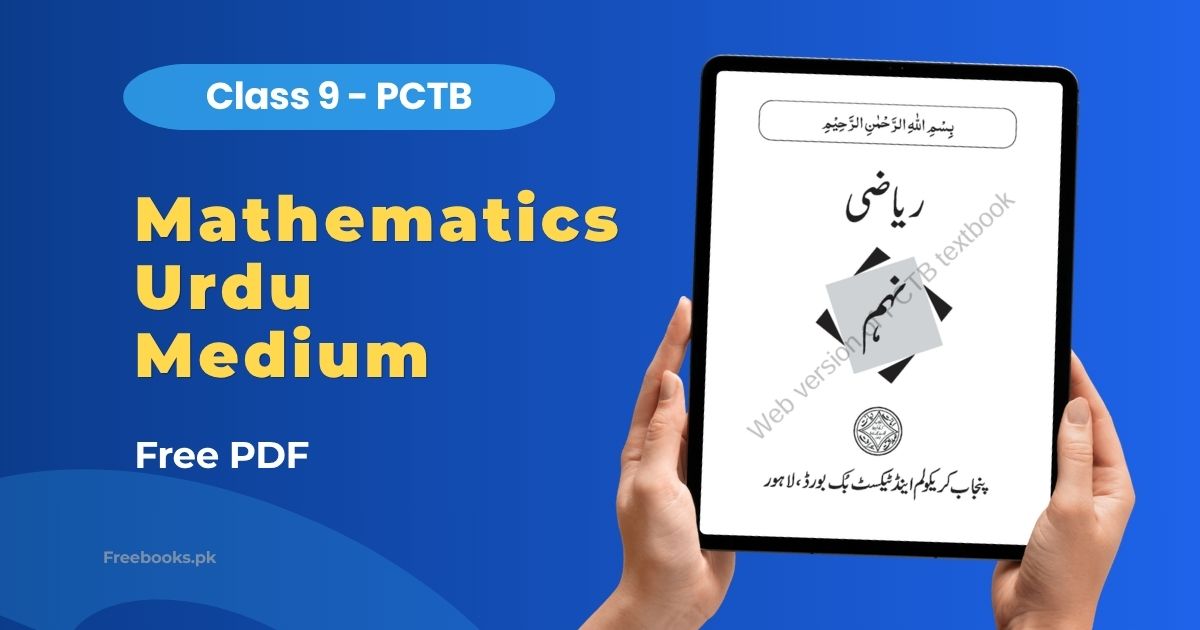
This page is a unit-by-unit guide to the 2025-26 Mathematics textbook for Class 9 Urdu Medium. Published by Punjab Curriculum and Textbook Board (PCTB) and based on the National Curriculum of Pakistan 2023, this is the newest approved edition for 9th class Mathematics Urdu medium.
This 2025-26 Urdu medium edition follows the same National Curriculum 2023 as the English medium version, organized into 13 units. Students who are more comfortable learning Mathematics in Urdu and are following the new curriculum should use this textbook for their board exam preparation.
Book Overview
- Class: 9th Class
- Subject: Mathematics (Riazi)
- Medium: Urdu Medium
- Curriculum: National Curriculum of Pakistan 2023
- Board: Punjab Curriculum and Textbook Board (PCTB)
- Authors: Muhammad Akhtar Shirani, Madiha Mahmood, Ghulam Murtaza
- Edition: Experimental Edition 2025-26
- Total Units: 13
Chapter List
Unit and topic names are given in English here; the Urdu Medium book covers the same 13 units. Each unit also links to our detailed notes.
Unit 1: Real Numbers
Key topics: rational and irrational numbers, decimal forms, number line, properties, radicals, surds, rationalization
The unit revises the number system and then builds working skill with roots. It shows how rational and irrational numbers combine, how their decimal forms differ, and how to place them on a number line. The properties of real numbers come next. The main practical work is on radical expressions: the laws of radicals and indices, simplifying surds, and rationalizing a denominator. It ends with daily-life applications such as temperature conversion and profit and loss.
Key Points:
- Rational numbers have terminating or repeating decimals; irrational numbers have non-terminating, non-repeating decimals.
- π and √2 are irrational.
- Radical form: the nth root of a equals a to the power 1/n.
- √a × √b = √(ab) for non-negative a and b.
- To rationalize 1/(√a + √b), multiply top and bottom by its conjugate √a − √b.
Smart Syllabus 2027: Sections 1.1 and 1.3, Exercise 1.3 and some review questions are removed.
Common Mistake: Writing √(a + b) as √a + √b. A root does not split across addition.
Important Questions:
- Rationalize the denominator of 1/(√3 + √2). Multiply top and bottom by √3 − √2. The denominator becomes 3 − 2 = 1, so the answer is √3 − √2.
- Is 0.333… rational or irrational? Rational. It is a repeating decimal and equals 1/3.
Detailed notes for Unit 1: Real Numbers
Unit 2: Logarithms
Key topics: scientific notation, logarithm, common log, characteristic, mantissa, antilog, natural log, laws
The unit starts with scientific notation, a compact way to write very large and very small numbers. It defines a logarithm as the exponent a base must be raised to, then concentrates on common logarithms to base 10. Students learn the two parts of a common log, the characteristic and mantissa, how to read them from tables, and how the antilogarithm reverses the process. Natural logarithms are introduced, and the unit finishes with the laws of logarithms and their applications.
Key Points:
- Scientific notation has the form a × 10ⁿ with 1 ≤ a < 10.
- If aˣ = y then logₐ y = x.
- Common logs use base 10; natural logs use base e.
- The characteristic is the integer part of a log; the mantissa is its decimal part, found from tables.
- Laws: log(mn) = log m + log n, log(m/n) = log m − log n, log mⁿ = n log m.
Smart Syllabus 2027: Section 2.4 (laws of logarithm), Exercise 2.4 and some review questions are removed.
Common Mistake: Forgetting that a number between 0 and 1 has a negative characteristic.
Important Questions:
- Write 0.00045 in scientific notation. 4.5 × 10⁻⁴.
- What is the value of log₂ 8? 3, because 2³ = 8.
Detailed notes for Unit 2: Logarithms
Unit 3: Sets and Functions
Key topics: sets, operations, Venn diagrams, three sets, binary relations, domain and range, functions
Mathematics is presented here as the study of patterns and relationships, with sets as its basic language. After the definitions, the unit covers operations on sets and uses Venn diagrams to show them, including problems with three sets and real-world counting. It then moves to binary relations, shown as tables, ordered pairs and graphs. A function is defined as a special relation, along with its domain, range and notation, and the unit closes with linear and quadratic functions.
Key Points:
- Union A ∪ B holds elements in A or B; intersection A ∩ B holds elements in both.
- The difference A − B holds elements in A that are not in B.
- A binary relation from A to B is a subset of A × B.
- In a function, each element of the domain has exactly one image.
- The range is the set of output values.
Smart Syllabus 2027: The introduction and 3.1 up to the basic definition of a set, all of 3.3 on relations and functions, Exercise 3.3 and some questions are removed.
Common Mistake: Treating every relation as a function. If one input has two outputs, it is not a function.
Important Questions:
- If A = {1, 2, 3} and B = {2, 3, 4}, find A ∩ B and A ∪ B. A ∩ B = {2, 3} and A ∪ B = {1, 2, 3, 4}.
- What is the difference between a set’s union and intersection? Union collects elements found in at least one set, while intersection keeps only the elements found in both.
Detailed notes for Unit 3: Sets and Functions
Unit 4: Factorization and Algebraic Manipulation
Key topics: common factors, trinomials, quadratic and cubic expressions, HCF, LCM, square root
This unit makes factorization concrete, starting from common factors and trinomials shown pictorially and symbolically. It extends the method to quadratic and cubic algebraic expressions. Students then find the highest common factor and least common multiple of algebraic expressions and use the relationship between them. The closing sections take the square root of an algebraic expression and apply factorization to real-world problems.
Key Points:
- Take out the common factor first in every question.
- x² + bx + c factors by finding two numbers with sum b and product c.
- a³ + b³ = (a + b)(a² − ab + b²).
- a³ − b³ = (a − b)(a² + ab + b²).
- For two expressions p and q: HCF × LCM = p × q.
Smart Syllabus 2027: Section 4.4 on square roots and real-world factorization, Exercise 4.4 and some review questions are removed.
Common Mistake: Stopping too early. Check whether each factor can be factorized again.
Important Questions:
- Factorize x² + 7x + 12. Two numbers with sum 7 and product 12 are 3 and 4, so the answer is (x + 3)(x + 4).
- Factorize x³ − 27. (x − 3)(x² + 3x + 9).
Detailed notes for Unit 4: Factorization and Algebraic Manipulation
Unit 5: Linear Equations and Inequalities
Key topics: linear equations, linear inequalities, two variables, feasible solution, maximum and minimum
The unit begins with solving linear equations in one variable, then introduces linear inequalities. Students solve one inequality in two variables by graphing a boundary line and shading a half-plane, and then solve two inequalities together to find the region where they overlap. The last section uses that region, called the feasible solution, to find the maximum and minimum values of a function.
Key Points:
- A linear equation in one variable has the form ax + b = 0 with a ≠ 0.
- Multiplying or dividing an inequality by a negative number reverses its sign.
- A linear inequality in two variables is shown as a shaded half-plane.
- Use a test point such as (0, 0) to decide which side to shade.
- The solution of two inequalities is the region common to both.
Smart Syllabus 2027: Section 5.3 on feasible solutions, Exercise 5.2 and some review questions are removed.
Common Mistake: Forgetting to reverse the inequality sign after multiplying by a negative number.
Important Questions:
- Solve 3x − 5 = 10. 3x = 15, so x = 5.
- Solve −2x > 6. Dividing by −2 reverses the sign, so x < −3.
Detailed notes for Unit 5: Linear Equations and Inequalities
Unit 6: Trigonometry
Key topics: degrees, radians, trigonometric ratios, identities, special angles, solving triangles, elevation and depression
Trigonometry opens with measuring angles in standard position: degrees, minutes and seconds, then radians. The six trigonometric ratios of an acute angle and the ratios of complementary angles follow. Students use the fundamental identities and the values at special angles, then solve right-angled triangles. The final section applies this to heights and distances through angles of elevation and depression.
Key Points:
- π radians = 180°.
- sin θ = perpendicular/hypotenuse, cos θ = base/hypotenuse, tan θ = perpendicular/base.
- sin²θ + cos²θ = 1.
- 1 + tan²θ = sec²θ.
- sin 30° = 1/2, cos 60° = 1/2, tan 45° = 1.
- sin(90° − θ) = cos θ.
Smart Syllabus 2027: Example 12, section 6.6 on elevation and depression, Exercise 6.6 and some exercise and review questions are removed.
Common Mistake: Leaving a calculator in the wrong mode. Check degrees or radians before you start.
Important Questions:
- Convert 60° into radians. 60 × π/180 = π/3 radians.
- Prove that (tan θ)(cos θ) = sin θ. tan θ = sin θ/cos θ, so multiplying by cos θ leaves sin θ.
Detailed notes for Unit 6: Trigonometry
Unit 7: Coordinate Geometry
Key topics: coordinate plane, distance formula, midpoint, slope, equations of lines, intercepts, standard forms
Working on the coordinate plane, the unit first finds the distance between two points and the midpoint of a segment. It then defines the slope of a line joining two points and writes the equations of lines parallel to each axis. The standard forms of a line’s equation, and the intercepts they reveal, take up the main part. A theorem shows that a linear equation in two variables represents a straight line, and students convert the general equation into the standard forms.
Key Points:
- Distance = √[(x₂ − x₁)² + (y₂ − y₁)²].
- Midpoint = ((x₁ + x₂)/2, (y₁ + y₂)/2).
- Slope m = (y₂ − y₁)/(x₂ − x₁).
- A line parallel to the x-axis has slope 0; a line parallel to the y-axis has undefined slope.
- Slope-intercept form is y = mx + c.
Smart Syllabus 2027: Section 7.3 on real-life applications, Exercise 7.3 and some exercise and review questions are removed.
Common Mistake: Mixing the order of points in the slope formula. Keep the same point first on top and bottom.
Important Questions:
- Find the distance between (1, 2) and (4, 6). √(3² + 4²) = √25 = 5 units.
- Find the slope of the line through (2, 3) and (6, 11). (11 − 3)/(6 − 2) = 8/4 = 2.
Detailed notes for Unit 7: Coordinate Geometry
Unit 8: Logic
Key topics: statements, logical operators, symbols, mathematical proof, theorem, conjecture, axiom
The unit treats mathematics as reasoning. It defines a statement, introduces the logical operators and their symbols, and explains how to read them. It then discusses what makes a mathematical proof, distinguishing a theorem, a conjecture and an axiom, and ends with deductive proof.
Key Points:
- A statement is a sentence that is either true or false.
- An axiom is accepted without proof.
- A conjecture is believed true but not yet proved.
- A theorem is a statement that has been proved.
Smart Syllabus 2027: This complete unit is removed for the 2027 exam.
Common Mistake: Calling a conjecture a theorem before it has been proved.
Important Questions:
- What is a statement in logic? A sentence that is either true or false, but not both.
- How is an axiom different from a theorem? An axiom is accepted without proof, while a theorem must be proved.
Detailed notes for Unit 8: Logic
Unit 9: Similar Figures
Key topics: similar polygons, similar triangles, quadrilaterals, area and volume ratios, polygon properties
The unit defines similarity for polygons and shows how to identify similar triangles and quadrilaterals. It then links the scale between two similar figures to the ratio of their areas, and extends that idea to the volumes of similar solids. The last section studies the geometrical properties of regular polygons, triangles and parallelograms and applies them.
Key Points:
- Similar figures have equal corresponding angles and proportional corresponding sides.
- If the side ratio is k, the area ratio is k².
- For similar solids with length ratio k, the volume ratio is k³.
- Use corresponding sides in the same order when writing a proportion.
Smart Syllabus 2027: Section 9.4 on polygons, Exercise 9.4 and some exercise and review questions are removed.
Common Mistake: Using the side ratio directly for area. Area uses the square of the ratio.
Important Questions:
- Two similar triangles have sides in the ratio 2 : 3. What is the ratio of their areas? 4 : 9.
- Two similar cubes have edges in the ratio 1 : 2. What is the ratio of their volumes? 1 : 8.
Detailed notes for Unit 9: Similar Figures
Unit 10: Graphs of Functions
Key topics: linear, quadratic, cubic, reciprocal and exponential graphs, gradients of curves
This unit teaches students to recognize a function from its graph. It works through linear, quadratic, cubic, reciprocal and exponential functions, then the general form y = axⁿ. Students draw each graph from a table of values and describe its shape. Later sections show exponential growth and decay, estimate the gradient of a curve by drawing a tangent, and apply graphs to real life.
Key Points:
- A linear function has a straight-line graph.
- A quadratic function has a parabola.
- The reciprocal function y = 1/x has a curve with two separate branches.
- In an exponential function the variable is in the power.
- The gradient of a curve at a point is the gradient of the tangent there.
Smart Syllabus 2027: Section 10.2 on exponential growth, gradients and applications, Exercise 10.2 and some review questions are removed.
Common Mistake: Joining the points of a parabola with straight line pieces instead of a smooth curve.
Important Questions:
- What shape is the graph of y = x²? A parabola that opens upward, with its vertex at the origin.
- Find y when x = 3 for y = 2x + 1. y = 7.
Detailed notes for Unit 10: Graphs of Functions
Unit 11: Loci and Construction
Key topics: triangle construction, perpendicular bisectors, medians, angle bisectors, altitudes, loci
Using compass and ruler, students construct triangles and then their special lines: perpendicular bisectors, medians, angle bisectors and altitudes. The unit then introduces a locus, the path of points that follow a given rule, in two dimensions. Intersections of loci and real-life uses close the unit.
Key Points:
- A locus is the set of all points satisfying a given condition.
- Points at a fixed distance from a fixed point form a circle.
- Points equidistant from two points lie on the perpendicular bisector of the segment joining them.
- Medians join a vertex to the midpoint of the opposite side.
- Altitudes are perpendicular from a vertex to the opposite side.
Smart Syllabus 2027: Sections 11.5.2 and 11.6, Exercise 11.2 and some review questions are removed.
Practice Tip: Keep compass arcs visible in every construction. They show your method.
Common Mistake: Confusing a median with an altitude. A median goes to a midpoint; an altitude is perpendicular.
Important Questions:
- What is the locus of points 3 cm from a fixed point? A circle with radius 3 cm centred at that point.
- What is the locus of points equidistant from A and B? The perpendicular bisector of AB.
Detailed notes for Unit 11: Loci and Construction
Unit 12: Information Handling
Key topics: frequency distribution, histogram, frequency polygon, mean, median, mode, weighted mean
The unit starts by organizing ungrouped and grouped data into frequency distributions. Students represent data with histograms, including unequal class limits, and frequency polygons. The second half covers measures of location: arithmetic mean, median, mode and weighted mean, followed by real-life situations where each is useful.
Key Points:
- Arithmetic mean = sum of values ÷ number of values.
- The median is the middle value after arranging data in order.
- The mode is the most frequent value.
- With unequal class limits, histogram height uses frequency density.
- A frequency polygon joins the midpoints of histogram bars.
Smart Syllabus 2027: Weighted mean (12.2.4) and several questions in Exercises 12.1 and 12.2 and the review exercise are removed.
Common Mistake: Finding the median before arranging the data in order.
Important Questions:
- Find the mean of 4, 6, 8, 10. 28 ÷ 4 = 7.
- Find the median of 3, 9, 5, 7, 11. In order the values are 3, 5, 7, 9, 11, so the median is 7.
Detailed notes for Unit 12: Information Handling
Unit 13: Probability
Key topics: single event, event not occurring, relative frequency, expected frequency
The final unit finds the probability of a single event and of an event not occurring, then applies these to real-life problems. It introduces relative frequency as an estimate of probability from repeated trials. The closing sections calculate expected frequency, how often an event should happen in a given number of trials.
Key Points:
- Probability = favourable outcomes ÷ total outcomes.
- Probability always lies between 0 and 1.
- P(not A) = 1 − P(A).
- Relative frequency = times the event occurred ÷ total trials.
- Expected frequency = probability × number of trials.
Smart Syllabus 2027: Sections 13.6 and 13.7, some of Exercise 13.2 and some review questions are removed.
Common Mistake: Giving a probability greater than 1. Recheck the total outcomes if this happens.
Important Questions:
- What is the probability of getting a 4 on a fair die? 1/6.
- If P(rain) = 0.3, find P(no rain). 1 − 0.3 = 0.7.
Detailed notes for Unit 13: Probability
How to Study This Book
Units 1 to 5 build the algebra used in the rest of the book, so study them in order. Unit 6 on trigonometry and Unit 7 on coordinate geometry depend on comfortable work with fractions, surds and equations from those units.
For the 2027 Punjab board exam, skip Unit 8 and mark the removed sections listed under each unit. Units 3, 4 and 6 give two MCQs each, so give them extra attention. Keep compass and ruler practice for Unit 11, because constructions need real hands-on work.
In every unit, work through the solved examples first, then try the exercise questions without looking at the method.
Who Should Read This
This book is for 9th class students studying Mathematics in Urdu medium under the new National Curriculum 2023. Students who prefer learning Mathematics in Urdu and are following the PCTB 2025-26 syllabus should use this textbook for their annual board exam preparation.
Applicable Boards
This textbook is published by Punjab Curriculum and Textbook Board (PCTB) based on National Curriculum of Pakistan 2023. It is used in all PCTB affiliated Urdu medium schools in Punjab.
Official Copy of Mathematics Class 9 (Urdu Medium)
The button below opens the latest official copy on PECTAA's Google Drive. PECTAA replaced the PCTB and has published this updated print of the book.
An earlier official print is also available:
→ Earlier Official Print (PCTB)These files are hosted on the official Google Drive of PECTAA (formerly the Punjab Curriculum & Textbook Board, PCTB). Freebooks.pk does not host them. Source: pectaa.edu.pk. Learn more: PCTB is now PECTAA.
FAQs
Is this the official PCTB Math 9 book for Urdu medium 2025-26?
Yes, this is the official PCTB Mathematics textbook for 9th class in Urdu medium for 2025-26, based on National Curriculum of Pakistan 2023.
Is there an English medium version of this book?
Yes, the English medium version of 9th class Mathematics 2025-26 is also available on our website.
What topics are new in this book compared to the old PTB Math 9?
New topics include Trigonometry, Logic, Sets and Functions, Similar Figures, and Probability which were not part of the old PTB Math 9 syllabus.
Is the old PTB Math 9 book still available?
Yes, the old PTB Math 9 book (2014-15 and 2020 versions) is also available on our website for students who still need it.
Is this the latest edition?
Yes, this is the 2025-26 Experimental Edition of PCTB Mathematics for 9th class in Urdu medium, based on National Curriculum 2023.
Related Books
- Mathematics Class 9 (English Medium)
- Mathematics Class 8 (Urdu Medium)
- Mathematics Class 10 (Urdu Medium)
- Mathematics Class 8 (English Medium)
- Mathematics Class 8
- Mathematics Class 10
Study Resources for Mathematics Class 9
Free exam-preparation resources for Mathematics Class 9 from the Freebooks.pk Editorial Team — the free PDF textbook, chapter-wise notes (definitions, short & long questions and MCQs), the latest paper pairing scheme. Study online or download.
© Copyright Policy
Freebooks.pk is an educational resource for students in Pakistan. Textbooks and other books belong to their respective boards, authors and publishers, and all rights remain with them. If you are the copyright holder of any material on this page and want it changed or removed, please contact us or file a request under our DMCA policy. We review every request and remove reported content promptly.