Factorization is the process of breaking a complex algebraic expression into a product of simpler expressions, and it is one of the most powerful tools in algebra. Once an expression is written as a product of factors, it becomes far easier to simplify, solve equations, find highest common factors and least common multiples, and even locate the roots or turning points of a real-world model. This unit builds the skill from the ground up — starting with concrete algebra tiles that let common factors and trinomials be seen physically, then moving to symbolic techniques for quadratics, higher-degree expressions, and special product forms.
Beyond pure manipulation, factorization has genuine practical value. Engineers use factorized cost and deflection functions to locate break-even points and points of zero stress; businesses use factorized profit functions to find the production level that maximizes return; and physicists use factorized potential-energy expressions to identify equilibrium points. This unit closes with several such applied examples, showing that factorization is not just an abstract classroom exercise but a working tool for real decisions.
Learning Objectives
- Identify common factors and factor trinomials concretely (using algebra tiles), pictorially, and symbolically.
- Factorize quadratic expressions of the form x² + px + q and ax² + bx + c.
- Factorize expressions of the type a⁴ + a²b² + b⁴ and a⁴ + b⁴.
- Factorize compound expressions such as (ax² + bx + c)(ax² + bx + d) + k and (x + a)(x + b)(x + c)(x + d) + k using substitution.
- Factorize perfect cubes a³ ± 3a²b + 3ab² ± b³ and sums/differences of cubes a³ ± b³.
- Find the HCF and LCM of algebraic expressions by factorization and by division, and use the relationship LCM × HCF = product of the two expressions.
- Find the square root of an algebraic expression by factorization and by division method.
- Apply factorization of quadratic and cubic expressions to real-world problems in engineering, physics, and finance.
Key Concepts
4.1 Common Factors and Trinomial Factoring
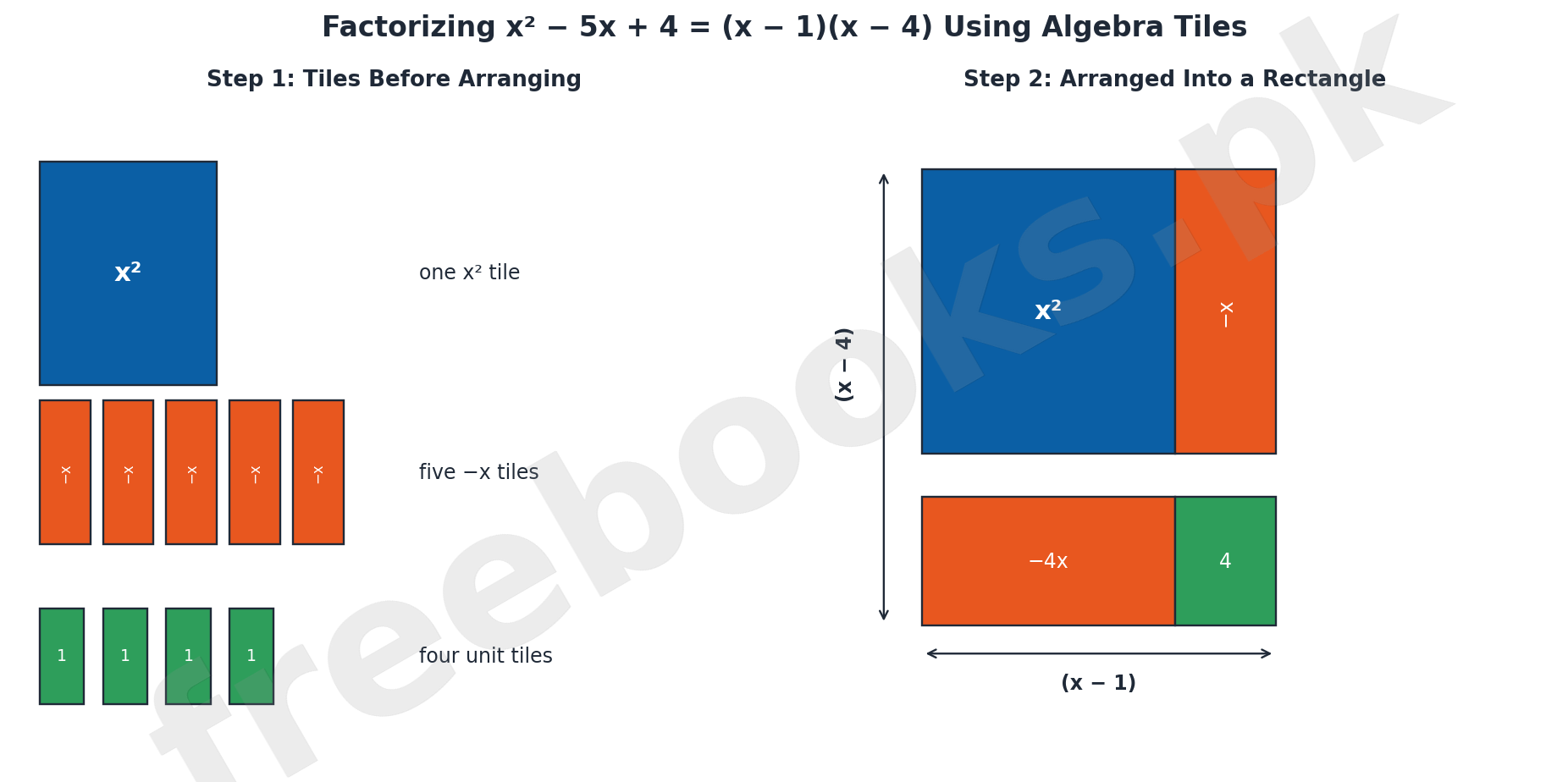
A common factor is an expression that divides two or more terms exactly — for example, in 2x − 6 = 2(x − 3), the number 2 is the common factor. To build intuition before jumping into symbols, algebra tiles represent terms physically: a unit tile represents 1 (or −1), a rectangular tile represents x (or −x), and a squared tile represents x² (or −x²). Arranging tiles into a rectangle whose side lengths are the two binomial factors makes trinomial factoring visible rather than purely mechanical.
A trinomial has three terms (like x² − 5x + 4) and factors into a product of two binomials (like (x − 1)(x − 4)). When a rectangle cannot be completed with the tiles given, a zero pair — equal numbers of opposite tiles that cancel to zero — can be added without changing the value of the expression, which then allows the rectangle to be completed.
4.1.3 Type I: x² + px + q and ax² + bx + c
For x² + px + q, find two numbers whose product is q and whose sum is p, then split the middle term and factor by grouping. For example, x² + 9x + 14 splits as x² + 2x + 7x + 14 = x(x + 2) + 7(x + 2) = (x + 2)(x + 7), since 2 × 7 = 14 and 2 + 7 = 9.
When the coefficient of x² is not 1, as in ax² + bx + c, first multiply a and c, list factor pairs of that product, find the pair whose sum equals b, split the middle term using that pair, and factor by grouping. For 2x² + 17x + 26: a·c = 52, and the pair 4, 13 sums to 17, giving 2x² + 4x + 13x + 26 = 2x(x + 2) + 13(x + 2) = (x + 2)(2x + 13).
4.1.3 Type II–V: Higher-Degree and Special Forms
Type II expressions like a⁴ + a²b² + b⁴ are factorized using the 'add and subtract' trick: rewrite as (a² + b²)² − a²b² = (a² + b²)² − (ab)², which is a difference of squares, giving (a² − ab + b²)(a² + ab + b²). The same idea handles a⁴ + b⁴ using √2ab as the adjustment term.
Type III expressions like (x + a)(x + b)(x + c)(x + d) + k are solved by regrouping factors so that the sums of the paired constants match (e.g., pairing so a + d = b + c), expanding each pair, substituting y for the repeated quadratic part, factoring the resulting quadratic in y, and substituting back.
Type IV expressions are perfect cubes: a³ + 3a²b + 3ab² + b³ = (a + b)³ and a³ − 3a²b + 3ab² − b³ = (a − b)³. Type V expressions are sum/difference of cubes: a³ + b³ = (a + b)(a² − ab + b²) and a³ − b³ = (a − b)(a² + ab + b²).
4.3 Highest Common Factor and Least Common Multiple
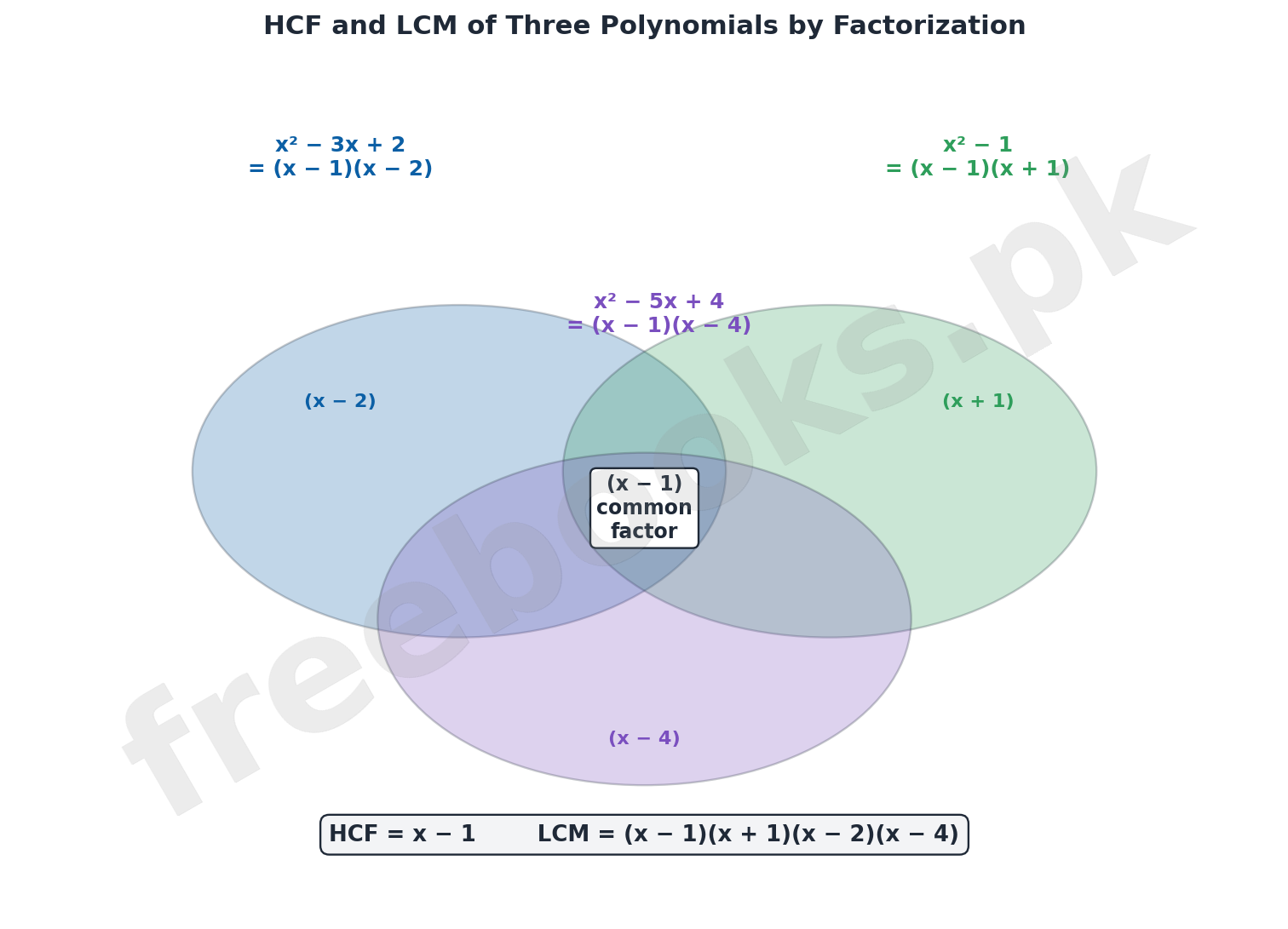
The HCF of two or more algebraic expressions is the greatest expression that divides each of them exactly, found either by factoring each expression and taking the product of common factors, or by repeated polynomial division. The LCM is the smallest expression divisible by each of the given expressions, found as the product of common factors and all non-common factors.
LCM and HCF are linked by the identity LCM × HCF = p(x) × q(x), where p(x) and q(x) are the two original expressions. This relationship makes it possible to find one polynomial when the LCM, HCF, and the other polynomial are known — a technique used repeatedly in the worked examples and exercises.
4.4 Square Root of an Algebraic Expression
The square root of an algebraic expression is found either by factorization — rewriting the expression as a perfect square of a simpler expression and taking the square root of both sides — or by a long-division-style method that works term by term, which is especially useful when the expression's degree is too high to factor by inspection.
For example, 36x⁴ − 36x² + 9 = 9(2x² − 1)² = [3(2x² − 1)]², so its square root is ±3(2x² − 1). The division method extends this same idea to expressions like x⁴ − 12x³ + 42x² − 36x + 9, whose square root is ±(x² − 6x + 3).
4.4.1 Real-World Applications
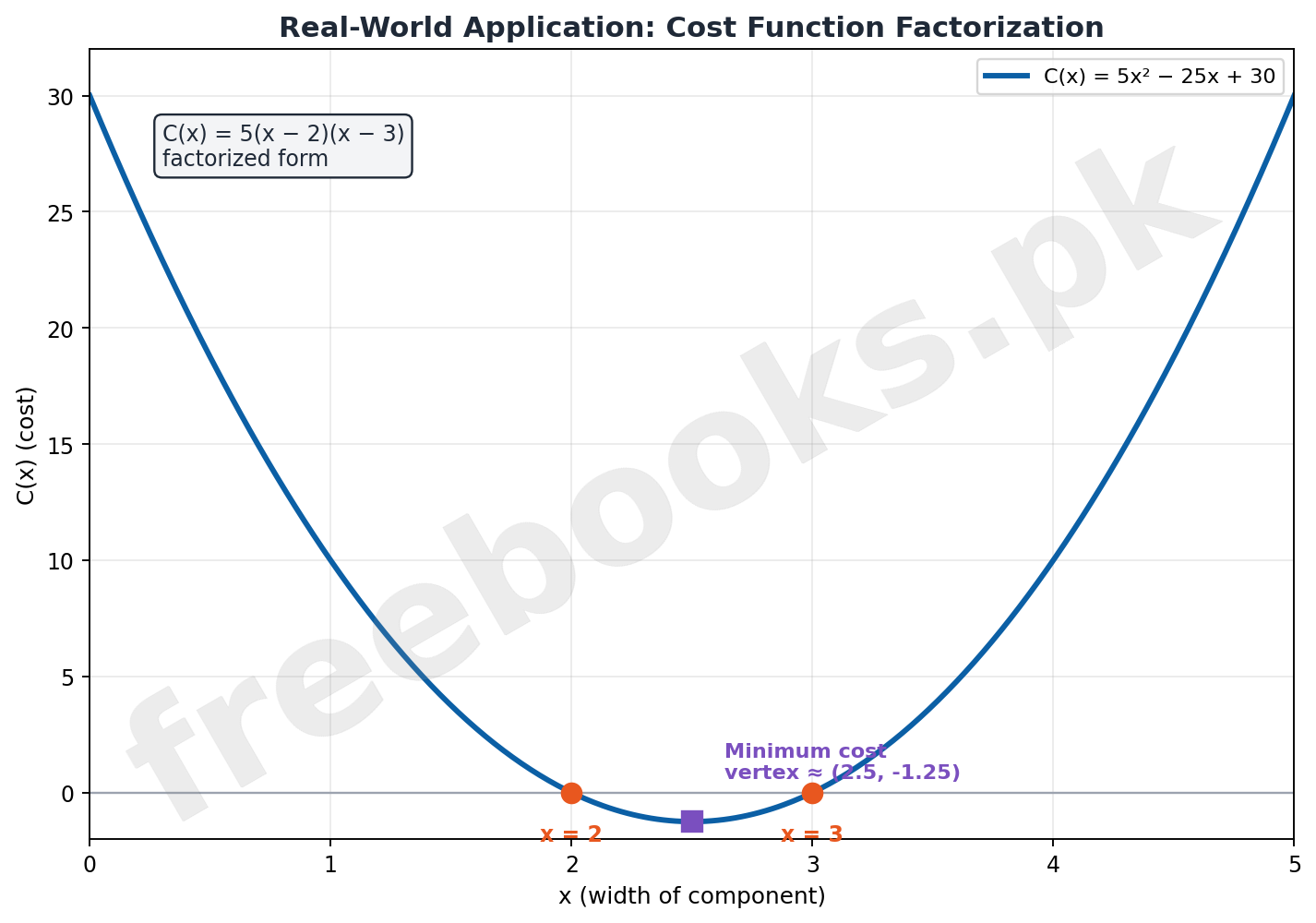
Factorization turns abstract cost, profit, and energy functions into forms that directly reveal meaningful points. A quadratic cost function C(x) = 5x² − 25x + 30 factorizes to 5(x − 2)(x − 3), showing the cost reaches its minimum between the roots x = 2 and x = 3. A cubic potential energy function U(x) = x³ − 6x² + 12x − 8 factorizes to (x − 2)³, revealing the single equilibrium point x = 2 directly.
For a profit function like P(x) = −5x² + 50x − 120, factorizing to −5(x − 4)(x − 6) shows profit is zero at x = 4 and x = 6; because the parabola opens downward, maximum profit occurs at the midpoint x = 5. These examples show factorization is a practical shortcut for locating minimums, maximums, and break-even points without calculus.
Important Definitions
Common Factor
An expression that divides two or more given expressions exactly, without leaving a remainder.
Trinomial
An algebraic expression consisting of exactly three terms, such as x² + 4x + 4.
Binomial
An algebraic expression consisting of exactly two terms, such as x + 2.
Zero Pair
Two equal and opposite tiles (or terms) that sum to zero and can be added to or removed from an expression without changing its value.
Highest Common Factor (HCF)
The greatest algebraic expression that divides two or more given expressions exactly, without leaving a remainder.
Least Common Multiple (LCM)
The smallest algebraic expression that is exactly divisible by each of two or more given expressions.
Quadratic Expression
An algebraic expression of degree 2, such as x² + px + q.
Cubic Expression
An algebraic expression of degree 3, such as a³ + 3a²b + 3ab² + b³.
Square Root of an Expression
An expression which, when multiplied by itself, produces the original given expression.
Sum/Difference of Cubes
The expressions a³ + b³ and a³ − b³, which factorize as (a + b)(a² − ab + b²) and (a − b)(a² + ab + b²) respectively.
Key Facts and Relations
| Topic | Key Fact / Relation |
|---|---|
| a² − b² = (a − b)(a + b) | Difference of squares identity. |
| (a + b)² = a² + 2ab + b² | Square of a sum. |
| (a − b)² = a² − 2ab + b² | Square of a difference. |
| (a + b)³ = a³ + 3a²b + 3ab² + b³ | Cube of a sum. |
| (a − b)³ = a³ − 3a²b + 3ab² − b³ | Cube of a difference. |
| a³ + b³ = (a + b)(a² − ab + b²) | Sum of cubes. |
| a³ − b³ = (a − b)(a² + ab + b²) | Difference of cubes. |
| a⁴ + a²b² + b⁴ = (a² − ab + b²)(a² + ab + b²) | Add-and-subtract technique for this special quartic form. |
| LCM × HCF = p(x) × q(x) | Relationship between LCM, HCF, and the two original polynomials. |
| LCM = Common factors × Non-common factors | Formula for computing LCM by the factorization method. |
Diagrams
Concrete-to-Symbolic Factoring With Algebra Tiles: A tile diagram showing x² − 5x + 4 factorized as (x − 1)(x − 4) by arranging unit, rectangular, and squared tiles into a rectangle
HCF and LCM by Factorization (Venn Diagram): A Venn-style diagram showing common and non-common factors of three polynomials, giving their HCF and LCM
Real-World Application: Cost Function Minimum: A graph of a factorized quadratic cost function showing its roots and minimum-cost vertex
Solved Examples
Example 1: Factorizing x² + 9x + 14 by Splitting the Middle Term
Problem: Factorize x² + 9x + 14.
- Find two numbers whose product is 14 and whose sum is 9: these are 2 and 7.
- Split the middle term: x² + 9x + 14 = x² + 2x + 7x + 14.
- Group and factor: x(x + 2) + 7(x + 2).
- Take the common binomial factor: (x + 2)(x + 7).
Example 2: Factorizing ax² + bx + c When a ≠ 1
Problem: Factorize 2x² + 17x + 26.
- Multiply the coefficient of x² by the constant term: 2 × 26 = 52.
- List factor pairs of 52 and find the pair summing to 17: 4 and 13.
- Split the middle term: 2x² + 4x + 13x + 26.
- Group and factor: 2x(x + 2) + 13(x + 2) = (x + 2)(2x + 13).
Example 3: Factorizing a⁴ + 64 Using the Add-and-Subtract Technique
Problem: Factorize a⁴ + 64.
- Write a⁴ + 64 as (a²)² + (8)².
- Add and subtract 2(a²)(8) = 16a²: (a²)² + (8)² + 16a² − 16a².
- Group as a perfect square minus a square: (a² + 8)² − (4a)².
- Apply the difference of squares identity: (a² + 8 − 4a)(a² + 8 + 4a) = (a² − 4a + 8)(a² + 4a + 8).
Example 4: Factorizing (x+2)(x+3)(x+4)(x+5) − 15 Using Substitution
Problem: Factorize (x + 2)(x + 3)(x + 4)(x + 5) − 15.
- Rearrange the factors so paired constants have equal sums: 2 + 5 = 3 + 4.
- Pair and expand: [(x+2)(x+5)][(x+3)(x+4)] − 15 = (x² + 7x + 10)(x² + 7x + 12) − 15.
- Let y = x² + 7x, giving (y + 10)(y + 12) − 15 = y² + 22y + 105.
- Factorize the quadratic in y: y² + 22y + 105 = (y + 15)(y + 7).
- Substitute back y = x² + 7x: (x² + 7x + 15)(x² + 7x + 7).
Example 5: Factorizing 8x³ + 27 as a Sum of Cubes
Problem: Factorize 8x³ + 27.
- Write 8x³ + 27 as (2x)³ + (3)³.
- Apply the sum-of-cubes identity a³ + b³ = (a + b)(a² − ab + b²).
- Substitute a = 2x, b = 3: (2x + 3)[(2x)² − (2x)(3) + (3)²].
- Simplify: (2x + 3)(4x² − 6x + 9).
Example 6: Finding HCF of Three Polynomials by Factorization
Problem: Find the HCF of x² − 27, x² + 6x − 27, and x² − 9.
- Factorize the first expression: x³ − 27 = (x − 3)(x² + 3x + 9).
- Factorize the second: x² + 6x − 27 = x² + 9x − 3x − 27 = (x + 9)(x − 3).
- Factorize the third: x² − 9 = (x − 3)(x + 3).
- Identify the factor common to all three expressions: (x − 3).
- State the result: HCF = x − 3.
Example 7: Finding LCM of Three Polynomials by Factorization
Problem: Find the LCM of x² − 3x + 2, x² − 1, and x² − 5x + 4.
- Factorize each expression: x² − 3x + 2 = (x − 2)(x − 1); x² − 1 = (x − 1)(x + 1); x² − 5x + 4 = (x − 4)(x − 1).
- Identify the common factor across all three: (x − 1).
- Identify the remaining non-common factors: (x + 1), (x − 2), (x − 4).
- Multiply common and non-common factors together: LCM = (x − 1)(x + 1)(x − 2)(x − 4).
Example 8: Real-World Application: Maximizing Profit by Factorization
Problem: A company's profit is P(x) = −5x² + 50x − 120. Factorize it and find the production level that maximizes profit.
- Factor out −5: −5(x² − 10x + 24).
- Split the middle term of the quadratic: x² − 4x − 6x + 24 = x(x − 4) − 6(x − 4) = (x − 4)(x − 6).
- Write the full factorization: P(x) = −5(x − 4)(x − 6).
- Profit is zero at x = 4 and x = 6; since the leading coefficient is negative, the maximum lies at the midpoint.
- Compute the midpoint: x = (4 + 6)/2 = 5, so producing 5 units maximizes profit.
Short Questions & Answers
What is a common factor, and how is it identified in an expression like 2x − 6?
A common factor is an expression that divides every term exactly. In 2x − 6 = 2(x − 3), the number 2 divides both 2x and 6 exactly, so it is the common factor.
What is the difference between a binomial and a trinomial?
A binomial has exactly two terms, such as x + 2, while a trinomial has exactly three terms, such as x² + 4x + 4.
Why is a 'zero pair' added when factoring some trinomials with algebra tiles?
A zero pair (equal numbers of opposite tiles) sums to zero, so adding one does not change the value of the expression — it is added only to allow the tiles to be arranged into a complete rectangle.
What is the first step in factoring ax² + bx + c when a is not 1?
Multiply the coefficient a by the constant c, then find two factors of that product whose sum equals b, and use them to split the middle term.
State the identity used to factorize a sum of two cubes.
a³ + b³ = (a + b)(a² − ab + b²).
How is the LCM of algebraic expressions calculated once each is factorized?
LCM = common factors × non-common factors, where common factors are taken once and non-common factors are all remaining factors from each expression.
What relationship links the LCM and HCF of two polynomials to the polynomials themselves?
LCM × HCF = p(x) × q(x), the product of the two original polynomials.
Long Questions & Answers
Explain the different types of factorization covered in this unit, with an example of each.
What is Type I factorization?
Type I covers x² + px + q and ax² + bx + c, factorized by splitting the middle term into two parts whose product matches ac and whose sum matches b, then grouping. For example, x² + 9x + 14 = (x + 2)(x + 7).
What is Type II factorization?
Type II covers a⁴ + a²b² + b⁴ and a⁴ + b⁴, factorized using the add-and-subtract technique to create a difference of squares. For example, a⁴ + 64 = (a² − 4a + 8)(a² + 4a + 8).
What is Type III factorization?
Type III covers compound products like (x+a)(x+b)(x+c)(x+d) + k, solved by regrouping factors with matching constant sums, substituting a variable for the repeated quadratic, and factoring the resulting quadratic before substituting back.
What are Types IV and V factorization?
Type IV covers perfect cubes such as a³ + 3a²b + 3ab² + b³ = (a + b)³. Type V covers sums and differences of cubes, a³ ± b³, factorized using the standard cube identities into a linear factor times a quadratic factor.
Describe how HCF and LCM of algebraic expressions are found, and how they relate to each other.
How is HCF found by factorization?
Each expression is factorized fully into irreducible factors, and the HCF is the product of the factors common to all the given expressions.
How is HCF found by division method?
The larger-degree expression is divided by the smaller repeatedly (similar to Euclid's algorithm for numbers), and the last nonzero remainder, after removing any purely numerical common factor, gives the HCF.
How is LCM found once expressions are factorized?
LCM = common factors × non-common factors — the common factors are included once, and every factor unique to any of the expressions is also included.
What identity links LCM, HCF, and the original expressions?
LCM × HCF = p(x) × q(x), the product of the two polynomials. This lets one polynomial be found algebraically if the LCM, HCF, and the other polynomial are known.
Multiple Choice Questions (MCQs)
The factorization of 12x + 36 is: (A) 12(x + 3) (B) 12(3x) (C) 12(3x + 1) (D) x(12 + 36x)
Correct answer: (A) 12(x + 3). 12 is the common factor of both terms: 12x + 36 = 12(x + 3).
The factors of 4x² − 12x + 9 are: (A) (2x + 3)² (B) (2x − 3)² (C) (2x − 3)(2x + 3) (D) (2 + 3x)(2 − 3x)²
Correct answer: (B) (2x − 3)². 4x² − 12x + 9 = (2x)² − 2(2x)(3) + 3² = (2x − 3)².
The HCF of a³b³ and ab² is: (A) a³b³ (B) ab² (C) a⁴b⁵ (D) a²b
Correct answer: (B) ab². The lower power of each common variable is taken: a¹ and b², giving HCF = ab².
Product of LCM and HCF equals the ________ of two polynomials. (A) sum (B) difference (C) product (D) quotient
Correct answer: (C) product. LCM × HCF always equals the product of the two original polynomials.
The square root of x² − 6x + 9 is: (A) ±(x − 3) (B) ±(x + 3) (C) x − 3 (D) x + 3
Correct answer: (A) ±(x − 3). x² − 6x + 9 = (x − 3)², so its square root is ±(x − 3).
The LCM of (a − b)² and (a − b)⁴ is: (A) (a − b)² (B) (a − b)³ (C) (a − b)⁴ (D) (a − b)⁶
Correct answer: (C) (a − b)⁴. The LCM takes the higher power present, which is (a − b)⁴.
Factorization of x³ + 3x² + 3x + 1 is: (A) (x + 1)³ (B) (x − 1)³ (C) (x + 1)(x² + x + 1) (D) (x − 1)(x² − x + 1)
Correct answer: (A) (x + 1)³. This matches the perfect-cube identity a³ + 3a²b + 3ab² + b³ with a = x, b = 1, giving (x + 1)³.
A cubic polynomial has degree: (A) 1 (B) 2 (C) 3 (D) 4
Correct answer: (C) 3. By definition, a cubic expression has degree 3.
One of the factors of x³ − 27 is: (A) x − 3 (B) x + 3 (C) x² − 3x + 9 (D) Both x − 3 and x² + 3x + 9
Correct answer: (D) Both x − 3 and x² + 3x + 9. x³ − 27 = (x − 3)(x² + 3x + 9), the difference-of-cubes identity, so both are factors.
The two numbers whose product is 14 and sum is 9, used to factor x² + 9x + 14, are: (A) 1 and 14 (B) 2 and 7 (C) 7 and 2 only (D) −2 and −7
Correct answer: (B) 2 and 7. 2 × 7 = 14 and 2 + 7 = 9, matching both required conditions.
Quick Revision Summary
- A common factor divides every term of an expression exactly; factor it out first before attempting other techniques.
- For x² + px + q, find two numbers with product q and sum p to split the middle term.
- For ax² + bx + c, multiply a and c first, then find factors of that product summing to b.
- a⁴ + a²b² + b⁴ and a⁴ + b⁴ are solved using the add-and-subtract trick to form a difference of squares.
- Perfect cubes (a ± b)³ expand to a³ ± 3a²b + 3ab² ± b³; sum/difference of cubes a³ ± b³ factor into a linear times a quadratic factor.
- LCM × HCF always equals the product of the two original polynomials — a useful check and shortcut.
Exam Tips
- Always check for a common factor first before applying any other factorization technique — it simplifies everything that follows.
- When splitting the middle term of ax² + bx + c, always multiply a × c first, not just look at c alone.
- Memorize the cube identities (a ± b)³ and a³ ± b³ — they appear constantly in Type IV and V problems.
- For compound expressions like (x+a)(x+b)(x+c)(x+d) + k, look for pairs of constants with equal sums before expanding.
- Verify a square root answer by squaring it back — it should exactly reproduce the original expression.
- In real-world problems, factoring reveals roots and turning points directly, often faster than other algebraic methods.