Coordinate geometry, also called analytic geometry, links algebra and geometry by describing every point in a plane with an ordered pair of numbers. This idea, introduced by René Descartes, means that geometric problems — distances, midpoints, and the equations of lines — can all be solved using algebra instead of relying purely on diagrams and constructions. This unit builds that toolkit from the ground up: locating points in the coordinate plane, deriving the distance and midpoint formulas from the Pythagoras theorem, and defining the slope of a line as a measure of its steepness.
The unit then develops six different standard forms for the equation of a straight line — slope-intercept, point-slope, two-point, intercept, symmetric, and normal form — showing that they are all different ways of expressing the same underlying relationship, and that any general linear equation ax + by + c = 0 can be converted freely between them. The unit closes with genuinely practical applications: using these formulas for physical measurements, real-world distances, aviation headings, and even latitude-longitude midpoints.
Learning Objectives
- Locate points in the coordinate plane using ordered pairs and identify the quadrant of a given point.
- Derive and apply the distance formula to find the distance between two points.
- Derive and apply the midpoint formula to find the midpoint of a line segment.
- Find the gradient (slope) of a straight line joining two given points.
- Determine the conditions for two lines to be parallel or perpendicular using their slopes.
- Find the equation of a straight line in slope-intercept, point-slope, two-point, intercept, symmetric, and normal form.
- Show that a linear equation in two variables always represents a straight line, and convert the general form into any of the standard forms.
- Apply distance, midpoint, and slope formulas to real-life situations such as physical measurements, navigation, and map reading.
Key Concepts
7.1 The Coordinate Plane
Two mutually perpendicular number lines — the horizontal x-axis and vertical y-axis — meet at the origin O and divide the plane into four quadrants. Any point P in the plane is located by an ordered pair (x, y), where x (the abscissa) is its signed horizontal distance from the y-axis and y (the ordinate) is its signed vertical distance from the x-axis. Quadrant I has x>0, y>0; Quadrant II has x<0, y>0; Quadrant III has x<0, y<0; Quadrant IV has x>0, y<0.
7.1.1 – 7.1.2 Distance and Midpoint Formulas
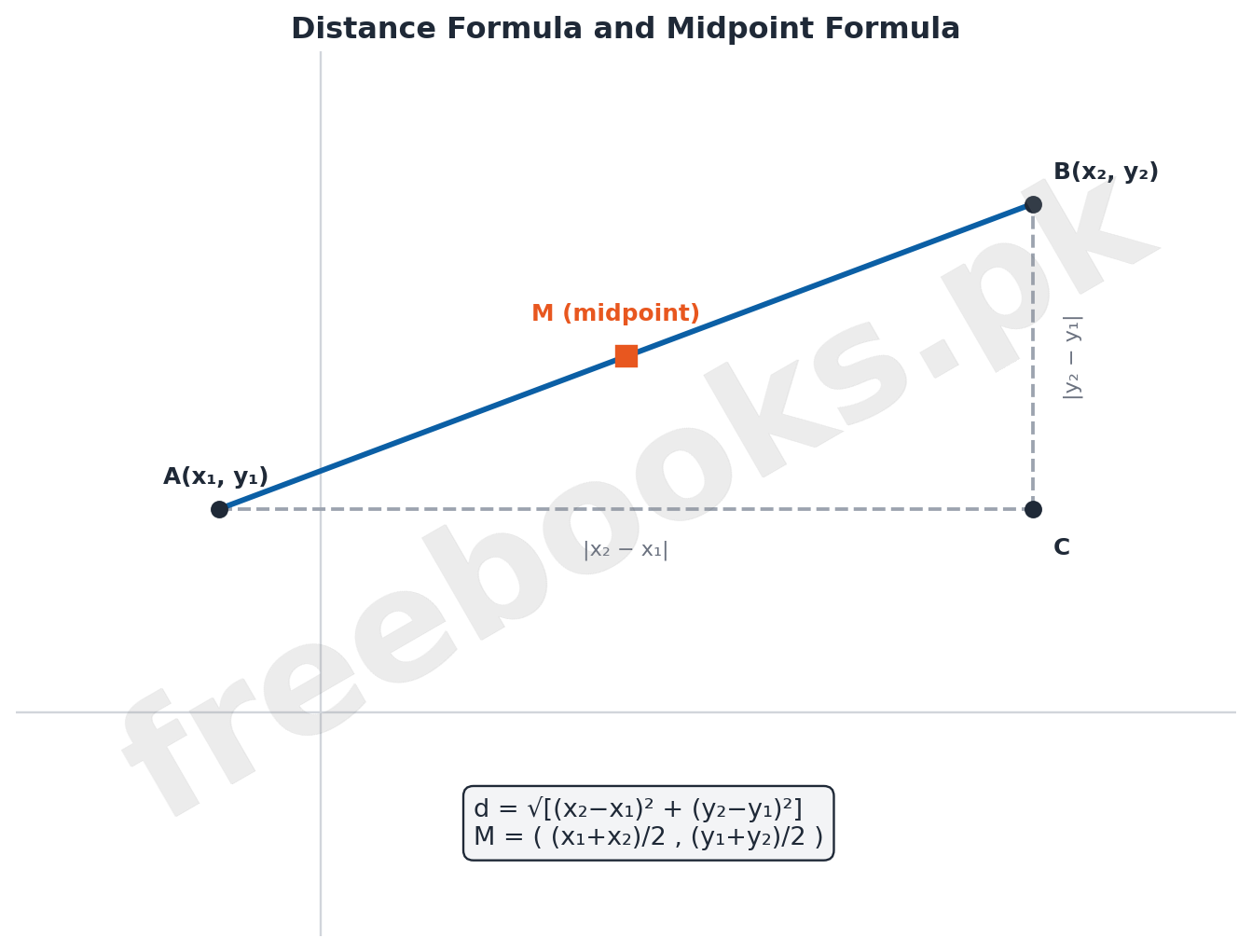
For two points A(x₁, y₁) and B(x₂, y₂), drawing a right triangle with legs parallel to the axes and applying the Pythagoras theorem gives the distance formula d = √[(x₂−x₁)² + (y₂−y₁)²]. Distance is always taken as non-negative, and either point may be labeled first without changing the result.
The midpoint M of the segment AB is found by averaging the x-coordinates and averaging the y-coordinates separately: M(x, y) = ((x₁+x₂)/2, (y₁+y₂)/2). Both formulas are used constantly throughout the unit, including to test whether three points form a right triangle, an isosceles triangle, or a parallelogram.
7.2 Slope (Gradient) of a Line
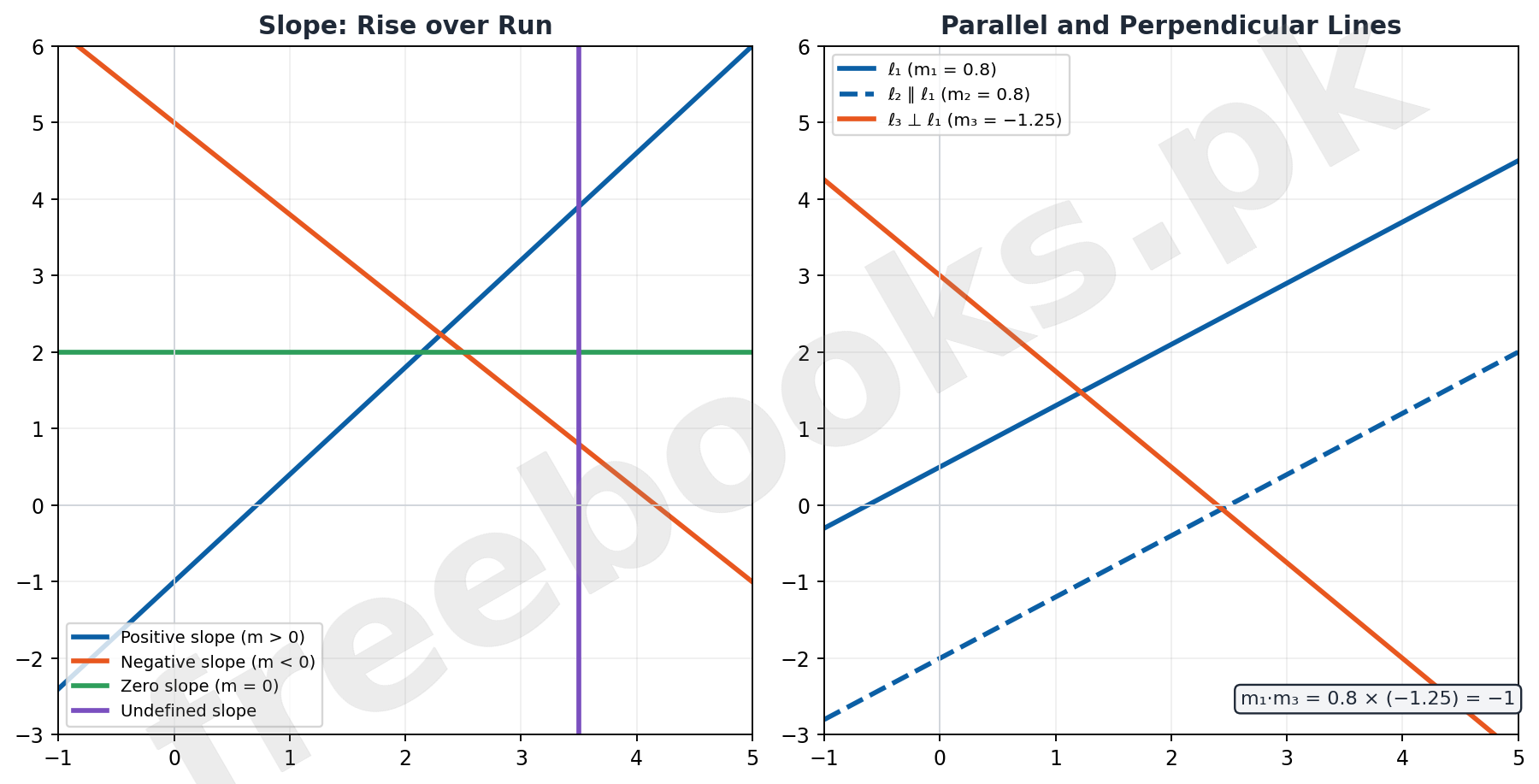
The inclination α of a line is the angle (0° < α < 180°) measured counterclockwise from the positive x-axis to the line. The slope m is defined as m = tan α, and equivalently, for two points P(x₁,y₁) and Q(x₂,y₂) on a non-vertical line, m = (y₂−y₁)/(x₂−x₁). A horizontal line has slope 0; a vertical line has undefined slope. Two lines are parallel exactly when their slopes are equal (m₁ = m₂), and perpendicular exactly when the product of their slopes is −1 (m₁m₂ = −1).
Three points A, B, C are collinear exactly when the slope of AB equals the slope of BC — this is a common technique for verifying collinearity or classifying a triangle as right-angled without directly measuring angles.
7.2.4 Six Standard Forms of a Line's Equation
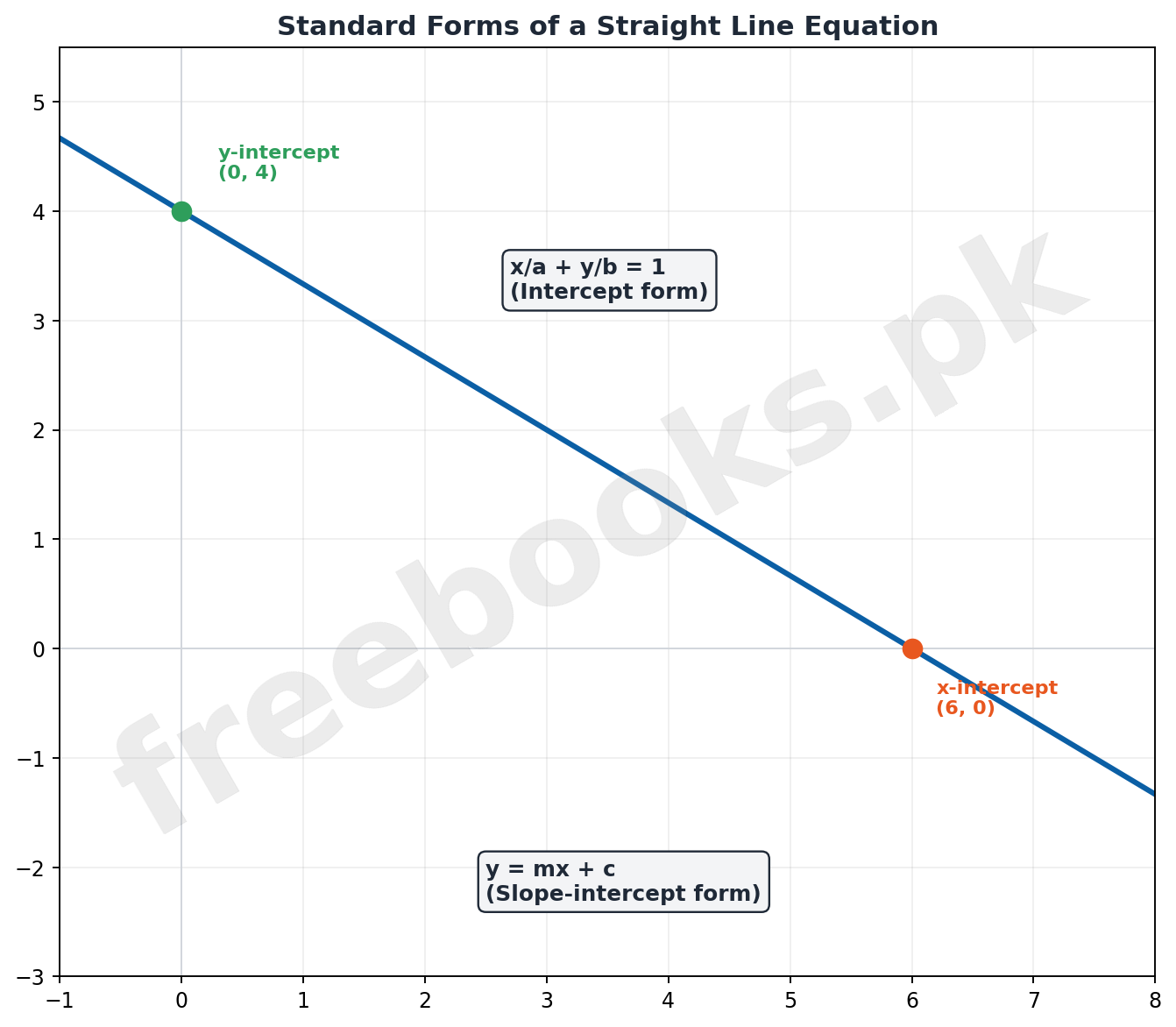
Slope-intercept form: y = mx + c, where m is the slope and c is the y-intercept. Point-slope form: y − y₁ = m(x − x₁), for a line through a known point with known slope. Two-point form: y − y₁ = [(y₂−y₁)/(x₂−x₁)](x − x₁), for a line through two known points.
Intercept form: x/a + y/b = 1, where a and b are the x- and y-intercepts. Symmetric form: (x−x₁)/cos α = (y−y₁)/sin α = r, expressed using the line's inclination. Normal form: x cos α + y sin α = p, where p is the perpendicular distance from the origin to the line and α is the inclination of that perpendicular.
7.2.5 – 7.2.6 The General Linear Equation
Every linear equation ax + by + c = 0 (with a, b not both zero) represents a straight line. If b = 0, the line is vertical (x = −c/a); if a = 0, the line is horizontal (y = −c/b); if neither is zero, the equation reduces to slope-intercept form with m = −a/b and y-intercept −c/b. Any such general equation can be systematically converted into any of the six standard forms by algebraic rearrangement.
7.3 Real-World Applications
Coordinate geometry formulas apply directly to physical and navigational problems: distances between towns or delivery points on a map, midpoints of bridges or pathways, side lengths of triangular plots of land, perimeters of rectangular fields, and even the heading angle a pilot should take (found using the arctangent of the slope between two coordinates). Latitude and longitude can also be averaged using the midpoint formula to find the midpoint of a journey.
Important Definitions
Coordinate Plane
A plane formed by two mutually perpendicular number lines, the x-axis and y-axis, intersecting at the origin, used to locate points via ordered pairs.
Abscissa and Ordinate
The x-coordinate (abscissa) and y-coordinate (ordinate) of a point, together forming its ordered pair (x, y).
Distance Formula
The formula d = √[(x₂−x₁)² + (y₂−y₁)²] for the straight-line distance between two points A(x₁,y₁) and B(x₂,y₂), derived from the Pythagoras theorem.
Midpoint Formula
The formula M = ((x₁+x₂)/2, (y₁+y₂)/2) giving the point exactly halfway between A(x₁,y₁) and B(x₂,y₂).
Inclination of a Line
The angle α (0° < α < 180°) measured counterclockwise from the positive x-axis to a non-horizontal line.
Slope (Gradient)
The measure m = tan α of a line's steepness, equivalently computed as m = (y₂−y₁)/(x₂−x₁) for two points on the line.
x-intercept and y-intercept
The x-coordinate where a line crosses the x-axis (y-intercept: the y-coordinate where it crosses the y-axis).
General Equation of a Line
The form ax + by + c = 0, where a and b are not both zero, which always represents some straight line.
Normal Form of a Line
The equation x cos α + y sin α = p, where p is the perpendicular distance from the origin to the line and α is the inclination of that perpendicular.
Collinear Points
Points that lie on the same straight line; three points are collinear exactly when the slope between the first pair equals the slope between the second pair.
Key Facts and Relations
| Topic | Key Fact / Relation |
|---|---|
| d = √[(x₂−x₁)² + (y₂−y₁)²] | Distance formula between two points. |
| M(x,y) = ((x₁+x₂)/2, (y₁+y₂)/2) | Midpoint formula for a line segment. |
| m = (y₂−y₁)/(x₂−x₁) = tan α | Slope of a line through two points, or via its inclination. |
| m₁ = m₂ (parallel) ; m₁m₂ = −1 (perpendicular) | Conditions for two lines to be parallel or perpendicular. |
| y = mx + c | Slope-intercept form of a line's equation. |
| y − y₁ = m(x − x₁) | Point-slope form of a line's equation. |
| x/a + y/b = 1 | Intercept form of a line's equation, with x-intercept a and y-intercept b. |
| x cos α + y sin α = p | Normal form of a line's equation. |
| ax + by + c = 0 | General form of the equation of a straight line. |
Diagrams
Distance Formula and Midpoint Formula: A coordinate-plane diagram showing two points joined by a right triangle to derive the distance formula, with the midpoint marked between them
Slope: Rise Over Run, and Parallel/Perpendicular Lines: Two-panel diagram showing lines of positive, negative, zero, and undefined slope, and a second panel showing parallel and perpendicular line pairs with their slope relationship
Standard Forms of a Straight Line Equation: A graphed line showing its x-intercept and y-intercept, annotated with the intercept form and slope-intercept form of its equation
Solved Examples
Example 1: Finding the Distance Between Two Points
Problem: Find the distance between the points C(−4, −2) and D(0, 9).
- Apply the distance formula: d = √[(x₂−x₁)² + (y₂−y₁)²].
- Substitute the coordinates: d = √[(0−(−4))² + (9−(−2))²] = √[4² + 11²].
- Simplify: d = √[16 + 121] = √137.
- State the result: the distance CD is √137 units.
Example 2: Showing Three Points Form a Right Triangle
Problem: Show that A(−1, 2), B(7, 5), and C(2, −6) are vertices of a right triangle.
- Compute each side length using the distance formula: |AB| = √73, |BC| = √146, |CA| = √73.
- Check the Pythagoras relationship: does the sum of two smaller squared sides equal the largest squared side?
- Verify: |CA|² + |AB|² = 73 + 73 = 146 = |BC|², so the Pythagoras theorem holds.
- Conclude that triangle ABC is right-angled, with the right angle at vertex A.
Example 3: Finding the Midpoint of a Line Segment
Problem: Find the midpoint of the segment joining A(2, 3) and B(8, 7).
- Apply the midpoint formula: M = ((x₁+x₂)/2, (y₁+y₂)/2).
- Substitute the coordinates: M = ((2+8)/2, (3+7)/2).
- Simplify: M = (10/2, 10/2) = (5, 5).
Example 4: Showing Three Points Are Collinear Using Slope
Problem: Show that A(−3, 6), B(3, 2), and C(6, 0) are collinear.
- Compute the slope of AB: (2−6)/(3−(−3)) = −4/6 = −2/3.
- Compute the slope of BC: (0−2)/(6−3) = −2/3.
- Compare: slope of AB equals slope of BC, both equal to −2/3.
- Since the slopes are equal and B is a shared point, conclude A, B, and C are collinear.
Example 5: Finding a Line's Equation Using Point-Slope Form
Problem: Find the equation of the line through (5, 1) that is parallel to the line through (0, −1) and (7, −15).
- Find the slope of the given line: m = (−15−(−1))/(7−0) = −14/7 = −2.
- Since parallel lines share the same slope, the required line also has slope −2.
- Apply point-slope form with point (5, 1): y − 1 = −2(x − 5).
- Simplify to general form: y = −2x + 11, or 2x + y − 11 = 0.
Example 6: Converting a General Equation to Slope-Intercept and Intercept Form
Problem: Transform 5x − 12y + 39 = 0 into slope-intercept form and intercept form.
- For slope-intercept form, isolate y: 12y = 5x + 39, so y = (5/12)x + 39/12, giving m = 5/12.
- For intercept form, rewrite as 5x − 12y = −39.
- Divide through by −39: 5x/(−39) + 12y/39 = 1, i.e., x/(−39/5) + y/(39/12) = 1.
- Read off the intercepts: x-intercept = −39/5, y-intercept = 39/12.
Example 7: Real-World Application: Finding a Bridge's Center Using the Midpoint Formula
Problem: An engineer is building a bridge between points (2, 5) and (8, 9) on a riverbank. Find the coordinates of the bridge's center.
- Apply the midpoint formula to the two given points: M = ((2+8)/2, (5+9)/2).
- Simplify: M = (10/2, 14/2) = (5, 7).
- State the result: the center of the bridge is located at (5, 7).
Example 8: Real-World Application: Finding an Aviation Heading Angle Using Slope
Problem: A pilot travels from city A(50, 60) to city B(120, 150). Find the heading angle relative to the east direction.
- Compute the slope between the two cities: m = (150−60)/(120−50) = 90/70 = 9/7.
- Relate the slope to the heading angle: tan θ = m = 9/7.
- Solve for θ: θ = tan⁻¹(9/7) = tan⁻¹(1.2857) ≈ 52.13°.
- State the conclusion: the plane should take a heading angle of approximately 52.13° north of east.
Short Questions & Answers
What is the abscissa and ordinate of a point (x, y)?
The abscissa is the x-coordinate (horizontal position) and the ordinate is the y-coordinate (vertical position) of the point.
How is the distance formula derived?
By drawing a right triangle between two points with legs parallel to the axes and applying the Pythagoras theorem to the horizontal and vertical differences.
What does it mean for a line to have zero slope versus undefined slope?
A horizontal line has zero slope (α = 0°); a vertical line has undefined slope (α = 90°, where tangent is undefined).
What condition on slopes indicates that two lines are perpendicular?
The product of their slopes equals −1, i.e., m₁m₂ = −1.
What is the slope-intercept form of a line's equation?
y = mx + c, where m is the slope and c is the y-intercept.
What does the general equation ax + by + c = 0 represent when a = 0?
It reduces to y = −c/b, a horizontal line parallel to the x-axis.
How can three points be tested for collinearity using slope?
By checking whether the slope between the first pair of points equals the slope between the second pair; if equal, the points are collinear.
Long Questions & Answers
Explain how the distance and midpoint formulas are derived and used to classify triangles and quadrilaterals.
How is the distance formula derived?
For points A(x₁,y₁) and B(x₂,y₂), a right triangle is formed with horizontal leg |x₂−x₁| and vertical leg |y₂−y₁|; applying the Pythagoras theorem gives d² = (x₂−x₁)² + (y₂−y₁)², so d = √[(x₂−x₁)² + (y₂−y₁)²].
How is the midpoint formula derived?
The midpoint's x-coordinate is the average of the two x-coordinates, and its y-coordinate is the average of the two y-coordinates, giving M = ((x₁+x₂)/2, (y₁+y₂)/2).
How is the distance formula used to identify a right triangle?
The three side lengths are computed with the distance formula, and the Pythagoras relationship (sum of squares of two sides equals the square of the third) is checked to confirm a right angle.
How are these formulas used to test a quadrilateral?
Side lengths and diagonal midpoints are computed; equal opposite sides or a shared diagonal midpoint can confirm shapes like parallelograms, following the same coordinate-based reasoning throughout.
Describe the six standard forms of a line's equation and how a general linear equation is converted between them.
What are the slope-intercept and point-slope forms?
Slope-intercept form is y = mx + c, using the slope and y-intercept; point-slope form is y − y₁ = m(x − x₁), using the slope and any one known point on the line.
What are the two-point and intercept forms?
Two-point form is y − y₁ = [(y₂−y₁)/(x₂−x₁)](x − x₁), built directly from two known points; intercept form is x/a + y/b = 1, using the x- and y-intercepts a and b.
What are the symmetric and normal forms?
Symmetric form is (x−x₁)/cos α = (y−y₁)/sin α = r, built from the inclination α; normal form is x cos α + y sin α = p, using the perpendicular distance p from the origin and the inclination α of that perpendicular.
How is a general equation ax+by+c=0 converted between these forms?
The equation is algebraically rearranged: isolating y gives slope-intercept form; picking a point on the line gives point-slope or two-point form; dividing by −c gives intercept form; dividing by ±√(a²+b²) gives normal form, choosing the sign so the right-hand side is positive.
Multiple Choice Questions (MCQs)
The equation of a straight line in slope-intercept form is written as: (A) y = m(x + c) (B) y − y₁ = m(x − x₁) (C) y = c + mx (D) ax + by + c = 0
Correct answer: (C) y = c + mx. Slope-intercept form is y = mx + c, which can be equivalently written y = c + mx.
The gradients of two parallel lines are: (A) equal (B) zero (C) negative reciprocals of each other (D) always undefined
Correct answer: (A) equal. Two lines are parallel exactly when their slopes are equal, m₁ = m₂.
If the product of the gradients of two lines is −1, then the lines are: (A) Parallel (B) perpendicular (C) Collinear (D) coincident
Correct answer: (B) perpendicular. m₁m₂ = −1 is precisely the condition for two lines to be perpendicular.
The distance between the points P(1, 2) and Q(4, 6) is: (A) 5 (B) 6 (C) √13 (D) 4
Correct answer: (A) 5. d = √[(4−1)² + (6−2)²] = √[9+16] = √25 = 5.
The midpoint of a line segment with endpoints (−2, 4) and (6, −2) is: (A) (4, 2) (B) (2, 1) (C) (1, 1) (D) (0, 0)
Correct answer: (B) (2, 1). M = ((−2+6)/2, (4−2)/2) = (4/2, 2/2) = (2, 1).
A line passing through points (1, 2) and (4, 5) is: (A) y = x + 1 (B) y = 2x + 3 (C) y = 3x − 2 (D) y = x + 2
Correct answer: (A) y = x + 1. Slope = (5−2)/(4−1) = 1; using point-slope form: y − 2 = 1(x − 1), so y = x + 1.
The equation of a line in point-slope form is: (A) y = m(x + c) (B) y − y₁ = m(x − x₁) (C) y = c + mx (D) ax + by + c = 0
Correct answer: (B) y − y₁ = m(x − x₁). Point-slope form is precisely y − y₁ = m(x − x₁).
2x + 3y − 6 = 0 in slope-intercept form is: (A) y = (−2/3)x + 2 (B) y = (2/3)x − 2 (C) y = (2/3)x + 1 (D) y = (−2/3)x − 2
Correct answer: (A) y = (−2/3)x + 2. 3y = −2x + 6, so y = (−2/3)x + 2.
The equation of a line in symmetric form is: (A) x/a + y/b = 1 (B) (x−x₁)/1 + (y−y₁)/m = (z−z₁)/1 (C) (x−x₁)/cos α = (y−y₁)/sin α = r (D) y − y₁ = m(x − x₁)
Correct answer: (C) (x−x₁)/cos α = (y−y₁)/sin α = r. Symmetric form uses the inclination α: (x−x₁)/cos α = (y−y₁)/sin α = r.
The equation of a line in normal form is: (A) y = mx + c (B) x/a + y/b = 1 (C) (x−x₁)/cos α = (y−y₁)/sin α (D) x cos α + y sin α = p
Correct answer: (D) x cos α + y sin α = p. Normal form is x cos α + y sin α = p, where p is the perpendicular distance from the origin.
Quick Revision Summary
- The distance formula d = √[(x₂−x₁)² + (y₂−y₁)²] comes directly from the Pythagoras theorem applied to a right triangle between two points.
- The midpoint formula averages the x-coordinates and y-coordinates separately: M = ((x₁+x₂)/2, (y₁+y₂)/2).
- Slope m = (y₂−y₁)/(x₂−x₁) = tan α; parallel lines have equal slopes, perpendicular lines have slopes multiplying to −1.
- There are six standard forms of a line's equation — slope-intercept, point-slope, two-point, intercept, symmetric, and normal — all describing the same line differently.
- Every linear equation ax + by + c = 0 (a, b not both zero) represents some straight line, and can be converted into any standard form.
- Real-world distance, midpoint, and slope problems (maps, navigation, latitude/longitude) use exactly the same formulas as pure coordinate geometry problems.
Exam Tips
- Always subtract coordinates in the same order in both the x and y terms of the distance formula to avoid sign errors.
- When testing collinearity, compute slopes between overlapping pairs of points (not all three independently) so a shared point can cancel out.
- Memorize the parallel condition (m₁=m₂) and perpendicular condition (m₁m₂=−1) — they appear in nearly every exercise in this unit.
- When converting a general equation to a standard form, isolate y first for slope-intercept form — most other forms follow easily from there.
- Sketch a quick graph before solving a word problem — visualizing intercepts and slope prevents sign and setup errors.
- For normal form, always double-check the sign of the radical so the right-hand side p comes out positive.