
Scientific notation writes very large or very small numbers compactly as a×10ⁿ, where 1≤a<10 and n is an integer — essential in science and engineering for handling numbers like the speed of light or the size of an atom. Logarithms extend this idea: the logarithm of a number x to base b, written log_b(x)=y, answers the question 'to what power y must b be raised to get x?', and is defined equivalently by b^y=x. Introduced by John Napier and extended by Henry Briggs (who developed the common logarithm and logarithm table), logarithms turn multiplication into addition and division into subtraction, making them powerful tools for simplifying complex calculations.
This unit covers converting numbers between ordinary and scientific notation, the logarithmic-exponential relationship, common logarithms (base 10) including the characteristic and mantissa and how to use logarithm/antilogarithm tables, natural logarithms (base e), and the four laws of logarithm (product, quotient, power, change of base) with their proofs — closing with real-world applications like the decibel sound scale, earthquake magnitude, compound growth, and population modelling.
Learning Objectives
- Express a number in scientific notation and convert scientific notation back to ordinary notation
- Describe the logarithm of a number and convert between logarithmic and exponential form
- Differentiate between common logarithm (base 10) and natural logarithm (base e)
- Find the characteristic and mantissa of a common logarithm, and use logarithm/antilogarithm tables
- State and prove the product, quotient, power, and change-of-base laws of logarithm
- Apply the laws of logarithm to expand, combine, and simplify logarithmic expressions and solve logarithmic equations
- Apply logarithms to real-life problems: decibel sound levels, earthquake magnitude, and exponential growth/decay
Key Concepts
2.1 Scientific Notation
A number in scientific notation is written a×10ⁿ, where 1≤a<10 and n∈Z. To convert an ordinary number to scientific notation, move the decimal point until only one non-zero digit remains before it, and count the number of places moved — this count becomes n (positive if the original number was ≥10, negative if it was <1). To convert back, move the decimal point |n| places right (if n is positive) or left (if n is negative).
2.2 Logarithm of a Real Number
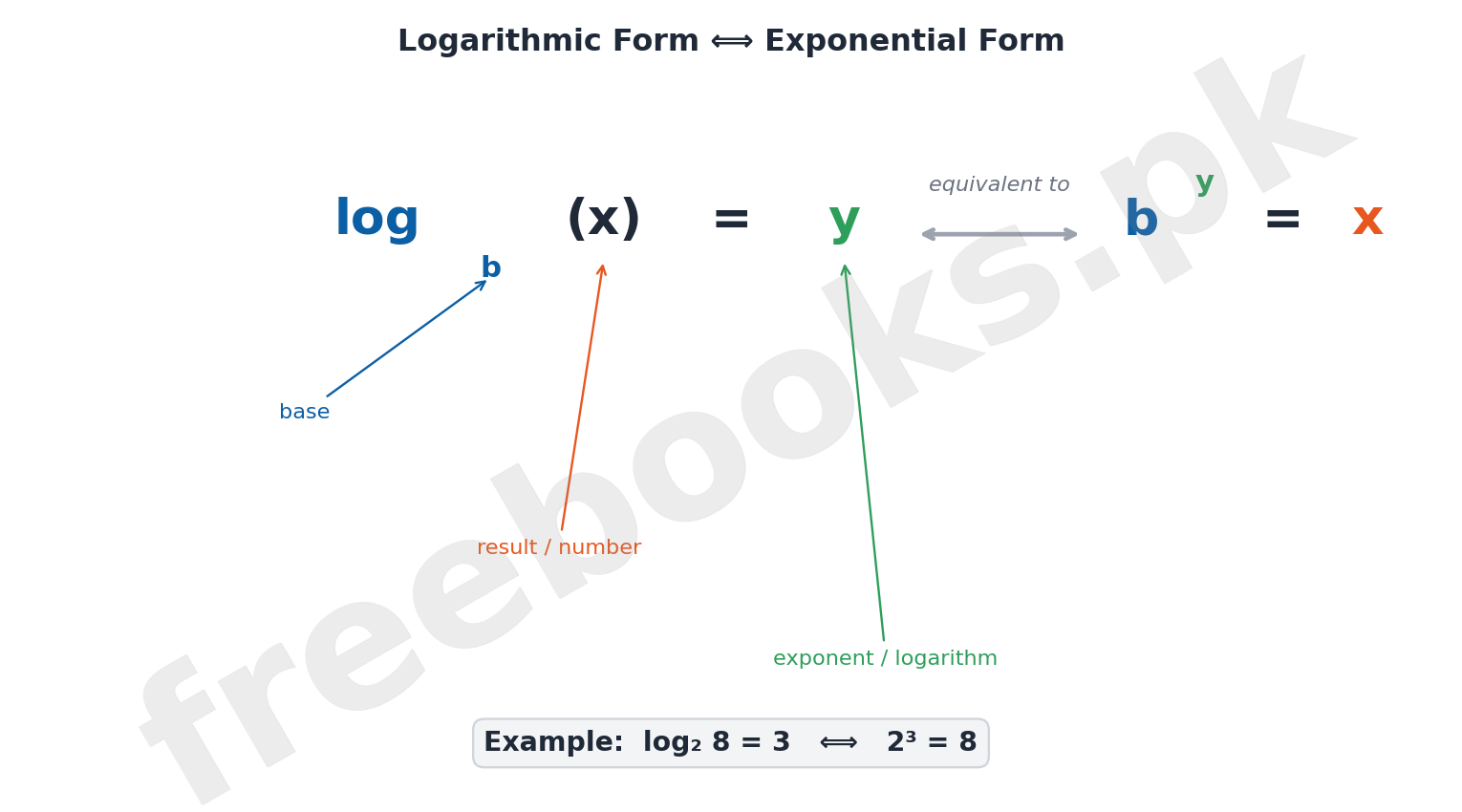
The logarithm of x to base b, log_b(x)=y, means b^y=x, where b>0, x>0, and b≠1. Here b is the base, x is the result whose logarithm is being taken, and y is the exponent (the logarithm itself). Converting between forms is direct: log_b(x)=y ⟺ b^y=x, e.g. log₂8=3 ⟺ 2³=8.
2.3 Common Logarithm: Characteristic and Mantissa
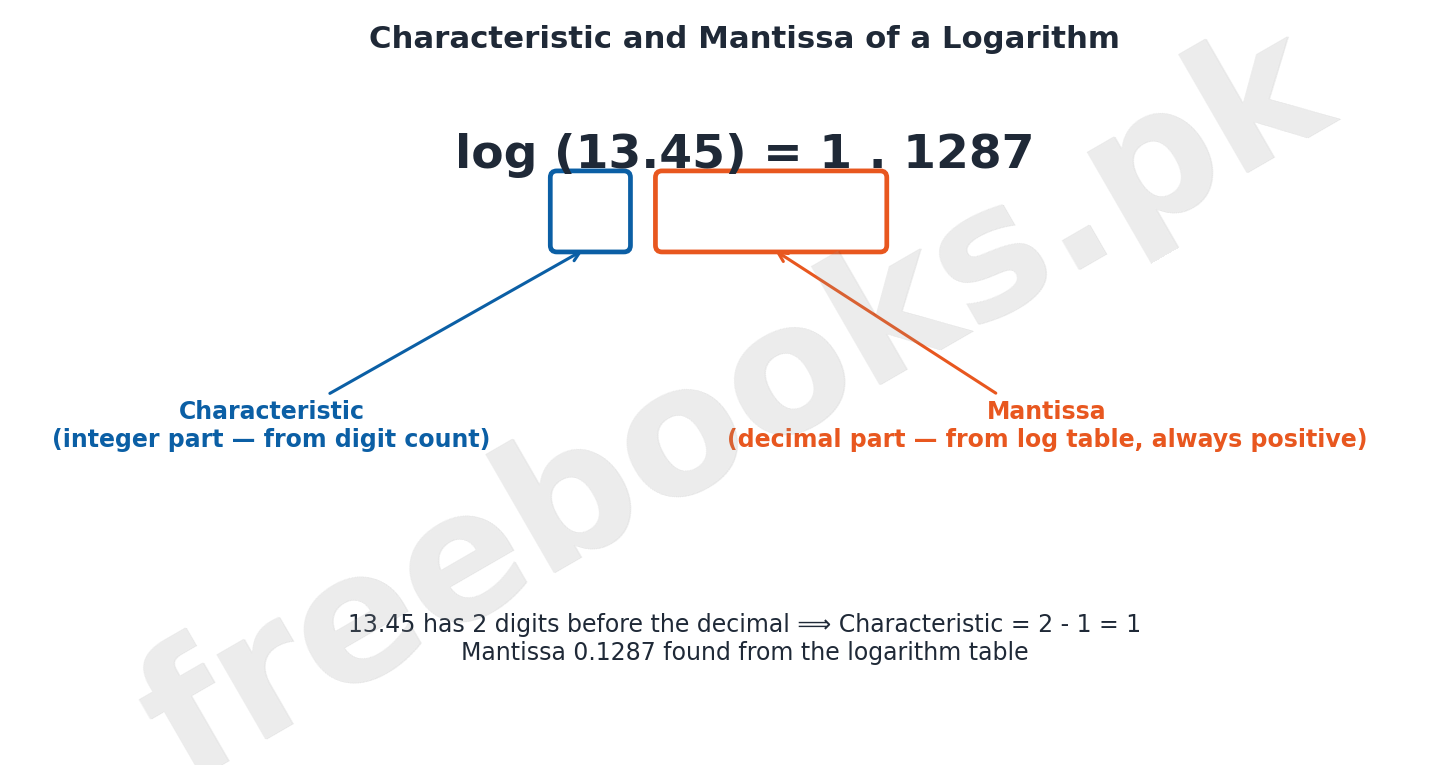
The common logarithm uses base 10, written log₁₀ or simply log. Every common logarithm splits into a characteristic (the integer part, found from the number of digits) and a mantissa (the decimal part, always positive, found from a logarithm table): log(Number)=Characteristic+Mantissa. For numbers ≥1, characteristic=(digits before decimal point)-1; for numbers <1, characteristic=-(zeros between decimal point and first non-zero digit + 1), written with a bar (e.g. 2̄).
Antilogarithm is the inverse operation: given a logarithm value, find the original number using an antilogarithm table, splitting the value into characteristic and (positive) mantissa, looking up the mantissa's table value, then placing the decimal point according to the characteristic.
2.4 Natural Logarithm
The natural logarithm uses base e≈2.71828 (introduced by Leonhard Euler), written ln(x). It is used extensively in calculus and to model exponential growth and decay. Common logarithm (base 10) is used in everyday scientific/engineering calculations; natural logarithm (base e) is used in higher mathematics and growth/decay modelling.
2.5 Laws of Logarithm
The four laws of logarithm are: Product Law, log_b(xy)=log_b(x)+log_b(y); Quotient Law, log_b(x/y)=log_b(x)-log_b(y); Power Law, log_b(xⁿ)=n·log_b(x); and Change of Base Law, log_b(x)=log_a(x)/log_a(b). Each is proved by writing the logarithms in exponential form, combining the exponents using the corresponding index law, then converting back to logarithmic form.
These laws let complex logarithmic expressions be expanded into sums/differences of simpler logarithms, or combined from several logarithms into a single one — both directions are used constantly when simplifying expressions or solving logarithmic equations.
2.6 Applications of Logarithm
Logarithms model real-world phenomena that span huge ranges of scale: the decibel sound scale L=40log₁₀(I/I₀) measures sound intensity relative to a reference; the earthquake magnitude scale M=log₁₀(A/A₀) measures amplitude relative to a reference; and exponential growth models like y=P(1+r)ᵗ (compound interest, population growth) are solved for the unknown time t by taking logarithms of both sides.
Important Definitions
What is scientific notation?
A way of writing a number as a×10ⁿ, where 1≤a<10 and n is an integer.
What is the logarithm of x to base b?
The exponent y such that b^y=x, written log_b(x)=y, where b>0, x>0, b≠1.
What is a common logarithm?
A logarithm with base 10, written log₁₀ or simply log.
What is a natural logarithm?
A logarithm with base e≈2.71828, written ln.
What is the characteristic of a common logarithm?
The integer part of the logarithm, found from the number of digits before the decimal point (for numbers ≥1) or the number of leading zeros after the decimal point (for numbers <1).
What is the mantissa of a common logarithm?
The decimal part of the logarithm, always positive, found using a logarithm table.
What is an antilogarithm?
The inverse operation of a logarithm: given y=log_b(x), the antilogarithm finds x.
State the Product Law of logarithm.
log_b(xy) = log_b(x) + log_b(y).
State the Power Law of logarithm.
log_b(xⁿ) = n·log_b(x).
State the Change of Base Law of logarithm.
log_b(x) = log_a(x) / log_a(b), converting from base b to any base a.
Key Facts and Relations
| Topic | Key Fact / Relation |
|---|---|
| Scientific notation form | a × 10ⁿ, where 1≤a<10, n∈Z |
| Logarithmic-exponential equivalence | log_b(x) = y ⟺ b^y = x |
| Common logarithm decomposition | log(Number) = Characteristic + Mantissa |
| Characteristic for a number ≥1 | Characteristic = (digits before decimal point) – 1 |
| Characteristic for a number <1 | Characteristic = -(zeros between decimal point and first non-zero digit + 1) |
| Product Law | log_b(xy) = log_b(x) + log_b(y) |
| Quotient Law | log_b(x/y) = log_b(x) – log_b(y) |
| Power Law | log_b(xⁿ) = n·log_b(x) |
| Change of Base Law | log_b(x) = log_a(x)/log_a(b) |
| Decibel and earthquake magnitude formulas | L = 40log₁₀(I/I₀); M = log₁₀(A/A₀) |
Diagrams
Logarithmic Form ⟺ Exponential Form: A labelled diagram showing the equivalence between log_b(x)=y and b^y=x, with the base, result, and exponent each labelled, illustrated with the example log₂8=3 ⟺ 2³=8
Characteristic and Mantissa of a Logarithm: A labelled breakdown of log(13.45)=1.1287 showing the characteristic (integer part, from digit count) and the mantissa (decimal part, from the logarithm table)
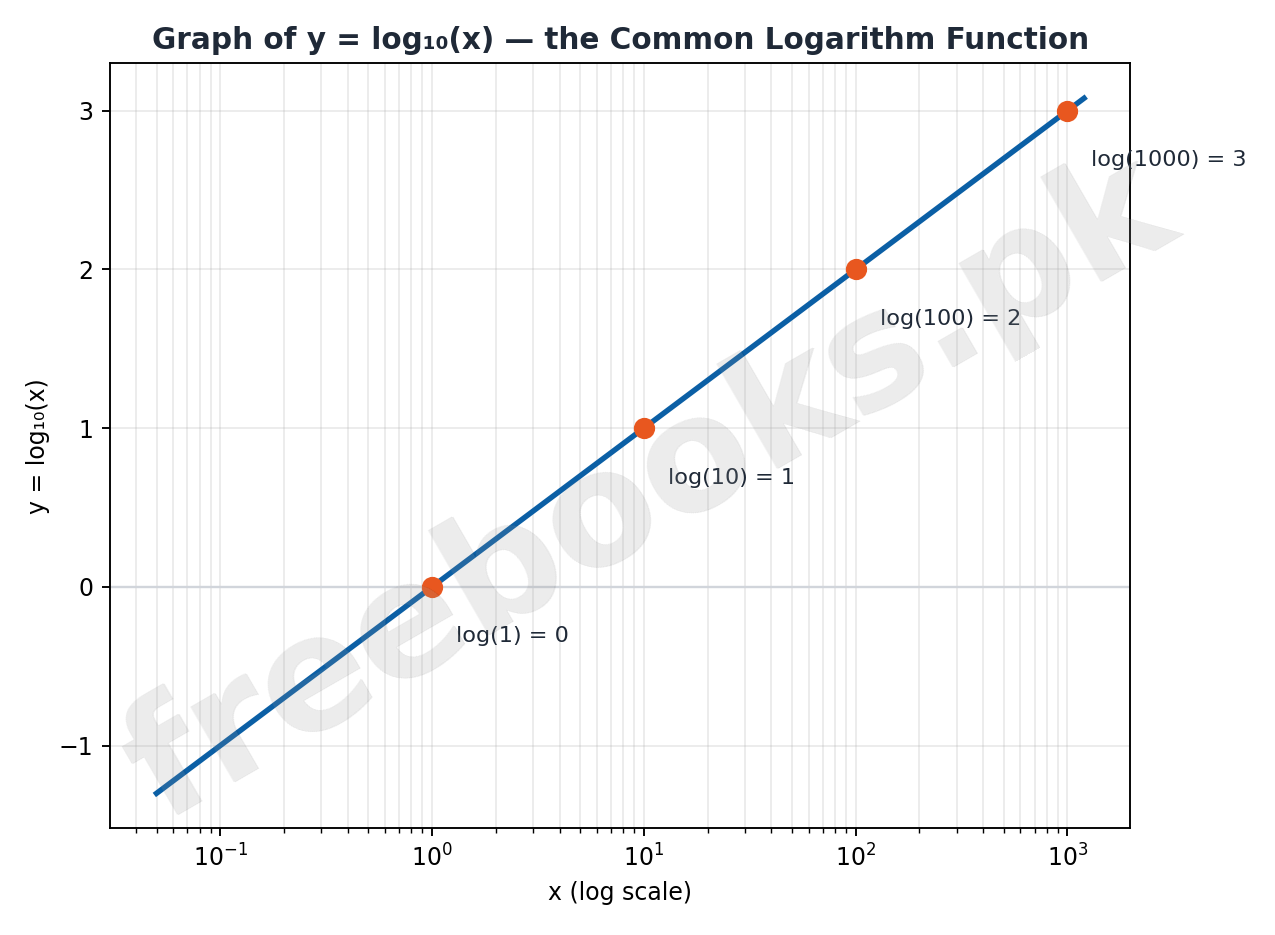
Graph of y = log₁₀(x) — the Common Logarithm Function: The common logarithm function plotted on a logarithmic x-axis, with key points log(1)=0, log(10)=1, log(100)=2, and log(1000)=3 marked
Solved Examples
Example 1: Converting to Scientific Notation
Problem: Convert 78,000,000 to scientific notation.
- Move the decimal point left until only one non-zero digit remains before it: 7.8.
- Count the number of places the decimal point moved: 7 places.
- Since the decimal moved left (the original number was greater than 1), the exponent is positive.
- Write the number as coefficient × 10^(places moved).
- Final answer: 78,000,000 = 7.8 × 10⁷.
Example 2: Converting Logarithmic and Exponential Forms
Problem: Convert log₂8=3 to exponential form, and find x if log₅25=x.
- For log₂8=3: using log_b(x)=y ⟺ b^y=x with b=2, x=8, y=3, the exponential form is 2³=8.
- For log₅25=x: write in exponential form, 5^x=25.
- Rewrite 25 as a power of 5: 5^x = 5².
- Since the bases match, equate the exponents: x=2.
- Final answer: log₂8=3 becomes 2³=8, and log₅25=x gives x=2.
Example 3: Finding the Characteristic and Mantissa
Problem: Find the characteristic of log 725 and log 0.00045.
- For log 725: this number has 3 digits before the decimal point, so characteristic = 3-1 = 2.
- For log 0.00045: there are 3 zeros between the decimal point and the first non-zero digit (4), so characteristic = -(3+1) = -4, written 4̄.
- Cross-check using scientific notation: 725=7.25×10², confirming characteristic 2; 0.00045=4.5×10⁻⁴, confirming characteristic -4.
- This scientific-notation cross-check works because the exponent of 10 always equals the characteristic.
- Final answer: characteristic of log 725 is 2; characteristic of log 0.00045 is 4̄ (-4).
Example 4: Finding a Common Logarithm Using Tables
Problem: Find log 13.45 using the logarithm table.
- Separate the integral and decimal parts: integral part 13, decimal part 45.
- Find the characteristic: number of digits before the decimal point (2) minus 1, giving characteristic=1.
- Look up the logarithm table at row 13, column 4 (from the digit '4' in 13.45): table value 1271.
- Add the mean difference for the next digit (5): row 13, mean-difference column 5, value 16; so 1271+16=1287, giving mantissa 0.1287.
- Final answer: log 13.45 = characteristic + mantissa = 1 + 0.1287 = 1.1287.
Example 5: Finding an Antilogarithm Using Tables
Problem: Find the antilogarithm of 2.1245.
- Separate the characteristic and mantissa: characteristic=2, mantissa=0.1245.
- Look up the antilogarithm table at row .12, column 4: table value 1330.
- Add the mean difference at row .12, column 5: value 2; so 1330+2=1332.
- Since the characteristic is 2, place the decimal point 2 digits to the right of the reference position, giving 133.2.
- Final answer: antilog(2.1245) ≈ 133.2.
Example 6: Proving and Applying the Product Law
Problem: Prove log_b(xy)=log_b(x)+log_b(y), then use it to expand log₃(20).
- Let m=log_b(x) and n=log_b(y), so in exponential form x=b^m and y=b^n.
- Multiply: xy = b^m·b^n = b^(m+n), so in logarithmic form log_b(xy)=m+n=log_b(x)+log_b(y), proving the law.
- Apply to log₃(20): rewrite 20=2²×5, so log₃(20)=log₃(2²)+log₃(5).
- Apply the Power Law to the first term: log₃(2²)=2log₃2.
- Final answer: log₃(20) = 2log₃2 + log₃5.
Example 7: Combining Logarithms into a Single Logarithm
Problem: Write 2log₃10 – log₃4 as a single logarithm.
- Apply the Power Law to the first term: 2log₃10 = log₃(10²) = log₃100.
- Rewrite the expression as log₃100 – log₃4.
- Apply the Quotient Law: log₃100 – log₃4 = log₃(100/4).
- Simplify the fraction: 100/4 = 25.
- Final answer: 2log₃10 – log₃4 = log₃25.
Example 8: Real-Life Application: Decibel Sound Scale
Problem: The decibel scale is L=40log₁₀(I/I₀). If sound intensity I is 10⁶ times the reference intensity I₀, find the sound level L.
- Substitute I=10⁶I₀ into the formula: L = 40log₁₀(10⁶I₀/I₀).
- Cancel I₀ in the fraction: L = 40log₁₀(10⁶).
- Apply the Power Law: log₁₀(10⁶) = 6log₁₀(10) = 6×1 = 6 (since log₁₀10=1).
- Multiply: L = 40 × 6.
- Final answer: L = 240 decibels.
Short Questions & Answers
What is the general form of a number written in scientific notation?
a×10ⁿ, where 1≤a<10 and n is an integer.
What does log_b(x)=y mean in exponential form?
b^y=x, where b>0, x>0, and b≠1.
What are the two parts of a common logarithm called?
The characteristic (integer part) and the mantissa (decimal part, always positive).
Which base does a natural logarithm use, and who introduced this constant?
Base e≈2.71828, a constant introduced by Leonhard Euler.
What does the Quotient Law of logarithm state?
log_b(x/y) = log_b(x) – log_b(y): the logarithm of a quotient is the difference of the logarithms.
Why is log(0) undefined?
Because there is no real exponent y such that 10^y=0; as y→-∞, 10^y approaches 0 but never reaches it.
What is the value of log(1), and why?
0, because 10⁰=1 for any nonzero base.
Long Questions & Answers
Explain what the characteristic and mantissa of a common logarithm are, how each is found, and how they combine to give the logarithm of a number.
What is the characteristic of a common logarithm, and how is it found for a number greater than 1?
The characteristic is the integer part of the logarithm; for a number greater than 1, it equals the number of digits to the left of the decimal point minus 1 — for example, 725 has 3 digits before the decimal, so its characteristic is 3-1=2.
How is the characteristic found for a number less than 1?
It equals negative the count of zeros between the decimal point and the first non-zero digit, plus 1 — for example, 0.00045 has 3 such zeros, so the characteristic is -(3+1)=-4, written with a bar as 4̄.
What is the mantissa, and how is it obtained?
The mantissa is the decimal part of the logarithm, always positive regardless of the sign of the characteristic; it is found by looking up the number's significant digits in a logarithm table, combining the table value with the mean-difference correction for the next digit.
How do the characteristic and mantissa combine to give the final logarithm value?
They are simply added together: log(Number) = Characteristic + Mantissa — for example, log(13.45) has characteristic 1 and mantissa 0.1287, giving log(13.45)=1.1287.
Explain the four laws of logarithm, how each is proved from the definition of a logarithm, and how they are used together to simplify expressions.
How is the Product Law log_b(xy)=log_b(x)+log_b(y) proved?
Let m=log_b(x) and n=log_b(y), so x=b^m and y=b^n in exponential form; multiplying gives xy=b^m·b^n=b^(m+n) by the index law for multiplying powers with the same base, and converting back to logarithmic form gives log_b(xy)=m+n=log_b(x)+log_b(y).
How is the Power Law log_b(xⁿ)=n·log_b(x) proved similarly?
Let m=log_b(x), so x=b^m; raising both sides to the power n gives xⁿ=(b^m)ⁿ=b^(mn) by the index law for a power of a power, and converting back to logarithmic form gives log_b(xⁿ)=mn=n·log_b(x).
What is the Change of Base Law used for, and how is it proved?
It converts a logarithm from base b to any other base a: log_b(x)=log_a(x)/log_a(b); it is proved by taking log base a of both sides of the exponential form b^m=x (where m=log_b(x)), giving m·log_a(b)=log_a(x), then solving for m.
How are these laws combined when expanding or simplifying a real logarithmic expression?
The Product and Quotient Laws break a logarithm of a product or quotient into a sum or difference of simpler logarithms, the Power Law pulls exponents out front as coefficients, and these steps can be reversed to combine several logarithm terms back into a single logarithm — for example, 2log₃10-log₃4 becomes log₃100-log₃4 via the Power Law, then log₃(100/4)=log₃25 via the Quotient Law.
Multiple Choice Questions (MCQs)
The standard form of 5.2 × 10⁶ is: (A) 52,000 (B) 520,000 (C) 5,200,000 (D) 52,000,000
Correct answer: (C) 5,200,000. Moving the decimal point 6 places to the right gives 5,200,000.
The base of a common logarithm is: (A) 2 (B) 10 (C) 5 (D) e
Correct answer: (B) 10. Common logarithm always uses base 10, written log or log₁₀.
log₂2³ equals: (A) 1 (B) 2 (C) 5 (D) 3
Correct answer: (D) 3. By definition, log_b(b^n)=n, so log₂2³=3.
log 100 equals: (A) 2 (B) 3 (C) 10 (D) 1
Correct answer: (A) 2. Since 10²=100, log 100 = 2.
If log 2 = 0.3010, then log 200 is: (A) 1.3010 (B) 0.6010 (C) 2.3010 (D) 2.6010
Correct answer: (C) 2.3010. log 200 = log(2×100) = log 2 + log 100 = 0.3010 + 2 = 2.3010.
log(0) is: (A) Positive (B) Negative (C) Zero (D) Undefined
Correct answer: (D) Undefined. There is no real exponent that makes 10^y equal exactly 0, so log(0) is undefined.
log 5 + log 3 equals: (A) log 0 (B) log 2 (C) log(5/3) (D) log 15
Correct answer: (D) log 15. By the Product Law, log 5 + log 3 = log(5×3) = log 15.
3⁴=81 in logarithmic form is: (A) log₃4=81 (B) log₄3=81 (C) log₃81=4 (D) log₄81=3
Correct answer: (C) log₃81=4. Using log_b(x)=y ⟺ b^y=x with b=3, x=81, y=4 gives log₃81=4.
The mantissa of a common logarithm is always: (A) Negative (B) Zero (C) Positive (D) Equal to the characteristic
Correct answer: (C) Positive. The mantissa, found from the logarithm table, is by convention always kept positive.
The natural logarithm ln(x) uses which base? (A) 10 (B) 2 (C) e (D) 1
Correct answer: (C) e. The natural logarithm uses base e≈2.71828, the constant introduced by Euler.
Quick Revision Summary
- Scientific notation: a×10ⁿ, 1≤a<10, n∈Z; move the decimal point and count places to find n
- Logarithm definition: log_b(x)=y ⟺ b^y=x, for b>0, x>0, b≠1
- Common logarithm uses base 10 (log or log₁₀); natural logarithm uses base e≈2.71828 (ln)
- log(Number) = Characteristic + Mantissa; characteristic from digit count, mantissa from the log table (always positive)
- Antilogarithm is the inverse of a logarithm, found using an antilogarithm table
- Product Law: log_b(xy)=log_b(x)+log_b(y) | Quotient Law: log_b(x/y)=log_b(x)-log_b(y)
- Power Law: log_b(xⁿ)=n·log_b(x) | Change of Base Law: log_b(x)=log_a(x)/log_a(b)
- log(1)=0 for any base; log(0) is undefined
- Applications: decibel scale L=40log₁₀(I/I₀), earthquake magnitude M=log₁₀(A/A₀), exponential growth models
- To solve exponential equations for an unknown exponent, take the logarithm of both sides, then apply the Power Law
Exam Tips
- When converting to scientific notation, count decimal-point moves carefully — moving LEFT (number was ≥10) gives a POSITIVE exponent, moving RIGHT (number was <1) gives a NEGATIVE exponent
- Always find the characteristic FIRST using the digit-counting rule, then look up the mantissa separately in the table — mixing up which part comes from which method is a common error
- Remember the mantissa is always written as positive, even when the characteristic is negative (shown with a bar, e.g. 2̄.5433) — never treat the whole logarithm value as one single negative decimal
- When applying the laws of logarithm, work one law at a time: fully expand or combine using one law before applying the next, rather than trying to do multiple steps in your head at once
- For change-of-base problems, pick the new base a to be whatever makes the calculation easiest — usually 10 (common log) or e (natural log), since those are the ones with tables/calculators
- For real-life logarithm problems (decibels, earthquakes, growth models), identify which given values correspond to which symbol in the formula before substituting — writing them out explicitly avoids sign and placement errors