
Trigonometry studies the relationships between the angles and sides of a triangle, most powerfully in the right-angled triangle, and it is one of the most widely applied branches of mathematics — used in physics, engineering, architecture, astronomy, surveying, and navigation. This unit begins with the language of angles themselves: how an angle is defined in standard position, how it is measured in degrees versus radians, and how to convert fluently between the two systems, including the degree-minute-second notation used in navigation and surveying.
From there, the unit builds the six trigonometric ratios — sine, cosine, tangent, and their reciprocals — from a right-angled triangle, derives the fundamental Pythagorean identities, and uses them to prove more complex trigonometric identities. The unit closes with genuinely practical applications: solving a right triangle when only some of its sides and angles are known, and using angles of elevation and depression to find heights and distances that would otherwise be dangerous or impossible to measure directly.
Learning Objectives
- Identify angles in standard position and express them in both degrees and radians.
- Convert between decimal degrees and degrees-minutes-seconds (DMS) notation, and between degrees and radians.
- Compute arc length and area of a circular sector using the radian measure of the central angle.
- Apply the Pythagoras theorem and define the sine, cosine, and tangent ratios (and their reciprocals) for an acute angle of a right triangle.
- Use the complementary angle relationships between trigonometric ratios.
- Prove trigonometric identities using the fundamental Pythagorean identities and ratio definitions.
- Recall and apply the exact trigonometric ratios of the special angles 0°, 30°, 45°, 60°, and 90°.
- Solve a right triangle given a sufficient combination of known sides and angles.
- Solve real-life problems in two dimensions involving angles of elevation and depression.
Key Concepts
6.1 Angles in Standard Position: Degrees and Radians
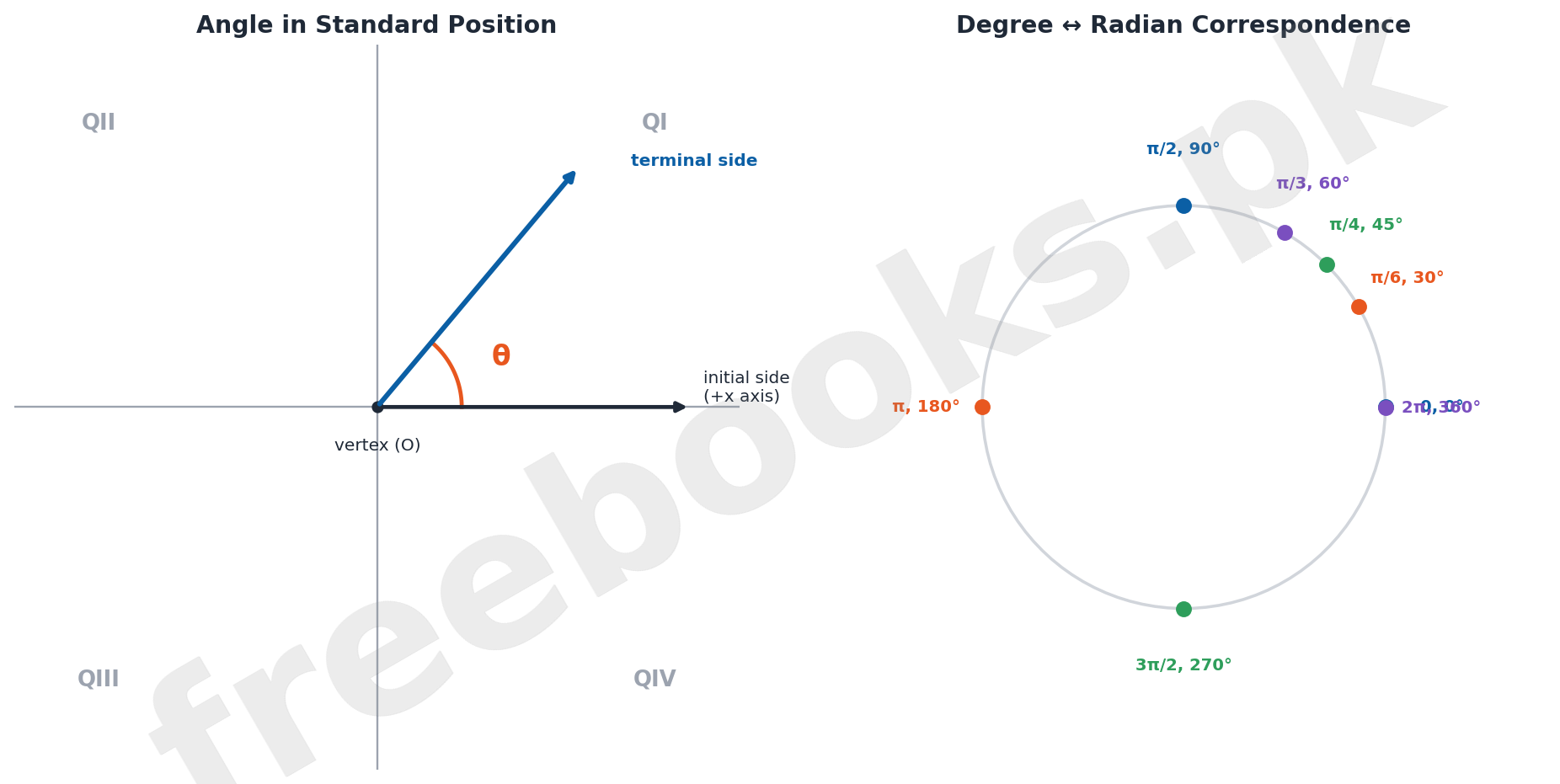
An angle is formed by two rays sharing a common endpoint (the vertex); it is in standard position when its vertex is at the origin and its initial side lies along the positive x-axis. An angle is positive if measured counterclockwise from the initial side, and negative if measured clockwise. Co-terminal angles share the same initial and terminal sides but differ by a multiple of 360° (or 2π radians).
A degree is 1/360 of a full rotation, further divided into 60 minutes (′) per degree and 60 seconds (″) per minute. A radian is defined as the angle subtended at a circle's center by an arc equal in length to the radius; a full rotation equals 2π radians. The conversions are 1 rad = 180°/π and 1° = π/180 rad.
Arc Length and Sector Area
For a circle of radius r and a central angle θ measured in radians, the arc length is ℓ = rθ and the area of the sector is A = (1/2)r²θ. Both formulas follow directly from the fact that a full circle (angle 2π) has circumference 2πr and area πr², so ℓ and A scale proportionally with θ/2π.
6.2 Trigonometric Ratios of an Acute Angle
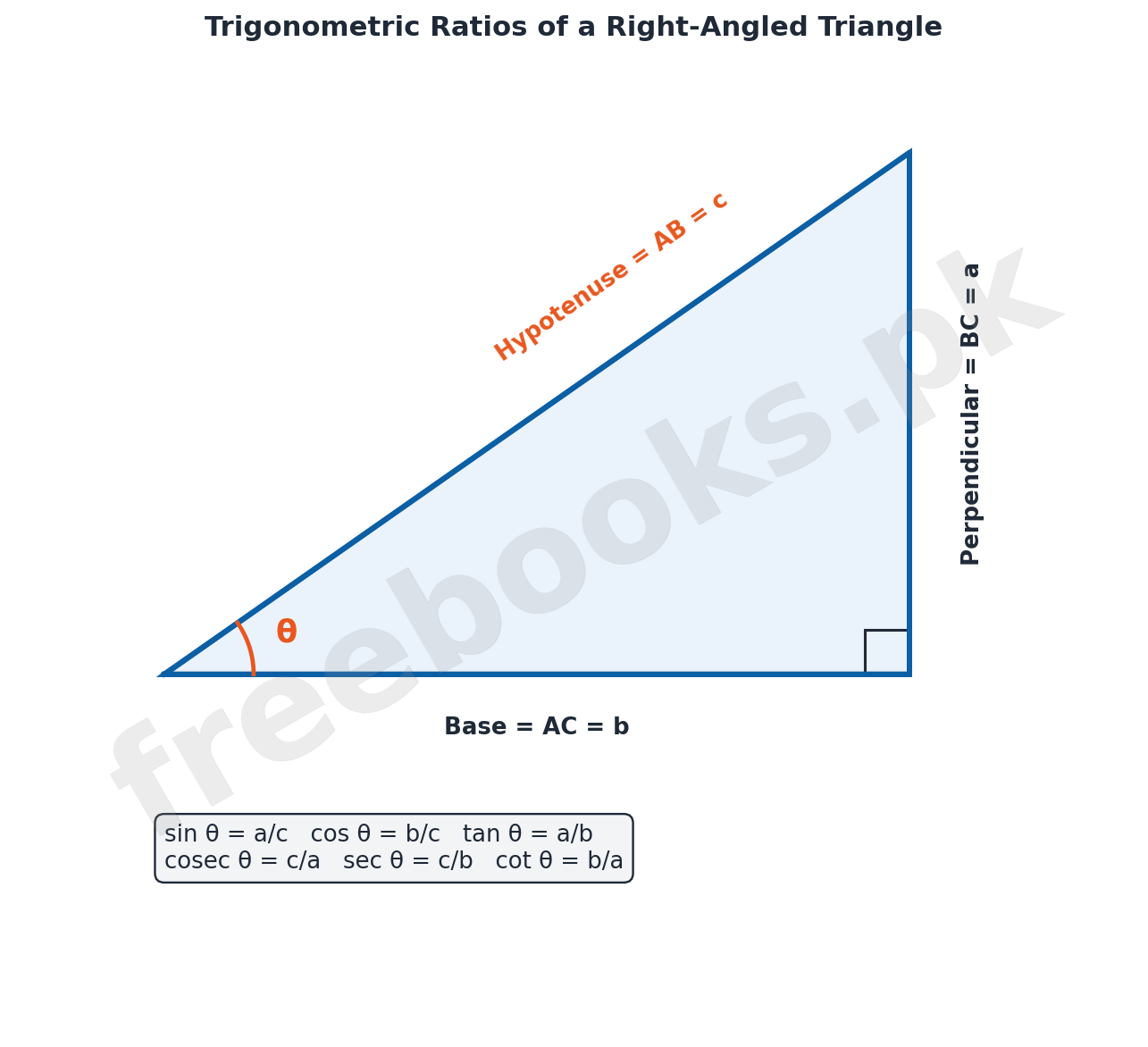
In a right triangle with angle θ, the side opposite θ is the perpendicular, the side adjacent to θ (not the hypotenuse) is the base, and the side opposite the right angle is the hypotenuse. The six ratios are sin θ = perpendicular/hypotenuse, cos θ = base/hypotenuse, tan θ = perpendicular/base, and their reciprocals cosec θ = 1/sin θ, sec θ = 1/cos θ, cot θ = 1/tan θ. Also, tan θ = sin θ/cos θ and cot θ = cos θ/sin θ.
For complementary angles (θ and 90° − θ), each ratio equals the 'co-ratio' of the other angle: sin(90° − θ) = cos θ, cos(90° − θ) = sin θ, tan(90° − θ) = cot θ, and similarly for the reciprocal ratios.
6.3 Fundamental Trigonometric Identities
The Pythagoras theorem a² + b² = c² gives rise to three Pythagorean identities by dividing through by c², b², or a² respectively: sin²θ + cos²θ = 1, tan²θ + 1 = sec²θ, and 1 + cot²θ = cosec²θ. These three identities are the foundation for proving virtually every other trigonometric identity in this unit, typically by converting all ratios to sine and cosine and simplifying algebraically.
6.4 Trigonometric Ratios of Special Angles
Using a right isosceles triangle (square cut along its diagonal) gives the ratios for 45°: sin 45° = cos 45° = 1/√2, tan 45° = 1. Using an equilateral triangle bisected into two 30-60-90 triangles gives the ratios for 30° and 60°: sin 30° = cos 60° = 1/2, cos 30° = sin 60° = √3/2, tan 30° = 1/√3, tan 60° = √3. These special-angle values should be memorized, since they appear constantly in exercises and applications.
6.5 Solving a Right Triangle
Solving a triangle means finding all its unknown sides and angles from the ones already known. For a right triangle, knowing any two of the three sides, or one side and one acute angle, is enough to find everything else, using the trigonometric ratios and the fact that the two acute angles sum to 90°. Four typical cases arise: one side and one angle known, the hypotenuse and one angle known, two sides known (using Pythagoras and an inverse trig ratio), and one side plus the hypotenuse known.
6.6 Angle of Elevation and Angle of Depression
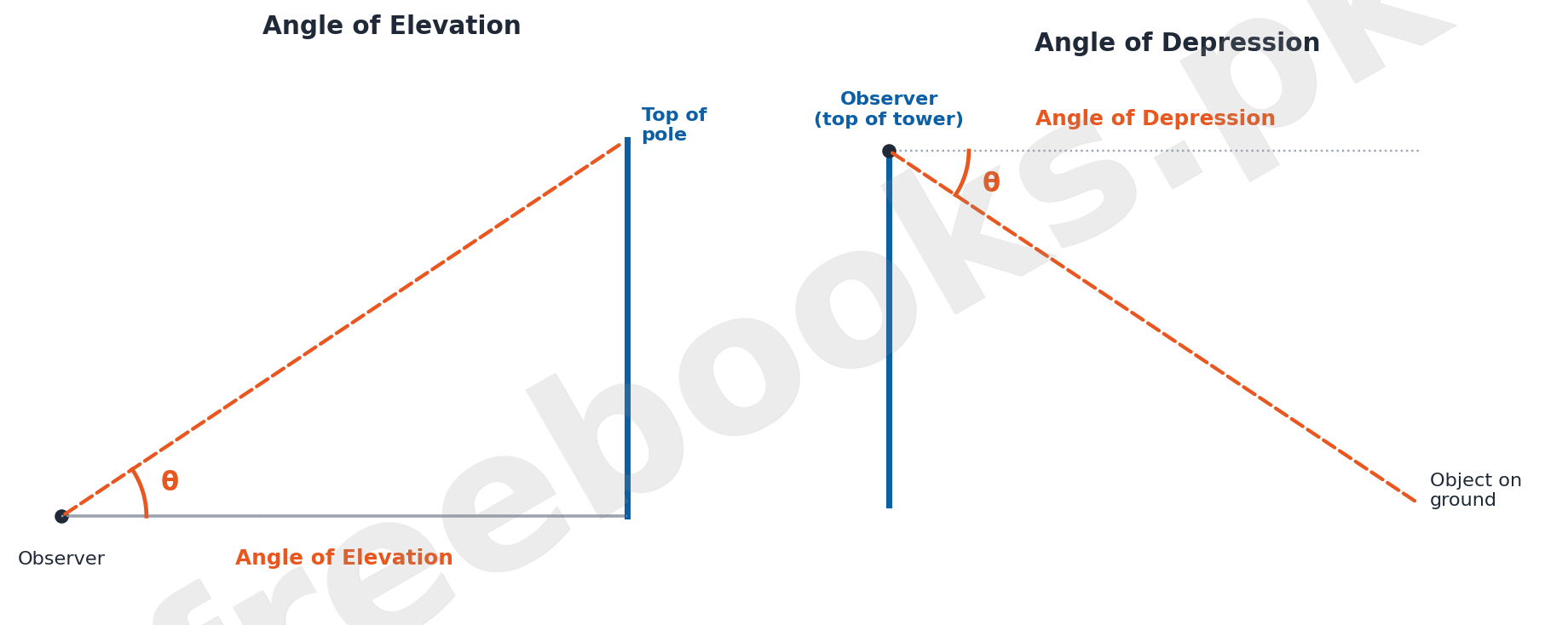
The angle of elevation is the angle between a horizontal line of sight and the line to an object above that horizontal — used, for instance, when looking up at the top of a building. The angle of depression is the angle between a horizontal line of sight and the line to an object below that horizontal — used when looking down from a height at an object on the ground. These angles let heights and distances be calculated indirectly using the tangent ratio, without needing to physically measure a dangerous or inaccessible height.
Important Definitions
Angle in Standard Position
An angle whose vertex is at the origin of the coordinate plane and whose initial side lies along the positive x-axis.
Co-terminal Angles
Angles that share the same initial and terminal sides in standard position but differ in measure by a multiple of 360° (or 2π radians).
Radian
The angle subtended at the center of a circle by an arc whose length equals the circle's radius; a full rotation equals 2π radians.
Sine, Cosine, Tangent
The three primary trigonometric ratios of an acute angle θ in a right triangle: sin θ = perpendicular/hypotenuse, cos θ = base/hypotenuse, tan θ = perpendicular/base.
Pythagorean Identities
The three identities sin²θ + cos²θ = 1, tan²θ + 1 = sec²θ, and 1 + cot²θ = cosec²θ, derived from the Pythagoras theorem.
Solving a Triangle
The process of finding all unknown sides and angles of a triangle from a given sufficient set of known sides and angles.
Angle of Elevation
The angle between a horizontal line of sight and the line of sight to an object located above the horizontal.
Angle of Depression
The angle between a horizontal line of sight and the line of sight to an object located below the horizontal.
Sector
The region of a circle bounded by two radii and the arc between them.
Degree-Minute-Second (DMS)
A way of expressing an angle using degrees, minutes (1° = 60′), and seconds (1′ = 60″) for finer precision than decimal degrees alone.
Key Facts and Relations
| Topic | Key Fact / Relation |
|---|---|
| 1° = π/180 rad ; 1 rad = 180°/π | Conversion between degrees and radians. |
| ℓ = rθ | Arc length of a sector, with θ in radians. |
| A = (1/2)r²θ | Area of a sector, with θ in radians. |
| sin θ = a/c, cos θ = b/c, tan θ = a/b | Primary trigonometric ratios for a right triangle with perpendicular a, base b, hypotenuse c. |
| cosec θ = 1/sin θ, sec θ = 1/cos θ, cot θ = 1/tan θ | Reciprocal trigonometric ratios. |
| sin²θ + cos²θ = 1 | First Pythagorean identity. |
| tan²θ + 1 = sec²θ | Second Pythagorean identity. |
| 1 + cot²θ = cosec²θ | Third Pythagorean identity. |
| sin(90° − θ) = cos θ ; cos(90° − θ) = sin θ | Complementary angle identities. |
| tan θ = height / distance (elevation/depression problems) | Basic relation used to solve real-world height and distance problems. |
Diagrams
Angle in Standard Position and Degree-Radian Correspondence: Two-panel diagram showing an angle drawn in standard position with quadrants labeled, alongside a circle marking key angles in both degrees and radians
Trigonometric Ratios of a Right-Angled Triangle: A labeled right triangle showing the perpendicular, base, and hypotenuse along with all six trigonometric ratio definitions
Angle of Elevation and Angle of Depression: Side-by-side diagrams illustrating the angle of elevation to the top of a pole and the angle of depression from a tower to a ground object
Solved Examples
Example 1: Converting Decimal Degrees to Degrees, Minutes, and Seconds
Problem: Convert 73.12° to degrees, minutes, and seconds.
- Keep the whole-number part as degrees: 73°.
- Multiply the decimal part by 60 to get minutes: 0.12 × 60 = 7.2′, so 7 whole minutes.
- Multiply the remaining decimal part of the minutes by 60 to get seconds: 0.2 × 60 = 12″.
- Combine the results: 73° 7′ 12″.
Example 2: Converting Between Radians and Degrees
Problem: Convert 5π/3 rad to degrees, and convert 75° to radians.
- To convert radians to degrees, multiply by 180°/π: (5π/3) × (180°/π) = 300°.
- To convert degrees to radians, multiply by π/180: 75 × (π/180) = 5π/12 rad, approximately 1.309 rad.
Example 3: Finding Arc Length and Sector Area
Problem: Find the arc length of a sector with radius 10 cm and central angle 60°, and the area of a sector with radius 8 cm and central angle 45°.
- Convert 60° to radians: 60 × π/180 = π/3 rad.
- Apply the arc length formula: ℓ = rθ = 10 × π/3 ≈ 10.47 cm.
- Convert 45° to radians: 45 × π/180 = π/4 rad.
- Apply the sector area formula: A = (1/2)r²θ = (1/2)(64)(π/4) = 8π ≈ 25.12 cm².
Example 4: Proving a Trigonometric Identity Using Pythagorean Identities
Problem: Show that tan θ + cot θ = sec θ cosec θ.
- Start from the left-hand side and write both terms using sine and cosine: (sin θ/cos θ) + (cos θ/sin θ).
- Combine over a common denominator: (sin²θ + cos²θ) / (sin θ cos θ).
- Apply the Pythagorean identity sin²θ + cos²θ = 1: result is 1 / (sin θ cos θ).
- Split into reciprocals: (1/cos θ)(1/sin θ) = sec θ cosec θ, matching the right-hand side.
Example 5: Finding Remaining Trigonometric Ratios From One Given Ratio
Problem: If tan θ = 3/4 and θ lies in the first quadrant, find the remaining trigonometric ratios.
- Interpret tan θ = 3/4 as perpendicular a = 3 and base b = 4.
- Use Pythagoras theorem to find the hypotenuse: c² = a² + b² = 9 + 16 = 25, so c = 5.
- Compute sin θ = a/c = 3/5 and cos θ = b/c = 4/5.
- Compute the reciprocals: cosec θ = 5/3, sec θ = 5/4, cot θ = 4/3.
Example 6: Deriving the Special Angle Ratios for 30° and 60°
Problem: Find the exact trigonometric ratios of 30° and 60° using an equilateral triangle.
- Start with an equilateral triangle of side 2 units and draw the perpendicular bisector from one vertex, splitting it into two right triangles.
- Each right triangle has a base of 1 unit, hypotenuse of 2 units, and angles of 30°, 60°, 90°.
- Apply Pythagoras theorem to find the remaining side: x² = 2² − 1² = 3, so x = √3.
- Read off the ratios: sin 30° = 1/2, cos 30° = √3/2, tan 30° = 1/√3; sin 60° = √3/2, cos 60° = 1/2, tan 60° = √3.
Example 7: Solving a Right Triangle Given One Side and One Angle
Problem: Solve triangle ABC where ∠B = 90°, ∠A = 30°, and side a = 2 cm.
- Find the third angle: ∠C = ∠B − ∠A = 90° − 30° = 60°.
- Use sin 30° = a/b to find side b: 2/b = 1/2, so b = 4 cm.
- Use tan 30° = a/c to find side c: 2/c = 1/√3, so c = 2√3 cm.
- State the complete solution: ∠C = 60°, b = 4 cm, c = 2√3 cm.
Example 8: Real-World Application: Finding Height Using the Angle of Elevation
Problem: The angle of elevation of the top of a 40 m high pole is 60° from a point on the ground. Find the distance of the point from the foot of the pole.
- Let x be the distance from the observation point to the foot of the pole.
- Set up the tangent ratio: tan 60° = (height)/(distance) = 40/x.
- Substitute tan 60° = √3: √3 = 40/x, so x = 40/√3.
- Simplify: x ≈ 23.09 m, the distance of the point from the foot of the pole.
Short Questions & Answers
What are the two conditions for an angle to be in standard position?
Its vertex must be at the origin of the coordinate plane, and its initial side must lie along the positive x-axis.
What defines a radian?
The angle subtended at the center of a circle by an arc whose length equals the circle's radius.
What are co-terminal angles?
Angles that share the same initial and terminal sides in standard position but whose measures differ by a multiple of 360° (or 2π radians).
In a right triangle, how is the tangent ratio related to sine and cosine?
tan θ = sin θ / cos θ, since dividing the perpendicular and base both by the hypotenuse gives this relationship directly.
State the three Pythagorean identities.
sin²θ + cos²θ = 1, tan²θ + 1 = sec²θ, and 1 + cot²θ = cosec²θ.
What is the difference between the angle of elevation and the angle of depression?
The angle of elevation is measured upward from the horizontal to an object above, while the angle of depression is measured downward from the horizontal to an object below.
What information is needed to fully solve a right triangle?
At least two of its six elements (three sides and three angles) must be known, including at least one side, since the right angle is already known.
Long Questions & Answers
Explain how the fundamental trigonometric ratios and their reciprocals are defined, and how the Pythagorean identities follow from them.
How are the six trigonometric ratios defined in a right triangle?
For an acute angle θ, sin θ = perpendicular/hypotenuse, cos θ = base/hypotenuse, tan θ = perpendicular/base, and their reciprocals are cosec θ = hypotenuse/perpendicular, sec θ = hypotenuse/base, cot θ = base/perpendicular.
How is tan θ related to sin θ and cos θ?
Dividing both the perpendicular and base by the hypotenuse in tan θ = perpendicular/base shows that tan θ = sin θ/cos θ, and similarly cot θ = cos θ/sin θ.
How is the first Pythagorean identity derived?
Starting from a² + b² = c² and dividing every term by c² gives (a/c)² + (b/c)² = 1, which is sin²θ + cos²θ = 1.
How are the other two Pythagorean identities derived?
Dividing a² + b² = c² by b² gives tan²θ + 1 = sec²θ, and dividing by a² gives 1 + cot²θ = cosec²θ — the same theorem, viewed through two different divisions.
Describe the procedure for solving real-world problems involving angles of elevation and depression, with worked reasoning.
What is the first step in an elevation or depression problem?
Sketch a right triangle representing the situation, clearly marking the horizontal line, the known height or distance, and the given angle as either an angle of elevation or depression.
Which trigonometric ratio is most commonly used, and why?
The tangent ratio is used most often, since it directly relates the vertical height (perpendicular) to the horizontal distance (base) without needing the hypotenuse.
How is the unknown value calculated once the triangle is set up?
The known angle and known side are substituted into the tangent equation, and the equation is solved algebraically for the unknown height or distance.
How does this apply to a real elevation example?
For a 40 m pole with an angle of elevation of 60°, tan 60° = 40/x gives x = 40/√3 ≈ 23.09 m — finding the horizontal distance without ever measuring it directly.
Multiple Choice Questions (MCQs)
The value of tan⁻¹2 in radians is approximately: (A) π/2 (B) 3π/2 (C) 1.11π (D) 1.11
Correct answer: (D) 1.11. tan⁻¹2 ≈ 63.43°, which in radians is approximately 1.11 (not multiplied by π).
In a right triangle with hypotenuse 13 units and one angle 30°, the opposite side length is: (A) 6.5 units (B) 7.5 units (C) 6 units (D) 5 units
Correct answer: (A) 6.5 units. sin 30° = opposite/hypotenuse = 1/2, so opposite = 13 × 1/2 = 6.5 units.
A person 50 m from a building sees its top at an angle of elevation of 45°. The building's height is: (A) 50 m (B) 25 m (C) 35 m (D) 70 m
Correct answer: (A) 50 m. tan 45° = height/50 = 1, so height = 50 m.
sec²θ − tan²θ equals: (A) sin²θ (B) 1 (C) cos²θ (D) cot²θ
Correct answer: (B) 1. This is a rearrangement of the identity tan²θ + 1 = sec²θ, giving sec²θ − tan²θ = 1.
If sin θ = 3/5 and θ is acute, cos²θ equals: (A) 7/25 (B) 24/25 (C) 16/25 (D) 4/25
Correct answer: (C) 16/25. cos²θ = 1 − sin²θ = 1 − 9/25 = 16/25.
5π/24 rad equals how many degrees? (A) 30° (B) 37.5° (C) 45° (D) 52.5°
Correct answer: (B) 37.5°. 5π/24 × 180/π = 900/24 = 37.5°.
Which of the following is a valid identity? (A) cos(π/2 − θ) = sin θ (B) cos(π/2 − θ) = cos θ (C) cos(π/2 − θ) = sec θ (D) cos(π/2 − θ) = cosec θ
Correct answer: (A) cos(π/2 − θ) = sin θ. This is the standard complementary angle identity: cos(90° − θ) = sin θ.
sin 60° equals: (A) 1 (B) 1/2 (C) √(3²) (D) √3/2
Correct answer: (D) √3/2. From the special-angle table, sin 60° = √3/2.
A radian is defined using: (A) the diameter of a circle (B) an arc equal in length to the radius (C) half the circumference (D) one-fourth of a full rotation
Correct answer: (B) an arc equal in length to the radius. A radian is the angle subtended by an arc whose length equals the circle's radius.
The angle between a horizontal line of sight and the line to an object below is called the: (A) angle of elevation (B) angle of depression (C) co-terminal angle (D) reference angle
Correct answer: (B) angle of depression. This downward-measured angle is specifically called the angle of depression.
Quick Revision Summary
- An angle in standard position has its vertex at the origin and initial side along the positive x-axis; positive angles rotate counterclockwise, negative angles clockwise.
- Convert degrees to radians by multiplying by π/180, and radians to degrees by multiplying by 180/π.
- Arc length ℓ = rθ and sector area A = (1/2)r²θ, always using θ in radians.
- The six trigonometric ratios are defined from a right triangle's perpendicular, base, and hypotenuse; tan θ = sin θ/cos θ.
- The three Pythagorean identities — sin²θ+cos²θ=1, tan²θ+1=sec²θ, 1+cot²θ=cosec²θ — are the key tool for proving other identities.
- Memorize the exact ratios for 0°, 30°, 45°, 60°, 90° — they appear constantly throughout the unit and beyond.
- In elevation/depression problems, sketch the triangle first and use the tangent ratio to relate height and horizontal distance.
Exam Tips
- Always double-check whether an angle is given in degrees or radians before applying any formula — mixing the two is the most common error.
- When proving an identity, convert every ratio to sine and cosine first; this almost always simplifies the algebra.
- Memorize the 30-45-60 special angle table rather than re-deriving it every time — it saves significant time in exams.
- In a right triangle problem, always identify which side is the perpendicular, base, and hypotenuse relative to the given angle before choosing a ratio.
- Draw a clear diagram for every elevation or depression word problem — most errors come from misidentifying which angle is given.
- Remember co-terminal angles differ by exactly 360° (or 2π) — never any other value.