
This chapter covers Ecosystem from the 2nd Year (FSc Part-II) Biology syllabus of the Punjab Curriculum and Textbook Board (PTB/PCTB). The term ecology comes from the Greek words oikos, meaning 'the family household,' and logy, meaning 'the study of'; it was coined by the German zoologist Ernst Haeckel in 1866, who called it oecologic and defined it as the study of the relationship of animals (organisms) to their environment. Environment includes not only physical but also biological conditions under which an organism lives. These notes are prepared by freebooks.pk.
The chapter covers the concept of the ecosystem and its biotic and abiotic components, the biosphere, habitat and ecological niche, autecology and synecology, the roles of producers, consumers and decomposers, food chains and food webs and trophic levels, ecological succession (primary and secondary, including the stages of xerosere), interspecies relationships (predation, parasitism, symbiosis, mutualism, commensalism, and grazing), biogeochemical cycles with a focus on the nitrogen cycle, and the flow of energy through an ecosystem's food chain.
Learning Objectives
- Define ecology, ecosystem, biosphere, habitat, and ecological niche.
- Differentiate between autecology and synecology, and describe the three levels of ecological integration.
- Describe the biotic and abiotic components of an ecosystem and the roles of producers, consumers, and decomposers.
- Explain food chains, food webs, and trophic levels, and describe how food web diversity maintains ecosystem stability.
- Describe ecological succession, distinguishing primary from secondary succession and outlining the stages of xerosere.
- Explain predation, parasitism, symbiosis, mutualism, commensalism, and grazing, with examples of each.
- Describe the nitrogen cycle, including ammonification, nitrification, assimilation, and denitrification.
- Explain how energy flows through an ecosystem's food chain, including gross and net primary production.
Key Concepts
Introduction to Ecology, Ecosystem, Biosphere and Niche
The term ecology comes from the Greek oikos ('the family household') and logy ('the study of'); it was coined by German zoologist Ernst Haeckel in 1866, who called it oecologic and defined it as the study of the relationship of organisms to their environment, including both physical conditions and interactions with members of other species and the same species. The major unit of ecology is the ecosystem: organisms interact with their environment within the confines of the ecosystem, which consists of two basic interacting components, the living or biotic and the physical or abiotic factors. Biotic components consist of animals, plants, fungi and micro-organisms, while abiotic components are atmosphere, climate, soil and water. A population is a group of interbreeding individuals of the same species occurring together in space and time, and all populations within an ecosystem, interconnected with one another, are known as a community. Major types of ecosystems that occupy broad geographical regions are called biomes, each characterized by a uniform life-form of vegetation such as grass or coniferous trees; combined, the biomes of earth together form the planetary ecosystem.
The biosphere is a thin layer of earth in which all living organisms exist; organisms within it not only adapt to the environment but also interact to modify and control its chemical and physical conditions. The actual location or place where an organism lives is called its habitat. In 1917, Joseph Grinnell, an American ornithologist, first proposed the term niche in ecology; a niche is the ultimate distributional unit within which a species is restrained by the limitations of its physical structure and physiology. Charles Elton considered the niche the basic role of an organism in the community – what it does in and for the living community, its relationship to its food and enemies – essentially defining niche as the species' occupation. A niche includes all physical factors of the environment necessary for survival, such as range of temperature, humidity, and pH of water and soil, as well as an organism's predators, prey, competitors, behaviour and interactions.
Autecology and Synecology
Ecology is the study of the relationship of living organisms to their environment. When studying a single population's relationship to its environment, this is called autecology; for example, studying 50 to 100 soybean plants to know the effect of water pollution on their growth and yield is autecology, since it examines a single population. Growth responses of individual organisms to their environment are complex, since various environmental factors interact with and aggravate one another, and the complexity of environment depends on the combination of these various factors.
The study of the relationship of different communities (groupings of populations) to their environment is called synecology, or community ecology. When you study only one population at different places in an environment, it is autecology; when you study all the populations together at the same time and place, it is synecology. In synecology you must consider various aspects of the community, including its origin, structure, composition, history and dynamics, since a community is not a fixed entity but changes over time. While studying the community, we encounter three levels of integration: individual, population, and community.
Components of the Ecosystem: Producers, Consumers and Decomposers
The ecosystem can be divided into two main components. Biotic components include all living organisms – plants and animals – supported by the biosphere, which is spread out over the surface of the planet earth, extending about 8-10 kilometres into the upper atmosphere and a similar distance into the depths of oceans. Abiotic components include all non-living components: air, water and soil, referred to ecologically as the atmosphere (atmo – air, sphere – place), hydrosphere (hydro – water, sphere – place), and lithosphere (litho – earth/soil, sphere – place).
The main processes occurring in an ecosystem include feeding and the circulation of chemical elements, together with the flow of energy through the ecosystem. An ecosystem is made up of three main components concerned with these processes: producers, consumers and decomposers. Producers are the autotrophs – green photosynthetic plants – which capture and bring light energy into the ecosystem, manufacturing organic food from simpler inorganic substances. Consumers are all the organisms, primarily animals, which obtain energy directly or indirectly from producers as ready-made organic food; they are mainly heterotrophic organisms. Decomposers are mainly fungi and bacteria, which obtain their energy from dead and decaying plants and animals, releasing chemical elements as ions such as nitrates, ammonia, phosphates, potassium and calcium. In a basic food chain, all animals ultimately depend on plants for food – for example, an eagle may eat a blue bird, the blue bird eats insects like caterpillars, and the caterpillar feeds on grass or green leaves.
Food Webs and Trophic Levels
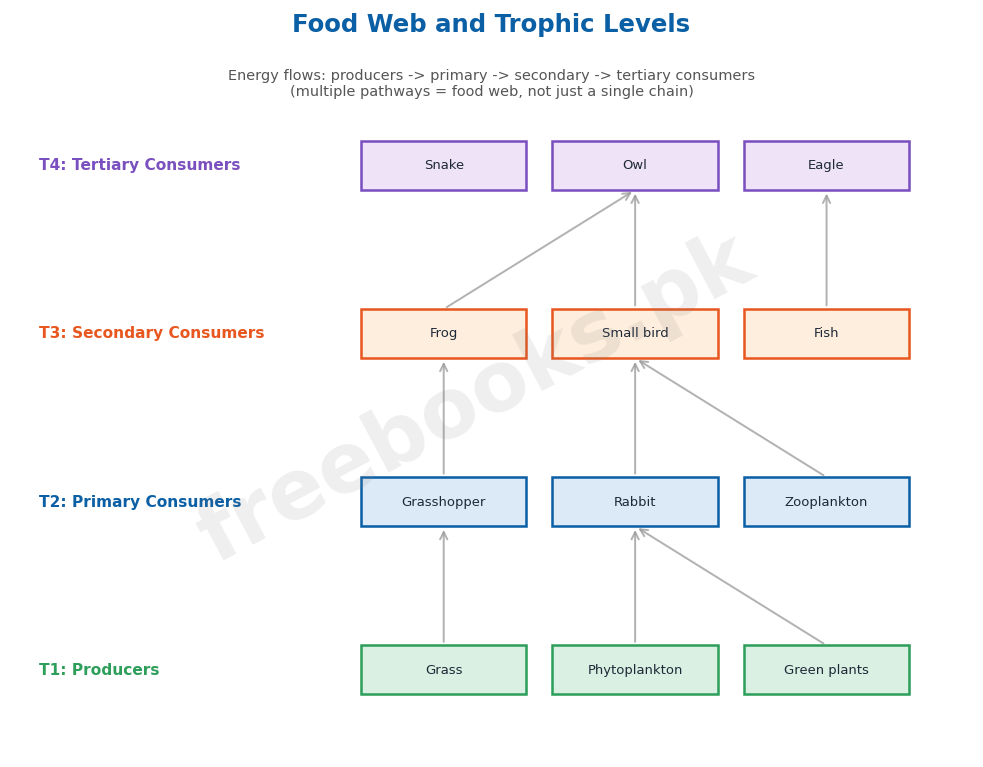
A food web is the combination of many food chains; food webs are not as simple as a single linear chain because most animals eat more than one type of food at different times – for instance, a fox does not feed entirely on rabbits but also takes beetles, rats and other prey. All food chains and food webs begin with a green plant (producer) and may consist of three to five links, or trophic levels: T1, the first trophic (producer) level, includes all green plants, grass and phytoplankton; T2, the second trophic level, consists of primary consumers; T3, the third trophic level, consists of secondary consumers; and T4, the fourth trophic level, consists of tertiary consumers.
The variety of pathways in a food web helps maintain the stability of the ecosystem. For example, owls prey on rabbits and mice; if a disease reduces the rabbit population, fewer plants are consumed, so the larger plant population produces more fruits and seeds, which in turn support a larger mouse population, and the increased number of mice becomes the major food source for the owls; the rabbit population then gradually increases and once again becomes a food source for owls, so nature maintains a balance through these interconnected pathways.
Ecological Succession
Succession is a sequence of changes in the community structure of an ecosystem over a period of time; community changes alter the ecosystem in ways that favour competitor species to replace their predecessors in a somewhat predictable manner, until a stable, self-sustaining climax community is reached. Succession is a kind of 'community relay' in which assemblages of plants and animals replace earlier ones in a sequence that is at least somewhat predictable; it is initiated by a few hardy invaders called pioneers and ends with a diverse and relatively stable climax community. Succession on dry land takes two major forms: primary succession, in which an ecosystem is forged from bare rock, sand or a clear glacial pool where there was no trace of previous life (a process often requiring thousands of years), and secondary succession, in which a new ecosystem develops after an existing ecosystem is disturbed, as in the case of a forest fire or an abandoned farm field; secondary succession happens much more rapidly than primary succession because the previous community has left its mark in the form of improved soil and seeds.
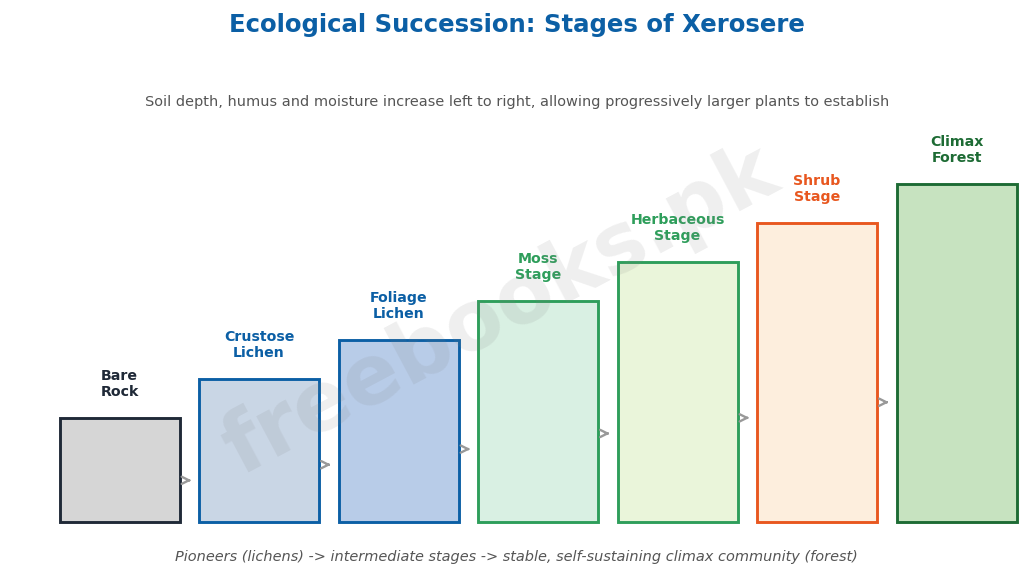
Primary succession starting in a pond is called hydrosere, and that on dry soil or habitat is called xerosere; plants growing in xeric conditions are called xerophytes, able to withstand prolonged periods of water shortage. Xerosere passes through several stages: the crustose lichen stage, in which special lichens impregnate the substratum as a crust and remain quiescent or dormant, desiccated during dry seasons, absorbing water during rain and dew; the foliage lichen stage, in which lichens resemble crumpled leaves attached at one point, shading and reducing the growth of crustose lichens as the area becomes rougher with fissures and depressions (examples include Dermatocarpon and Parmelia); the moss stage, with mosses such as Polytrichum and Tortula competing with lichens for water while penetrating deeper into the soil and adding more humus; the herbaceous plant stage, in which small seedlings of herbaceous plants establish due to increased moisture, humus and soil for anchorage; the shrub stage, in which shrubby plants dominate and shadow herbaceous plants, which die and add more humus to the soil; and finally the climax forest stage, in which improved soil allows woody plants to establish, whose shade inhibits growth of most other plants (leaving only mosses, lichens and a few ferns), forming a stable climax stage that persists unless the environmental balance is upset.
Interspecies Relationships: Predation, Parasitism, Symbiosis, Mutualism, Commensalism and Grazing
An animal that preys on other animals is a predator, itself a type of consumer; the animal caught and eaten is the prey, and the overall process is called predation. The sizes of predator and prey populations are related to each other in a cycle: if the number of prey is large, predator numbers increase; as predators feed on prey, prey numbers fall; as prey becomes scarce, predator numbers also decrease due to reduced food supply; and as predators decrease, prey numbers begin to increase again. Examples include cat/mouse, fox/rabbit, seal/fish, frog/mosquito, and hawk/small birds. Parasitism is an association between a host and a parasite in which the host provides the parasite with food, protection and conditions for survival, and the parasite may or may not harm the host; diseases caused by parasites are called infestations. Parasites may be ectoparasites, living outside the host's body (e.g. fungi causing dandruff), or endoparasites, living inside the host's body (e.g. tapeworm in the human intestine).
Symbiosis is an association between two organisms that brings benefit to both. In root nodules, legume plants such as pea and bean host symbiont bacteria in their roots, which fix nitrogen from the air into amino acids that the host uses, while the host provides the bacteria food and protection; in mycorrhiza, an association between plant roots in acid soil and certain fungi (host plants include pine, beech or heather), the host provides the fungus an enzyme to digest carbohydrates in leaf litter, while the fungus passes mineral ions from the soil to the host. Mutualism is a relationship in which both organisms benefit, such as lichens (a mutualistic association between a fungus and an alga, growing on exposed rock surfaces and important colonizers of bare ground) or the relationship between insects and flowering plants (the insect gets nectar, and the flower is pollinated). Commensalism is a relationship in which only one organism benefits and the other is unaffected, such as remoras attached to sharks, picking up feeding scraps without affecting the shark. Grazing is the feeding mode of animals like rabbits, goats, sheep, cows, buffaloes and horses on grasses in pastureland; moderate grazing is helpful for maintaining a grassland ecosystem by destroying competitors and helping grass grow well, but overgrazing tramples the soil into a hard, impermeable layer, causing rainwater runoff and topsoil loss, ultimately transforming grassland into barren land or desert.
Biogeochemical Cycles and the Nitrogen Cycle
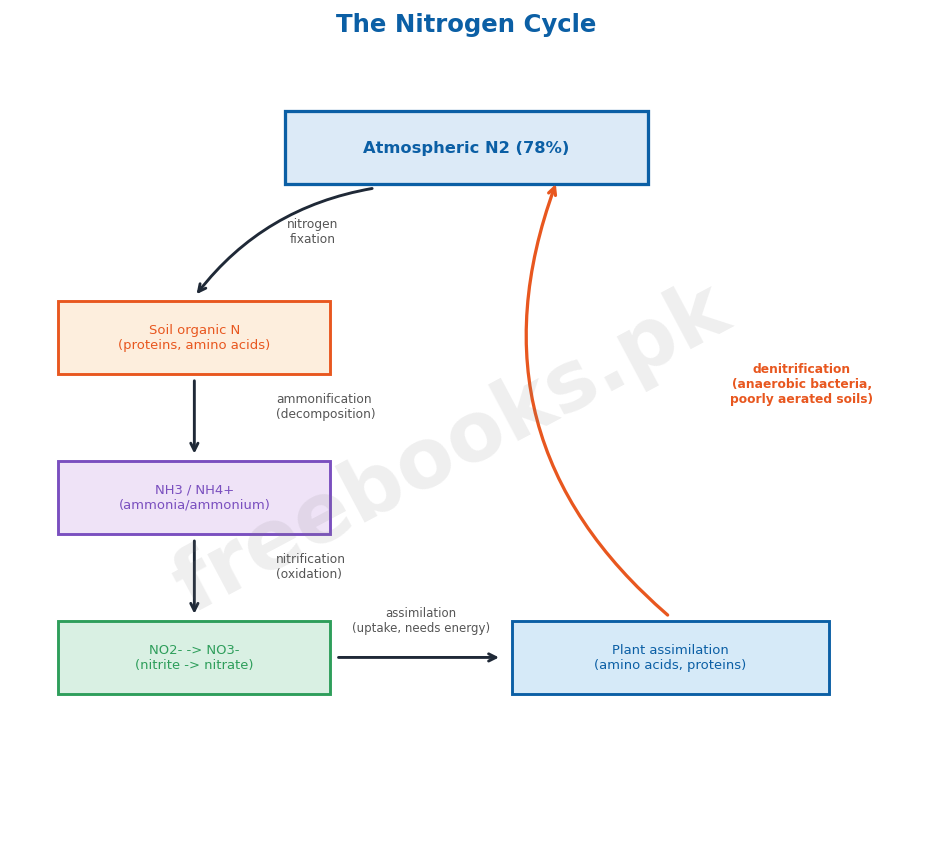
Chemical elements essential for life are called biogenic or nutrient elements; macronutrients are elements required in large amounts, such as water, carbon, hydrogen, oxygen, nitrogen, phosphorus, sulphur and calcium, while micronutrients are required in small or trace amounts, such as zinc, molybdenum, iron and iodine. Nutrient cycles are also called biogeochemical cycles, as nutrients move from living to non-living to living portions of the ecosystem in a cyclic manner. The chief reservoir of nitrogen is the atmosphere, which is 78 percent nitrogen gas; however, most living things cannot use elemental atmospheric nitrogen directly to make amino acids and other nitrogen-containing compounds, so they depend on nitrogen present in soil minerals, making nitrogen shortage in soil often the major limiting factor in plant growth. The nitrogen cycle has three principal stages: ammonification, nitrification, and assimilation.
Much soil nitrogen results from decomposition of organic materials (proteins, amino acids, nucleic acids and nucleotides), rapidly decomposed by soil-dwelling bacteria and fungi into simpler compounds; these microorganisms release excess ammonia or ammonium ions, a process called ammonification. Several soil bacteria then oxidize ammonia or ammonium ions, a process called nitrification. Although plants can utilize ammonium directly, nitrate is the main form in which nitrogen moves from soil into plant roots; once inside the plant cell, nitrate is reduced back to ammonium, a process called assimilation, which (unlike nitrification) requires energy, and the resulting ammonium ions are transferred to carbon-containing compounds to produce amino acids and other nitrogenous organic compounds the plant needs.
Nitrogen Depletion and the Flow of Energy in the Food Chain
Although the nitrogen cycle appears complete and self-sustaining, nitrates are steadily lost through soil erosion, fire, and water percolating through soil, as well as through the activity of certain soil bacteria that, in the absence of oxygen, break down nitrates and release nitrogen back into the atmosphere while using the oxygen for their own respiration – a process called denitrification, occurring in poorly drained (poorly aerated) soils. The cycle is maintained despite these losses primarily by nitrogen-fixing bacteria, which incorporate gaseous nitrogen from the air into organic nitrogen-containing compounds; just as all organisms ultimately depend on photosynthesis for energy, they all depend on nitrogen fixation for nitrogen. Soil nitrogen resources are also strengthened by the addition of nitrogen fertilizers by humans.
Energy in the form of radiant heat and light from the sun flows through an ecosystem, passing through different trophic levels and eventually radiating back into outer space. The total amount of energy fixed by plants is gross primary production; the energy remaining after plants meet their own respiratory needs is net primary production, which shows up as plant biomass. About 1% of the total solar energy is trapped by producers in an ecosystem, while the remaining 99% is used to evaporate water, heat soil, and is lost to outer space. As energy is transferred from one trophic level to the next – from producer to primary consumer, and onward – between 80 and 90% of the energy is lost as heat, a by-product of respiration; however, the continuous flux of energy from the sun prevents the ecosystem from running down. A short food chain of two or three links supports a community more efficiently than a long chain of five links, where much of the original energy from producers would never reach organisms at higher trophic levels; decomposers obtain energy by converting plant and animal tissues and waste into inorganic mineral ions.
Important Definitions
Ecology
The study of the relationship of organisms to their environment, coined by Ernst Haeckel in 1866 from the Greek oikos (household) and logy (study of).
Ecosystem
A unit of ecology consisting of two interacting components – the living (biotic) and the physical (abiotic) – within which organisms interact with their environment.
Habitat
The actual location or place where an organism lives.
Ecological niche
The role a species plays in a community, including its behaviour, food and enemy relationships, and influence, as well as the physical environmental factors it requires.
Autecology
The study of a single population's relationship to its environment.
Synecology
The study of the relationship of different communities (groupings of populations) to their environment, also called community ecology.
Succession
A sequence of predictable changes in the community structure of an ecosystem over time, beginning with pioneer species and ending in a stable climax community.
Biogeochemical cycle
The cyclic movement of nutrient elements from living to non-living to living portions of an ecosystem.
Key Facts
| Item | Fact |
|---|---|
| Coining of ecology | Ernst Haeckel, German zoologist, coined the term 'oecologic' (ecology) in 1866. |
| Coining of niche | Joseph Grinnell, American ornithologist, first proposed the term 'niche' in ecology in 1917. |
| Biosphere extent | The biosphere extends about 8-10 kilometres into the upper atmosphere and a similar distance into ocean depths. |
| Atmospheric nitrogen | Nitrogen makes up 78 percent of the gases in the atmosphere, the chief reservoir of nitrogen. |
| 3 stages of nitrogen cycle | Ammonification, nitrification, and assimilation are the three principal stages of the nitrogen cycle. |
| Solar energy capture | About 1% of total solar energy is trapped by producers in an ecosystem; the remaining 99% is lost as heat or used to evaporate water. |
| Energy loss between trophic levels | Between 80% and 90% of energy is lost as heat (a by-product of respiration) when transferred from one trophic level to the next. |
| Food chain trophic levels | Food chains/webs typically consist of three to five links or trophic levels (T1 producers, T2 primary consumers, T3 secondary consumers, T4 tertiary consumers). |
Diagrams & Illustrations
Food Web and Trophic Levels: a diagram showing a food web with multiple interconnected food chains, illustrating the four trophic levels: T1 producers (green plants), T2 primary consumers, T3 secondary consumers, and T4 tertiary consumers.
Ecological Succession: Stages of Xerosere: a diagram showing the sequential stages of xerosere (primary succession on dry land): crustose lichen stage, foliage lichen stage, moss stage, herbaceous stage, shrub stage, and climax forest stage.
The Nitrogen Cycle: a diagram showing the nitrogen cycle: atmospheric nitrogen, nitrogen fixation, ammonification (decomposition to ammonia), nitrification (ammonia to nitrites to nitrates), assimilation by plants, and denitrification (nitrates back to atmospheric nitrogen).
Short Questions & Answers
What are the biogeochemical cycles?
Biogeochemical cycles are the cyclic movements of essential chemical (nutrient) elements from the living to the non-living to the living portions of an ecosystem, such as the nitrogen cycle, carbon cycle, and water cycle.
Sketch/describe the three main steps in the nitrogen cycle.
The three principal stages of the nitrogen cycle are ammonification (decomposition of organic nitrogen compounds into ammonia/ammonium ions by soil bacteria and fungi), nitrification (oxidation of ammonia/ammonium into nitrates by soil bacteria), and assimilation (uptake of nitrate by plant roots, reduction back to ammonium, and conversion into amino acids).
Define grazing.
Grazing is the mode of feeding in which animals such as rabbits, goats, sheep, cows, buffaloes and horses feed on grasses in pastureland; moderate grazing helps maintain grassland ecosystems, while overgrazing can transform grassland into barren land.
What percentage of the sun's energy reaches producers, and what happens to the rest?
About 1% of the total solar energy reaching earth is trapped by producers (green plants) in an ecosystem; the remaining 99% is used to evaporate water, heat up soil, and is eventually lost to outer space.
What is autecology?
Autecology is the study of a single population's relationship to its environment, such as studying the effect of water pollution on the growth and yield of one population of soybean plants.
Define synecology.
Synecology, or community ecology, is the study of the relationship of different communities (groupings of populations) to their environment, considering the origin, structure, composition, history and dynamics of the community.
Long Questions & Answers
Discuss ecological succession, distinguishing primary from secondary succession and describing the stages of xerosere.
Ecological succession represents one of the most fundamental and thoroughly documented processes shaping the long-term structure and composition of ecological communities over time, and properly understanding the concept requires examining both its two major underlying forms and the specific sequence of stages through which one of these forms, xerosere, characteristically proceeds. Succession itself is most usefully defined as a sequence of changes occurring within the community structure of a given ecosystem over an extended period of time, in which ongoing changes within the community progressively alter the ecosystem in ways that favour certain competitor species, allowing them to gradually replace their predecessor species in a manner that is at least somewhat predictable, continuing in this fashion until an eventual stable, self-sustaining climax community is finally reached; succession is therefore often usefully described as a kind of ongoing 'community relay,' in which one assemblage of plants and animals is progressively replaced by the next in a broadly predictable sequence, a process that in every case is initiated by a small number of hardy pioneer invader species and that eventually terminates in a diverse and comparatively stable climax community. Succession occurring on dry land characteristically takes one of two major distinct forms, namely primary succession and secondary succession, and distinguishing carefully between these two forms is essential to understanding the overall concept properly. Primary succession refers specifically to the case in which an entirely new ecosystem is gradually forged essentially from scratch, starting from bare rock, bare sand, or a newly formed clear glacial pool in which there was previously no trace whatsoever of prior biological life, a demanding process that consequently often requires many thousands of years to fully complete; secondary succession, by contrast, refers to the quite different case in which a new ecosystem instead develops specifically after some pre-existing, already-established ecosystem has been significantly disturbed or disrupted in some way, such as by an intervening forest fire or by the abandonment of a previously cultivated farm field, and secondary succession consequently proceeds very considerably more rapidly than primary succession precisely because the previously established community has already left behind its own significant biological mark on the site, particularly in the form of already meaningfully improved soil conditions and an already-present bank of viable seeds. When primary succession specifically begins within a body of water such as a pond, the resulting successional sequence is given the specific technical name hydrosere, whereas primary succession beginning instead on dry soil or a comparable dry habitat is given the specific technical name xerosere, and the particular xerophytic plants able to tolerate and grow successfully in such markedly dry conditions are correspondingly termed xerophytes, plants specifically adapted to withstand prolonged periods of significant water shortage. The xerosere successional sequence itself proceeds through a series of clearly recognizable and sequentially ordered stages: it begins with the crustose lichen stage, in which specially adapted crustose lichens become physically impregnated directly into the bare rock substratum in the form of a thin protective crust, remaining largely quiescent or fully dormant and significantly desiccated throughout dry seasons while absorbing whatever moisture becomes available during periods of rain or morning dew; this is followed by the foliage lichen stage, in which a different type of lichen, now resembling a loose cluster of crumpled leaves attached to the rock surface at only a single point, begins to cast increasing shade over the earlier crustose lichens, thereby progressively reducing their growth, while the immediate surrounding area simultaneously becomes considerably rougher in texture as more numerous fissures and small depressions gradually develop within it; the sequence then proceeds to the moss stage, in which true mosses become established and begin actively competing with the earlier lichens for available water while additionally penetrating considerably deeper into the developing soil layer than the lichens had previously managed, in the process contributing substantially more organic humus material to the accumulating soil; this is followed in turn by the herbaceous plant stage, in which small seedlings of various herbaceous plant species are now finally able to successfully establish themselves, made possible specifically by the by-now considerably greater availability of adequate moisture, accumulated humus, and sufficient soil depth to provide secure anchorage for root systems; the sequence then progresses further to the shrub stage, in which larger, woody shrub species begin actively growing and progressively come to dominate and cast shade over the smaller herbaceous plants growing beneath them, which correspondingly die back and in doing so contribute still further additional humus to the continuously improving soil; and the xerosere sequence finally culminates in the climax forest stage, in which the by-now substantially improved soil conditions are sufficient to permit the successful establishment and growth of full-sized woody trees, whose dense overhead shade in turn effectively inhibits the successful growth of most other plant species apart from a limited number of shade-tolerant mosses, lichens, and ferns, so that the resulting woody forest comes to dominate the site and this particular stage of the succession accordingly remains essentially unchanged and stable for as long as nothing subsequently occurs within the surrounding environment to meaningfully upset this newly achieved ecological balance, precisely the defining characteristic that qualifies the woody forest as the true climax stage for that particular region.
Describe the nitrogen cycle in detail, explaining ammonification, nitrification, assimilation, and denitrification, along with the causes and remedies of nitrogen depletion.
The nitrogen cycle represents one of the most ecologically essential of all the various biogeochemical cycles operating within the biosphere, precisely because nitrogen itself constitutes an absolutely indispensable structural component of amino acids, proteins, nucleic acids and numerous other biologically essential nitrogen-containing compounds required by every living organism, and properly understanding this particular cycle in its entirety requires carefully tracing the movement of nitrogen atoms as they pass in turn through each of the cycle's several interconnected principal stages. The single chief reservoir of nitrogen anywhere on the planet is unquestionably the atmosphere itself, within which nitrogen gas alone makes up a substantial 78 percent of the total volume of atmospheric gases present; however, despite this considerable atmospheric abundance, the great majority of living organisms are nevertheless entirely unable to make any direct biological use whatsoever of this elemental atmospheric nitrogen gas in order to manufacture amino acids or other essential nitrogen-containing biological compounds, and as a direct consequence, most organisms instead remain critically dependent upon whatever nitrogen happens to already be present within the soil in the form of various soil mineral compounds, a basic biological constraint that helps explain why an underlying shortage of usable nitrogen within the soil so frequently turns out to be the principal factor actually limiting plant growth in a great many natural and agricultural environments alike, quite independent of the vast, but biologically inaccessible, atmospheric nitrogen reserve. The overall nitrogen cycle itself can be most usefully broken down into three clearly distinguishable principal successive stages, namely ammonification, nitrification, and assimilation, each of which is carried out by a different specialized set of microorganisms and which together convert nitrogen progressively from one chemical form into the next as it moves through the cycle. The first stage, ammonification, begins with the simple observation that a substantial proportion of the total nitrogen actually present within ordinary soil originates directly from the ongoing decomposition of pre-existing organic materials, materials that are initially present in the relatively complex chemical forms of proteins, amino acids, nucleic acids and nucleotides; these various complex nitrogenous organic compounds are then typically decomposed comparatively rapidly into much simpler chemical compounds through the combined metabolic activity of various soil-dwelling microorganisms, chiefly ordinary soil bacteria together with various soil fungi, and these particular microorganisms characteristically make direct metabolic use of the available proteins and amino acids for their own nutritional purposes while simultaneously releasing a corresponding excess quantity of either ammonia gas or, alternatively, dissolved ammonium ions back into the surrounding soil environment as a direct metabolic by-product, and this particular overall process is accordingly given the specific technical name ammonification. The second principal stage, nitrification, subsequently involves several further specialized types of soil bacteria that are metabolically capable of chemically oxidizing this previously produced ammonia or ammonium, in the specific technical sense of chemical oxidation, converting these particular nitrogen-containing compounds progressively into nitrite and ultimately into nitrate ions, with this particular subsequent oxidation process accordingly given the specific technical name nitrification. The third principal stage, assimilation, then follows, in which, although growing plants are in fact fully capable of directly utilizing ammonium ions when these happen to be available, it is instead nitrate that actually constitutes the predominant chemical form in which the great majority of soil nitrogen is ultimately transported from the surrounding soil directly into plant root systems; once any given nitrate ion has successfully entered a living plant cell, it is then promptly chemically reduced back down into ammonium once again, and this particular assimilation process, in clear contrast to the immediately preceding nitrification process, specifically requires a net metabolic input of energy on the part of the plant in order to proceed, following which the resulting ammonium ions are then further metabolically transferred onto various carbon-containing organic compounds already present within the plant in order to successfully produce the various amino acids and other essential nitrogenous organic compounds that the growing plant specifically requires for its own biological functioning. Beyond these three principal forward-moving stages, the nitrogen cycle additionally includes a further, distinctly different process known as denitrification, occurring specifically within poorly drained or otherwise poorly aerated soils, in which yet another group of specialized soil bacteria, operating characteristically under conditions of low or entirely absent oxygen availability, instead actively break down existing soil nitrates, in the process releasing the resulting nitrogen gas directly back into the surrounding atmosphere while simultaneously making metabolic use of the oxygen atoms thereby liberated to support their own cellular respiration; more generally, despite the nitrogen cycle's overall appearance of forming an essentially complete and fully self-sustaining natural loop, soil nitrates are nevertheless continuously and steadily lost from the soil through several additional distinct pathways beyond denitrification alone, including ordinary soil erosion, the periodic occurrence of fire, and the simple physical process of water gradually percolating downward through the soil profile and carrying dissolved nitrates away with it; however, despite this ongoing, continuous loss of soil nitrogen through these several combined pathways, the overall nitrogen cycle nevertheless continues to be successfully maintained over time, primarily through the essential ongoing biological activity of specialized nitrogen-fixing bacteria, which are uniquely capable of directly incorporating otherwise biologically inaccessible gaseous atmospheric nitrogen into various usable organic nitrogen-containing compounds, meaning that, in a directly analogous fashion to the way in which essentially all living organisms remain ultimately dependent upon ongoing photosynthesis as their fundamental original source of usable biological energy, all living organisms similarly remain simultaneously and equally dependent upon ongoing biological nitrogen fixation as their fundamental original source of usable biological nitrogen; finally, in modern agricultural practice, existing soil nitrogen resources are additionally and very substantially further supplemented and reinforced through the widespread deliberate human application of manufactured nitrogen-based chemical fertilizers, a practical human intervention specifically intended to help compensate for the various natural nitrogen losses described above and thereby to help sustain adequate soil nitrogen levels for continued successful crop production.
MCQs with Answers
The term 'ecology' was coined in 1866 by the German zoologist: (a) Charles Darwin (b) Ernst Haeckel (c) Joseph Grinnell (d) Charles Elton
Correct Answer: (b) Ernst Haeckel. Ernst Haeckel coined the term 'oecologic' (ecology) in 1866, defining it as the study of the relationship of organisms to their environment.
The term 'niche' in ecology was first proposed in 1917 by: (a) Ernst Haeckel (b) Charles Elton (c) Joseph Grinnell (d) Charles Darwin
Correct Answer: (c) Joseph Grinnell. Joseph Grinnell, an American ornithologist, first proposed the term 'niche' in ecology in 1917.
The study of a single population's relationship to its environment is called: (a) synecology (b) autecology (c) biogeography (d) phytogeography
Correct Answer: (b) autecology. Autecology is the study of a single population's relationship to its environment, as opposed to synecology, which studies communities.
Organisms that manufacture their own organic food from inorganic substances are called: (a) consumers (b) decomposers (c) producers (d) parasites
Correct Answer: (c) producers. Producers are autotrophs, mainly green photosynthetic plants, that manufacture organic food from simple inorganic substances.
In a food web, the second trophic level (T2) consists of: (a) green plants (b) primary consumers (c) secondary consumers (d) decomposers
Correct Answer: (b) primary consumers. T2, the second trophic level, consists of primary consumers, which feed directly on producers (T1).
Primary succession beginning in a pond is called: (a) xerosere (b) hydrosere (c) lithosere (d) psammosere
Correct Answer: (b) hydrosere. Primary succession starting in a pond is called hydrosere, while that on dry soil is called xerosere.
The first stage of xerosere, in which lichens form a crust on bare rock, is called the: (a) foliage lichen stage (b) moss stage (c) crustose lichen stage (d) climax stage
Correct Answer: (c) crustose lichen stage. The crustose lichen stage is the first stage of xerosere, in which crustose lichens become impregnated as a crust on the bare rock substratum.
An association between two organisms that brings benefit to both is called: (a) parasitism (b) commensalism (c) predation (d) mutualism
Correct Answer: (d) mutualism. Mutualism is a relationship in which both organisms benefit, such as the lichen association between a fungus and an alga.
The process by which soil bacteria oxidize ammonia or ammonium ions into nitrates is called: (a) ammonification (b) nitrification (c) denitrification (d) assimilation
Correct Answer: (b) nitrification. Nitrification is the oxidation of ammonia/ammonium ions into nitrites and nitrates by soil bacteria, the second stage of the nitrogen cycle.
Approximately what percentage of total solar energy reaching earth is trapped by producers in an ecosystem? (a) 1% (b) 10% (c) 50% (d) 90%
Correct Answer: (a) 1%. About 1% of the total solar energy reaching earth is trapped by producers; the remaining 99% is used to evaporate water, heat soil, or is lost to space.
Quick Revision Summary
- Ecology (Haeckel, 1866) = study of organisms & environment. Ecosystem = biotic (living) + abiotic (non-living) components. Biosphere = thin layer of earth with all life. Habitat = where organism lives; Niche (Grinnell, 1917) = role/occupation of species in community.
- Autecology = study of ONE population. Synecology = study of communities (multiple populations). 3 levels of integration: individual -> population -> community.
- Ecosystem components: Producers (autotrophs, e.g. green plants) -> Consumers (heterotrophs) -> Decomposers (fungi/bacteria, release nutrient ions). Food chain -> Food web (many food chains) -> Trophic levels T1 (producers) to T4 (tertiary consumers).
- Succession = predictable community change over time, pioneers -> climax community. Primary succession (bare rock/pond, from scratch, slow) vs Secondary succession (after disturbance, faster). Hydrosere (pond) vs Xerosere (dry land) – 6 stages: crustose lichen -> foliage lichen -> moss -> herbaceous -> shrub -> climax forest.
- Interspecies relationships: Predation (predator-prey cycle), Parasitism (ecto/endoparasites, host harmed or not), Symbiosis (root nodules, mycorrhiza – both benefit), Mutualism (lichens, insect-flower – both benefit), Commensalism (remora-shark – one benefits, other unaffected), Grazing (moderate = healthy grassland; overgrazing = desertification).
- Nitrogen cycle: atmosphere = 78% N2 (chief reservoir, but unusable directly). 3 stages: Ammonification (organic N -> NH3/NH4+ by bacteria/fungi) -> Nitrification (NH3/NH4+ -> nitrites -> nitrates, oxidation) -> Assimilation (nitrate -> ammonium -> amino acids in plant, needs energy). Denitrification = nitrates -> N2 gas (poorly aerated soil).
- Energy flow: Sun -> ~1% trapped by producers (99% lost/used for evaporation/heat). Gross primary production (total fixed) vs Net primary production (after plant respiration = biomass). 80-90% energy lost as heat between trophic levels -> short food chains (2-3 links) more efficient than long ones (5 links). Notes by freebooks.pk.
Exam Tips
- Memorise the 3 key historical figures with their contributions: Haeckel (1866, coined ecology), Grinnell (1917, coined niche), Elton (defined niche as species' occupation/role) – commonly asked as short questions.
- Keep autecology (ONE population) vs synecology (communities/MULTIPLE populations) as a clean opposite pair – a very frequently tested distinction.
- Build a 3-row table for producers/consumers/decomposers with one defining feature each (autotrophic/heterotrophic/release nutrient ions) rather than memorising prose definitions alone.
- Memorise the 6 xerosere stages in strict order (crustose lichen -> foliage lichen -> moss -> herbaceous -> shrub -> climax forest) – exams often ask you to sequence or name all six stages.
- Build a 2-column comparison table for interspecies relationships (predation/parasitism/symbiosis/mutualism/commensalism/grazing) with one example and one 'who benefits' note for each – this structure directly answers most related exam questions.
- Memorise the nitrogen cycle's 3 forward stages in order (ammonification -> nitrification -> assimilation) plus denitrification as the reverse process, and note which stage requires energy (assimilation).
- Remember the energy flow numbers as a pair: ~1% of solar energy trapped by producers, and 80-90% lost as heat between each trophic level – together they explain why food chains rarely exceed 4-5 links.