This chapter covers Evolution from the 2nd Year (FSc Part-II) Biology syllabus of the Punjab Curriculum and Textbook Board (PTB/PCTB). Questions of the origins of the earth and of life on it have occupied human minds since prehistoric times: how old is the planet earth, how long has life existed on it, and how did particular species come into existence? Evolution refers to the processes that have transformed life on earth from its earliest forms to the vast diversity we observe today, based mainly on interactions between populations of organisms and their environments. These notes are prepared by freebooks.pk.
The chapter covers the historical concept of evolution versus special creation, the evolution of eukaryotic cells from prokaryotic ancestors, Lamarck's theory of inheritance of acquired characteristics, Darwin's theory of natural selection and the modern evolutionary synthesis (Neo-Darwinism), the major evidences of evolution (biogeography, fossil record, comparative anatomy, comparative embryology, molecular biology), natural and artificial selection, population genetics (gene pools, allele and genotype frequencies), the Hardy-Weinberg theorem, and endangered species.
Learning Objectives
- Contrast the theory of special creation with the theory of evolution by natural selection.
- Describe the two major hypotheses (endosymbiont and membrane invagination) for the evolution of eukaryotic cells from prokaryotic ancestors.
- Explain Lamarck's theory of inheritance of acquired characteristics and why it is now rejected.
- State Darwin's two main points from The Origin of Species: descent with modification and natural selection.
- Describe at least five categories of evidence supporting evolution, with an example of each.
- Differentiate between homologous and analogous structures, and between natural and artificial selection.
- Define population, gene pool, and allele/genotype frequency, and state the Hardy-Weinberg theorem.
- Explain the factors that alter gene frequency in a population and describe the concept of endangered and threatened species.
Key Concepts
Concept of Evolution versus Special Creation
In a bid to explain the diversity of life and the interrelationships among living organisms, two schools of thought emerged in the early nineteenth century: creationists believed in the Theory of Special Creation, holding that all living things came into existence in their present forms, specially and specifically created by Nature, while evolutionists believed in the Theory of Natural Selection. Among scientists who believed in divine creation was Carolus Linnaeus (1707-1778), who nonetheless sought and found order in the diversity of life and introduced binomial nomenclature for naming species. The idea that organisms might evolve through time, with one type giving rise to another, is an ancient one, existing since the days of Aristotle, who recognized that organisms ranged from relatively simple to very complex structures; however, the present-day concept of evolution is based on a known history of contributions from several scientists, including Lamarck (1744-1829, published his theory of evolution), Malthus (1766-1834, published an essay on the Principle of Population), Cuvier (1769-1832, explained Earth's history by catastrophism), Lyell (1797-1875, published Principles of Geology), Darwin (1809-1882, voyage of the Beagle and On the Origin of Species), Mendel (1822-1884, published papers on inheritance), and Wallace (1823-1913, sent his own theory of natural selection to Darwin).
Carolus Linnaeus, in the eighteenth century, classified organisms by grouping similar species in the same genus and similar genera in one family, but as a natural theologian he believed species were permanent creations; a century later, his taxonomic system became a focal point in Darwin's arguments for evolution.
Evolution from Prokaryotes to Eukaryotes
One speculation explaining the origin of life is that it may have begun deep in the oceans, in underwater hot springs called hydrothermal vents, which could have supplied energy and raw materials for the origin and survival of early life forms; a group of bacteria called archaeobacteria, which tolerate temperatures up to 120 degrees Celsius and seem to have undergone less evolutionary change than any other living species, supports this vent hypothesis. The first photosynthetic organisms probably used hydrogen sulfide as a source of hydrogen for reducing carbon dioxide to sugars; later, water served this purpose, and oxygen liberated by photosynthesis began accumulating in the atmosphere, eventually building enough protective ozone (about 420 million years ago) to make life on land possible. The first cells were most likely simple prokaryotic forms that may have arisen more than 3.5 billion years ago, while eukaryotes are thought to have first appeared about 1.5 billion years ago.
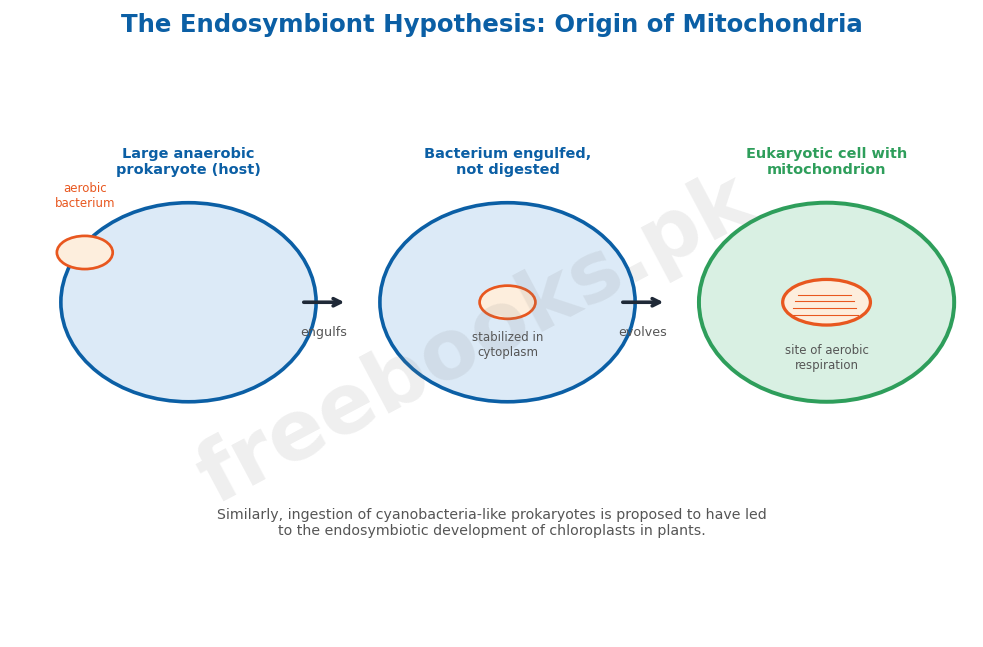
The eukaryotic cell might have evolved when a large anaerobic amoeboid prokaryote ingested small aerobic bacteria and stabilized them instead of digesting them, an idea known as the endosymbiont hypothesis, first proposed by Lynn Margulis; according to this hypothesis, the aerobic bacteria developed into mitochondria, the sites of aerobic respiration in eukaryotic cells, while ingestion of prokaryotes resembling present-day cyanobacteria could have led to the endosymbiotic development of chloroplasts in plants. An alternative hypothesis, membrane invagination, proposes that the prokaryotic cell membrane folded inward to enclose copies of its genetic material, resulting in the formation of several double-membrane-bound organelles within a single cell, which could then have evolved into the mitochondrion, nucleus, and chloroplast. Whatever the exact mechanism, the formation of the eukaryotic cell led to a dramatic increase in the complexity and diversity of life, with some eukaryotic cells later evolving into multicellular organisms with cells specialized into tissues and organs.
Lamarckism and Darwin's Theory of Natural Selection
Jean Baptiste Lamarck (1744-1829) published his theory of evolution in 1809, the year Darwin was born, arguing that body parts used extensively to cope with the environment become larger and stronger, while unused parts deteriorate; his second idea, the inheritance of acquired characteristics, held that modifications an organism acquires during its lifetime can be passed to its offspring, such as the giraffe's neck lengthening gradually as the cumulative product of generations of ancestors stretching for leaves. However, we now know that acquired characteristics cannot be inherited. Charles Darwin, born in Shrewsbury, England in 1809, joined the expedition of the Beagle to the South American coastline, where he collected thousands of specimens and noticed that the fauna and flora of different regions had a definite South American character; a particularly puzzling case was the fauna of the Galapagos Islands, including 13 types of finches that, though quite similar, seemed to be different species, some unique to individual islands.
After returning to Britain in 1836, Darwin perceived the origin of new species and adaptations as closely related processes, with a new species arising from an ancestral form by gradual accumulation of adaptations to different environments, separated by geographical barriers. By the early 1840s Darwin had worked out the major features of his theory of natural selection, but before he could publish, Alfred Wallace, a young naturalist working in the East Indies, independently developed an essentially identical theory; both were presented to the Linnaean Society of London in 1858, and Darwin published The Origin of Species the following year. In it, Darwin developed two main points: descent with modification (all organisms are related through descent from a common ancestor, with the history of life resembling a branching tree) and natural selection and adaptation, based on the observations that populations produce more individuals than the environment can support (leading to a struggle for existence), that survival is not random but depends partly on hereditary constitution (individuals best fitted to their environment leave more offspring), and that this unequal ability to survive and reproduce leads to gradual change in a population as favourable characteristics accumulate over generations, ultimately leading to the evolution of new species.
Neo-Darwinism and the Evidences of Evolution
The Origin of Species convinced most biologists that species are products of evolution. An important turning point was the birth of population genetics, which emphasizes extensive genetic variation within populations; with progress in population genetics in the 1930s, Mendelism and Darwinism were reconciled, producing a comprehensive theory known as the modern synthesis or Neo-Darwinism, developed in the early 1940s by integrating discoveries from paleontology, taxonomy, biogeography and population genetics. Evolution leaves several kinds of observable evidence. Biogeography, the geographical distribution of species, was what first suggested the idea of evolution to Darwin; islands have many species that are endemic yet closely related to species of the nearest mainland, such as armadillos, armored mammals that live only in America, whose fossil ancestors confirm this pattern. The fossil record provides a strong evidence in favour of evolution, with the oldest known fossils being prokaryotes (consistent with molecular evidence placing prokaryotes as ancestors of all life) and with vertebrate classes appearing in a chronological sequence in the fossil record – fish, then amphibians, then reptiles, then mammals and birds – consistent with the history of vertebrate descent.
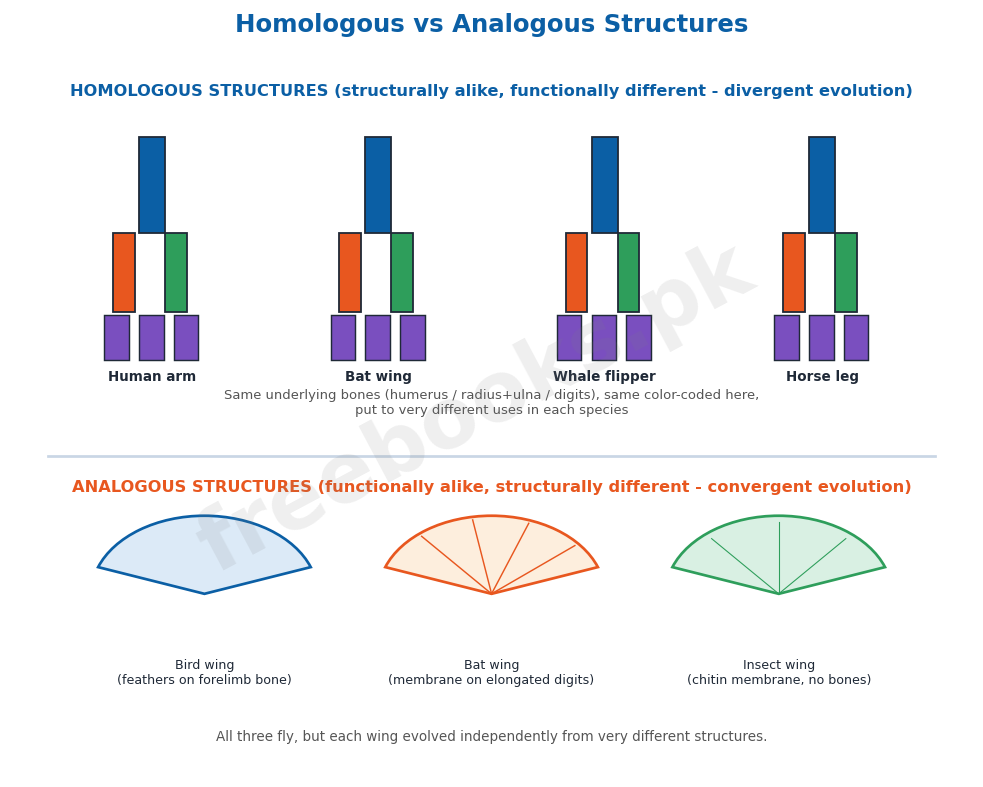
Comparative anatomy shows that the same skeletal elements make up the forelimbs of humans, cats, whales and bats, although these appendages perform very different functions; similarity resulting from common ancestry is called homology, and such anatomical signs of evolution are called homologous structures – functionally different but structurally alike, as seen in divergent evolution. Analogous organs, by contrast, are functionally alike but structurally different, such as the wings of bats, birds and insects, examples of convergent evolution. Vestigial organs are historical remnants of structures that had important functions in ancestors but are no longer essential, such as the pelvic and leg bones retained by whales and some snakes, the vermiform appendix in carnivores, or ear muscles in humans. Comparative embryology shows that closely related organisms go through similar stages in embryonic development, such as the gill pouches present in all vertebrate embryos, which become gills in fish but modify into structures such as the eustachian tube in terrestrial vertebrates. Molecular biology provides strong evidence too: if two species have genes and proteins with closely matching sequences, the sequences must have been copied from a common ancestor, and a common genetic code and shared proteins (such as cytochrome c, found in all aerobic species) support the unity and diversity of life.
Natural Selection and Artificial Selection
Natural selection occurs through an interaction between the environment and the variability inherent in any population. Darwin found supporting evidence in artificial selection, the breeding of domesticated plants and animals, in which humans modify other species over many generations by selecting individuals with desired traits as breeding stock, so the plants and animals grown for food bear little resemblance to their wild ancestors; from the changes achieved by artificial selection within a relatively short period, Darwin postulated that natural selection operating over vast spans of time could account for the entire diversity of life. A population is a group of interbreeding individuals belonging to a particular species and sharing a common geographic area.
Natural selection can amplify or diminish only variations that are heritable – adaptations an organism acquires through its own actions during its lifetime are not heritable. The specifics of natural selection are regional and timely, since environmental factors vary from place to place and from time to time, and an adaptation favourable in one situation may be useless or even detrimental in other circumstances; a well-known example of natural selection in action is the evolution of antibiotic resistance in bacteria.
Population, Gene Pool, Allele and Genotype Frequencies
A population is a localized group of individuals belonging to the same species; a species is defined as a group of populations that have the potential to interbreed in nature. Each species has a geographical range within which individuals are concentrated in several localized populations rather than spread evenly, and a population may be isolated from others of the same species, exchanging genetic material only rarely, particularly common for populations confined to widely separated islands, unconnected lakes, or mountain ranges separated by lowlands. The total aggregate of genes in a population at any one time is called the population's gene pool, consisting of all alleles at all gene loci in all individuals of the population; for a diploid species, each locus is represented twice in the genome of an individual, who may be homozygous or heterozygous.
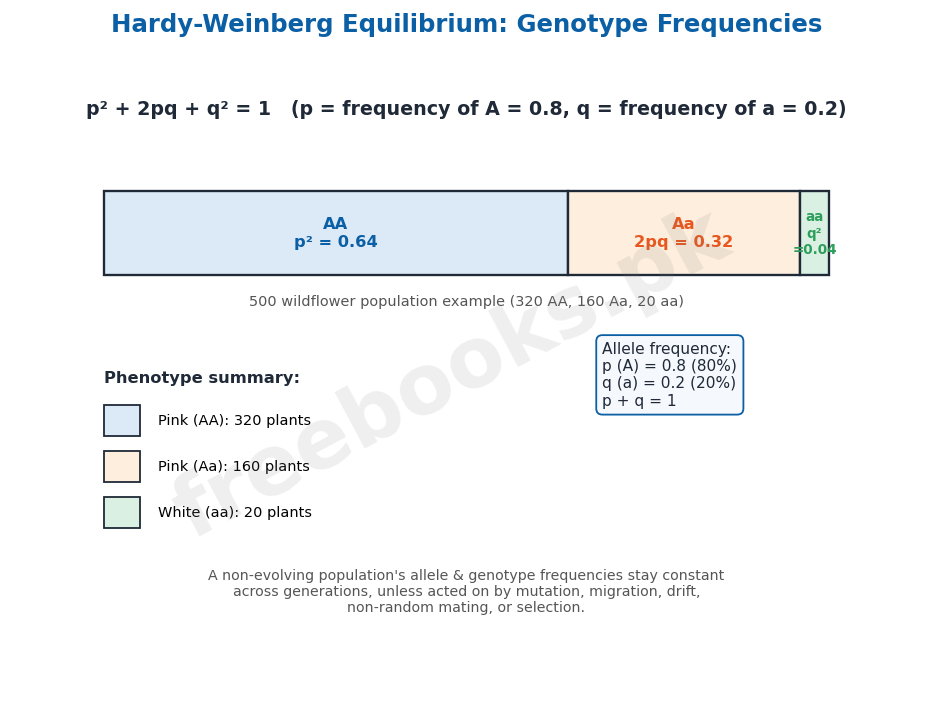
If all members of a population are homozygous for the same allele, that allele is said to be fixed in the gene pool; more often, there are two or more alleles for a gene, each with a relative frequency in the gene pool. For example, in an imaginary wildflower population of 500 plants with a dominant pink-flower allele A and a recessive white-flower allele a: 20 plants are homozygous recessive (aa, white), 320 are homozygous dominant (AA, pink), and 160 are heterozygous (Aa, pink). With 1000 total gene copies for flower colour (500 plants x 2 alleles), the dominant allele A accounts for 800 of these copies (320×2 + 160×1), giving allele frequency of A = 0.8 (80%) and of a = 0.2 (20%); the corresponding genotype frequencies are AA = 0.64 (64%), Aa = 0.32 (32%), and aa = 0.04 (4%).
Hardy-Weinberg Theorem and Factors Affecting Gene Frequency
The frequencies of genotypes in non-evolving populations are described by the Hardy-Weinberg theorem, named for the two scientists who derived the principle independently in 1908; it states that the frequencies of alleles and genotypes in a population's gene pool remain constant over generations unless acted upon by agents other than sexual recombination, meaning that the shuffling of alleles due to meiosis and random fertilization alone has no effect on the overall genetic structure of a population. For a gene locus with only two alleles, population geneticists use p to represent the frequency of one allele and q for the other, where p + q = 1; when gametes combine to form zygotes, the probability of an AA genotype is p-squared, of aa is q-squared, and of heterozygous Aa is 2pq, so that p-squared + 2pq + q-squared = 1 (a binomial expansion of (p+q)-squared). In the wildflower example, p = 0.8 and q = 0.2, giving p-squared = 0.64 (AA), 2pq = 0.32 (Aa), and q-squared = 0.04 (aa), which together sum to 1.
Five factors can alter gene frequency enough to produce significant deviations from Hardy-Weinberg proportions: mutation (the ultimate source of all changes, though individual mutations occur so rarely that mutation alone does not change allele frequency much), migration (a potent agent of change through emigration and immigration disturbing the gene pool, while also acting locally to prevent populations that exchange members from diverging from one another), genetic drift (a chance-based change in allele frequency, especially significant in small populations where fluctuations may lead to loss of particular alleles), non-random mating (such as inbreeding, which does not alter allele frequency but lessens the proportion of heterozygous individuals), and selection (whether artificial, where breeders select for desired characters, or natural, where the environment plays this role), where some individuals leave behind more progeny than others due to their inherited characteristics.
Endangered Species
Extinction has been the fate of most plant and animal species and is a natural process that will continue; however, in recent years the threat to wild plants and animals has increased dramatically, mostly as a result of habitat destruction. Tropical rain forests, the most threatened areas on earth, have been reduced to 44% of their original extent, and in certain areas such as Ecuador, forest coverage has been reduced by 95%; this decrease in habitat has resulted in tens of thousands of extinctions, with the true number impossible to estimate accurately since taxonomists have not even described most species in areas like rain forests. Other causes of extinction include climate change, pollution, and invasions from foreign species, and habitats other than rain forest, such as grasslands, marshes, deserts, and coral reefs, are also seriously threatened.
An endangered species is in imminent danger of extinction throughout its range, while a threatened species is likely to become endangered in the near future; saving species requires preserving a large diversity of genes within species groups to promote survival in changing environments, which requires large populations, not just a few remnant individuals. A multifaceted conservation plan includes a global system of national parks and wildlife corridors, protected landscapes and multiple-use areas that allow controlled private activity while retaining wildlife habitat value, and zoos and botanical gardens to save species whose extinction is imminent. In Pakistan, the cheetah, tiger, Asian lion, Indian rhino, cheer pheasant, crocodile and gharial (Gavial) have been declared extinct, while the Indus dolphin, blackbuck, common leopard, great Indian bustard, houbara bustard, white-headed duck and marbled teal are among the species near extinction, with deserts, sub-mountainous tracts and wetlands identified as habitats in peril and more than 500 endangered plant species recorded.
Important Definitions
Evolution
The processes that have transformed life on earth from its earliest forms to the vast diversity observed today, based on interactions between populations and their environments.
Natural selection
The process by which individuals whose inherited characteristics best fit them to their environment tend to survive and leave more offspring, gradually changing a population over generations.
Endosymbiont hypothesis
The hypothesis, proposed by Lynn Margulis, that the eukaryotic cell evolved when a large anaerobic prokaryote ingested and stabilized small aerobic bacteria, which developed into mitochondria.
Homologous structures
Anatomical structures that are functionally different but structurally alike due to common ancestry, such as the forelimbs of humans, bats, and whales.
Analogous structures
Anatomical structures that are functionally alike but structurally different, arising through convergent evolution, such as the wings of bats, birds and insects.
Gene pool
The total aggregate of genes (all alleles at all gene loci) present in all individuals of a population at a given time.
Hardy-Weinberg theorem
The principle that allele and genotype frequencies in a population's gene pool remain constant across generations unless acted upon by agents other than sexual recombination.
Endangered species
A species that is in imminent danger of extinction throughout its range.
Key Facts
| Item | Fact |
|---|---|
| Hardy-Weinberg equation | p^2 + 2pq + q^2 = 1, where p^2 = frequency of AA, 2pq = frequency of Aa, q^2 = frequency of aa, and p + q = 1. |
| Age of first prokaryotes | The first prokaryotic cells are thought to have arisen more than 3.5 billion years ago. |
| Age of first eukaryotes | Eukaryotes are thought to have first appeared about 1.5 billion years ago. |
| Hardy-Weinberg year | The Hardy-Weinberg theorem was derived independently by two scientists in 1908. |
| Darwin & Wallace presentation | Wallace's and Darwin's independently developed theories of natural selection were presented to the Linnaean Society of London on 1 July 1858. |
| Publication of Origin of Species | Charles Darwin published On the Origin of Species in 1859. |
| Rain forest reduction | Tropical rain forests have been reduced to 44% of their original extent worldwide; in Ecuador, by 95%. |
| Ozone and life on land | About 420 million years ago, enough protective ozone had built up in the atmosphere to make life on land possible. |
Diagrams & Illustrations
The Endosymbiont Hypothesis: Origin of Mitochondria: a diagram showing the endosymbiont hypothesis for the evolution of the eukaryotic cell: a large anaerobic prokaryote engulfing a small aerobic bacterium, which is stabilized rather than digested and gradually develops into a mitochondrion within the host cell.
Homologous vs Analogous Structures: a comparison diagram showing homologous structures (the forelimb bones of a human, bat, whale and horse, structurally alike but functionally different, from divergent evolution) alongside analogous structures (the wings of a bird, bat and insect, functionally alike but structurally different, from convergent evolution).
Hardy-Weinberg Equilibrium: Genotype Frequencies: a diagram illustrating the Hardy-Weinberg equation (p^2 + 2pq + q^2 = 1) applied to the wildflower population example, showing the genotype frequencies of AA (0.64), Aa (0.32), and aa (0.04) as proportional segments.
Short Questions & Answers
What are hydrothermal vents, and why are they relevant to the origin of life?
Hydrothermal vents are underwater hot springs that could have supplied the energy and raw materials needed for the origin and survival of early life forms; archaeobacteria, which tolerate temperatures up to 120 degrees Celsius, support this vent hypothesis for the origin of life.
State the endosymbiont hypothesis.
The endosymbiont hypothesis, proposed by Lynn Margulis, states that the eukaryotic cell evolved when a large anaerobic amoeboid prokaryote ingested small aerobic bacteria and stabilized rather than digested them; these bacteria developed into mitochondria, the sites of aerobic respiration in eukaryotic cells.
Explain the term homology with a suitable example.
Homology is similarity in characteristics resulting from common ancestry; anatomical signs of evolution called homologous structures are functionally different but structurally alike, such as the forelimb bones of humans, cats, whales and bats, which are all built from the same skeletal elements despite performing very different functions.
What are vestigial organs? Give two examples.
Vestigial organs are rudimentary structures that had important functions in ancestors but are of marginal or no use to the organism today; examples include the pelvic and leg bones retained by whales and some snakes, the vermiform appendix in carnivores, and ear muscles in humans.
State the Hardy-Weinberg theorem.
The Hardy-Weinberg theorem states that the frequencies of alleles and genotypes in a population's gene pool remain constant over generations unless acted upon by agents other than sexual recombination, meaning shuffling of alleles by meiosis and random fertilization alone has no effect on a population's genetic structure.
What is the difference between an endangered species and a threatened species?
An endangered species is in imminent danger of extinction throughout its range, whereas a threatened species is likely to become endangered in the near future.
Long Questions & Answers
Describe the evidences of evolution from any five branches of biology, explaining how each supports the theory of evolution.
Evolution, unlike a directly observable single event, is nevertheless supported by an extraordinarily wide and mutually reinforcing body of observable evidence drawn from many entirely different branches of biological science, and examining several of these branches in turn makes clear just how consistently they all point toward the same underlying conclusion that living species share common ancestry and have changed gradually over immense spans of time. The first major branch of evidence is biogeography, the study of the geographical distribution of species, which was in fact the very branch of evidence that first suggested the idea of evolution to Darwin himself during his voyage on the Beagle; islands, he observed, characteristically harbour many species of plants and animals that are found nowhere else in the world, and yet these endemic island species are consistently found to be closely related to species inhabiting the nearest mainland or a neighbouring island, exactly the pattern one would expect if the islands had originally been colonized by mainland species that subsequently diversified in isolation, a pattern strikingly illustrated by armadillos, armoured mammals that live only in the Americas, whose fossil record confirms that earlier armadillo-like ancestors did indeed occupy these same continents. The second major branch of evidence is the fossil record, which provides a strong and often startlingly complete visual record of the successive forms through which particular evolutionary lineages have passed over time; the fossil record's own internal chronology turns out to be entirely consistent with independent evolutionary predictions, since the oldest known fossils recovered anywhere in the geological record are consistently prokaryotic in nature, exactly as would be expected if prokaryotes truly are the evolutionary ancestors of all subsequent life, and similarly the different classes of vertebrate animals appear in the fossil record in a clear chronological sequence, with fossil fishes as the earliest vertebrates, followed in turn by amphibians, then reptiles, and only much later by mammals and birds, a sequence that corresponds precisely with the independently reconstructed history of vertebrate descent. The third major branch of evidence is comparative anatomy, which examines the anatomical similarities shared between species that are grouped together within the same taxonomic category; a particularly clear example is the observation that the very same underlying set of skeletal elements is used to construct the forelimbs of humans, cats, whales, bats, and indeed all other mammals, even though these superficially very different-looking appendages have subsequently been put to radically different functional uses in each lineage, ranging from grasping to swimming to flying, a basic similarity that is best explained as the direct consequence of common descent from a shared mammalian ancestor, with such anatomically similar but functionally divergent structures properly termed homologous structures, a concept that stands in useful contrast to purely superficial similarities such as the wings of birds, bats and insects, which are functionally alike but structurally quite different and are instead properly termed analogous structures, arising through the entirely separate process of convergent evolution rather than through shared ancestry. The fourth major branch of evidence is comparative embryology, which reveals that closely related organisms characteristically pass through remarkably similar stages during their own individual embryonic development, even in cases where the fully grown adult forms of those same organisms subsequently end up looking extremely different from one another; a particularly striking example is that all vertebrate embryos, without exception, pass through an early developmental stage in which they possess gill pouches located on the sides of their throat region, structures that in fish go on to develop directly into functional gills, but that in terrestrial vertebrates instead become substantially modified during later development to serve entirely different purposes, such as forming the eustachian tube that connects the middle ear to the throat in humans, a pattern of shared early development that is again most readily and economically explained by shared evolutionary ancestry. The fifth major branch of evidence is molecular biology, which examines evolutionary relationships as they are directly reflected within the genes and gene products, meaning the DNA and protein sequences, of different species; when two different species are found to possess genes or proteins whose monomer sequences match one another unusually closely, the most probable explanation is that those matching sequences were originally copied down, with only minor subsequent modification, from a single shared common ancestor, and indeed the fact that essentially all known living organisms share the same fundamental genetic code, along with the fact that taxonomically very remote organisms such as humans and bacteria nevertheless still share certain specific proteins in common, such as the respiratory protein cytochrome c which is found in essentially all aerobic species, together provide particularly strong and compelling molecular-level evidence in direct support of evolution as the fundamental basis underlying both the unity and the diversity that we observe throughout all of life.
Explain Darwin's theory of natural selection as the mechanism of evolution, and describe how the modern evolutionary synthesis (Neo-Darwinism) built upon it.
Charles Darwin's theory of natural selection represents one of the single most influential and thoroughly well-supported explanatory frameworks in the entire history of biological science, and properly understanding both the theory itself and the way it was subsequently extended and refined requires tracing the argument carefully through each of its component observations and logical inferences in turn. Darwin's own thinking on this subject was shaped very substantially by his personal experiences during the voyage of the Beagle, during which he collected thousands of specimens of the diverse fauna and flora of South America and personally observed that the living species inhabiting different regions of that continent consistently displayed a definite and unmistakably South American character, quite distinct from the character of equivalent life forms found in Europe, while the South American fossil specimens that he collected, although clearly representing extinct and different species from those living today, nevertheless still bore a distinctly South American resemblance to the modern plants and animals of that same continent; a particularly puzzling case that especially struck Darwin was the highly unusual fauna of the Galapagos Islands, most of which live nowhere else in the entire world despite closely resembling related species found living on the nearby South American mainland, exactly the pattern one would expect if these islands had originally been colonized by stray mainland organisms that had subsequently diversified along separate evolutionary paths on the different individual islands, a phenomenon strikingly illustrated by the thirteen distinct types of Galapagos finches that Darwin collected, some confined to individual islands and others more widely distributed. After returning to Great Britain in 1836, Darwin came to perceive the origin of new species and the origin of new adaptations as two closely related aspects of the very same underlying evolutionary process, in which an entirely new species would gradually arise from some pre-existing ancestral form through the slow, cumulative accumulation of successive adaptations to a new and different environment, a process typically initiated and sustained by geographical separation from the original ancestral population; over the course of many successive generations, two populations that had originally been separated from one another in this way could plausibly become sufficiently dissimilar from each other to properly warrant being designated as entirely separate species, apparently exactly what had happened among the various populations of Galapagos finches that Darwin had personally observed and collected. By the early 1840s Darwin had already privately worked out the major essential features of his eventual theory of natural selection as the fundamental underlying mechanism driving the entire process of evolutionary change, though before he was able to publish his ideas the young naturalist Alfred Wallace, working independently in the East Indies, developed an essentially identical theory of natural selection entirely on his own; the two men's respective findings were jointly presented together to the Linnaean Society of London in 1858, and Darwin quickly completed and published his now-famous book The Origin of Species the following year, in which he laid out two central and closely interrelated points, namely descent with modification, the idea that all living organisms are ultimately related to one another through shared descent from some common ancestor that lived in the remote evolutionary past, and natural selection and adaptation, the proposal that populations of individual species gradually become progressively better adapted to their particular local environments specifically through the ongoing operation of natural selection, a process grounded in three closely linked underlying observations: first, that any given population characteristically produces substantially more offspring individuals than the surrounding environment can actually support, which inevitably leads to an ongoing struggle for existence among the individual members of that population, with only some fraction of the total offspring produced actually managing to survive through to reproduce in each successive generation; second, that survival within this ongoing struggle for existence is emphatically not a purely random matter, but instead depends at least partly upon each individual's own particular hereditary constitution, meaning that those specific individuals whose inherited characteristics happen to fit them relatively better to their local environment are correspondingly more likely to survive and to leave behind a correspondingly larger number of surviving offspring than their comparatively less well-adapted fellow individuals; and third, that this resulting unequal ability of different individuals to successfully survive and reproduce will, purely as an inevitable logical consequence, progressively lead to a gradual cumulative change in the overall genetic composition of the population as a whole, as those particular favourable heritable characteristics steadily accumulate in frequency over the course of many successive generations, ultimately giving rise over sufficiently long spans of time to the evolution of an entirely new species. Following the initial publication of The Origin of Species, an important subsequent turning point for the further development and refinement of evolutionary theory more broadly was the later birth of the distinct field of population genetics, which placed particular scientific emphasis specifically upon the extensive genetic variation that is characteristically found to exist within essentially all natural populations, and which additionally recognized the particular importance of quantitative, continuously varying hereditary characters; with substantial further scientific progress subsequently made within the field of population genetics specifically during the 1930s, the previously apparently conflicting theoretical frameworks of Mendelian genetics and classical Darwinian natural selection were at last successfully reconciled with one another, with the underlying genetic basis both of heritable variation itself and of the specific process of natural selection acting upon that variation being worked out in considerably greater mechanistic detail than Darwin himself had originally been able to achieve; the resulting comprehensive and substantially more mechanistically complete theory of evolution that emerged from this reconciliation became subsequently known as the modern evolutionary synthesis, or more commonly simply as Neo-Darwinism, and was fully developed during the early 1940s specifically by successfully integrating relevant discoveries and ideas drawn from several previously largely separate scientific fields, including palaeontology, taxonomy, biogeography, and, of course, the newly developed field of population genetics itself.
MCQs with Answers
Who introduced binomial nomenclature for naming species? (a) Charles Darwin (b) Carolus Linnaeus (c) Jean Baptiste Lamarck (d) Alfred Wallace
Correct Answer: (b) Carolus Linnaeus. Carolus Linnaeus (1707-1778) introduced binomial nomenclature and sought order in the diversity of life, though he believed species were permanent creations.
The idea that mitochondria evolved from engulfed aerobic bacteria is called the: (a) membrane invagination hypothesis (b) endosymbiont hypothesis (c) special creation hypothesis (d) catastrophism hypothesis
Correct Answer: (b) endosymbiont hypothesis. The endosymbiont hypothesis, proposed by Lynn Margulis, holds that mitochondria evolved from aerobic bacteria engulfed and stabilized by a host prokaryote.
Lamarck's theory that modifications acquired during an organism's lifetime can be passed to offspring is called: (a) natural selection (b) genetic drift (c) inheritance of acquired characteristics (d) descent with modification
Correct Answer: (c) inheritance of acquired characteristics. Lamarck's theory of inheritance of acquired characteristics proposed that traits acquired during an organism's life could be inherited by offspring; this is now known to be incorrect.
Darwin and Wallace's theories of natural selection were jointly presented to the Linnaean Society of London in: (a) 1836 (b) 1844 (c) 1858 (d) 1908
Correct Answer: (c) 1858. Wallace's paper and extracts from Darwin's unpublished essay were jointly presented to the Linnaean Society of London on 1 July 1858.
Structures that are functionally different but structurally alike due to common ancestry are called: (a) analogous structures (b) vestigial structures (c) homologous structures (d) convergent structures
Correct Answer: (c) homologous structures. Homologous structures, such as the forelimbs of humans, bats and whales, are structurally alike but functionally different due to shared common ancestry (divergent evolution).
Wings of bats, birds and insects, which are functionally similar but structurally different, are examples of: (a) homologous structures (b) analogous structures (c) vestigial organs (d) genetic drift
Correct Answer: (b) analogous structures. Analogous structures are functionally alike but structurally different, arising through convergent evolution rather than shared ancestry.
The total aggregate of all genes in a population at a given time is called its: (a) genotype (b) phenotype (c) gene pool (d) gene locus
Correct Answer: (c) gene pool. The gene pool is the total aggregate of all alleles at all gene loci in all individuals of a population.
In the Hardy-Weinberg equation p^2 + 2pq + q^2 = 1, the term 2pq represents the frequency of: (a) homozygous dominant individuals (AA) (b) homozygous recessive individuals (aa) (c) heterozygous individuals (Aa) (d) the total population
Correct Answer: (c) heterozygous individuals (Aa). 2pq represents the frequency of heterozygous (Aa) individuals in a population at Hardy-Weinberg equilibrium.
Which of the following is NOT one of the five major factors that alter gene frequency? (a) Mutation (b) Genetic drift (c) Photosynthesis (d) Non-random mating
Correct Answer: (c) Photosynthesis. The five major factors affecting gene frequency are mutation, migration, genetic drift, non-random mating, and selection; photosynthesis is not one of them.
A species that is in imminent danger of extinction throughout its range is called: (a) a threatened species (b) an endangered species (c) an invasive species (d) a keystone species
Correct Answer: (b) an endangered species. An endangered species is in imminent danger of extinction throughout its range, while a threatened species is likely to become endangered in the near future.
Quick Revision Summary
- Evolution vs special creation: Creationists (Special Creation) vs Evolutionists (Natural Selection). Key historical scientists: Linnaeus (binomial nomenclature), Lamarck (theory of evolution, 1809), Malthus (Principle of Population), Cuvier (catastrophism), Lyell (Principles of Geology), Darwin (Origin of Species, 1859), Mendel (inheritance), Wallace (independent natural selection theory).
- Prokaryotes -> eukaryotes: prokaryotes >3.5 billion years ago, eukaryotes ~1.5 billion years ago. Endosymbiont hypothesis (Margulis): aerobic bacteria -> mitochondria; cyanobacteria-like -> chloroplasts. Alternative: membrane invagination hypothesis.
- Lamarckism (inheritance of acquired characteristics, rejected) vs Darwinism (natural selection). Darwin's Origin of Species (1859) 2 main points: Descent with modification + Natural selection/adaptation (overproduction -> struggle for existence -> differential survival -> gradual change).
- Neo-Darwinism = Mendelism + Darwinism (1930s-40s), via population genetics. 5 evidences of evolution: Biogeography, Fossil record, Comparative anatomy (homologous vs analogous structures, vestigial organs), Comparative embryology (gill pouches), Molecular biology (cytochrome c, genetic code).
- Natural selection (environment selects) vs Artificial selection (humans select, e.g. breeding). Population = interbreeding group sharing geographic area. Gene pool = total alleles at all loci in a population.
- Hardy-Weinberg theorem: p + q = 1, p^2 + 2pq + q^2 = 1 (non-evolving population). Derived 1908. 5 factors altering gene frequency: Mutation, Migration, Genetic drift, Non-random mating, Selection.
- Endangered species = imminent extinction risk; Threatened species = likely to become endangered. Pakistan extinct: cheetah, tiger, Asian lion, Indian rhino, cheer pheasant, crocodile, gharial. Conservation: national parks, protected landscapes, zoos/botanical gardens. Notes by freebooks.pk.
Exam Tips
- Build a simple timeline of the 8 key historical scientists (Linnaeus -> Lamarck -> Malthus -> Cuvier -> Lyell -> Darwin -> Mendel -> Wallace) with one achievement each – this exact list appears repeatedly in short-question format.
- Keep the endosymbiont hypothesis and membrane invagination hypothesis as a clearly separated pair: endosymbiont = engulfed bacteria become organelles; invagination = membrane folds inward to form organelles.
- Memorise Darwin's 2 main points from Origin of Species as a fixed pair (descent with modification + natural selection/adaptation), and be ready to list the 3 underlying observations behind natural selection in order.
- Build a homologous vs analogous 2-column comparison table with one example each (homologous = forelimbs of man/bat/whale, divergent evolution; analogous = wings of bat/bird/insect, convergent evolution) – a very common exam question.
- Memorise the Hardy-Weinberg equation p^2 + 2pq + q^2 = 1 alongside the wildflower numeric example (p=0.8, q=0.2 -> AA=0.64, Aa=0.32, aa=0.04) so you can both state and apply the theorem.
- Learn the 5 factors affecting gene frequency as a fixed list (Mutation, Migration, Genetic drift, Non-random mating, Selection) – exams often ask you to name and briefly describe all five.
- Keep endangered vs threatened species as a clear distinction (endangered = imminent extinction; threatened = likely to become endangered soon), and memorise at least 3 Pakistan-specific extinct species examples (cheetah, tiger, Asian lion).