This chapter covers Variation and Genetics from the 2nd Year (FSc Part-II) Biology syllabus of the Punjab Curriculum and Textbook Board (PTB/PCTB). Hereditary characteristics pass from parents to offspring through genes carried in gametes; a gene is the basic unit of biological information, a segment of DNA occupying a specific position (locus) on a chromosome, and paired alleles on homologous chromosomes may be identical or different, producing the inherited resemblances and variations seen across generations. These notes are prepared by freebooks.pk.
The chapter covers Mendel's experiments and laws of inheritance (segregation and independent assortment), the four dominance relations (complete, incomplete, codominance, overdominance) illustrated through human and other blood group systems (MN, ABO, Rh), epistasis and pleiotropy, continuously varying (polygenic) traits, gene linkage and crossing over, the chromosomal patterns of sex determination, sex linkage in Drosophila and humans (haemophilia, colour blindness, X-linked dominant and Y-linked traits, sex-limited and sex-influenced traits), and the genetic basis of diabetes mellitus.
Learning Objectives
- Define gene, allele, locus, phenotype, genotype and gene pool.
- Describe Mendel's monohybrid cross and state the law of segregation, including the test cross.
- Describe Mendel's dihybrid cross and state the law of independent assortment, including the product rule.
- Differentiate complete dominance, incomplete dominance, codominance and overdominance with examples.
- Describe the ABO, MN and Rh blood group systems and their genetic and clinical significance.
- Explain epistasis (Bombay phenotype), pleiotropy, and polygenic (continuously varying) inheritance.
- Explain gene linkage, crossing over, and recombination frequency.
- Describe the chromosomal patterns of sex determination and sex linkage in Drosophila and humans.
Key Concepts
Genes, Alleles, Gene Pool and Mendel's Experimental Approach
A gene is the basic unit of biological information, a segment of DNA whose base sequence encodes hereditary information; its position on a chromosome is its locus. Genes form pairs on pairs of homologous chromosomes, with one member of the pair (allele) on each homologue; alleles at a locus may be identical or different. Phenotype is the observable form of a trait, while genotype is the genetic constitution underlying it; a gene pool is the total genetic information (all genes/alleles) present in a breeding population at a given time – conceptualised as a 'beanbag' of individually segregating, randomly assorting alleles. Gregor Johann Mendel (1822-1884) laid the foundation of classical genetics through eleven years (1854-1865) of breeding experiments on the garden pea (Pisum sativum), a plant well suited to the task: easy to cultivate, normally self-fertilizing but capable of cross-fertilization, with a short generation time and seven sharply contrasting trait pairs (such as round versus wrinkled seeds), allowing him to establish true-breeding lines before beginning his crosses.
Mendel crossed true-breeding plants differing in a single trait (monohybrid cross), such as round-seeded and wrinkled-seeded plants; all F1 offspring were round, showing complete dominance of round over wrinkled, with wrinkled (the masked trait) called recessive. Self-fertilizing F1 monohybrids produced F2 offspring in a consistent 3:1 ratio (round to wrinkled) across all seven traits he studied, and further self-fertilization to produce F3 revealed that one-third of F2 round plants bred true (like the P1 parent) while two-thirds behaved like heterozygous F1 plants.
Mendel's Interpretation and the Law of Segregation
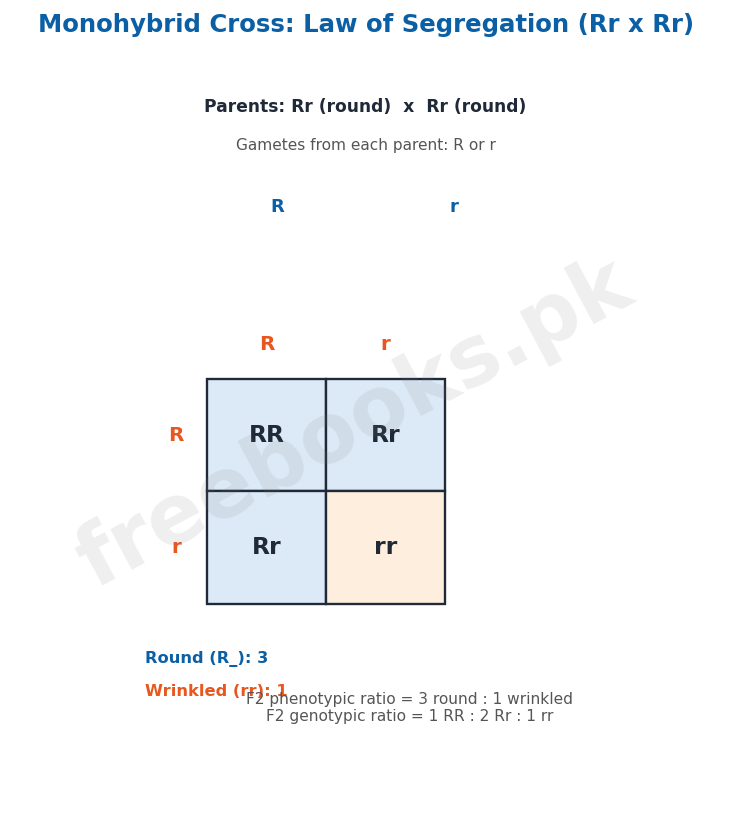
Mendel proposed that each contrasting trait form was governed by paired hereditary factors (later renamed genes by Johannsen), one from each parent, designated with capital letters for dominant and small letters for recessive forms (e.g. R for round, r for wrinkled); an organism with identical alleles at a locus is homozygous, while one with different alleles is heterozygous. He inferred that allele pairs separate (segregate) during gamete formation, so each gamete receives only one allele per trait, with fertilization restoring the pair randomly – the true-breeding round parent (RR) and wrinkled parent (rr) thus produced a heterozygous F1 (Rr), phenotypically round but genotypically a monohybrid; self-fertilizing F1 produced F2 in a 1 RR : 2 Rr : 1 rr genotypic ratio, matching the observed 3:1 phenotypic ratio. This led Mendel to formulate the law of segregation: the two alleles for a trait in an individual separate from each other during meiosis, so each gamete receives only one, and alleles reunite randomly at fertilization.
Mendel devised the test cross to determine whether an individual showing a dominant phenotype is homozygous or heterozygous, by crossing it with a homozygous recessive individual: if the tested parent is homozygous dominant (RR), all offspring show the dominant phenotype; if heterozygous (Rr), offspring appear in a 1:1 ratio of dominant to recessive phenotypes, with even a single recessive offspring proving heterozygosity in the parent.
Dihybrid Cross and the Law of Independent Assortment
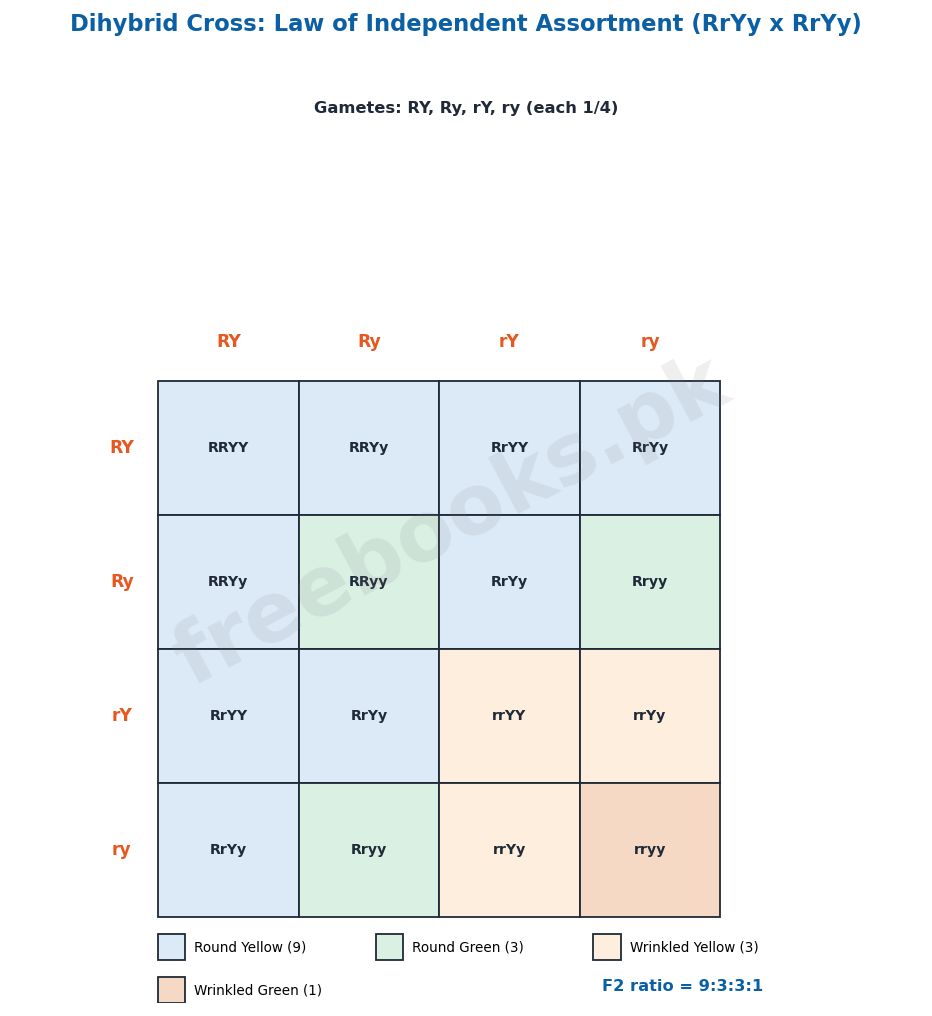
Mendel also studied inheritance of two traits simultaneously (e.g. seed shape and colour) using a dihybrid cross: crossing true-breeding round-yellow with true-breeding wrinkled-green plants produced all round-yellow F1 (dihybrids); self-fertilizing these F1 dihybrids produced F2 offspring showing not just the two parental combinations (round-yellow, wrinkled-green) but also two new recombinant combinations (round-green, wrinkled-yellow), in a clear 9:3:3:1 phenotypic ratio. This indicated the alleles for seed shape and colour assort independently into gametes rather than staying in fixed parental combinations, forming four gamete types (RY, Ry, rY, ry) in equal 1:1:1:1 proportions, leading Mendel to formulate the law of independent assortment: when two trait pairs are followed together, their alleles assort into gametes independently of each other.
Probability, the chance of an event occurring, underlies this law: since seed shape and seed colour are independent events, the joint probability of any combined phenotype equals the product of their individual probabilities (the product rule) – e.g. round (3/4) x yellow (3/4) = round-yellow (9/16). Independent assortment of genes actually depends on independent assortment of the chromosomes bearing them; genes on the same chromosome (linked genes) do not assort independently, while genes on different (non-homologous) chromosomes do. Mendel presented his findings in 1865 (published 1866), but his work lay neglected for 34 years until its rediscovery in 1900 by Correns, de Vries and Tschermak.
Dominance Relations: Complete, Incomplete, Codominance and Overdominance
There are four recognised dominance relations between alleles. In complete dominance (shown by all seven of Mendel's pea traits), one allele fully masks its partner, so the heterozygote is phenotypically identical to the dominant homozygote. In incomplete dominance, discovered by Carl Correns in the 4 O'clock plant, the heterozygote shows an intermediate phenotype between the two homozygotes (e.g. crossing true-breeding red and white flowers produces pink F1, with F2 segregating 1 red : 2 pink : 1 white) – since neither allele is truly dominant, both are denoted with the same letter, distinguished by superscript (R1, R2). In codominance, both alleles are expressed independently and simultaneously in the heterozygote, each producing its own distinct product, rather than blending; the human MN blood group system illustrates this, with genotype LM LN individuals expressing both M and N antigens on their red blood cells.
In overdominance, the heterozygote's phenotypic expression actually exceeds that of either homozygote, as seen in Drosophila eye pigment, where the heterozygote (w+/w) shows more fluorescent pigment than either the wild-type or white-eyed homozygote. Gene mutations may also produce multiple alleles, more than two alternative forms of a gene (some genes have up to 300); any diploid individual carries at most two of these, while a haploid gamete carries only one. The ABO blood group system, discovered by Karl Landsteiner (1901) and genetically explained by Bernstein (1925), is encoded by three multiple alleles (IA, IB, i) of a single gene on chromosome 9: IA and IB are codominant with each other (producing type AB when both present) but both are dominant to i (recessive), so genotypes IAIA/IAi give type A, IBIB/IBi give type B, and ii gives type O; O individuals are universal donors (no A or B antigen) and AB individuals are universal recipients (no anti-A or anti-B antibodies).
Rh Blood Group System, Epistasis and Pleiotropy
The Rh blood group system, named after the Rhesus monkey in which its antigen was first found (Landsteiner, 1930s), is defined primarily by the D locus: allele D (dominant, produces Rh factor, Rh+) and allele d (recessive, no Rh factor, Rh-); unlike ABO antibodies, anti-Rh antibody production requires prior exposure to Rh antigen. Erythroblastosis foetalis (haemolytic disease of the newborn) occurs when an Rh- mother carrying an Rh+ foetus is exposed to foetal Rh antigen (often at a prior birth), producing maternal anti-Rh antibodies that cross the placenta in a later pregnancy and destroy the foetal red blood cells, causing anaemia, jaundice, and potentially death; this is prevented by giving the Rh- mother an Rh antiserum injection during pregnancy and immediately after birth, destroying any foetal Rh+ cells before they can stimulate her own antibody production.
Epistasis is gene interaction in which an allele at one locus interferes with or masks the effect of a gene at a different locus (distinct from dominance, which involves alleles at the same locus); the Bombay phenotype illustrates this, in which a recessive hh genotype at the H locus (chromosome 19) prevents attachment of A or B antigens to red blood cells even in individuals who genetically carry IA or IB alleles, making them phenotypically (but not genotypically) type O. Pleiotropy is the phenomenon in which a single gene affects two or more apparently unrelated traits (a pleiotropic gene); for example, the dominant W allele in cats causes both pure white fur and deafness, since the underlying melanocyte defect disrupts both fur pigmentation and the inner ear hair cells that detect sound.
Continuously Varying (Polygenic) Traits, Gene Linkage and Crossing Over
While traits like pea seed shape show discontinuous, qualitative variation (sharply distinct phenotypes controlled by one gene), many traits, such as human height, weight, skin colour, and wheat grain colour, show continuous, quantitative variation across a smooth range of phenotypes; such polygenic traits are controlled by multiple genes (polygenes) at different loci, each contributing a small additive positive or negative effect. Nilsson-Ehle's classic wheat grain colour study found that crossing true-breeding dark red and white grain plants produced intermediate light-red F1, and F2 grains showed seven distinct shades in a 1:6:15:20:15:6:1 ratio, explained by three independently assorting gene pairs (Aa, Bb, Cc) whose combined 'dose' of red-pigment alleles determines shade; environmental factors further smooth the distribution of phenotypes, producing the bell-shaped curve typical of traits like human height.
Because chromosome number is limited relative to the number of genes, each chromosome carries many genes, all linked together as a linkage group (humans have 23 linkage groups); linked genes do not assort independently, reducing genetic recombination among offspring. However, crossing over, the exchange of chromosome segments between non-sister chromatids of homologous chromosomes during meiosis, can separate linked genes, producing recombinant gamete types alongside parental types; the closer two loci are, the less likely they are to be separated by crossing over. Recombination frequency, the proportion of recombinant types among all gamete combinations, is directly proportional to the physical distance between linked gene loci, allowing genes to be mapped along a chromosome (1% recombination frequency = 1 map unit).
Chromosomal Patterns of Sex Determination and Sex Linkage in Drosophila
T.H. Morgan (1911) discovered that Drosophila's fourth chromosome pair differs between sexes: females have two similar rod-shaped X chromosomes, while males have one X and one differently shaped Y, together called sex chromosomes (all other chromosomes are autosomes); humans similarly have 22 autosome pairs and one sex chromosome pair (XX in females, XY in males), with the SRY gene (Sex-determining Region of Y) at the tip of the Y chromosome's short arm triggering male development. Three common sex determination patterns exist: in the XO-XX type (grasshopper, Protenor bug), males lack a second sex chromosome entirely (XO, heterogametic, producing X-bearing or nullo gametes) while females are XX (homogametic); in the XY-XX type (Drosophila, humans, most mammals), males (XY) are heterogametic and females (XX) homogametic, giving a 1:1 sex ratio; in the ZZ-ZW type (birds, moths, butterflies, discovered by Seiler in 1914), the pattern is reversed – females (ZW) are heterogametic and males (ZZ) homogametic. Despite sharing the XY-XX pattern, Drosophila and humans differ mechanistically: an XO individual is a sterile male in Drosophila but a sterile female (Turner's syndrome) in humans, while XXY is a fertile female in Drosophila but sterile male (Klinefelter's syndrome) in humans, since Drosophila sex depends on the ratio of X chromosomes to autosome sets rather than the presence of Y (as in humans, where SRY is decisive).
T.H. Morgan (1910) provided key experimental support for the chromosomal theory of inheritance through his discovery of sex linkage in Drosophila, an organism well suited to genetics due to its easy culture, sexual dimorphism, two-week generation time, large number of distinct traits, and just eight chromosomes (four pairs). When Morgan's colleague Calvin Bridges found a mutant white-eyed male fly and Morgan crossed it with a wild-type red-eyed female, all F1 offspring had red eyes (showing red is dominant); F1 x F1 crosses produced F2 in which all white-eyed flies were male, a result inconsistent with simple autosomal Mendelian inheritance. Morgan concluded the eye-colour gene is located on the X chromosome with no corresponding allele on Y, so males (hemizygous, having just one X) express even a single recessive allele, while females (with two X chromosomes) can be homozygous or heterozygous; a subsequent test cross of the white-eyed P1 male with his heterozygous red-eyed F1 daughter confirmed this hypothesis, producing red-eyed and white-eyed offspring of both sexes in a 1:1 ratio each.
Sex Linkage in Humans, Sex-limited/Sex-influenced Traits, and Diabetes Genetics
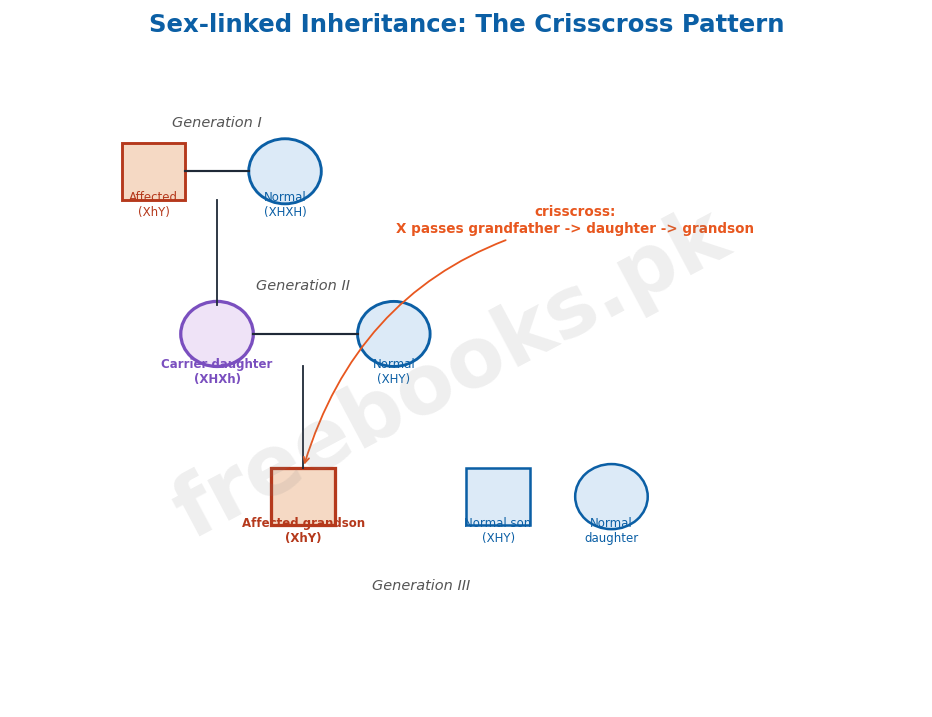
A trait whose gene lies on the X chromosome is X-linked (sex-linked); such traits pass in a characteristic crisscross fashion from maternal grandfather through a carrier daughter to a grandson, never directly from father to son (since a son inherits only Y from his father). X-linked recessive traits in humans include haemophilia (types A and B, affecting blood clotting factors VIII and IX respectively; type C is autosomal) and red-green colour blindness (caused by mutations in the X-linked red or green opsin genes); such traits affect males more often than females, since a male needs only one recessive allele to be affected while a female needs two. X-linked dominant traits, such as hypophosphatemic (vitamin D-resistant) rickets, follow a different pattern: all daughters of an affected father are affected while none of his sons are, and an affected heterozygous mother passes the trait to half her children of both sexes. Y-linked traits pass only from father to son (since only sons inherit the Y chromosome), with maleness itself (via the SRY gene) being the clearest example.
Sex-limited traits (such as milk yield in dairy cattle or beard growth in humans) are expressed in only one sex due to anatomical differences, even though the underlying genes may be carried and transmitted by both sexes; sex-influenced traits (such as pattern baldness) occur in both sexes but are expressed differently due to hormonal differences, with the same allele behaving as dominant in one sex and recessive in the other (so a heterozygous man goes bald while a heterozygous woman does not). Diabetes mellitus, a hereditary disorder of elevated blood sugar, has two major types: Type I (insulin-dependent, juvenile-onset, an autoimmune disorder in which the immune system destroys insulin-producing pancreatic beta cells, requiring lifelong insulin treatment) and Type II (non-insulin-dependent, accounting for 90% of cases, typically arising after age 40 and associated with obesity-driven insulin resistance, involving multifactorial polygenic inheritance combined with environmental influence); MODY (maturity-onset diabetes of the young), an early-onset autosomal dominant form, is caused about half the time by mutations in the glucokinase gene.
Important Definitions
Gene
The basic unit of biological information; a DNA segment occupying a specific locus on a chromosome that encodes hereditary information.
Allele
One of the alternative forms of a gene occupying the same locus on homologous chromosomes.
Genotype
The genetic constitution of an individual for a particular trait, as distinct from its observable phenotype.
Test cross
A cross between an individual showing a dominant phenotype and a homozygous recessive individual, used to determine the dominant individual's genotype.
Codominance
A dominance relation in which both alleles of a heterozygote are expressed independently and simultaneously, each producing a distinct product.
Epistasis
Gene interaction in which an allele at one locus masks or interferes with the phenotypic effect of a gene at a different locus.
Linkage group
The set of genes located together on the same chromosome, which do not assort independently during meiosis.
Recombination frequency
The proportion of recombinant-type gametes (or offspring) relative to the total, used to estimate the map distance between two linked gene loci.
Key Facts
| Item | Fact |
|---|---|
| Monohybrid F2 ratio | Mendel's monohybrid cross (Rr x Rr) gives F2 phenotypic ratio 3 (dominant) : 1 (recessive), genotypic ratio 1:2:1 (RR:Rr:rr). |
| Dihybrid F2 ratio | Mendel's dihybrid cross gives F2 phenotypic ratio 9:3:3:1 (two parental + two recombinant phenotype classes). |
| Product rule | Joint probability of two independent events = product of their individual probabilities (e.g. 3/4 x 3/4 = 9/16 for round-yellow). |
| Recombination frequency formula | Recombination frequency (%) = (Recombinant types / Sum of all combinations) x 100. |
| Map distance | 1% recombination frequency = 1 map unit of distance between two linked gene loci. |
| Down's/Klinefelter's/Turner's chromosome counts | Down's = 47 (trisomy 21); Klinefelter's = 47 (44+XXY); Turner's = 45 (44+X). |
| Wheat grain colour F2 ratio | Nilsson-Ehle's trihybrid polygenic wheat cross gives F2 ratio 1:6:15:20:15:6:1 across 7 colour shades (3 gene pairs, 6 alleles). |
| Sex ratio in XY-XX and ZZ-ZW systems | All common sex determination patterns (XO-XX, XY-XX, ZZ-ZW) produce an expected male:female sex ratio of 1:1. |
Diagrams & Illustrations
Monohybrid Cross: Law of Segregation: a Punnett square diagram of Mendel's Rr x Rr monohybrid cross, showing the F2 genotypic ratio 1 RR : 2 Rr : 1 rr and phenotypic ratio 3 round : 1 wrinkled.
Dihybrid Cross: Law of Independent Assortment: a Punnett square diagram of Mendel's dihybrid cross (RrYy x RrYy) showing the F2 phenotypic ratio 9:3:3:1, including two new recombinant phenotype classes.
Sex-linked Inheritance: The Crisscross Pattern: a diagram illustrating the crisscross inheritance pattern of an X-linked recessive trait, passing from an affected maternal grandfather through a phenotypically normal carrier daughter to an affected grandson.
Short Questions & Answers
Differentiate phenotype and genotype.
Phenotype is the observable form or appearance of a trait (e.g. red or white flowers); genotype is the underlying genetic constitution (allele combination) responsible for that phenotype (e.g. RR, Rr, or rr).
What is a test cross, and why is it useful?
A test cross mates an individual showing a dominant phenotype with a homozygous recessive individual; it reveals whether the dominant individual is homozygous (all offspring show the dominant phenotype) or heterozygous (offspring appear in a 1:1 dominant:recessive ratio), since even one recessive offspring proves heterozygosity.
Differentiate incomplete dominance and codominance.
In incomplete dominance, the heterozygote shows a single intermediate phenotype blending both parental traits (e.g. pink from red x white 4 O'clock flowers); in codominance, both alleles are expressed fully and independently in the heterozygote, producing two distinct, separately visible products rather than a blend (e.g. MN blood type showing both M and N antigens).
What is epistasis, and how does it differ from dominance?
Epistasis is interaction between genes at different loci, where one gene's effect masks or interferes with another gene's effect (e.g. the Bombay phenotype, where hh at the H locus masks IA/IB expression at the ABO locus); dominance, by contrast, is a relationship between alleles of the same gene at the same locus.
What is crossing over, and how does it relate to recombination frequency?
Crossing over is the exchange of chromosome segments between non-sister chromatids of homologous chromosomes during meiosis, which can separate linked genes; recombination frequency (the proportion of recombinant gamete types) is directly proportional to the distance between the linked loci, allowing genes to be mapped along a chromosome.
Why do X-linked recessive traits appear more often in males than in females?
Males are hemizygous for X-linked genes (having only one X chromosome), so a single recessive allele is sufficient to express the trait; females have two X chromosomes and so need two copies of the recessive allele (homozygous recessive) to express the same trait, making them far more likely to be unaffected carriers instead.
Long Questions & Answers
Describe Mendel's dihybrid cross experiment and explain how it led to the law of independent assortment.
After thoroughly working out the pattern of inheritance for each of his seven pea traits studied one at a time, Mendel took the logical next step of investigating what would happen when two different traits were followed together simultaneously within the very same cross, choosing to examine seed shape (round versus wrinkled) and seed colour (yellow versus green) together as his test case. He began, exactly as in his earlier monohybrid work, by crossing two true-breeding parental lines that differed from each other in both of these traits at once: a true-breeding plant producing seeds that were both round and yellow was crossed with a true-breeding plant producing seeds that were both wrinkled and green, and because round and yellow had each already been separately established as the dominant phenotype for their respective trait, every single F1 offspring produced by this cross, referred to as dihybrids because they were heterozygous for two different gene pairs simultaneously, displayed the completely dominant round and yellow phenotype for both traits. Mendel's crucial next step, the one that actually defined this as a true dihybrid cross rather than merely two separate monohybrid crosses run in parallel, was to allow these F1 dihybrid plants to self-fertilize with each other and then carefully examine the full range of phenotypes that appeared among their F2 offspring, and the results he obtained here proved genuinely surprising and highly informative: the resulting F2 seeds were not restricted to reappearing in only the original two parental combinations of round-yellow and wrinkled-green, but instead also included two entirely new phenotypic combinations that had never actually been present in either of the original true-breeding parental lines, namely round-green seeds and wrinkled-yellow seeds, and when Mendel carefully counted out the relative proportions of all four of these phenotype classes among his F2 population, he consistently found them occurring in a remarkably clean and highly reproducible ratio of 9 round-yellow to 3 round-green to 3 wrinkled-yellow to 1 wrinkled-green, a characteristic pattern now universally known as the classic 9:3:3:1 dihybrid ratio. The unmistakable appearance of these two entirely new, non-parental recombinant phenotype classes among the F2 generation provided Mendel with clear and compelling evidence that some genuine process of shuffling or reshuffling must have taken place involving the alleles for these two different traits at some specific point during the process of gamete formation in the F1 dihybrid plants, since there was simply no way for genuinely new trait combinations like round-green to have arisen at all if the alleles for seed shape and the alleles for seed colour had instead remained forever locked together in only their original parental combinations throughout the entire process. Mendel correctly identified and named the precise underlying mechanism responsible for generating this reshuffling as the independent assortment of alleles into gametes, and from this he drew the broader and highly significant conclusion that the allele for seed shape carried by any given plant and the allele for seed colour carried by that very same plant were not permanently bound together in their original parental combination, meaning that the allele 'R' for roundness was not eternally forced to travel together specifically with the allele 'Y' for yellowness, nor was the allele 'r' for wrinkledness permanently bound only to the allele 'y' for greenness; rather, during the process of meiotic gamete formation in the doubly heterozygous F1 dihybrid, the two members of each individual allele pair were now understood to separate from each other and become distributed into gametes completely independently of how the members of the other, entirely separate allele pair happened to be simultaneously distributing themselves, so that the R allele had exactly as much chance of ending up paired together with either the Y allele or the y allele in any given gamete, and likewise the r allele had exactly as much chance of pairing with either Y or y. Working through the direct genetic consequence of this principle of independent assortment, Mendel correctly determined that an F1 dihybrid plant with the genotype RrYy would actually produce four genetically distinct types of gametes rather than merely the two parental gamete types one might otherwise naively expect, with these four gamete types specifically being RY, Ry, rY and ry, and critically, because of the truly independent nature of this assortment process, all four of these possible gamete types would be produced by the dihybrid plant in exactly equal proportions relative to one another, in a precise 1:1:1:1 ratio. When Mendel then worked through the full mathematical consequences of allowing all four of these equally frequent gamete types to combine with each other entirely at random during the process of self-fertilization, which is most conveniently and systematically visualized using a sixteen-box Punnett square constructed by crossing all four possible types of female gametes against all four possible types of male gametes, the resulting mathematical combinations reliably and predictably generated precisely the observed 9:3:3:1 phenotypic ratio among the F2 offspring, thereby providing full and complete theoretical justification and explanation for the actual experimental results Mendel had originally observed. On the basis of this entire body of dihybrid cross evidence, Mendel went on to formally state what has become permanently known as his law of independent assortment, which holds specifically that whenever two different, separately contrasting pairs of traits are simultaneously followed together within the very same genetic cross, the alleles governing each of those two traits will assort themselves into the resulting gametes in a manner that is genuinely independent of how the alleles governing the other trait happen to be simultaneously assorting themselves, meaning in practical terms that the particular way in which any one specific trait pair, such as seed shape, distributes its own alleles into gametes has absolutely no influence whatsoever upon how a second, entirely separate and different trait pair, such as seed colour, happens to distribute its own alleles into those very same gametes.
Discuss the chromosomal patterns of sex determination found in different organisms, and compare sex determination in Drosophila and humans.
The scientific search to properly understand the underlying genetic mechanism responsible for the inheritance of biological sex began in earnest shortly after the rediscovery and widespread acceptance of Mendel's original work around 1900, but it was really only with the subsequent discovery of specialized sex chromosomes that biologists finally obtained a genuinely clear and complete picture of exactly how sex determination actually operates at the genetic level, and this understanding revealed that there are, in practice, three broad chromosomal patterns of sex determination that occur most commonly across different groups of organisms. The first of these common patterns is known as the XO-XX type, characteristically found in organisms such as grasshoppers and the Protenor bug, in which the male of the species possesses only a single X chromosome and is described as XO because the second member of what would normally be a matched sex chromosome pair is simply entirely absent from his genome altogether; because of this, the male is considered heterogametic, since the process of meiosis in his body actually produces two genuinely different types of sperm cells in equal number, with exactly half of all his sperm carrying a single X chromosome and the other half instead carrying no sex chromosome whatsoever (a so-called nullo gamete), while the corresponding female of the species, possessing two complete X chromosomes and therefore properly described as XX, is by contrast homogametic, since every single egg cell she produces is entirely uniform and invariably carries exactly one X chromosome; the eventual sex of any given offspring in this system is therefore determined entirely by which specific type of paternal sperm happens to fertilize the maternal egg, with an X-bearing sperm producing an XX daughter and a nullo sperm instead producing an XO son, and this mechanism reliably yields the expected overall 1:1 sex ratio between male and female offspring across the population as a whole. The second, and by far most broadly familiar, pattern is the XY-XX type, characteristically exhibited by Drosophila, by humans, and indeed by the great majority of other mammalian species, in which the male is XY and is therefore the heterogametic sex, producing two distinct types of sperm in equal proportion (half bearing an X chromosome, half instead bearing a Y chromosome), while the female, being XX, is homogametic and produces only a single uniform type of egg, each invariably carrying one X chromosome; here, an X-bearing sperm fertilizing the egg will reliably produce an XX female zygote, whereas a Y-bearing sperm fertilizing that same egg will instead reliably produce an XY male zygote, and this mechanism again reliably yields the familiar overall 1:1 sex ratio observed between sons and daughters. The third recognized pattern, discovered specifically by J. Seiler working with moths back in 1914, is the ZZ-ZW type, characteristically found in birds, in butterflies, and in moths, and this particular pattern represents essentially a direct mechanistic reversal of the more familiar XY-XX pattern described above, since in this specific case it is instead the female of the species who is heterogametic, described as ZW, while it is the corresponding male who is homogametic and described as ZZ; here it is specifically the type of egg produced by the mother, rather than the type of sperm produced by the father, that ultimately determines the resulting sex of any given offspring, since the male in this system produces only a single uniform type of sperm (each invariably carrying a Z chromosome), while the female instead produces two genuinely different types of egg in equal number, one type carrying a Z chromosome and the other type instead carrying a W chromosome, so that fertilization of a Z-bearing egg by the uniform sperm produces a male (ZZ) offspring while fertilization of a W-bearing egg instead produces a female (ZW) offspring, once again yielding the expected overall 1:1 sex ratio. Although both Drosophila and humans happen to share this same broadly similar XY-XX chromosomal pattern of sex determination on the surface, there nevertheless exists a fundamentally important underlying mechanistic difference in precisely how sex is actually determined at a deeper biological level between these two particular organisms: in the specific case of humans, the mere physical presence of a single copy of the highly specific SRY gene, located right at the very tip of the short arm of the Y chromosome, is itself absolutely essential and sufficient to actively trigger the entire developmental cascade leading toward maleness, meaning that the simple absence of any Y chromosome (and therefore the absence of SRY) in a human individual will, by default, always lead the developing embryo down the alternative female developmental pathway regardless of how many X chromosomes happen to be present; this SRY-dependent mechanism specifically explains why a human individual with only a single X chromosome and no Y chromosome at all, described as XO and clinically corresponding to Turner's syndrome, is invariably female (albeit typically sterile), while conversely a human individual carrying an additional extra X chromosome alongside a normal Y chromosome, described as XXY and clinically corresponding to Klinefelter's syndrome, is invariably still recognizably male (though again typically sterile) purely because that necessary Y chromosome bearing the crucial SRY gene remains present. In striking contrast, Drosophila sex determination does not actually depend directly upon the simple presence or absence of the Y chromosome as such at all, but instead depends specifically upon the overall numerical ratio existing between the total number of X chromosomes present in a given fly's genome relative to the total number of complete sets of autosomes also present in that same genome, an arrangement generally referred to as the X-chromosome-to-autosome balance system; under this alternative balance-based mechanism, an X-to-autosome ratio of 1.00 or higher will reliably produce female development, whereas a ratio of 0.5 or lower will instead reliably produce male development, and this fundamentally different underlying mechanism directly explains why the very same XO chromosomal constitution that reliably produces a sterile female in humans instead reliably produces a sterile male in Drosophila (since a single X against two full sets of autosomes yields a low X:autosome ratio of 0.5), while conversely that same XXY chromosomal constitution that reliably produces a sterile male in humans instead reliably produces an entirely fertile female fly in Drosophila (since two X chromosomes against two full sets of autosomes yields a full X:autosome ratio of 1.0), demonstrating clearly and conclusively that superficially identical chromosomal constitutions can nevertheless correspond to dramatically different final sexual phenotypes whenever the two organisms being compared actually rely upon two genuinely different underlying molecular mechanisms to translate raw chromosome number into the final observed developmental outcome of biological sex.
MCQs with Answers
Partners of a gene pair occupying the same locus on homologous chromosomes are called: (a) genotypes (b) alleles (c) phenotypes (d) loci
Correct Answer: (b) alleles. Alleles are the alternative forms of a gene occupying the same locus on homologous chromosomes.
Mendel's monohybrid cross (Rr x Rr) produces an F2 phenotypic ratio of: (a) 1:1 (b) 1:2:1 (c) 3:1 (d) 9:3:3:1
Correct Answer: (c) 3:1. The monohybrid F2 phenotypic ratio is 3 dominant : 1 recessive (genotypic ratio 1:2:1).
A test cross is used to determine whether a dominant-phenotype individual is: (a) male or female (b) homozygous or heterozygous (c) diploid or haploid (d) linked or unlinked
Correct Answer: (b) homozygous or heterozygous. A test cross (crossing with a homozygous recessive) reveals whether the tested individual is homozygous or heterozygous dominant.
In incomplete dominance, the heterozygote phenotype is: (a) identical to one homozygote (b) intermediate between the two homozygotes (c) a novel, unrelated phenotype (d) always lethal
Correct Answer: (b) intermediate between the two homozygotes. Incomplete dominance produces a heterozygote phenotype intermediate between the two homozygous parental phenotypes.
The ABO blood group system has how many multiple alleles at its single gene locus? (a) two (b) three (c) four (d) five
Correct Answer: (b) three. The ABO system has three multiple alleles: IA, IB, and i.
Erythroblastosis foetalis results from incompatibility of which blood group system between mother and foetus? (a) ABO (b) MN (c) Rh (d) Bombay
Correct Answer: (c) Rh. Erythroblastosis foetalis results from Rh incompatibility between an Rh- mother and an Rh+ foetus.
The Bombay phenotype is an example of which genetic phenomenon? (a) codominance (b) epistasis (c) pleiotropy (d) overdominance
Correct Answer: (b) epistasis. The Bombay phenotype results from epistasis: the hh genotype at the H locus masks expression of IA/IB alleles at the ABO locus.
A quantitative trait controlled by multiple genes at different loci, each with a small additive effect, is called: (a) a monogenic trait (b) an epistatic trait (c) a polygenic trait (d) a sex-limited trait
Correct Answer: (c) a polygenic trait. Polygenic (continuously varying) traits are controlled by multiple genes (polygenes) at different loci with additive effects.
In the XY-XX sex determination pattern (e.g. humans), which sex is heterogametic? (a) female (b) male (c) both equally (d) neither
Correct Answer: (b) male. In the XY-XX system, the male (XY) is heterogametic, producing two types of sperm (X-bearing and Y-bearing).
X-linked recessive traits such as haemophilia typically pass from: (a) father directly to son (b) mother directly to daughter only (c) maternal grandfather through a carrier daughter to a grandson (d) father to daughter only, never sons
Correct Answer: (c) maternal grandfather through a carrier daughter to a grandson. X-linked recessive traits show a crisscross pattern, passing from maternal grandfather through a carrier daughter to a grandson.
Quick Revision Summary
- Basics: Gene=basic hereditary unit; allele=alternative form at a locus; genotype=genetic makeup; phenotype=observable trait; gene pool=all alleles in a breeding population. Mendel: pea plant, 7 traits, true-breeding lines, monohybrid cross.
- Law of Segregation: Rr x Rr -> F2 = 3:1 phenotype (1:2:1 genotype). Alleles separate at meiosis, reunite randomly at fertilization. Test cross = dominant phenotype x homozygous recessive, reveals genotype.
- Law of Independent Assortment: dihybrid cross RrYy x RrYy -> F2 = 9:3:3:1 (2 parental + 2 recombinant classes). Product rule: joint probability = product of individual probabilities. Genes on different chromosomes (or far apart) assort independently.
- Dominance relations: Complete (heterozygote=dominant homozygote) | Incomplete (heterozygote=intermediate blend, e.g. 4 O'clock pink) | Codominance (both alleles expressed separately, e.g. MN blood group) | Overdominance (heterozygote exceeds both homozygotes, e.g. Drosophila eye pigment).
- Blood groups: ABO = 3 multiple alleles (IA, IB codominant; i recessive) -> A/B/AB/O; O=universal donor, AB=universal recipient. Rh = D (dominant, Rh+) vs d (recessive, Rh-); erythroblastosis foetalis = Rh- mother + Rh+ foetus -> maternal anti-Rh antibodies attack foetal RBCs; prevented by Rh antiserum injection.
- Epistasis (different loci interact, e.g. Bombay phenotype: hh masks IA/IB) vs Pleiotropy (1 gene affects multiple traits, e.g. cat W allele = white fur + deafness). Polygenic traits (height, skin colour, wheat grain colour) = continuous variation, multiple genes with additive small effects + environment.
- Gene linkage: genes on same chromosome = linkage group (23 in humans), don't assort independently. Crossing over separates linked genes -> recombinant gametes. Recombination frequency % = map distance (1%=1 map unit). Sex determination: XO-XX (grasshopper), XY-XX (Drosophila/humans, male heterogametic), ZZ-ZW (birds/moths, female heterogametic) – all give 1:1 sex ratio. Sex linkage: X-linked recessive (haemophilia, colour blindness) = crisscross inheritance, more common in males. Notes by freebooks.pk.
Exam Tips
- Master the Punnett square for both monohybrid (4-box, 3:1) and dihybrid (16-box, 9:3:3:1) crosses by practicing drawing them from memory – almost every exam includes at least one cross-based numerical question.
- Keep the four dominance relations as a clean comparison table (complete/incomplete/codominant/overdominant) with one example organism/trait for each – this is a very common 'differentiate' or 'define with example' question.
- Memorise the ABO genotype-phenotype mapping as a compact table (IAIA/IAi=A, IBIB/IBi=B, IAIB=AB, ii=O) alongside universal donor (O) and universal recipient (AB) facts.
- Learn epistasis vs pleiotropy as opposite directions: epistasis = one gene affects/masks another gene's trait; pleiotropy = one gene affects multiple traits. Attach exactly one example to each (Bombay phenotype / cat white fur+deafness).
- For sex determination, build a 3-row table (XO-XX / XY-XX / ZZ-ZW) with example organism + which sex is heterogametic – and separately memorise the Drosophila vs human XO/XXY outcome differences as a 2×2 grid.
- Practice the crisscross X-linked recessive inheritance pattern as a 3-generation diagram (affected grandfather -> carrier daughter -> affected grandson) – this exact pattern is tested repeatedly for haemophilia and colour blindness questions.
- Distinguish X-linked recessive, X-linked dominant, Y-linked, sex-limited, and sex-influenced traits with one identifying rule each (recessive=more common in males; dominant=all daughters of affected father affected; Y-linked=father to son only; sex-limited=expressed in one sex only; sex-influenced=dominant in one sex, recessive in other) – exam questions frequently mix these up deliberately.