This unit introduces the limit of a function — the value a function approaches as its input gets arbitrarily close to a given number — which is the foundational idea on which all of calculus rests. Starting from the informal meaning of phrases like 'x approaches a', the unit builds up to a precise definition, a set of theorems that let limits be evaluated by direct substitution in most cases, and algebraic techniques (factoring, rationalizing) for the 0/0 indeterminate form that substitution alone cannot resolve.
The unit then extends these ideas to limits at infinity, the limit of a sequence, the important number e as a limit, and the Sandwich Theorem (used to prove the famous result lim(theta->0) sin(theta)/theta = 1). Finally, it defines one-sided limits and uses them to give a precise, three-condition definition of continuity at a point, closing with real-world applications of limits in radioactive decay, compound interest, population growth, and other transcendental-function models.
Learning Objectives
- Explain the meaning of the phrases 'x approaches a', 'x approaches zero', and 'x approaches infinity'
- State and apply the theorems on limits of functions to evaluate limits by direct substitution
- Evaluate limits that produce a 0/0 indeterminate form using factoring and rationalization
- Evaluate limits at infinity, including limits of sequences and limits involving the number e
- Apply the Sandwich Theorem to prove and use lim(theta->0) sin(theta)/theta = 1
- Determine left-hand and right-hand limits, and use them to test whether a limit exists at a point
- Determine whether a function is continuous or discontinuous at a point, and apply limits to real-world models
Key Concepts
12.1 The Meaning of a Limit
The phrase 'x approaches a' (written x -> a) means x gets arbitrarily close to a from both the left and right sides, without ever actually equaling a; this is different from x = a, which means x is actually equal to a. If a function f(x) approaches a specific number L as x approaches a from both sides, L is called the limit of f(x) as x approaches a, written lim(x->a) f(x) = L.
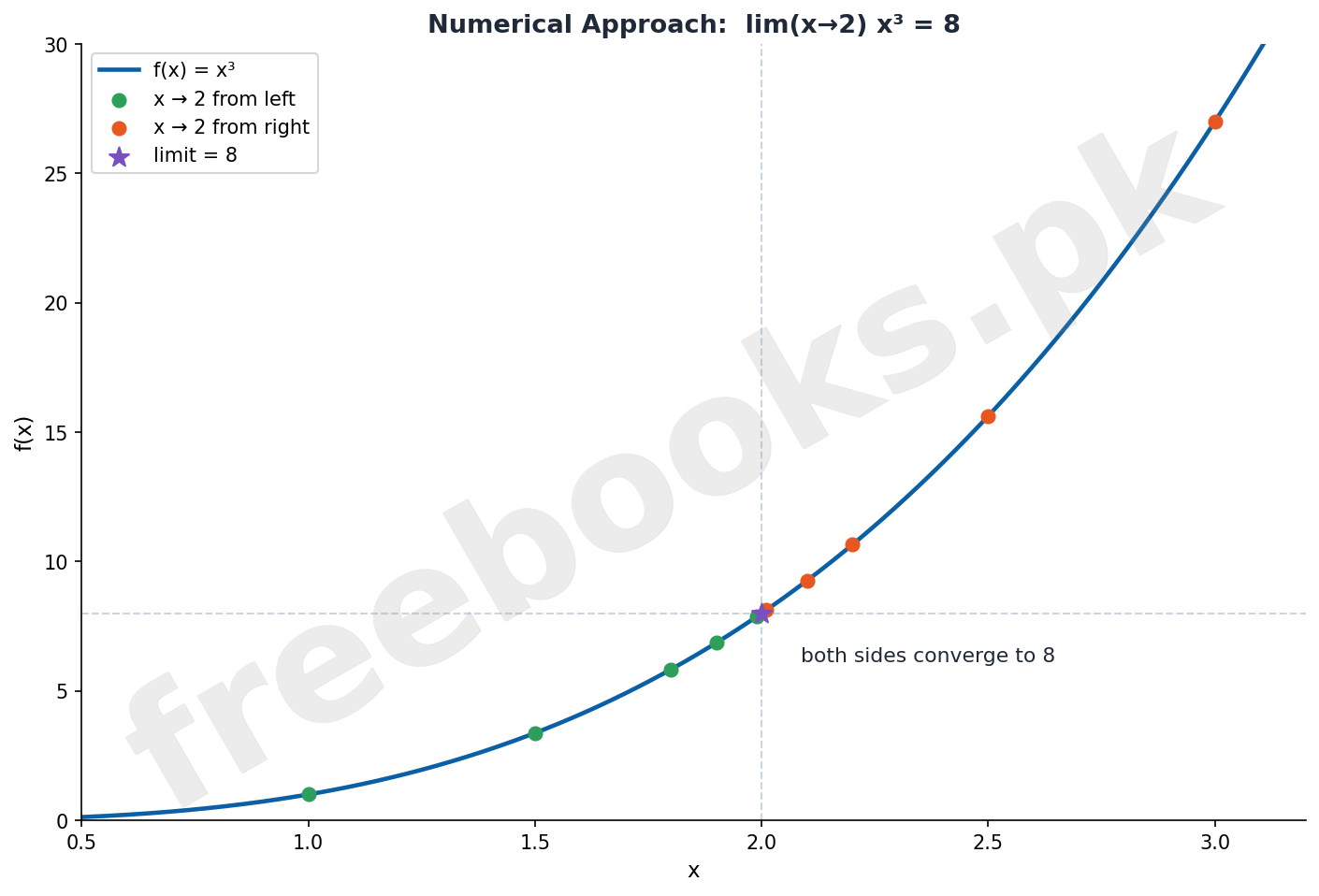
This idea can be seen numerically: for f(x) = x^3, as x takes values closer and closer to 2 from both the left (1.9, 1.99, 1.999, …) and the right (2.1, 2.01, 2.001, …), f(x) gets closer and closer to 8 — so lim(x->2) x^3 = 8, even though evaluating this way for every limit is impractical, which is why the theorems on limits are needed.
12.2 Theorems on Limits of Functions
If lim(x->a) f(x) = L and lim(x->a) g(x) = M, a set of theorems establishes that the limit of a sum, difference, constant multiple, product, quotient (with nonzero denominator limit), or integer power of functions equals the same operation applied to their individual limits — for example, lim(x->a)[f(x)+g(x)] = L+M and lim(x->a)[f(x)g(x)] = LM.
The practical consequence of these theorems is that most limits of polynomial, rational, and root functions can be evaluated by simple direct substitution of the value x approaches into the function — no special technique is needed unless substitution produces an indeterminate form like 0/0.
12.3 Evaluating 0/0 Forms and Limits at Infinity
When direct substitution produces 0/0, the function must first be simplified — typically by factoring and cancelling a common factor (using identities like x^n – a^n = (x-a)(x^(n-1)+ax^(n-2)+…+a^(n-1))) or by rationalizing a numerator or denominator containing a square root — before the limit can be evaluated.
Limits at infinity (x -> +infinity or x -> -infinity) describe the long-term behavior of a function; a key result is that lim(x->+-infinity) a/x^p = 0 for any real a and positive rational p. For a ratio of polynomials, dividing every term of the numerator and denominator by the highest power of x in the denominator reduces the limit to a form this result can evaluate directly.
12.4 The Number e and the Sandwich Theorem
The important limit lim(n->infinity) (1+1/n)^n = e (approximately 2.718281) arises naturally from the binomial theorem, and its counterpart lim(x->0) (1+x)^(1/x) = e is obtained by substituting n=1/x; both forms are used to express related limits (like (1+3/n)^(2n)) in terms of e through algebraic manipulation of the exponent.
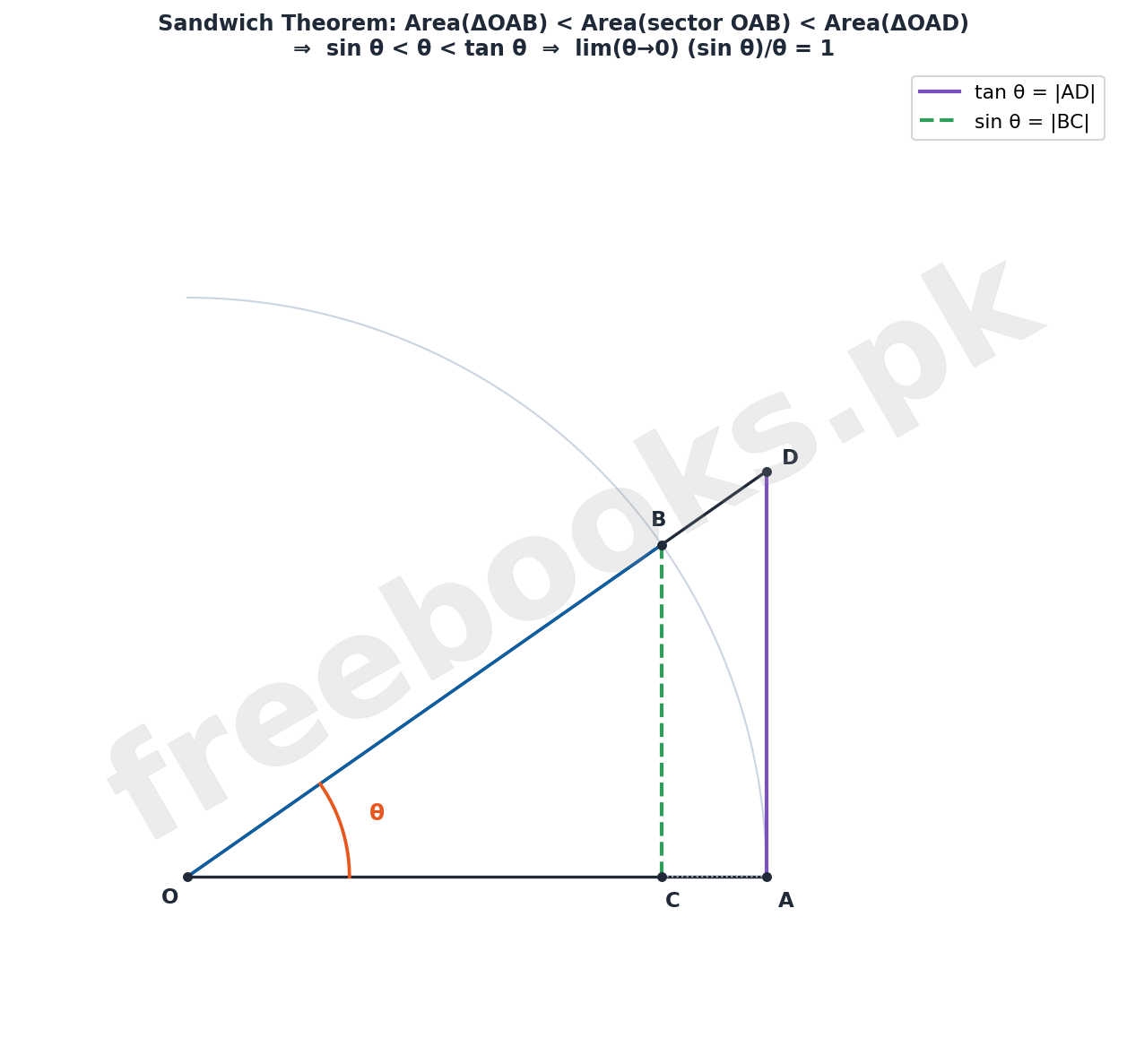
The Sandwich Theorem states that if f(x) <= g(x) <= h(x) near c (except possibly at c) and both f and h approach the same limit L as x -> c, then g must also approach L. This theorem is used geometrically (comparing the areas of a triangle, a circular sector, and a larger triangle) to prove the cornerstone trigonometric limit lim(theta->0) sin(theta)/theta = 1.
12.5 One-Sided Limits and the Criterion for Existence
The left-hand limit lim(x->c-) f(x) = L describes the value f(x) approaches as x approaches c only from values less than c; the right-hand limit lim(x->c+) f(x) = M describes the same from values greater than c. The two-sided limit lim(x->c) f(x) exists, and equals a value L, if and only if both one-sided limits exist and are equal to that same L.
This criterion is especially useful for piecewise-defined functions, where the formula for f(x) changes at the point c — the left-hand and right-hand limits must be computed separately using whichever piece of the definition applies on each side, and then compared.
12.6 Continuity, Discontinuity, and Real-World Applications
A function f is continuous at a number c if and only if three conditions all hold: f(c) is defined, lim(x->c) f(x) exists, and lim(x->c) f(x) = f(c). If any one of these three conditions fails, f is discontinuous at c — this might show up as a removable break (an undefined or mismatched point), or a jump (where the one-sided limits disagree, as commonly happens with piecewise functions).
Limits of transcendental functions (especially e^x and its variants) model many real-world long-term behaviors: radioactive decay A(t)=A0*e^(-kt) approaches 0 as t->infinity, continuously compounded investments A(t)=P0*e^(rt) grow without bound, and logistic population models approach a fixed carrying capacity — in each case, evaluating lim(t->infinity) of the model reveals its eventual real-world behavior.
Important Definitions
What does the phrase 'x approaches a' mean?
x gets arbitrarily close to a from both sides, without x ever actually equaling a.
What is the limit of a function f(x) as x approaches a?
The single number L that f(x) approaches as x approaches a from both sides, written lim(x->a) f(x) = L.
What is an indeterminate form?
An expression like 0/0 obtained by direct substitution that does not by itself reveal the value of the limit, requiring further algebraic simplification.
What is the limit of a sequence?
The value L that the terms of a sequence {a_n} approach as n approaches infinity; if such an L exists, the sequence converges to L.
What is a divergent sequence?
A sequence that does not converge to any single value — either increasing/decreasing without bound, or oscillating between values.
What does the Sandwich Theorem state?
If f(x) <= g(x) <= h(x) near c (except possibly at c) and both f and h approach the same limit L as x->c, then g(x) also approaches L.
What is the left-hand limit of f(x) as x approaches c?
The value f(x) approaches as x approaches c only through values less than c.
What is the right-hand limit of f(x) as x approaches c?
The value f(x) approaches as x approaches c only through values greater than c.
What is the criterion for the existence of lim(x->c) f(x)?
The limit exists and equals L if and only if the left-hand and right-hand limits both exist and are equal to L.
What are the three conditions for f to be continuous at c?
f(c) is defined; lim(x->c) f(x) exists; and lim(x->c) f(x) = f(c).
Key Facts and Relations
| Topic | Key Fact / Relation |
|---|---|
| Basic limit theorems | lim[f+g] = L+M; lim[fg] = LM; lim[f/g] = L/M (M not 0) |
| Important algebraic limit | lim(x->a) (x^n – a^n)/(x-a) = n a^(n-1) |
| Rationalization limit | lim(x->0) (sqrt(x+a) – sqrt(a))/x = 1/(2 sqrt(a)) |
| Limit at infinity | lim(x-> +-infinity) a/x^p = 0, p > 0 |
| The number e | lim(n->infinity) (1 + 1/n)^n = e; lim(x->0) (1+x)^(1/x) = e |
| Exponential limit | lim(x->0) (a^x – 1)/x = log_e a; lim(x->0) (e^x – 1)/x = 1 |
| Sandwich theorem result | lim(theta->0) sin(theta)/theta = 1 |
| Criterion for limit existence | lim(x->c) f(x) = L iff lim(x->c-) f(x) = lim(x->c+) f(x) = L |
| Continuity at a point | f continuous at c iff f(c) defined, lim(x->c) f(x) exists, and lim(x->c) f(x) = f(c) |
Diagrams
Numerical Approach to a Limit: A graph of f(x)=x^3 with points approaching x=2 from the left and right, both converging to the limit value 8
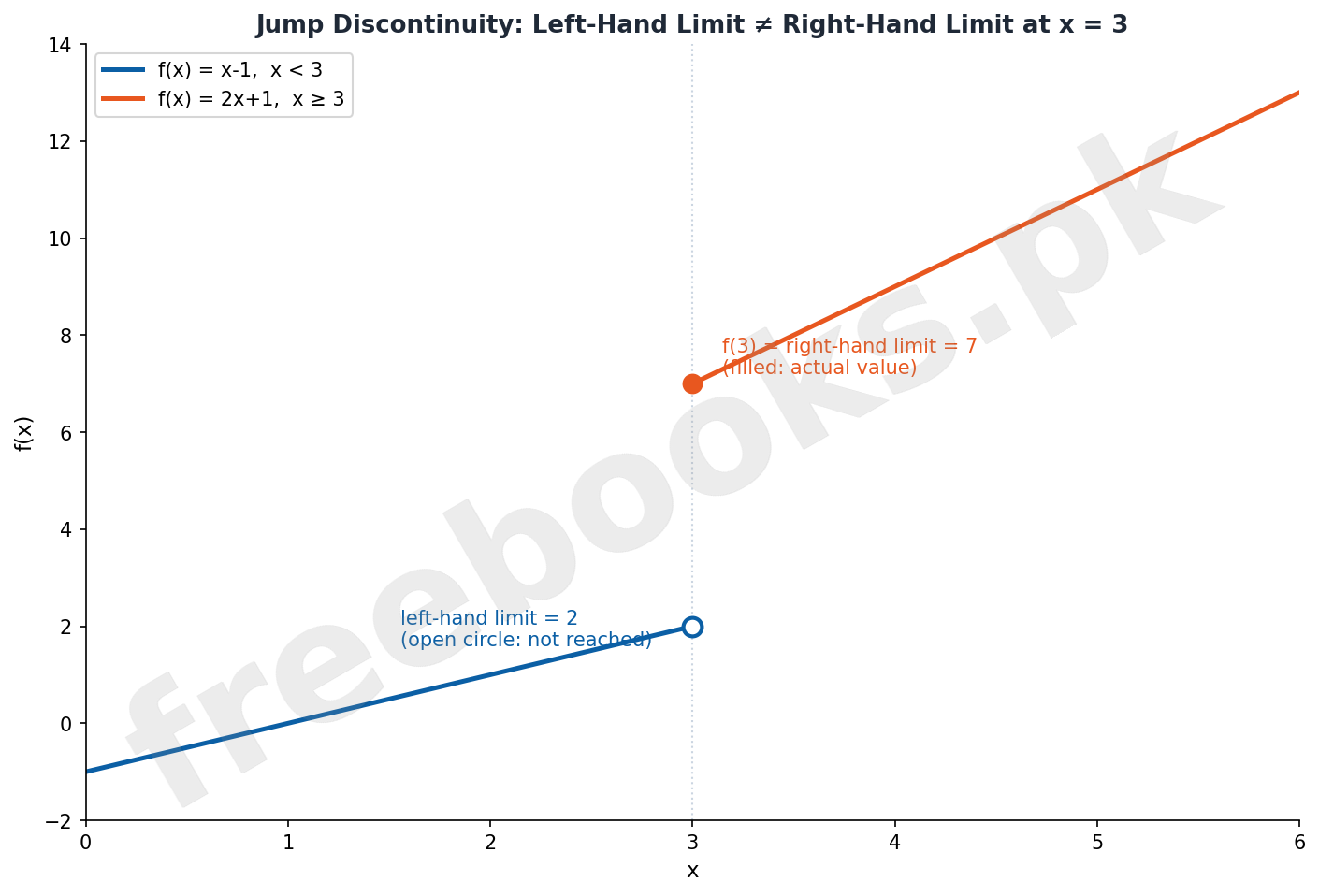
Jump Discontinuity: A piecewise graph showing a function with different left-hand and right-hand limits at x=3, illustrating a jump discontinuity
Geometric Proof: lim(theta->0) sin(theta)/theta = 1: A unit-circle sector diagram showing triangle OAB, sector OAB, and triangle OAD, used with the Sandwich Theorem to prove the limit
Solved Examples
Example 1: Evaluating a 0/0 Limit by Factoring
Problem: Evaluate lim(x->1) (x^2-1)/(x^2-x).
- Substitute x=1 directly: (1-1)/(1-1) = 0/0, an indeterminate form, so factoring is needed.
- Factor the numerator and denominator: x^2-1 = (x-1)(x+1), and x^2-x = x(x-1).
- Cancel the common factor (x-1): (x-1)(x+1) / [x(x-1)] = (x+1)/x.
- Now substitute x=1 into the simplified expression: (1+1)/1 = 2/1 = 2.
- Final answer: lim(x->1) (x^2-1)/(x^2-x) = 2.
Example 2: Evaluating a 0/0 Limit by Rationalizing
Problem: Evaluate lim(x->3) (x-3)/(sqrt(x)-sqrt(3)).
- Substitute x=3 directly: (3-3)/(sqrt3-sqrt3) = 0/0, an indeterminate form.
- Multiply numerator and denominator by the conjugate (sqrt(x)+sqrt(3)): the denominator becomes (sqrt(x)-sqrt(3))(sqrt(x)+sqrt(3)) = x-3.
- The expression becomes (x-3)(sqrt(x)+sqrt(3)) / (x-3), and the common factor (x-3) cancels, leaving sqrt(x)+sqrt(3).
- Substitute x=3: sqrt(3)+sqrt(3) = 2 sqrt(3).
- Final answer: lim(x->3) (x-3)/(sqrt(x)-sqrt(3)) = 2 sqrt(3).
Example 3: Finding the Limit of a Sequence
Problem: Find the limit of the sequence a_n = (2n+3)/(n+1) as n -> infinity.
- Divide every term in the numerator and denominator by n, the highest power of n present: a_n = (2 + 3/n) / (1 + 1/n).
- As n -> infinity, both 3/n and 1/n approach 0.
- Substitute these limits: a_n -> (2+0)/(1+0) = 2/1 = 2.
- Since the terms approach a single finite value, the sequence converges.
- Final answer: lim(n->infinity) (2n+3)/(n+1) = 2.
Example 4: Evaluating a Limit at Infinity for a Rational Function
Problem: Evaluate lim(x->+infinity) (5x^4-10x^2+1) / (-3x^3+10x^2+50).
- Identify the highest power of x in the denominator: x^3.
- Divide every term in the numerator and denominator by x^3: numerator becomes 5x – 10/x + 1/x^3; denominator becomes -3 + 10/x + 50/x^3.
- As x -> +infinity, the terms 10/x, 1/x^3, 10/x, and 50/x^3 all approach 0, while 5x grows without bound.
- The expression approaches (infinity – 0 + 0) / (-3 + 0 + 0), i.e. infinity divided by a negative constant.
- Final answer: since the numerator grows without bound while the denominator approaches -3, the limit is -infinity.
Example 5: Expressing a Limit in Terms of e
Problem: Express lim(n->+infinity) (1 + 3/n)^(2n) in terms of e.
- Recognize the resemblance to lim(n->infinity) (1+1/n)^n = e; rewrite the exponent to match this pattern.
- Write (1+3/n)^(2n) = [(1+3/n)^(n/3)]^6, since (n/3) x 6 = 2n.
- Let m = n/3; as n -> infinity, m -> infinity also, so (1+3/n)^(n/3) = (1+1/m)^m -> e.
- Substitute back: [(1+1/m)^m]^6 -> e^6.
- Final answer: lim(n->+infinity) (1+3/n)^(2n) = e^6.
Example 6: Applying the Sandwich Theorem Result to Trigonometric Limits
Problem: Evaluate (i) lim(theta->0) sin(7 theta)/theta and (ii) lim(theta->0) (1-cos theta)/theta.
- For (i): let x=7 theta, so theta = x/7; as theta->0, x->0 also. Rewrite: sin(7theta)/theta = sin(x)/(x/7) = 7 sin(x)/x.
- Using lim(x->0) sin(x)/x = 1: lim(theta->0) sin(7theta)/theta = 7(1) = 7.
- For (ii): multiply numerator and denominator by (1+cos theta): (1-cos theta)/theta = (1-cos^2 theta) / [theta(1+cos theta)] = sin^2(theta) / [theta(1+cos theta)].
- Rewrite as sin(theta) . [sin(theta)/theta] . [1/(1+cos theta)], and take the limit of each factor: 0 . 1 . (1/2) = 0.
- Final answer: (i) lim(theta->0) sin(7theta)/theta = 7; (ii) lim(theta->0) (1-cos theta)/theta = 0.
Example 7: Discussing Continuity of a Piecewise Function
Problem: Discuss the continuity of f(x) = x-1 if x<3, and f(x) = 2x+1 if x>=3, at x=3.
- Check condition (i): f(3) = 2(3)+1 = 7, so f(3) is defined.
- Find the left-hand limit: lim(x->3-) f(x) = lim(x->3-) (x-1) = 3-1 = 2.
- Find the right-hand limit: lim(x->3+) f(x) = lim(x->3+) (2x+1) = 2(3)+1 = 7.
- Since the left-hand limit (2) does not equal the right-hand limit (7), lim(x->3) f(x) does not exist — condition (ii) fails.
- Final answer: f(x) is discontinuous at x=3, because the two-sided limit does not exist (a jump discontinuity), even though f(3) itself is defined.
Example 8: Applying Limits to a Real-World Population Model
Problem: A town's population is modeled by P(t) = 100000 / (1 + 9 e^(-0.5t)). Find the long-term population as t -> infinity.
- As t -> infinity, the exponent -0.5t -> -infinity, so e^(-0.5t) -> 0 (since e raised to a very negative power approaches 0).
- Substitute this into the denominator: 1 + 9(0) = 1.
- So the model approaches P(t) -> 100000/1 = 100000.
- This means the population grows but levels off, approaching a fixed maximum rather than growing without bound.
- Final answer: the long-term population as t -> infinity is 100,000 (the model's carrying capacity).
Short Questions & Answers
What does x -> a mean?
x gets arbitrarily close to a from both sides, without ever equaling a.
What is an indeterminate form?
An expression like 0/0 that does not directly reveal a limit's value and requires further simplification.
What is the value of lim(n->infinity) (1+1/n)^n?
e, approximately 2.718281.
What does the Sandwich Theorem allow you to conclude?
If a function is squeezed between two others that both approach the same limit L, it also approaches L.
What is the value of lim(theta->0) sin(theta)/theta?
1.
What is the criterion for lim(x->c) f(x) to exist?
The left-hand limit and right-hand limit must both exist and be equal.
What are the three conditions for continuity of f at x=c?
f(c) is defined; lim(x->c) f(x) exists; and lim(x->c) f(x) equals f(c).
Long Questions & Answers
Explain how the theorems on limits allow most limits to be evaluated by substitution, and describe the algebraic techniques needed when substitution produces a 0/0 form.
What do the theorems on limits state about sums, products, and quotients of functions?
If lim(x->a) f(x)=L and lim(x->a) g(x)=M, then the limit of their sum, difference, product, and quotient (with M not 0) equals the same operation applied to L and M — for example, lim[f(x)g(x)] = LM.
Why do these theorems mean most limits can be found by direct substitution?
Since sums, differences, products, and quotients of limits reduce to the same operations on the individual function values at a, evaluating the limit of a polynomial or rational function (with nonzero denominator) is the same as simply substituting the approached value into the function.
What should be done when direct substitution produces a 0/0 form?
The function must be algebraically simplified first — typically by factoring both the numerator and denominator to reveal and cancel a common factor, using identities like x^n-a^n=(x-a)(x^(n-1)+…+a^(n-1)).
How is rationalization used when the 0/0 form involves a square root?
Multiplying the numerator and denominator by the conjugate of the square-root expression eliminates the root from the problematic term, turning the difference of square roots into a difference of squares that can be cancelled with the denominator.
Describe how left-hand and right-hand limits are used to test whether a two-sided limit exists, and explain the three conditions required for a function to be continuous at a point.
What is the difference between a left-hand limit and a right-hand limit?
The left-hand limit lim(x->c-) f(x) considers only values of x approaching c from below (less than c), while the right-hand limit lim(x->c+) f(x) considers only values approaching from above (greater than c).
What is the criterion for the two-sided limit lim(x->c) f(x) to exist?
The two-sided limit exists, and equals L, if and only if both the left-hand and right-hand limits exist and are equal to that same value L.
Why is this criterion especially important for piecewise-defined functions?
Because the formula defining f(x) changes at the boundary point c, the one-sided limits often must be computed using different pieces of the definition on each side, and a mismatch between them (a jump) is a common source of discontinuity.
What three conditions must all hold for f to be continuous at c?
f(c) must be defined, lim(x->c) f(x) must exist, and the two must be equal (lim(x->c) f(x) = f(c)); if any one of these three conditions fails, f is discontinuous at c.
Multiple Choice Questions (MCQs)
The phrase 'x approaches a' means: (A) x equals a (B) x gets arbitrarily close to a without equaling a (C) x is always greater than a (D) x is undefined
Correct answer: (B) x gets arbitrarily close to a without equaling a. x -> a means x gets arbitrarily close to a from both sides, but x never actually equals a.
lim(x->a) [f(x) + g(x)] equals: (A) lim f(x) – lim g(x) (B) lim f(x) + lim g(x) (C) lim f(x) x lim g(x) (D) Cannot be determined
Correct answer: (B) lim f(x) + lim g(x). The limit of a sum equals the sum of the individual limits.
When direct substitution gives 0/0, the correct next step is to: (A) Conclude the limit is 0 (B) Conclude the limit does not exist (C) Simplify algebraically (factor or rationalize) and retry (D) Conclude the limit is 1
Correct answer: (C) Simplify algebraically (factor or rationalize) and retry. A 0/0 result is indeterminate and requires algebraic simplification before the limit can be evaluated.
lim(n->infinity) (1 + 1/n)^n equals: (A) 1 (B) 0 (C) e (D) infinity
Correct answer: (C) e. This is the defining limit of the number e, approximately 2.718281.
The Sandwich Theorem is used to prove which important limit? (A) lim(x->0) x^2 = 0 (B) lim(theta->0) sin(theta)/theta = 1 (C) lim(x->infinity) 1/x = 0 (D) lim(x->a) c = c
Correct answer: (B) lim(theta->0) sin(theta)/theta = 1. The Sandwich Theorem is used geometrically to prove lim(theta->0) sin(theta)/theta = 1.
lim(x-> +infinity) a/x^p, where p>0, equals: (A) a (B) infinity (C) 0 (D) 1/a
Correct answer: (C) 0. As x grows without bound, a/x^p approaches 0 for any real a and positive rational p.
The two-sided limit lim(x->c) f(x) exists if and only if: (A) f(c) is defined (B) The left-hand and right-hand limits both exist and are equal (C) f is a polynomial (D) f(x) is always positive
Correct answer: (B) The left-hand and right-hand limits both exist and are equal. The two-sided limit exists exactly when the one-sided limits both exist and agree.
A function f is continuous at c if: (A) f(c) is defined only (B) lim(x->c) f(x) exists only (C) f(c) is defined, the limit exists, and they are equal (D) f is a straight line
Correct answer: (C) f(c) is defined, the limit exists, and they are equal. Continuity requires all three conditions to hold simultaneously.
A jump discontinuity occurs when: (A) f(c) is undefined (B) The left-hand and right-hand limits disagree (C) f(x) is a constant function (D) The domain of f is all real numbers
Correct answer: (B) The left-hand and right-hand limits disagree. A jump discontinuity happens when the one-sided limits exist but are not equal to each other.
For the radioactive decay model A(t) = A0 e^(-kt), the limit as t -> infinity is: (A) A0 (B) infinity (C) 0 (D) k
Correct answer: (C) 0. Since e^(-kt) -> 0 as t -> infinity (for k>0), the amount of substance approaches 0.
Quick Revision Summary
- x -> a means x gets arbitrarily close to a without ever equaling a
- lim(x->a) f(x) = L means f(x) approaches L as x approaches a from both sides
- The theorems on limits let sums, differences, products, quotients, and powers of functions be evaluated by direct substitution
- A 0/0 result requires algebraic simplification — factoring or rationalizing — before the limit can be found
- lim(x-> +-infinity) a/x^p = 0 for any real a and positive rational p
- lim(n->infinity) (1+1/n)^n = e; lim(x->0) (1+x)^(1/x) = e
- The Sandwich Theorem: if f(x)<=g(x)<=h(x) near c and f, h both approach L, then g also approaches L
- lim(theta->0) sin(theta)/theta = 1, proved geometrically via the Sandwich Theorem
- lim(x->c) f(x) exists iff the left-hand and right-hand limits both exist and are equal
- f is continuous at c iff f(c) is defined, lim(x->c) f(x) exists, and the two are equal
- A discontinuity can arise from an undefined point, a mismatched value, or a jump (unequal one-sided limits)
- Limits of exponential/transcendental functions model real-world long-term behavior: decay to 0, unbounded growth, or leveling off at a carrying capacity
Exam Tips
- Always try direct substitution first — only switch to factoring or rationalizing if you get an indeterminate form like 0/0
- When rationalizing, multiply by the conjugate of whichever part of the expression contains the square root
- For limits at infinity in a rational function, divide every term by the highest power of x in the denominator
- Recognize the pattern (1+1/n)^n before assuming a limit needs a totally new technique — many 'in terms of e' problems are just algebraic rewrites of this one pattern
- For piecewise functions, always compute the left-hand and right-hand limits separately using the matching piece of the definition on each side
- Remember continuity needs all three conditions — a function can have a limit at a point without being continuous there if f(c) is undefined or does not match the limit