A function is a rule of correspondence that connects two sets so that every input produces exactly one output — it is one of the most fundamental ideas in all of mathematics, describing how one quantity depends on another. This unit builds a precise understanding of a function's domain, codomain, and range, introduces the notation y = f(x), and explains how to evaluate a function at a number or at an expression. It then covers the vertical line test for recognizing a function from its graph, and the three key types of functions — one-to-one, onto, and bijective — along with piecewise functions defined by different rules on different intervals.
The second half of the unit turns to graphs: finding where a line crosses the coordinate axes, where two lines cross each other, and where a line crosses a parabola — with two, one, or no solutions depending on the situation. It closes with the characteristic shapes of square root and cube root function graphs, and two real-life applications of exponential growth and decay: predicting stock prices and modelling how a pollutant's concentration falls over time.
Learning Objectives
- Define a function, its domain, codomain, and range
- Evaluate a function at given values and expressions using function notation f(x)
- Find the domain and range of polynomial, rational, and radical functions
- Apply the vertical line test to determine whether a graph represents a function
- Define and identify one-to-one (injective) functions
- Define and identify onto (surjective) functions
- Define and identify bijective functions
- Define and evaluate piecewise functions
- Find the point(s) of intersection of a linear function with the coordinate axes graphically
- Find the point(s) of intersection of two linear functions, and of a linear and a quadratic function, graphically
- Graph square root and cube root functions and describe their domain and range
- Apply exponential growth and decay models to real-life problems such as stock prices and pollutant concentration
Key Concepts
2.1 Function, Domain, Codomain, and Range
The term function was introduced by the German mathematician Leibniz to describe the dependence of one quantity on another. Formally, a function f from a set X to a set Y is a rule of correspondence that assigns to each element x in X a unique element y in Y. The set X is called the domain of f — the permitted inputs. The set Y is called the codomain — the set the outputs are allowed to belong to. The range is the set of values actually produced as output, and the range is always a subset of the codomain (the two can be equal, but the codomain may contain values the function never actually reaches).
The Swiss mathematician Euler introduced the notation y = f(x), read "y equals f of x", to write the statement "y is a function of x". A function can be thought of as a machine that takes an input x, operates on it, and produces exactly one output f(x), called the value of f at x or the image of x under f. Here x is the independent variable and y is the dependent variable. Evaluating a function at a number or an expression is done by substituting that number or expression everywhere the variable appears in the formula.
2.2 Domain and Range of Common Function Types
For a polynomial function, the domain is always all real numbers, since any real number can be substituted into the formula without difficulty. For a rational function (a fraction with the variable in the denominator), every value of x that makes the denominator equal to zero must be excluded from the domain, since division by zero is undefined. For a function involving a square root, the expression under the root sign (the radicand) must be greater than or equal to zero, since the square root of a negative number is not a real number — this condition is solved as an inequality, often using critical points to divide the number line into regions.
The range of a function is often found by setting y = f(x) and solving the equation for x in terms of y; the range is exactly the set of y-values for which that expression for x is defined (real-valued). For a rational function, this typically means checking which y-value makes the resulting denominator zero and excluding it; for a radical function, it means checking the smallest and largest values the expression under the root can produce as x ranges over the domain.
2.3 The Vertical Line Test and Types of Functions
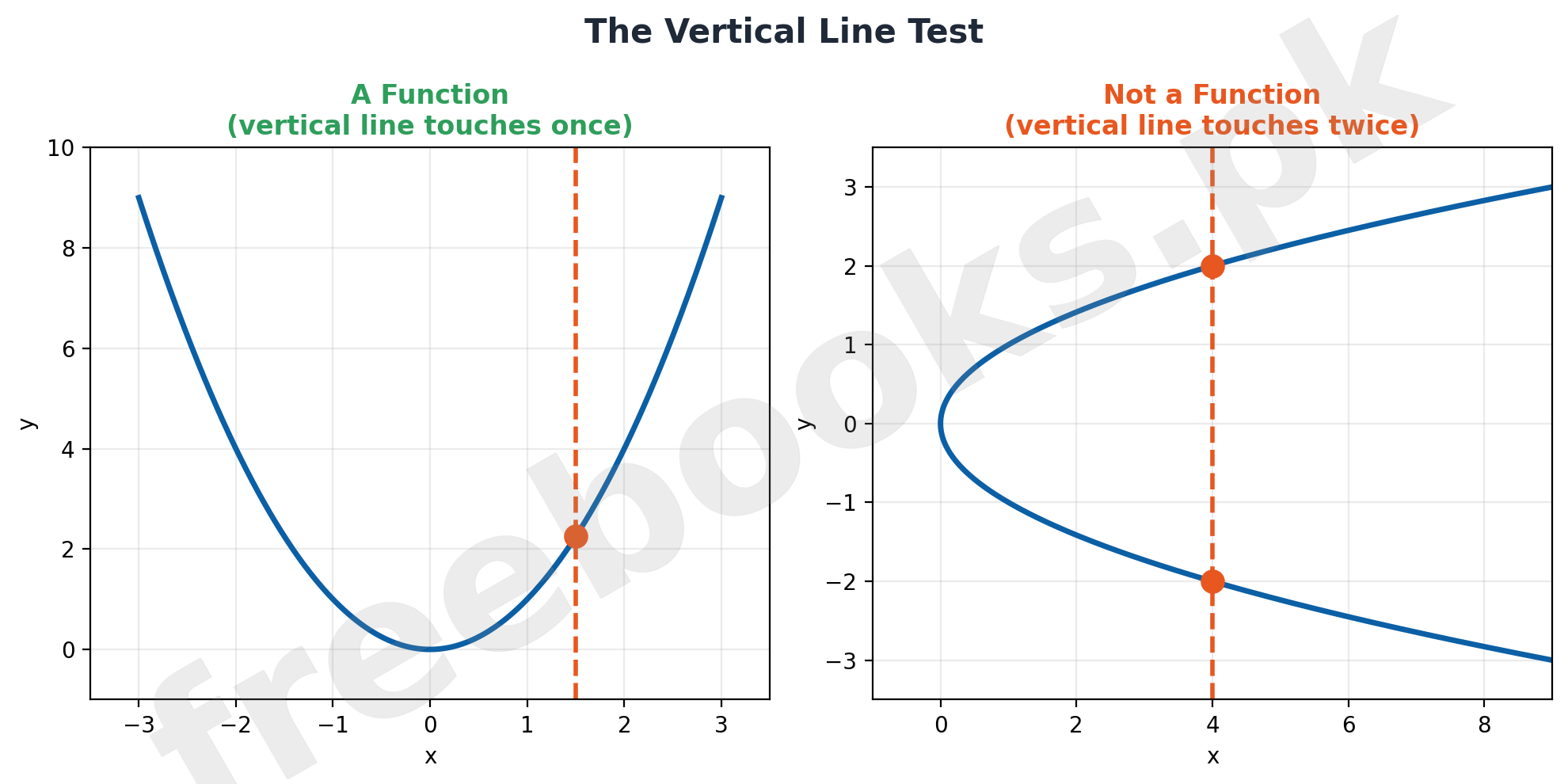
The vertical line test is a graphical method for checking whether a curve represents a function: a graph represents a function if and only if no vertical line intersects it more than once. This works because a vertical line at a fixed x-value crosses the graph once for every output value paired with that x — if it crosses more than once, that x-value has more than one output, which violates the very definition of a function.
A function f is one-to-one (injective) if different inputs always produce different outputs, i.e., f(x1) = f(x2) implies x1 = x2. A function f is onto (surjective) if every element of the stated codomain has at least one pre-image in the domain — for every y in the codomain, there exists an x in the domain with f(x) = y. A function that is both one-to-one and onto is called bijective. A piecewise function is a function defined by different expressions over different intervals of its domain, such as f(x) = 2x+1 for x<0 and f(x) = x^2-1 for x>=0.
2.4 Graphical Intersection of Functions
The point of intersection of two graphs is the point where both graphs meet, and it represents the common solution to both equations at once. The intersection of a linear function with the coordinate axes is found by setting x=0 to get the y-intercept, and setting y=0 to get the x-intercept. The intersection of two linear functions is the single point (if any) where both lines have the same x and y values simultaneously — found either by plotting both lines and reading off the crossing point, or by solving the two equations together algebraically.
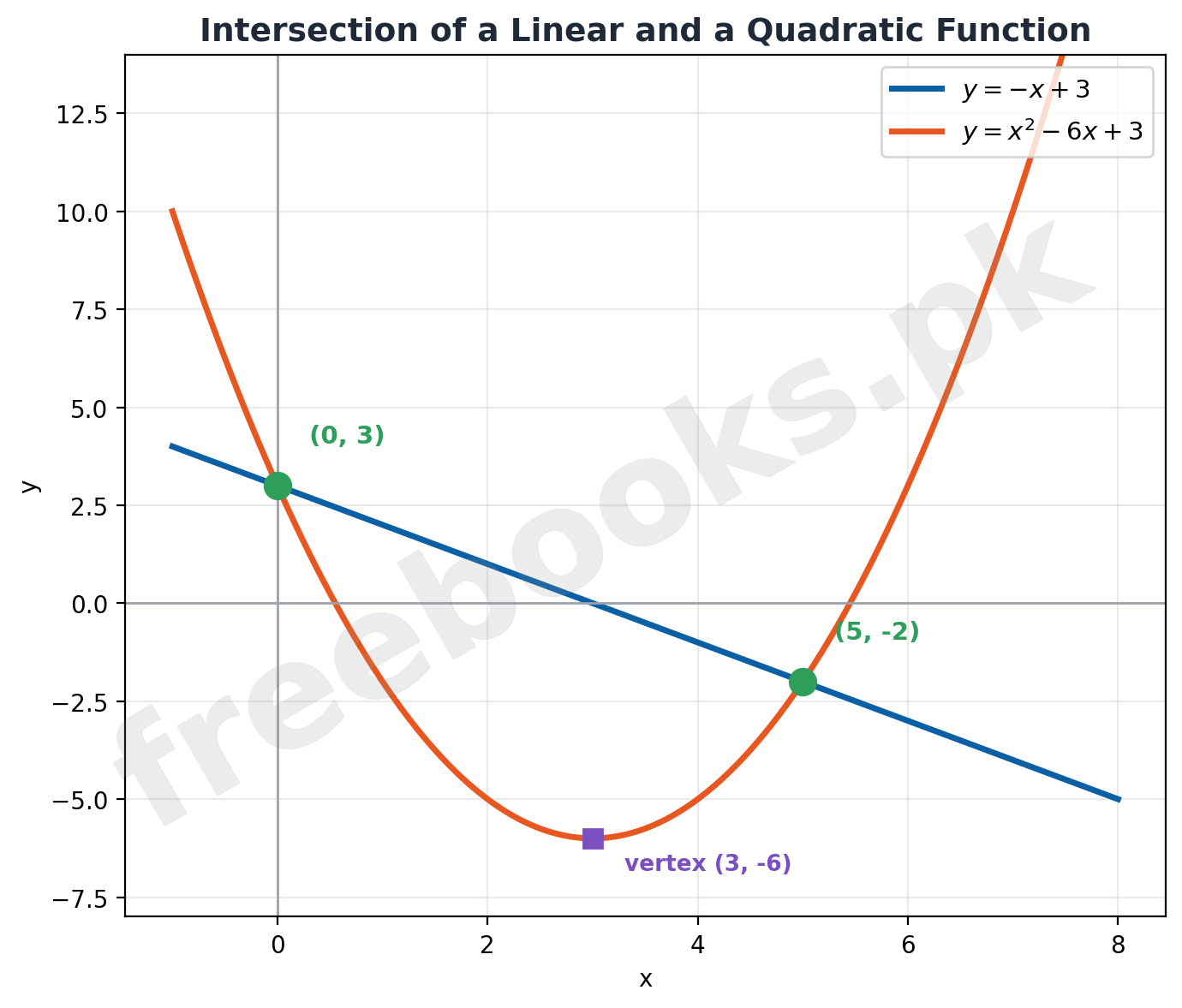
A line and a parabola can intersect at two points, exactly one point (where the line is tangent to the parabola), or not at all, depending on the equations involved — this can be seen by setting the two expressions for y equal to each other and examining the resulting quadratic equation's discriminant. Sketching the parabola's vertex (found using h = -b/2a, k = f(h)) alongside the line's intercepts makes it easy to see, and check, how many solutions exist.
2.5 Graphs of Square Root and Cube Root Functions
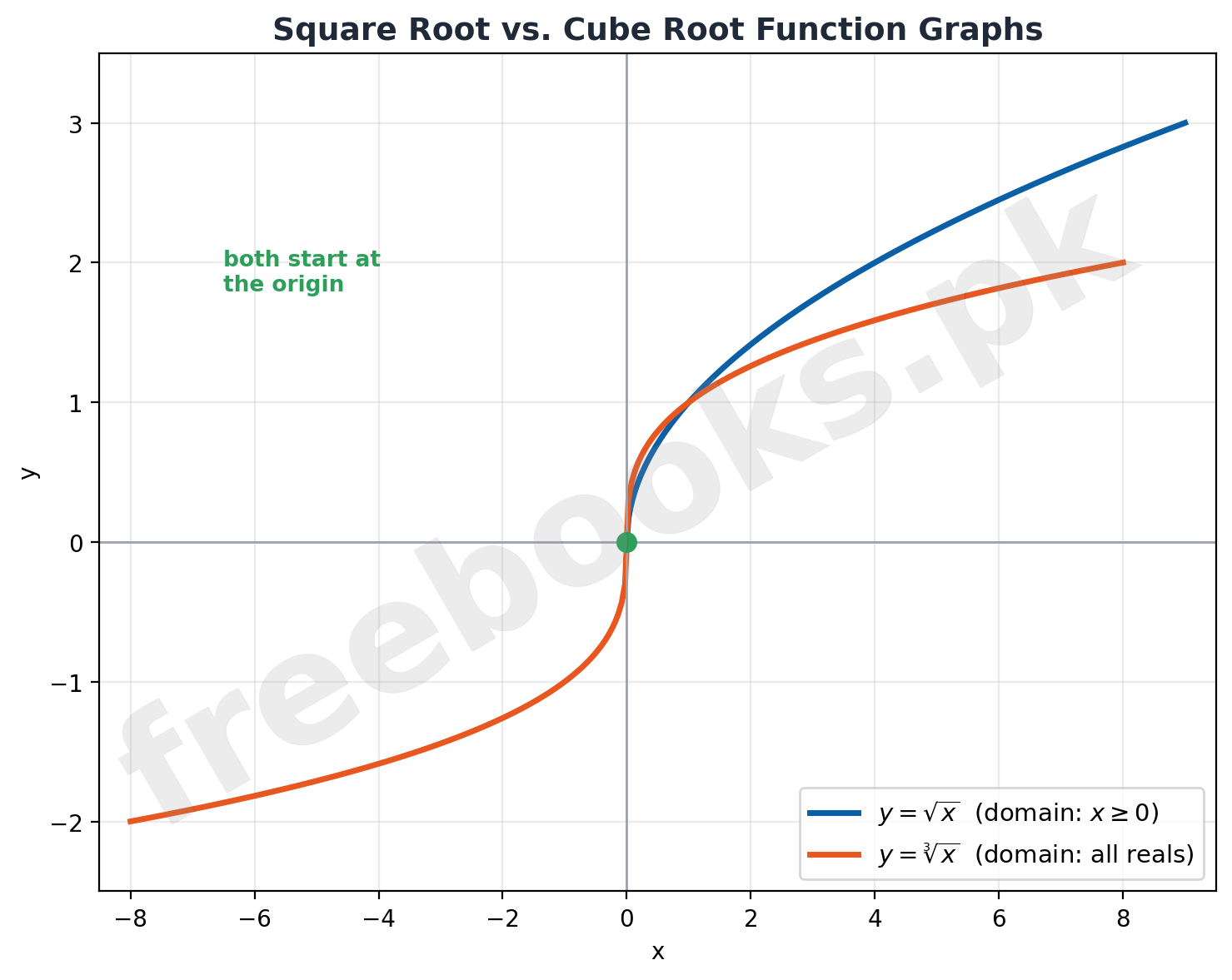
The square root function y = a*sqrt(x) (and its shifted forms) has domain restricted to x >= 0, since the square root of a negative number is not real; its graph is a curve that starts at a fixed point and rises (or falls) steadily, always staying on one side of the vertical line through its starting point. Its range depends on the sign of a and any vertical shift applied to the function.
The cube root function y = a*cbrt(x) (and its shifted forms) has domain and range equal to all real numbers, because the cube root of a negative number is a real (negative) number, unlike the square root. Its graph is an S-shaped curve that passes through the origin (or through the shifted centre point) and extends in both directions, growing more slowly as |x| increases.
2.6 Real-Life Applications: Growth and Decay
When a quantity increases over time — money earning interest, a growing population — it is called growth; when a quantity decreases over time — a radioactive substance losing strength, a cooling cup of coffee — it is called decay. The exponential growth model P(t) = P0 * e^(rt) describes quantities like stock prices, where P0 is the initial value, r is the growth rate, and t is time; the time needed for the quantity to double is found by setting 2 = e^(rt) and solving to get t = ln(2)/r.
Decay-type situations are modelled by similar functions, such as a pollutant's concentration C(t) = 100/sqrt(t+1) falling over time; these are solved the same way as any other function equation — substituting a known time to find the concentration, or setting the concentration to a target value and solving algebraically for the time.
Important Definitions
What is a function?
A rule of correspondence from a set X to a set Y that assigns to each element of X exactly one element of Y.
What is the domain of a function?
The set X of all permitted input values of the function.
What is the codomain of a function?
The set Y in which the function's output values are allowed to lie; it may contain values that are never actually produced by the function.
What is the range of a function?
The set of actual output values produced by the function; the range is always a subset of the codomain.
What does the function notation y = f(x) mean?
A way of writing "y is a function of x", where f(x) denotes the value (or image) of the function f at the input x.
What is a one-to-one (injective) function?
A function in which different inputs always produce different outputs, i.e., f(x1) = f(x2) implies x1 = x2.
What is an onto (surjective) function?
A function in which every element of the codomain has at least one pre-image in the domain.
What is a bijective function?
A function that is both one-to-one and onto.
What is the vertical line test?
A graphical test stating that a curve represents a function if and only if no vertical line intersects it more than once.
What is a piecewise function?
A function defined by different expressions over different intervals of its domain.
Key Facts and Relations
| Topic | Key Fact / Relation |
|---|---|
| Function notation | y = f(x) |
| One-to-one condition | f(x1) = f(x2) implies x1 = x2 |
| Onto condition | For every y in Y, there exists x in X such that f(x) = y |
| Domain rule (rational function) | Exclude every x that makes the denominator equal to 0 |
| Domain rule (square root function) | The radicand (expression under the root) must be >= 0 |
| Vertex of a parabola y = ax^2+bx+c | h = -b/2a, k = f(h) |
| Quadratic formula (for x-intercepts) | x = [-b +/- sqrt(b^2-4ac)] / 2a |
| Square root function y = a*sqrt(x+h)+k | Domain x >= -h; range depends on sign of a and value of k |
| Cube root function y = a*cbrt(x-h)+k | Domain and range = all real numbers |
| Exponential growth model | P(t) = P0 * e^(rt) |
| Doubling time | t = ln(2) / r |
Diagrams
The Vertical Line Test: Two side-by-side graphs: a parabola y = x^2, where a vertical line touches the curve only once (a function), and a sideways parabola x = y^2, where a vertical line touches the curve twice (not a function)
Intersection of a Linear and a Quadratic Function: The line y = -x+3 and the parabola y = x^2-6x+3 plotted together, with their two intersection points (0,3) and (5,-2) marked, and the parabola's vertex (3,-6) shown
Square Root vs. Cube Root Function Graphs: The graphs of y = sqrt(x), which only exists for x >= 0, and y = cbrt(x), which exists for all real x, plotted on the same axes to compare their domains and characteristic shapes
Solved Examples
Example 1: Evaluating a Function
Problem: If f(x) = 2x^2 – 3x + 5, find f(-2), f(3), and f(a+1).
- f(-2): substitute x=-2 — f(-2) = 2(-2)^2 – 3(-2) + 5 = 2(4) + 6 + 5 = 8 + 6 + 5 = 19.
- f(3): substitute x=3 — f(3) = 2(3)^2 – 3(3) + 5 = 2(9) – 9 + 5 = 18 – 9 + 5 = 14.
- f(a+1): substitute x=(a+1) everywhere — f(a+1) = 2(a+1)^2 – 3(a+1) + 5 = 2(a^2+2a+1) – 3a – 3 + 5 = 2a^2+4a+2-3a+2 = 2a^2+a+4.
- Final answer: f(-2) = 19, f(3) = 14, f(a+1) = 2a^2+a+4.
Example 2: Domain and Range of a Rational Function
Problem: Find the domain and range of f(x) = (x+1)/(x-3).
- Domain: the denominator x-3 equals 0 when x=3, so x=3 must be excluded. Domain = all real numbers except 3.
- Range: let y = (x+1)/(x-3). Then y(x-3) = x+1, so xy – 3y = x+1, so x(y-1) = 3y+1, so x = (3y+1)/(y-1).
- This expression for x is defined for every y except y=1 (which would make the denominator zero).
- Final answer: Domain = all reals except 3; Range = all reals except 1.
Example 3: Domain and Range of a Square Root Function
Problem: Find the domain and range of f(x) = sqrt(x^2 – 16).
- The radicand must be >= 0: x^2 – 16 >= 0, so x^2 >= 16, giving x <= -4 or x >= 4.
- Domain = (-infinity, -4] union [4, infinity).
- The smallest value the radicand can take is 0, at x = +/-4, which gives y = sqrt(0) = 0. As |x| grows beyond 4, x^2-16 grows without bound, so y grows without bound too.
- Final answer: Domain = (-infinity,-4] union [4,infinity); Range = [0, infinity).
Example 4: Proving a Function Is Bijective
Problem: Show that f(x) = 3x – 5, with domain and codomain both the real numbers, is bijective.
- One-to-one: assume f(x1) = f(x2). Then 3×1-5 = 3×2-5, so 3×1 = 3×2, so x1 = x2. So f is one-to-one.
- Onto: for any real number y, solve y = 3x-5 for x, giving x = (y+5)/3, which is a real number for every real y, and f((y+5)/3) = 3*(y+5)/3 – 5 = y+5-5 = y.
- Since f is both one-to-one and onto, f is bijective.
- Final answer: f(x) = 3x-5 is bijective.
Example 5: Intersection with the Coordinate Axes
Problem: Find where the line y = -3x + 9 crosses the x-axis and the y-axis.
- y-intercept: set x=0 — y = -3(0)+9 = 9, giving the point (0, 9).
- x-intercept: set y=0 — 0 = -3x+9, so 3x=9, so x=3, giving the point (3, 0).
- Final answer: the line crosses the axes at (0, 9) and (3, 0).
Example 6: Intersection of a Linear and a Quadratic Function
Problem: Find the points of intersection of y = x+1 and y = x^2-x-3.
- Set the two expressions for y equal: x+1 = x^2-x-3.
- Rearranging: 0 = x^2-2x-4, so x = [2 +/- sqrt(4+16)]/2 = [2 +/- sqrt(20)]/2 = 1 +/- sqrt(5).
- Since sqrt(5) is approximately 2.236, x is approximately 3.236 or -1.236.
- Substituting back into y=x+1: y is approximately 4.236 or -0.236.
- Final answer: the graphs intersect at approximately (3.24, 4.24) and (-1.24, -0.24).
Example 7: Application: Exponential Growth
Problem: A bacteria population grows according to P(t) = P0*e^(rt), starting at P0 = 2000 with growth rate r = 8% per hour. Find the population after 5 hours, and the time for the population to double.
- Population after 5 hours: P(5) = 2000*e^(0.08*5) = 2000*e^0.4. Using e^0.4 is approximately 1.4918, P(5) is approximately 2000*1.4918 = 2983.6, about 2984 bacteria.
- Doubling time: set 2*P0 = P0*e^(rt), so 2 = e^(rt), so ln(2) = rt, so t = ln(2)/r.
- t = 0.6931/0.08, which is approximately 8.66 hours.
- Final answer: population after 5 hours is approximately 2984; doubling time is approximately 8.66 hours.
Short Questions & Answers
What is the domain of a function?
The set of all permitted input values of the function.
What is the difference between range and codomain?
The range is the actual set of outputs the function produces; the codomain is the set the outputs are allowed to belong to. The range is always a subset of the codomain.
State the vertical line test.
A curve represents a function if and only if no vertical line crosses it more than once.
When is a function called one-to-one?
When different inputs always give different outputs, i.e., f(x1)=f(x2) implies x1=x2.
When is a function called onto?
When every element of the codomain has at least one pre-image in the domain.
What is a piecewise function?
A function defined by different expressions over different intervals of its domain.
What is the domain restriction for a square root function?
The expression under the square root (the radicand) must be greater than or equal to zero.
Long Questions & Answers
Define a function together with its domain, codomain, and range, and explain how the domain and range of a rational function are determined, using a worked example.
What is a function, and what are its domain, codomain, and range?
A function f from a set X to a set Y is a rule of correspondence that assigns to every element x in X exactly one element y in Y. X is the domain (the permitted inputs), Y is the codomain (the set the outputs are allowed to belong to), and the range is the actual subset of Y that is produced as output — the range is always a subset of the codomain, though the two can be equal.
How is the domain of a rational function determined?
The domain of a rational function excludes every value of x that makes the denominator equal to zero, since division by zero is undefined; all other real numbers are permitted inputs.
How is the range of a rational function typically found?
Set y = f(x), solve the resulting equation for x in terms of y, and determine which values of y make that expression for x defined; the range is exactly the set of such y values.
Work through an example of finding the domain and range of a rational function.
For f(x) = (x+1)/(x-3): the denominator is zero at x=3, so the domain is all real numbers except 3. Setting y=(x+1)/(x-3) and solving gives x=(3y+1)/(y-1), which is defined for every y except y=1, so the range is all real numbers except 1.
Explain the vertical line test and the three key types of functions — one-to-one, onto, and bijective — with the reasoning behind each definition.
What is the vertical line test, and what does it check?
The vertical line test says a graph represents a function if and only if no vertical line intersects it more than once; a vertical line at a fixed x-value crosses the graph once for each output value that corresponds to that x, so more than one crossing means that x-value has more than one output, which violates the definition of a function.
What makes a function one-to-one (injective)?
A function is one-to-one if different inputs always produce different outputs — formally, f(x1)=f(x2) implies x1=x2. Geometrically, a one-to-one function's graph passes a horizontal line test: no horizontal line crosses it more than once.
What makes a function onto (surjective)?
A function is onto if every element of the stated codomain is actually produced as an output by some input — that is, for every y in the codomain, there exists at least one x in the domain with f(x)=y. This depends on how the codomain is defined, not just on the formula for f.
What makes a function bijective, and why does that matter?
A function is bijective if it is both one-to-one and onto. Bijective functions are important because they have a well-defined inverse function — every output corresponds to exactly one input, so the process can be reversed uniquely.
Multiple Choice Questions (MCQs)
The domain of a function is: (A) The set of outputs (B) The set of permitted inputs (C) The graph of the function (D) The codomain
Correct answer: (B) The set of permitted inputs. The domain is the set X of all permitted input values of a function.
The range of a function is always: (A) Equal to the codomain (B) A subset of the codomain (C) Larger than the codomain (D) Unrelated to the codomain
Correct answer: (B) A subset of the codomain. The range is the actual set of outputs produced, and it is always a subset of the codomain.
A function is one-to-one if: (A) f(x1)=f(x2) implies x1=x2 (B) Every output has a pre-image (C) The graph is a straight line (D) The domain equals the range
Correct answer: (A) f(x1)=f(x2) implies x1=x2. One-to-one (injective) means different inputs always give different outputs: f(x1)=f(x2) implies x1=x2.
A function is onto if: (A) It passes the vertical line test (B) Every element of the codomain has a pre-image (C) It is one-to-one (D) Its domain is all real numbers
Correct answer: (B) Every element of the codomain has a pre-image. Onto (surjective) means every element of the codomain is actually produced as an output by some input.
A bijective function is: (A) Only one-to-one (B) Only onto (C) Both one-to-one and onto (D) Neither one-to-one nor onto
Correct answer: (C) Both one-to-one and onto. A bijective function satisfies both the one-to-one and onto conditions.
The vertical line test checks whether: (A) A graph is a function (B) A graph is one-to-one (C) A graph is onto (D) A graph is bijective
Correct answer: (A) A graph is a function. The vertical line test determines whether a curve represents a function at all, not whether it is one-to-one or onto.
The domain of f(x) = sqrt(x-5) is: (A) x <= 5 (B) x >= 5 (C) All real numbers (D) x is not equal to 5
Correct answer: (B) x >= 5. The radicand x-5 must be >= 0, so x >= 5.
The graph of a cube root function y = cbrt(x) has domain and range: (A) x >= 0 only (B) Both all real numbers (C) y >= 0 only (D) Both restricted to positive numbers
Correct answer: (B) Both all real numbers. Unlike the square root function, the cube root function is defined for negative inputs too, so both its domain and range are all real numbers.
In the exponential growth model P(t) = P0*e^(rt), the doubling time is found using: (A) t = 2/r (B) t = ln(2)/r (C) t = r/ln(2) (D) t = 2r
Correct answer: (B) t = ln(2)/r. Setting 2 = e^(rt) and solving gives t = ln(2)/r.
A piecewise function is: (A) A function with only one formula (B) A function defined by different expressions on different intervals (C) A function with no domain restrictions (D) A function that is always one-to-one
Correct answer: (B) A function defined by different expressions on different intervals. A piecewise function uses different formulas over different parts of its domain.
Quick Revision Summary
- A function assigns exactly one output to every input in its domain
- Domain = permitted inputs; Codomain = set outputs are allowed to belong to; Range = actual outputs produced (range is a subset of codomain)
- Function notation: y = f(x); f(x) is the value/image of f at x
- Vertical line test: a graph is a function if and only if no vertical line crosses it more than once
- One-to-one: f(x1)=f(x2) implies x1=x2
- Onto: every element of the codomain has at least one pre-image
- Bijective: both one-to-one and onto
- Domain of a rational function excludes values that make the denominator zero
- Domain of a square-root function requires the radicand to be >= 0
- Cube root functions have domain and range equal to all real numbers
- Linear-quadratic intersections can have two, one, or no solutions depending on the discriminant
- Exponential growth/decay models: P(t) = P0*e^(rt); doubling time t = ln(2)/r
Exam Tips
- Always check the denominator for zero and the radicand for negativity before stating a function's domain
- To prove a function is one-to-one, start by assuming f(x1)=f(x2) and show algebraically that x1 must equal x2
- To prove a function is onto, solve y=f(x) for x and confirm a valid real x exists for every y in the codomain
- Sketch intercepts and the vertex before graphing a linear-quadratic intersection — it makes the number of solutions visually obvious
- Remember that square root graphs only exist for x >= some value, while cube root graphs exist for all real x
- In growth/decay problems, take the natural log of both sides to solve for time in the exponent