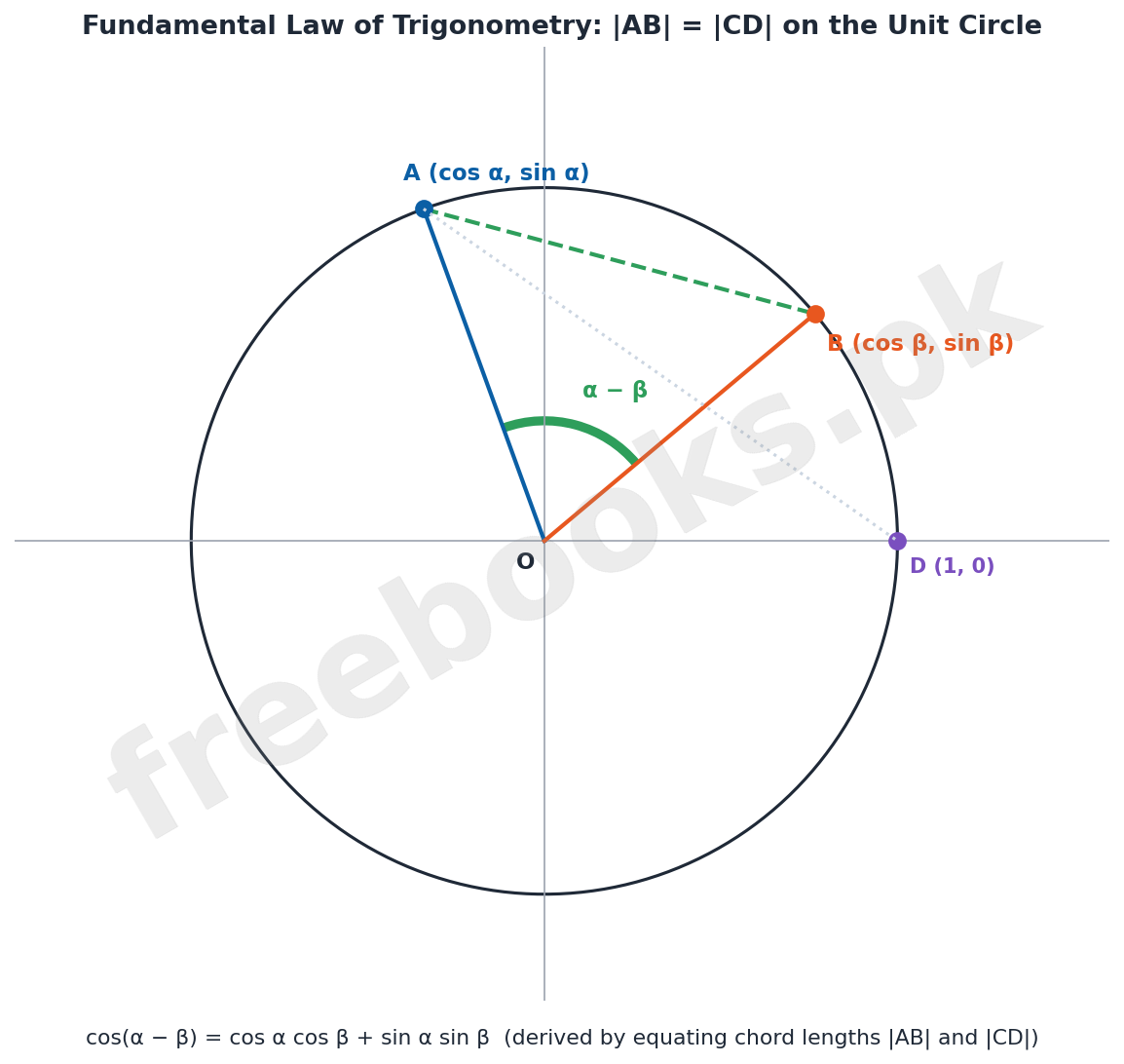
This unit builds the whole machinery of trigonometric identities from a single geometric fact: the Fundamental Law of Trigonometry, cos(alpha-beta) = cos alpha cos beta + sin alpha sin beta, proved by equating two equal chord lengths on the unit circle. From this one law, a chain of deductions produces the co-function identities, the sum and difference formulas for sine, cosine, and tangent, and the rules for evaluating trigonometric ratios of allied angles (angles that differ from a multiple of a right angle).
Building further on the sum-angle formulas, the unit develops double angle, half angle, and triple angle identities (by setting beta=alpha or solving for the half-angle), and finally the product-to-sum and sum-to-product identities, which convert between a product of sines/cosines and a sum or difference, and back again — tools that are essential for simplifying complex trigonometric expressions and proving identities without a calculator.
Learning Objectives
- State and prove the Fundamental Law of Trigonometry using the unit circle
- Derive the sum and difference formulas for sine, cosine, and tangent from the fundamental law
- Evaluate trigonometric ratios of allied angles using the co-ratio and sign rules
- Derive and apply double angle, half angle, and triple angle identities
- Convert products of sines and cosines into sums or differences, and vice versa
- Simplify trigonometric expressions and prove trigonometric identities without using tables or a calculator
- Apply sum-angle and double-angle identities to solve for unknown trigonometric ratios given partial information
Key Concepts
10.1 The Fundamental Law of Trigonometry
Using the distance formula between two points on a unit circle, the Fundamental Law of Trigonometry is derived: cos(alpha-beta) = cos alpha cos beta + sin alpha sin beta. Two angles alpha and beta placed in standard position cut the unit circle at points A(cos alpha, sin alpha) and B(cos beta, sin beta); rotating triangle AOB to an equivalent triangle COD (where C is at angle alpha-beta and D is at (1,0)) gives |AB|=|CD|, and equating the squared distances yields the law.
Although proved for alpha > beta > 0, the law holds for all real values of alpha and beta. This single identity is the seed from which every other sum, difference, double angle, half angle, and product-sum identity in this unit is systematically derived.
10.2 Deductions from the Fundamental Law
Substituting specific values for alpha or beta into the fundamental law produces the co-function identities — cos(pi/2 – beta) = sin beta and sin(pi/2 + alpha) = cos alpha — and, by replacing beta with -beta, the cosine sum formula cos(alpha+beta) = cos alpha cos beta – sin alpha sin beta.
Continuing the chain of substitutions produces the sine sum and difference formulas, sin(alpha+beta) = sin alpha cos beta + cos alpha sin beta and sin(alpha-beta) = sin alpha cos beta – cos alpha sin beta, and dividing the sine formulas by the corresponding cosine formulas (then dividing every term by cos alpha cos beta) produces the tangent sum and difference formulas.
10.3 Trigonometric Ratios of Allied Angles
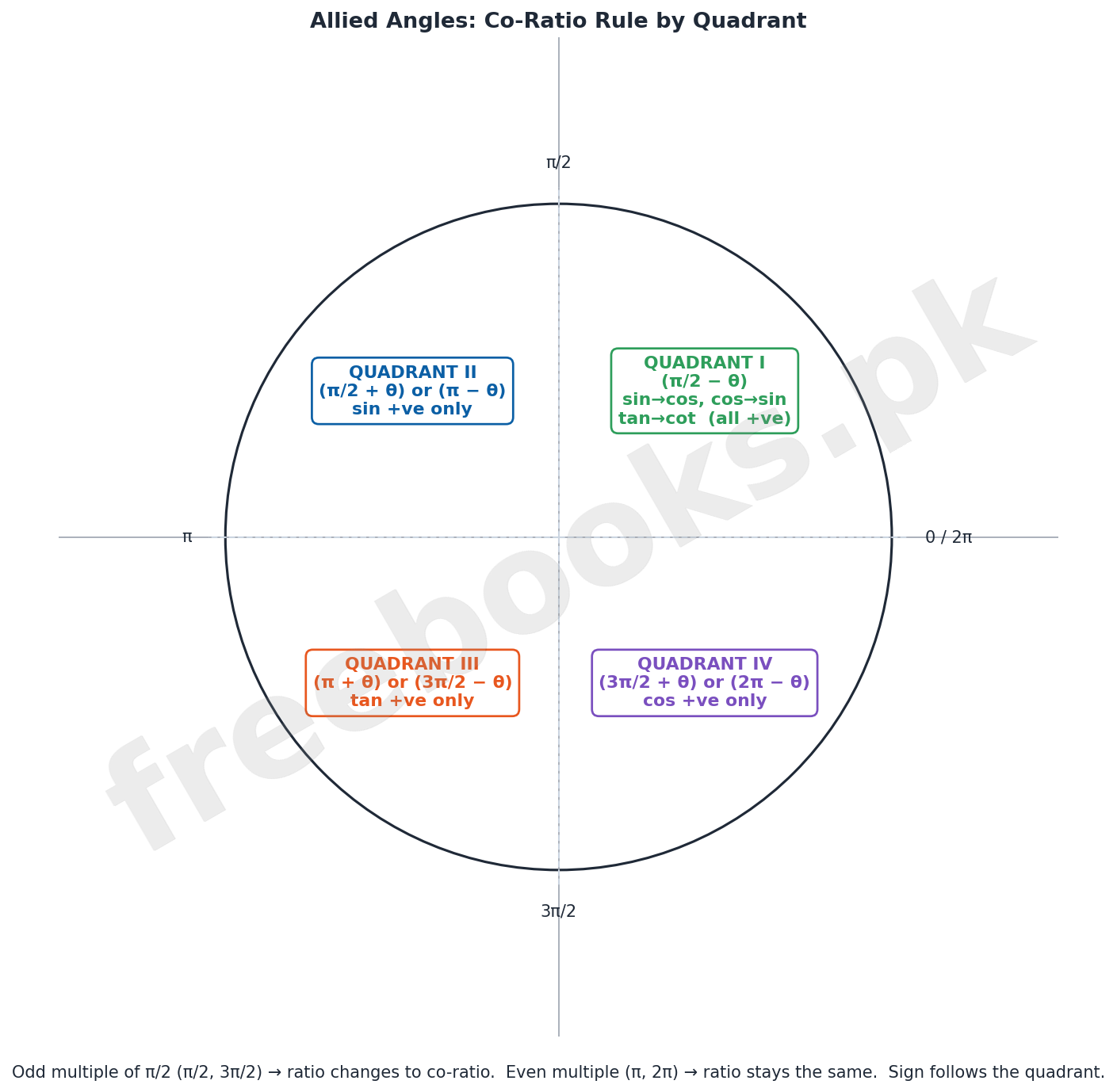
Two angles alpha and beta are called allied if alpha +/- beta = n(90 degrees) for some integer n; common allied angles of theta include 90 degrees +/- theta, 180 degrees +/- theta, 270 degrees +/- theta, and 360 degrees +/- theta. Using the fundamental law and its deductions, a full set of identities can be derived for the sine, cosine, and tangent of every allied angle.
These identities follow a memorable pattern: if theta is added to or subtracted from an odd multiple of a right angle, the ratio changes to its co-ratio (sin to cos, tan to cot, and vice versa); if theta is added to or subtracted from an even multiple, the ratio stays the same. In both cases, the sign of the result is decided by which quadrant the resulting angle's terminal side falls in.
10.4 Double Angle Identities
Setting beta = alpha in the sum formulas for sine, cosine, and tangent produces the double angle identities: sin 2 alpha = 2 sin alpha cos alpha, cos 2 alpha = cos^2 alpha – sin^2 alpha (which can also be written as 2 cos^2 alpha – 1 or 1 – 2 sin^2 alpha using the Pythagorean identity), and tan 2 alpha = 2 tan alpha / (1 – tan^2 alpha).
The three equivalent forms of cos 2 alpha are especially useful, since each expresses the double angle purely in terms of a single ratio (cos alpha alone, or sin alpha alone) — this flexibility is what makes the half angle identities in the next section possible.
10.5 Half Angle and Triple Angle Identities
Solving the double angle identity cos alpha = 2 cos^2(alpha/2) – 1 for cos(alpha/2) gives the half angle identity cos(alpha/2) = +/- sqrt((1+cos alpha)/2); the same approach applied to cos alpha = 1 – 2 sin^2(alpha/2) gives sin(alpha/2) = +/- sqrt((1-cos alpha)/2), and dividing the two gives tan(alpha/2) = +/- sqrt((1-cos alpha)/(1+cos alpha)).
Writing 3 alpha as 2 alpha + alpha and expanding with the sum and double angle formulas produces the triple angle identities sin 3 alpha = 3 sin alpha – 4 sin^3 alpha and cos 3 alpha = 4 cos^3 alpha – 3 cos alpha, both useful for reducing higher powers of sine and cosine to expressions in multiples of the original angle.
10.6 Product-to-Sum and Sum-to-Product Identities
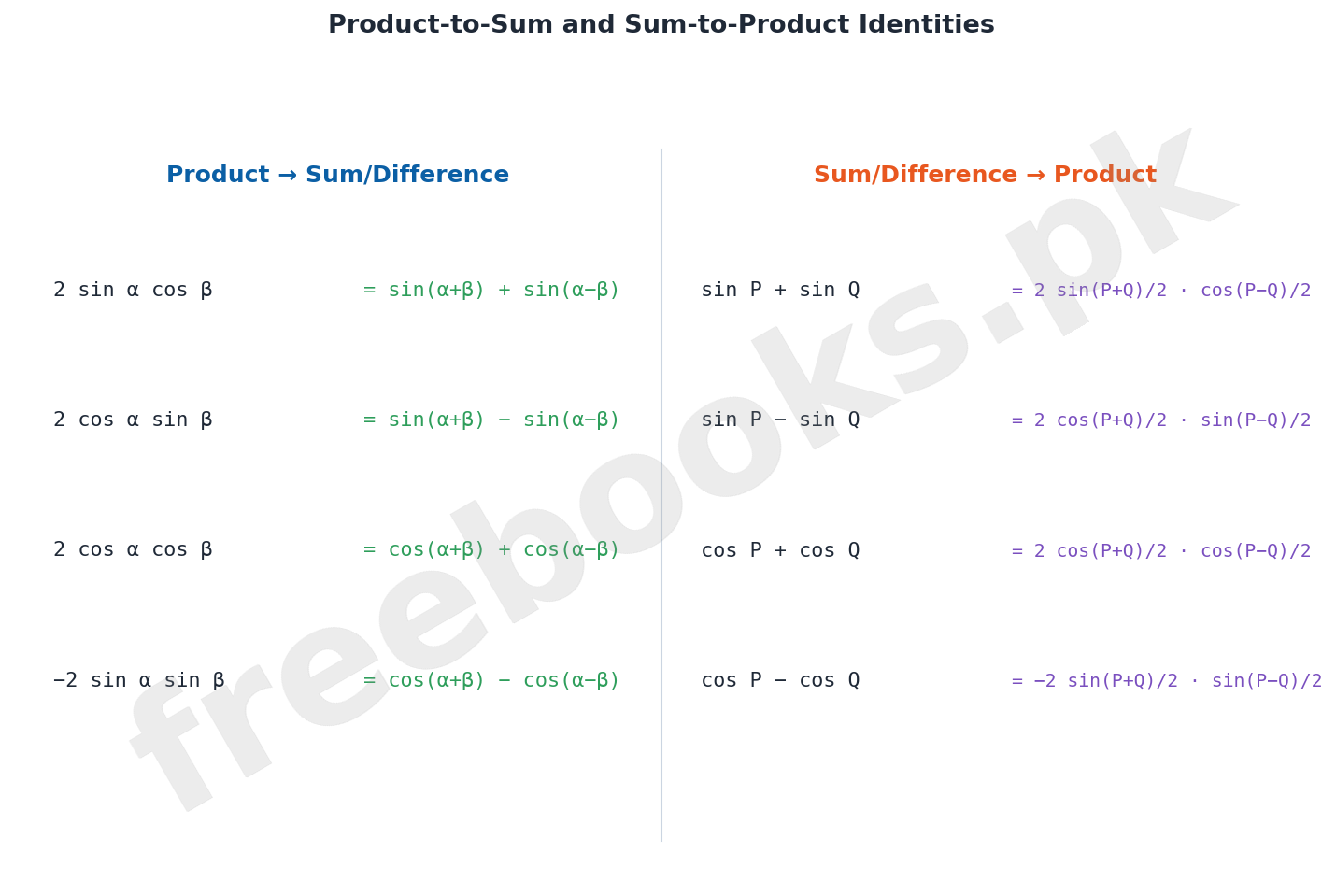
Adding and subtracting the sine sum/difference formulas (and separately the cosine sum/difference formulas) converts a product of a sine and a cosine, or two cosines, or two sines, into a sum or difference: for example, 2 sin alpha cos beta = sin(alpha+beta) + sin(alpha-beta).
Substituting P = alpha+beta and Q = alpha-beta into these four product-to-sum identities and solving for alpha and beta in terms of P and Q produces the reverse set — the sum-to-product identities, such as sin P + sin Q = 2 sin((P+Q)/2) cos((P-Q)/2) — which are essential for simplifying sums of sines/cosines and proving identities involving multiple angles.
Important Definitions
What is the Fundamental Law of Trigonometry?
cos(alpha-beta) = cos alpha cos beta + sin alpha sin beta, proved by equating two equal chord lengths on the unit circle.
What are allied angles?
Two angles alpha and beta such that alpha +/- beta = n(90 degrees) for some integer n.
What is the sum formula for sin(alpha+beta)?
sin(alpha+beta) = sin alpha cos beta + cos alpha sin beta.
What is the double angle identity for sin 2 alpha?
sin 2 alpha = 2 sin alpha cos alpha.
What are the three equivalent forms of cos 2 alpha?
cos 2 alpha = cos^2 alpha – sin^2 alpha = 2 cos^2 alpha – 1 = 1 – 2 sin^2 alpha.
What is the half angle identity for cos(alpha/2)?
cos(alpha/2) = +/- sqrt((1+cos alpha)/2).
What is the triple angle identity for sin 3 alpha?
sin 3 alpha = 3 sin alpha – 4 sin^3 alpha.
What is the triple angle identity for cos 3 alpha?
cos 3 alpha = 4 cos^3 alpha – 3 cos alpha.
State one product-to-sum identity.
2 sin alpha cos beta = sin(alpha+beta) + sin(alpha-beta).
What memory device helps recall how allied angles change trigonometric ratios?
If theta is added to or subtracted from an odd multiple of a right angle, the ratio changes to its co-ratio; if from an even multiple, the ratio stays the same; the sign is decided by the quadrant.
Key Facts and Relations
| Topic | Key Fact / Relation |
|---|---|
| Fundamental Law | cos(alpha-beta) = cos alpha cos beta + sin alpha sin beta |
| Cosine sum/difference | cos(alpha+beta) = cos alpha cos beta – sin alpha sin beta |
| Sine sum/difference | sin(alpha+beta) = sin alpha cos beta + cos alpha sin beta |
| Tangent sum/difference | tan(alpha+beta) = (tan alpha + tan beta) / (1 – tan alpha tan beta) |
| Double angle (sine) | sin 2 alpha = 2 sin alpha cos alpha |
| Double angle (cosine, 3 forms) | cos 2 alpha = cos^2 alpha – sin^2 alpha = 2 cos^2 alpha – 1 = 1 – 2 sin^2 alpha |
| Double angle (tangent) | tan 2 alpha = 2 tan alpha / (1 – tan^2 alpha) |
| Half angle (cosine) | cos(alpha/2) = +/- sqrt((1+cos alpha)/2) |
| Triple angle | sin 3 alpha = 3 sin alpha – 4 sin^3 alpha; cos 3 alpha = 4 cos^3 alpha – 3 cos alpha |
| Sum-to-product (sine) | sin P + sin Q = 2 sin((P+Q)/2) cos((P-Q)/2) |
Diagrams
Fundamental Law of Trigonometry: A unit-circle diagram showing points A and B at angles alpha and beta, the chord AB, and the angle alpha-beta at the origin, illustrating the geometric basis of the fundamental law
Allied Angles: Co-Ratio Wheel: A four-quadrant wheel showing which allied-angle forms (pi/2-theta, pi+theta, 3pi/2-theta, 2pi-theta, etc.) fall in each quadrant, and the co-ratio/sign rule that applies
Product-to-Sum and Sum-to-Product Identities: A side-by-side comparison of the four product-to-sum identities and their corresponding four sum-to-product identities
Solved Examples
Example 1: Using the Fundamental Law to Find sin(5pi/12)
Problem: Find the value of sin(5pi/12) without using tables.
- Rewrite 5pi/12 as a sum of standard angles: 5pi/12 = 75 degrees = 45 degrees + 30 degrees = pi/4 + pi/6.
- Apply the sine sum formula: sin(pi/4 + pi/6) = sin(pi/4)cos(pi/6) + cos(pi/4)sin(pi/6).
- Substitute known values: (1/sqrt(2))(sqrt(3)/2) + (1/sqrt(2))(1/2).
- Combine over a common denominator: (sqrt(3)+1) / (2 sqrt(2)).
- Final answer: sin(5pi/12) = (sqrt(3)+1) / (2 sqrt(2)).
Example 2: Evaluating Allied Angles Without Tables
Problem: Without using tables, find the values of sin 225 degrees and tan 600 degrees.
- For sin 225 degrees: rewrite as sin(180 degrees + 45 degrees). Since (180 degrees + theta) is in Quadrant III where sine is negative, and even multiples of 90 degrees keep the same ratio, sin(180+45) = -sin 45 degrees.
- So sin 225 degrees = -1/sqrt(2).
- For tan 600 degrees: rewrite as tan(540 degrees + 60 degrees) = tan(6×90 degrees + 60 degrees). Since 540 degrees is a multiple of 180 degrees (period of tangent), this reduces to tan 60 degrees.
- So tan 600 degrees = sqrt(3).
- Final answer: sin 225 degrees = -1/sqrt(2), tan 600 degrees = sqrt(3).
Example 3: Simplifying a Trigonometric Expression Using Allied Angles
Problem: Simplify: [sin(180 deg – theta) cos(360 deg – theta) tan(90 deg + theta)] / [sin(90 deg – theta) cos(180 deg + theta) tan(270 deg – theta)].
- Convert each allied-angle term using the co-ratio/sign rules: sin(180-theta)=sin theta, cos(360-theta)=cos theta, tan(90+theta)=-cot theta.
- Convert the denominator terms similarly: sin(90-theta)=cos theta, cos(180+theta)=-cos theta, tan(270-theta)=cot theta.
- Substitute into the original expression: [sin theta . cos theta . (-cot theta)] / [cos theta . (-cos theta) . cot theta].
- Cancel the common cos theta and cot theta factors, leaving (-sin theta) / (-cos theta).
- Final answer: the expression simplifies to tan theta.
Example 4: Finding All Trigonometric Ratios of 105 Degrees
Problem: Without using tables, find sin 105 degrees, cos 105 degrees, and tan 105 degrees.
- Rewrite 105 degrees as a sum of standard angles: 105 degrees = 60 degrees + 45 degrees.
- Apply the sine sum formula: sin 105 = sin 60 cos 45 + cos 60 sin 45 = (sqrt(3)/2)(1/sqrt(2)) + (1/2)(1/sqrt(2)) = (sqrt(3)+1)/(2sqrt(2)).
- Apply the cosine sum formula: cos 105 = cos 60 cos 45 – sin 60 sin 45 = (1/2)(1/sqrt(2)) – (sqrt(3)/2)(1/sqrt(2)) = (1-sqrt(3))/(2sqrt(2)).
- Apply the tangent sum formula: tan 105 = (tan 60 + tan 45)/(1 – tan 60 tan 45) = (sqrt(3)+1)/(1-sqrt(3)).
- Final answer: sin 105 = (sqrt(3)+1)/(2sqrt(2)), cos 105 = (1-sqrt(3))/(2sqrt(2)), tan 105 = (sqrt(3)+1)/(1-sqrt(3)).
Example 5: Finding sin(alpha+beta) and cos(alpha+beta) from Given Ratios and Quadrants
Problem: If cos alpha = -7/25 with alpha's terminal side in Quadrant II, and tan beta = 12/5 with beta's terminal side in Quadrant III, find sin(alpha+beta) and cos(alpha+beta), and state which quadrant (alpha+beta) lies in.
- Find sin alpha using sin^2 alpha + cos^2 alpha = 1: sin alpha = +/- sqrt(1-(-7/25)^2) = +/- 24/25. Since alpha is in Quadrant II where sine is positive, sin alpha = 24/25.
- Find cos beta and sin beta from tan beta = 12/5: sec beta = +/- sqrt(1+(12/5)^2) = +/- 13/5. Since beta is in Quadrant III where secant is negative, sec beta = -13/5, so cos beta = -5/13, and sin beta = -12/13 (sine is also negative in Quadrant III).
- Apply the sine sum formula: sin(alpha+beta) = sin alpha cos beta + cos alpha sin beta = (24/25)(-5/13) + (-7/25)(-12/13) = (-120+84)/325 = -36/325.
- Apply the cosine sum formula: cos(alpha+beta) = cos alpha cos beta – sin alpha sin beta = (-7/25)(-5/13) – (24/25)(-12/13) = (35+288)/325 = 323/325.
- Since sin(alpha+beta) is negative and cos(alpha+beta) is positive, (alpha+beta) lies in Quadrant IV.
Example 6: Finding Double Angle Ratios from a Given Sine Value
Problem: If sin alpha = 3/5 with 0 < alpha < pi/2, find sin 2 alpha, cos 2 alpha, and tan 2 alpha.
- Find cos alpha using sin^2 alpha + cos^2 alpha = 1: cos alpha = sqrt(1-(3/5)^2) = 4/5 (positive since alpha is in Quadrant I).
- Apply the double angle formula for sine: sin 2 alpha = 2 sin alpha cos alpha = 2(3/5)(4/5) = 24/25.
- Apply the double angle formula for cosine: cos 2 alpha = cos^2 alpha – sin^2 alpha = (4/5)^2 – (3/5)^2 = 16/25 – 9/25 = 7/25.
- Find tan 2 alpha as the ratio: tan 2 alpha = sin 2 alpha / cos 2 alpha = (24/25)/(7/25) = 24/7.
- Final answer: sin 2 alpha = 24/25, cos 2 alpha = 7/25, tan 2 alpha = 24/7.
Example 7: Expressing 3 sin theta + 4 cos theta in the Form r sin(theta + phi)
Problem: Express 3 sin theta + 4 cos theta in the form r sin(theta + phi), where the terminal side of phi is in Quadrant I.
- Let 3 = r cos phi and 4 = r sin phi (matching coefficients with the expanded form of r sin(theta+phi)).
- Square and add both equations: 3^2 + 4^2 = r^2(cos^2 phi + sin^2 phi) = r^2, so r^2 = 25 and r = 5.
- Divide the two equations to find phi: tan phi = 4/3, so phi = arctan(4/3), with phi in Quadrant I since both 3 and 4 are positive.
- Substitute back: 3 sin theta + 4 cos theta = r cos phi sin theta + r sin phi cos theta = r sin(theta+phi).
- Final answer: 3 sin theta + 4 cos theta = 5 sin(theta + phi), where r=5 and tan phi = 4/3.
Example 8: Proving a Product Identity Using Product-to-Sum Formulas
Problem: Show that cos 20 degrees cos 40 degrees cos 80 degrees = 1/8.
- Multiply and divide by 4: cos20 cos40 cos80 = (1/4)(4 cos20 cos40 cos80) = (1/4)[(2cos40cos20)(2cos80)].
- Apply the product-to-sum identity to 2cos40cos20: 2cos40cos20 = cos60+cos20 = 1/2+cos20.
- Substitute back: (1/4)[(1/2+cos20)(2cos80)] = (1/4)[cos80 + 2cos80cos20].
- Apply the product-to-sum identity to 2cos80cos20: 2cos80cos20 = cos100+cos60 = -cos80+1/2 (using cos100=cos(180-80)=-cos80).
- Substitute and simplify: (1/4)[cos80 – cos80 + 1/2] = (1/4)(1/2) = 1/8. Final answer: cos20 cos40 cos80 = 1/8.
Short Questions & Answers
What is the Fundamental Law of Trigonometry?
cos(alpha-beta) = cos alpha cos beta + sin alpha sin beta.
What are allied angles?
Two angles alpha and beta such that alpha +/- beta = n(90 degrees) for some integer n.
What is the double angle formula for sin 2 alpha?
sin 2 alpha = 2 sin alpha cos alpha.
Give the three forms of cos 2 alpha.
cos^2 alpha – sin^2 alpha, 2 cos^2 alpha – 1, and 1 – 2 sin^2 alpha.
What is the half angle identity for sin(alpha/2)?
sin(alpha/2) = +/- sqrt((1-cos alpha)/2).
What is the triple angle identity for cos 3 alpha?
cos 3 alpha = 4 cos^3 alpha – 3 cos alpha.
How does an odd multiple of a right angle affect an allied-angle ratio?
It changes the ratio to its co-ratio (sin to cos, tan to cot, and so on).
Long Questions & Answers
Derive the Fundamental Law of Trigonometry using the unit circle, and explain how it leads to the sum and difference formulas for sine, cosine, and tangent.
What is the Fundamental Law of Trigonometry and how is it proved geometrically?
It states cos(alpha-beta) = cos alpha cos beta + sin alpha sin beta. It is proved by placing angles alpha and beta in standard position on a unit circle at points A and B, noting that triangle AOB is congruent to a triangle COD (where C is at angle alpha-beta and D is at (1,0)), so |AB|=|CD|; equating the squared distances using the distance formula and simplifying gives the law.
How is the formula for cos(alpha+beta) derived from the fundamental law?
By replacing beta with -beta in the fundamental law and using cos(-beta)=cos beta and sin(-beta)=-sin beta, the law becomes cos(alpha+beta) = cos alpha cos beta – sin alpha sin beta.
How are the sine sum and difference formulas derived?
Using the co-function identity sin(pi/2+alpha)=cos alpha (itself derived from the fundamental law) together with the cosine sum formula, substitution produces sin(alpha+beta) = sin alpha cos beta + cos alpha sin beta, and replacing beta with -beta gives the difference formula sin(alpha-beta) = sin alpha cos beta – cos alpha sin beta.
How is the tangent sum formula tan(alpha+beta) derived?
By writing tan(alpha+beta) as sin(alpha+beta)/cos(alpha+beta), substituting the sine and cosine sum formulas, and dividing every term in the numerator and denominator by cos alpha cos beta, which produces tan(alpha+beta) = (tan alpha+tan beta)/(1-tan alpha tan beta).
Explain the double angle, half angle, and triple angle identities for sine and cosine, and describe how each is derived from the sum-angle formulas.
How are the double angle identities for sin 2 alpha and cos 2 alpha derived?
By setting beta = alpha in the sine and cosine sum formulas: sin(alpha+alpha) gives sin 2 alpha = 2 sin alpha cos alpha, and cos(alpha+alpha) gives cos 2 alpha = cos^2 alpha – sin^2 alpha.
Why does cos 2 alpha have three equivalent forms?
Because the Pythagorean identity sin^2 alpha + cos^2 alpha = 1 lets cos^2 alpha – sin^2 alpha be rewritten by substituting sin^2 alpha = 1-cos^2 alpha (giving 2cos^2 alpha – 1) or cos^2 alpha = 1-sin^2 alpha (giving 1-2sin^2 alpha) — all three forms are algebraically equal, just expressed in different single ratios.
How is the half angle identity for cos(alpha/2) obtained from the double angle identity?
Starting from cos alpha = 2 cos^2(alpha/2) – 1 (substituting alpha/2 for alpha in the 2cos^2-1 form), solving for cos(alpha/2) gives cos^2(alpha/2) = (1+cos alpha)/2, and taking the square root gives cos(alpha/2) = +/- sqrt((1+cos alpha)/2).
How is the triple angle identity for sin 3 alpha derived?
By writing 3 alpha as 2 alpha + alpha and expanding sin(2alpha+alpha) = sin 2 alpha cos alpha + cos 2 alpha sin alpha using the double angle formulas, then simplifying with the Pythagorean identity to get sin 3 alpha = 3 sin alpha – 4 sin^3 alpha.
Multiple Choice Questions (MCQs)
The Fundamental Law of Trigonometry states cos(alpha-beta) equals: (A) sin alpha sin beta – cos alpha cos beta (B) cos alpha cos beta + sin alpha sin beta (C) cos alpha sin beta + sin alpha cos beta (D) cos alpha – cos beta
Correct answer: (B) cos alpha cos beta + sin alpha sin beta. The fundamental law states cos(alpha-beta) = cos alpha cos beta + sin alpha sin beta.
Two angles alpha and beta are called allied if: (A) alpha = beta (B) alpha + beta = 180 degrees only (C) alpha +/- beta = n(90 degrees), n an integer (D) alpha – beta = 0
Correct answer: (C) alpha +/- beta = n(90 degrees), n an integer. Allied angles satisfy alpha +/- beta = n(90 degrees) for some integer n.
sin(pi/2 + theta) equals: (A) sin theta (B) -sin theta (C) cos theta (D) -cos theta
Correct answer: (C) cos theta. sin(pi/2 + theta) = cos theta, a direct deduction from the fundamental law.
cos(pi – theta) equals: (A) cos theta (B) -cos theta (C) sin theta (D) -sin theta
Correct answer: (B) -cos theta. cos(pi – theta) = -cos theta, since pi is an even multiple of pi/2 (ratio unchanged) but the terminal side is in Quadrant II (cosine negative).
The double angle identity sin 2 alpha equals: (A) sin^2 alpha – cos^2 alpha (B) 2 sin alpha cos alpha (C) sin alpha + cos alpha (D) 2 cos^2 alpha – 1
Correct answer: (B) 2 sin alpha cos alpha. sin 2 alpha = 2 sin alpha cos alpha, obtained by setting beta=alpha in the sine sum formula.
Which of these is NOT a valid form of cos 2 alpha? (A) cos^2 alpha – sin^2 alpha (B) 2 cos^2 alpha – 1 (C) 1 – 2 sin^2 alpha (D) 2 sin alpha cos alpha
Correct answer: (D) 2 sin alpha cos alpha. 2 sin alpha cos alpha is the formula for sin 2 alpha, not cos 2 alpha.
The double angle identity for tangent, tan 2 alpha, equals: (A) tan alpha / 2 (B) 2 tan alpha / (1 – tan^2 alpha) (C) tan^2 alpha – 1 (D) 2 tan alpha + 1
Correct answer: (B) 2 tan alpha / (1 – tan^2 alpha). tan 2 alpha = 2 tan alpha / (1 – tan^2 alpha).
The triple angle identity for cosine, cos 3 alpha, equals: (A) 4 cos^3 alpha – 3 cos alpha (B) 3 cos alpha – 4 cos^3 alpha (C) cos^3 alpha – 3 cos alpha (D) 4 cos alpha – 3 cos^3 alpha
Correct answer: (A) 4 cos^3 alpha – 3 cos alpha. cos 3 alpha = 4 cos^3 alpha – 3 cos alpha.
The product-to-sum identity for 2 sin alpha cos beta is: (A) cos(alpha+beta) + cos(alpha-beta) (B) sin(alpha+beta) + sin(alpha-beta) (C) sin(alpha+beta) – sin(alpha-beta) (D) cos(alpha-beta) – cos(alpha+beta)
Correct answer: (B) sin(alpha+beta) + sin(alpha-beta). 2 sin alpha cos beta = sin(alpha+beta) + sin(alpha-beta).
The sum-to-product identity for sin P + sin Q is: (A) 2 sin((P+Q)/2) cos((P-Q)/2) (B) 2 cos((P+Q)/2) sin((P-Q)/2) (C) 2 cos((P+Q)/2) cos((P-Q)/2) (D) -2 sin((P+Q)/2) sin((P-Q)/2)
Correct answer: (A) 2 sin((P+Q)/2) cos((P-Q)/2). sin P + sin Q = 2 sin((P+Q)/2) cos((P-Q)/2).
Quick Revision Summary
- The Fundamental Law of Trigonometry: cos(alpha-beta) = cos alpha cos beta + sin alpha sin beta, proved via the unit circle
- Cosine sum formula: cos(alpha+beta) = cos alpha cos beta – sin alpha sin beta
- Sine sum/difference: sin(alpha+beta) = sin alpha cos beta + cos alpha sin beta; sin(alpha-beta) = sin alpha cos beta – cos alpha sin beta
- Tangent sum/difference: tan(alpha+beta) = (tan alpha+tan beta)/(1-tan alpha tan beta)
- Allied angles satisfy alpha +/- beta = n(90 degrees); odd multiples of 90 degrees change the ratio to a co-ratio, even multiples keep it the same
- The sign of an allied-angle result is determined by the quadrant of the resulting angle's terminal side
- Double angle: sin 2 alpha = 2 sin alpha cos alpha; cos 2 alpha = cos^2 alpha – sin^2 alpha = 2cos^2 alpha-1 = 1-2sin^2 alpha
- Double angle for tangent: tan 2 alpha = 2 tan alpha / (1 – tan^2 alpha)
- Half angle: cos(alpha/2) = +/- sqrt((1+cos alpha)/2); sin(alpha/2) = +/- sqrt((1-cos alpha)/2)
- Triple angle: sin 3 alpha = 3 sin alpha – 4 sin^3 alpha; cos 3 alpha = 4 cos^3 alpha – 3 cos alpha
- Product-to-sum identities convert a product of two sines/cosines into a sum or difference
- Sum-to-product identities convert a sum or difference of two sines/cosines into a product
Exam Tips
- Memorize the fundamental law first — every other identity in this unit can be re-derived from it if forgotten
- For allied angles, first check whether the multiple of 90 degrees involved is odd or even to know if the ratio changes to its co-ratio
- Always determine the sign of an allied-angle result last, by checking which quadrant the terminal side falls in
- When solving for missing trigonometric ratios (like sin alpha from cos alpha), always use the given quadrant to pick the correct sign
- For product-to-sum/sum-to-product proofs, look for terms that can be paired and multiplied/divided by 2 or 4 to match a known identity pattern
- Practice rewriting non-standard angles (105, 15, 75 degrees, etc.) as a sum or difference of two standard angles (30, 45, 60, 90 degrees) before applying any formula