This unit builds the essential counting tools used throughout probability, computer science, and everyday decision-making: the fundamental principle of counting, factorial notation, permutations, and combinations. Permutations count the number of ways objects can be arranged in a specific order, while combinations count the number of ways objects can be selected without regard to order — and knowing which one a real-world problem calls for is the single most important skill this unit develops.
Building on the basic nPr and nCr formulas, the unit also covers permutations of objects that are not all different (like the letters of a word with repeated letters), circular permutations (arranging objects around a table or a ring), and the complementary combination identity. It closes with real-life applications spanning cryptographic password counting, lottery odds, and selecting teams or committees — all situations where recognizing whether order matters is the key first step.
Learning Objectives
- Apply the fundamental principle of counting to determine the total number of outcomes of combined events
- Define factorial notation and evaluate expressions involving factorials
- Define a permutation and evaluate nPr for arranging r objects out of n
- Find the number of permutations of objects when some objects are alike (not all different)
- Distinguish between the two cases of circular permutations and evaluate them
- Define a combination and evaluate nCr for selecting r objects out of n
- Apply the complementary combination property nCr = nC(n-r)
- Distinguish between permutations and combinations, and choose the correct one for a given real-world problem
- Apply permutations and combinations to real-life situations such as passwords, lotteries, and selecting teams or committees
Key Concepts
7.1 Fundamental Principle of Counting and Factorial Notation
If event A can occur in m ways and event B can occur in n ways, the two events together (one after the other) can occur in m x n ways; this extends to any number of events by multiplying the number of ways for each. This principle underlies both permutations and combinations.
The factorial of a natural number n, written n!, is the product n(n-1)(n-2)…3.2.1, with the special definition 0!=1 (chosen so that formulas like nPn=n!/0! remain consistent). Factorials appear throughout permutation and combination formulas, and the useful identity n! = n(n-1)! lets factorial expressions be simplified without full expansion.
7.2 Permutations
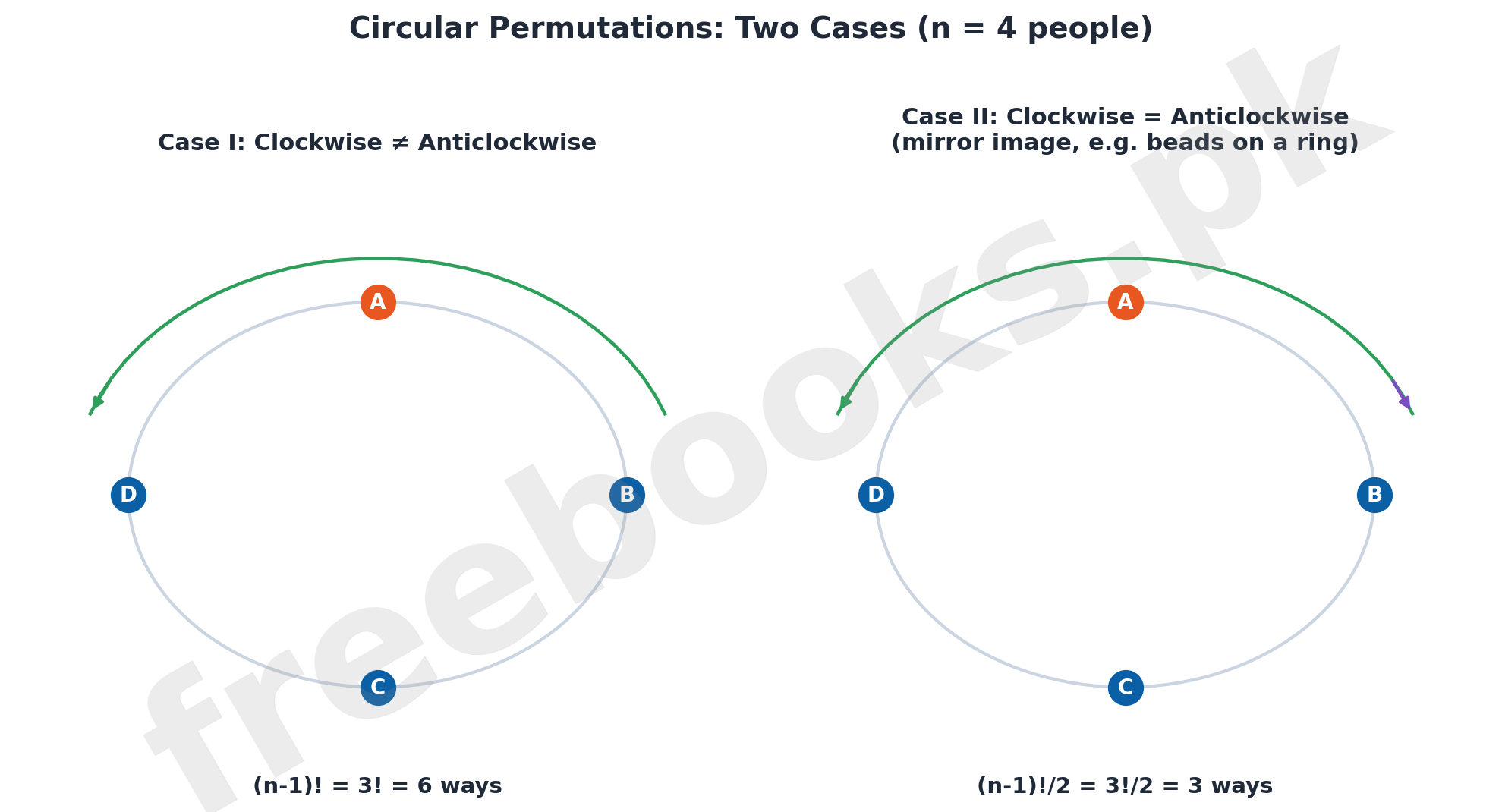
An arrangement of all or part of a set of objects in a specific order is called a permutation; the number of permutations of r objects chosen from a set of n distinct objects is nPr = n!/(n-r)!, valid for r less than or equal to n. Since order matters in a permutation, ab and ba count as two different permutations.
The formula follows directly from the fundamental principle of counting: the first of the r positions can be filled in n ways, the second in (n-1) ways (since one object is already used), and so on down to the rth position, which can be filled in (n-r+1) ways; multiplying these together and simplifying gives nPr = n!/(n-r)!.
7.3 Permutations of Objects Not All Different, and Circular Permutations
When some of the n objects being arranged are identical, straightforward n! overcounts the arrangements, since swapping identical objects produces no visibly different result. If there are n1 objects of one kind, n2 of a second kind, and so on, the number of distinct permutations of all n objects is n!/(n1! n2! n3! …).
A circular permutation arranges objects around a circle rather than in a row; because rotating the whole circle produces no new arrangement, n objects in a circle give only (n-1)! distinct arrangements (not n!) when clockwise and anticlockwise orders are considered different. When a circular arrangement and its mirror-image reflection are considered the same (as with beads on a ring), the count is halved again to (n-1)!/2.
7.4 Combinations
A combination of r objects taken from a set of n objects is simply a subset of r objects — order does not matter, so selecting {Ahmad, Sana} is the same combination as selecting {Sana, Ahmad}. The number of combinations of n objects taken r at a time is nCr = n!/[r!(n-r)!].
Since each combination of r objects can itself be internally arranged in r! different orders (each giving a different permutation), the relationship nCr x r! = nPr connects the two formulas directly, and dividing through by r! derives the combination formula from the permutation formula.
7.5 Complementary Combinations and Permutation vs Combination
The complementary combination identity nCr = nC(n-r) reflects a simple symmetry: choosing r objects to include is equivalent to choosing the remaining (n-r) objects to exclude. This identity is especially useful for evaluating nCr when r is more than half of n, since nC(n-r) with the smaller value of (n-r) is quicker to compute by hand.
The essential distinction between the two counting tools is whether order matters: use a permutation whenever the arrangement or sequence of the chosen objects matters (like arranging books on a shelf or people in a queue), and use a combination whenever only the makeup of the selected group matters, not its order (like choosing team members or committee members).
7.6 Real-Life Applications
Permutations and combinations appear throughout daily life and technology: permutations count ordered outcomes like passwords (when character order matters), rankings, and seating arrangements, while combinations count unordered selections like lottery number choices, team rosters, and committee memberships.
Recognizing whether a real-world scenario cares about order (calling for nPr, or a product of factorials if the count is built from independent stages) or does not care about order (calling for nCr) is the essential first step in solving any applied counting problem, from cryptographic password counting to estimating the odds of winning a lottery.
Important Definitions
What is the fundamental principle of counting?
If event A can occur in m ways and event B can occur in n ways, both events together can occur in m x n ways.
What is n factorial (n!)?
The product of all natural numbers from n down to 1: n! = n(n-1)(n-2)…3.2.1, with 0! defined as 1.
What is a permutation?
An arrangement of all or part of a set of objects in a specific order.
What is the formula for nPr?
nPr = n!/(n-r)!, the number of ways to arrange r objects chosen from n distinct objects.
What is a circular permutation?
An arrangement of objects around a circle rather than in a row.
How many distinct circular permutations exist for n objects when clockwise and anticlockwise arrangements are different?
(n-1)!
What is a combination?
A selection of r objects from a set of n objects, where order does not matter.
What is the formula for nCr?
nCr = n!/[r!(n-r)!], the number of ways to choose r objects from n distinct objects.
What is the complementary combination identity?
nCr = nC(n-r).
What is the key difference between a permutation and a combination?
In a permutation, order matters; in a combination, order does not matter.
Key Facts and Relations
| Topic | Key Fact / Relation |
|---|---|
| Fundamental principle of counting | m x n ways for two events; extends to m . n . k … for more events |
| Factorial | n! = n(n-1)(n-2)…3.2.1, with 0! = 1 |
| Useful factorial identity | n! = n(n-1)! |
| Permutation formula | nPr = n! / (n-r)! |
| Permutation with repeated objects | n! / (n1! n2! n3! …) |
| Circular permutation (clockwise different from anticlockwise) | (n-1)! |
| Circular permutation (clockwise same as anticlockwise) | (n-1)! / 2 |
| Combination formula | nCr = n! / [r!(n-r)!] |
| Relationship between nPr and nCr | nCr = nPr / r! |
| Complementary combinations | nCr = nC(n-r) |
Diagrams
Permutation vs Combination: A summary table comparing permutations and combinations, showing whether order matters, the underlying idea, the formula, and a typical real-world example for each
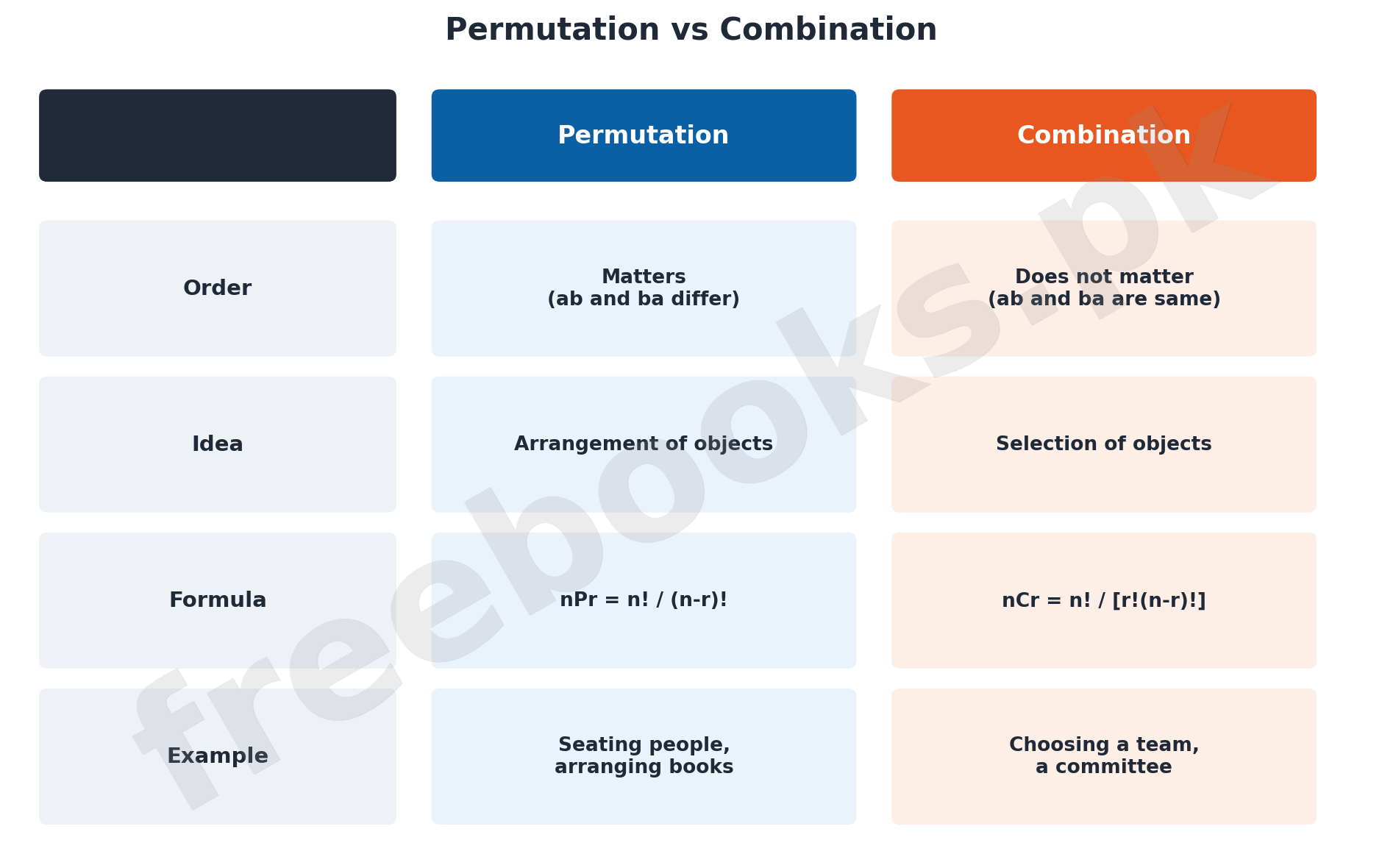
Filling r Positions: the Permutation Counting Process: A flow diagram showing how each of the r positions in a permutation is filled — n ways for the first position, (n-1) ways for the second, and so on down to (n-r+1) ways for the rth position — which multiply together to give nPr = n!/(n-r)!
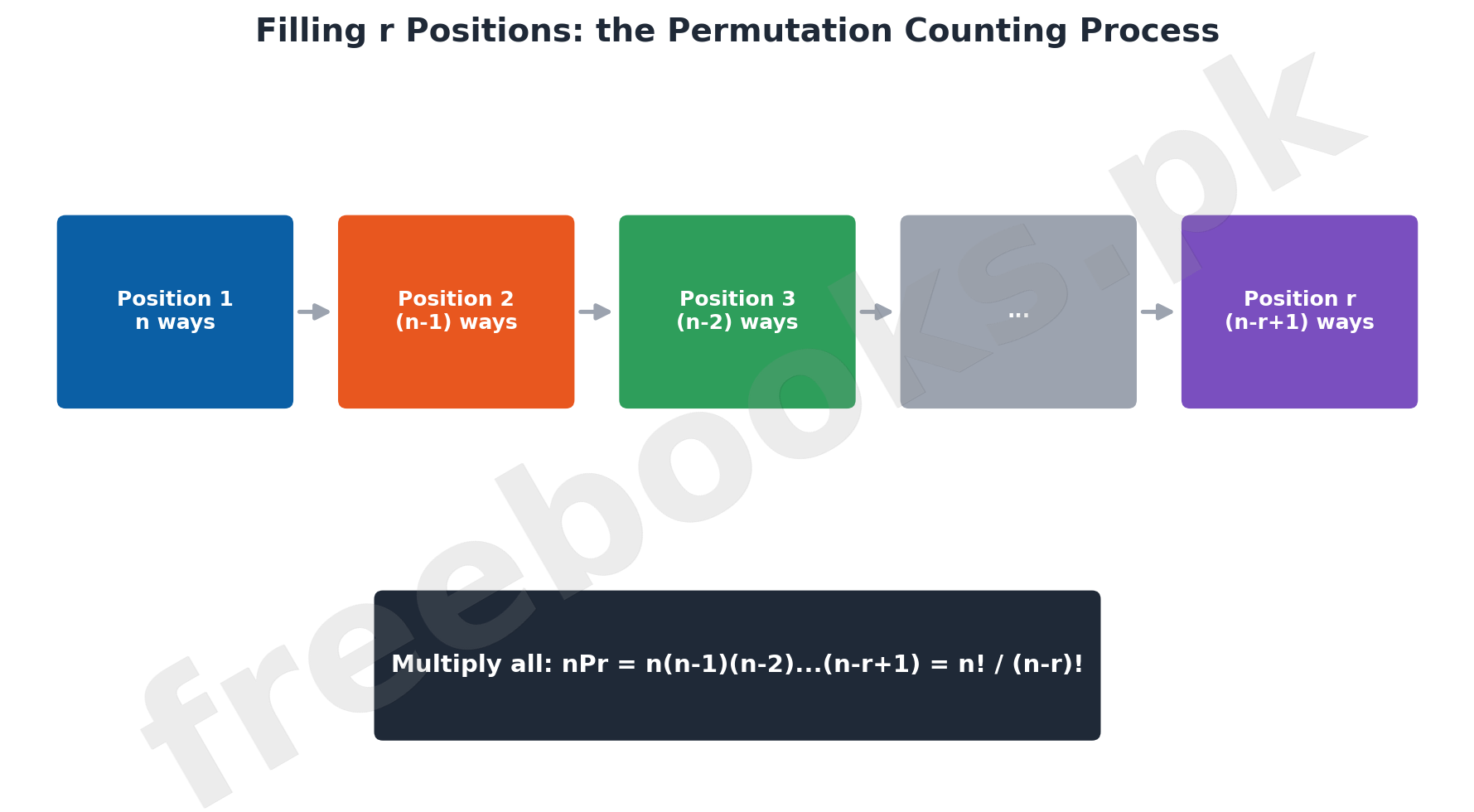
Circular Permutations: Two Cases: A schematic showing 4 people (A, B, C, D) seated around a circle, illustrating Case I (clockwise and anticlockwise arrangements considered different, giving (n-1)! = 6 ways) alongside Case II (clockwise and anticlockwise arrangements considered identical, as with beads on a ring, giving (n-1)!/2 = 3 ways)
Solved Examples
Example 1: Evaluating a Factorial Expression
Problem: Evaluate 9!/(6!3!).
- Expand 9! as 9x8x7x6! so it cancels with the 6! in the denominator: 9!/(6!3!) = (9x8x7x6!)/(6!x3!) = (9x8x7)/3!.
- Compute the numerator: 9x8x7 = 504.
- Compute 3! = 3x2x1 = 6.
- Divide: 504/6 = 84.
- Final answer: 9!/(6!3!) = 84.
Example 2: Counting Permutations (Order Matters)
Problem: How many different 4-digit numbers can be formed from the digits 1,2,3,4,5,6,7 when no digit is repeated?
- Identify n=7 (total digits) and r=4 (digits used per number); since digits form an ordered number, this is a permutation.
- Use nPr = n!/(n-r)!: 7P4 = 7!/3!.
- Expand: 7!/3! = (7x6x5x4x3!)/3! = 7x6x5x4.
- Multiply: 7×6=42, 42×5=210, 210×4=840.
- Final answer: 840 different 4-digit numbers.
Example 3: Permutations of Objects Not All Different
Problem: In how many ways can the letters of the word ENGINEERING be arranged when all the letters are used?
- Total letters = 11. Count repeated letters: E appears 3 times, N appears 3 times, G appears 2 times, I appears 2 times, R appears once.
- Use n!/(n1! n2! n3! n4!) = 11!/(3! 3! 2! 2!).
- Compute 11! = 39,916,800, and 3! x 3! x 2! x 2! = 6x6x2x2 = 144.
- Divide: 39,916,800/144 = 277,200.
- Final answer: 277,200 distinct arrangements.
Example 4: Circular Permutations
Problem: In how many ways can 6 people be seated at a round table if clockwise and anticlockwise arrangements are considered different?
- Since clockwise and anticlockwise orders are different, use Case I: (n-1)!.
- Substitute n=6: (6-1)! = 5!.
- Compute 5! = 5x4x3x2x1 = 120.
- Final answer: 120 ways.
Example 5: Counting Combinations (Order Doesn't Matter)
Problem: A committee of 4 students is to be chosen from a class of 10 students. In how many ways can this be done?
- Since the committee is a selection with no regard to order, use nCr with n=10, r=4.
- nCr = n!/[r!(n-r)!] = 10!/(4!6!).
- Expand: 10!/(4!6!) = (10x9x8x7x6!)/(4!x6!) = (10x9x8x7)/4!.
- Compute the numerator: 10×9=90, 90×8=720, 720×7=5040. Compute 4! = 24.
- Divide: 5040/24 = 210.
- Final answer: 210 ways.
Example 6: Complementary Combinations
Problem: Evaluate 14C11 using the complementary combination identity.
- Use the identity nCr = nC(n-r): 14C11 = 14C(14-11) = 14C3.
- Compute 14C3 = (14x13x12)/(3x2x1).
- Numerator: 14×13=182, 182×12=2184. Denominator: 3x2x1=6.
- Divide: 2184/6 = 364.
- Final answer: 14C11 = 364.
Example 7: Combining Combinations for a Selection with Restrictions
Problem: A group has 7 boys and 5 girls. In how many ways can a team of 4 be selected with exactly 2 boys and 2 girls?
- Select 2 boys from 7: 7C2 = 7!/(2!5!) = (7×6)/(2×1) = 21.
- Select 2 girls from 5: 5C2 = 5!/(2!3!) = (5×4)/(2×1) = 10.
- Since these two selections happen together, multiply by the fundamental principle of counting: 21 x 10 = 210.
- Final answer: 210 ways.
Example 8: Application: Counting Cryptographic Passwords
Problem: A password must be exactly 5 characters long, using only lowercase letters (a-z, 26 letters). Find the number of possible passwords (i) if repetition of letters is not allowed, and (ii) if repetition is allowed.
- (i) Without repetition, this is a permutation of 5 characters chosen from 26: 26P5 = 26!/(26-5)! = 26x25x24x23x22.
- Compute: 26×25=650, 650×24=15,600, 15,600×23=358,800, 358,800×22=7,893,600.
- (ii) With repetition allowed, each of the 5 positions independently has 26 choices, so by the fundamental principle of counting the total is 26^5.
- Compute 26^5 = 11,881,376.
- Final answer: without repetition, 7,893,600 passwords; with repetition, 11,881,376 passwords.
Short Questions & Answers
What is the fundamental principle of counting?
If one event can occur in m ways and another in n ways, both together can occur in m x n ways.
What is 0! defined as?
1.
What is the formula for nPr?
nPr = n!/(n-r)!.
What is the formula for nCr?
nCr = n!/[r!(n-r)!].
How many distinct circular permutations exist for n objects when clockwise and anticlockwise are different?
(n-1)!.
What is the complementary combination identity?
nCr = nC(n-r).
When should a permutation be used instead of a combination?
When the order of the arrangement matters.
Long Questions & Answers
Explain what a permutation is, derive the formula for nPr, and describe how the formula changes when some of the objects being arranged are identical.
What is a permutation, and how does it differ from a combination?
A permutation is an arrangement of all or part of a set of objects in a specific order, so ab and ba count as two different permutations; a combination, by contrast, is a selection where order does not matter.
How is the formula nPr = n!/(n-r)! derived?
By the fundamental principle of counting, the first of the r positions can be filled in n ways, the second in (n-1) ways, and so on down to the rth position in (n-r+1) ways; multiplying these together and rewriting the product using factorials gives nPr = n!/(n-r)!.
Why is 0! defined as 1?
When r=n, nPn should equal n! (all n objects arranged with no leftover), but the formula gives n!/(n-n)! = n!/0!; for this to equal n!, 0! must be defined as 1.
How does the permutation formula change when some objects are identical?
If among n objects there are n1 identical objects of one kind, n2 of a second kind, and so on, the count n! overcounts every group of identical objects' internal rearrangements, so the corrected formula divides by the factorial of each group's size: n!/(n1! n2! n3! …).
Describe circular permutations, explaining both cases based on whether clockwise and anticlockwise arrangements are considered the same or different, with formulas.
Why does a circular arrangement have fewer distinct permutations than a linear one?
In a linear arrangement, every rotation gives a visibly different order, but in a circular arrangement, rotating the entire circle produces the same relative arrangement, so each set of n linear permutations that are rotations of one another collapses into just 1 circular permutation.
What is the formula when clockwise and anticlockwise arrangements are considered different (Case I)?
Since each circular arrangement corresponds to n rotations of a single linear arrangement, the n! linear permutations collapse to n!/n = (n-1)! distinct circular permutations.
What is the formula when clockwise and anticlockwise arrangements are considered identical (Case II)?
When a circular arrangement and its mirror-image reflection (reversing the direction) are not considered different, the Case I count is further divided by 2, giving (n-1)!/2 distinct circular permutations.
Give an example illustrating the difference between the two cases.
For 4 people seated at a round table, Case I gives (4-1)! = 3! = 6 distinct seatings when direction matters, while Case II (such as 4 beads arranged on a ring, where flipping the ring over gives the same pattern) gives (4-1)!/2 = 3!/2 = 3 distinct arrangements.
Multiple Choice Questions (MCQs)
The fundamental principle of counting states that if event A occurs in m ways and event B in n ways, both together occur in: (A) m+n ways (B) m x n ways (C) m-n ways (D) m/n ways
Correct answer: (B) m x n ways. The events combine multiplicatively: m x n total ways.
0! is defined as: (A) 0 (B) 1 (C) Undefined (D) -1
Correct answer: (B) 1. 0! is defined as 1 so that formulas like nPn = n!/0! remain consistent.
The formula for nPr is: (A) n!/(n-r)! (B) n!/[r!(n-r)!] (C) n!/r! (D) r!/n!
Correct answer: (A) n!/(n-r)!. The permutation formula is nPr = n!/(n-r)!.
In a permutation, ab and ba are considered: (A) The same (B) Different (C) Undefined (D) Equal only if a=b
Correct answer: (B) Different. Order matters in a permutation, so ab and ba are two distinct permutations.
The number of distinct arrangements of n objects with n1 alike of one kind is: (A) n! (B) n!/n1! (C) n1!/n! (D) n! x n1!
Correct answer: (B) n!/n1!. Dividing n! by n1! corrects for the overcounting caused by the identical objects.
The number of distinct circular permutations of n objects (clockwise different from anticlockwise) is: (A) n! (B) (n-1)! (C) (n-1)!/2 (D) n!/2
Correct answer: (B) (n-1)!. Rotating the circle gives no new arrangement, so the count reduces from n! to (n-1)!.
The formula for nCr is: (A) n!/(n-r)! (B) n!/[r!(n-r)!] (C) n!/r! (D) r!(n-r)!/n!
Correct answer: (B) n!/[r!(n-r)!]. The combination formula divides the permutation formula by r! to remove ordering.
In a combination, the order of the selected objects: (A) Matters (B) Does not matter (C) Always increases the count (D) Is always fixed
Correct answer: (B) Does not matter. A combination is a selection where order is irrelevant.
The complementary combination identity states that nCr equals: (A) nC(r-1) (B) nCn (C) nC(n-r) (D) nPr
Correct answer: (C) nC(n-r). Choosing r objects to include is equivalent to choosing the remaining (n-r) objects to exclude: nCr = nC(n-r).
A committee selection problem (where order doesn't matter) should be solved using: (A) A permutation (B) A combination (C) A factorial alone (D) The fundamental principle of counting alone
Correct answer: (B) A combination. Since committee membership does not depend on order, a combination (nCr) is the correct tool.
Quick Revision Summary
- The fundamental principle of counting: if event A occurs in m ways and event B in n ways, both together occur in m x n ways
- n! = n(n-1)(n-2)…3.2.1, with 0! defined as 1
- Permutation: an arrangement where ORDER matters; nPr = n!/(n-r)!
- Permutations with repeated objects: n!/(n1! n2! n3! …)
- Circular permutations (clockwise different from anticlockwise): (n-1)!
- Circular permutations (clockwise same as anticlockwise, e.g. a ring of beads): (n-1)!/2
- Combination: a selection where ORDER does not matter; nCr = n!/[r!(n-r)!]
- Relationship between the two: nCr = nPr / r!
- Complementary combinations: nCr = nC(n-r) — useful when r is more than half of n
- Use a permutation for arrangements/orderings; use a combination for selections/groupings
- Multi-stage selections (e.g. choosing boys AND girls separately) are combined by multiplying the individual combination counts
- Real-life uses include passwords, lottery odds, seating arrangements, and committee selection
Exam Tips
- Before solving, always ask: does order matter? If yes, use a permutation; if no, use a combination
- Remember 0! = 1 — a common point of confusion in factorial calculations
- For circular permutations, check whether the problem treats mirror-image (flipped) arrangements as the same or different
- Use the complementary identity nCr = nC(n-r) to simplify calculations when r is large (closer to n than to 0)
- When a problem has repeated identical objects, divide n! by the factorial of each group's size to avoid overcounting
- For multi-category selections, compute each category's combination separately, then multiply the results together