
The real number system has no solution for an equation as simple as x^2 + 1 = 0, because no real number squares to a negative value. Complex numbers extend the real numbers by introducing the imaginary unit i = sqrt(-1), so that i^2 = -1, and every polynomial equation — not just some of them — finally has a solution. This unit builds complex numbers from the ground up: their algebra (addition, subtraction, multiplication, division), their formal ordered-pair definition and field properties, how to plot and measure them on the Argand diagram, equality and square roots, factorization of complex polynomials, the cube and fourth roots of unity, and the polar form that makes multiplying and dividing complex numbers far simpler.
Complex numbers are not just an abstract algebra exercise — the unit closes with two real-world uses: analysing alternating-current (AC) electrical circuits, where impedance is naturally expressed as a complex number, and cryptography, where multiplying a message by a complex "key" encrypts it, and dividing by that same key decrypts it.
Learning Objectives
- Define a complex number and identify its real and imaginary parts
- Perform addition, subtraction, multiplication, and division of complex numbers
- Define a complex number as an ordered pair of real numbers and verify its field properties
- Plot a complex number on the Argand diagram and find its modulus
- State the condition for the equality of two complex numbers
- Find the square root of a complex number using the general formula
- Apply the Fundamental Theorem of Algebra and the Rational Root Theorem to factor complex polynomials
- Solve quadratic equations with complex roots by completing the square
- Find the cube roots and fourth roots of unity and state their key properties
- Convert a complex number between rectangular form and polar form
- Multiply and divide complex numbers in polar form, and apply complex numbers to AC circuits and cryptography
Key Concepts
1.1 Complex Numbers and Their Algebra
A complex number is a number of the form z = x + iy, where x and y are real numbers and i is the imaginary unit defined by i = sqrt(-1), so that i^2 = -1. Here x = Re(z) is called the real part of z and y = Im(z) is called the imaginary part of z. If y = 0, z is simply a real number; if x = 0 and y is not 0, z is called purely imaginary.
Addition and subtraction of complex numbers is done by combining the real parts together and the imaginary parts together: (a+ib) +/- (c+id) = (a+/-c) + i(b+/-d). Multiplication is done by distributing normally and then simplifying using i^2 = -1: (a+ib)(c+id) = (ac-bd) + i(ad+bc). Division is done by multiplying both the numerator and the denominator by the conjugate of the denominator, which turns the denominator into a real number so the result can be written in x+iy form.
1.2 Ordered Pair Definition and Field Properties
A complex number can also be defined formally as an ordered pair of real numbers (a, b), with addition defined as (a,b) + (c,d) = (a+c, b+d) and multiplication defined as (a,b)(c,d) = (ac-bd, ad+bc). Under this definition, i corresponds to the pair (0,1), and (0,1)(0,1) = (-1,0) matches i^2 = -1 exactly — this is what makes i^2 = -1 rigorous rather than just a rule to memorize.
Complex numbers under these operations satisfy all the properties of a mathematical field: closure and commutativity of addition and multiplication, associativity, the distributive law, an additive identity (0,0) and multiplicative identity (1,0), an additive inverse -z for every z, and a multiplicative inverse z^(-1) = z-bar / |z|^2 for every non-zero z.
1.3 The Argand Diagram and Modulus
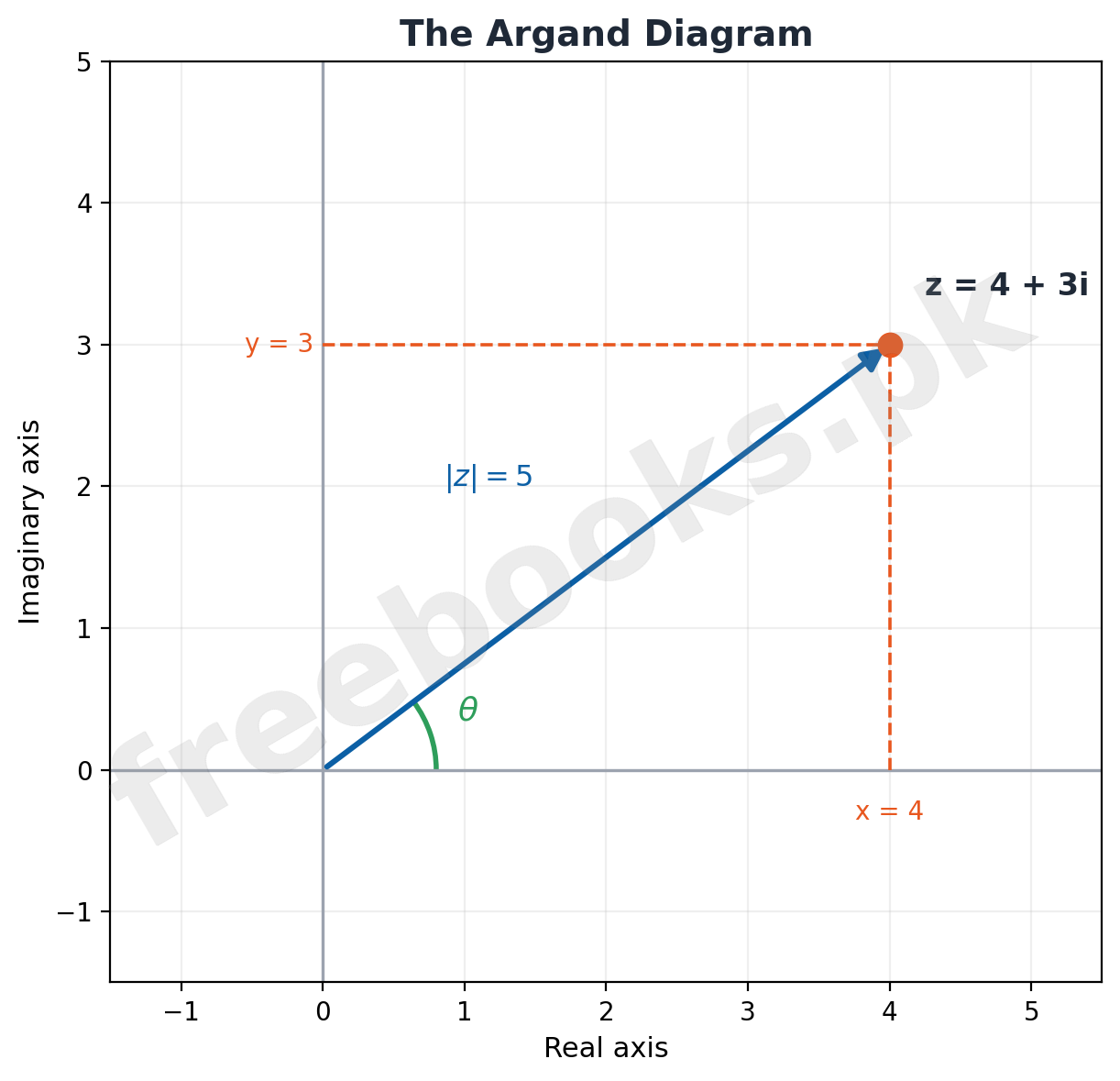
A complex number z = x + iy can be represented as the point (x, y) on a coordinate plane called the Argand diagram (or complex plane), where the horizontal axis is the real axis and the vertical axis is the imaginary axis. This turns every complex number into a specific, plottable point, and every algebraic operation on complex numbers into a geometric operation on points.
The modulus of z, written |z|, is the distance of the point (x, y) from the origin: |z| = sqrt(x^2 + y^2). The conjugate of z, written z-bar, is x – iy — the reflection of z across the real axis. Multiplying a complex number by its own conjugate always gives a real, non-negative result: z * z-bar = |z|^2.
1.4 Equality and Square Roots of Complex Numbers
Two complex numbers x + iy and a + ib are equal if and only if their real parts are equal AND their imaginary parts are equal separately: x = a and y = b. This single rule — comparing real parts to real parts and imaginary parts to imaginary parts — is the main tool used to solve equations where an unknown complex number appears.
The square root of a complex number z = x + iy is found using the general formula sqrt(x+iy) = +/-[ sqrt((|z|+x)/2) + i*sgn(y)*sqrt((|z|-x)/2) ], where |z| = sqrt(x^2+y^2) and sgn(y) is +1 if y is positive and -1 if y is negative. This formula comes from assuming the square root equals a+ib, squaring both sides, and matching real and imaginary parts to solve for a and b.
1.5 Complex Polynomials, the Fundamental Theorem of Algebra, and Completing the Square
The Fundamental Theorem of Algebra states that every polynomial of degree n (n >= 1) with complex coefficients has at least one complex root, and therefore has exactly n roots when counted with multiplicity — meaning the polynomial can always be written as a product of n linear factors. The Rational Root Theorem narrows down which rational numbers could possibly be roots: any rational root must be of the form (a factor of the constant term) divided by (a factor of the leading coefficient), which gives a manageable list of candidates to test.
A quadratic equation ax^2 + bx + c = 0 whose discriminant b^2 – 4ac is negative has no real roots, but it always has exactly two roots that are complex conjugates of each other. These roots are found using the same completing-the-square technique used for real quadratics — the only difference is that the square root of a negative number is now expressed using i instead of being called "no solution".
1.6 Cube Roots and Fourth Roots of Unity
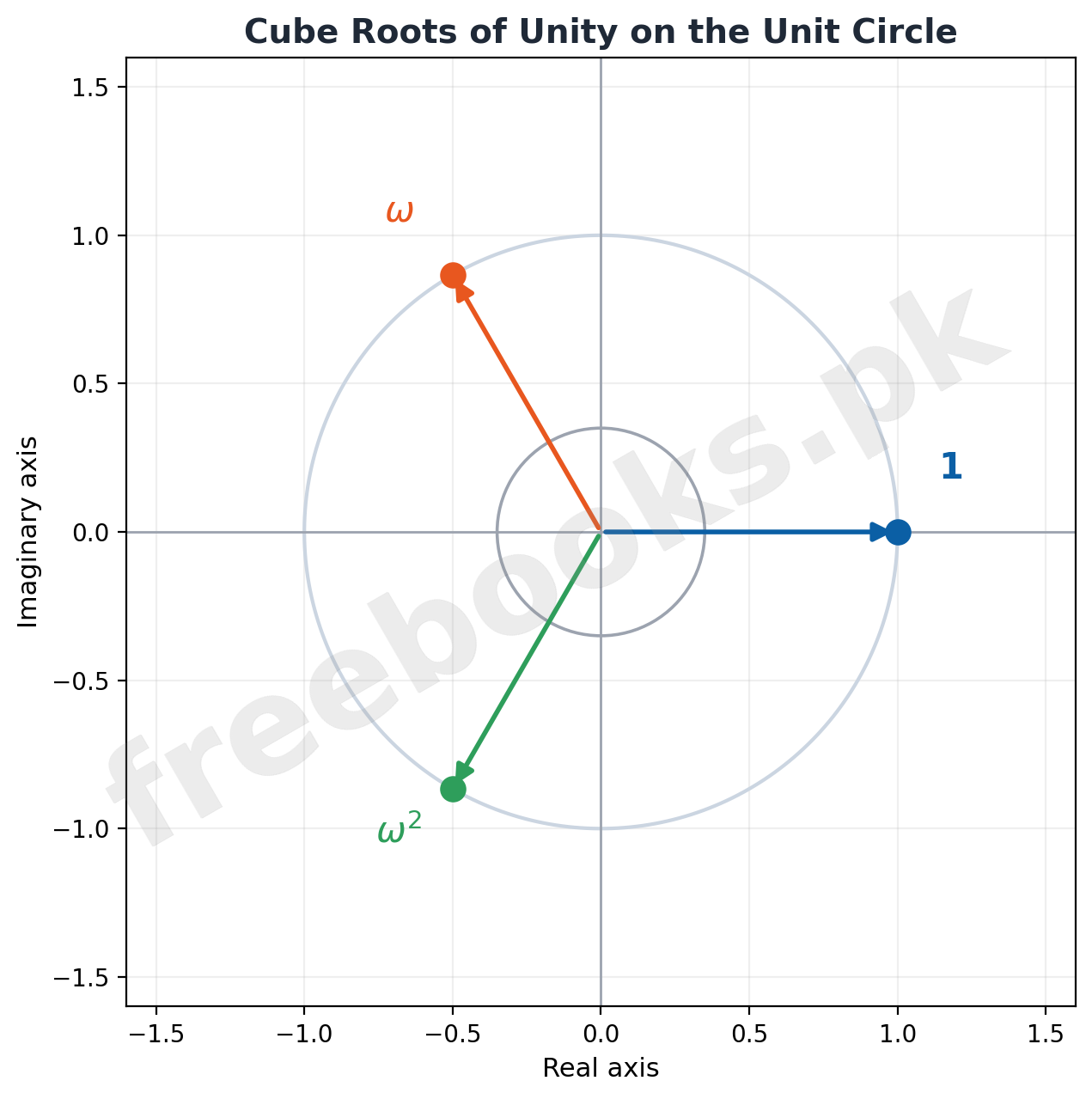
The cube roots of unity are the three solutions of the equation x^3 = 1. Rewriting this as x^3 – 1 = 0 and factoring using the difference-of-cubes identity gives (x-1)(x^2+x+1) = 0. One root is x = 1; the quadratic formula applied to x^2+x+1=0 gives the other two roots, usually denoted omega = (-1+i*sqrt(3))/2 and omega^2 = (-1-i*sqrt(3))/2.
The cube roots of unity satisfy two key properties that are used constantly to simplify algebraic expressions: 1 + omega + omega^2 = 0 (their sum is zero), and omega^3 = 1 (repeated multiplication cycles back to 1). The fourth roots of unity, solutions of x^4 = 1, are found by factoring x^4 – 1 = (x-1)(x+1)(x^2+1) = 0, giving the four roots 1, -1, i, and -i.
1.7 Polar Form and Real-World Applications
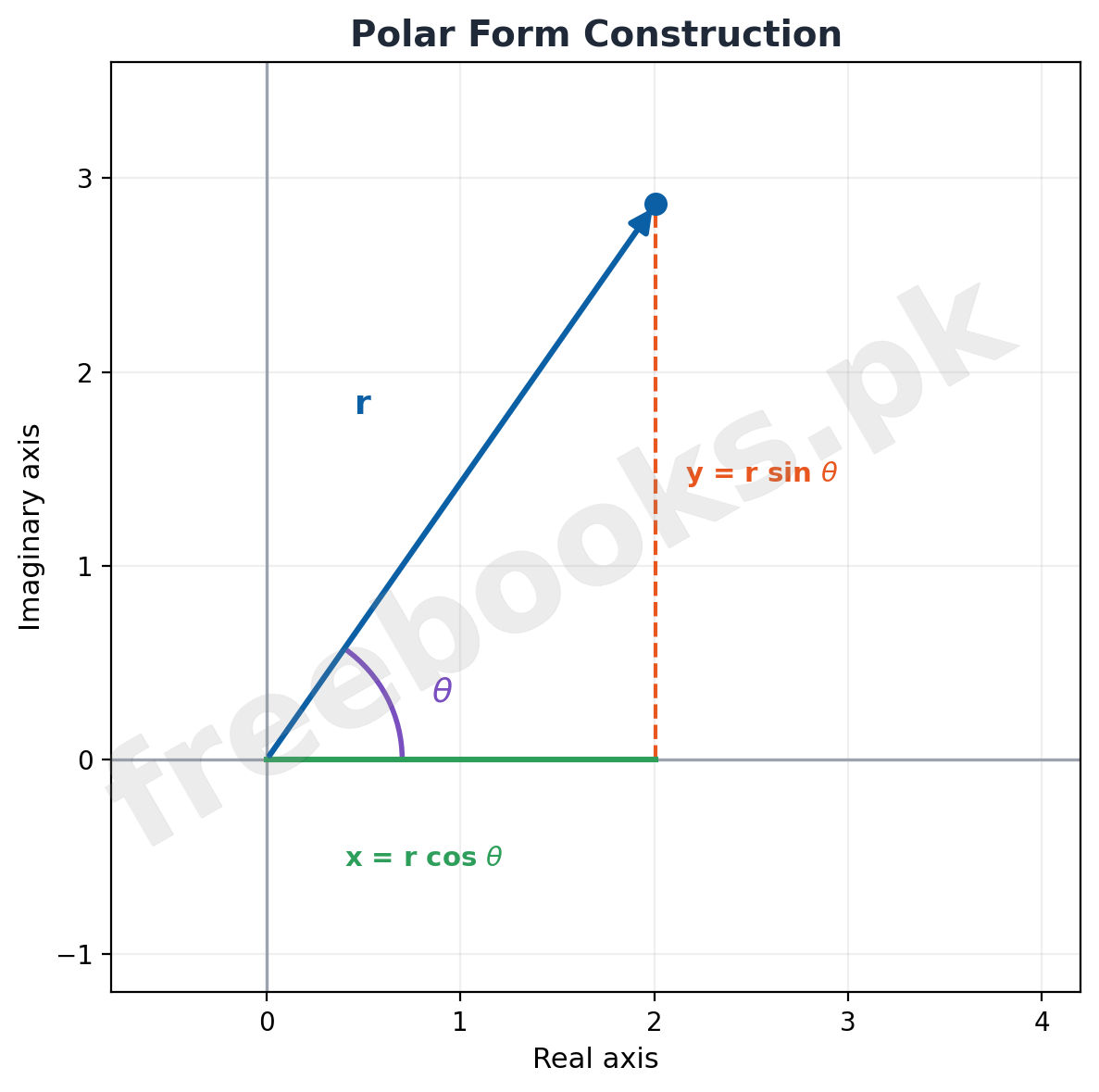
Any complex number z = x + iy can also be written in polar form as z = r(cos(theta) + i*sin(theta)), where r = |z| is the modulus and theta = Arg(z) = tan^(-1)(y/x), adjusted for the quadrant of (x,y), is the argument. Multiplying two complex numbers in polar form multiplies their moduli and ADDS their arguments; dividing them divides their moduli and SUBTRACTS their arguments — this makes polar form far more efficient than rectangular form whenever several complex numbers need to be multiplied or divided together.
Complex numbers describe real systems, not just abstract algebra. In alternating-current (AC) electrical circuits, impedance Z = R + iX combines a circuit's resistance R and reactance X into a single complex quantity, and Ohm's Law generalizes to V = I*Z. In cryptography, a message's numeric encoding can be encrypted by multiplying it by a fixed complex "key", and decrypted by multiplying by the key's multiplicative inverse (equivalently, dividing by the key).
Important Definitions
What is a complex number?
A number of the form z = x + iy, where x and y are real numbers and i = sqrt(-1) is the imaginary unit; x is called the real part and y the imaginary part of z.
What is the imaginary unit i, and what is its key property?
i is defined by i = sqrt(-1), so that i^2 = -1; it is the building block that allows equations with no real solution, such as x^2+1=0, to be solved.
What are Re(z) and Im(z)?
For z = x+iy, Re(z) = x is the real part and Im(z) = y is the imaginary part; both Re(z) and Im(z) are themselves real numbers.
What is the conjugate of a complex number?
For z = x+iy, the conjugate is z-bar = x – iy, obtained by reversing the sign of the imaginary part; geometrically it is the reflection of z across the real axis.
What is the modulus of a complex number?
For z = x+iy, the modulus is |z| = sqrt(x^2+y^2), the distance of the point (x,y) from the origin on the Argand diagram.
What is the argument (Arg z) of a complex number?
The angle theta that the line from the origin to z makes with the positive real axis, given by theta = tan^(-1)(y/x) with the quadrant of (x,y) determining the correct angle, restricted to the principal range (-pi, pi].
What is an Argand diagram?
A coordinate plane used to plot complex numbers, where the horizontal axis represents the real part and the vertical axis represents the imaginary part.
What are the cube roots of unity?
The three solutions of x^3 = 1, namely 1, omega = (-1+i*sqrt(3))/2, and omega^2 = (-1-i*sqrt(3))/2, satisfying 1+omega+omega^2 = 0 and omega^3 = 1.
What is the polar form of a complex number?
z = r(cos(theta) + i*sin(theta)), where r = |z| is the modulus and theta = Arg(z) is the argument of z.
What is impedance in an AC circuit?
A complex quantity Z = R + iX combining a circuit's resistance R and reactance X into one value, used in the AC form of Ohm's Law, V = I*Z.
Key Facts and Relations
| Topic | Key Fact / Relation |
|---|---|
| Imaginary unit | i^2 = -1 |
| Complex number | z = x + iy, Re(z) = x, Im(z) = y |
| Conjugate | z-bar = x – iy |
| Modulus | |z| = sqrt(x^2 + y^2) |
| Argument | theta = tan^(-1)(y/x), adjusted for quadrant |
| Equality | x + iy = a + ib if and only if x = a and y = b |
| Square root formula | sqrt(x+iy) = +/-[ sqrt((|z|+x)/2) + i*sgn(y)*sqrt((|z|-x)/2) ] |
| Cube roots of unity | 1, omega, omega^2, with 1+omega+omega^2 = 0 and omega^3 = 1 |
| Fourth roots of unity | 1, i, -1, -i |
| Polar form | z = r(cos theta + i sin theta), r = |z| |
| Multiplication in polar form | z1*z2 = r1*r2 [cos(theta1+theta2) + i sin(theta1+theta2)] |
| Division in polar form | z1/z2 = (r1/r2) [cos(theta1-theta2) + i sin(theta1-theta2)] |
| Ohm's Law for AC circuits | V = I * Z |
Diagrams
The Argand Diagram: A plotted point z = 4+3i on the complex plane, with the real and imaginary axes, dashed projection lines onto each axis, the modulus shown as the length of the line from the origin to the point, and the argument shown as the angle this line makes with the positive real axis
Cube Roots of Unity on the Unit Circle: The three cube roots of unity — 1, omega, and omega^2 — plotted as three points spaced exactly 120 degrees apart on the unit circle, illustrating why they sum to zero and why each is a 120-degree rotation of the last
Polar Form Construction: A right triangle in the complex plane showing how a point at modulus r and argument theta relates to its rectangular coordinates, with x = r*cos(theta) as the horizontal leg and y = r*sin(theta) as the vertical leg
Solved Examples
Example 1: Operations on Complex Numbers
Problem: If z1 = 3+4i and z2 = 2-5i, find (a) z1+z2, (b) z1*z2, and (c) z1/z2.
- Addition: combine real parts and imaginary parts separately — z1+z2 = (3+2) + (4-5)i = 5 – i.
- Multiplication: distribute and simplify using i^2 = -1 — z1*z2 = (3)(2) + (3)(-5i) + (4i)(2) + (4i)(-5i) = 6 – 15i + 8i – 20i^2 = 6 – 7i + 20 = 26 – 7i.
- Division: multiply numerator and denominator by the conjugate of the denominator, 2+5i — z1/z2 = (3+4i)(2+5i) / [(2-5i)(2+5i)] = (6+15i+8i+20i^2) / (4+25) = (-14+23i) / 29.
- Final answer: z1+z2 = 5-i, z1*z2 = 26-7i, z1/z2 = -14/29 + (23/29)i.
Example 2: Modulus and Argument on the Argand Diagram
Problem: Find the modulus and argument of z = -2+2i.
- Modulus: |z| = sqrt((-2)^2 + 2^2) = sqrt(4+4) = sqrt(8) = 2*sqrt(2).
- Since x = -2 is negative and y = 2 is positive, the point lies in the second quadrant.
- Reference angle: tan^(-1)(2/2) = tan^(-1)(1) = 45 degrees. Because z is in the second quadrant, theta = 180 deg – 45 deg = 135 deg (that is, 3*pi/4 radians).
- Final answer: |z| = 2*sqrt(2), Arg(z) = 135 degrees, plotted 2*sqrt(2) units from the origin at 135 degrees from the positive real axis.
Example 3: Square Root of a Complex Number
Problem: Find sqrt(3+4i) using the general square-root formula.
- Here x = 3 and y = 4, so |z| = sqrt(3^2+4^2) = sqrt(25) = 5.
- Apply sqrt(x+iy) = +/-[ sqrt((|z|+x)/2) + i*sgn(y)*sqrt((|z|-x)/2) ]: sqrt((5+3)/2) = sqrt(4) = 2, and sqrt((5-3)/2) = sqrt(1) = 1.
- Since y = 4 is positive, sgn(y) = +1, so sqrt(3+4i) = +/-(2+i).
- Check by squaring: (2+i)^2 = 4 + 4i + i^2 = 4 + 4i – 1 = 3+4i. Correct.
- Final answer: sqrt(3+4i) = +/-(2+i).
Example 4: Cube Roots of Unity
Problem: Show that 1+omega+omega^2 = 0 and omega^3 = 1 for omega = (-1+i*sqrt(3))/2, then use this to find the three cube roots of 8.
- omega = (-1+i*sqrt(3))/2 and omega^2 = (-1-i*sqrt(3))/2 (the other non-real root of x^3=1).
- Adding: 1 + omega + omega^2 = 1 + (-1+i*sqrt(3))/2 + (-1-i*sqrt(3))/2 = 1 + (-2/2) = 1 – 1 = 0.
- Multiplying: omega^3 = omega * omega^2 = [(-1)(-1) + (-1)(-i*sqrt(3)) + (i*sqrt(3))(-1) + (i*sqrt(3))(-i*sqrt(3))] / 4 = [1 + i*sqrt(3) – i*sqrt(3) + 3] / 4 = 4/4 = 1.
- Since 8 = 2^3, and (r*omega^k)^3 = r^3 * omega^(3k) = r^3 for any k, the three cube roots of 8 are 2(1), 2(omega), and 2(omega^2), i.e. 2, -1+i*sqrt(3), and -1-i*sqrt(3).
- Final answer: the three cube roots of 8 are 2, -1+i*sqrt(3), and -1-i*sqrt(3).
Example 5: Converting to Polar Form
Problem: Express z = -1 + i*sqrt(3) in polar form.
- Modulus: |z| = sqrt((-1)^2 + (sqrt(3))^2) = sqrt(1+3) = sqrt(4) = 2.
- x = -1 (negative) and y = sqrt(3) (positive), so z lies in the second quadrant.
- Reference angle: tan^(-1)(sqrt(3)/1) = 60 degrees. In the second quadrant, theta = 180 deg – 60 deg = 120 degrees (2*pi/3 radians).
- Final answer: z = 2(cos120 deg + i sin120 deg).
Example 6: Multiplying and Dividing in Polar Form
Problem: If z1 = 6(cos150 deg + i sin150 deg) and z2 = 3(cos30 deg + i sin30 deg), find z1*z2 and z1/z2 in rectangular (x+iy) form.
- Multiplication: multiply the moduli and add the arguments — z1*z2 = (6)(3)[cos(150+30) + i sin(150+30)] = 18[cos180 deg + i sin180 deg] = 18(-1 + 0i) = -18.
- Division: divide the moduli and subtract the arguments — z1/z2 = (6/3)[cos(150-30) + i sin(150-30)] = 2[cos120 deg + i sin120 deg] = 2(-1/2 + i*sqrt(3)/2) = -1 + i*sqrt(3).
- Final answer: z1*z2 = -18, z1/z2 = -1 + i*sqrt(3).
Example 7: Application: Current in an AC Circuit
Problem: A circuit has impedance Z = 10(cos40 deg + i sin40 deg) ohms and is supplied with voltage V = 40(cos70 deg + i sin70 deg) volts. Find the current I using V = I*Z.
- Rearranging Ohm's Law for AC circuits: I = V / Z.
- Divide the moduli and subtract the arguments: I = (40/10)[cos(70-40) + i sin(70-40)] = 4[cos30 deg + i sin30 deg].
- Convert to rectangular form: I = 4(sqrt(3)/2 + i/2) = 2*sqrt(3) + 2i.
- Final answer: I = 4(cos30 deg + i sin30 deg), approximately 3.46 + 2i amperes.
Short Questions & Answers
What is the value of i^2?
i^2 = -1, since i is defined as sqrt(-1).
Define the modulus of a complex number z = x+iy.
|z| = sqrt(x^2+y^2), the distance of the point (x,y) from the origin on the Argand diagram.
How is a complex number divided by another complex number?
Multiply both the numerator and the denominator by the conjugate of the denominator; this turns the denominator into a real number, and the result can then be simplified into x+iy form.
State the four fourth roots of unity.
1, i, -1, and -i — the four solutions of x^4 = 1.
What is the sum of the three cube roots of unity?
1 + omega + omega^2 = 0.
Write the polar form of a complex number with modulus r and argument theta.
z = r(cos theta + i sin theta).
When two complex numbers in polar form are multiplied, what happens to their moduli and arguments?
The moduli are multiplied together, and the arguments are added together.
Long Questions & Answers
Explain how a complex number is represented in rectangular form and in polar form, and describe with a worked example how to convert a complex number from rectangular to polar form.
What is the rectangular form of a complex number, and what do x and y represent?
z = x + iy is the rectangular (or Cartesian) form of a complex number, where x is the real part and y is the imaginary part. It corresponds directly to plotting the point (x, y) on the Argand diagram, with x measured along the real axis and y measured along the imaginary axis.
How are the modulus and argument of a complex number calculated from its rectangular form?
The modulus is |z| = sqrt(x^2+y^2), the straight-line distance from the origin to the point (x,y). The argument theta = tan^(-1)(y/x), but this basic inverse-tangent value only gives an angle between -90 degrees and 90 degrees, so the quadrant that (x,y) actually lies in must be checked and the angle adjusted accordingly.
What is the polar form of a complex number, and how is it written using the modulus and argument?
Once r = |z| and theta = Arg(z) have been found, the complex number can be written in polar form as z = r(cos theta + i sin theta). This form separates the "size" of the complex number (r) from its "direction" (theta), which is especially useful for multiplication and division.
Work through an example of converting a complex number to polar form.
To convert z = -1 + i*sqrt(3): the modulus is |z| = sqrt(1+3) = 2. Since x is negative and y is positive, z lies in the second quadrant; the reference angle is tan^(-1)(sqrt(3)/1) = 60 degrees, so theta = 180 – 60 = 120 degrees. Hence z = 2(cos120 deg + i sin120 deg).
Define the cube roots of unity and the fourth roots of unity, showing how each is obtained and stating their key properties.
How are the cube roots of unity obtained from the equation x^3 = 1?
Rewriting x^3 – 1 = 0 and factoring using the difference-of-cubes identity gives (x-1)(x^2+x+1) = 0. Setting each factor to zero gives x = 1 from the first factor, while the quadratic formula applied to x^2+x+1=0 gives the other two, non-real roots.
What are the three cube roots of unity, and how are they usually denoted?
The three roots are 1, omega = (-1+i*sqrt(3))/2, and omega^2 = (-1-i*sqrt(3))/2. Omega is the standard symbol used for the non-real cube root of unity, and the third root is simply its square, omega^2.
What key properties do the cube roots of unity satisfy?
They satisfy 1 + omega + omega^2 = 0, meaning their sum is always zero, and omega^3 = 1, meaning repeated multiplication by omega cycles back to 1 after three steps. These two identities are used constantly to simplify algebraic expressions involving omega without substituting its full value.
How are the fourth roots of unity obtained, and what are they?
Factoring x^4 – 1 = 0 as (x-1)(x+1)(x^2+1) = 0 gives four roots: x = 1 and x = -1 from the first two factors, and x = i and x = -i from x^2+1=0. So the four fourth roots of unity are 1, i, -1, and -i, corresponding to four points spaced 90 degrees apart on the unit circle.
Multiple Choice Questions (MCQs)
i^2 equals: (A) 1 (B) -1 (C) i (D) -i
Correct answer: (B) -1. By definition i = sqrt(-1), so squaring both sides gives i^2 = -1.
The modulus of z = x+iy is: (A) x+y (B) sqrt(x^2+y^2) (C) x^2+y^2 (D) x-y
Correct answer: (B) sqrt(x^2+y^2). The modulus is the distance from the origin to the point (x,y): |z| = sqrt(x^2+y^2).
The conjugate of a+bi is: (A) a+bi (B) -a-bi (C) a-bi (D) -a+bi
Correct answer: (C) a-bi. The conjugate reverses the sign of the imaginary part only, giving a-bi.
The sum of the three cube roots of unity equals: (A) 1 (B) -1 (C) 0 (D) 3
Correct answer: (C) 0. 1 + omega + omega^2 = 0 is a key identity for the cube roots of unity.
The cube roots of unity are usually denoted: (A) 1, i, -i (B) 1, omega, omega^2 (C) i, -i, 1 (D) -1, 0, 1
Correct answer: (B) 1, omega, omega^2. The standard notation for the cube roots of unity is 1, omega, and omega^2.
omega^3 equals: (A) 0 (B) omega (C) 1 (D) -1
Correct answer: (C) 1. Since omega is a cube root of unity, omega^3 = 1 by definition.
The four fourth roots of unity are: (A) 1, -1, i, -i (B) 1, i, -1 only (C) 1, 2, 3, 4 (D) i, -i only
Correct answer: (A) 1, -1, i, -i. Solving x^4=1 by factoring gives exactly four roots: 1, -1, i, and -i.
The polar form of a complex number with modulus r and argument theta is: (A) z = r + i*theta (B) z = r(cos theta + i sin theta) (C) z = r*theta (D) z = r/theta
Correct answer: (B) z = r(cos theta + i sin theta). Polar form combines the modulus and argument as z = r(cos theta + i sin theta).
When two complex numbers in polar form are multiplied, the result's argument is: (A) the product of the two arguments (B) the sum of the two arguments (C) the difference of the two arguments (D) unchanged
Correct answer: (B) the sum of the two arguments. Multiplying complex numbers in polar form multiplies the moduli and ADDS the arguments.
Dividing z1 by z2 in polar form gives an argument equal to: (A) the sum of the two arguments (B) the product of the two arguments (C) the difference of the two arguments (D) the two arguments unchanged
Correct answer: (C) the difference of the two arguments. Division in polar form divides the moduli and SUBTRACTS the arguments: z1/z2 = (r1/r2)[cos(theta1-theta2)+i sin(theta1-theta2)].
Quick Revision Summary
- A complex number has the form z = x + iy, with i^2 = -1
- Re(z) = x and Im(z) = y are both real numbers
- The conjugate of z = x+iy is z-bar = x – iy
- Modulus: |z| = sqrt(x^2+y^2); Argument: theta = tan^(-1)(y/x), adjusted for quadrant
- Two complex numbers are equal only when both their real parts and imaginary parts match
- Square root formula: sqrt(x+iy) = +/-[ sqrt((|z|+x)/2) + i*sgn(y)*sqrt((|z|-x)/2) ]
- The Fundamental Theorem of Algebra guarantees every degree-n polynomial has exactly n complex roots
- Cube roots of unity: 1, omega, omega^2, with 1+omega+omega^2 = 0 and omega^3 = 1
- Fourth roots of unity: 1, i, -1, -i
- Polar form: z = r(cos theta + i sin theta), where r = |z|
- Multiplying in polar form: multiply moduli, add arguments; dividing: divide moduli, subtract arguments
- Complex numbers model real systems — impedance in AC circuits (V = I*Z) and encryption keys in cryptography
Exam Tips
- Always rationalize the denominator by multiplying by its conjugate when dividing complex numbers
- Remember the principal argument Arg z is restricted to the range (-pi, pi]
- Sketch the Argand diagram whenever a problem involves modulus or argument — it makes sign and quadrant errors obvious
- Memorize omega = (-1+i*sqrt(3))/2 and 1+omega+omega^2 = 0 — they turn long cube-root algebra into instant answers
- Convert to polar form before multiplying or dividing several complex numbers together — it is far less error-prone than expanding everything in rectangular form
- After finding the square root of a complex number, always square your answer back to check it matches the original number