This unit studies patterns of numbers that follow a clear rule — sequences — and the sums formed by adding their terms together, called series. Three major types of progressions are covered in depth: arithmetic progressions, where each term is formed by adding a fixed constant to the one before it; geometric progressions, where each term is formed by multiplying by a fixed constant; and harmonic progressions, whose reciprocals form an arithmetic progression.
For each type of progression, the unit develops the formula for the general (nth) term, the arithmetic/geometric/harmonic mean between two numbers, and the formula for the sum of the corresponding series — including the special case of the sum to infinity of a geometric series. It closes with sigma notation, key summation formulas, and real-world applications such as simple interest, compound interest, vehicle leasing, and depreciation, all of which turn out to be arithmetic or geometric progressions in disguise.
Learning Objectives
- Define a sequence and distinguish between finite and infinite sequences
- Identify an arithmetic progression (A.P.) and find its common difference, general term, and specific terms
- Find the arithmetic mean (A.M.) between two numbers, and insert n arithmetic means between two numbers
- Derive and apply the formula for the sum of an arithmetic series
- Identify a geometric progression (G.P.) and find its common ratio, general term, and specific terms
- Find the geometric mean (G.M.) between two numbers, and derive and apply the formula for the sum of a geometric series (finite and infinite)
- Identify a harmonic progression (H.P.) and find the harmonic mean (H.M.) between two numbers
- Use sigma notation to express series, and apply the summation formulas for the sums of the first n natural numbers, their squares, and their cubes
- Apply sequences and series to solve real-world problems involving simple interest, compound interest, and other practical scenarios
Key Concepts
6.1 Sequences: Definitions and Types
A sequence is a function whose domain is the set of natural numbers N, and whose range may be any subset of real (or complex) numbers; the numbers in a sequence are called its terms, with the nth term (or general term) denoted a_n. A sequence with a finite number of terms is a finite sequence; one that continues indefinitely is an infinite sequence.
If the general term a_n is known, any specific term of the sequence can be found by substitution; conversely, if enough terms are given, a formula for a_n can often be found. Sequences following a specific pattern are also called progressions, and this unit studies three major types: arithmetic, geometric, and harmonic progressions.
6.2 Arithmetic Progression (A.P.) and Arithmetic Mean (A.M.)
A sequence is an arithmetic progression if the difference between any term and the one before it is always the same constant, called the common difference d. The general term of an A.P. is a_n = a_1 + (n-1)d, and three numbers a, b, c are in A.P. if and only if 2b = a+c.
A number A is the arithmetic mean between a and b if a, A, b are in A.P.; solving gives A = (a+b)/2. More generally, if n arithmetic means are to be inserted between a and b, the sequence a, A1, A2, …, An, b is treated as an A.P. with n+2 terms, and the common difference is found using the general term formula.
6.3 Arithmetic Series
The sum of the terms of a sequence is called a series, and the sum of the first n terms is denoted S_n. The sum of an arithmetic series is given by S_n = (n/2)(a1+an), or equivalently S_n = (n/2)[2a1+(n-1)d] when an is not directly known.
These two forms of the sum formula are interchangeable — the first is quicker when the last term an is already known, and the second is quicker when only a1 and d are known — and many real-life problems (like total lease payments or total interest) are solved by recognizing the pattern of amounts as an arithmetic series and applying one of these formulas.
6.4 Geometric Progression (G.P.) and Geometric Mean (G.M.)
A sequence is a geometric progression if each term after the first is found by multiplying the previous term by a fixed non-zero constant r, called the common ratio, found by dividing any term by the one before it. The general term of a G.P. is a_n = a1 * r^(n-1), and three numbers a, b, c are in G.P. if and only if b^2 = ac.
A number G is the geometric mean between a and b if a, G, b are in G.P.; solving gives G = +/- sqrt(ab). If the positive numbers of a G.P. are replaced by their logarithms, the resulting sequence is always an A.P., and vice versa — a useful link between the two progression types.
6.5 Geometric Series
The sum of the first n terms of a geometric series is Sn = a1(1-r^n)/(1-r), for r not equal to 1 (and Sn = n*a1 when r=1); it is derived by subtracting rSn from Sn, which cancels all the middle terms.
When |r| < 1, r^n approaches 0 as n grows without bound, so the sum to infinity of a geometric series converges to S_infinity = a1/(1-r) — a result with no counterpart in arithmetic series, since arithmetic series never converge to a finite sum as n increases.
6.6 Harmonic Progression (H.P.) and Harmonic Mean (H.M.)
A sequence is a harmonic progression if the reciprocals of its terms form an arithmetic progression; since the reciprocal of zero is undefined, zero can never be a term of an H.P. The nth term of an H.P. is found by first finding the nth term of the corresponding A.P. of reciprocals, then taking its reciprocal.
A number H is the harmonic mean between a and b if a, H, b are in H.P., giving H = 2ab/(a+b). To insert n harmonic means between a and b, first insert n arithmetic means between 1/a and 1/b, then take the reciprocal of each one.
6.7 Sigma Notation and Summation Formulas
The Greek letter sigma (Σ) is used as shorthand for a sum: the sum from k=1 to n of a_k means a1+a2+…+an, where k is the index of summation and 1 and n are its lower and upper limits. Summation obeys two useful properties: the sum of a sum equals the sum of the sums (term by term), and a constant multiplier can be pulled outside the sigma.
Using a telescoping identity, three key summation formulas can be derived: the sum of k (from 1 to n) = n(n+1)/2, the sum of k^2 = n(n+1)(2n+1)/6, and the sum of k^3 = [n(n+1)/2]^2 — these let more complicated series (like sums of squares of odd numbers) be evaluated by expanding the general term and summing each power separately.
6.8 Real-Life Applications
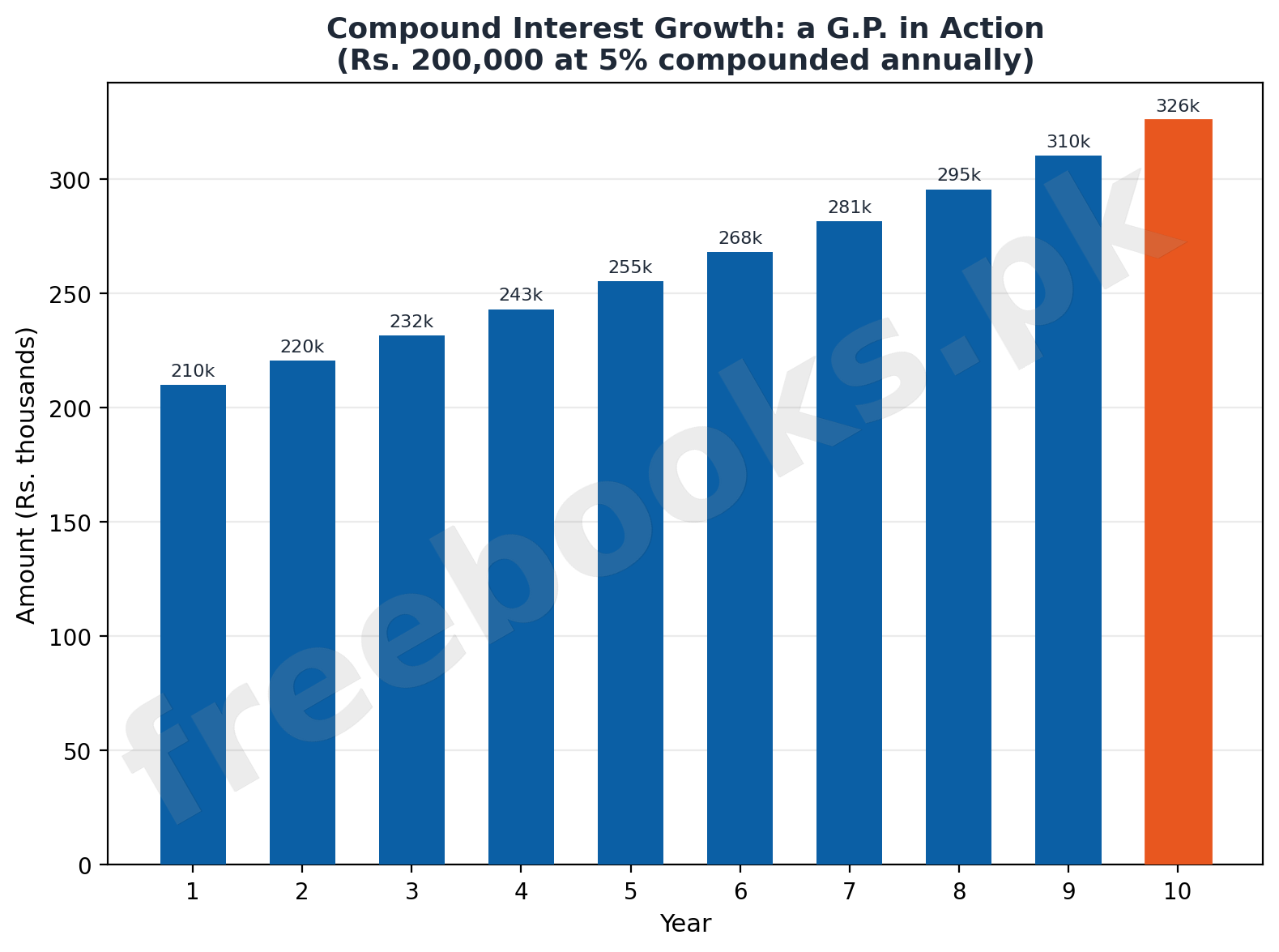
Many real-world growth and payment patterns follow arithmetic or geometric progressions: a lease payment that increases by a fixed amount each month is an arithmetic sequence (solved with the an and Sn formulas), while an investment earning fixed-percentage compound interest each year is a geometric sequence (solved with An = P(1+rate)^n), since each year's amount is a constant multiple of the previous year's.
Recognizing which type of progression a real-world scenario follows — constant addition (arithmetic) or constant multiplication (geometric) — is the key first step in solving problems involving vehicle traffic counts, simple interest, compound interest, population growth, and similar applied scenarios.
Important Definitions
What is a sequence?
A function whose domain is the set of natural numbers N; its terms are a1, a2, a3, …, with the nth term an called the general term.
What is a finite sequence?
A sequence with a finite number of terms.
What is an infinite sequence?
A sequence with an infinite number of terms.
What is an arithmetic progression (A.P.)?
A sequence in which the difference between any term and the one before it is always the same constant, called the common difference.
What is the arithmetic mean (A.M.) between two numbers?
The number A such that a, A, b are in A.P.; A = (a+b)/2.
What is a geometric progression (G.P.)?
A sequence in which each term after the first is found by multiplying the previous term by a fixed non-zero constant called the common ratio.
What is the geometric mean (G.M.) between two numbers?
The number G such that a, G, b are in G.P.; G = plus or minus the square root of ab.
What is a harmonic progression (H.P.)?
A sequence whose reciprocals form an arithmetic progression.
What is a series?
The sum of the terms of a sequence.
What does sigma notation represent?
A shorthand way of writing the sum of a sequence of terms, from k=1 to n of a_k equals a1+a2+…+an.
Key Facts and Relations
| Topic | Key Fact / Relation |
|---|---|
| General term of an A.P. | an = a1 + (n-1)d |
| Arithmetic mean | A = (a+b) / 2 |
| Sum of an arithmetic series | Sn = (n/2)(a1+an) = (n/2)[2a1+(n-1)d] |
| General term of a G.P. | an = a1 . r^(n-1) |
| Geometric mean | G = plus or minus square root of (ab) |
| Sum of a finite geometric series | Sn = a1(1-r^n)/(1-r), r not equal to 1 |
| Sum to infinity of a geometric series | S(infinity) = a1/(1-r), valid only when |r| < 1 |
| Harmonic mean | H = 2ab / (a+b) |
| Sum of first n natural numbers | sum of k = n(n+1)/2 |
| Sum of squares of first n natural numbers | sum of k^2 = n(n+1)(2n+1)/6 |
| Sum of cubes of first n natural numbers | sum of k^3 = [n(n+1)/2]^2 |
| Compound interest as a G.P. | An = P(1 + rate)^n |
Diagrams
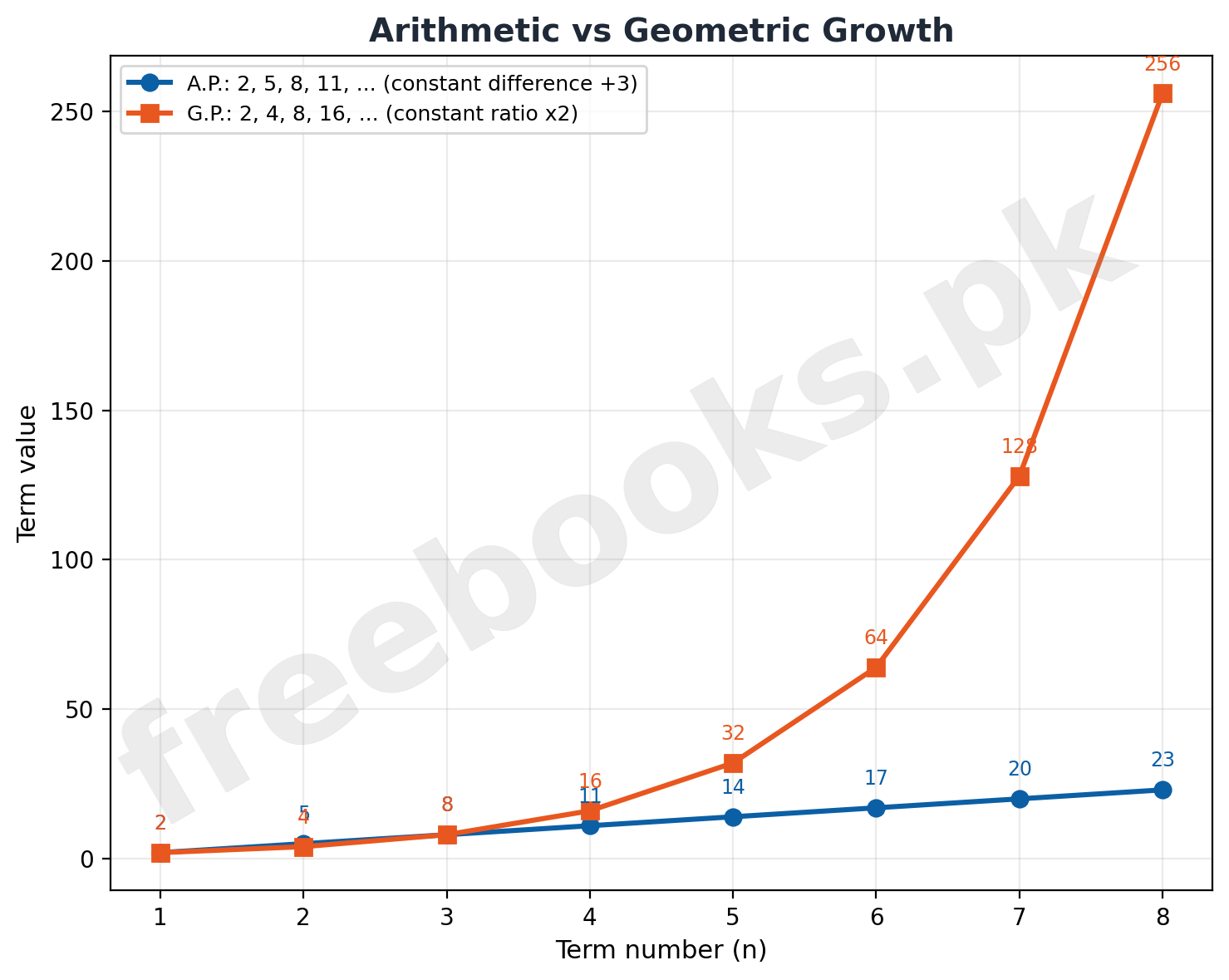
Arithmetic vs Geometric Growth: A line plot comparing an arithmetic progression (2, 5, 8, 11, … growing by a constant difference of 3) against a geometric progression (2, 4, 8, 16, … growing by a constant ratio of 2), visually showing linear growth versus exponential growth over 8 terms
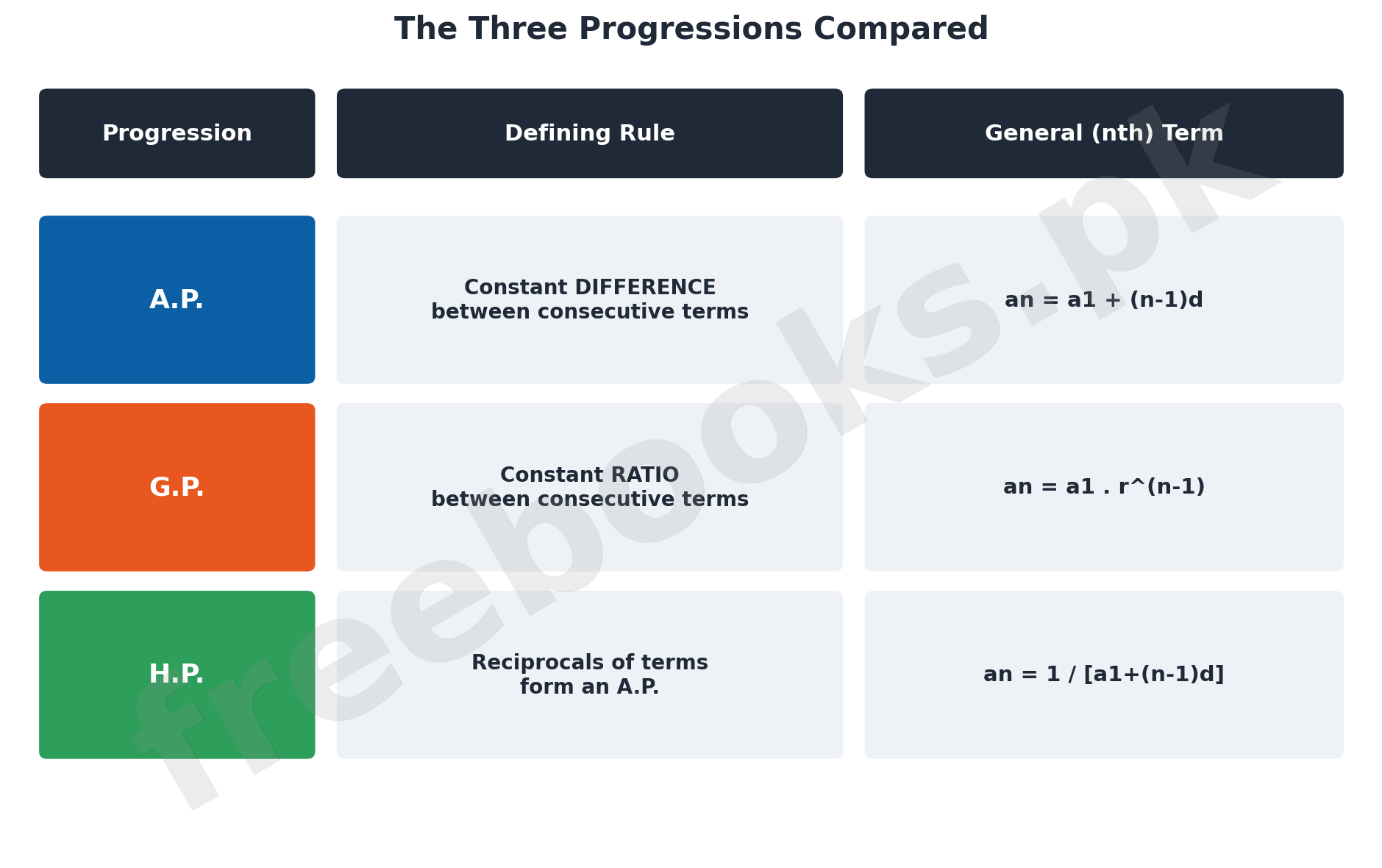
The Three Progressions Compared: A summary table comparing arithmetic, geometric, and harmonic progressions, showing the defining rule and the general (nth) term formula for each
Compound Interest Growth: a G.P. in Action: A bar chart showing an investment of Rs. 200,000 growing year by year at 5% compounded annually over 10 years, illustrating how compound interest forms a geometric progression
Solved Examples
Example 1: Finding the General Term and a Specific Term of an A.P.
Problem: Find the general term and the 15th term of the A.P. whose first term is 4 and common difference is 5.
- Use an = a1 + (n-1)d with a1=4, d=5: an = 4 + (n-1)(5) = 4 + 5n – 5.
- Simplify: an = 5n – 1. This is the general term.
- Substitute n=15 to find the 15th term: a15 = 5(15) – 1 = 75 – 1 = 74.
- Final answer: general term an = 5n-1, and a15 = 74.
Example 2: Inserting Arithmetic Means
Problem: Insert three arithmetic means between 4 and 20.
- Write 4, A1, A2, A3, 20 as an A.P. with 5 terms, so a1=4 and a5=20.
- Use a5 = a1 + 4d: 20 = 4 + 4d, so 4d = 16, giving d = 4.
- A1 = a1 + d = 4 + 4 = 8. A2 = A1 + d = 8 + 4 = 12. A3 = A2 + d = 12 + 4 = 16.
- Final answer: the three arithmetic means are 8, 12, 16.
Example 3: Sum of an Arithmetic Series
Problem: Find the sum of the first 30 terms of the arithmetic series 5+9+13+17+…
- Identify a1=5, d=9-5=4, n=30.
- Use Sn = (n/2)[2a1+(n-1)d]: S30 = (30/2)[2(5)+(30-1)(4)] = 15[10+116].
- Simplify inside the brackets: 10+116 = 126.
- Multiply: S30 = 15(126) = 1890.
- Final answer: S30 = 1890.
Example 4: Finding a Specific Term of a G.P.
Problem: Find the 7th term of the G.P. 5, 15, 45, …
- Identify a1=5 and r=15/5=3.
- Use an = a1 . r^(n-1): a7 = 5 . 3^(7-1) = 5 . 3^6.
- Compute 3^6 = 729.
- Multiply: a7 = 5(729) = 3645.
- Final answer: a7 = 3645.
Example 5: Sum to Infinity of a Geometric Series
Problem: Find the sum to infinity of the G.P. 8, 4, 2, 1, …
- Identify a1=8 and r=4/8=1/2; since |r|<1, the sum to infinity exists.
- Use S(infinity) = a1/(1-r): S(infinity) = 8/(1 – 1/2) = 8/(1/2).
- Simplify: 8 divided by 1/2 equals 16.
- Final answer: S(infinity) = 16.
Example 6: Finding the Harmonic Mean between Two Numbers
Problem: Find the harmonic mean between 6 and 10.
- Use H = 2ab/(a+b) with a=6, b=10.
- Compute the numerator: 2(6)(10) = 120.
- Compute the denominator: 6+10 = 16.
- Divide: H = 120/16 = 7.5.
- Final answer: H = 7.5.
Example 7: Summing a Series Using a Sigma Notation Formula
Problem: Find the sum of the series 1^2+2^2+3^2+…+12^2 using the summation formula.
- Use the formula sum of k^2 = n(n+1)(2n+1)/6 with n=12.
- Substitute: sum = 12(13)(25)/6.
- Compute the numerator: 12 x 13 = 156, then 156 x 25 = 3900.
- Divide: 3900/6 = 650.
- Final answer: the sum is 650.
Example 8: Application: Compound Interest as a Geometric Sequence
Problem: Farah invests Rs. 100,000 at 6% annual interest compounded annually. Find the total amount after 5 years.
- This scenario is a G.P., since each year's amount is a constant multiple (1.06) of the previous year's amount.
- Use the formula for the amount after n years: An = P(1+rate)^n = 100000(1.06)^5.
- Compute (1.06)^5 by repeated multiplication: 1.06^2=1.1236, 1.06^3=1.19102, 1.06^4=1.26248, 1.06^5=1.33823 (approximately).
- Multiply: A5 = 100000 x 1.33823 = Rs. 133,823 (approximately).
- Final answer: the total amount after 5 years is approximately Rs. 133,823.
Short Questions & Answers
What is the general term formula for an A.P.?
an = a1 + (n-1)d.
What is the common ratio of a G.P.?
The constant multiplier between consecutive terms, found by dividing any term by the one before it.
What is the arithmetic mean between a and b?
A = (a+b)/2.
What is the geometric mean between a and b?
G = plus or minus the square root of ab.
What condition must |r| satisfy for a geometric series to have a sum to infinity?
|r| must be less than 1.
What is a harmonic progression?
A sequence whose reciprocals form an arithmetic progression.
What does the sigma symbol represent?
A shorthand notation for the sum of a sequence of terms.
Long Questions & Answers
Explain what an arithmetic progression is, and derive the formula for the sum of the first n terms of an arithmetic series.
What is an arithmetic progression, and what is its common difference?
An arithmetic progression (A.P.) is a sequence in which the difference between any term and the one immediately before it is always the same constant, called the common difference d, found as d = an – a(n-1) for any n greater than 1.
What is the formula for the nth term of an A.P.?
The nth (general) term is an = a1 + (n-1)d, where a1 is the first term and d is the common difference; this formula lets any specific term be found directly without listing every term before it.
How is the sum of the first n terms of an arithmetic series derived?
Writing Sn forwards and then backwards and adding the two versions term by term, every pair sums to (a1+an), and since there are n such pairs, 2Sn = n(a1+an), giving Sn = (n/2)(a1+an).
Why is there also a second version of the sum formula?
Substituting an = a1+(n-1)d into Sn=(n/2)(a1+an) gives Sn = (n/2)[2a1+(n-1)d], which is more convenient when the last term an is not directly known but a1 and d are.
Describe geometric progressions and geometric series, including how the sum to infinity is derived and when it exists.
What is a geometric progression, and what is its common ratio?
A geometric progression (G.P.) is a sequence in which each term after the first is found by multiplying the previous term by a fixed non-zero constant r, called the common ratio, found by dividing any term by the one immediately before it.
What is the formula for the nth term of a G.P.?
The nth term is an = a1 . r^(n-1), derived by repeatedly multiplying the first term by r one more time for each step further into the sequence.
How is the sum of the first n terms of a geometric series derived?
Writing Sn and then rSn (Sn multiplied by the common ratio), subtracting the two cancels every middle term, leaving Sn(1-r) = a1(1-r^n), so Sn = a1(1-r^n)/(1-r) for r not equal to 1.
When does the sum to infinity of a geometric series exist, and what is its formula?
The sum to infinity exists only when |r| < 1, because in that case r^n approaches 0 as n grows without bound, reducing the finite-sum formula to S(infinity) = a1/(1-r); if |r| is 1 or greater, the terms do not shrink and the series has no finite sum.
Multiple Choice Questions (MCQs)
The nth term of an A.P. is given by: (A) a1 . r^(n-1) (B) a1 + (n-1)d (C) a1 + nd (D) a1/(n-1)
Correct answer: (B) a1 + (n-1)d. The general term of an A.P. is an = a1 + (n-1)d, using the common difference d.
Three numbers a, b, c are in A.P. if and only if: (A) b^2 = ac (B) 2b = a+c (C) b = a+c (D) ac = a+c
Correct answer: (B) 2b = a+c. The middle term of three numbers in A.P. equals half the sum of the outer two: 2b = a+c.
The common ratio of a G.P. is found by: (A) Subtracting consecutive terms (B) Dividing a term by the one before it (C) Adding consecutive terms (D) Multiplying all terms
Correct answer: (B) Dividing a term by the one before it. The common ratio r is found by dividing any term by its immediately preceding term.
The arithmetic mean between a and b is: (A) square root of ab (B) 2ab/(a+b) (C) (a+b)/2 (D) a+b
Correct answer: (C) (a+b)/2. The arithmetic mean is the simple average, A = (a+b)/2.
The geometric mean between a and b is: (A) (a+b)/2 (B) plus or minus square root of ab (C) 2ab/(a+b) (D) ab
Correct answer: (B) plus or minus square root of ab. The geometric mean satisfies G^2=ab, so G = plus or minus the square root of ab.
The sum to infinity of a geometric series exists only when: (A) r > 1 (B) |r| < 1 (C) r = 0 (D) r is negative
Correct answer: (B) |r| < 1. The infinite sum formula only converges when the common ratio's absolute value is less than 1.
A harmonic progression is a sequence whose: (A) Terms are constant (B) Squares are in A.P. (C) Reciprocals are in A.P. (D) Reciprocals are in G.P.
Correct answer: (C) Reciprocals are in A.P.. A harmonic progression is defined as a sequence whose reciprocals form an arithmetic progression.
The formula for the sum of the first n natural numbers is: (A) n(n+1)/2 (B) n(n+1)(2n+1)/6 (C) [n(n+1)/2]^2 (D) n^2
Correct answer: (A) n(n+1)/2. The sum of the first n natural numbers is n(n+1)/2.
The harmonic mean between a and b is: (A) (a+b)/2 (B) plus or minus square root of ab (C) 2ab/(a+b) (D) a-b
Correct answer: (C) 2ab/(a+b). The harmonic mean is H = 2ab/(a+b).
A fixed-percentage compound interest investment forms: (A) An A.P. (B) A G.P. (C) An H.P. (D) None of these
Correct answer: (B) A G.P.. Since each year's amount is a constant multiple of the previous year's, compound interest forms a geometric progression.
Quick Revision Summary
- A sequence is a function whose domain is the natural numbers; its terms are a1, a2, …, an, …
- An A.P. has a constant common difference d; general term an = a1 + (n-1)d
- Arithmetic mean: A = (a+b)/2; sum of an arithmetic series: Sn = (n/2)(a1+an) = (n/2)[2a1+(n-1)d]
- A G.P. has a constant common ratio r; general term an = a1 . r^(n-1)
- Geometric mean: G = plus or minus square root of ab; sum of a finite geometric series: Sn = a1(1-r^n)/(1-r), r not equal to 1
- Sum to infinity of a geometric series: S(infinity) = a1/(1-r), only when |r| < 1
- A harmonic progression is a sequence whose reciprocals form an A.P.
- Harmonic mean: H = 2ab/(a+b)
- Sigma notation is shorthand for a sum: sum from k=1 to n of ak = a1+a2+…+an
- Key summation formulas: sum of k = n(n+1)/2, sum of k^2 = n(n+1)(2n+1)/6, sum of k^3 = [n(n+1)/2]^2
- Constant addition each step signals an A.P.; constant multiplication each step signals a G.P.
- Real-world compound interest, population growth, and depreciation problems are typically G.P.s; fixed-increment payments and simple interest are typically A.P.s
Exam Tips
- Always identify whether a sequence has a constant DIFFERENCE (A.P.) or a constant RATIO (G.P.) before choosing a formula
- When the last term an is already known, use Sn=(n/2)(a1+an) — it is faster than the expanded version
- Remember the sum to infinity only exists for a G.P. when |r| < 1 — never apply it otherwise
- For H.P. problems, always work with the reciprocals (which form an A.P.) first, then take the reciprocal of your final answer
- In real-life applications, translate the wording carefully: 'increases by a fixed amount' means A.P., 'increases by a fixed percentage' means G.P.
- Double check by substituting your answer back into the original sequence or series to confirm it fits the given pattern