
This unit introduces differentiation, the process at the heart of differential calculus, developed independently by Newton and Leibniz to study instantaneous rates of change. It begins geometrically — the tangent line to a curve at a point is defined as the limiting position of a secant line as a second point slides toward the first — and this same limiting idea gives the derivative, the instantaneous rate of change of a function, whether that rate describes a slope, a velocity, or any other quantity that varies continuously.
The unit then develops the formal definition of the derivative (differentiation 'by first principles' or 'ab-initio'), proves the power rule and the key theorems on differentiation (constant multiple, sum/difference, product, and quotient rules), and examines the important connection between differentiability and continuity. It closes with real-world applications of derivatives in business, physics, and engineering — marginal profit, velocity and acceleration, investment growth, and structural stress.
Learning Objectives
- Explain the tangent line to a curve as the limiting position of a secant line
- Define the derivative of a function as the limit of a difference quotient
- Find derivatives of functions by definition (first principles / ab-initio method)
- State and apply the power rule for differentiation, including for rational exponents
- Explain the connection between differentiability and continuity, including cases where a function is continuous but not differentiable
- State and apply the constant multiple, sum/difference, product, and quotient rules of differentiation
- Apply differentiation to real-world problems involving velocity, acceleration, marginal profit, and rates of change
Key Concepts
13.1 Tangent to a Curve and the Derivative as a Limit
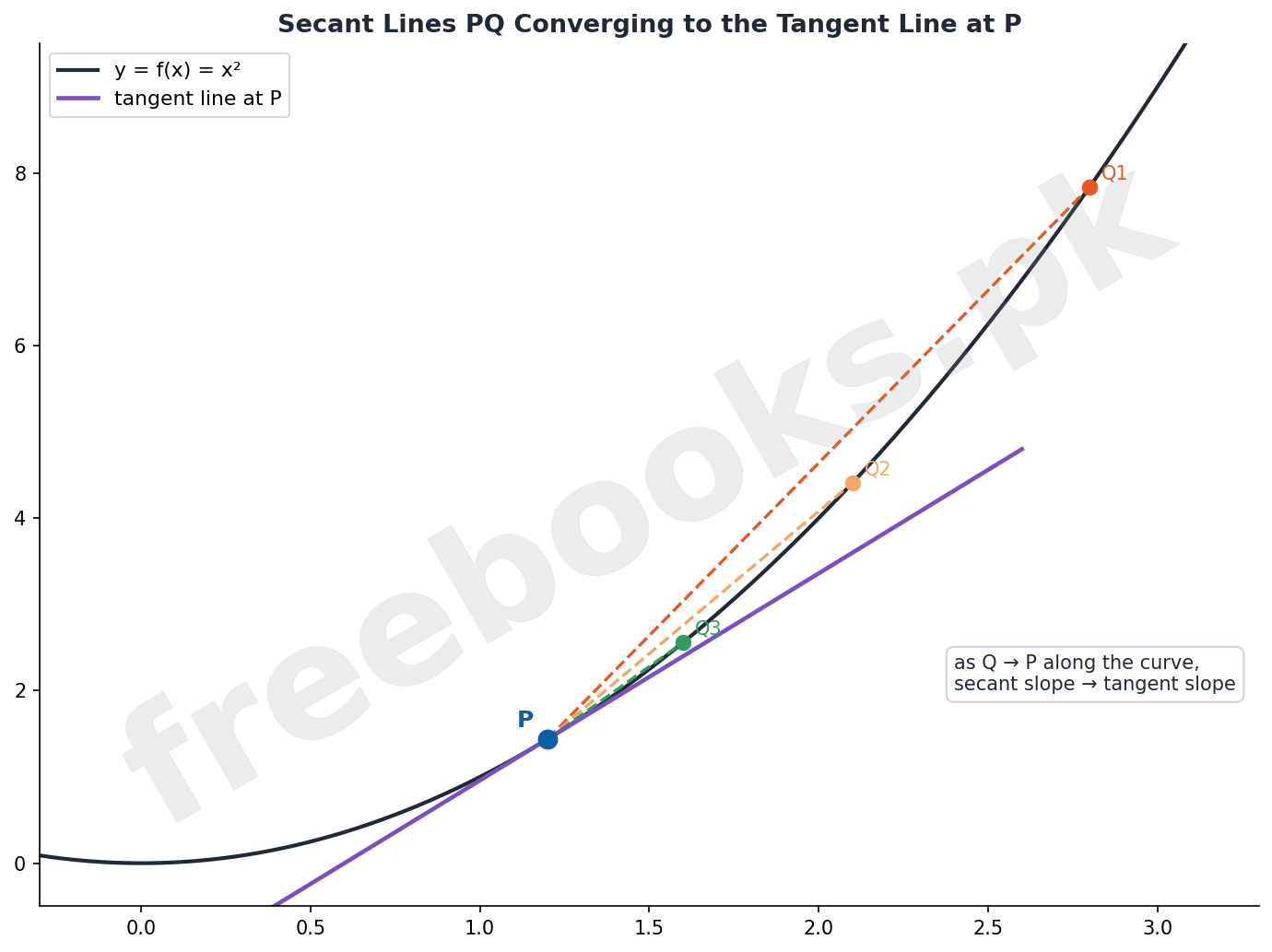
For two points P(x, f(x)) and Q(x+delta x, f(x+delta x)) on a curve y=f(x), the secant line through P and Q has slope [f(x+delta x)-f(x)]/delta x. As Q slides along the curve toward P (delta x -> 0), the secant line rotates into the tangent line at P, and its slope approaches the limit m_tan = lim(delta x->0) [f(x+delta x)-f(x)]/delta x.
This limiting slope is exactly the derivative of f at x. The same idea — an average rate of change over a shrinking interval settling down to an instantaneous rate — appears throughout calculus, whether the 'curve' represents a graph, a position-versus-time relationship, or any other continuously varying quantity.
13.2 The Derivative as Instantaneous Rate of Change
For a quantity changing over an interval, the average rate of change is the difference quotient [f(x1)-f(x)]/(x1-x); as x1 approaches x, this ratio approaches the instantaneous rate of change, written f'(x) — the derivative of f at x. The process of finding f' is called differentiation, and f is differentiable at x whenever this limit exists.
A common physical interpretation is velocity: if s(t) gives a particle's position at time t, the average velocity over [t, t1] is [s(t1)-s(t)]/(t1-t), and as t1 -> t, this approaches the instantaneous velocity at t — the derivative of the position function with respect to time.
13.3 Finding the Derivative by Definition and Notation
The derivative f'(x) can be found from its limit definition using four steps: find f(x+delta x); simplify f(x+delta x)-f(x); divide by delta x and simplify; then take the limit as delta x -> 0. This process is called differentiation by definition, by first principles, or ab-initio.
Several equivalent notations for the derivative of y=f(x) are in common use: Leibniz's dy/dx, Newton's f'(x) or y', Lagrange's f'(x), and Euler's Df(x); the value of the derivative at a specific point a is written f'(a) or dy/dx evaluated at x=a.
13.4 The Power Rule and Connection to Continuity
The power rule states d/dx(x^n) = n x^(n-1) for any real number n — proved for positive and negative integers using the binomial theorem, and holding also for rational exponents. This single rule, combined with the constant rule d/dx(c)=0, handles the derivative of any power of x directly, without needing to return to first principles each time.
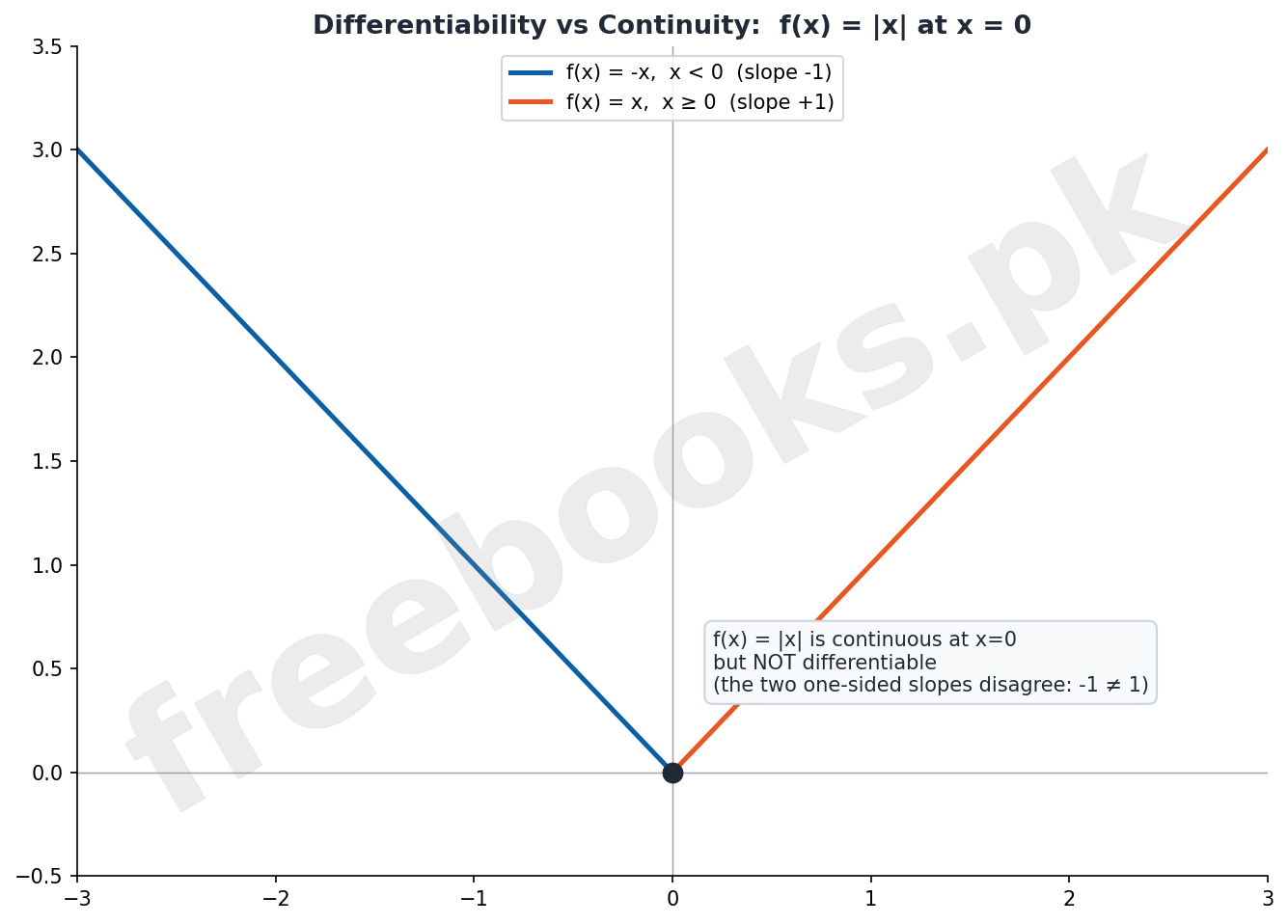
A key theorem connects the two central ideas of this and the previous unit: if a function is differentiable at a point, it must also be continuous there — but the converse is false. The function f(x)=|x| is continuous at x=0 but not differentiable there, because its left-hand derivative (-1) and right-hand derivative (+1) disagree, leaving no single, well-defined tangent line at that sharp corner.
13.5 Theorems on Differentiation
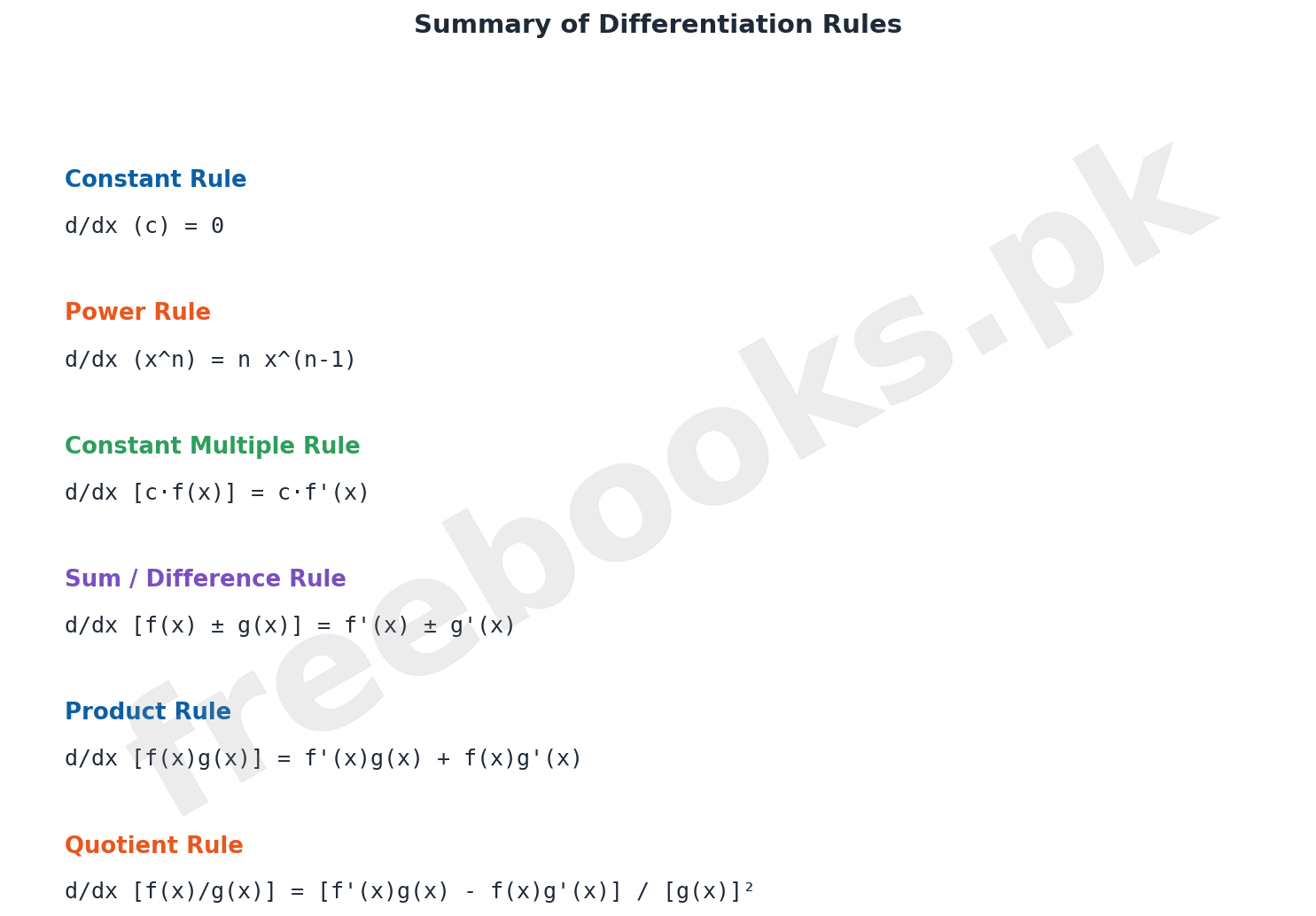
Beyond the constant and power rules, four further theorems make differentiation of combined functions efficient: the constant multiple rule d/dx[cf(x)]=c f'(x); the sum/difference rule d/dx[f(x)+-g(x)]=f'(x)+-g'(x); the product rule d/dx[f(x)g(x)]=f'(x)g(x)+f(x)g'(x); and the quotient rule d/dx[f(x)/g(x)]=[f'(x)g(x)-f(x)g'(x)]/[g(x)]^2 (for g(x) not 0).
Each of these theorems is proved directly from the limit definition of the derivative, using the same difference-quotient technique as first principles — but once proved, they let derivatives of complicated combinations of functions be found quickly, without repeating the limit process every time.
13.6 Applications of Differentiation
Because the derivative measures an instantaneous rate of change, it applies wherever a real-world quantity varies continuously: marginal profit (the derivative of a profit function with respect to units produced), velocity and acceleration (the first and second derivatives of a position function with respect to time), the rate of growth of an investment, and the rate of change of structural stress along a beam.
In every such application, the same pattern applies: model the quantity as a function of the relevant variable, differentiate using the rules of this unit, then substitute the specific value of interest to find the instantaneous rate at that point.
Important Definitions
What is the slope of the secant line through P(x,f(x)) and Q(x+delta x, f(x+delta x))?
[f(x+delta x) – f(x)] / delta x.
What is the derivative of a function f at x?
f'(x) = lim(delta x->0) [f(x+delta x) – f(x)] / delta x, provided the limit exists.
What does it mean for f to be differentiable at x?
The limit defining f'(x) exists at that point.
What is differentiation?
The process of finding the derivative of a function.
What is meant by 'differentiation by first principles' or 'ab-initio'?
Finding a derivative directly from its limit definition, using the four-step process, rather than by applying a shortcut rule.
What does the power rule state?
d/dx(x^n) = n x^(n-1), for any real number n.
What is the key relationship between differentiability and continuity?
If a function is differentiable at a point, it must be continuous there; however, a function can be continuous at a point without being differentiable there.
What does the product rule state?
d/dx[f(x)g(x)] = f'(x)g(x) + f(x)g'(x).
What does the quotient rule state?
d/dx[f(x)/g(x)] = [f'(x)g(x) – f(x)g'(x)] / [g(x)]^2, for g(x) not equal to 0.
What is instantaneous velocity?
The derivative of the position function s(t) with respect to time t, i.e. the limit of average velocity as the time interval shrinks to zero.
Key Facts and Relations
| Topic | Key Fact / Relation |
|---|---|
| Derivative (limit definition) | f'(x) = lim(delta x->0) [f(x+delta x) – f(x)] / delta x |
| Alternative form at x=a | f'(a) = lim(x->a) [f(x) – f(a)] / (x-a) |
| Constant rule | d/dx (c) = 0 |
| Power rule | d/dx (x^n) = n x^(n-1) |
| Constant multiple rule | d/dx [c f(x)] = c f'(x) |
| Sum / difference rule | d/dx [f(x) +- g(x)] = f'(x) +- g'(x) |
| Product rule | d/dx [f(x) g(x)] = f'(x) g(x) + f(x) g'(x) |
| Quotient rule | d/dx [f(x)/g(x)] = [f'(x)g(x) – f(x)g'(x)] / [g(x)]^2 |
| Instantaneous velocity | v(t) = ds/dt; acceleration a(t) = dv/dt |
Diagrams
Secant Lines Converging to the Tangent Line: A curve y=f(x) with a fixed point P and several secant lines PQ shown converging to the tangent line at P as Q approaches P
Differentiability vs Continuity: f(x) = |x|: A graph of f(x)=|x| showing the sharp corner at x=0, where the function is continuous but the left-hand and right-hand slopes disagree, so it is not differentiable
Summary of Differentiation Rules: A reference table listing the constant, power, constant multiple, sum/difference, product, and quotient rules of differentiation
Solved Examples
Example 1: Finding the Gradient and Tangent Line by Definition
Problem: Find the gradient and an equation of the tangent line to f(x)=x^2-2 at the point P(-1,-1).
- Apply the limit definition at x=-1: m_tan = lim(delta x->0) [f(-1+delta x)-f(-1)]/delta x.
- Expand: f(-1+delta x) = (-1+delta x)^2-2 = 1-2 delta x+(delta x)^2-2, and f(-1) = 1-2 = -1.
- Simplify the difference quotient: [1-2 delta x+(delta x)^2-2-(-1)]/delta x = (-2 delta x+(delta x)^2)/delta x = -2+delta x.
- Take the limit as delta x -> 0: m_tan = -2.
- Using point-slope form with slope -2 and point (-1,-1): y+1 = -2(x+1), giving the final answer y = -2x-3.
Example 2: Average and Instantaneous Velocity
Problem: A particle's position is s(t) = 4t^2+2t+1 (miles). Find (a) the average velocity over [2,5] and (b) the instantaneous velocity at t=3.
- (a) Average velocity = [s(5)-s(2)]/(5-2). Compute s(5)=4(25)+10+1=111 and s(2)=4(4)+4+1=21.
- Average velocity = (111-21)/3 = 90/3 = 30 miles/hour.
- (b) Instantaneous velocity = lim(delta t->0) [s(3+delta t)-s(3)]/delta t. Expand s(3+delta t) = 4(3+delta t)^2+2(3+delta t)+1 = 36+24 delta t+4(delta t)^2+6+2 delta t+1.
- Simplify the difference quotient: [43+26 delta t+4(delta t)^2-43]/delta t = 26+4 delta t.
- Take the limit as delta t -> 0: instantaneous velocity = 26 miles/hour.
Example 3: Derivative of sqrt(x) by First Principles
Problem: Find the derivative of f(x) = sqrt(x) at x=a from first principles.
- Form the difference f(x+delta x)-f(x) = sqrt(x+delta x)-sqrt(x), and rationalize by multiplying by the conjugate sqrt(x+delta x)+sqrt(x).
- This gives f(x+delta x)-f(x) = delta x / [sqrt(x+delta x)+sqrt(x)].
- Divide by delta x: [f(x+delta x)-f(x)]/delta x = 1/[sqrt(x+delta x)+sqrt(x)].
- Take the limit as delta x -> 0: f'(x) = 1/[sqrt(x)+sqrt(x)] = 1/(2 sqrt(x)).
- Final answer: at x=a, f'(a) = 1/(2 sqrt(a)).
Example 4: Derivative of 1/x^2 by Ab-Initio Method
Problem: If y = 1/x^2, find dy/dx at x=-1 by the ab-initio method.
- Form delta y = 1/(x+delta x)^2 – 1/x^2 = [x^2-(x+delta x)^2] / [x^2(x+delta x)^2].
- Factor the numerator as a difference of squares: [x+(x+delta x)][x-(x+delta x)] = (2x+delta x)(-delta x).
- Divide by delta x: delta y/delta x = -(2x+delta x) / [x^2(x+delta x)^2].
- Take the limit as delta x -> 0: dy/dx = -2x / (x^2 . x^2) = -2/x^3.
- Substitute x=-1: dy/dx = -2/(-1)^3 = -2/-1 = 2. Final answer: the gradient at x=-1 is 2.
Example 5: Applying the Power Rule and Sum Rule
Problem: Find the derivative of y = (3/4)x^4 + (2/3)x^3 + (1/2)x^2 + 2x + 5 with respect to x.
- Apply the sum rule, differentiating each term separately.
- Differentiate each power term using the power rule: d/dx[(3/4)x^4] = (3/4)(4x^3) = 3x^3; d/dx[(2/3)x^3] = (2/3)(3x^2) = 2x^2.
- Continue: d/dx[(1/2)x^2] = (1/2)(2x) = x; d/dx[2x] = 2; d/dx[5] = 0 (constant rule).
- Add all the terms together: 3x^3 + 2x^2 + x + 2.
- Final answer: dy/dx = 3x^3 + 2x^2 + x + 2.
Example 6: Applying the Product Rule
Problem: Find the derivative of y = (x^2+5)(x^3+7) with respect to x, using the product rule.
- Let f(x) = x^2+5 and g(x) = x^3+7, so f'(x) = 2x and g'(x) = 3x^2.
- Apply the product rule: dy/dx = f'(x)g(x) + f(x)g'(x) = 2x(x^3+7) + (x^2+5)(3x^2).
- Expand each term: 2x(x^3+7) = 2x^4+14x; (x^2+5)(3x^2) = 3x^4+15x^2.
- Combine like terms: 2x^4+14x+3x^4+15x^2 = 5x^4+15x^2+14x.
- Final answer: dy/dx = 5x^4 + 15x^2 + 14x.
Example 7: Applying the Quotient Rule
Problem: Differentiate phi(x) = (2x^3-3x^2+5)/(x^2+1) with respect to x, using the quotient rule.
- Let f(x) = 2x^3-3x^2+5 and g(x) = x^2+1, so f'(x) = 6x^2-6x and g'(x) = 2x.
- Apply the quotient rule: phi'(x) = [f'(x)g(x) – f(x)g'(x)] / [g(x)]^2.
- Expand the numerator: (6x^2-6x)(x^2+1) – (2x^3-3x^2+5)(2x) = (6x^4-6x^3+6x^2-6x) – (4x^4-6x^3+10x).
- Simplify: 6x^4-6x^3+6x^2-6x-4x^4+6x^3-10x = 2x^4+6x^2-16x.
- Final answer: phi'(x) = (2x^4+6x^2-16x) / (x^2+1)^2.
Example 8: Real-World Application: Velocity and Acceleration of a Particle
Problem: A particle's position is s(t) = 4t^3-3t^2+2t (metres). Find the velocity and acceleration at t=2 seconds.
- Velocity is the derivative of position: v(t) = d/dt(4t^3-3t^2+2t) = 12t^2-6t+2.
- Substitute t=2: v(2) = 12(4)-6(2)+2 = 48-12+2 = 38 m/s.
- Acceleration is the derivative of velocity: a(t) = d/dt(12t^2-6t+2) = 24t-6.
- Substitute t=2: a(2) = 24(2)-6 = 48-6 = 42 m/s^2.
- Final answer: velocity at t=2 is 38 m/s; acceleration at t=2 is 42 m/s^2.
Short Questions & Answers
What is the slope of a tangent line defined as?
The limit of the slope of the secant line as the second point approaches the point of tangency.
What is the derivative of a constant function?
Zero: d/dx(c) = 0.
What does the power rule state?
d/dx(x^n) = n x^(n-1), for any real number n.
Is every continuous function differentiable?
No — a function can be continuous at a point without being differentiable there, as with f(x)=|x| at x=0.
Is every differentiable function continuous?
Yes — differentiability at a point always implies continuity at that point.
What is the product rule?
d/dx[f(x)g(x)] = f'(x)g(x) + f(x)g'(x).
What is acceleration in terms of derivatives?
The derivative of velocity with respect to time (the second derivative of position).
Long Questions & Answers
Explain how the tangent line to a curve is defined using secant lines and limits, and describe the four-step process for finding a derivative by definition.
What is a secant line, and what does its slope represent?
A secant line is a line joining two points P(x,f(x)) and Q(x+delta x, f(x+delta x)) on a curve; its slope, [f(x+delta x)-f(x)]/delta x, represents the average rate of change of f between those two points.
How does the tangent line arise from secant lines?
As the point Q slides along the curve toward P (i.e. as delta x -> 0), the secant line PQ rotates continuously until it becomes the tangent line at P; the tangent's slope is the limit of the secant's slope as delta x -> 0.
What are the four steps for finding a derivative by definition?
Step I: find f(x+delta x). Step II: simplify f(x+delta x)-f(x). Step III: divide by delta x and simplify. Step IV: take the limit of the resulting expression as delta x -> 0.
Why is this method called 'first principles' or 'ab-initio'?
Because it derives the result directly from the fundamental limit definition of the derivative, without relying on any shortcut differentiation rule — 'ab-initio' is Latin for 'from the beginning'.
Describe the theorems on differentiation (constant multiple, sum/difference, product, and quotient rules), and explain the relationship between differentiability and continuity.
What do the constant multiple and sum/difference rules state?
The constant multiple rule states d/dx[c f(x)] = c f'(x); the sum/difference rule states d/dx[f(x)+-g(x)] = f'(x)+-g'(x) — both let derivatives of scaled or combined functions be found term by term.
What does the product rule state, and why is it not simply f'(x)g'(x)?
The product rule states d/dx[f(x)g(x)] = f'(x)g(x)+f(x)g'(x); this is proved by adding and subtracting a cross term in the difference quotient, and it is more complex than simply multiplying the two derivatives because both functions are changing simultaneously.
What does the quotient rule state?
d/dx[f(x)/g(x)] = [f'(x)g(x)-f(x)g'(x)] / [g(x)]^2, valid wherever g(x) is not zero; like the product rule, it accounts for the way both the numerator and denominator change together.
What is the relationship between differentiability and continuity?
Differentiability at a point implies continuity at that point, but the converse does not hold — a function such as f(x)=|x| is continuous everywhere, including at x=0, yet is not differentiable at x=0 because its left-hand slope (-1) and right-hand slope (+1) disagree there.
Multiple Choice Questions (MCQs)
The slope of the tangent line at P is defined as: (A) The slope of any line through P (B) The limit of the secant slope as Q approaches P (C) Always equal to 1 (D) The y-coordinate of P
Correct answer: (B) The limit of the secant slope as Q approaches P. The tangent slope is the limit of the secant slope PQ as Q approaches P along the curve.
The derivative of a constant function c is: (A) c (B) 1 (C) 0 (D) x
Correct answer: (C) 0. d/dx(c) = 0, since a constant function never changes.
The power rule states d/dx(x^n) equals: (A) x^n (B) n x^(n-1) (C) n x^n (D) x^(n-1)
Correct answer: (B) n x^(n-1). The power rule gives d/dx(x^n) = n x^(n-1) for any real number n.
If a function is differentiable at a point, then it is: (A) Not necessarily continuous there (B) Always continuous there (C) Always discontinuous there (D) Undefined there
Correct answer: (B) Always continuous there. Differentiability at a point always implies continuity at that point.
The function f(x) = |x| at x = 0 is: (A) Differentiable but not continuous (B) Continuous but not differentiable (C) Neither continuous nor differentiable (D) Both continuous and differentiable
Correct answer: (B) Continuous but not differentiable. f(x)=|x| is continuous at x=0, but its left-hand and right-hand derivatives disagree (-1 and +1), so it is not differentiable there.
The product rule states d/dx[f(x)g(x)] equals: (A) f'(x)g'(x) (B) f'(x)g(x) + f(x)g'(x) (C) f'(x)g(x) – f(x)g'(x) (D) f(x)g(x)
Correct answer: (B) f'(x)g(x) + f(x)g'(x). The product rule is f'(x)g(x) + f(x)g'(x), not simply the product of the two derivatives.
The quotient rule for d/dx[f(x)/g(x)] requires: (A) f(x) not equal to 0 (B) g(x) not equal to 0 (C) f(x) = g(x) (D) No conditions
Correct answer: (B) g(x) not equal to 0. The quotient rule requires g(x) to be non-zero, since division by zero is undefined.
Instantaneous velocity is defined as: (A) The average velocity over a large interval (B) The derivative of the position function with respect to time (C) A constant value (D) The derivative of velocity with respect to time
Correct answer: (B) The derivative of the position function with respect to time. Instantaneous velocity is the derivative of position with respect to time, v(t) = ds/dt.
Acceleration is the derivative of: (A) Position with respect to time (B) Velocity with respect to time (C) Time with respect to velocity (D) A constant
Correct answer: (B) Velocity with respect to time. Acceleration is the derivative of velocity with respect to time, i.e. the second derivative of position.
Differentiation 'by first principles' means finding the derivative using: (A) The power rule only (B) A table of known derivatives (C) The direct limit definition of the derivative (D) Guesswork
Correct answer: (C) The direct limit definition of the derivative. First principles (ab-initio) means computing the derivative directly from its limit definition, without using shortcut rules.
Quick Revision Summary
- The tangent slope at P is the limit of the secant slope PQ as Q approaches P
- f'(x) = lim(delta x->0) [f(x+delta x)-f(x)]/delta x is the derivative of f at x
- Differentiation by first principles (ab-initio): find f(x+delta x), simplify the difference, divide by delta x, take the limit
- Common notations for the derivative: dy/dx (Leibniz), f'(x) or y' (Newton/Lagrange), Df(x) (Euler)
- Power rule: d/dx(x^n) = n x^(n-1), valid for any real number n
- Differentiability implies continuity, but continuity does not imply differentiability (e.g. f(x)=|x| at x=0)
- Constant multiple rule: d/dx[c f(x)] = c f'(x)
- Sum/difference rule: d/dx[f(x)+-g(x)] = f'(x)+-g'(x)
- Product rule: d/dx[f(x)g(x)] = f'(x)g(x) + f(x)g'(x)
- Quotient rule: d/dx[f(x)/g(x)] = [f'(x)g(x)-f(x)g'(x)] / [g(x)]^2
- Velocity is the derivative of position; acceleration is the derivative of velocity
- Derivatives model real-world rates of change: marginal profit, investment growth, structural stress, and more
Exam Tips
- When finding a derivative by first principles, always simplify f(x+delta x)-f(x) fully before dividing by delta x — factor out delta x wherever possible
- For square-root expressions in first-principles problems, rationalize the numerator using the conjugate before taking the limit
- Apply the power rule directly for any term of the form x^n — there is no need to use first principles once the rule is known
- Remember 'differentiable implies continuous' only works in one direction — always check both one-sided derivatives at a sharp corner or cusp before assuming differentiability
- In product and quotient rule problems, write out f(x), g(x), f'(x), and g'(x) separately first, then substitute into the rule to avoid sign errors
- For real-world applications, always identify what the derivative represents (velocity, marginal profit, rate of stress, etc.) before differentiating