This unit examines trigonometric functions as functions in their own right: their domains and ranges (derived from the unit circle), whether each is even or odd, and the periodicity that makes them repeat their values at fixed intervals. Building on this foundation, the unit shows how to construct and read the graphs of sine, cosine, and tangent, and lists the key properties (domain, range, continuity, symmetry, intercepts, amplitude) that each graph displays.
The unit then develops the general sinusoidal function a + b sin(c theta + d), showing how the constants a, b, c, and d control vertical shift, amplitude, period, and phase shift respectively, and how to find the maximum and minimum values of such functions (and their reciprocals) without graphing. It closes with real-world applications — Ferris wheels, tidal water levels, temperature cycles, and angle-of-elevation/depression problems — that show sinusoidal functions modeling genuinely periodic real-world phenomena.
Learning Objectives
- Determine the domain and range of each of the six trigonometric functions
- Determine whether a given trigonometric function is even, odd, or neither
- Find the period of a trigonometric function, including functions of the form sin(cx), tan(cx), etc.
- Construct and interpret the graphs of y = sin x, y = cos x, and y = tan x, and state their key properties
- Identify the vertical shift, amplitude, period, and phase shift of a general sinusoidal function a + b sin(c theta + d)
- Find the maximum and minimum values of sinusoidal functions and their reciprocals
- Apply sinusoidal functions to model real-world periodic phenomena such as Ferris wheels, tides, and temperature cycles
Key Concepts
11.1 Domains and Ranges of Trigonometric Functions
For a point P(x,y) on the unit circle with m angle XOP = theta in standard position, cos theta = x and sin theta = y; since every real theta gives exactly one such point, both sine and cosine are functions with domain R (all real numbers), and since -1<=x<=1 and -1<=y<=1 on the unit circle, both have range [-1,1].
Tangent (=y/x) and secant (=1/x) are undefined wherever x=0, i.e. at odd multiples of pi/2, so their domain excludes those points; cotangent (=x/y) and cosecant (=1/y) are undefined wherever y=0, i.e. at integer multiples of pi, so their domain excludes those points instead. The range of tangent and cotangent is all of R, while the range of secant and cosecant is R minus the open interval (-1,1), since |1/x|>=1 whenever 0<|x|<=1.
11.2 Even and Odd Functions
A function f is even if f(-x)=f(x) for every x in its domain (graph symmetric about the y-axis); it is odd if f(-x)=-f(x) for every x in its domain (graph symmetric about the origin). Since cos(-theta)=cos theta, cosine is an even function; since sin(-theta)=-sin theta, sine is an odd function — and this same test classifies every other trigonometric function and combination of them.
Recognizing whether a trigonometric expression is even, odd, or neither is often the fastest way to predict symmetry in its graph before plotting a single point, and is a routine first step when simplifying or analyzing a new trigonometric function.
11.3 Period of Trigonometric Functions
A function f is periodic if f(theta+p)=f(theta) for all theta in its domain, and the smallest positive such p is called the period. By substituting theta=0 and testing candidate values, sine and cosine are proved to have period 2 pi, while tangent and cotangent have the smaller period pi (since tan(theta+pi)=tan theta, unlike sin(theta+pi)=-sin theta).
For a function of the form sin(cx) or tan(cx), the period scales inversely with |c|: if the period of sin x is 2pi, then sin(cx) repeats every 2pi/|c|, since sin(c(x+2pi/c))=sin(cx+2pi)=sin(cx). Adding or subtracting a constant (like the '3' in 3+tan(x/3)) never affects the period, only the vertical position of the graph.
11.4 Graphs of Trigonometric Functions
To graph a trigonometric function, a table of ordered pairs (x, y) is built using standard angle values, the points are plotted with angle measure on the x-axis and function value on the y-axis, and the points are joined with a smooth curve; because sine, cosine, and tangent are periodic, the resulting curve repeats indefinitely in both directions once one full period is drawn.
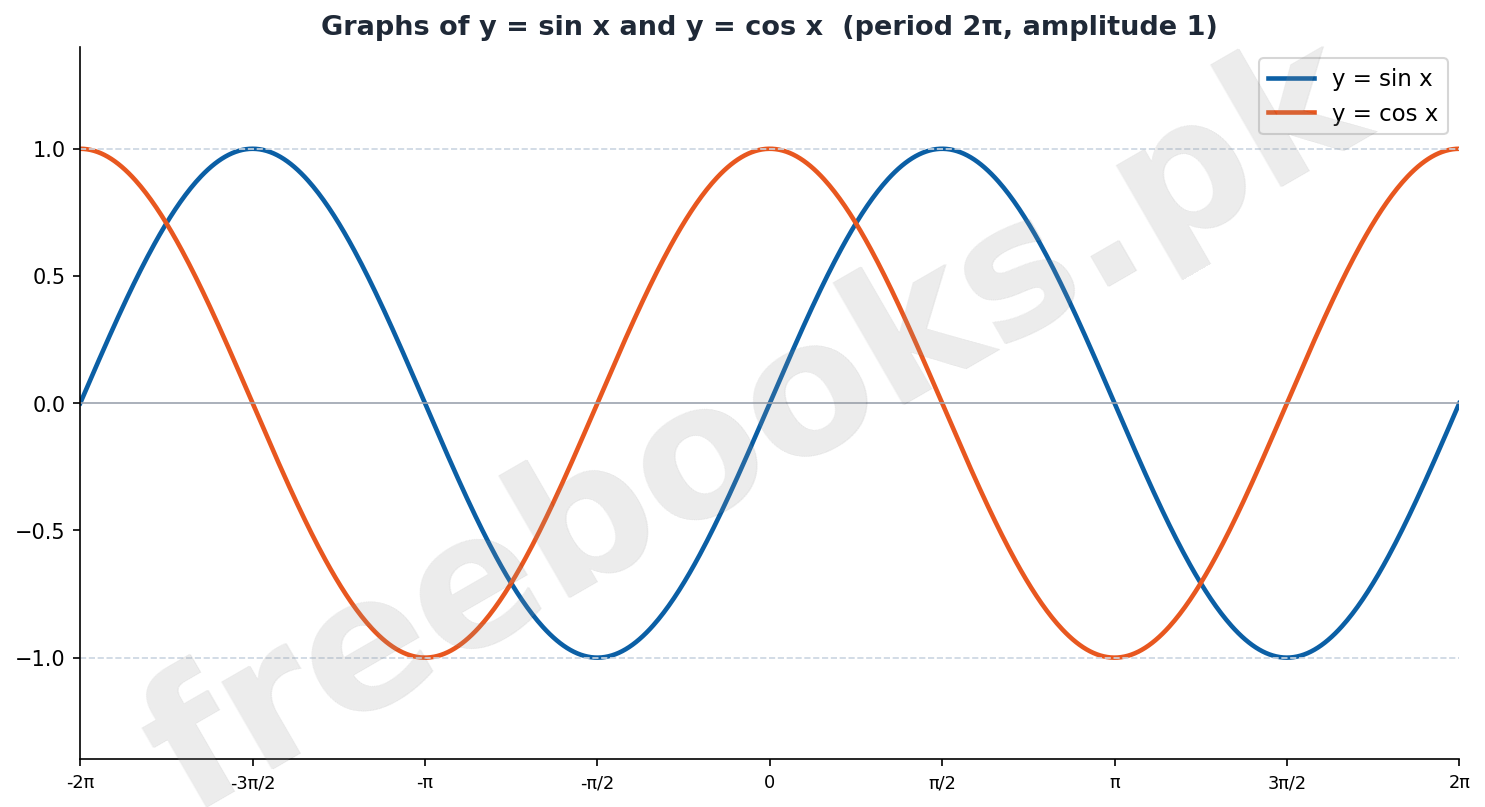
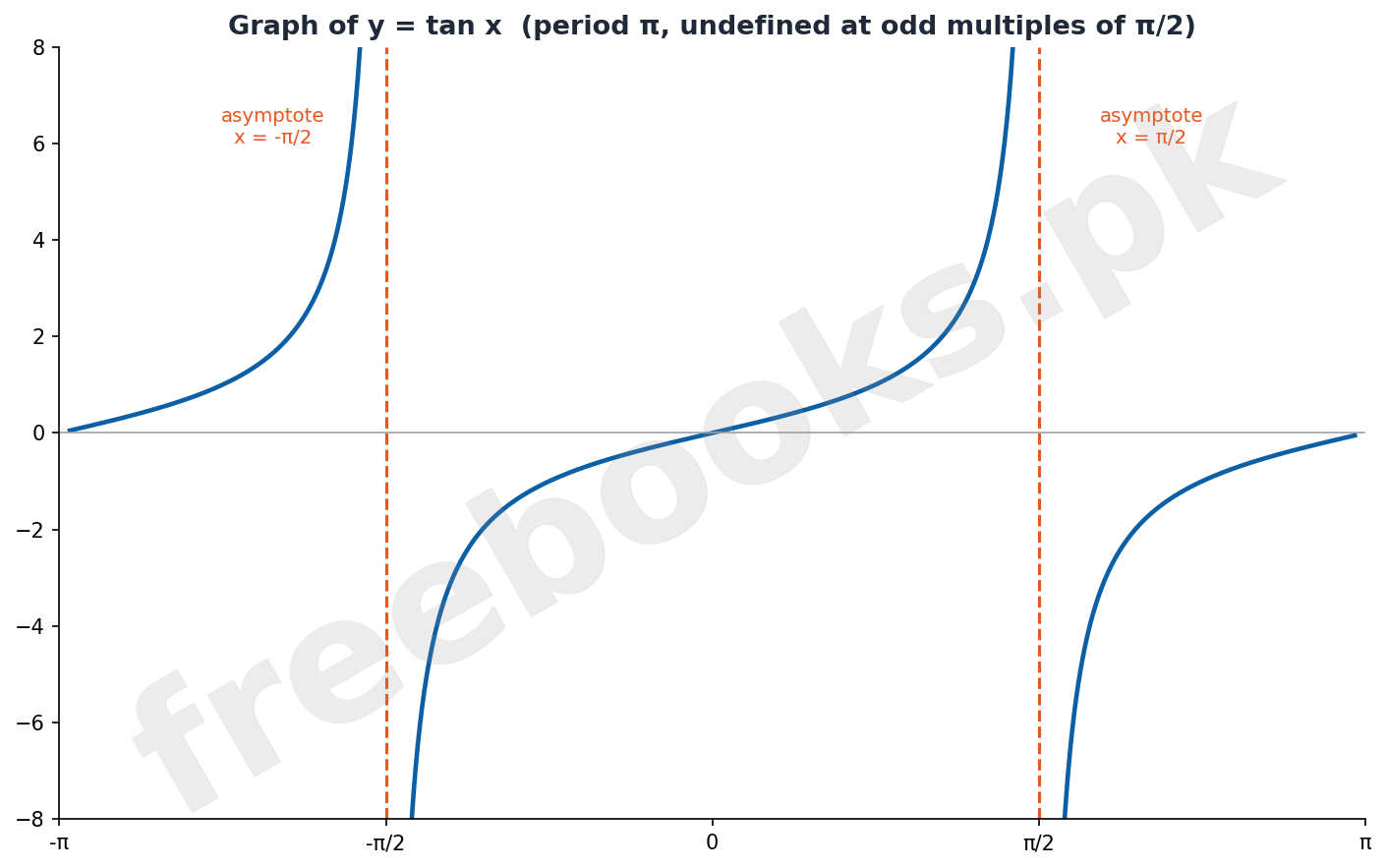
The graphs of y=sin x and y=cos x are smooth, continuous waves confined between y=-1 and y=1, with sine passing through the origin and cosine starting at its maximum; the graph of y=tan x, by contrast, is discontinuous, breaking into separate branches at each odd multiple of pi/2 where the function is undefined, with the curve shooting toward positive or negative infinity as it approaches each break.
11.5 Maximum and Minimum Values of Sinusoidal Functions
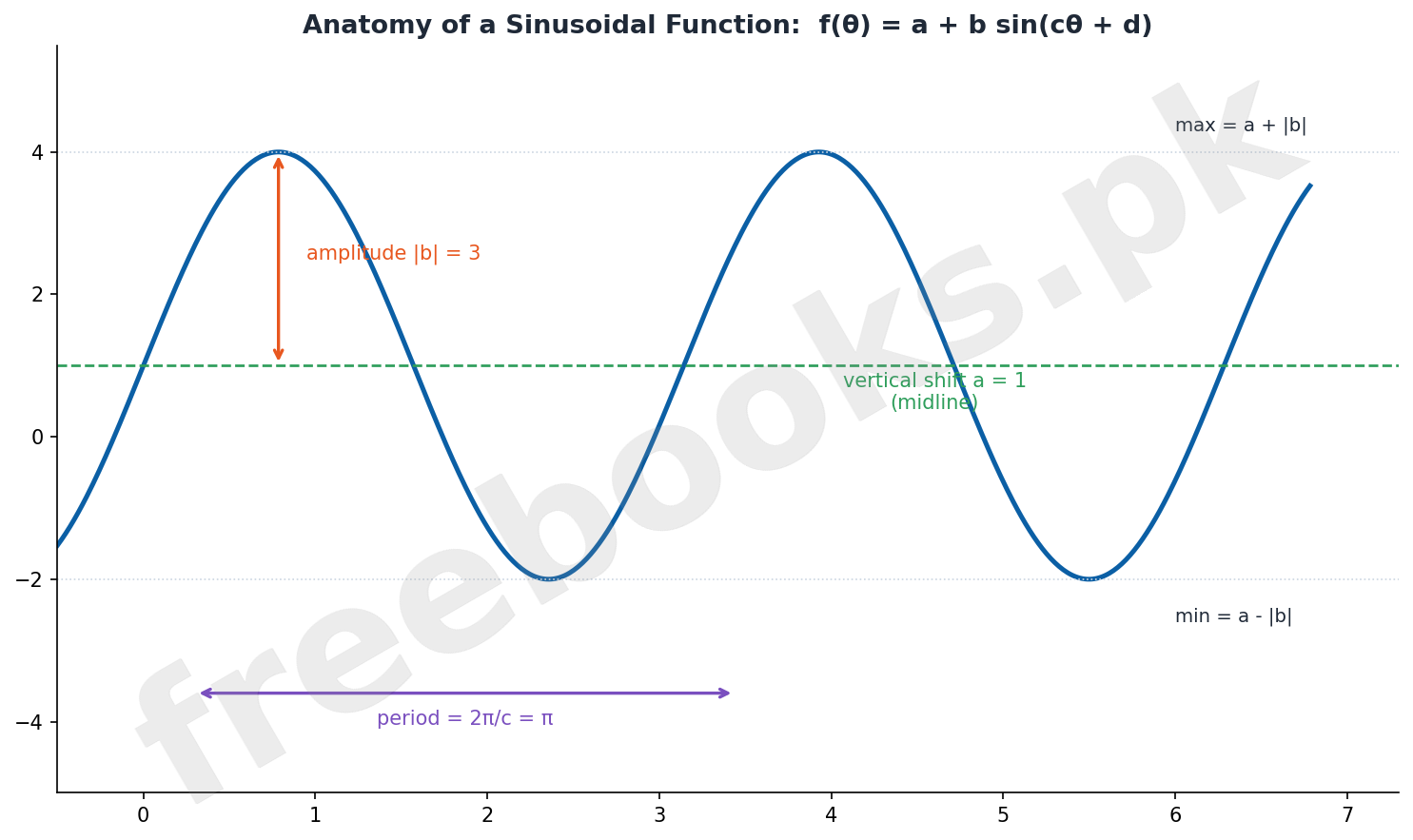
For a general sinusoidal function f(theta) = a + b sin(c theta + d) (or the cosine equivalent), a is the vertical shift (moves the whole graph up/down without changing its shape), |b| is the amplitude (maximum height of the wave from its midline), the period is 2pi/c, and d is the phase shift (moves the wave left or right along the x-axis).
Since sine and cosine never exceed 1 or fall below -1, the maximum value of f(theta) is M = a + |b| (attained when sin/cos equals 1) and the minimum is m = a – |b| (attained when sin/cos equals -1); for the reciprocal of such a function, the maximum of the reciprocal is 1/m and the minimum is 1/M, since taking a reciprocal reverses which extreme is 'largest'.
11.6 Real-World Applications of Sinusoidal Functions
Sinusoidal functions naturally model any quantity that oscillates in a regular, repeating cycle: the height of a rider on a Ferris wheel over time, the rise and fall of tidal water levels through the day, daily or seasonal temperature swings, and population cycles driven by seasonal migration — in every case, the period matches the physical cycle time, the amplitude matches half the total swing, and the vertical shift matches the average/center value.
Angle of elevation and depression problems (such as finding the height of a distant peak from two different angles) use the sum and difference identities from Unit 10 together with basic right-triangle trigonometry, often solved elegantly using the algebraic technique of componendo and dividendo on a ratio of two tangent expressions.
Important Definitions
What is the domain of the sine and cosine functions?
The set of all real numbers, R, since every real angle theta gives exactly one point (cos theta, sin theta) on the unit circle.
What is the range of the sine and cosine functions?
The closed interval [-1, 1].
What is the domain of the tangent function?
All real numbers except odd multiples of pi/2, i.e. R – {x : x = (2n+1)pi/2, n in Z}.
What does it mean for a function f to be even?
f(-x) = f(x) for every x in the domain of f; its graph is symmetric about the y-axis.
What does it mean for a function f to be odd?
f(-x) = -f(x) for every x in the domain of f; its graph is symmetric about the origin.
What is the period of a function?
The smallest positive number p such that f(theta+p) = f(theta) for all theta in the domain of f.
What are the periods of sine, cosine, tangent, and cotangent?
Sine and cosine have period 2 pi; tangent and cotangent have period pi.
In the sinusoidal function a + b sin(c theta + d), what does 'a' represent?
The vertical shift — the upward or downward translation of the graph's midline.
In the sinusoidal function a + b sin(c theta + d), what does '|b|' represent?
The amplitude — the maximum height of the wave measured from its midline.
In the sinusoidal function a + b sin(c theta + d), what does 'd' represent?
The phase shift — the horizontal translation of the graph along the x-axis.
Key Facts and Relations
| Topic | Key Fact / Relation |
|---|---|
| Domain/Range of sin, cos | Domain = R; Range = [-1, 1] |
| Domain of tan, sec | R – {(2n+1) pi/2 : n in Z} |
| Domain of cot, csc | R – {n pi : n in Z} |
| Period of sin x, cos x | 2 pi |
| Period of tan x, cot x | pi |
| Period of sin(cx) or cos(cx) | 2 pi / |c| |
| Period of tan(cx) or cot(cx) | pi / |c| |
| Sinusoidal function | f(theta) = a + b sin(c theta + d): vertical shift a, amplitude |b|, period 2pi/c, phase shift d |
| Maximum / minimum value | M = a + |b|; m = a – |b| |
| Max/min of reciprocal 1/f(theta) | max = 1/m; min = 1/M |
Diagrams
Graphs of y = sin x and y = cos x: The sine and cosine curves plotted together from -2pi to 2pi, showing their shared period of 2pi, amplitude of 1, and the horizontal shift between them
Graph of y = tan x with Asymptotes: The tangent curve from -pi to pi, showing its period of pi and the vertical asymptotes at x = -pi/2 and x = pi/2 where the function is undefined
Anatomy of a Sinusoidal Function: A labeled sine wave for f(theta) = 1 + 3 sin(2 theta), showing the vertical shift (midline), amplitude, and period
Solved Examples
Example 1: Determining Whether a Function is Even or Odd
Problem: Determine whether f(x) = sin^2 x is even, odd, or neither.
- Compute f(-x): f(-x) = sin^2(-x) = (sin(-x))^2 = (-sin x)^2 = sin^2 x.
- Compare f(-x) to f(x): f(-x) = sin^2 x = f(x).
- Since f(-x) = f(x) for every x, the function satisfies the definition of an even function.
- Final answer: f(x) = sin^2 x is an even function (its graph is symmetric about the y-axis).
Example 2: Finding the Period of Trigonometric Functions
Problem: Find the periods of (i) sin 2x and (ii) 3 + tan(x/3).
- For sin 2x: the period of sin x is 2pi, so sin(2x + 2pi) = sin 2x means sin 2(x+pi) = sin 2x — the value repeats when x increases by pi.
- So the period of sin 2x is pi (using period = 2pi/|c| with c=2: 2pi/2 = pi).
- For 3 + tan(x/3): the period of tan x is pi, so tan(x/3 + pi) = tan(x/3) means tan(1/3)(x+3pi) = tan(x/3) — the value repeats when x increases by 3pi.
- So the period of tan(x/3) is 3pi (using period = pi/|c| with c=1/3: pi/(1/3) = 3pi); adding the constant 3 does not change the period.
- Final answer: period of sin 2x is pi; period of 3+tan(x/3) is 3pi.
Example 3: Finding Maximum and Minimum Values of Sinusoidal Functions
Problem: Find the maximum and minimum values of (i) 2 + 3 sin x and (ii) 5 – 2 cos 3x.
- For 2 + 3 sin x: here a=2, b=3. Maximum M = a + |b| = 2+3 = 5, occurring when sin x = 1.
- Minimum m = a – |b| = 2-3 = -1, occurring when sin x = -1.
- For 5 – 2 cos 3x: here a=5, b=-2. Maximum M = a + |b| = 5 + 2 = 7, occurring when cos 3x = 1.
- Minimum m = a – |b| = 5 – 2 = 3, occurring when cos 3x = -1.
- Final answer: (i) max=5, min=-1; (ii) max=7, min=3.
Example 4: Finding Maximum and Minimum Values of a Reciprocal Sinusoidal Function
Problem: Find the maximum and minimum values of the reciprocal of 5 – 2 cos 3x.
- First find the maximum and minimum of 5 – 2 cos 3x itself: from the previous example, M=7 and m=3.
- For a reciprocal function g(x) = 1/(5-2cos3x), the maximum of g occurs where the original function is at its minimum, and vice versa.
- Maximum of g(x) = 1/m = 1/3, approximately 0.33.
- Minimum of g(x) = 1/M = 1/7, approximately 0.14.
- Final answer: maximum = 1/3 (approximately 0.33), minimum = 1/7 (approximately 0.14).
Example 5: Modeling a Ferris Wheel with a Sinusoidal Function
Problem: A Ferris wheel with a radius of 45 feet has its lowest point 5 feet above the ground and completes one revolution every 60 seconds. Model the height of a rider as a function of time, and find the height after 40 seconds.
- The period equals the time for one revolution: 2pi/c = 60, so c = 2pi/60 = pi/30.
- The amplitude b equals the radius: b = 45. The vertical shift a is the height of the wheel's center: since the lowest point is 5 feet up, a = 5 + 45 = 50.
- Since the rider starts at the lowest point (minimum), model with a negative cosine: h(t) = -b cos(ct) + a = -45 cos(pi t/30) + 50.
- Substitute t=40: h(40) = -45 cos(pi(40)/30) + 50 = -45 cos(4pi/3) + 50.
- Since cos(4pi/3) = -0.5, h(40) = -45(-0.5) + 50 = 22.5 + 50 = 72.5. Final answer: the rider is 72.5 feet above the ground after 40 seconds.
Example 6: Modeling Tidal Water Level with a Sinusoidal Function
Problem: The water level of a tidal river is modeled by L(t) = 8 + 4 sin(pi t/6), where t is in hours. Find the water level at t=3 hours and the minimum water level.
- Substitute t=3 into the model: L(3) = 8 + 4 sin(pi(3)/6) = 8 + 4 sin(pi/2).
- Since sin(pi/2) = 1, L(3) = 8 + 4(1) = 12. So the water level at t=3 hours is 12 feet.
- For the minimum water level, use the minimum value of sine: sin(pi t/6) = -1.
- Substitute: L(t) = 8 + 4(-1) = 8 – 4 = 4.
- Final answer: water level at t=3 hours is 12 feet; the minimum water level is 4 feet.
Example 7: Finding the Height of a Peak Using Angles of Elevation and Depression
Problem: From a point 100 m above a lake's surface, the angle of elevation of a cliff peak is 15 degrees and the angle of depression of its reflection is 30 degrees. Find the height of the peak.
- Let h = height of the peak above the lake, y = horizontal distance to the peak. From the elevation angle: tan 15 = (h-100)/y. From the depression angle to the reflection (which appears 100m below the lake surface): tan 30 = (h+100)/y.
- Divide the two equations: tan15/tan30 = (h-100)/(h+100).
- Apply componendo and dividendo: (tan30+tan15)/(tan30-tan15) = [(h+100)+(h-100)] / [(h+100)-(h-100)] = 2h/200 = h/100.
- Substitute known values tan15=0.2679 and tan30=0.5774: h = 100 x (0.5774+0.2679)/(0.5774-0.2679) = 100 x 0.8453/0.3095.
- Final answer: h is approximately 273 metres.
Example 8: Finding the Period and Maximum Height of a Swing
Problem: The height of a swing seat is modeled by h(t) = 1.5 + 1.2 sin(3 pi t), where t is in seconds. Find the maximum height and the period of the motion.
- Here a=1.5, b=1.2, c=3pi. Maximum height M = a + |b| = 1.5 + 1.2 = 2.7 metres, occurring when sin(3 pi t) = 1.
- Minimum height m = a – |b| = 1.5 – 1.2 = 0.3 metres, occurring when sin(3 pi t) = -1.
- The period is given by 2 pi / c = 2 pi / (3 pi) = 2/3 seconds.
- This means the swing completes one full back-and-forth cycle every 2/3 of a second.
- Final answer: maximum height = 2.7 m, minimum height = 0.3 m, period = 2/3 second.
Short Questions & Answers
What is the domain of the sine function?
All real numbers, R.
What is the range of the tangent function?
All real numbers, R (unbounded).
Is the cosine function even or odd?
Even, since cos(-theta) = cos theta.
Is the sine function even or odd?
Odd, since sin(-theta) = -sin theta.
What is the period of tan x?
pi.
What does the amplitude of a sinusoidal function represent?
The maximum height of the wave measured from its midline, equal to |b| in a + b sin(c theta + d).
What is the formula for the maximum value of a + b sin(c theta + d)?
M = a + |b|, occurring when sin(c theta + d) = 1.
Long Questions & Answers
Explain how the domains and ranges of the six trigonometric functions are derived from the unit circle, and describe the graphs of sine, cosine, and tangent.
How are the domain and range of sine and cosine determined from the unit circle?
For a point P(x,y) on the unit circle with angle theta, cos theta = x and sin theta = y; since every real theta produces exactly one such point, the domain of both is R, and since -1<=x,y<=1 on the unit circle, the range of both is [-1,1].
Why are tangent and secant undefined at odd multiples of pi/2?
Because tan theta = y/x and sec theta = 1/x, both of which require x not equal to 0; x=0 occurs exactly when the terminal side lies on the y-axis, i.e. at odd multiples of pi/2, so those values are excluded from the domain.
What are the key visual properties of the graphs of y=sin x and y=cos x?
Both are smooth, continuous waves confined between y=-1 and y=1 with period 2pi; sine passes through the origin and is symmetric about the origin (odd), while cosine starts at its maximum value 1 and is symmetric about the y-axis (even).
How does the graph of y=tan x differ from the graphs of sine and cosine?
Unlike the continuous sine and cosine curves, the tangent graph is discontinuous: it breaks into separate branches at each odd multiple of pi/2 (where tangent is undefined), with the curve increasing or decreasing without bound as it approaches each break, and it has a shorter period of pi instead of 2pi.
Describe the general sinusoidal function a + b sin(c theta + d), explain what each constant controls, and show how to find its maximum and minimum values.
What does the constant 'a' control in a + b sin(c theta + d)?
It controls the vertical shift — translating the entire graph up or down along the y-axis to set the midline of the wave, without changing its shape, amplitude, or period.
What does the constant 'b' control?
Its absolute value |b| is the amplitude — the maximum height of the wave measured from its midline; a larger |b| makes the wave taller.
What do the constants 'c' and 'd' control?
c determines the period, equal to 2pi/c — a larger c compresses the wave horizontally, fitting more cycles into the same interval; d is the phase shift, translating the wave left or right along the x-axis without changing its shape or period.
How are the maximum and minimum values of the function found?
Since sine (and cosine) never exceed 1 or fall below -1, the maximum value is M = a + |b| (when sin/cos equals 1) and the minimum is m = a – |b| (when sin/cos equals -1); for a reciprocal of such a function, the maximum becomes 1/m and the minimum becomes 1/M.
Multiple Choice Questions (MCQs)
The domain of the sine and cosine functions is: (A) Only positive real numbers (B) All real numbers, R (C) [-1, 1] (D) Only integers
Correct answer: (B) All real numbers, R. Every real number theta produces exactly one point on the unit circle, so the domain of sin and cos is all of R.
The range of the sine function is: (A) R (B) [0, 1] (C) [-1, 1] (D) (-infinity, infinity)
Correct answer: (C) [-1, 1]. Since sin theta equals the y-coordinate on the unit circle, and -1<=y<=1, the range is [-1,1].
A function f is even if: (A) f(-x) = -f(x) (B) f(-x) = f(x) (C) f(x) = 0 (D) f(x) = x
Correct answer: (B) f(-x) = f(x). An even function satisfies f(-x) = f(x) for every x in its domain.
The cosine function is: (A) Odd (B) Even (C) Neither odd nor even (D) Undefined at x=0
Correct answer: (B) Even. cos(-theta) = cos theta, so cosine is an even function.
The period of the tangent function is: (A) 2 pi (B) pi/2 (C) pi (D) 4 pi
Correct answer: (C) pi. tan(theta+pi) = tan theta, and pi is the smallest such positive value, so the period of tangent is pi.
The period of sin(3x) is: (A) 2 pi (B) 2 pi / 3 (C) 3 pi (D) pi / 3
Correct answer: (B) 2 pi / 3. Using period = 2pi/|c| with c=3, the period is 2pi/3.
The graph of y = tan x is: (A) Continuous everywhere (B) Discontinuous at odd multiples of pi/2 (C) A straight line (D) Bounded between -1 and 1
Correct answer: (B) Discontinuous at odd multiples of pi/2. The tangent graph breaks into separate branches at odd multiples of pi/2, where the function is undefined.
In f(theta) = a + b sin(c theta + d), the amplitude is: (A) a (B) |b| (C) c (D) d
Correct answer: (B) |b|. The amplitude is the absolute value of b, the maximum height of the wave from its midline.
The maximum value of f(theta) = a + b sin(c theta + d) is: (A) a – |b| (B) a + |b| (C) a x |b| (D) |b| – a
Correct answer: (B) a + |b|. The maximum value M = a + |b|, occurring when sin(c theta + d) = 1.
For a reciprocal function 1/f(theta), if f(theta) has maximum M and minimum m, the reciprocal's maximum is: (A) M (B) m (C) 1/M (D) 1/m
Correct answer: (D) 1/m. Taking a reciprocal reverses the extremes: the reciprocal's maximum is 1/m (using the original minimum).
Quick Revision Summary
- Sine and cosine have domain R and range [-1,1]; tangent and cotangent have range R
- Tangent and secant are undefined at odd multiples of pi/2; cotangent and cosecant are undefined at integer multiples of pi
- A function is even if f(-x)=f(x) (symmetric about y-axis); odd if f(-x)=-f(x) (symmetric about origin)
- Cosine is even; sine is odd
- Sine and cosine have period 2 pi; tangent and cotangent have period pi
- The period of sin(cx) or cos(cx) is 2pi/|c|; the period of tan(cx) is pi/|c|
- The graphs of sin x and cos x are smooth, continuous waves between -1 and 1; the graph of tan x is discontinuous with asymptotes
- In f(theta) = a + b sin(c theta + d): a = vertical shift, |b| = amplitude, 2pi/c = period, d = phase shift
- Maximum value M = a + |b|; minimum value m = a – |b|
- For a reciprocal function, maximum = 1/m and minimum = 1/M (using the original function's extremes)
- Sinusoidal functions model periodic real-world phenomena: Ferris wheels, tides, temperature cycles, population cycles
- Angle of elevation/depression problems often use componendo and dividendo to solve for an unknown height
Exam Tips
- Always identify a, b, c, d first when working with a sinusoidal function before computing max/min or period
- Remember that adding a constant to a trigonometric function shifts the graph vertically but never changes its period
- For reciprocal functions, find the max/min of the original function first, then swap and invert to get the reciprocal's min/max
- When modeling real-world periodic phenomena, match the period to the physical cycle time and the vertical shift to the average value
- Check whether the phenomenon starts at a maximum/minimum (use cosine) or at the midline (use sine) when choosing which function to model with
- For angle of elevation/depression problems with two ratios, try componendo and dividendo before attempting to solve directly