
This unit explores how one polynomial divides into another to produce a quotient and a remainder, and develops two powerful theorems that make working with polynomial division far more efficient. The remainder theorem lets the remainder of a division by (x-a) be found by a single evaluation, f(a), without performing the division at all; the factor theorem then uses this idea to test whether a given linear expression is a factor of a polynomial simply by checking whether that evaluation equals zero.
The unit also introduces synthetic division, a compact shortcut method for dividing by (x-a) using only coefficients, and closes with real-world applications in polynomial regression (statistical modeling) and digital signal processing, where the poles and zeros of a system's transfer function — found using exactly these same theorems — determine whether a real engineering system is stable.
Learning Objectives
- Define a polynomial and its degree
- Divide one polynomial by another using long division to find the quotient and remainder
- State and apply the remainder theorem to find a remainder without performing division
- State and apply the factor theorem to test whether a linear polynomial is a factor of a given polynomial
- Use synthetic division as a shortcut method for dividing a polynomial by x-a
- Apply the remainder and factor theorems to solve for unknown coefficients in a polynomial
- Apply polynomial division concepts to real-world applications in polynomial regression and digital signal processing
Key Concepts
9.1 Polynomials and Polynomial Division
A polynomial in x is an expression of the form a_n x^n + a_(n-1) x^(n-1) + … + a_1 x + a_0, where n is a non-negative integer and the coefficients are real numbers; the highest power of x with a non-zero coefficient is called the degree of the polynomial.
Dividing one polynomial by another (of lower or equal degree) using long division produces a unique quotient q(x) and remainder R, so that the dividend f(x) = (divisor)(quotient) + remainder — exactly analogous to dividing whole numbers, and division continues until the remainder's degree is less than the divisor's degree.
9.2 The Remainder Theorem
If a polynomial f(x) of degree n>=1 is divided by x-a, the remainder is simply f(a) — the value of the polynomial evaluated at x=a. This is proved by substituting x=a into the division identity f(x) = (x-a)q(x) + R, which makes the (x-a)q(x) term vanish, leaving f(a) = R.
The remainder theorem is a major shortcut: instead of performing the entire long division just to find the remainder, only a single substitution and evaluation is needed — this also makes it easy to solve for an unknown coefficient in a polynomial when the remainder of a particular division is given.
9.3 The Factor Theorem
The polynomial x-a is a factor of f(x) if and only if f(a)=0 — in other words, x=a is a root of f(x)=0 exactly when x-a divides f(x) with no remainder. This follows directly from the remainder theorem: since the remainder of dividing by x-a is f(a), a remainder of zero means x-a divides evenly.
The factor theorem is used both to test whether a given linear expression is a factor of a polynomial (by checking whether f(a)=0) and, when multiple factors are known, to set up a system of equations to solve for unknown coefficients in the polynomial.
9.4 Synthetic Division
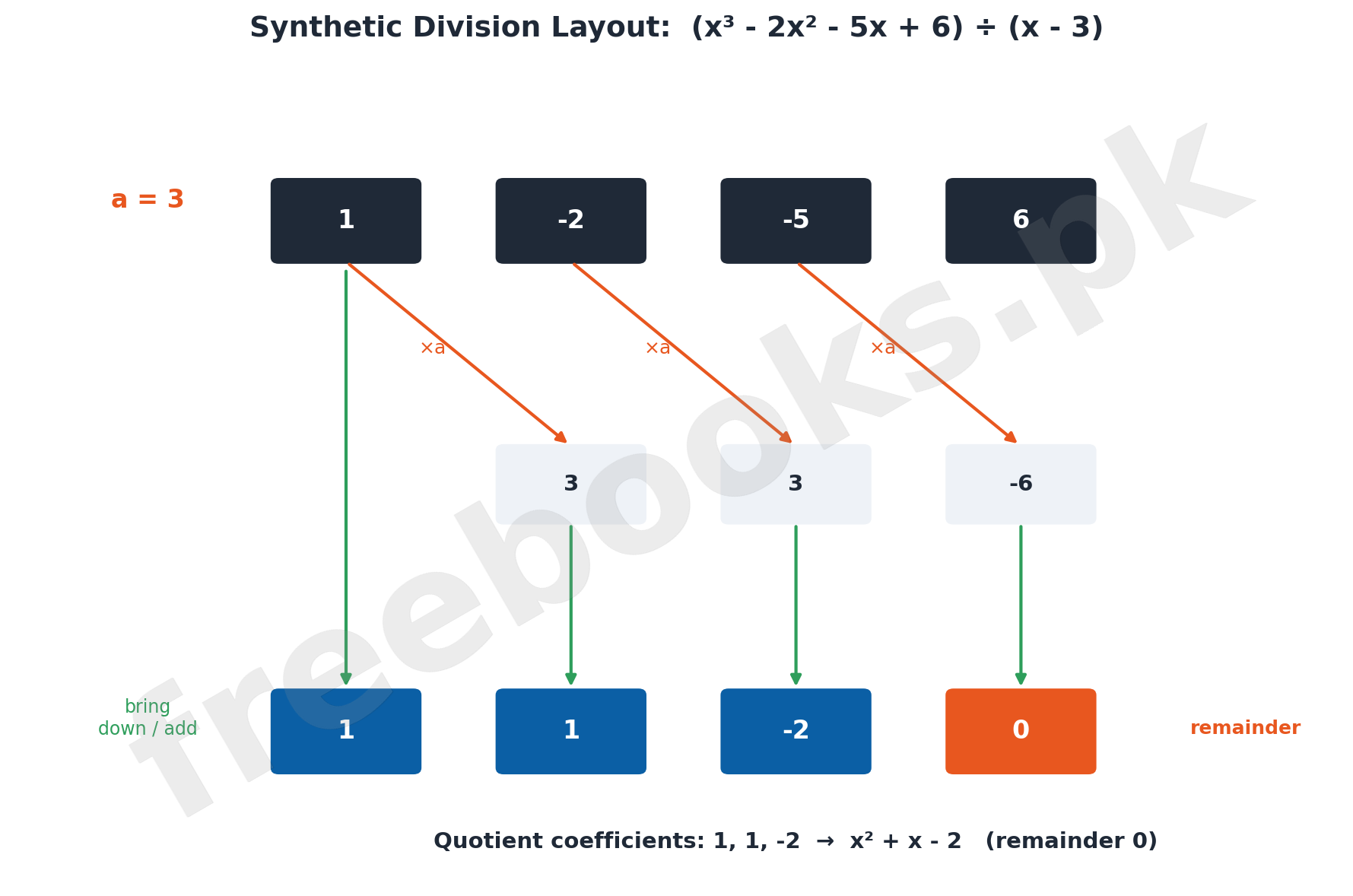
Synthetic division is a shortcut method for dividing a polynomial by a linear divisor of the form x-a, using only the coefficients of the dividend (with 0 inserted for any missing power) arranged in a compact numerical layout, avoiding the need to write out the full long-division process with variables.
The method uses two repeating patterns: working diagonally, each number is multiplied by a and placed under the next coefficient; working vertically, each column is added straight down — the final row gives the coefficients of the quotient (one degree lower than the dividend) followed by the remainder.
9.5 Real-Life Applications: Polynomial Regression
In polynomial regression, a statistical model fits an nth-degree polynomial P(x) to a set of data points; the remainder theorem is used to evaluate the model's predicted value at any given point x (by direct substitution), and the difference between an observed value and the predicted value gives the prediction error, often expressed as a percentage of the observed value.
The factor theorem also helps simplify or reduce a regression model's degree when a known root (a point where the fitted curve crosses zero) is identified, since that root corresponds to a linear factor that can be divided out.
9.6 Real-Life Applications: Digital Signal Processing
In digital signal processing, a system's transfer function H(z) is a ratio of two polynomials, B(z)/A(z); the roots of the numerator B(z) are called the zeros of the system, and the roots of the denominator A(z) are called the poles, both found using the factor theorem by solving B(z)=0 or A(z)=0.
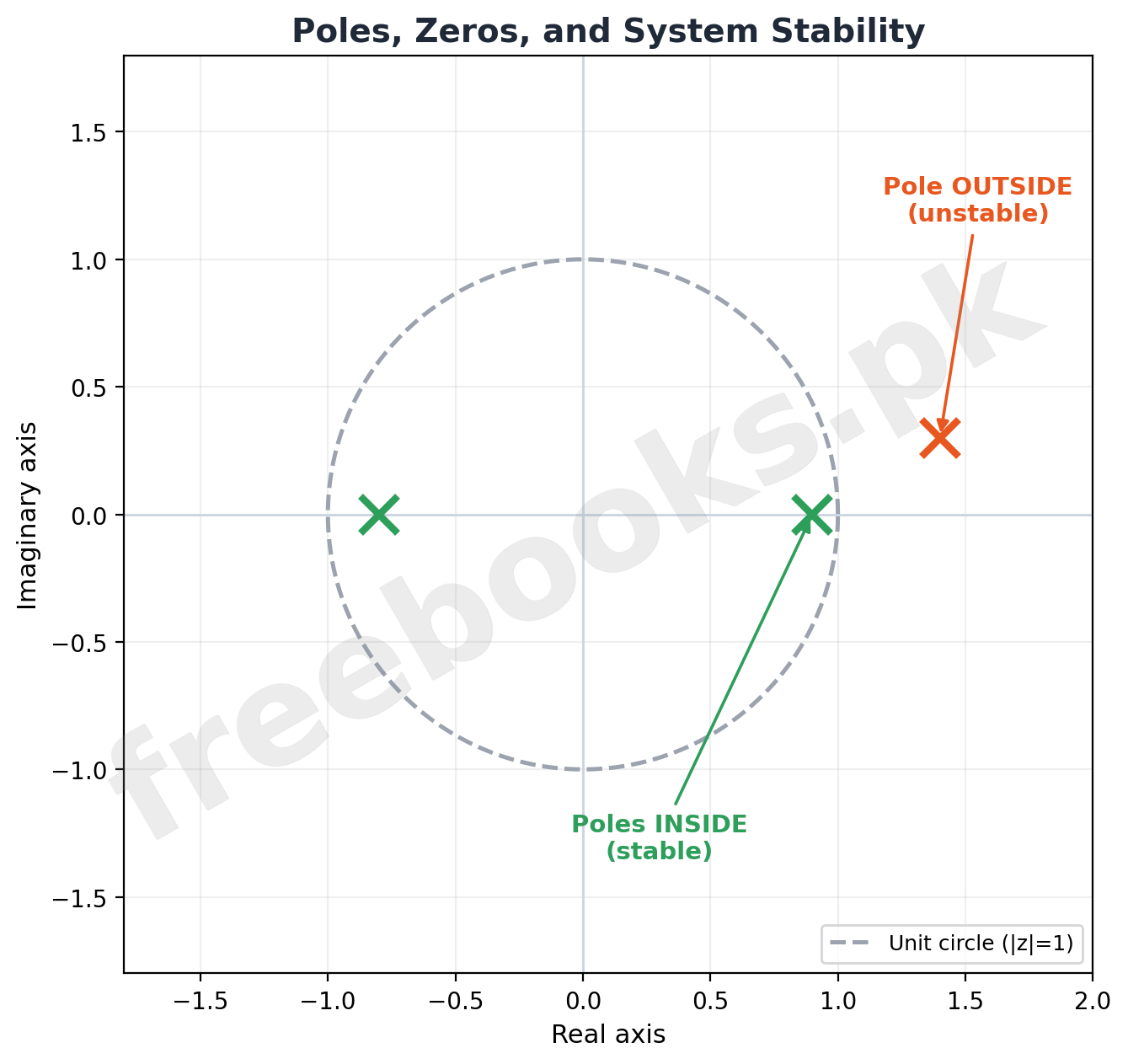
A system is stable only if every one of its poles lies strictly inside the unit circle in the complex plane, meaning the absolute value (modulus) of each pole is less than 1; finding the poles via the factor theorem and checking their magnitudes is therefore how the stability of a signal-processing system is determined.
Important Definitions
What is a polynomial in x?
An expression a_n x^n + a_(n-1)x^(n-1) + … + a_1 x + a_0, where n is a non-negative integer and the coefficients are real numbers.
What is the degree of a polynomial?
The highest power of x with a non-zero coefficient.
What does the remainder theorem state?
If a polynomial f(x) is divided by x-a, the remainder equals f(a).
What does the factor theorem state?
x-a is a factor of f(x) if and only if f(a)=0.
What is synthetic division?
A shortcut method for dividing a polynomial by x-a using only its coefficients.
What is a root (or zero) of a polynomial equation f(x)=0?
A value of x that makes f(x) equal to zero.
In the division identity f(x)=(x-a)q(x)+R, what are q(x) and R called?
q(x) is the quotient and R is the remainder.
What is polynomial regression?
A statistical modeling technique that fits an nth-degree polynomial to a data set.
In a signal processing transfer function H(z)=B(z)/A(z), what are the zeros and poles?
The zeros are the roots of the numerator B(z); the poles are the roots of the denominator A(z).
What condition on the poles determines whether a signal processing system is stable?
Every pole must lie inside the unit circle, meaning its absolute value (modulus) is less than 1.
Key Facts and Relations
| Topic | Key Fact / Relation |
|---|---|
| Division identity | f(x) = (x-a) . q(x) + R |
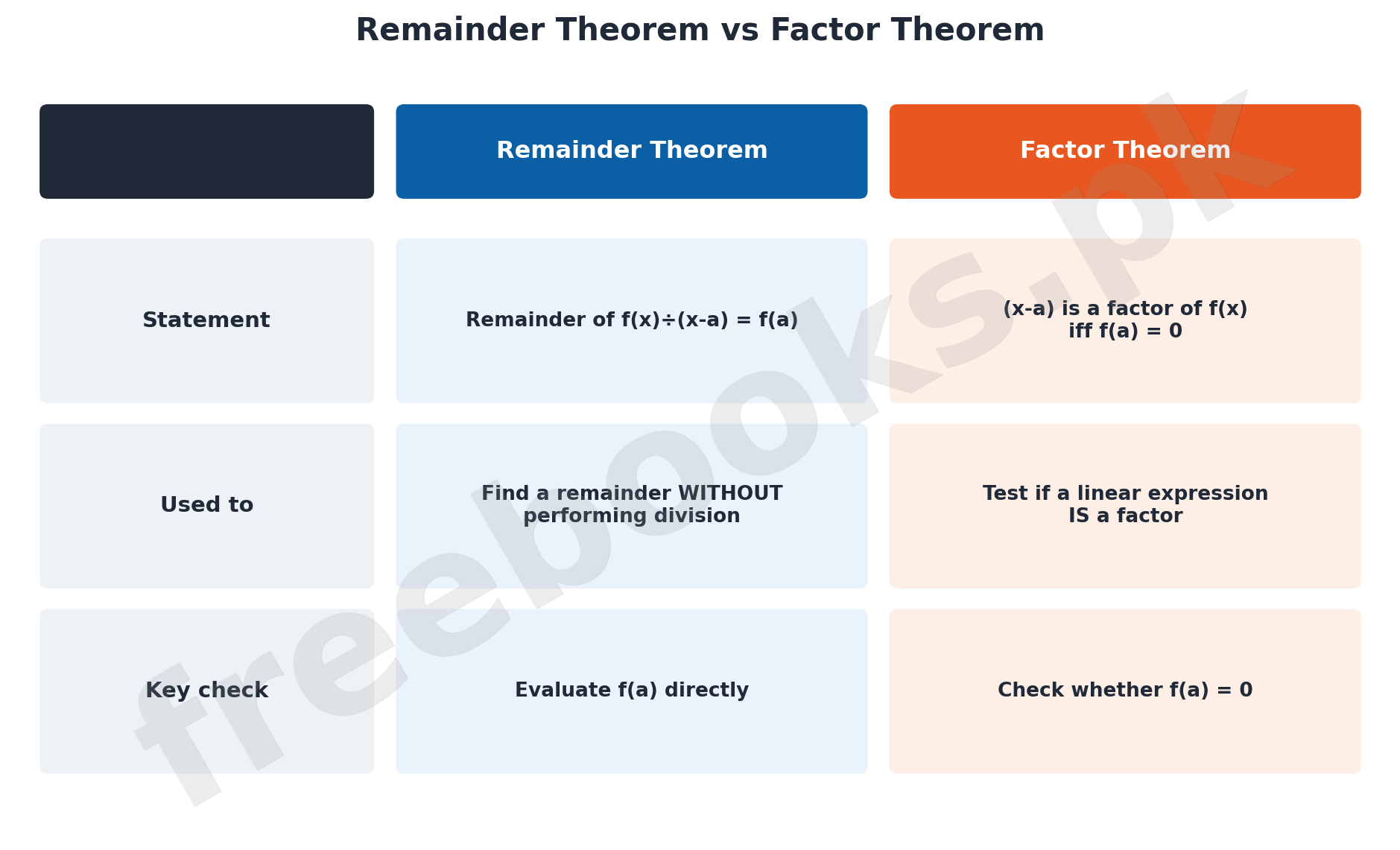
| Remainder theorem | remainder of f(x) divided by (x-a) = f(a) |
| Factor theorem | (x-a) is a factor of f(x) iff f(a) = 0 |
| Synthetic division layout | diagonal = multiply by a, vertical = add |
| Percentage error | |observed – predicted| / observed x 100 |
| Transfer function | H(z) = B(z) / A(z) |
| Stability condition | every pole p0 satisfies |p0| < 1 |
Diagrams
Synthetic Division Layout: A step-by-step schematic of synthetic division for (x^3-2x^2-5x+6) divided by (x-3), showing the diagonal 'multiply by a' pattern and the vertical 'add' pattern, ending in the quotient coefficients and remainder
Remainder Theorem vs Factor Theorem: A comparison table showing the statement, typical use, and key check for the remainder theorem alongside the factor theorem
Poles, Zeros, and System Stability: A complex-plane plot showing the unit circle, with example poles inside the circle (stable) marked in green and a pole outside the circle (unstable) marked in orange
Solved Examples
Example 1: Long Division of Polynomials
Problem: Divide 2x^3 – 3x^2 – 8x + 3 by x-3, finding the quotient and remainder.
- Divide the leading term: 2x^3 divided by x gives 2x^2. Multiply 2x^2(x-3)=2x^3-6x^2, and subtract from the dividend to get 3x^2-8x (bringing down the -8x term).
- Divide the new leading term: 3x^2 divided by x gives 3x. Multiply 3x(x-3)=3x^2-9x, and subtract to get x+3 (bringing down the +3 term).
- Divide again: x divided by x gives 1. Multiply 1(x-3)=x-3, and subtract to get a final remainder of 6.
- Final answer: quotient = 2x^2+3x+1, remainder = 6.
Example 2: Using the Remainder Theorem
Problem: Find the remainder when f(x)=2x^3+3x^2-5x+7 is divided by x+2, without performing division.
- Since the divisor is x+2 = x-(-2), identify a=-2.
- By the remainder theorem, the remainder equals f(-2).
- Compute f(-2) = 2(-2)^3+3(-2)^2-5(-2)+7 = -16+12+10+7.
- Add the terms: -16+12=-4, -4+10=6, 6+7=13.
- Final answer: the remainder is 13.
Example 3: Finding an Unknown Coefficient Using the Remainder Theorem
Problem: Find the value of k so that the polynomial 2x^3+kx^2-5x+8 leaves a remainder of 6 when divided by x-1.
- Since the divisor is x-1, use the remainder theorem with a=1: remainder = f(1).
- Compute f(1) = 2(1)^3+k(1)^2-5(1)+8 = 2+k-5+8 = k+5.
- Set this equal to the given remainder: k+5=6.
- Solve: k=1.
- Final answer: k=1.
Example 4: Applying the Factor Theorem
Problem: Show that x+3 is a factor of f(x)=x^3+2x^2-5x-6, without factorizing.
- Since the factor is x+3 = x-(-3), identify a=-3.
- Compute f(-3) = (-3)^3+2(-3)^2-5(-3)-6 = -27+18+15-6.
- Add the terms: -27+18=-9, -9+15=6, 6-6=0.
- Since f(-3)=0, by the factor theorem x+3 is a factor of f(x).
- Final answer: x+3 is confirmed to be a factor of f(x).
Example 5: Finding Unknown Coefficients from Two Known Factors
Problem: If x-1 and x+2 are factors of x^3+px^2+qx-6, find the values of p and q.
- Since x-1 is a factor, f(1)=0: 1+p+q-6=0, giving p+q=5. (i)
- Since x+2 is a factor, f(-2)=0: -8+4p-2q-6=0, giving 2p-q=7. (ii)
- From (i), q=5-p. Substitute into (ii): 2p-(5-p)=7, so 3p-5=7, giving p=4.
- Substitute p=4 back into q=5-p to get q=1.
- Final answer: p=4, q=1.
Example 6: Synthetic Division
Problem: Use synthetic division to divide f(x)=x^3-2x^2-5x+6 by x-3, and state the quotient and remainder.
- Write the coefficients of f(x) in order: 1, -2, -5, 6, with a=3 (since the divisor is x-3).
- Bring down the first coefficient (1). Multiply by a: 1×3=3, add to the next coefficient: -2+3=1.
- Multiply the new value by a: 1×3=3, add to the next coefficient: -5+3=-2. Multiply again: -2×3=-6, add to the last coefficient: 6+(-6)=0.
- The bottom row 1, 1, -2, 0 gives the quotient x^2+x-2 with remainder 0.
- Final answer: quotient = x^2+x-2, remainder = 0 (so x-3 is a factor).
Example 7: Application: Polynomial Regression Prediction Error
Problem: A polynomial regression model P(x)=2x^3-x^2+3x-4 is fitted to monthly sales data. If the observed sales in month 4 are 130 units, find the percentage error.
- Use the remainder theorem to evaluate the model at x=4: P(4)=2(4)^3-(4)^2+3(4)-4 = 128-16+12-4.
- Simplify: 128-16=112, 112+12=124, 124-4=120. So the predicted value is 120.
- Compute the error: Error = Observed – Predicted = 130-120 = 10.
- Percentage error = |10/130| x 100, approximately 7.7%.
- Final answer: the percentage error is approximately 7.7%.
Example 8: Application: Poles and Stability of a Signal Processing System
Problem: A signal processing system has a transfer function with denominator A(z)=z^2-0.1z-0.72. Use the factor theorem to find the poles and determine if the system is stable.
- Poles occur where A(z)=0: z^2-0.1z-0.72=0.
- Factor: looking for two numbers that multiply to -0.72 and combine to match the -0.1z coefficient: 0.9 and -0.8 work, since 0.9x(-0.8)=-0.72 and -0.9+0.8=-0.1.
- So z^2-0.1z-0.72 = (z-0.9)(z+0.8) = 0, giving poles z=0.9 and z=-0.8.
- Check stability: |0.9|=0.9<1 and |-0.8|=0.8<1 — both poles lie inside the unit circle.
- Final answer: the poles are z=0.9 and z=-0.8; since both lie inside the unit circle, the system is stable.
Short Questions & Answers
What is the degree of a polynomial?
The highest power of x with a non-zero coefficient.
What does the remainder theorem state?
The remainder when f(x) is divided by x-a equals f(a).
What does the factor theorem state?
x-a is a factor of f(x) if and only if f(a)=0.
What is synthetic division used for?
A shortcut method for dividing a polynomial by x-a using only coefficients.
In H(z)=B(z)/A(z), what are the zeros of the system?
The roots of the numerator B(z).
In H(z)=B(z)/A(z), what are the poles of the system?
The roots of the denominator A(z).
What condition makes a signal processing system stable?
Every pole must have an absolute value less than 1 (lie inside the unit circle).
Long Questions & Answers
Explain the remainder theorem and the factor theorem, including how the factor theorem follows directly from the remainder theorem.
What does the remainder theorem state, and how is it proved?
If a polynomial f(x) is divided by x-a, the remainder equals f(a); this is proved by substituting x=a into the division identity f(x)=(x-a)q(x)+R, which makes the (x-a)q(x) term vanish, leaving f(a)=R.
Why is the remainder theorem useful in practice?
It lets the remainder of a division be found with a single substitution and evaluation, avoiding the need to perform the entire long division just to learn the remainder.
What does the factor theorem state?
The polynomial x-a is a factor of f(x) if and only if f(a)=0, meaning x=a is a root of the equation f(x)=0.
How does the factor theorem follow from the remainder theorem?
Since the remainder theorem says the remainder of dividing f(x) by x-a is f(a), a remainder of exactly zero means x-a divides f(x) with nothing left over — which is precisely the definition of x-a being a factor.
Describe synthetic division as a method for dividing a polynomial by x-a, and explain its real-world use in evaluating signal processing transfer functions.
What is synthetic division, and what does it require as input?
Synthetic division is a shortcut method for dividing a polynomial by a linear divisor x-a, using only the polynomial's coefficients (in order, with 0 inserted for any missing power) rather than writing out the full division with variables.
What are the two repeating patterns used in synthetic division?
Working diagonally, each number in the bottom row is multiplied by a and placed under the next coefficient; working vertically, each column is then added straight down to produce the next entry in the bottom row.
What does the final row of a synthetic division represent?
The final row gives the coefficients of the quotient (one degree lower than the original polynomial), followed by the remainder as the very last entry.
How is this method applied in digital signal processing?
A system's transfer function H(z)=B(z)/A(z) is a ratio of polynomials; finding the roots of A(z) (the poles) using the factor theorem, and checking whether each pole's absolute value is less than 1, determines whether the physical system the transfer function models is stable.
Multiple Choice Questions (MCQs)
The degree of a polynomial is: (A) The number of terms (B) The highest power of x with a non-zero coefficient (C) The value of the leading coefficient (D) Always an even number
Correct answer: (B) The highest power of x with a non-zero coefficient. The degree is the highest power of x whose coefficient is not zero.
By the remainder theorem, the remainder when f(x) is divided by (x-a) equals: (A) f(0) (B) f(a) (C) a (D) f(x)/a
Correct answer: (B) f(a). The remainder theorem states the remainder equals f(a), the value of the polynomial at x=a.
By the factor theorem, (x-a) is a factor of f(x) if and only if: (A) f(a)=1 (B) f(0)=a (C) f(a)=0 (D) f(x)=0 for all x
Correct answer: (C) f(a)=0. x-a divides f(x) exactly (with zero remainder) precisely when f(a)=0.
Synthetic division is a shortcut method for dividing a polynomial by: (A) Any polynomial (B) A linear divisor x-a (C) A quadratic divisor (D) A constant
Correct answer: (B) A linear divisor x-a. Synthetic division only works for a linear divisor of the form x-a.
In synthetic division, the diagonal pattern means: (A) Add the two numbers (B) Multiply by a (C) Subtract the numbers (D) Divide by a
Correct answer: (B) Multiply by a. The diagonal step multiplies the previous bottom-row entry by a.
In a transfer function H(z)=B(z)/A(z), the roots of the denominator A(z) are called: (A) Zeros (B) Poles (C) Coefficients (D) Remainders
Correct answer: (B) Poles. The roots of the denominator are called the poles of the system.
A signal processing system is stable if all its poles: (A) Lie outside the unit circle (B) Lie exactly on the unit circle (C) Lie inside the unit circle (D) Equal zero
Correct answer: (C) Lie inside the unit circle. Stability requires every pole's absolute value to be less than 1, i.e. inside the unit circle.
If f(x) is divided by (x-a) and the remainder is 0, then: (A) x-a is not a factor (B) a is not a root (C) x-a is a factor of f(x) (D) f(x) is undefined
Correct answer: (C) x-a is a factor of f(x). A zero remainder means x-a divides f(x) exactly, so x-a is a factor.
Percentage error in a regression model is calculated as: (A) Observed x Predicted (B) |Observed – Predicted| / Observed x 100 (C) Predicted / Observed (D) Observed / Predicted x 100
Correct answer: (B) |Observed – Predicted| / Observed x 100. Percentage error is the absolute difference between observed and predicted, divided by the observed value, times 100.
To find the remainder of a polynomial divided by x+3 using the remainder theorem, substitute: (A) x=3 (B) x=-3 (C) x=0 (D) x=1/3
Correct answer: (B) x=-3. Since x+3 = x-(-3), the value to substitute is a=-3.
Quick Revision Summary
- A polynomial's degree is the highest power of x with a non-zero coefficient
- Dividing f(x) by a divisor gives f(x) = (divisor)(quotient) + remainder
- Remainder theorem: the remainder when f(x) is divided by (x-a) equals f(a)
- Factor theorem: (x-a) is a factor of f(x) if and only if f(a)=0
- Synthetic division divides a polynomial by (x-a) using only coefficients: diagonal = multiply by a, vertical = add
- The final row of synthetic division gives the quotient's coefficients, then the remainder
- To find an unknown coefficient, set f(a) equal to the given remainder and solve
- To find unknown coefficients from two known factors, set up f(a1)=0 and f(a2)=0 as simultaneous equations
- Polynomial regression fits an nth-degree polynomial to data; the remainder theorem evaluates predictions at any point
- Percentage error = |observed – predicted| / observed x 100
- In signal processing, zeros are roots of the numerator B(z); poles are roots of the denominator A(z)
- A system is stable only if every pole's absolute value (modulus) is less than 1 (inside the unit circle)
Exam Tips
- Always rewrite the divisor as x-a first (e.g. x+3 means a=-3) before applying the remainder or factor theorem
- Use the remainder theorem to check answers from long division — f(a) should match the remainder you found
- For unknown-coefficient problems, translate remainder theorem facts into simple linear equations and solve
- In synthetic division, always insert 0 for any missing power of x in the coefficient row
- Remember: a zero remainder from the factor theorem confirms a factor; it does NOT mean the polynomial itself is zero
- For stability problems, compute the absolute value of every pole and compare it to 1 — all poles must qualify for the system to be stable