
This chapter covers Kingdom Protista (or Protoctista) from the 1st Year (FSc Part-I) Biology syllabus of the Punjab Curriculum and Textbook Board (PTB/PCTB). Kingdom Protista is essentially defined by exclusion: it groups eukaryotic organisms that do not fit neatly into the Plantae, Fungi or Animalia kingdoms, and from which those three eukaryotic kingdoms are thought to have arisen. These notes are prepared by freebooks.pk.
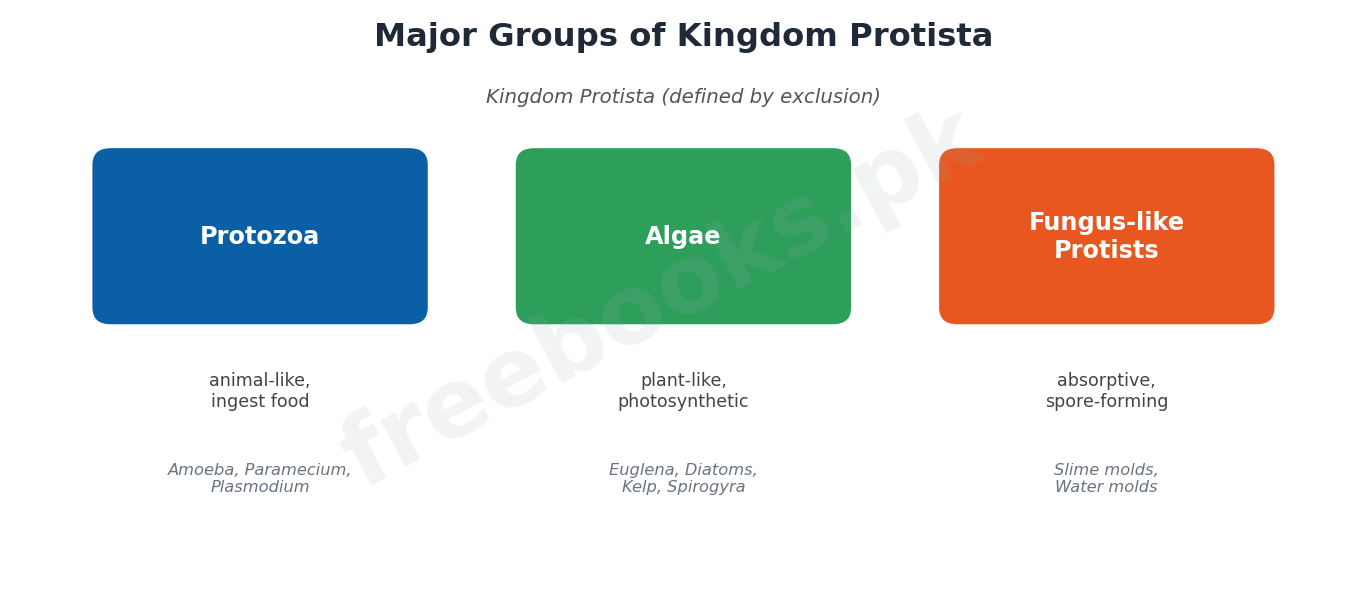
The chapter traces the historical development of the kingdom concept from Hogg and Haeckel through Copeland, Whittaker, and Margulis and Schwartz, then works through the three major groups of protists: the animal-like protozoa (amoebae, zooflagellates, ciliates, foraminiferans/actinopods, and apicomplexans), the plant-like algae (euglenoids, dinoflagellates, diatoms, brown algae, red algae and green algae), and the fungus-like protists (slime molds and water molds/oomycetes), along with their ecological and economic importance.
Learning Objectives
- Explain why Kingdom Protista is difficult to characterize and describe its historical development.
- Describe the major groups of protozoa: amoebae, zooflagellates, ciliates, foraminiferans/actinopods and apicomplexans.
- Describe the general characteristics of algae and classify them into their six major phyla by pigment.
- Describe euglenoids, dinoflagellates, diatoms, brown algae, red algae and green algae with examples.
- State the economic and ecological importance of algae.
- Describe the structure and reproduction of slime molds (Myxomycota).
- Differentiate water molds (Oomycotes) from true fungi and describe their importance.
Key Concepts
Kingdom Protista: Definition, Diversity and Historical Perspective
Kingdom Protista consists of a vast assortment of primarily aquatic eukaryotic organisms whose diverse body forms, types of reproduction, modes of nutrition and lifestyles make them difficult to characterize; the kingdom is essentially defined by exclusion, since all its members have characteristics that exclude them from the other four kingdoms. All protists are eukaryotic and are thought to have evolved from prokaryotes; the other eukaryotic kingdoms (Plantae, Fungi and Animalia) arose from protists in various ways, which is part of why placing certain eukaryotic organisms in the correct kingdom is difficult. Protists are unicellular, colonial or simple multicellular organisms with eukaryotic cell organization, but unlike plants and animals they do not develop from a blastula or an embryo. Kingdom Protista contains four major groups of organisms: single-celled protozoans, unicellular algae, multicellular algae, and slime molds and oomycetes (fungus-like protists).
The concept of this kingdom developed gradually. In 1861, John Hogg proposed the kingdom Protoctista for microscopic organisms. In 1866, Ernst Haeckel suggested creating Kingdom Protista to include bacteria and other microorganisms such as Euglena, though he separated blue-green algae and bacteria (prokaryotes) into a group he called Monera within Protista. In 1938, Herbert Copeland elevated the prokaryotes to full kingdom status, separating them from Protista. In Robert Whittaker's five-kingdom system (1969), only unicellular eukaryotes were placed in Kingdom Protista; today the kingdom also includes colonial and simple multicellular eukaryotes. Margulis and Schwartz (1988) modified the five-kingdom system further, keeping Protista (or Protoctista) as one of the five kingdoms. Because of this diversity, most biologists regard the protist kingdom as polyphyletic, meaning its members probably do not share a single common ancestor; Margulis and Schwartz listed 27 phyla to accommodate this diverse assemblage.
Protozoa: Animal-like Protists
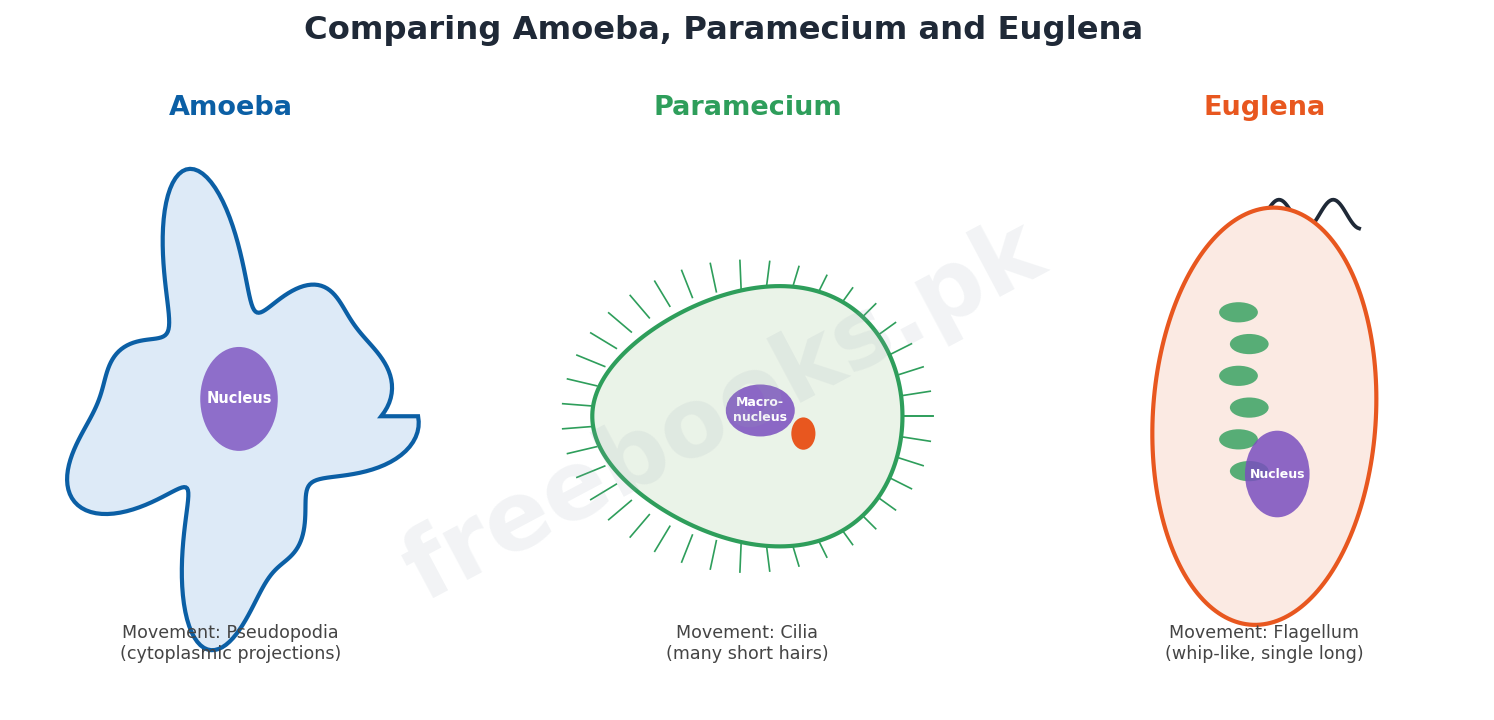
All protozoans are unicellular, and most ingest their food by endocytosis. Amoebae include all free-living freshwater, marine and soil amoebae as well as parasitic species; they lack flagella and move using specialized cytoplasmic projections called pseudopodia ("false feet"). The intestinal parasite Entamoeba histolytica causes amoebic dysentery in humans, while the giant amoeba Pelomyxa palustris, possibly the most primitive of all eukaryote-like forms, has multiple membrane-bound nuclei but lacks the other organelles found in typical eukaryotes and obtains energy from methanogenic bacteria living inside it.
Zooflagellates are mostly unicellular (a few colonial) organisms with spherical or elongated bodies and a single central nucleus, possessing one to many long, whip-like flagella for movement; they may be free-living, symbionts or parasites. Trichonympha are complex flagellates with many flagella that live symbiotically in the guts of termites and help digest wood, while Trypanosoma is a parasitic flagellate that causes African sleeping sickness, transmitted by the bite of an infected tsetse fly. Choanoflagellates are sessile flagellates attached by a stalk, with a single flagellum surrounded by a delicate collar, and are notable for their striking resemblance to the collar cells found in sponges. Ciliates are unicellular organisms with a flexible outer covering called a pellicle, giving them a definite but changeable shape; in Paramecium the cell surface is covered with thousands of short, hair-like cilia beating in coordinated waves for movement. Ciliates possess two kinds of nuclei: one or more small, diploid micronuclei involved in sexual processes, and a large, polyploid macronucleus that controls cell metabolism and growth; most ciliates reproduce sexually through conjugation, in which two individuals exchange genetic material. Foraminiferans and actinopods are marine protozoans that produce shells (tests) — calcium-based in foraminiferans and silica-based in actinopods — with pores through which sticky cytoplasmic projections extend to trap prey; foraminiferan shells accumulating on the ocean floor have formed vast limestone deposits over geological time. Apicomplexans are a large group of parasitic protozoa lacking specific locomotory structures but able to move by flexing; the apicomplexan Plasmodium causes malaria, entering the human bloodstream through the bite of an infected female Anopheles mosquito, multiplying first in liver cells and then in red blood cells, whose simultaneous bursting causes malaria's characteristic chills and fever.
The Algae: Plant-like Protists
Algae are photosynthetic protists that carry out an estimated 50 to 60 percent of all photosynthesis on Earth. They differ from true plants in that their sex organs are unicellular and their zygote is not protected by parental tissue, whereas a plant zygote develops into a multicellular, parentally protected embryo. Algae show a remarkable range of growth forms: some are unicellular, others filamentous (composed of distinct cells or coenocytes, multinucleate structures lacking cross-walls), and still others, such as seaweeds, are multicellular with intricate branching or leaf-like extensions; a body not differentiated into true roots, stems and leaves, and lacking xylem and phloem, is called a thallus. All algae contain chlorophyll a and carotenoids, but different algal phyla also possess distinctive additional pigments such as xanthophylls and phycoerythrin, and classification of algae into phyla is based largely on this pigment composition. Except for the red algae (Rhodophyta), all algal phyla have flagellated, motile cell stages at some point in their life cycle. Almost all algae are aquatic, restricted when actively growing to damp or wet habitats such as oceans, freshwater bodies, hot springs, polar ice, and moist soil, trees or rocks.
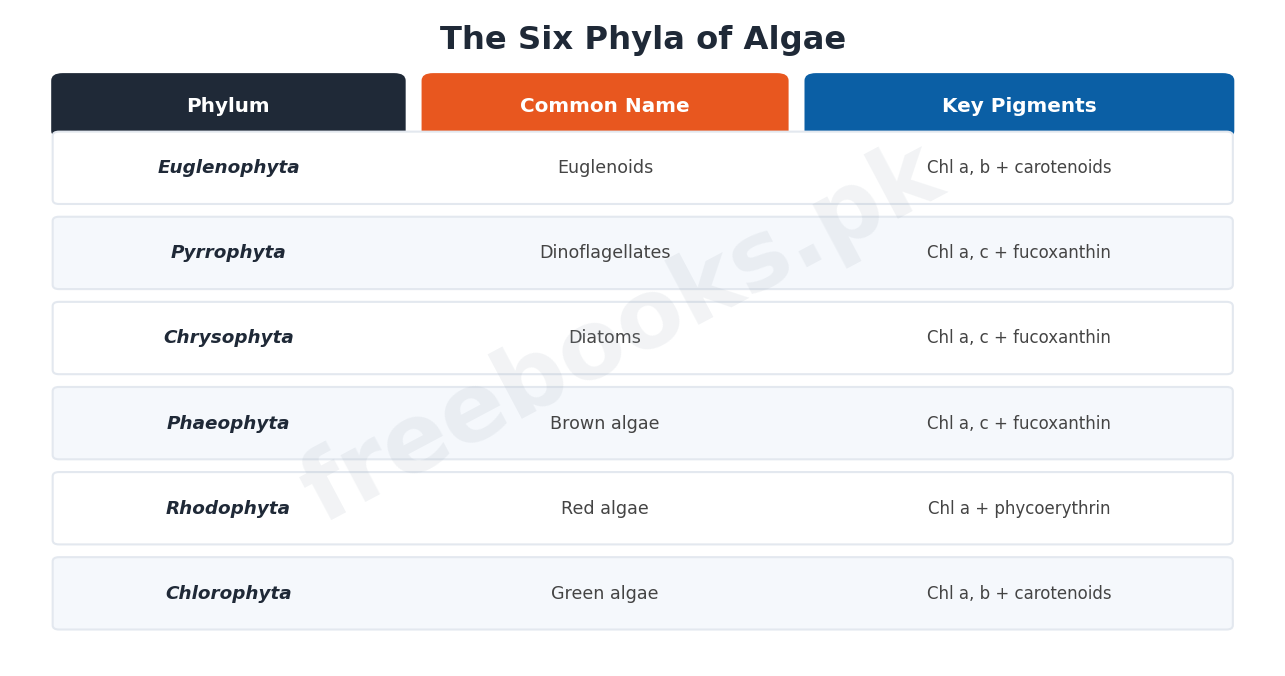
Algae are classified into six major phyla based on pigments, form and locomotion: Euglenophyta (euglenoids, unicellular, two unequal flagella, chlorophyll a and b plus carotenoids), Pyrrophyta (dinoflagellates, unicellular, two flagella, chlorophyll a and c plus fucoxanthin), Chrysophyta (diatoms, usually unicellular, usually non-motile, chlorophyll a and c plus fucoxanthin), Phaeophyta (brown algae, multicellular, flagellated reproductive cells, chlorophyll a and c plus fucoxanthin), Rhodophyta (red algae, uni- or multicellular, non-motile, chlorophyll a plus phycoerythrin), and Chlorophyta (green algae, unicellular to multicellular, mostly flagellated, chlorophyll a and b plus carotenoids).
Euglenoids and Dinoflagellates
Euglenoids have historically been classified with both the plant kingdom (as algae) and the animal kingdom (as protozoans), and molecular data suggest they are closely related to zooflagellates; they are plant-like in their pigments, but some photosynthetic euglenoids lose their chlorophyll when grown in darkness and switch to heterotrophic feeding by ingesting organic matter, while other species are permanently colourless and heterotrophic. Dinoflagellates are among the most unusual protist phyla; most are unicellular, and their cells are often covered with shells of interlocking, silicate-impregnated cellulose plates. Ecologically, dinoflagellates are among the most important producers in marine ecosystems, second only to diatoms, and are known for occasional population explosions or blooms that colour the water orange, red or brown, known as red tides.
Diatoms, Brown Algae and Red Algae
The cell wall of each diatom consists of two overlapping shells, fitting together like a petri dish, with silica deposited in intricate glasslike patterns. Diatoms are major producers in both marine and freshwater ecosystems because of their extremely large numbers, making them very important in aquatic food chains. Brown algae (Phaeophyta) include the giants of the protist kingdom; all are multicellular, ranging from a few centimetres to about 75 metres in length, with the largest, the kelps, being tough and leathery and possessing leaf-like blades, stem-like stipes and root-like anchoring holdfasts. Brown algae are common in cooler marine waters, especially along rocky intertidal coastlines.
Red algae (Rhodophyta) commonly have a multicellular body made of complex, delicate, feathery, interwoven filaments, though a few are flattened sheets of cells; most attach to rocks or other substrates by a basal holdfast. Some red algae incorporate calcium carbonate into their cell walls and, together with coral animals, contribute to building coral reefs.
Green Algae and the Importance of Algae
Green algae (Chlorophyta) have pigments, energy-reserve products and cell walls essentially identical to those of true plants: they are photosynthetic, containing chlorophyll a, chlorophyll b and carotenoids in their chloroplasts, store energy mainly as starch, and mostly possess cellulose cell walls. Because of these similarities, and supporting evidence from RNA sequencing, it is generally accepted that land plants arose from ancestral green algae and that green algae and plants form a single monophyletic lineage. Green algae display diverse forms, from the unicellular Chlamydomonas and Chlorella (a non-motile, easily cultured freshwater alga used in photosynthesis research and studied as an alternate food source), to desmids, the colonial Volvox, filamentous Spirogyra and sheet-like Ulva.
Algae are of great economic and environmental importance: edible species such as kelps can help address world food shortages, marine algae are a source of useful substances such as algin, agar, carrageenan and antiseptics, and as major producers of the aquatic ecosystem, algae play a fundamental role in food chains, supplying both food and oxygen to other organisms.
Fungus-like Protists: Slime Molds and Water Molds
Some protists superficially resemble fungi, being non-photosynthetic and, in some cases, having bodies formed of thread-like hyphae; however, they differ fundamentally from true fungi, since many fungus-like protists possess centrioles and produce cellulose as a major cell-wall component, whereas fungi lack centrioles and have chitin cell walls. The two major groups of fungus-like protists are slime molds (Myxomycota) and water molds (Oomycotes). The feeding stage of a slime mold is a plasmodium, a slimy, multinucleate mass of cytoplasm that can grow up to about 30 cm in diameter, streaming over damp, decaying logs and leaf litter and ingesting bacteria, yeasts, spores and decaying organic matter as it creeps along. Under unfavourable conditions, a slime mold forms resistant haploid spores by meiosis within stalked structures called sporangia; when conditions improve, these spores germinate into biflagellated or amoeboid reproductive (swarm) cells, which unite to form a diploid zygote that develops into a new multinucleate plasmodium, each nucleus being diploid. Physarum polycephalum, a plasmodial slime mold, is a model organism widely used to study growth and differentiation, cytoplasmic streaming, and cytoskeletal function.
Water molds (Oomycotes) show close structural relationships to fungi but are now regarded as a more ancient group; their cell walls contain cellulose rather than chitin, and their hyphae are aseptate (lacking cross-walls). Oomycotes include several notorious pathogens, most famously Phytophthora infestans, the cause of late blight of potatoes and of the Irish potato famine of the 1840s. Several rainy, cool Irish summers in that decade allowed the water mold to multiply unchecked, rotting potato tubers in the fields; since potatoes were the staple food of Irish peasants, between roughly 250,000 and over a million people starved to death, and the famine triggered mass emigration from Ireland to countries such as the United States.
Important Definitions
Protist
A eukaryotic organism, usually unicellular or simple multicellular, that does not fit into the Plantae, Fungi or Animalia kingdoms.
Pseudopodia
Temporary, false-foot-like cytoplasmic projections used by amoebae for movement and feeding.
Cilia
Numerous short, hair-like structures on the surface of ciliates (e.g. Paramecium) that beat in coordination to produce movement.
Conjugation
A sexual process in ciliates in which two individuals temporarily join and exchange genetic material.
Thallus
A simple algal or fungal body not differentiated into true roots, stems and leaves, and lacking xylem and phloem.
Plasmodium (slime mold)
The feeding stage of a slime mold: a slimy, multinucleate mass of cytoplasm that streams over damp surfaces.
Sporangium
A stalked structure in which a slime mold produces resistant haploid spores by meiosis under unfavourable conditions.
Coenocyte
A multinucleate cytoplasmic structure, as in some filamentous algae, that lacks internal cross-walls.
Key Facts
| Item | Fact |
|---|---|
| Kingdom Protista proposed | Ernst Haeckel, 1866 (built on Hogg's 1861 "Protoctista"). |
| Five Kingdom System | Robert Whittaker, 1969 – originally placed only unicellular eukaryotes in Protista. |
| Algae & global photosynthesis | Algae carry out about 50-60% of all photosynthesis on Earth. |
| Amoebic dysentery agent | Entamoeba histolytica (an amoeba). |
| Ciliate nuclei | Micronucleus (diploid, sexual reproduction) + Macronucleus (polyploid, metabolism/growth). |
| Malaria transmission | Plasmodium (Apicomplexa) via bite of infected female Anopheles mosquito. |
| Largest brown algae (kelps) | Can grow up to approx. 75 metres in length. |
| Irish potato famine cause | Phytophthora infestans (water mold/Oomycete), 1840s Ireland. |
Diagrams & Illustrations
Major Groups of Kingdom Protista: an overview chart of the three major protist groups – Protozoa (animal-like), Algae (plant-like) and fungus-like protists – with representative examples of each.
Comparing Amoeba, Paramecium and Euglena: a labelled comparison of three representative protists and their means of locomotion: Amoeba (pseudopodia), Paramecium (cilia) and Euglena (flagellum).
The Six Phyla of Algae: a summary chart of the six algal phyla (Euglenophyta, Pyrrophyta, Chrysophyta, Phaeophyta, Rhodophyta, Chlorophyta) with their common names and key pigments.
Short Questions & Answers
What is a pseudopodium? Name an organism that uses it for movement.
A pseudopodium ("false foot") is a temporary cytoplasmic projection used for movement and feeding; Amoeba is a classic example of an organism that moves using pseudopodia.
Differentiate macronucleus and micronucleus in Paramecium.
The macronucleus is large and polyploid and controls cell metabolism and growth, while the micronucleus (or micronuclei) is small and diploid and functions in the sexual process of conjugation.
What is conjugation in ciliates?
Conjugation is a sexual process in which two ciliate individuals (e.g. Paramecium) come together temporarily and exchange genetic material through their micronuclei.
On what basis are algae classified into phyla?
Algae are classified into phyla largely on the basis of their pigment composition, along with differences in form and locomotion (e.g. flagellation).
What is a thallus?
A thallus is a simple plant/algal body that is not differentiated into true roots, stems and leaves and lacks vascular tissues (xylem and phloem).
Differentiate slime molds and water molds (oomycetes).
Slime molds (Myxomycota) form a multinucleate, creeping plasmodium and produce spores in stalked sporangia, while water molds (Oomycotes) have a hyphal, fungus-like structure with aseptate hyphae and cellulose (not chitin) cell walls, and include important plant pathogens such as Phytophthora infestans.
Long Questions & Answers
Discuss important features of protists. Why are protists so difficult to classify?
Kingdom Protista consists mainly of aquatic eukaryotic organisms showing enormous diversity in body form, reproduction, nutrition and lifestyle, which makes it difficult to give the kingdom a single positive definition; instead, it is essentially defined by exclusion, grouping organisms that do not belong to Plantae, Fungi or Animalia. All protists share a eukaryotic cell organization, distinguishing them from the prokaryotic kingdom Monera, but unlike plants and animals they do not develop from a blastula or embryo. The kingdom includes single-celled protozoans, unicellular and multicellular algae, and fungus-like slime molds and water molds — organisms as different in structure and lifestyle as Amoeba, giant kelp, and Plasmodium. Protists are difficult to classify because the other three eukaryotic kingdoms are believed to have evolutionarily arisen from various protist lineages, making it hard to draw sharp boundaries; because of this diversity, most biologists regard Protista as a polyphyletic group, probably not sharing a single common ancestor, with some biologists recognizing as many as 27 different phyla within it.
Describe protozoan diversity with reference to amoebae, zooflagellates, ciliates and apicomplexans.
Protozoa are unicellular, animal-like protists that mostly ingest food by endocytosis. Amoebae are free-living or parasitic organisms that lack flagella and move using pseudopodia; Entamoeba histolytica, an intestinal parasite, causes amoebic dysentery in humans. Zooflagellates are mostly unicellular organisms possessing one to many whip-like flagella for movement; examples include Trichonympha, which lives symbiotically in termite guts and helps digest wood, and Trypanosoma, which causes African sleeping sickness after transmission by the tsetse fly, while choanoflagellates are sessile, collared flagellates resembling sponge collar cells. Ciliates, such as Paramecium, are covered with numerous short cilia used for coordinated movement, and uniquely possess two types of nuclei — a diploid micronucleus for sexual reproduction (conjugation) and a polyploid macronucleus controlling metabolism and growth. Apicomplexans are parasitic protozoa lacking locomotory structures but capable of moving by flexing; Plasmodium, the apicomplexan that causes malaria, is transmitted by the female Anopheles mosquito and multiplies inside human liver cells and red blood cells, whose bursting produces the characteristic chills and fever of malaria. Foraminiferans and actinopods, closely related marine groups, produce calcium- or silica-based shells (tests) with pores for cytoplasmic projections that trap prey, and foraminiferan shells have historically formed vast limestone deposits.
Discuss the general characteristics of algae and describe their classification into six phyla.
Algae are photosynthetic protists responsible for an estimated 50-60% of all photosynthesis on Earth. They differ from true plants in having unicellular sex organs and an unprotected zygote, and they show a wide range of growth forms, from unicellular and filamentous (including coenocytic) forms to large, complex multicellular bodies called thalli, which lack true roots, stems, leaves and vascular tissue. All algae contain chlorophyll a and carotenoids, but the presence of additional pigments differs between groups, and this pigment composition forms the main basis for classifying algae into six phyla: Euglenophyta (euglenoids, unicellular, two unequal flagella), Pyrrophyta (dinoflagellates, unicellular, two flagella, often armoured with cellulose plates), Chrysophyta (diatoms, mostly unicellular, glass-like silica shells), Phaeophyta (brown algae, multicellular, includes the giant kelps), Rhodophyta (red algae, uni- or multicellular, phycoerythrin pigment, contributors to coral reefs), and Chlorophyta (green algae, from unicellular Chlamydomonas to multicellular Ulva, considered ancestral to land plants). Almost all algae are aquatic, and except for the red algae, all have flagellated motile stages somewhere in their life cycle.
Green algae are considered ancestral organisms of green land plants. Discuss.
Green algae (Chlorophyta) are considered the ancestors of land plants because they share pigments, energy-reserve products and cell-wall composition that are essentially identical to those of true plants: both groups contain chlorophyll a and chlorophyll b along with carotenoids in their chloroplasts, both store surplus food mainly as starch, and both typically build their cell walls from cellulose. These shared biochemical and structural traits strongly suggest common ancestry rather than coincidence. This conclusion is further supported by molecular evidence: RNA sequencing data indicate that green algae and land plants form a single monophyletic lineage, meaning they share a common ancestor not shared by other algal groups. Because of this close relationship, green algae such as Chlamydomonas, desmids, Volvox, Spirogyra and Ulva are studied as useful models for understanding the evolutionary origins of the plant kingdom.
What features distinguish oomycetes from fungi? Describe the structure and reproduction of slime molds.
Although water molds (Oomycotes) superficially resemble true fungi in having hyphal, thread-like bodies and a non-photosynthetic lifestyle, several features distinguish them: oomycete cell walls are made of cellulose rather than the chitin found in fungal cell walls, oomycetes possess centrioles (which fungi lack), and their hyphae are aseptate, lacking the cross-walls found in most fungal hyphae. Oomycotes are now regarded as a more ancient group than true fungi and include notable plant pathogens such as Phytophthora infestans, which causes late blight of potatoes and was responsible for the devastating Irish potato famine of the 1840s. Slime molds (Myxomycota), the other major group of fungus-like protists, exist in a feeding stage called a plasmodium: a slimy, multinucleate mass of cytoplasm, sometimes growing up to 30 cm across, that streams over damp, decaying organic matter such as logs and leaf litter, ingesting bacteria, yeasts and spores as it moves. Under unfavourable conditions, the plasmodium forms resistant haploid spores through meiosis inside stalked sporangia; when favourable conditions return, these spores germinate into biflagellated or amoeboid swarm cells, which fuse to form a diploid zygote that develops into a new multinucleate plasmodium in which every nucleus is diploid. The model organism Physarum polycephalum, a plasmodial slime mold, has been widely used to study cell growth, differentiation, cytoplasmic streaming and cytoskeletal function.
MCQs with Answers
Kingdom Protista was proposed by: (a) John Hogg (b) Ernst Haeckel (c) Herbert Copeland (d) Robert Whittaker
Correct Answer: (b) Ernst Haeckel. Ernst Haeckel proposed Kingdom Protista in 1866, building on Hogg's earlier "Protoctista" concept.
Amoeba moves using: (a) cilia (b) flagella (c) pseudopodia (d) setae
Correct Answer: (c) pseudopodia. Amoebae lack flagella and cilia; they move using cytoplasmic projections called pseudopodia.
Entamoeba histolytica causes: (a) malaria (b) sleeping sickness (c) amoebic dysentery (d) late blight of potato
Correct Answer: (c) amoebic dysentery. Entamoeba histolytica is an intestinal parasite that causes amoebic dysentery in humans.
Malaria in humans is caused by: (a) Trypanosoma (b) Plasmodium (c) Paramecium (d) Euglena
Correct Answer: (b) Plasmodium. Plasmodium, an apicomplexan protozoan, causes malaria and is transmitted by the female Anopheles mosquito.
In Paramecium, cell metabolism and growth are controlled by the: (a) micronucleus (b) macronucleus (c) nucleolus (d) contractile vacuole
Correct Answer: (b) macronucleus. The large, polyploid macronucleus controls metabolism and growth, while the micronucleus is involved in sexual reproduction.
Algae are estimated to carry out what percentage of Earth's total photosynthesis? (a) 10-20% (b) 30-40% (c) 50-60% (d) 80-90%
Correct Answer: (c) 50-60%. Algae are estimated to carry out about 50 to 60 percent of all photosynthesis on Earth.
Which algal phylum is exceptional in lacking flagellated motile cells in its life cycle? (a) Chlorophyta (b) Phaeophyta (c) Rhodophyta (d) Pyrrophyta
Correct Answer: (c) Rhodophyta. Rhodophyta (red algae) is the one algal phylum in which flagellated motile stages are absent.
The largest protists, the kelps, belong to the phylum: (a) Chrysophyta (b) Phaeophyta (c) Rhodophyta (d) Euglenophyta
Correct Answer: (b) Phaeophyta. Kelps are giant brown algae, belonging to phylum Phaeophyta, reaching up to about 75 metres in length.
The Irish potato famine of the 1840s was caused by: (a) Plasmodium falciparum (b) Phytophthora infestans (c) Entamoeba histolytica (d) Trypanosoma brucei
Correct Answer: (b) Phytophthora infestans. Phytophthora infestans, a water mold (oomycete), caused late blight of potatoes and the Irish potato famine.
The feeding stage of a slime mold is called a: (a) hypha (b) mycelium (c) plasmodium (d) thallus
Correct Answer: (c) plasmodium. The feeding stage of a slime mold is a multinucleate, creeping mass of cytoplasm called a plasmodium.
Quick Revision Summary
- Kingdom Protista is defined by exclusion; historical development: Hogg (1861) -> Haeckel (1866) -> Copeland (1938) -> Whittaker (1969) -> Margulis & Schwartz (1988). Mostly polyphyletic, aquatic, eukaryotic.
- Protozoa (animal-like): Amoebae (pseudopodia, Entamoeba histolytica), Zooflagellates (flagella, Trypanosoma, Trichonympha, choanoflagellates), Ciliates (cilia, macro+micronucleus, conjugation, Paramecium), Foraminifera/Actinopods (shells/tests), Apicomplexans (Plasmodium, malaria).
- Algae (plant-like): 50-60% of Earth's photosynthesis; classified into 6 phyla by pigment: Euglenophyta, Pyrrophyta (dinoflagellates), Chrysophyta (diatoms), Phaeophyta (brown algae/kelps), Rhodophyta (red algae), Chlorophyta (green algae, ancestor of land plants).
- Thallus = undifferentiated algal/plant body, no true roots/stems/leaves, no xylem/phloem. Coenocyte = multinucleate structure without cross-walls.
- Fungus-like protists: Slime molds (Myxomycota – plasmodium, sporangia, spores) and Water molds (Oomycotes – cellulose walls, aseptate hyphae, e.g. Phytophthora infestans, Irish potato famine).
- Algae economic importance: food (kelps), algin, agar, carrageenan, antiseptics; ecological importance: major aquatic producers, food chains, oxygen. Notes by freebooks.pk.
Exam Tips
- Remember Kingdom Protista is defined by exclusion — learn the historical sequence of scientists (Hogg, Haeckel, Copeland, Whittaker, Margulis & Schwartz) in order.
- Learn the 3 major protist groups (Protozoa, Algae, Fungus-like) with at least 2 examples each — a common short-question format.
- Memorise the 6 algal phyla with their common names and one distinguishing pigment/feature each.
- Be ready to compare macronucleus vs micronucleus, and slime molds vs water molds — classic "differentiate" questions.
- Know the Plasmodium malaria life cycle steps and the Phytophthora infestans/Irish potato famine story — frequently asked extensive questions.
- Practise linking green algae's shared traits with plants (pigments, starch storage, cellulose walls) to the "ancestor of land plants" argument.