This chapter covers Biological Molecules from the 1st Year (FSc Part-I) Biology syllabus of the Punjab Curriculum and Textbook Board (PTB/PCTB). It introduces biochemistry, the branch of biology that studies the chemical compounds and reactions of living things, and explains why carbon and water are central to life. It then works through the four major classes of organic molecules found in every cell: carbohydrates, lipids, proteins and nucleic acids, along with the conjugated molecules formed when these classes combine. These notes are prepared by freebooks.pk.
Understanding how a monosaccharide becomes a polysaccharide, how amino acids fold into a functional protein, and how nucleotides pair up inside the DNA double helix gives the chemical vocabulary needed for cell biology, genetics and physiology in later chapters. The chapter also introduces key scientists — Sanger, Chargaff, Watson and Crick — whose work revealed these structures.
Learning Objectives
- Define biochemistry and distinguish organic from inorganic compounds in living cells.
- Explain why carbon's tetravalency and water's polarity make them central to life chemistry.
- Classify carbohydrates into monosaccharides, oligosaccharides and polysaccharides with examples.
- Describe the main classes of lipids and explain why they store more energy than carbohydrates.
- Describe amino acids, the peptide bond, and the primary, secondary, tertiary and quaternary levels of protein structure.
- Describe the structure of a nucleotide and explain the DNA double helix, including Chargaff's base-pairing rule.
- Differentiate the three types of RNA (mRNA, tRNA, rRNA) and state their roles in protein synthesis.
- Explain what conjugated molecules are, with examples such as glycoproteins and nucleoproteins.
Key Concepts
Introduction to Biochemistry
Biochemistry is the branch of biology that studies the chemical components and chemical processes of living organisms; because every structure in an organism has a biochemical basis, biochemistry underlies the understanding of anatomy and physiology, and processes such as photosynthesis, respiration, digestion and muscle contraction can all be described in biochemical terms. Living matter is built of organic compounds (mainly carbohydrates, proteins, lipids and nucleic acids) and inorganic substances (water, carbon dioxide, acids, bases and salts); water and proteins together make up the bulk of both bacterial and mammalian cells, with nucleic acids, carbohydrates and lipids present in smaller amounts.
All the chemical reactions of a cell are together called metabolism, which has two coordinated sides: anabolic reactions build complex substances from simpler ones and require energy, while catabolic reactions break complex molecules down into simpler ones and release energy. Anabolism and catabolism run side by side, so that molecules broken down in one pathway are reused as building blocks in another, which is why carbohydrates, proteins and lipids are constantly interconverted inside living cells.
Importance of Carbon
Carbon is the basic element of organic compounds and occupies the central position in the chemistry of life because it is tetravalent: it forms four covalent bonds arranged symmetrically in a tetrahedron, giving a very stable configuration. Carbon atoms also bond to one another to form stable branched or unbranched chains and rings, and this ability is responsible for the huge variety of organic compounds; these C-C bonds form the basic skeleton of organic molecules.
Carbon commonly combines with hydrogen, oxygen, nitrogen, phosphorus and sulphur. The C-H bond is a key source of chemical energy for cellular activity, carbon-oxygen linkages (glycosidic bonds) give stability to complex carbohydrates, and carbon-nitrogen linkages (peptide bonds) build proteins. Large organic macromolecules such as cellulose, fats and proteins are usually insoluble in water and form the structural parts of cells, while small molecules such as glucose, amino acids and fatty acids act as an energy source or as subunits for building macromolecules; some, like ATP, are unstable enough to be broken down immediately to release energy for metabolism.
Importance of Water
Water is the medium of life and the most abundant compound in organisms, making up anywhere from about 65% to 89% of body mass depending on the tissue (for example, about 20% in human bone cells but about 85% in brain cells). Because of its polarity, water is an excellent solvent for polar and ionic substances, which dissociate or disperse in it and can then move and react freely; this is why almost all of a cell's enzyme-catalysed reactions happen in an aqueous medium, while non-polar molecules such as fats stay insoluble and help form membranes that create separate compartments in the cell.
Water also has a very high heat capacity, absorbing large amounts of heat with only a small rise in its own temperature (because much of the energy goes into breaking hydrogen bonds), which lets it act as a temperature stabilizer for organisms. Its high heat of vaporization means evaporating a small amount of water removes a large amount of heat, giving a cooling effect when water is transpired from plants or perspired by animals. Water molecules also ionize reversibly into H+ and OH- ions, which take part in many cellular reactions, and water acts as a lubricant and protective cushion, for example in tears and around internal organs.
Carbohydrates
Carbohydrates, or saccharides, are hydrated carbons composed of carbon, hydrogen and oxygen in the general formula Cx(H2O)y; chemically they are polyhydroxy aldehydes or ketones, or compounds that yield such subunits on hydrolysis. They occur abundantly in living organisms, playing both structural roles (such as cellulose in plant cell walls) and functional roles (as the main energy source in cells), and are classified into three groups: monosaccharides, oligosaccharides and polysaccharides.
Monosaccharides are simple sugars, sweet and water-soluble, that cannot be hydrolysed further; common examples by carbon number are trioses, tetroses, pentoses, hexoses and heptoses, with glucose (a hexose) being the most biologically important, formed naturally in plants by photosynthesis and normally present at about 0.08% in human blood. Oligosaccharides yield 2 to 10 monosaccharides on hydrolysis and are joined by glycosidic bonds; the physiologically important disaccharides are maltose, sucrose and lactose, with sucrose (C12H22O11) yielding glucose and fructose on hydrolysis. Polysaccharides are the most complex and abundant carbohydrates, usually branched, tasteless and only sparingly soluble; starch (the main plant storage carbohydrate, in amylose and amylopectin forms) and glycogen (animal starch, stored mainly in liver and muscle) both yield glucose on hydrolysis and give a blue or red colour respectively with iodine, while cellulose, the most abundant carbohydrate in nature, forms plant cell walls and is not digestible by humans, only by herbivores with cellulase-producing gut microbes.
Lipids
Lipids are a chemically varied group of compounds related to fatty acids; they are insoluble in water but soluble in organic solvents, and include fats, oils, waxes, cholesterol and related compounds. Because they have a high proportion of C-H bonds and very little oxygen, lipids store roughly double the energy of an equal mass of carbohydrate, and besides energy storage they form cellular membranes, provide thermal insulation, waterproofing and mechanical protection.
Acylglycerols, such as triacylglycerol (a triglyceride), are esters formed from glycerol and fatty acids; fatty acids themselves are straight (in animals) or sometimes branched (in plants) carbon chains with a carboxyl group, which may be saturated (no double bonds, usually solid fats) or unsaturated (one or more double bonds, usually liquid oils). Waxes are mixtures of long-chain alkanes, alcohols, ketones and esters that protect leaves, fruits and insect exoskeletons from water loss and abrasion. Phospholipids are derivatives of phosphatidic acid (glycerol, fatty acids and phosphoric acid, often with a nitrogenous base such as choline) and are major structural components of cell membranes. Terpenoids are built from repeating isoprenoid units and give rise to compounds such as steroids and carotenoids.
Proteins: Amino Acids and Levels of Structure
Proteins are the most abundant organic compounds in cells, often over 50% of dry weight, and perform an enormous range of roles: building cell structures, acting as enzymes that control metabolism, working as hormones, transporting substances (as in haemoglobin), defending the body as antibodies, and enabling movement. Proteins are polymers of amino acids, each of which has an amino group and a carboxyl group attached to the same (alpha) carbon, differing from one another only in their side chain (R group); of about 170 known amino acids, roughly 20 commonly make up proteins. Amino acids join through peptide bonds, formed when the amino group of one reacts with the carboxyl group of another, releasing water; two linked amino acids form a dipeptide, and many linked together form a polypeptide chain.
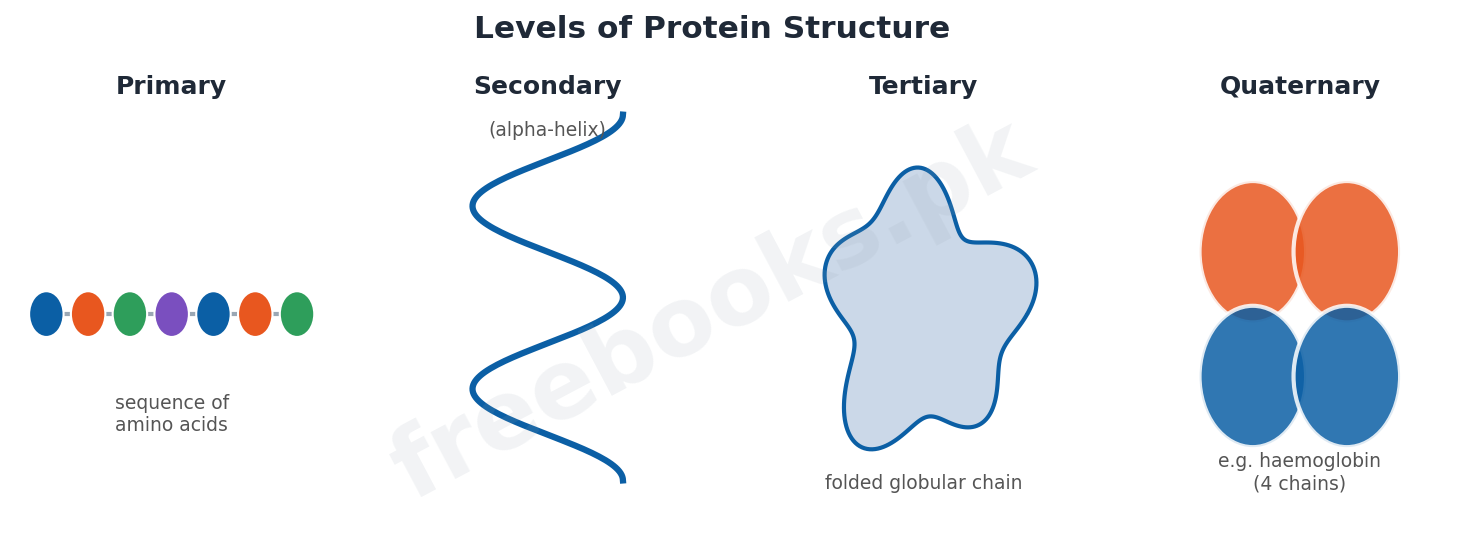
A protein's properties depend on four levels of structure. The primary structure is the specific number and sequence of amino acids in the chain (Sanger showed insulin has 51 amino acids in two chains linked by disulphide bridges, while haemoglobin has four chains, two alpha of 141 amino acids and two beta of 146 amino acids); even a single wrong amino acid, as in sickle-cell haemoglobin, can disrupt normal function. The secondary structure is a regular local folding pattern such as the coiled alpha-helix (about 3.6 amino acids per turn, held by hydrogen bonds) or the folded beta-pleated sheet. The tertiary structure is the overall three-dimensional folding of a single polypeptide into a compact globular shape, stabilized by ionic, hydrogen and disulphide bonds, typically burying hydrophobic amino acids inside and keeping hydrophilic ones on the surface. The quaternary structure describes how multiple folded polypeptide chains associate together, as in haemoglobin. By overall shape, proteins are classified as fibrous (insoluble, structural, e.g. keratin, silk, fibrin) or globular (soluble, functional, e.g. enzymes, antibodies, haemoglobin).
Nucleic Acids: DNA and RNA
Nucleic acids, first isolated in 1869 by Friedrich Miescher from the nuclei of pus cells, are polymers of nucleotides and occur as DNA (deoxyribonucleic acid) and RNA (ribonucleic acid). Each nucleotide has three parts: a five-carbon pentose sugar (deoxyribose in DNA, ribose in RNA), a nitrogenous base, and a phosphoric acid group; a base plus a sugar (without phosphate) is called a nucleoside. The nitrogenous bases are the single-ringed pyrimidines (cytosine, thymine, uracil) and the double-ringed purines (adenine, guanine); DNA uses adenine, guanine, cytosine and thymine, while RNA uses adenine, guanine, cytosine and uracil in place of thymine.
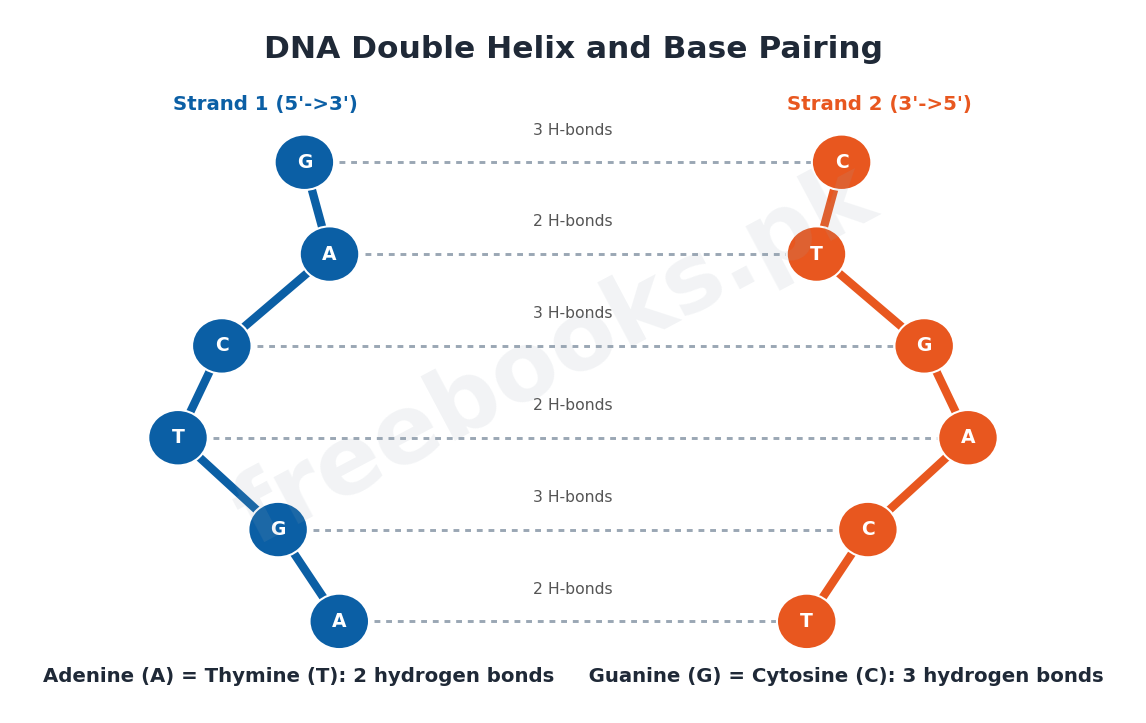
DNA is the hereditary material, controlling a cell's properties and activities; its nucleotides join through phosphodiester linkages into long polynucleotide chains. In 1951 Erwin Chargaff showed that the amount of adenine always closely matches thymine, and guanine closely matches cytosine, in DNA from many different organisms. Using X-ray diffraction data from Maurice Wilkins and Rosalind Franklin, James Watson and Francis Crick proposed that DNA consists of two antiparallel polynucleotide strands wound into a double helix, held together by hydrogen bonds between complementary bases: two hydrogen bonds between adenine and thymine, and three between guanine and cytosine, with about 10 base pairs in each full turn of the helix. The amount of DNA per cell is constant for a given species and is halved in germ cells (sperm and ova) compared with body cells; the sequence of bases along DNA encodes genes, the units of biological inheritance — the bacterium E. coli, for example, has a genome of 4,639,221 base pairs coding for at least 4,288 proteins.
RNA is a polymer of ribonucleotides, usually single-stranded (though it may fold back on itself), pairing cytosine with guanine and uracil with adenine, and is synthesized from DNA by transcription. Three types of RNA carry out protein synthesis: messenger RNA (mRNA) carries the genetic message from DNA in the nucleus to the ribosomes; transfer RNA (tRNA), small molecules of 75-90 nucleotides with one specific type for each amino acid, carries amino acids to the ribosome; and ribosomal RNA (rRNA), the major component of RNA in the cell, forms part of the ribosome's structure and machinery for linking amino acids into a protein.
Conjugated Molecules
When two molecules from different categories combine, the product is called a conjugated molecule. Carbohydrates combining with proteins form glycoproteins, and with lipids form glycolipids; both are important structural components of plasma membranes, and most cellular secretions are glycoproteins. Lipids combining with proteins form lipoproteins, which provide the basic structural framework of cell membranes. Nucleic acids have a strong affinity for basic proteins, combining to form nucleoproteins such as the nucleohistones found in chromosomes; besides their structural role, these conjugated proteins are important in regulating gene expression.
Important Definitions
Metabolism
The sum of all chemical reactions taking place within a cell, made up of anabolic (building) and catabolic (breaking-down) reactions.
Monosaccharide
A simple sugar, such as glucose or ribose, that cannot be hydrolysed into a simpler sugar.
Polysaccharide
A complex carbohydrate formed of many monosaccharide units joined by glycosidic bonds, e.g. starch, glycogen or cellulose.
Fatty acid
A straight or branched carbon chain with a carboxyl (-COOH) group, which may be saturated or unsaturated; a building block of lipids.
Peptide bond
The covalent C-N bond formed between the carboxyl group of one amino acid and the amino group of another, releasing water.
Nucleotide
The basic subunit of a nucleic acid, made of a pentose sugar, a nitrogenous base and a phosphoric acid group.
Nucleoside
A compound formed by a nitrogenous base joined to a pentose sugar, without a phosphate group.
Conjugated molecule
A compound formed when two molecules of different categories combine, e.g. a glycoprotein (carbohydrate + protein).
Key Facts
| Item | Fact |
|---|---|
| General formula of carbohydrates | Cx(H2O)y, where x is 3 or more. |
| Photosynthesis (glucose formation) | 6CO2 + 12H2O –(light, chlorophyll)–> C6H12O6 + 6O2 + 6H2O |
| Normal blood glucose | About 0.08% in human blood. |
| Sucrose formula | C12H22O11 — hydrolyses to glucose + fructose. |
| DNA base pairing (Chargaff's rule) | Adenine = Thymine; Guanine = Cytosine. |
| Hydrogen bonds in base pairs | A-T pair: 2 hydrogen bonds. G-C pair: 3 hydrogen bonds. |
| DNA double helix geometry | About 10 base pairs per turn; one turn spans about 34 Angstrom units. |
| Insulin / Haemoglobin structure | Insulin: 51 amino acids in 2 chains (Sanger). Haemoglobin: 4 chains – 2 alpha (141 aa) + 2 beta (146 aa). |
Diagrams & Illustrations
Levels of Protein Structure: a diagram comparing the primary (amino acid sequence), secondary (alpha-helix / beta-sheet), tertiary (folded globular chain) and quaternary (multiple chains, e.g. haemoglobin) levels of protein organization.
DNA Double Helix and Base Pairing: a diagram of the DNA double helix showing the two antiparallel strands and complementary base pairing, adenine with thymine (2 hydrogen bonds) and guanine with cytosine (3 hydrogen bonds).
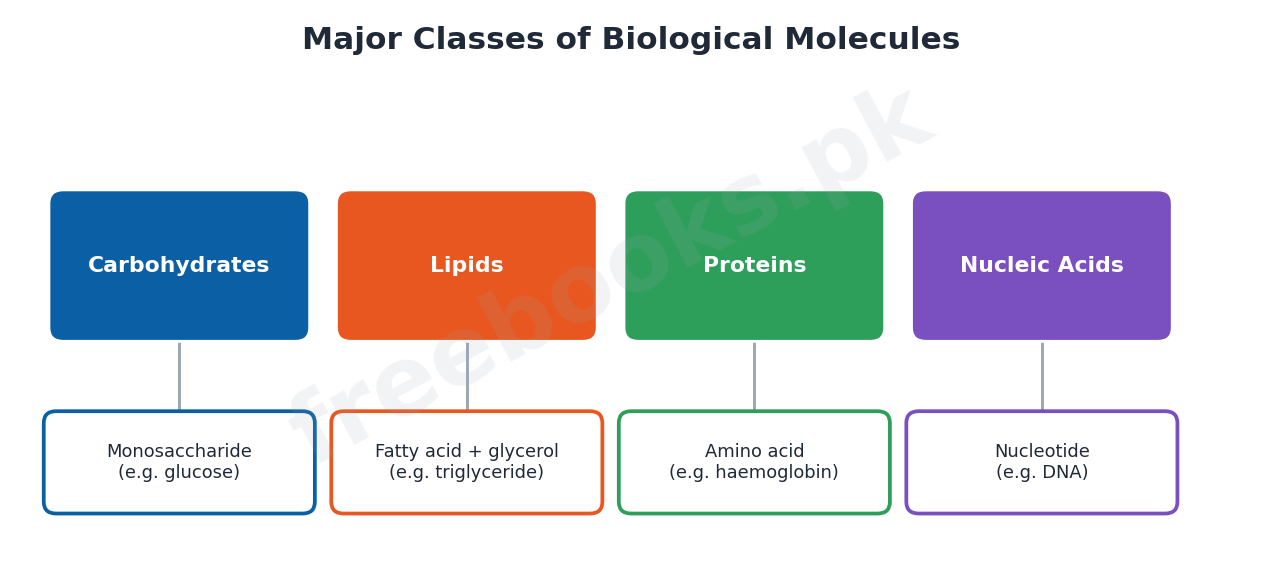
Major Classes of Biological Molecules: a summary chart of the four major classes of biological molecules – carbohydrates, lipids, proteins and nucleic acids – with their basic monomer unit and a common example of each.
Short Questions & Answers
Differentiate between monosaccharides and polysaccharides.
Monosaccharides are simple, sweet, water-soluble sugars that cannot be hydrolysed further (e.g. glucose), while polysaccharides are large, usually tasteless, only sparingly soluble molecules made of many monosaccharide units joined by glycosidic bonds (e.g. starch, cellulose).
Why do lipids store more energy than an equal mass of carbohydrate?
Lipids have a much higher proportion of C-H bonds and very little oxygen compared with carbohydrates, so oxidising the same mass of lipid releases roughly double the energy released from carbohydrate.
What is a peptide bond, and how is it formed?
A peptide bond is the C-N covalent bond linking two amino acids; it forms when the carboxyl group of one amino acid reacts with the amino group of another, releasing a molecule of water.
Differentiate between the primary and secondary structure of a protein.
Primary structure is simply the number and specific sequence of amino acids in the polypeptide chain, while secondary structure is the regular local folding of that chain, such as an alpha-helix or beta-pleated sheet, held together by hydrogen bonds.
State Chargaff's rule for DNA base composition.
In DNA from any organism, the amount of adenine is always approximately equal to the amount of thymine, and the amount of guanine is always approximately equal to the amount of cytosine.
Differentiate between mRNA and tRNA.
Messenger RNA (mRNA) carries the genetic message from DNA in the nucleus to the ribosomes, while transfer RNA (tRNA) is a small molecule that picks up specific amino acids and carries them to the ribosome to be linked into a protein.
Long Questions & Answers
Describe the classification of carbohydrates with examples of each group.
Carbohydrates are classified into three groups based on the number of sugar units they yield on hydrolysis. Monosaccharides are simple sugars such as glyceraldehyde, ribose and glucose that cannot be broken down into simpler sugars; they are sweet, water-soluble, and named by their carbon number (trioses, tetroses, pentoses, hexoses, heptoses), with glucose, a hexose, being the most important biologically since it is the main product of photosynthesis and the normal sugar of blood. Oligosaccharides yield two to ten monosaccharides on hydrolysis; the most important are disaccharides such as sucrose (glucose + fructose), maltose and lactose, joined by a glycosidic bond. Polysaccharides are the largest and most complex group, formed of many monosaccharide units and usually insoluble or only sparingly soluble; starch (amylose and amylopectin) is the main plant storage carbohydrate, glycogen is the equivalent storage carbohydrate in animals, and cellulose, the most abundant carbohydrate in nature, forms the rigid cell walls of plants and is digestible only by organisms with cellulase-producing gut microbes. Together these three groups supply energy, provide structural support, and combine with other molecules to form conjugated compounds such as glycoproteins.
Describe the four levels of protein structure.
A protein's specific shape and function depend on four levels of organization. The primary structure is the exact number and sequence of amino acids joined by peptide bonds along the polypeptide chain; this sequence, determined ultimately by the DNA that codes for the protein, is so specific that even one wrongly placed amino acid, as in sickle-cell haemoglobin, can seriously disrupt the protein's function. The secondary structure describes regular, repeating local folding patterns held together by hydrogen bonds between nearby parts of the chain, most commonly the coiled alpha-helix (about 3.6 amino acids per turn) or the folded-back beta-pleated sheet. The tertiary structure is the overall three-dimensional folding of the whole polypeptide chain into a compact globular shape, stabilized by ionic bonds, hydrogen bonds and disulphide bridges, typically with hydrophobic amino acids folded into the interior and hydrophilic ones exposed on the surface in an aqueous environment. The quaternary structure applies only to proteins built from more than one polypeptide chain, describing how these separate tertiary-folded chains associate together through hydrophobic interactions and hydrogen and ionic bonds; haemoglobin, with its two alpha and two beta chains, is the classic example. Together these four levels explain why proteins as different as fibrous keratin and globular haemoglobin can be built from the same basic units — amino acids — arranged and folded in entirely different ways.
Describe the structure of DNA as proposed by Watson and Crick.
DNA (deoxyribonucleic acid) is a polymer of deoxyribonucleotides, each made of a deoxyribose sugar, a phosphate group, and one of four nitrogenous bases: the purines adenine and guanine, and the pyrimidines cytosine and thymine. In 1951 Erwin Chargaff analysed the base composition of DNA from many organisms and found that the amount of adenine always closely equals the amount of thymine, and guanine always closely equals cytosine, a pattern that strongly hinted at a pairing relationship between bases. Using X-ray diffraction images produced by Maurice Wilkins and Rosalind Franklin, James Watson and Francis Crick built a scale model showing that DNA consists of two polynucleotide strands wound around each other in a double helix, running antiparallel to one another (coiled in opposite directions). The two strands are held together by hydrogen bonds between complementary base pairs on the inside of the helix: adenine always pairs with thymine through two hydrogen bonds, and guanine always pairs with cytosine through three hydrogen bonds, which explains Chargaff's ratios. The helix is very regular, with about 10 base pairs in each complete turn spanning roughly 34 Angstrom units. Because the sequence of bases along one strand automatically determines the sequence on the other (through this base-pairing rule), each strand can act as a template, and the linear order of hundreds of bases at a time forms functional units called genes, which store all the hereditary information needed to build and run a cell.
Explain the different types of lipids and their biological importance.
Lipids are a chemically diverse group of compounds, united mainly by being insoluble in water but soluble in organic solvents, and they serve several biological roles: storing about twice as much energy per gram as carbohydrates, forming the structural basis of cell membranes, and providing insulation and waterproofing. Acylglycerols, especially triacylglycerols (triglycerides), are esters of glycerol and fatty acids and are the main energy-storage lipids in the body; the fatty acids that make them up may be saturated (no double bonds, generally forming solid fats) or unsaturated (one or more double bonds, generally forming liquid oils). Waxes are mixtures of long-chain alkanes, alcohols and esters that coat leaves, fruits, insect exoskeletons and animal fur to reduce water loss and resist abrasion. Phospholipids, built from glycerol, fatty acids, phosphoric acid and often a nitrogenous base such as choline, are the main structural lipids of cell membranes because one end of the molecule is water-attracting and the other is water-repelling. Terpenoids, built from repeating isoprenoid units, give rise to important biological compounds such as steroids and carotenoids. Taken together, this range of lipid types allows the same broad chemical class to serve as fuel, as membrane material, and as protective coating across very different organisms.
Describe the three main types of RNA and their functions in protein synthesis.
Protein synthesis depends on three types of RNA, all transcribed from DNA in the nucleus before moving into the cytoplasm to do their specific jobs. Messenger RNA (mRNA) is a single strand of variable length, matched to the size of the gene and protein it codes for (a protein of 1,000 amino acids needs an mRNA of about 3,000 nucleotides); it carries the genetic message copied from DNA out to the ribosomes, where it specifies the order in which amino acids must be joined. Transfer RNA (tRNA) molecules are small, only 75 to 90 nucleotides long, and there is at least one specific type of tRNA for each of the roughly 20 amino acids used in proteins; each tRNA picks up its matching amino acid and carries it to the ribosome, positioning it correctly according to the mRNA sequence. Ribosomal RNA (rRNA) makes up the largest share of a cell's total RNA and is tightly combined with ribosomal proteins to form the physical machinery of the ribosome itself, on whose surface mRNA and tRNA interact so that the genetic information in a gene is finally translated into a specific, functional protein.
MCQs with Answers
Biochemistry is best described as the study of: (a) fossils and evolution (b) chemical components and processes in living organisms (c) classification of organisms (d) distribution of organisms
Correct Answer: (b) chemical components and processes in living organisms. Biochemistry studies the chemical compounds and chemical processes of living things.
Reactions in which simple substances combine to form complex substances, using energy, are called: (a) catabolic reactions (b) anabolic reactions (c) hydrolysis reactions (d) ionization reactions
Correct Answer: (b) anabolic reactions. Anabolic reactions build complex molecules from simpler ones and require energy.
Carbon is described as tetravalent because it: (a) has 4 electron shells (b) forms four covalent bonds (c) occurs in 4 forms in nature (d) has 4 isotopes
Correct Answer: (b) forms four covalent bonds. A carbon atom forms four covalent bonds, arranged tetrahedrally, giving stable molecules.
The general formula of a carbohydrate is usually written as: (a) CxH2yOy (b) Cx(H2O)y (c) CxNyOy (d) Cx(H2N)y
Correct Answer: (b) Cx(H2O)y. Carbohydrates are "hydrated carbons" with general formula Cx(H2O)y.
Which polysaccharide is the main carbohydrate storage form in animals? (a) Starch (b) Cellulose (c) Glycogen (d) Sucrose
Correct Answer: (c) Glycogen. Glycogen, sometimes called animal starch, is stored mainly in liver and muscle.
Compared to a carbohydrate of equal mass, a lipid stores approximately: (a) the same energy (b) half the energy (c) double the energy (d) four times the energy
Correct Answer: (c) double the energy. Lipids have more C-H bonds and less oxygen, so they store roughly double the energy.
The bond joining two amino acids in a protein is called a: (a) glycosidic bond (b) peptide bond (c) phosphodiester bond (d) hydrogen bond
Correct Answer: (b) peptide bond. Amino acids join through peptide bonds, releasing a water molecule.
According to Chargaff's rule, in a DNA molecule the amount of adenine equals the amount of: (a) guanine (b) cytosine (c) thymine (d) uracil
Correct Answer: (c) thymine. Adenine pairs with thymine; guanine pairs with cytosine (Chargaff's rule).
How many hydrogen bonds hold a guanine-cytosine base pair together in DNA? (a) 1 (b) 2 (c) 3 (d) 4
Correct Answer: (c) 3. G-C pairs are held by three hydrogen bonds, versus two for an A-T pair.
Which type of RNA carries amino acids to the ribosome during protein synthesis? (a) mRNA (b) tRNA (c) rRNA (d) hnRNA
Correct Answer: (b) tRNA. Transfer RNA (tRNA) picks up specific amino acids and delivers them to the ribosome.
Quick Revision Summary
- Metabolism = anabolism (builds, uses energy) + catabolism (breaks down, releases energy).
- Carbon's tetravalency and ability to form C-C chains/rings explain the huge variety of organic molecules; water's polarity makes it the solvent and temperature-stabilizer of life.
- Carbohydrates: monosaccharides (e.g. glucose) -> oligosaccharides/disaccharides (e.g. sucrose) -> polysaccharides (starch, glycogen, cellulose).
- Lipids (acylglycerols, waxes, phospholipids, terpenoids) store about double the energy of carbohydrates and build membranes.
- Proteins are polymers of amino acids joined by peptide bonds; 4 structure levels: primary (sequence), secondary (helix/sheet), tertiary (3-D fold), quaternary (multi-chain, e.g. haemoglobin).
- DNA: double helix (Watson & Crick), antiparallel strands, A-T (2 H-bonds) and G-C (3 H-bonds) pairing (Chargaff). RNA types: mRNA (message), tRNA (amino acid carrier), rRNA (ribosome structure).
- Conjugated molecules: glycoprotein/glycolipid (carbohydrate + protein/lipid), lipoprotein (lipid + protein), nucleoprotein (nucleic acid + protein). Notes by freebooks.pk.
Exam Tips
- Learn the three carbohydrate classes and one named example of each — a very common short-question and MCQ topic.
- Be ready to list all four levels of protein structure in order, with what stabilizes each one (hydrogen bonds, disulphide bonds, etc.).
- Memorise Chargaff's rule and the 2 vs 3 hydrogen-bond difference between A-T and G-C pairs; it is repeatedly tested.
- Know the three types of RNA and one specific function of each (mRNA = message, tRNA = amino-acid carrier, rRNA = ribosome structure).
- Practise naming conjugated molecules from their two components (e.g. carbohydrate + lipid = glycolipid).
- For "why do lipids store more energy" style questions, always mention the higher C-H / lower oxygen content, not just "lipids have more energy".