
This chapter covers Enzymes from the 1st Year (FSc Part-I) Biology syllabus of the Punjab Curriculum and Textbook Board (PTB/PCTB). Enzymes are the biological catalysts, almost all of them globular proteins, that make every metabolic reaction in a cell happen fast enough to sustain life. The chapter explains what enzymes are made of, how cofactors and coenzymes help some of them work, and the key characteristics that make enzymes such precise biological tools. These notes are prepared by freebooks.pk.
It then looks at how an enzyme actually catalyses a reaction at its active site, comparing the classic Lock and Key model with the modern Induced Fit model, and examines the four main factors — enzyme concentration, substrate concentration, temperature and pH — that control how fast an enzyme-catalysed reaction runs. The chapter closes with enzyme inhibitors, which is essential background for later chapters on metabolism and for understanding how drugs and poisons act on the body.
Learning Objectives
- Describe the composition of an enzyme, including the active site and, where present, its cofactor.
- Differentiate between a cofactor, prosthetic group, coenzyme, apoenzyme and holoenzyme.
- List the main characteristics of enzymes as biochemical catalysts.
- Explain the mechanism of enzyme action, including the binding site and catalytic site of the active site.
- Compare the Lock and Key model and the Induced Fit model of enzyme-substrate interaction.
- Explain how enzyme concentration, substrate concentration, temperature and pH each affect the rate of an enzyme-catalysed reaction.
- Differentiate between reversible and irreversible enzyme inhibitors, and between competitive and non-competitive inhibition.
Key Concepts
What Are Enzymes?
Enzymes are the most important group of biologically active proteins; they tremendously increase the efficiency (rate) of biochemical reactions and are specific for each type of reaction, so that without them reactions would proceed far too slowly to sustain life. An enzyme is composed of hundreds of amino acids joined together and coiled upon themselves into a globular structure, but its catalytic activity is restricted to a small region called the active site, to which the reactant — called the substrate — attaches; the rest of the bulky amino acid chain simply maintains the enzyme's overall globular shape.
Cofactors, Coenzymes and Related Terms
Some enzymes consist solely of protein, while others also need a non-protein part called a cofactor to function properly. A cofactor often acts as a bridge between the enzyme and its substrate, sometimes contributing directly to the chemical reaction or supplying chemical energy; metal ions such as Mg2+, Fe2+, Cu2+ and Zn2+ commonly act as cofactors, and a detachable inorganic-ion cofactor is called an activator.
If the non-protein part is covalently bonded to the enzyme, it is called a prosthetic group; if it is only loosely attached, it is called a coenzyme. Coenzymes are closely related to vitamins, the essential raw materials from which they are made, and because coenzymes (like enzymes) can be reused repeatedly, only small quantities of vitamins are needed in the diet. An enzyme with its coenzyme or prosthetic group removed is called an apoenzyme, and adding the correct coenzyme back restores its activity; the complete, active combination of a polypeptide chain plus its cofactor is called a holoenzyme.
Characteristics of Enzymes
As biochemical catalysts, enzymes share several important characteristics: all enzymes are globular proteins; they increase the rate of a reaction without themselves being used up; their presence does not change the nature or properties of the end products; small amounts of an enzyme can accelerate large amounts of reaction; each enzyme is highly specific, usually catalysing only one reaction or a small group of related reactions; enzymes are sensitive to even minor changes in pH, temperature and substrate concentration; some enzymes need a cofactor to function properly; and all enzymes work by lowering the activation energy of a reaction. Enzymes may be dissolved freely in the cytoplasm or tightly bound to specific organelles — for example, the enzymes of photosynthesis are found in chloroplasts and those of cellular respiration in mitochondria, while some protein-synthesis enzymes are built into the ribosome itself. Some enzymes are potentially damaging if manufactured directly in their active form, so cells make them as inactive precursors instead; pepsin, a powerful protein-digesting enzyme, is produced as inactive pepsinogen and converted to its active form only inside the digestive tract, where it is actually needed.
Mechanism of Enzyme Action
An enzyme is a three-dimensional globular protein with a specific chemical composition and shape that allows it to recognize and react with one particular substrate, transform it into product(s), and then be released completely unchanged so it can be used again and again. In some pathways, such as respiration or photosynthesis, several enzymes act in a fixed order, forming an enzyme-to-enzyme chain in which the product of one step is handed directly to the enzyme catalysing the next step.
The active site itself is shaped by particular amino acids brought close together as the polypeptide chain coils and folds, and it consists of two distinct regions: the binding site, which recognizes and binds the correct substrate to form an enzyme-substrate (ES) complex, and the catalytic site, which is activated once binding occurs and actually carries out the chemical transformation of substrate into product. After catalysis the enzyme detaches from the product completely unchanged; enzymes require an aqueous medium to work, and most are not freely floating in the cytoplasm but attached in an orderly way to membrane systems such as those of mitochondria and chloroplasts.
Lock and Key Model vs Induced Fit Model
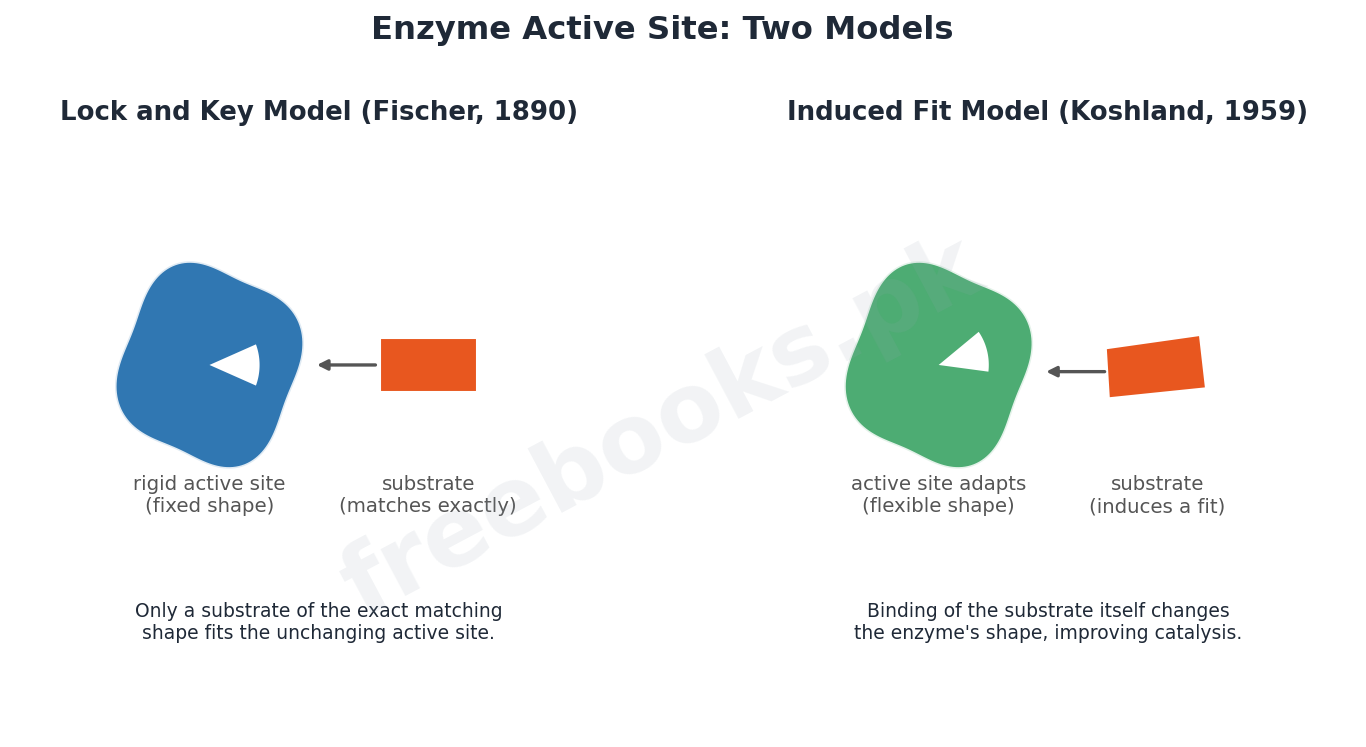
In 1890, Emil Fischer proposed the Lock and Key model to explain enzyme-substrate interaction: just as one specific key opens only one specific lock, a specific enzyme can transform only one particular substrate into product(s). In this model the active site is treated as a rigid structure that acts purely as a fixed template, with no change in shape before, during or after the reaction; later studies showed this model does not hold for every enzyme reaction.
Based on newer evidence, Koshland proposed a modified version in 1959 called the Induced Fit model. According to this model, when a substrate binds an enzyme it actually induces a change in the enzyme's structure, and this change in shape enables the enzyme to carry out its catalytic activity more effectively — making the active site flexible and responsive rather than a rigid, unchanging template.
Enzyme and Substrate Concentration
The rate of an enzyme-catalysed reaction depends on both how much enzyme and how much substrate are present. At an unlimited substrate concentration, the reaction rate depends directly on the amount of enzyme present — doubling the enzyme doubles the rate, because more active sites become available to convert substrate into product; beyond a certain enzyme concentration, however, the rate stops depending on this increase (some other factor becomes limiting).
At a low substrate concentration, the reaction rate is directly proportional to the amount of substrate available. But if enzyme concentration is held constant while substrate is increased, a point is reached where further increases in substrate no longer speed up the reaction, because at high substrate levels every active site of every enzyme molecule is already occupied.
Temperature and pH
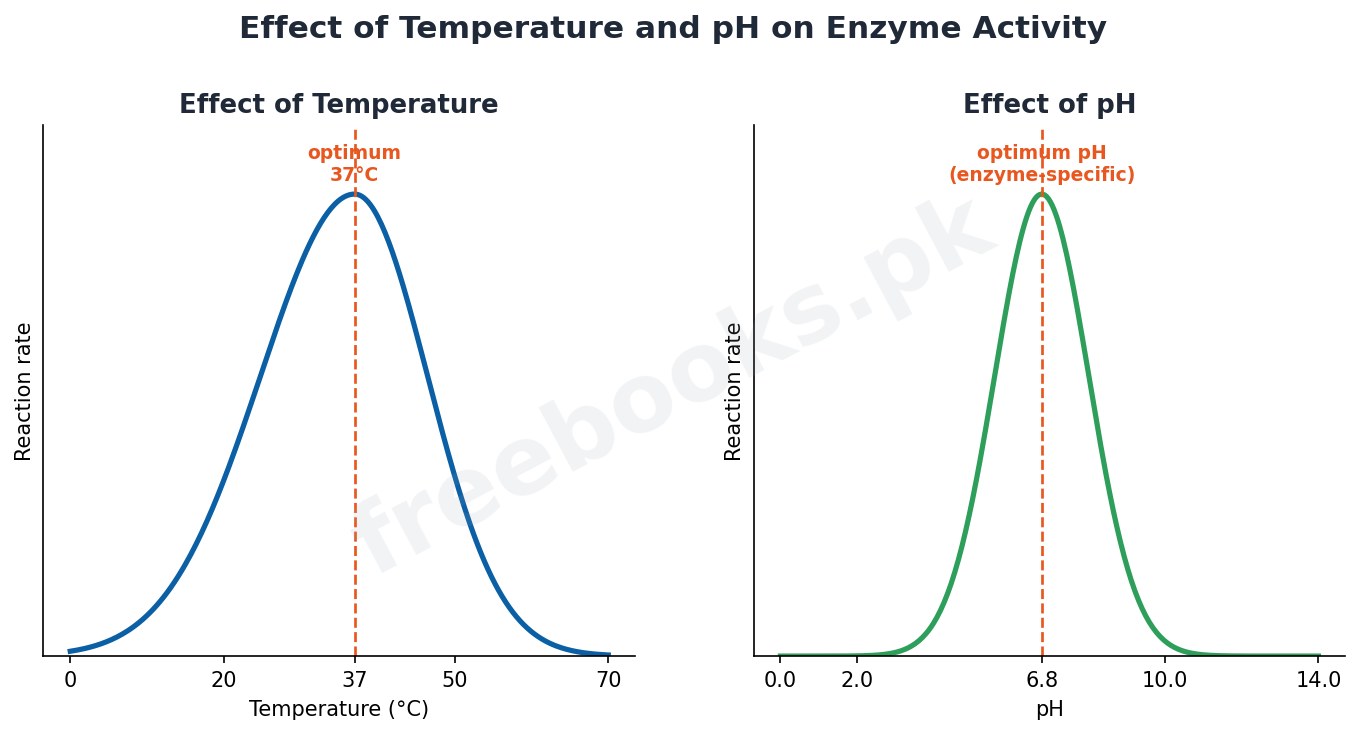
The rate of an enzyme-controlled reaction generally rises with temperature up to a certain limit; every enzyme has a specific optimum temperature at which it works fastest, and for enzymes in the human body this optimum is 37 degrees Celsius. Heat provides activation energy and kinetic energy, making reacting molecules move and collide faster, but if heating continues past the optimum, it makes the atoms in the enzyme vibrate too violently, destroying the globular structure essential for activity; this loss of shape and function is called denaturation.
Every enzyme also works most effectively over a narrow range of pH known as its optimum pH — for example pepsin at about pH 2.0, salivary amylase at about pH 6.8, and pancreatic lipase at about pH 9.0. A slight shift in pH can alter the ionization of amino acids at the active site (and of the substrate itself), retarding or blocking enzyme activity, while extreme pH changes break the bonds that hold the enzyme's structure together, again causing denaturation.
Enzyme Inhibitors
An inhibitor is a chemical substance that reacts with an enzyme in place of its normal substrate but is not converted into product, so it blocks the active site temporarily or permanently; examples include poisons such as cyanide, certain antibiotics, anti-metabolites and some drugs. Inhibitors are divided into irreversible inhibitors, which permanently occupy the active site (often through covalent bonds) or destroy the enzyme's globular structure altogether, and reversible inhibitors, which form only weak linkages with the enzyme so that their effect can be reduced or removed by increasing substrate concentration.
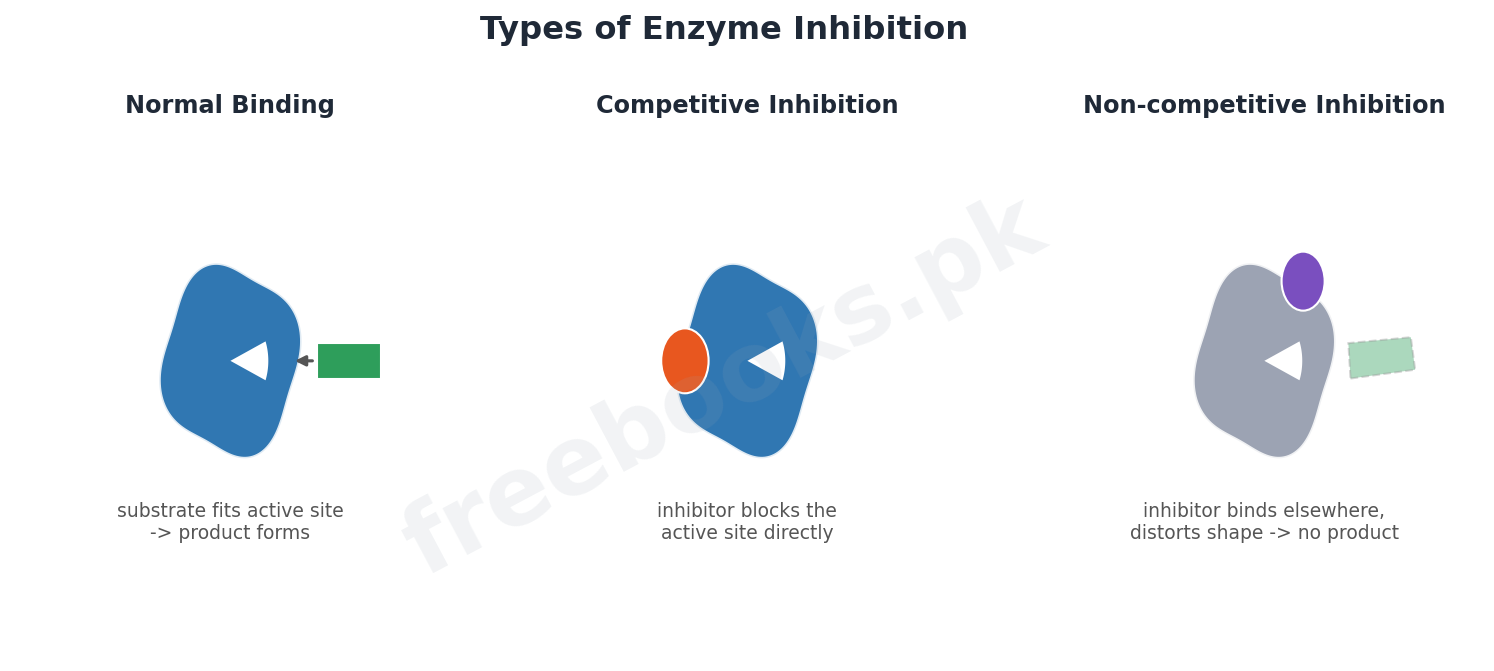
Reversible inhibitors are further divided into two types. Competitive inhibitors resemble the substrate closely enough in structure to be accepted by the binding site, but they cannot activate the catalytic site, so no product is formed while they occupy the active site. Non-competitive inhibitors instead bind the enzyme at a site other than the active site, altering the enzyme's overall structure so that catalysis fails even when the genuine substrate does manage to bind the active site.
Important Definitions
Enzyme
A biological catalyst, almost always a globular protein, that greatly increases the rate of a specific biochemical reaction without itself being used up.
Substrate
The specific reactant molecule that binds to an enzyme's active site and is converted into product.
Active site
The small region of an enzyme, made of specific amino acids, where the substrate binds and catalysis occurs.
Cofactor
A non-protein component, such as a metal ion, needed by some enzymes for proper functioning.
Coenzyme
A cofactor that is only loosely attached to an enzyme's protein part, often derived from a vitamin.
Holoenzyme
The complete, catalytically active enzyme, consisting of the polypeptide (apoenzyme) plus its cofactor.
Denaturation
The loss of an enzyme's normal globular shape and activity caused by extreme heat or pH.
Inhibitor
A substance that binds an enzyme in place of the substrate and blocks or reduces its catalytic activity.
Key Facts
| Item | Fact |
|---|---|
| Optimum temperature (human enzymes) | 37 degrees Celsius. |
| Optimum pH – Pepsin | About pH 2.0 (strongly acidic, stomach enzyme). |
| Optimum pH – Salivary amylase | About pH 6.8 (near neutral). |
| Optimum pH – Pancreatic lipase | About pH 9.0 (alkaline). |
| Lock and Key model | Proposed by Emil Fischer, 1890 – rigid active site, fixed template. |
| Induced Fit model | Proposed by Koshland, 1959 – active site changes shape when substrate binds. |
| Effect of doubling enzyme concentration | Reaction rate doubles, at unlimited substrate concentration. |
| Types of inhibitors | Irreversible (permanent) vs Reversible (competitive or non-competitive). |
Diagrams & Illustrations
Enzyme Active Site: Lock and Key vs Induced Fit: a side-by-side comparison of the Lock and Key model (rigid active site matching only one substrate shape) and the Induced Fit model (active site changes shape as the substrate binds), showing the enzyme-substrate complex forming in each case.
Effect of Temperature and pH on Enzyme Activity: two curves showing enzyme reaction rate against temperature (rising to a peak at the optimum temperature of 37 degrees Celsius for human enzymes, then falling as the enzyme denatures) and against pH (a similar peak at each enzyme's own optimum pH).
Types of Enzyme Inhibition: a diagram comparing normal enzyme-substrate binding with competitive inhibition (an inhibitor occupies the active site instead of the substrate) and non-competitive inhibition (an inhibitor binds elsewhere on the enzyme and distorts the active site).
Short Questions & Answers
What is a cofactor? Differentiate a prosthetic group from a coenzyme.
A cofactor is a non-protein part needed by some enzymes to function; if it is covalently bonded to the enzyme it is called a prosthetic group, while if it is only loosely attached it is called a coenzyme.
Differentiate between apoenzyme and holoenzyme.
An apoenzyme is the enzyme protein with its coenzyme or prosthetic group removed (and therefore inactive), while a holoenzyme is the complete, catalytically active combination of the polypeptide chain plus its cofactor.
Why is enzyme activity lost at very high temperature?
Excess heat makes the atoms of the enzyme vibrate too violently, breaking the bonds that hold its globular shape; this loss of structure, called denaturation, destroys the active site and stops catalysis.
Differentiate between competitive and non-competitive inhibitors.
A competitive inhibitor resembles the substrate and binds the active site itself, blocking the substrate from binding, while a non-competitive inhibitor binds at a different site on the enzyme and changes its shape so catalysis fails even if the substrate does bind the active site.
State two characteristics of enzymes.
Enzymes are globular proteins that speed up a reaction without being consumed, and each enzyme is highly specific, usually catalysing only one reaction or a small group of closely related reactions.
What is the Induced Fit model of enzyme action?
Proposed by Koshland in 1959, it states that an enzyme's active site is not rigid; when the substrate binds, it induces a change in the enzyme's shape that allows the enzyme to catalyse the reaction more effectively.
Long Questions & Answers
Describe in detail the mechanism of enzyme action.
An enzyme is a three-dimensional globular protein whose specific chemical composition and shape allow it to recognize and bind one particular substrate at a small region called the active site. The active site itself is made up of two distinct parts: the binding site, which recognizes and physically binds the correct substrate to form an enzyme-substrate (ES) complex, and the catalytic site, which becomes active once binding has occurred and carries out the actual chemical transformation of substrate into product. Once the reaction is complete, the enzyme detaches from the product completely unchanged and is free to bind a new substrate molecule, which is why small amounts of enzyme can process large amounts of substrate. In multi-step metabolic pathways such as respiration or photosynthesis, several enzymes may be arranged in a fixed sequence, forming an enzyme-to-enzyme chain in which the product released by one enzyme becomes the substrate handed directly to the next. Most enzymes require an aqueous medium and are not simply dissolved loose in the cytoplasm but are attached in an orderly way to specific membrane systems, such as the enzymes of respiration in the mitochondria and those of photosynthesis in the chloroplasts.
Explain the Lock and Key model and the Induced Fit model of enzyme action.
Two models have been proposed to explain how an enzyme recognizes and acts on its substrate. In 1890, Emil Fischer proposed the Lock and Key model, comparing the relationship between an enzyme and its substrate to a lock and its one matching key: a specific enzyme can transform only one particular substrate into product(s) because the active site is treated as a rigid, fixed-shape template that does not change before, during or after the reaction. This model explained enzyme specificity well but could not account for all enzyme behaviour observed in later experiments. Building on new evidence, Koshland proposed the Induced Fit model in 1959, arguing that the active site is not rigid at all; instead, when the correct substrate approaches and binds, it actually induces a change in the shape of the enzyme's active site, and this induced change in structure enables the enzyme to carry out catalysis more effectively than a perfectly rigid template would allow. The Induced Fit model is now considered a more accurate general description of how enzymes and substrates interact, while the Lock and Key model remains a useful simple picture of enzyme specificity.
Describe the effect of enzyme concentration and substrate concentration on the rate of an enzyme-catalysed reaction.
When substrate is present in unlimited amount, the rate of an enzyme-catalysed reaction depends directly on the amount of enzyme present: doubling the enzyme concentration doubles the number of available active sites and therefore doubles the reaction rate, though beyond a certain enzyme concentration some other factor becomes limiting and the rate levels off. Conversely, when enzyme concentration is held constant, increasing substrate concentration initially increases the reaction rate in direct proportion, because more substrate molecules are available to occupy active sites at any given moment. However, once substrate concentration becomes high enough that every active site of every enzyme molecule is continuously occupied, adding still more substrate no longer increases the rate, since the enzyme molecules are already working at their maximum capacity; the reaction rate then plateaus regardless of further substrate increases.
Explain the effect of temperature and pH on enzyme activity.
Enzyme-controlled reactions generally speed up as temperature rises, because heat supplies both the activation energy needed to start the reaction and extra kinetic energy that makes molecules move and collide more often; each enzyme, however, has its own optimum temperature at which it works fastest, and for human-body enzymes this optimum is 37 degrees Celsius. Beyond the optimum, continued heating makes the atoms within the enzyme vibrate so violently that the bonds maintaining its globular shape break down, a process called denaturation, which destroys the active site and stops catalysis even though temperature is still rising. In the same way, every enzyme has a narrow optimum pH range at which it functions best — for example, pepsin works best around pH 2.0, salivary amylase around pH 6.8, and pancreatic lipase around pH 9.0 — because a shift in pH changes the ionization of amino acids in the active site (and sometimes of the substrate itself), which can slow or completely block binding and catalysis. Extreme pH changes, like extreme heat, break the bonds holding the enzyme's structure together and cause denaturation, permanently destroying enzyme activity.
Write a detailed note on enzyme inhibitors.
An inhibitor is a chemical substance that reacts with an enzyme in place of the normal substrate but is not converted into product, thereby blocking the active site temporarily or permanently; common examples include poisons such as cyanide, certain antibiotics, anti-metabolites and some therapeutic drugs. Inhibitors fall into two broad categories. Irreversible inhibitors permanently reduce enzyme activity, either by forming covalent bonds that occupy the active site or by physically destroying the enzyme's globular structure, so the enzyme cannot recover its function. Reversible inhibitors, in contrast, form only weak, non-covalent linkages with the enzyme, so their inhibitory effect can be partly or completely overcome by increasing the substrate concentration; these are further divided into competitive inhibitors, which are structurally similar enough to the true substrate to be accepted at the binding site (blocking the substrate from binding and preventing any product from forming), and non-competitive inhibitors, which attach at a location other than the active site and distort the enzyme's overall shape so that catalysis fails even if the real substrate does manage to bind the active site. Understanding these categories of inhibition is essential for later topics such as drug action and metabolic regulation, since many medicines and toxins work precisely by inhibiting specific enzymes in the body.
MCQs with Answers
Enzymes are chemically classified as: (a) carbohydrates (b) lipids (c) globular proteins (d) nucleic acids
Correct Answer: (c) globular proteins. All enzymes are globular proteins, though some need a non-protein cofactor.
A non-protein part of an enzyme that is only loosely attached is called a: (a) prosthetic group (b) coenzyme (c) apoenzyme (d) holoenzyme
Correct Answer: (b) coenzyme. A loosely attached cofactor is a coenzyme; a covalently bonded one is a prosthetic group.
The Lock and Key model of enzyme action was proposed by: (a) Koshland (b) Emil Fischer (c) Watson and Crick (d) Erwin Chargaff
Correct Answer: (b) Emil Fischer. Emil Fischer proposed the Lock and Key model in 1890.
The Induced Fit model of enzyme action was proposed by: (a) Koshland (1959) (b) Emil Fischer (1890) (c) Sanger (1950s) (d) Miescher (1869)
Correct Answer: (a) Koshland (1959). Koshland proposed the Induced Fit model in 1959, based on new evidence.
The optimum temperature for most human body enzymes is: (a) 20°C (b) 37°C (c) 50°C (d) 100°C
Correct Answer: (b) 37°C. Human enzymes work best at the normal body temperature of 37°C.
Pepsin, a stomach enzyme, works best at an optimum pH of about: (a) 2.0 (b) 6.8 (c) 7.6 (d) 9.0
Correct Answer: (a) 2.0. Pepsin's optimum pH is strongly acidic, around 2.0, matching stomach conditions.
If enzyme concentration is doubled at an unlimited substrate concentration, the reaction rate: (a) stays the same (b) is halved (c) doubles (d) becomes zero
Correct Answer: (c) doubles. More enzyme means more active sites, so the rate doubles when substrate is unlimited.
Loss of an enzyme's globular shape and activity due to extreme heat or pH is called: (a) activation (b) denaturation (c) inhibition (d) hydrolysis
Correct Answer: (b) denaturation. This loss of structure and function is called denaturation.
An inhibitor that resembles the substrate and binds the active site itself is called a: (a) non-competitive inhibitor (b) competitive inhibitor (c) irreversible inhibitor (d) cofactor
Correct Answer: (b) competitive inhibitor. Competitive inhibitors compete with the substrate for the active site due to structural similarity.
An enzyme with its coenzyme or prosthetic group removed is called a(n): (a) holoenzyme (b) apoenzyme (c) isoenzyme (d) zymogen
Correct Answer: (b) apoenzyme. Without its cofactor, the inactive protein part of an enzyme is called an apoenzyme.
Quick Revision Summary
- Enzymes are globular protein catalysts; the active site (binding site + catalytic site) binds a specific substrate.
- Cofactor = non-protein helper; covalently bonded = prosthetic group, loosely attached = coenzyme; apoenzyme + cofactor = holoenzyme.
- 8 key characteristics: globular proteins, not consumed, don't change end products, work in small amounts, highly specific, sensitive to pH/temperature/substrate, may need cofactor, lower activation energy.
- Lock and Key model (Fischer, 1890): rigid active site. Induced Fit model (Koshland, 1959): active site changes shape on substrate binding.
- Rate depends on enzyme concentration and substrate concentration, each levelling off once the other becomes limiting.
- Optimum temperature for human enzymes = 37°C; each enzyme has its own optimum pH (e.g. pepsin ~2.0, pancreatic lipase ~9.0); extremes cause denaturation.
- Inhibitors: irreversible (permanent) vs reversible (competitive = active site, non-competitive = elsewhere on enzyme). Notes by freebooks.pk.
Exam Tips
- Memorise the 8 characteristics of enzymes as a list — a frequent "write a note" exam question.
- Be ready to name both enzyme-action models with their proposers and years: Fischer (1890, Lock and Key) and Koshland (1959, Induced Fit).
- Learn the exact optimum pH values for at least 3 named enzymes (pepsin, salivary amylase, pancreatic lipase) from the table.
- Practise sketching or describing the rate-vs-temperature and rate-vs-substrate-concentration curves, including why they plateau.
- Do not confuse competitive inhibition (blocks the active site) with non-competitive inhibition (binds elsewhere, distorts shape).
- Remember 37°C as the optimum temperature for human enzymes — a guaranteed MCQ.