
This chapter covers Kingdom Plantae from the 1st Year (FSc Part-I) Biology syllabus of the Punjab Curriculum and Textbook Board (PTB/PCTB). Kingdom Plantae mainly includes eukaryotic, autotrophic, multicellular, non-motile organisms that develop from embryos and have cellulose cell walls, with about 360,000 known species. These notes are prepared by freebooks.pk.
The chapter divides Plantae into non-vascular Bryophyta and vascular Tracheophyta, and works through bryophyte structure and alternation of generations, the vascular plant subdivisions (Psilopsida, Lycopsida, Sphenopsida and Pteropsida), the evolution of the leaf and of the seed habit, the gymnosperms and angiosperms (including double fertilization), and the classification of angiosperms into monocots and dicots along with several important angiosperm families and their economic importance.
Learning Objectives
- Describe the general characteristics of Kingdom Plantae and its broad classification into Bryophyta and Tracheophyta.
- Describe the structure, reproduction and classification of bryophytes and explain alternation of generations.
- Describe the vascular plant subdivisions Psilopsida, Lycopsida and Sphenopsida.
- Describe the evolution of the leaf (microphylls and megaphylls) and the structure/life cycle of ferns (Adiantum).
- Describe the evolution of the seed habit and the characteristics of gymnosperms and angiosperms.
- Explain double fertilization in angiosperms and its significance.
- Differentiate monocots from dicots and describe the economic importance of key angiosperm families.
Key Concepts
Kingdom Plantae: Overview and Classification
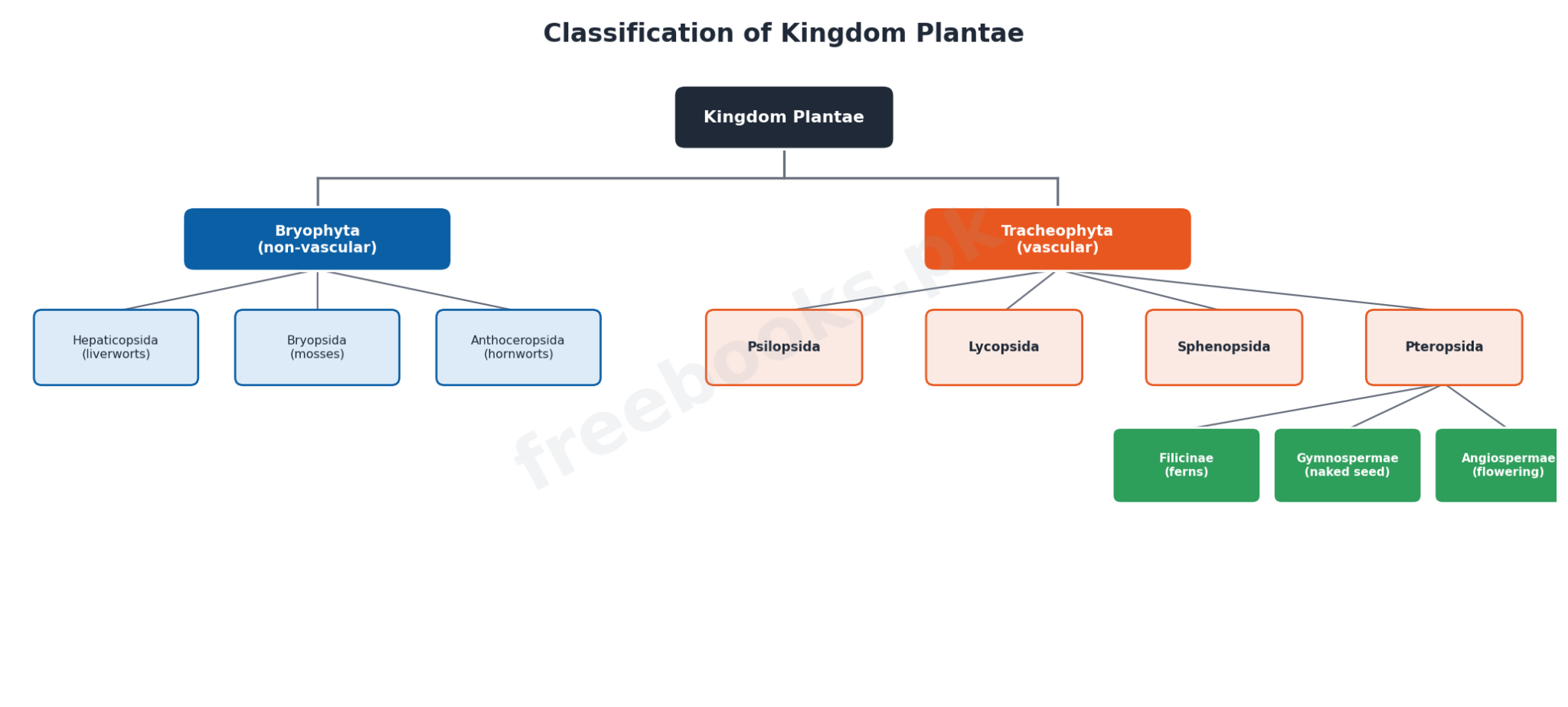
Biologists classify living organisms using a phylogenetic system of classification, one that reflects natural relationships and evolutionary origin among organisms. Kingdom Plantae mainly includes eukaryotic, autotrophic, multicellular, non-motile organisms that develop from embryos and possess a cellulose cell wall outer to the cell membrane; about 360,000 species of plants are known. For convenience, Plantae is divided into two broad categories: the non-vascular Bryophyta and the vascular Tracheophyta. Bryophyta comprises three subdivisions — Hepaticopsida (liverworts), Musci/Bryopsida (mosses) and Anthoceropsida (hornworts) — while Tracheophyta comprises Psilopsida (whisk ferns), Lycopsida (club mosses), Sphenopsida (horsetails) and Pteropsida, which itself includes class Filicinae (ferns), class Gymnospermae (naked-seeded plants) and class Angiospermae (flowering plants).
Division Bryophyta: Structure, Reproduction and Classification
Bryophytes were the first plants to colonize land, likely evolving from green algae, but remain poorly adapted to terrestrial life and are mainly confined to damp, shady places; they are sometimes called the amphibians of the plant world because they still need water for reproduction. They lack specialized conducting tissues (xylem and phloem) and rely on diffusion and osmosis for transport, have only a thin cuticle (or none), and absorb water over their general body surface. Bryophytes show a regular alternation of heteromorphic generations: a dominant, free-living haploid gametophyte (thalloid in many liverworts, or differentiated into stem-, leaf- and rhizoid-like structures in mosses) produces a less conspicuous diploid sporophyte (consisting of foot, seta and capsule) that remains dependent on the gametophyte for nourishment. The sporophyte produces one kind of haploid spore (homosporous) by meiosis in sporangia; spores germinate into a new haploid gametophyte, which bears multicellular male antheridia (producing motile antherozoids) and female archegonia (each producing a single egg); fertilization occurs in water, and the resulting diploid zygote develops into an embryo and then a new sporophyte, remaining attached to and nourished by the gametophyte, since it lacks chloroplasts of its own.
Bryophytes show several adaptations to land life: a compact multicellular body with a cuticle to conserve water, specialized chambers for gas exchange, rhizoids for absorption and anchorage, heterogamy (non-motile eggs and motile sperm), protected multicellular sex organs, a retained and protected multicellular embryo, and alternation of generations for genetic variability. Bryophytes are classified into three subdivisions: Hepaticopsida (liverworts, e.g. Marchantia, Porella — about 900 species, simplest bryophytes, thalloid or falsely leafy gametophyte), Bryopsida (mosses, e.g. Funaria, Polytrichum — gametophyte differentiated into stem- and leaf-like structures, spores germinate into an algal-like protonema before forming new gametophyte plants), and Anthoceropsida (hornworts, e.g. Anthoceros — a more advanced group whose sporophyte has stomata, chloroplasts and a persistent meristematic growth zone, allowing it to photosynthesize and grow indefinitely, largely independent of the gametophyte).
Alternation of Generations
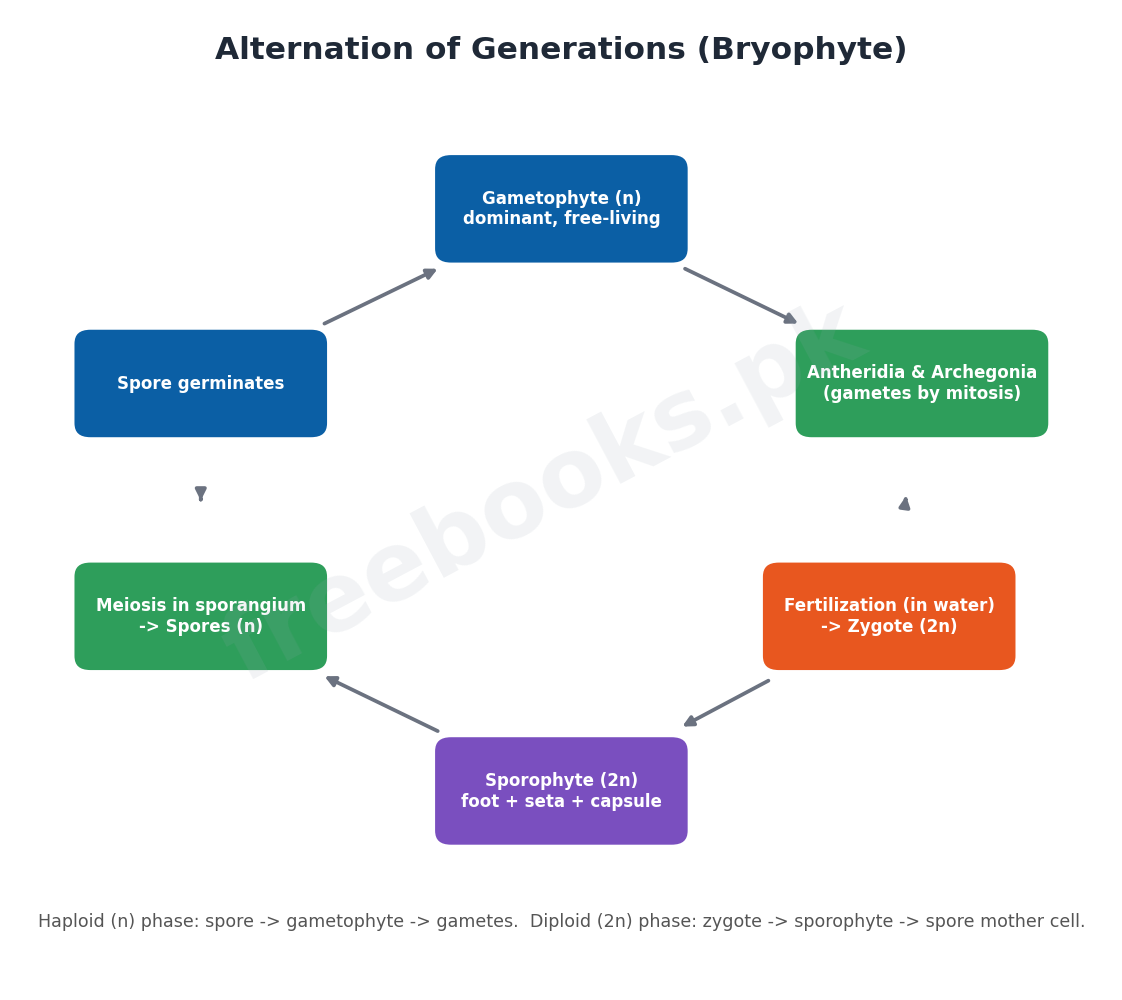
In liverworts, mosses and hornworts, two distinct multicellular generations regularly alternate: the dominant, conspicuous haploid gametophyte, which produces gametes (antherozoids and eggs) by mitosis, and the less conspicuous diploid sporophyte (differentiated into foot, seta and capsule/sporogonium), which produces haploid spores by meiosis from spore mother cells. A haploid antherozoid fuses with a haploid egg to form a diploid zygote (oospore), which develops into the sporophyte rather than directly into a gametophyte; the sporophyte's spores, upon germination, give rise to a new gametophyte rather than another sporophyte — this cyclical alternation of gametophyte and sporophyte generations is called alternation of generations. The gametophyte (haploid) phase runs from spore to gamete, while the sporophyte (diploid) phase runs from oospore to spore mother cell.
Alternation of generations is significant because meiotic division during spore formation reshuffles genes, producing spores (and hence gametophytes) with varied genetic combinations; gametophytes with favourable genetic makeup survive better in their environment, while less-adapted ones are eliminated. Since no further reshuffling occurs during gamete formation (which is by mitosis), the new genetic combination created at fertilization (oospore) is passed to the sporophyte, which upon maturity again produces genetically varied spores. Over many generations, this natural process of variability and selection allows plant populations to become progressively better adapted to their environment.
Division Tracheophyta: Psilopsida, Lycopsida and Sphenopsida
Tracheophytes are called vascular plants because they possess xylem and phloem; the evolution of roots, stems, leaves, vascular tissue, protected sporangia (leading to seeds), pollen tubes, flowers and fruit, and heteromorphic alternation of generations enabled vascular plants, and flowering plants especially, to dominate the land flora. Tracheophyta is subdivided into Psilopsida, Lycopsida, Sphenopsida and Pteropsida. Psilopsida (e.g. the living genera Psilotum and Tmesipeteris, and extinct genera like Cooksonia) are considered the earliest vascular plants; their rootless sporophytes have a dichotomously branched rhizome and leafless green aerial stem bearing sporangia at branch tips, and their thalloid, underground gametophyte lives in mycorrhizal symbiosis with a fungus.
Lycopsida (club mosses, e.g. Lycopodium, Selaginella) have sporophytes differentiated into true roots, stems and small, single-veined leaves called microphylls, with sporangia developing on sporophylls that may form club-shaped strobili; Lycopodium is homosporous while Selaginella is heterosporous, producing microspores and megaspores, making it resemble seed plants in some respects. Sphenopsida (horsetails, e.g. Equisetum), also called arthrophytes, have jointed, ridged stems, whorled leaves, and sporangia borne on sporangiophores aggregated into strobili.
Evolution of the Leaf and Class Filicineae (Ferns)
Early vascular land plants such as Cooksonia lacked true leaves or roots, having only dichotomously branched, leafless aerial stems and an anchoring rhizome. Lycopods were the first plants to evolve true leaves and roots, but their leaves (microphylls) are small, with a single undivided vein. Ferns and seed plants, by contrast, evolved megaphylls: large leaves with divided veins and an expanded blade, believed to have evolved from a dichotomous branching system in primitive psilopsids roughly 350 million years ago, over a further 15-20 million years, through three successive steps: overtopping (unequal growth of dichotomous branches in different planes), planation (arrangement of these unequal branches into one plane), and fusion/webbing (parenchyma filling the spaces between overtopped branches to form a flat leaf blade with dichotomously, and later reticulately, branched veins).
Class Filicineae (ferns) comprises seedless plants with foliar sporangia attached to leaves called fronds, whose immature fronds are coiled in a pattern called circinate vernation. Adiantum (maidenhair fern) illustrates the fern life cycle well: its dominant diploid sporophyte has a rhizome, adventitious roots and large compound fronds bearing sori (clusters of sporangia) on the underside of leaflet margins; each sporangium produces haploid spores by meiosis, dispersed when the annulus contracts in dry weather and ruptures the thin-walled stomial cells. A spore germinates on moist soil into a small, heart-shaped, autotrophic gametophyte (prothallus) bearing both archegonia (near the notch) and antheridia (among the rhizoids); motile, spirally coiled antherozoids swim through water to fertilize the egg in the archegonium, forming an oospore that develops into a new, initially dependent but later independent, sporophyte.
Evolution of the Seed Habit
The evolution of the seed habit, one of the most significant events in land plant history, began roughly 390 million years ago, with the first complete seeds appearing about 365 million years ago in the late Devonian. A seed is technically a fertilized ovule, and an ovule is an integumented, indehiscent megasporangium. The evolution of the seed habit proceeded through six key steps: (1) evolution of heterospory, in which plants began producing distinct microspores (forming male microgametophytes) and megaspores (forming female megagametophytes), rather than a single spore type (homospory); (2) retention and germination of the megaspore within the megasporangium, rather than shedding it before germination; (3) development of protective integument layers around the megasporangium, forming the ovule; (4) reduction to a single functional megaspore per megasporangium, with the other three of the four products of meiosis aborting; (5) development of an embryo sac (the megaspore's female gametophyte) retained within the megasporangium; and (6) modification of the megasporangium's distal end to capture pollen, allowing pollen tubes to deliver male gametes directly to the embryo sac for fertilization without needing external water, after which the fertilized ovule develops into a seed and its integuments become the seed coat.
Class Gymnospermae and Class Angiospermae
Gymnosperms ("naked-seeded" plants) are a successful, worldwide group of heterosporous seed plants that form about one-third of the world's forests; their ovules lie exposed (naked) on the surface of fertile leaves called megasporophylls rather than being enclosed in an ovary. Important genera include Cycas, Pinus, Taxus, Picea and Cedrus. In Pinus, the dominant sporophyte bears separate male cones (with microsporophylls containing microsporangia that produce winged, wind-dispersed pollen grains) and female cones (with woody megasporophylls, each bearing two ovules/megasporangia); pollen lands directly on the ovule and forms a pollen tube delivering male gametes to the embryo sac, after which the fertilized ovule develops into a seed — an important evolutionary adaptation freeing gymnosperms from dependence on water for fertilization.
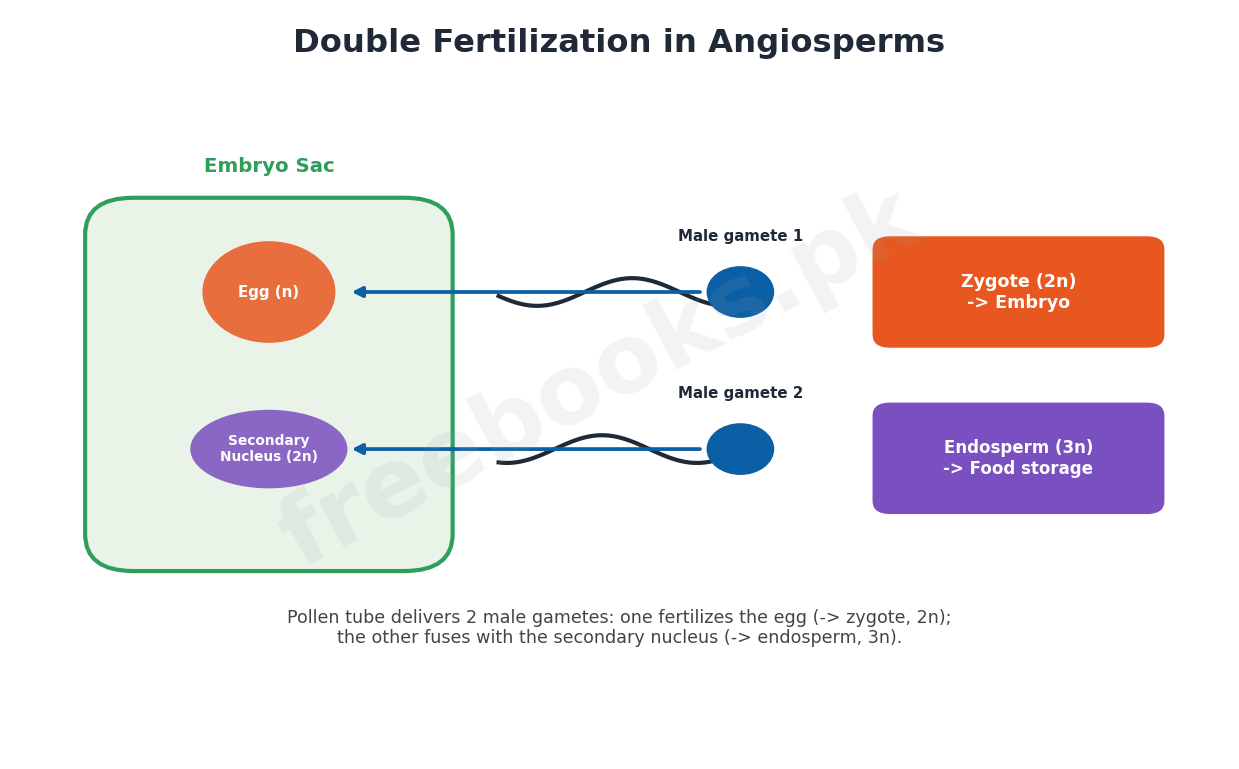
Angiosperms ("enclosed-seeded" plants) have fertile leaves (carpels) folded and fused at the margins to form an ovary, which develops into a fruit after fertilization; angiosperms make up about 235,000 of the 360,000 known plant species and are the most highly evolved seed plants, producing flowers, fruits and seeds. The diploid sporophyte produces flowers containing stamens (bearing anthers with microspore mother cells that form pollen/microgametophytes by meiosis) and carpels (with an ovary containing ovules, each with an integument and nucellus). After pollination, the pollen tube grows through the style into the ovule, delivering two male gametes to the seven-celled female gametophyte (embryo sac). One male gamete fuses with the egg to form a diploid zygote (developing into the embryo), while the second fuses with the secondary (fusion) nucleus to form a triploid endosperm nucleus (developing into nutritive endosperm tissue) — this process, unique to angiosperms, is called double fertilization, and helps the plant economize food resources by producing endosperm only after successful fertilization. The ovule's integuments become the seed coat (testa and tegmen), and the ovary wall develops into the fruit.
Classification of Angiosperms and Important Families
Class Angiospermae is divided into two subclasses based on the number of cotyledons in the embryo: Monocotyledonae (one cotyledon; monocots) and Dicotyledonae (two cotyledons; dicots), which also differ in features such as leaf venation, vascular bundle arrangement, and floral parts in multiples of three versus four or five. Several important angiosperm families and their economic importance include: Rosaceae (rose family; ~100 genera, 2000 species; e.g. Rosa, Malus, Fragaria — important temperate fruits like apple, pear and strawberry, and ornamental roses); Solanaceae (potato/nightshade family; ~90 genera, 2000 species; e.g. Solanum tuberosum, Nicotiana tabacum, Lycopersicum esculentum — provides food crops like potato and tomato, tobacco, and medicinal alkaloids such as atropine); Fabaceae/Papilionaceae (pea family; ~400 genera, 9000 species; e.g. Lathyrus, Arachis hypogea, Cicer arietinum — an important source of high-protein pulses, forage crops and timber, with characteristic papilionaceous flowers bearing a standard, wings and keel).
Caesalpiniaceae (cassia family; ~152 genera, 2300 species; e.g. Tamarindus indica, Cassia fistula, Bauhinia variegata) provides medicinal drugs (e.g. senna, a laxative), ornamentals and dyes; Mimosaceae (mimosa/acacia family; ~56 genera, 2800 species; e.g. Acacia nilotica, Albizia lebbek, Mimosa pudica) provides commercial timber, gum arabic and ornamentals; and Poaceae/Gramineae (grass family; ~600 genera, 10,000 species; e.g. Triticum, Zea mays, Oryza sativa, Saccharum officinarum) is economically the most important flowering plant family, providing the world's major cereal and fodder crops, sugar, building materials (bamboo) and fibres, with a characteristic spikelet inflorescence and a caryopsis (grain) fruit type.
Important Definitions
Phylogenetic classification
A system of classification that groups organisms to reflect their natural evolutionary relationships and mode of origin.
Bryophyte
A non-vascular, flowerless land plant (liverwort, moss or hornwort) with a dominant gametophyte and a dependent sporophyte.
Alternation of generations
The regular alternation, in a plant life cycle, between a haploid, gamete-producing gametophyte and a diploid, spore-producing sporophyte.
Heterospory
The production of two distinct types of spores – smaller microspores and larger megaspores – by a plant sporophyte.
Megaphyll
A large leaf with divided veins and veinlets and an expanded blade, characteristic of ferns and seed plants.
Ovule
An integumented, indehiscent megasporangium that develops into a seed after fertilization.
Double fertilization
A process unique to angiosperms in which one male gamete fuses with the egg (forming the zygote) and a second fuses with the secondary nucleus (forming the triploid endosperm).
Monocot / Dicot
The two subclasses of angiosperms, distinguished mainly by having one cotyledon (monocot) or two cotyledons (dicot) in the seed embryo.
Key Facts
| Item | Fact |
|---|---|
| Known plant species | About 360,000 species; angiosperms make up about 235,000 of these. |
| Bryophyte subdivisions | Hepaticopsida (liverworts), Bryopsida (mosses), Anthoceropsida (hornworts). |
| Bryophyte sporophyte parts | Foot, seta and capsule (sporogonium). |
| Seed evolution timeline | Seed habit began ~390 million years ago; first complete seeds ~365 million years ago (late Devonian). |
| Pinus pollen adaptation | Two wings on pollen grain aid long-distance wind dispersal. |
| Double fertilization result | Egg (n) + male gamete (n) -> zygote (2n, embryo); secondary nucleus (2n) + male gamete (n) -> endosperm (3n). |
| Angiosperm subclasses | Monocotyledonae (1 cotyledon) and Dicotyledonae (2 cotyledons). |
| Most economically important family | Poaceae (Gramineae) – cereals, fodder, sugar cane, bamboo; ~600 genera, 10,000 species. |
Diagrams & Illustrations
Classification of Kingdom Plantae: a tree diagram showing Kingdom Plantae divided into Bryophyta (Hepaticopsida, Bryopsida, Anthoceropsida) and Tracheophyta (Psilopsida, Lycopsida, Sphenopsida, Pteropsida with classes Filicinae, Gymnospermae, Angiospermae).
Alternation of Generations in a Bryophyte: a life-cycle diagram showing the haploid gametophyte producing gametes that fuse to form a diploid zygote, developing into a sporophyte that produces haploid spores by meiosis, which germinate into a new gametophyte.
Double Fertilization in Angiosperms: a diagram of double fertilization showing one male gamete fusing with the egg to form the diploid zygote, and a second male gamete fusing with the secondary nucleus to form the triploid endosperm nucleus.
Short Questions & Answers
How are ferns better adapted to life on land than liverworts and mosses?
Ferns have true vascular tissue (xylem and phloem) for efficient water and nutrient transport, true roots, stems and megaphyll leaves, and a dominant, independent sporophyte, whereas liverworts and mosses lack vascular tissue and have a dominant gametophyte that still depends on external water for fertilization.
Differentiate microphyll and megaphyll.
A microphyll is a small leaf with a single, undivided vein, found in lycopods, whereas a megaphyll is a large leaf with divided veins, veinlets and an expanded blade, characteristic of ferns and seed plants.
What is heterospory? Why is it significant in seed evolution?
Heterospory is the production of two distinct spore types – smaller microspores (forming male gametophytes) and larger megaspores (forming female gametophytes) – by a single sporophyte; it was the first essential step in the evolution of the seed habit, since retention of the megaspore within the megasporangium eventually led to the ovule and seed.
What is a seed? Define ovule and integument.
A seed is technically a fertilized ovule. An ovule is an integumented, indehiscent megasporangium, and integuments are the specialized protective layers surrounding the megasporangium that later become the seed coat.
What is double fertilization? State its significance.
Double fertilization is the angiosperm-specific process in which one male gamete fuses with the egg to form the diploid zygote (embryo), while a second male gamete fuses with the secondary nucleus to form the triploid endosperm nucleus (nutritive tissue); its significance is that it economizes the plant's food resources by producing nutritive endosperm only after successful fertilization has occurred.
Differentiate monocots and dicots (any two characters).
Monocots have one cotyledon in the seed embryo and scattered vascular bundles in the stem, whereas dicots have two cotyledons and vascular bundles arranged in a ring; monocot leaves typically show parallel venation while dicot leaves show reticulate (net-like) venation.
Long Questions & Answers
Discuss alternation of generations, defining sporophyte and gametophyte, with reference to bryophytes.
Alternation of generations refers to the regular alternation, in the life cycle of plants such as bryophytes, between two distinct multicellular phases: the haploid gametophyte and the diploid sporophyte. The gametophyte is the gamete-producing generation; in bryophytes it is the dominant, conspicuous, free-living phase, producing motile male gametes (antherozoids) in antheridia and a single egg in each archegonium, both by mitosis. A haploid antherozoid fuses with a haploid egg (fertilization occurring in water) to form a diploid zygote or oospore, which develops — not into a new gametophyte, but into the sporophyte, a genetically and structurally distinct generation consisting of a foot, seta and capsule, that remains attached to and nutritionally dependent on the gametophyte. The sporophyte is the spore-producing generation: within its capsule, spore mother cells undergo meiosis to produce haploid spores, and these spores germinate not into another sporophyte but into a new gametophyte, completing the cycle. An adult animal is comparable only to the diploid sporophyte generation of a plant, since animals produce gametes directly by meiosis within a single diploid body, without ever passing through a free-living, multicellular haploid stage equivalent to the gametophyte; this is the key reproductive dissimilarity between plants and animals.
Describe the evolution of the leaf and its importance in vascular plants.
Early vascular land plants, such as Cooksonia, lacked true leaves or roots and consisted only of dichotomously branched, leafless green aerial stems and an anchoring underground rhizome. Lycopods were the first plants to evolve true leaves and roots, though their leaves (microphylls) remained small, with only a single, undivided vascular strand. The much larger, more complex megaphyll leaf — with divided veins, veinlets and an expanded blade — is thought to have evolved from a dichotomously branching stem system in primitive psilopsids roughly 350 million years ago, over a further 15 to 20 million years, through three successive evolutionary steps: overtopping, in which some branches of a dichotomously branching stem grew faster and larger than others in different planes; planation, in which these unequally overtopped branches became rearranged into a single plane; and fusion (webbing), in which parenchyma tissue filled the spaces between the overtopped, planated branches, forming a continuous, flattened leaf blade with a branching (and eventually reticulate) venation pattern. The evolution of the megaphyll leaf was of enormous importance to vascular plants because its greatly expanded surface area dramatically increased the plant's capacity for photosynthesis, and megaphylls became the characteristic and highly successful leaf type of both ferns and all seed plants.
Discuss the evolution of seed habit and its significance.
The seed habit evolved through a defined sequence of six steps over tens of millions of years, beginning roughly 390 million years ago, with complete seeds appearing by about 365 million years ago. First, heterospory evolved: instead of producing a single spore type (homospory), some plant lineages began producing distinct microspores (forming male gametophytes) and larger megaspores (forming female gametophytes). Second, rather than being shed immediately, the megaspore began to be retained and to germinate within the megasporangium itself. Third, sporophytic tissue surrounding the megasporangium fused to form a protective integument, converting the megasporangium into an ovule (an integumented, indehiscent megasporangium). Fourth, of the four megaspores normally produced by meiosis of a megaspore mother cell, only one was retained as functional, the other three aborting, reducing competition for space and food. Fifth, the single surviving megaspore developed into a female gametophyte called the embryo sac, fully enclosed and protected within the megasporangium. Finally, the distal end of the now fully integumented, indehiscent megasporangium became modified to capture pollen, enabling pollen tubes to deliver male gametes directly to the embryo sac without needing external water for fertilization, after which the fertilized ovule became a seed with the integuments forming its seed coat. This sequence was of immense evolutionary significance: the resulting seed offered maximum protection to the developing embryo under harsh, variable terrestrial conditions, and freed reproduction almost entirely from a dependence on external water, enabling seed plants to permanently and successfully colonize the land.
Describe the process of double fertilization in angiosperms and explain its significance.
In an angiosperm, after pollination, the pollen grain germinates on the stigma to form a pollen tube, and the pollen's nucleus divides mitotically to produce two male gametes plus a tube nucleus; meanwhile, within the ovule, a megaspore develops into a seven-celled female gametophyte (embryo sac), one cell of which is the egg. The pollen tube grows down through the style, enters the ovule, and reaches the embryo sac, where it discharges its two male gametes. In double fertilization, one male gamete fuses with the egg cell to form a diploid (2n) zygote, which develops into the embryo, while the second male gamete simultaneously fuses with the diploid secondary (fusion) nucleus of the embryo sac to form a triploid (3n) endosperm nucleus, which develops into the nutritive endosperm tissue. This process, unique to flowering plants, is evolutionarily significant because it means that food-storing endosperm tissue is produced only after fertilization has actually taken place, allowing the plant to economize its food resources rather than pre-provisioning ovules that might never be fertilized; the endosperm formed then nourishes the developing embryo within the seed.
How do monocots and dicots structurally differ, and what is the economic importance of the Poaceae and Fabaceae families?
Monocotyledonous and dicotyledonous plants, the two subclasses of Angiospermae, differ in the number of cotyledons in their seed embryo (one in monocots, two in dicots) as well as in several other structural features: monocot leaves usually show parallel venation while dicot leaves show reticulate (net-like) venation; monocot stems have scattered vascular bundles while dicot stems have vascular bundles arranged in a ring around the periphery; and monocot floral parts typically occur in multiples of three, while dicot floral parts typically occur in multiples of four or five. The family Poaceae (Gramineae), a monocot family with about 600 genera and 10,000 species, is economically the most important family of flowering plants: it supplies the world's staple cereal crops (wheat, rice, corn, barley, oats), major fodder grasses for livestock, sugar (from sugarcane), building materials such as bamboo, and various fibres and oils. The family Fabaceae (Papilionaceae), a dicot family with about 400 genera and 9,000 species, is likewise of major economic importance, providing high-protein pulses (gram, pea, kidney bean) that are a key food source, important forage crops (alfalfa, clover), valuable timber trees (Dalbergia sissoo/Shisham), medicinal plants (Glycyrrhiza glabra for cough and cold), and characteristic papilionaceous (butterfly-shaped) flowers with a standard, wings and keel.
MCQs with Answers
Kingdom Plantae contains approximately how many known species? (a) 36,000 (b) 100,000 (c) 235,000 (d) 360,000
Correct Answer: (d) 360,000. About 360,000 species of plants are known, of which angiosperms make up about 235,000.
Bryophyta is divided into how many subdivisions? (a) 2 (b) 3 (c) 4 (d) 5
Correct Answer: (b) 3. Bryophyta has 3 subdivisions: Hepaticopsida (liverworts), Bryopsida (mosses) and Anthoceropsida (hornworts).
The sporophyte of a bryophyte consists of: (a) root, stem, leaf (b) foot, seta, capsule (c) rhizoid, thallus, cuticle (d) anther, ovary, stigma
Correct Answer: (b) foot, seta, capsule. The bryophyte sporophyte is differentiated into foot, seta and capsule (sporogonium).
The production of two distinct spore types (microspores and megaspores) is called: (a) homospory (b) heterospory (c) isospory (d) sporogenesis
Correct Answer: (b) heterospory. Heterospory is the production of two spore types and was the first key step in seed evolution.
Technically, a seed may be defined as a: (a) fertilized ovule (b) unfertilized megaspore (c) mature pollen grain (d) young embryo sac
Correct Answer: (a) fertilized ovule. A seed is technically a fertilized ovule, which is itself an integumented, indehiscent megasporangium.
The term "Gymnospermae" literally means: (a) enclosed seed (b) naked seed (c) no seed (d) double seed
Correct Answer: (b) naked seed. Gymnospermae means "naked seed" (gymno = naked, spermae = seed), reflecting their exposed ovules.
In double fertilization, the second male gamete fuses with the secondary nucleus to form the: (a) zygote (b) embryo (c) endosperm nucleus (d) pollen tube
Correct Answer: (c) endosperm nucleus. The second male gamete fuses with the secondary (fusion) nucleus to form the triploid endosperm nucleus.
Class Angiospermae is divided into the subclasses Monocotyledonae and: (a) Gymnospermae (b) Pteropsida (c) Dicotyledonae (d) Filicinae
Correct Answer: (c) Dicotyledonae. Angiosperms are divided into Monocotyledonae (1 cotyledon) and Dicotyledonae (2 cotyledons).
Which family is economically the most important among flowering plants, providing the world's major cereal crops? (a) Rosaceae (b) Solanaceae (c) Poaceae (d) Mimosaceae
Correct Answer: (c) Poaceae. Poaceae (Gramineae), the grass family, is the most economically important flowering plant family.
Pinus pollen grains have two wings, which help in: (a) water dispersal (b) insect attachment (c) wind dispersal over long distances (d) self-pollination only
Correct Answer: (c) wind dispersal over long distances. The two wings on Pinus pollen grains allow them to float in air and travel long distances by wind.
Quick Revision Summary
- Kingdom Plantae: eukaryotic, autotrophic, multicellular, non-motile, cellulose walls, ~360,000 species. Divided into Bryophyta (non-vascular) and Tracheophyta (vascular).
- Bryophyta: 3 subdivisions (Hepaticopsida, Bryopsida, Anthoceropsida); dominant gametophyte, dependent sporophyte (foot+seta+capsule); homosporous; need water for fertilization.
- Alternation of generations: haploid gametophyte (gamete-producing, mitosis) <-> diploid sporophyte (spore-producing, meiosis); provides genetic variability for natural selection.
- Tracheophyta subdivisions: Psilopsida (rootless, e.g. Psilotum), Lycopsida (microphylls, e.g. Lycopodium/Selaginella), Sphenopsida (jointed stems, e.g. Equisetum), Pteropsida (Filicinae/Gymnospermae/Angiospermae).
- Leaf evolution: microphyll (1 vein, lycopods) vs megaphyll (divided veins, ferns/seed plants) via overtopping -> planation -> fusion/webbing.
- Seed evolution (6 steps): heterospory -> megaspore retention -> integument/ovule formation -> single functional megaspore -> embryo sac -> pollen capture modification.
- Gymnosperms = naked seed (e.g. Pinus, Cycas); Angiosperms = enclosed seed, double fertilization (zygote 2n + endosperm 3n); Monocots (1 cotyledon) vs Dicots (2 cotyledons).
- Key angiosperm families: Rosaceae (fruits/ornamentals), Solanaceae (potato/tomato/tobacco), Fabaceae (pulses/forage), Caesalpiniaceae (senna/dyes), Mimosaceae (timber/gum), Poaceae (cereals – most economically important). Notes by freebooks.pk.
Exam Tips
- Learn the classification tree of Plantae (Bryophyta vs Tracheophyta with all subdivisions) — a very common diagram/fill-in-the-blank question.
- Master alternation of generations: define gametophyte and sporophyte precisely, and know which is haploid/diploid and gamete-/spore-producing.
- Memorise the 6 steps in the evolution of the seed habit in order — a classic extensive question.
- Be ready to differentiate: microphyll/megaphyll, gymnosperm/angiosperm, monocot/dicot, homospory/heterospory.
- Understand double fertilization clearly: which gamete forms the zygote (2n) and which forms the endosperm (3n).
- Know at least 2-3 economically important plants and uses for each of the 6 angiosperm families listed (especially Poaceae and Fabaceae).