This chapter covers Bioenergetics from the 1st Year (FSc Part-I) Biology syllabus of the Punjab Curriculum and Textbook Board (PTB/PCTB). Bioenergetics is the quantitative study of energy relationships and energy conversions in biological systems, and all biological energy transformations obey the laws of thermodynamics; nearly all life on Earth is ultimately powered by solar energy, which chloroplasts capture and convert into chemical energy stored in sugars. These notes are prepared by freebooks.pk.
The chapter works through photosynthesis, the energy-capturing process (its reactants and products, the role of chloroplasts, photosynthetic pigments, light absorption and action spectra, the role of carbon dioxide, and the light-dependent and light-independent/Calvin cycle reactions), and then respiration, the energy-releasing process (aerobic vs anaerobic respiration, the role of mitochondria and ATP, and the four stages of cellular respiration: glycolysis, pyruvate oxidation, the Krebs cycle, and the respiratory electron transport chain with oxidative phosphorylation).
Learning Objectives
- Define bioenergetics and describe the overall relationship between photosynthesis and respiration.
- Describe the structure of the chloroplast and the roles of chlorophylls and accessory pigments.
- Differentiate absorption spectrum and action spectrum, and explain the role of CO2 in photosynthesis.
- Describe the light-dependent reactions of photosynthesis, including photosystems, the Z-scheme, and chemiosmosis.
- Describe the light-independent reactions (Calvin cycle) and its three phases.
- Differentiate aerobic and anaerobic respiration and describe the fate of pyruvate under each.
- Describe the four stages of cellular respiration (glycolysis, pyruvate oxidation, Krebs cycle, respiratory chain) and calculate ATP yield.
Key Concepts
Bioenergetics and the Photosynthesis-Respiration Relationship
Bioenergetics is the quantitative study of energy relationships and energy conversions in biological systems, governed by the laws of thermodynamics. All organisms need free energy to stay alive, and nearly all life is powered directly or indirectly by solar energy, though no organism can use sunlight directly for metabolism — instead, chloroplasts capture light energy and convert it into chemical energy stored in sugars and other organic molecules. With the emergence of photosynthesis, molecular oxygen accumulated in the atmosphere, making possible the evolution of respiration, which releases energy and couples some of it to forming ATP, the key chemical link between catabolism and anabolism.
Photosynthesis is an energy-capturing process (using solar energy to build energy-rich organic molecules that cannot form without an energy input), while glycolysis and respiration are energy-releasing processes (breaking down that stored chemical energy in a controlled, stepwise manner). The overall photosynthesis equation (6CO2 + 6H2O + light energy -> C6H12O6 + 6O2) is almost exactly the reverse of the aerobic respiration equation (C6H12O6 + 6O2 -> 6CO2 + 6H2O + energy): photosynthesis uses respiration's products and vice versa. Photosynthesis occurs only during daylight while respiration continues day and night; at low light (dawn/dusk), the two rates may briefly equal each other so there is no net gas exchange with the atmosphere, a condition called the compensation point.
Chloroplasts and Photosynthetic Pigments
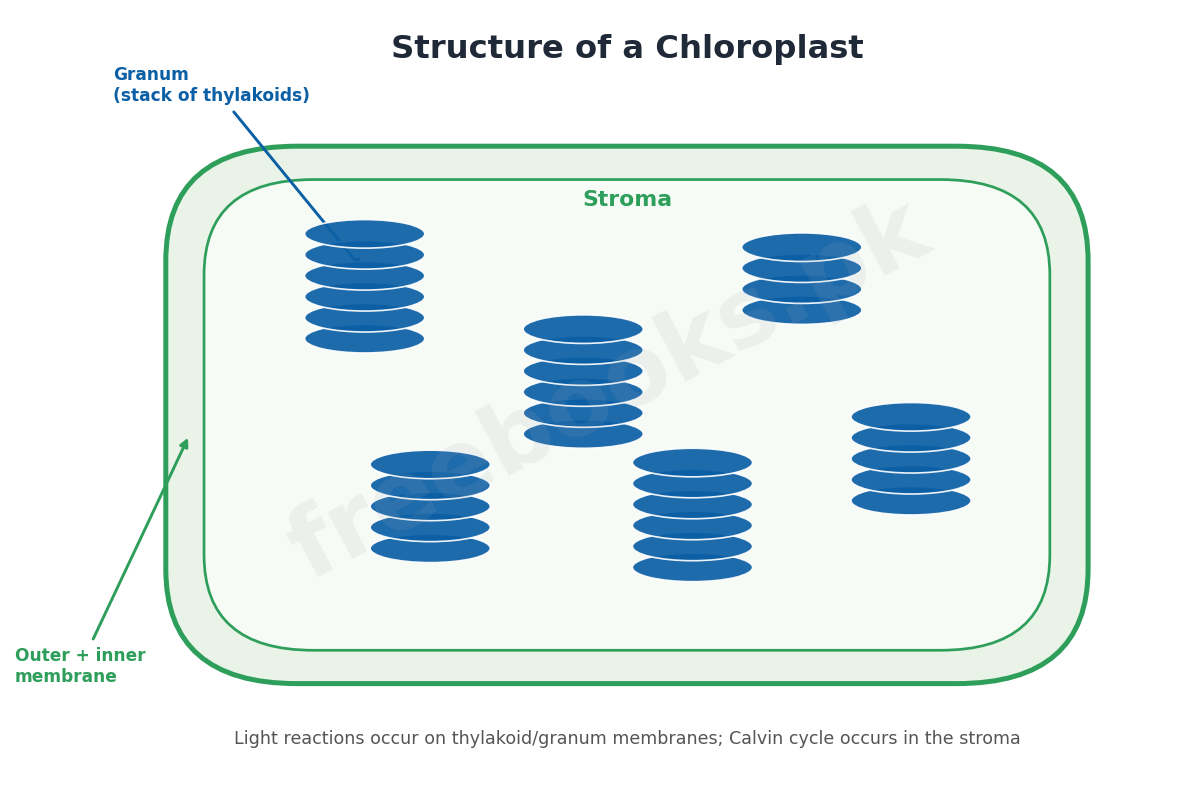
Water is one of photosynthesis's two raw materials (with CO2); Van Niel's 1930s hypothesis (based on photosynthetic bacteria) proposed that water, not CO2, is split to release oxygen, and this was confirmed in the 1940s using an O18 isotopic tracer, showing that plants supplied with heavy-oxygen water (H2O18) released O18 gas, while those supplied with heavy-oxygen CO2 did not. Hydrogen from split water reduces NADP to NADPH, the "reducing power" that, along with ATP from light reactions, is used to reduce CO2 into sugar during dark reactions. Chloroplasts, present in about half a million per square millimetre of leaf surface (mostly in mesophyll cells, with 20-100 per cell), have a double membrane enclosing the fluid-filled stroma (containing sugar-synthesizing enzymes) and an internal membrane system of flattened sacs called thylakoids (sometimes stacked into columns called grana), which house chlorophyll, other pigments, and the electron transport chain, and carry out ATP synthesis by chemiosmosis.
Thylakoid membranes contain several pigment types, chiefly chlorophylls, plus accessory carotenoids (red-to-orange carotenes and yellow-to-orange xanthophylls) that broaden the range of usable light. Chlorophyll a and b (found in eukaryotic plants/algae) differ only in one functional group (a methyl group in chlorophyll a vs. a carbonyl group in chlorophyll b), giving them slightly different absorption spectra and colours (blue-green vs. yellow-green); chlorophyll a is the most abundant and directly participates in light reactions, while chlorophyll b and carotenoids are accessory pigments, absorbing light and passing the energy to chlorophyll a (order of transfer: carotenoids -> chlorophyll b -> chlorophyll a). A chlorophyll molecule has a light-absorbing porphyrin "head" (with a central magnesium atom — its deficiency causes chlorosis/yellowing) and a hydrophobic phytol "tail" anchoring it in the thylakoid membrane.
Light Absorption and the Role of Carbon Dioxide
Visible light (about 380-750 nm) is the radiation most important to photosynthesis; only about 1% of light striking a leaf is actually absorbed. A graph of a pigment's relative light absorption at each wavelength is its absorption spectrum, showing chlorophyll's two absorption peaks near 430 nm (blue) and 670 nm (red); a graph of photosynthetic effectiveness at each wavelength is the action spectrum (first obtained by T.W. Engelmann in 1883, using Spirogyra and aerobic bacteria to detect oxygen release). The action spectrum closely parallels chlorophyll's absorption spectrum (confirming chlorophyll as the key photosynthetic pigment) but shows broader peaks and a shallower valley, because accessory pigments like carotenoids absorb additional wavelengths (e.g. green light) and pass that energy on to chlorophyll.
Sugar is formed during the light-independent reactions by reducing CO2 using the ATP and NADPH generated in light-dependent reactions, so photosynthesis cannot occur without CO2. About 90% of global photosynthesis occurs in aquatic environments (using dissolved CO2, bicarbonates and carbonates), with the remaining 10% on land, using atmospheric CO2 (about 0.03-0.04%) that diffuses into leaves through adjustable pores called stomata; stomata cover only 1-2% of leaf surface yet allow proportionally much more gas exchange, and their opening/closing (regulated by guard cells, and following an internal circadian rhythm) is coordinated with the plant's photosynthetic needs, being open mostly during daylight.
Light-Dependent Reactions: Photosystems and Photophosphorylation
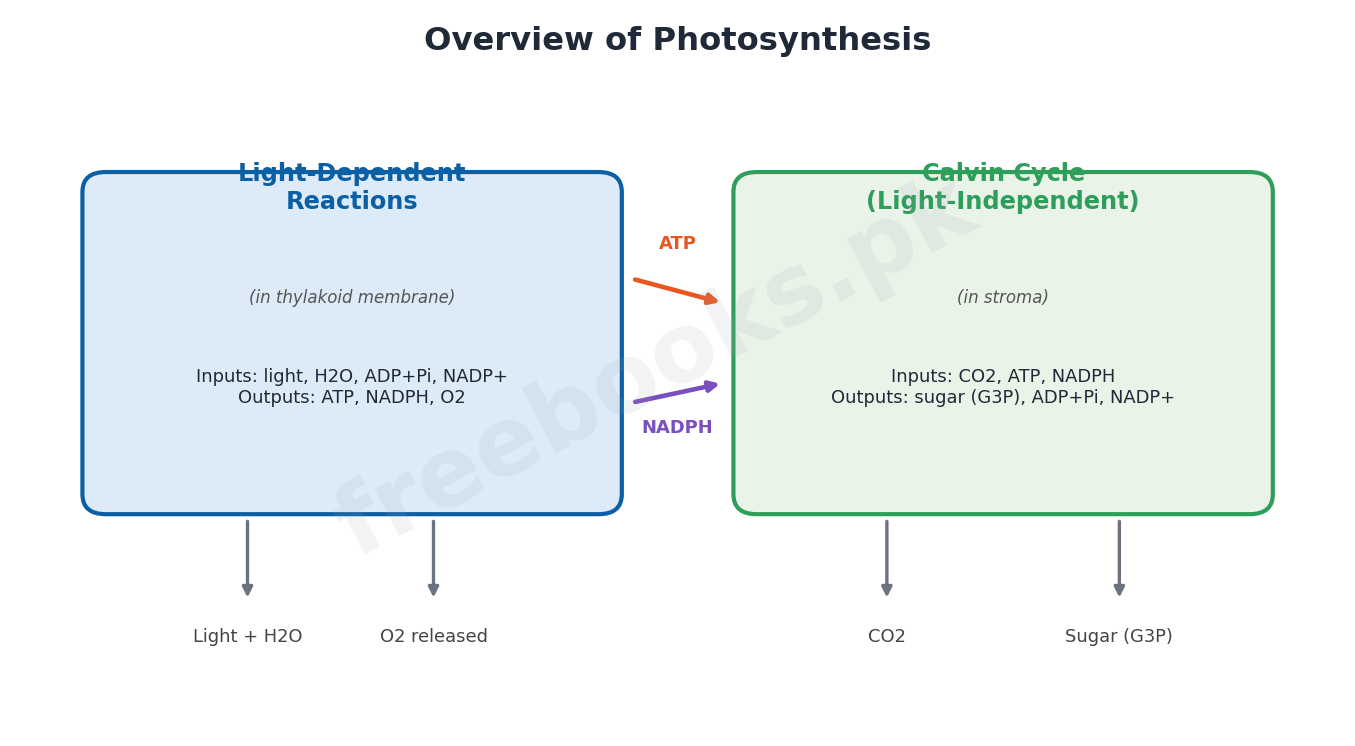
Photosynthesis is a redox process occurring in two parts: light-dependent reactions (using light directly, generating ATP and NADPH) and light-independent/dark reactions (using that stored ATP and NADPH to reduce CO2 into sugar, whether or not light is present). In the thylakoid membrane, pigments are organized into photosystems, each with a light-gathering antenna complex (chlorophyll a, b and carotenoids channeling energy inward) and a reaction center (special chlorophyll a plus a primary electron acceptor). Photosystem II (reaction-center chlorophyll P680, absorbing best at 680 nm) and Photosystem I (reaction-center chlorophyll P700, absorbing best at 700 nm) are named by order of discovery, not sequence of action.
In the predominant non-cyclic electron flow, light excites an electron in PS II's P680, captured by its primary acceptor; the resulting electron "hole" is filled by electrons extracted from water via an enzyme, splitting water into hydrogen ions and oxygen (photolysis) — the main source of atmospheric oxygen replenishment. The photoexcited electron passes via an electron transport chain (plastoquinone, cytochromes, plastocyanin) to PS I, its energy loss driving ATP synthesis (non-cyclic photophosphorylation, so-called because light drives it). At PS I, light re-excites the electron (filling the earlier P700 hole), and the newly excited electron passes through a second transport chain to ferredoxin, then via NADP reductase reduces NADP+ to NADPH — this whole non-cyclic pathway, from water to NADPH, is called the Z-scheme. In the less common cyclic electron flow, only PS I is involved, and the electron eventually returns to PS I's reaction center, generating ATP (cyclic photophosphorylation) but no NADPH or oxygen. In both pathways, ATP synthesis occurs by chemiosmosis: the electron transport chain pumps H+ into the thylakoid space, and the resulting proton gradient drives H+ back through ATP synthase, powering ATP formation.
Light-Independent Reactions: The Calvin Cycle
The Calvin cycle, occurring in the chloroplast stroma, is the cyclic series of enzyme-catalyzed reactions by which carbon is fixed and reduced to synthesize sugar, using the ATP and NADPH generated by light reactions; its path was worked out by Melvin Calvin (Nobel Prize, 1961) and has three phases. In Phase 1 (carbon fixation), CO2 reacts with the five-carbon sugar RuBP (ribulose bisphosphate), catalyzed by the enzyme Rubisco (the most abundant protein on Earth), forming an unstable six-carbon intermediate that immediately splits into two molecules of the three-carbon compound 3-phosphoglycerate (PGA) — since the first stable product is three carbons, the Calvin cycle is also called the C3 pathway. In Phase 2 (reduction), each PGA molecule is phosphorylated by ATP (forming 1,3-bisphosphoglycerate) and then reduced by NADPH to form glyceraldehyde 3-phosphate (G3P), the same three-carbon sugar produced in glycolysis; of every six G3P molecules formed (from 3 CO2 + 3 RuBP), only one leaves the cycle as net carbohydrate gain, used to build glucose, sucrose, starch and other organic compounds.
In Phase 3 (regeneration of the CO2 acceptor), the remaining five G3P molecules are rearranged, using three more ATP molecules, back into three molecules of the five-carbon RuBP, regenerating the CO2 acceptor so the cycle can continue. Overall, three turns of the cycle (fixing 3 CO2) consume 9 ATP and 6 NADPH to net one G3P molecule.
Respiration: Aerobic and Anaerobic Pathways
Respiration is the universal process by which organisms break down carbon-containing compounds to harvest usable energy for cellular activities. "External respiration" refers to gas exchange (O2/CO2) between an organism and its environment, while cellular respiration is the stepwise intracellular breakdown of fuel molecules (typically glucose) to release energy. Before entering a mitochondrion, glucose is first split into two molecules of pyruvic acid in a process called glycolysis (occurring in the cytosol, without requiring oxygen); this same basic reaction is believed to have occurred in the earliest cells on Earth. From this point, pyruvate can follow different pathways depending on oxygen availability: alcoholic fermentation and lactic acid fermentation occur without oxygen (anaerobic), while complete glucose breakdown to CO2 and water, releasing far more energy, requires oxygen (aerobic respiration).
In alcoholic fermentation (in primitive cells and some eukaryotes like yeast), pyruvic acid is converted into ethanol and CO2. In lactic acid fermentation (e.g. in human muscle cells during intense exercise, when oxygen cannot be supplied fast enough), each pyruvic acid molecule is converted directly into lactic acid. Both fermentation pathways yield only a small fraction of glucose's stored energy as ATP (about 2%). Mitochondria, the cell's "powerhouses," have an outer membrane and a folded inner membrane (cristae) housing the enzymes and coenzymes that gradually release energy from organic molecules and transfer it to ATP's chemical bonds; ATP's terminal ("high-energy") phosphate bond releases about 7.3 kcal of free energy upon hydrolysis, powering processes such as biosynthesis, active transport, muscle contraction and nerve conduction. Biological oxidation, which ultimately supplies the free energy for nearly all cellular processes (apart from photosynthesis and some chemosynthesis), often proceeds via dehydrogenase-catalyzed removal of hydrogen atoms, since cellular respiration is essentially an oxidation process.
Cellular Respiration Stage 1: Glycolysis and Pyruvate Oxidation
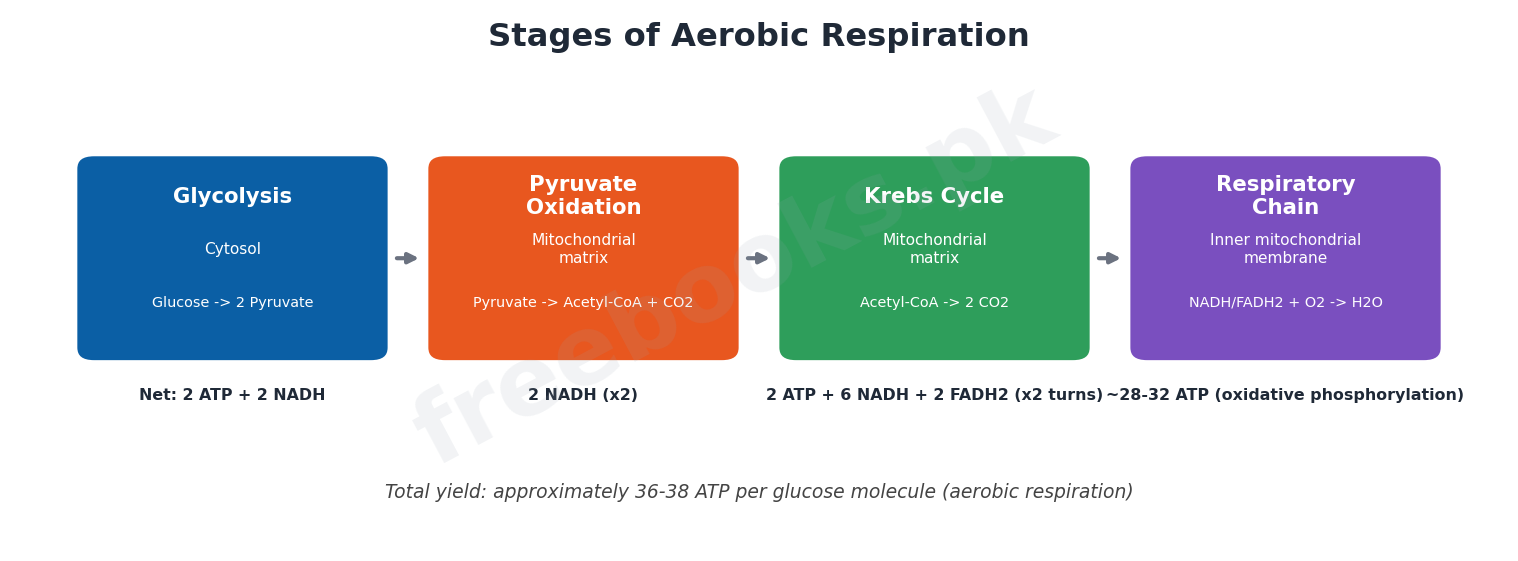
Cellular respiration is divided into four stages: glycolysis, pyruvate (pyruvic acid) oxidation, the Krebs (citric acid) cycle, and the respiratory chain; only glycolysis occurs in the cytosol without requiring oxygen, while the remaining three occur inside the mitochondria and require oxygen. Glycolysis breaks glucose down to pyruvic acid via enzyme-catalyzed steps requiring ATP and the coenzyme NAD, and has two phases. In the preparatory phase, glucose is phosphorylated (using 2 ATP) and rearranged, ultimately splitting into two three-carbon molecules (G3P and DHAP, readily interconverted). In the oxidative (payoff) phase, each G3P is oxidized (its hydrogens transferred to NAD, forming NADH) while gaining a phosphate to form 1,3-bisphosphoglycerate (BPG); this high-energy phosphate is then transferred to ADP (forming ATP) as BPG converts to 3-phosphoglycerate, which is further converted through several intermediate steps (via 2-phosphoglycerate and phosphoenolpyruvate) to pyruvate, transferring a second high-energy phosphate to ADP to form a second ATP. Overall, glycolysis nets 2 ATP and 2 NADH per glucose molecule (from an initial investment of 2 ATP and a total production of 4 ATP).
Pyruvate does not enter the Krebs cycle directly: it is first decarboxylated (releasing one carbon as CO2), converting the 3-carbon pyruvate into a 2-carbon acetic acid unit, which combines with coenzyme A to form acetyl-CoA (active acetate) upon entering the mitochondrion, with additional hydrogen atoms transferred to NAD in the process.
Cellular Respiration Stages 2-4: Krebs Cycle and the Respiratory Chain
Acetyl CoA enters the Krebs (citric acid) cycle, discovered by biochemist Hans Krebs, by combining with the 4-carbon oxaloacetate to form 6-carbon citrate (regenerating free CoA). Citrate is rearranged to isocitrate, then oxidized (releasing CO2, forming NADH) to alpha-ketoglutarate, which is further oxidized and decarboxylated (another NADH and CO2 released) to succinate, with enough free energy released in this step to directly form one ATP molecule. Succinate is oxidized to fumarate (using FAD as the oxidizing agent, forming FADH2), then hydrated to malate, and finally oxidized (another NADH formed) back to oxaloacetate, completing the cycle so it can combine with a new acetyl-CoA and repeat. Each turn of the Krebs cycle (per acetyl-CoA/pyruvate) yields 3 NADH, 1 FADH2, 1 ATP, and releases 2 CO2.
In the respiratory chain (electron transport chain), NADH transfers its hydrogen/electrons through a series of redox carriers — coenzyme Q, then a series of cytochromes (b, c, a, a3, containing iron-bearing haem groups like those in haemoglobin) — ultimately to molecular oxygen, the final, most electronegative electron acceptor, forming water. Three points along this chain release enough energy to synthesize ATP, so each NADH entering the chain yields about 3 ATP via oxidative phosphorylation (ATP synthesis coupled to oxygen-dependent electron transport). As in photosynthesis, this ATP synthesis occurs by chemiosmosis, but here the electron transport chain pumps protons across the inner mitochondrial membrane (from the matrix into the intermembrane space), and their subsequent diffusion back through ATP synthase drives ATP formation — though the specific carrier and coupling molecules differ from those used in photosynthesis.
Important Definitions
Bioenergetics
The quantitative study of energy relationships and energy conversions (governed by thermodynamics) in biological systems.
Photosynthesis
The process by which chlorophyll-containing organisms use light energy to convert CO2 and water into energy-rich glucose and oxygen.
Photolysis
The light-driven splitting of water molecules into hydrogen ions, electrons and oxygen during the light reactions of photosynthesis.
Photophosphorylation
The light-driven synthesis of ATP occurring during the light-dependent reactions of photosynthesis (cyclic or non-cyclic).
Chemiosmosis
The process in which a proton (H+) gradient across a membrane, created by an electron transport chain, drives ATP synthesis via ATP synthase.
Glycolysis
The cytosolic, oxygen-independent breakdown of one glucose molecule into two molecules of pyruvic acid, with a net gain of 2 ATP and 2 NADH.
Krebs cycle (citric acid cycle)
The mitochondrial cyclic series of reactions that completes the oxidation of acetyl-CoA, producing NADH, FADH2, ATP and CO2.
Oxidative phosphorylation
The synthesis of ATP that occurs in the respiratory (electron transport) chain, coupled to the reduction of oxygen to water.
Key Facts
| Item | Fact |
|---|---|
| Photosynthesis (overall equation) | 6CO2 + 6H2O + light energy -> C6H12O6 + 6O2 (occurs in chloroplasts). |
| Aerobic respiration (overall equation) | C6H12O6 + 6O2 -> 6CO2 + 6H2O + energy (the reverse of photosynthesis). |
| Source of photosynthetic O2 | Water (confirmed by Van Niel's hypothesis and O18 isotope-tracer experiments). |
| Chlorophyll absorption peaks | Photosystem II: P680 (680 nm); Photosystem I: P700 (700 nm). |
| Calvin cycle discoverer | Melvin Calvin – Nobel Prize, 1961; enzyme Rubisco = most abundant protein on Earth. |
| Glycolysis net yield | 1 glucose -> 2 pyruvate + net 2 ATP + 2 NADH (occurs in the cytosol, no O2 required). |
| ATP high-energy bond | Hydrolysis of ATP's terminal phosphate bond releases about 7.3 kcal of free energy. |
| Anaerobic fermentation efficiency | Only about 2% of glucose's stored energy is converted into ATP without oxygen. |
Diagrams & Illustrations
Overview of Photosynthesis: a diagram showing the two-phase overview of photosynthesis – light-dependent reactions (using light, H2O and producing ATP, NADPH and O2) feeding into light-independent Calvin cycle reactions (using CO2, ATP and NADPH to produce sugar).
Structure of a Chloroplast: a labelled diagram of a chloroplast showing the outer double membrane, the stroma, and the internal thylakoid membrane system stacked into grana.
Stages of Aerobic Respiration: a flow diagram of the four stages of aerobic cellular respiration – glycolysis, pyruvate oxidation, the Krebs cycle and the respiratory (electron transport) chain – with their approximate ATP yield.
Short Questions & Answers
What is the net production of ATP during glycolysis?
Glycolysis produces 4 ATP molecules but consumes 2 ATP in its preparatory phase, giving a net gain of 2 ATP per glucose molecule, along with 2 NADH.
What is the main difference between photophosphorylation and oxidative phosphorylation?
Photophosphorylation is the light-driven synthesis of ATP during the light reactions of photosynthesis in chloroplasts, whereas oxidative phosphorylation is the synthesis of ATP during the respiratory electron transport chain in mitochondria, driven by the reduction of oxygen to water.
What is the role of accessory pigments in light absorption?
Accessory pigments such as chlorophyll b and carotenoids absorb light at wavelengths not well absorbed by chlorophyll a and transfer that energy to chlorophyll a, broadening the range of light wavelengths usable for photosynthesis.
When and why is there no net exchange of CO2 and O2 between leaves and the atmosphere?
At low light intensities, such as dawn or dusk, the rate of photosynthesis may briefly equal the rate of respiration, so the oxygen released by photosynthesis is exactly used up by respiration and the CO2 released by respiration is exactly used up by photosynthesis; this is called the compensation point.
Differentiate cyclic and non-cyclic photophosphorylation.
Non-cyclic photophosphorylation involves both photosystem I and II, produces ATP, NADPH and oxygen, and electrons flow from water to NADPH (Z-scheme); cyclic photophosphorylation involves only photosystem I, produces only ATP (no NADPH or oxygen), with electrons returning to the same reaction center.
What are T.W. Engelmann and Melvin Calvin famous for?
T.W. Engelmann obtained the first action spectrum of photosynthesis in 1883 using Spirogyra and aerobic bacteria; Melvin Calvin discovered the path of carbon fixation and reduction in the light-independent reactions (the Calvin cycle), for which he won the Nobel Prize in 1961.
Long Questions & Answers
Give an account of the light-dependent reactions of photosynthesis, explaining the Z-scheme.
The light-dependent reactions occur in the thylakoid membranes of the chloroplast, where photosynthetic pigments are organized into photosystems, each with a light-gathering antenna complex and a reaction center. In the predominant pathway, non-cyclic electron flow, light striking Photosystem II excites an electron in its reaction-center chlorophyll (P680), which is captured by a primary electron acceptor; the resulting electron "hole" in P680 is refilled by electrons extracted from water molecules through an enzyme-catalyzed reaction (photolysis), which splits water into hydrogen ions and oxygen gas, the source of atmospheric oxygen replenishment. The photoexcited electron then passes down an electron transport chain (plastoquinone, cytochromes, plastocyanin) to Photosystem I, and the energy released as it moves down this chain is used to synthesize ATP by chemiosmosis, a process called non-cyclic photophosphorylation. Meanwhile, light also excites an electron in PS I's reaction-center chlorophyll (P700); this hole is filled by the electron arriving from PS II, while the newly excited P700 electron passes through a second electron transport chain to the iron-containing protein ferredoxin, and finally, via the enzyme NADP reductase, reduces NADP+ to NADPH. This entire electron pathway, tracing electrons from water through both photosystems to NADPH, is called the Z-scheme because of its characteristic zigzag shape when the redox potentials are plotted. In both non-cyclic and the less common cyclic electron flow (which uses only Photosystem I and generates ATP but no NADPH or oxygen), ATP synthesis occurs by chemiosmosis: the electron transport chain pumps protons into the thylakoid interior space, creating a proton gradient whose energy is released as protons diffuse back out through ATP synthase complexes, driving ATP formation from ADP and inorganic phosphate.
Give an account of the light-independent reactions (Calvin cycle) of photosynthesis.
The light-independent (dark) reactions take place in the stroma of the chloroplast and do not require light directly, proceeding equally well in light or darkness provided the ATP and NADPH generated by the light reactions are available; these reactions constitute the Calvin cycle, whose path was elucidated by Melvin Calvin (Nobel Prize, 1961), and comprise three phases. In Phase 1, carbon fixation, a molecule of CO2 combines with the five-carbon sugar ribulose bisphosphate (RuBP), a reaction catalyzed by the abundant enzyme Rubisco, forming an unstable six-carbon intermediate that immediately splits into two molecules of the three-carbon compound 3-phosphoglycerate (PGA) — since three-carbon PGA is the first stable product, the Calvin cycle is also called the C3 pathway. In Phase 2, reduction, each PGA molecule receives a phosphate group from ATP (forming 1,3-bisphosphoglycerate) and is then reduced, using electrons donated by NADPH, to glyceraldehyde 3-phosphate (G3P), the same three-carbon sugar produced during glycolysis; for every three CO2 molecules fixed (reacting with 3 RuBP), six G3P molecules are formed, but only one of these six leaves the cycle as the net carbohydrate product, to be used in synthesizing glucose, sucrose, starch and other organic compounds. In Phase 3, regeneration of the CO2 acceptor, the remaining five G3P molecules undergo a complex series of rearrangements, using three further ATP molecules, to regenerate three molecules of the five-carbon RuBP, allowing the cycle to accept new CO2 and continue. Overall, fixing three CO2 molecules to net one G3P molecule consumes nine ATP and six NADPH generated by the light reactions.
Describe the various steps involved in the oxidative breakdown of glucose to pyruvate (glycolysis).
Glycolysis, the breakdown of one glucose molecule into two molecules of pyruvic acid, occurs in the cytosol and does not require oxygen, though it proceeds in both aerobic and anaerobic conditions; it comprises a preparatory phase and an oxidative (payoff) phase. In the preparatory phase, glucose first receives a phosphate group from ATP, forming glucose-6-phosphate, which is isomerized to fructose-6-phosphate; a second ATP then donates another phosphate, forming fructose 1,6-bisphosphate, which is enzymatically split into two three-carbon molecules, glyceraldehyde 3-phosphate (G3P/PGAL) and dihydroxyacetone phosphate (readily interconverted into more G3P) — this phase consumes 2 ATP per glucose molecule. In the oxidative phase, each G3P molecule is oxidized (transferring two hydrogen atoms/electrons to NAD+, forming NADH) while simultaneously gaining an inorganic phosphate group, forming 1,3-bisphosphoglycerate (BPG), a high-energy intermediate; this high-energy phosphate is then transferred to ADP, forming one ATP molecule and leaving 3-phosphoglycerate (3-PG), which is converted to 2-phosphoglycerate and then, by loss of a water molecule, to phosphoenolpyruvate (PEP); PEP's remaining high-energy phosphate is finally transferred to a second ADP, forming a second ATP molecule and leaving pyruvate (pyruvic acid) as the end product. Since each glucose molecule yields two three-carbon fragments, these oxidative-phase reactions occur twice per glucose, so the total yield is 4 ATP and 2 NADH, but since 2 ATP were consumed in the preparatory phase, the net yield of glycolysis is 2 ATP and 2 NADH, plus 2 molecules of pyruvate.
Sketch and discuss the Krebs cycle and its energy-yielding steps.
Before entering the Krebs cycle, pyruvate (a 3-carbon molecule) is oxidatively decarboxylated, releasing one carbon as CO2 and forming a 2-carbon acetate unit, which combines with coenzyme A to form acetyl-CoA, with an additional pair of hydrogen atoms transferred to NAD+ to form NADH. The Krebs (citric acid) cycle then begins as acetyl-CoA combines with the 4-carbon oxaloacetate to form 6-carbon citrate, regenerating free coenzyme A in the process. Citrate is rearranged into its isomer isocitrate, which then undergoes an NAD-linked oxidation with loss of a CO2 molecule, forming the 5-carbon alpha-ketoglutarate; this in turn is further oxidized (producing another NADH) and decarboxylated (releasing a second CO2), forming succinate, a step in which enough free energy is released to directly synthesize one ATP molecule. Succinate is then oxidized to fumarate by the coenzyme FAD (rather than NAD), producing FADH2; a molecule of water is added to fumarate to form malate, which undergoes a final NAD-linked oxidation to regenerate oxaloacetate, completing the cycle so that oxaloacetate can combine with a new acetyl-CoA molecule and begin again. Each single turn of the Krebs cycle (corresponding to one acetyl-CoA/one original pyruvate) yields three molecules of NADH, one molecule of FADH2, one molecule of ATP (formed directly, by substrate-level phosphorylation), and releases two molecules of CO2; because each glucose molecule yields two pyruvate (and hence two acetyl-CoA), the Krebs cycle turns twice per glucose molecule, doubling this yield.
Discuss the respiratory electron transport chain and oxidative phosphorylation, and sum up the total ATP yield from one glucose molecule.
In the respiratory (electron transport) chain, located in the inner mitochondrial membrane, the NADH and FADH2 produced during glycolysis, pyruvate oxidation and the Krebs cycle donate their electrons (and associated energy) to a sequence of redox carriers: NADH is oxidized by coenzyme Q, which is oxidized by cytochrome b, then cytochrome c, then the cytochrome a/a3 complex, with molecular oxygen serving as the final, most electronegative electron acceptor, combining with electrons and protons to form water. Three of these transfer steps release enough free energy to synthesize an ATP molecule each, so complete oxidation of one NADH via this chain yields approximately 3 ATP (while FADH2, entering the chain at a later point, yields approximately 2 ATP); this coupling of electron transport to ATP synthesis, called oxidative phosphorylation, occurs by chemiosmosis, in which the electron transport chain pumps protons from the mitochondrial matrix into the intermembrane space, and the resulting proton gradient drives ATP synthesis as protons diffuse back through ATP synthase. Summing the ATP yield from all stages: glycolysis nets 2 ATP directly plus 2 NADH (worth about 6 ATP via the respiratory chain); pyruvate oxidation (occurring twice per glucose) yields 2 NADH (about 6 ATP); and the Krebs cycle (also turning twice per glucose) yields 2 ATP directly, 6 NADH (about 18 ATP) and 2 FADH2 (about 4 ATP) — giving a total yield in the range of about 36-38 ATP molecules from the complete aerobic oxidation of one glucose molecule, vastly more than the roughly 2 ATP obtainable from fermentation alone.
MCQs with Answers
The overall equation of photosynthesis shows that the raw materials are carbon dioxide, water and: (a) oxygen (b) light energy (c) glucose (d) ATP
Correct Answer: (b) light energy. Photosynthesis uses CO2, water and light energy as raw materials/energy input to produce glucose and oxygen.
Van Niel's hypothesis, later confirmed by O18 isotope experiments, showed that the oxygen released in photosynthesis comes from: (a) carbon dioxide (b) glucose (c) water (d) ATP
Correct Answer: (c) water. The oxygen released during photosynthesis originates from water, not carbon dioxide, as confirmed by O18-tracer experiments.
The reaction-center chlorophyll of Photosystem II is best known as: (a) P680 (b) P700 (c) P600 (d) P870
Correct Answer: (a) P680. Photosystem II's reaction-center chlorophyll, P680, absorbs light best at 680 nm.
Rubisco, the enzyme that catalyzes carbon fixation in the Calvin cycle, is notable for being: (a) the smallest known enzyme (b) the most abundant protein on Earth (c) found only in animal cells (d) a coenzyme, not an enzyme
Correct Answer: (b) the most abundant protein on Earth. Rubisco (ribulose bisphosphate carboxylase) is considered the most abundant protein on Earth.
The Calvin cycle is also known as the C3 pathway because its first stable product is a: (a) 2-carbon compound (b) 3-carbon compound (c) 4-carbon compound (d) 6-carbon compound
Correct Answer: (b) 3-carbon compound. The first stable product of carbon fixation is 3-phosphoglycerate (PGA), a 3-carbon compound, giving the name C3 pathway.
Glycolysis occurs in the: (a) mitochondrial matrix (b) thylakoid membrane (c) cytosol (d) nucleus
Correct Answer: (c) cytosol. Glycolysis takes place in the cytosol and does not require the presence of oxygen.
The net ATP yield from glycolysis per glucose molecule is: (a) 0 ATP (b) 2 ATP (c) 4 ATP (d) 36 ATP
Correct Answer: (b) 2 ATP. Glycolysis produces 4 ATP but consumes 2 ATP, giving a net yield of 2 ATP per glucose molecule.
The Krebs cycle takes place in the: (a) cytosol (b) mitochondrial matrix (c) thylakoid lumen (d) nuclear envelope
Correct Answer: (b) mitochondrial matrix. The Krebs (citric acid) cycle occurs within the mitochondrial matrix.
In the respiratory electron transport chain, the final acceptor of electrons is: (a) NAD+ (b) coenzyme Q (c) molecular oxygen (d) FAD
Correct Answer: (c) molecular oxygen. Molecular oxygen is the final, most electronegative electron acceptor, forming water.
ATP synthesis coupled to a proton gradient across a membrane is known as: (a) substrate-level phosphorylation (b) chemiosmosis (c) glycolysis (d) fermentation
Correct Answer: (b) chemiosmosis. Chemiosmosis is the process where a proton gradient generated by electron transport drives ATP synthesis via ATP synthase.
Quick Revision Summary
- Bioenergetics = study of energy transformations in living systems. Photosynthesis (energy-capturing) vs Respiration (energy-releasing); overall equations are near-exact reverses of each other. Compensation point = photosynthesis rate equals respiration rate.
- Chloroplast: double membrane, stroma (Calvin cycle enzymes), thylakoids/grana (light reactions, pigments). Chlorophyll a = main pigment (P680 in PSII, P700 in PSI); chlorophyll b + carotenoids = accessory pigments.
- Absorption spectrum (pigment's light absorption by wavelength) vs Action spectrum (photosynthetic effectiveness by wavelength) – closely match, confirming chlorophyll's role. Van Niel + O18 tracer proved photosynthetic O2 comes from water.
- Light reactions (thylakoid): PS II -> photolysis of water (releases O2) -> electron transport -> PS I -> NADPH; ATP made by chemiosmosis (non-cyclic = Z-scheme, makes ATP+NADPH+O2; cyclic = PS I only, makes ATP only).
- Calvin cycle (stroma, C3 pathway): Carbon fixation (CO2 + RuBP -> 2 PGA via Rubisco) -> Reduction (PGA -> G3P using ATP+NADPH) -> Regeneration of RuBP (using ATP). Net: 3CO2 + 9ATP + 6NADPH -> 1 G3P.
- Respiration: Glycolysis (cytosol, glucose -> 2 pyruvate, net 2 ATP + 2 NADH) -> Pyruvate oxidation (pyruvate -> acetyl-CoA + CO2 + NADH) -> Krebs cycle (mitochondrial matrix, acetyl-CoA -> 2CO2 + 3NADH + 1FADH2 + 1ATP per turn) -> Respiratory chain (NADH/FADH2 -> ETC -> O2 -> H2O + ATP via oxidative phosphorylation/chemiosmosis).
- Anaerobic respiration (fermentation): alcoholic (yeast: pyruvate -> ethanol + CO2) or lactic acid (muscle: pyruvate -> lactic acid); only ~2% of glucose's energy converted to ATP, vs ~36-38 ATP from full aerobic respiration. Notes by freebooks.pk.
Exam Tips
- Learn the overall equations of photosynthesis and respiration side by side — note how one is the reverse of the other.
- Be clear on absorption spectrum vs action spectrum, and why the action spectrum has broader peaks (accessory pigments).
- Master the Z-scheme (non-cyclic electron flow) step by step: PS II -> photolysis -> ETC -> PS I -> NADPH; also know cyclic electron flow (PS I only, ATP only).
- Memorise the 3 phases of the Calvin cycle (fixation, reduction, regeneration) with the key molecules (RuBP, Rubisco, PGA, G3P) at each step.
- Practise adding up ATP yield: glycolysis (net 2 ATP), Krebs cycle (1 ATP/turn x 2), respiratory chain (~3 ATP/NADH, ~2 ATP/FADH2) to reach the ~36-38 ATP total per glucose.
- Compare cyclic vs non-cyclic photophosphorylation, and photophosphorylation vs oxidative phosphorylation — both are classic exam "differentiate" questions.