
This unit presents William Blake's poem 'The Echoing Green', as given in the Class 11 English textbook of the PECTAA Board under the Updated National Curriculum of Pakistan 2023.
The poem follows a single day on a village green from sunrise to sunset — children playing, the elderly watching and remembering their own youth, and the children finally growing weary and going home to rest — using this day-cycle to reflect the joyful innocence of childhood and the larger cycle of human life.
These notes summarise the poem strictly as given in the textbook, provide the full poem text, a stanza-wise explanation (the specific skill tested in the exam question 'explain the given stanza with reference to context'), literary devices with examples from the poem, comprehension questions, vocabulary, and exam-oriented material for this unit.
Learning Objectives
- Demonstrate attentive listening skills while working in groups and taking turns to speak with standard pronunciation and intonation.
- Use pre-reading and while-reading strategies to analyse and explore different layers of meaning within the poem, including biases and opinions.
- Verify the preliminary determination of the meaning of a word or phrase by checking its inferred meaning in context or in a dictionary.
- Demonstrate understanding of figurative language, word relationships, and nuances in word meanings.
- Apply knowledge of parts of speech, tenses, and sentence structure to understand how language functions within the poem.
- Use paraphrasing skills to restate a stanza of the poem in simpler words while preserving its meaning.
Key Concepts
About the Poet: William Blake
William Blake (1757-1827) was an English poet and painter, known for his unique and visionary work. 'The Echoing Green' reflects his recurring themes of innocence, nature, and the cycles of life, expressing the joy and innocence of children's early life experiences and appreciating nature in simple words.
Blake often combined his poetry with illustrations, creating a blend of visual and literary art — a wider body of work into which 'The Echoing Green' fits as an example of his 'Songs of Innocence' style.
Central Idea of the Poem
The central idea of 'The Echoing Green' is the joyful and harmonious relationship between nature and human life. The poem celebrates the happiness of children playing and the wisdom of the elderly, all within the peaceful setting of a green field.
The progression of the day is used to reflect the cycle of life: the bright morning, full of birdsong and play, gives way to a calm, darkening evening, mirroring the movement from childhood through adulthood and into old age.
Theme: Innocence and Joy of Childhood
The children's carefree play on the Green — described through cheerful bells, singing birds, and lively 'sports' — represents pure, untroubled innocence. Blake presents this joy as something natural and universal, requiring no explanation beyond the simple pleasure of a spring day.
Theme: Age, Memory, and the Passage of Time
Old John and the other elderly folk sit beneath the oak, laughing at the children's play and remembering, 'Such, such were the joys… in our youth-time,' when they too played on the Green. This creates a bridge between generations, showing how the same joys repeat across a human lifetime, and how memory allows the old to relive their youth by watching the young.
Theme: Nature and the Cycle of the Day
The poem is structured around the natural progression of a single day — sunrise, midday activity, and sunset — used as a symbol for the larger cycle of human life from childhood to old age. The 'darkening Green' at the poem's close does not suggest sadness so much as natural, peaceful rest, paralleling old age as a calm, restful stage of life rather than an ending to be feared.
Poem Text
The sun does arise,
And make happy the skies.
The merry bells ring
To welcome the Spring.
The sky-lark and thrush,
The birds of the bush,
Sing louder around,
To the bells' cheerful sound.
While our sports shall be seen
On the Echoing Green.
Old John, with white hair
Does laugh away care,
Sitting under the oak,
Among the old folk,
They laugh at our play,
And soon they all say.
'Such, such were the joys.
When we all girls & boys,
In our youth-time were seen,
On the Echoing Green.'
Till the little ones weary
No more can be merry
The sun does descend,
And our sports have an end:
Round the laps of their mothers,
Many sisters and brothers,
Like birds in their nest,
Are ready for rest;
And sport no more seen,
On the darkening Green.
Stanza-wise Explanation
Stanza 1
The sun does arise,
And make happy the skies.
The merry bells ring
To welcome the Spring.
The sky-lark and thrush,
The birds of the bush,
Sing louder around,
To the bells' cheerful sound.
While our sports shall be seen
On the Echoing Green.
The poem opens at sunrise, with the rising sun making the sky 'happy' — an example of personification that sets a joyful, welcoming tone. Church bells ring cheerfully to welcome spring, and the sky-lark and thrush sing louder in response, as if nature itself is celebrating the season. The stanza closes by introducing the children's 'sports' (games and play) on the Echoing Green, establishing the poem's central setting and its atmosphere of shared, natural joy between the birds, the bells, and the children.
Stanza 2
Old John, with white hair
Does laugh away care,
Sitting under the oak,
Among the old folk,
They laugh at our play,
And soon they all say.
'Such, such were the joys.
When we all girls & boys,
In our youth-time were seen,
On the Echoing Green.'
The scene shifts to Old John and the elderly folk sitting beneath an oak tree, watching the children play. Their laughter 'away care' shows that watching the young brings them relief from the burdens of age. Their remembered words — 'Such, such were the joys… in our youth-time' — form the poem's most direct statement of its theme: the same green, the same joys, are shared across generations, with the elders reliving their own childhood through the children in front of them.
Stanza 3
Till the little ones weary
No more can be merry
The sun does descend,
And our sports have an end:
Round the laps of their mothers,
Many sisters and brothers,
Like birds in their nest,
Are ready for rest;
And sport no more seen,
On the darkening Green.
As the day ends, the children grow weary and their play comes to a natural close, timed exactly with the setting sun — 'The sun does descend, / And our sports have an end.' The children return to their mothers' laps, and Blake compares them to birds settling into a nest, a simile that conveys warmth, safety, and natural rest rather than loss. The 'darkening Green' that closes the poem completes the day-cycle begun in stanza one, and by extension suggests that old age and rest are a peaceful, natural close to life's cycle, not something to fear.
Important Definitions (Glossary)
cheerful
happy, and showing it by the way that you behave
descend
to slope or move downwards
folk
people in general
merry
happy and cheerful
thrush
a bird with a brown back and brown spots on its chest
weary
very tired, especially after working hard or doing something for a long time
youth
the time of life when a person is young, especially the time before a child becomes an adult
Poem at a Glance
| Aspect | Key Fact |
|---|---|
| Poet | William Blake (1757-1827). |
| Form | Three stanzas of ten lines each, simple rhyming couplets. |
| Style | Song-like, simple language associated with Blake's 'Songs of Innocence'. |
| Central theme | The joyful cycle of life, reflected through a single day's progression from sunrise to sunset. |
| Personification | "The sun does arise, / And make happy the skies." — the sun and sky are given human-like joy. |
| Simile | "Like birds in their nest, / Are ready for rest" — comparing tired children to birds settling for the night. |
| Symbolism | The Echoing Green itself symbolises a shared, timeless space where childhood joy repeats across generations. |
| Structure mirrors theme | Morning → Midday → Evening structure mirrors the human life cycle of childhood → adulthood → old age. |
Diagram
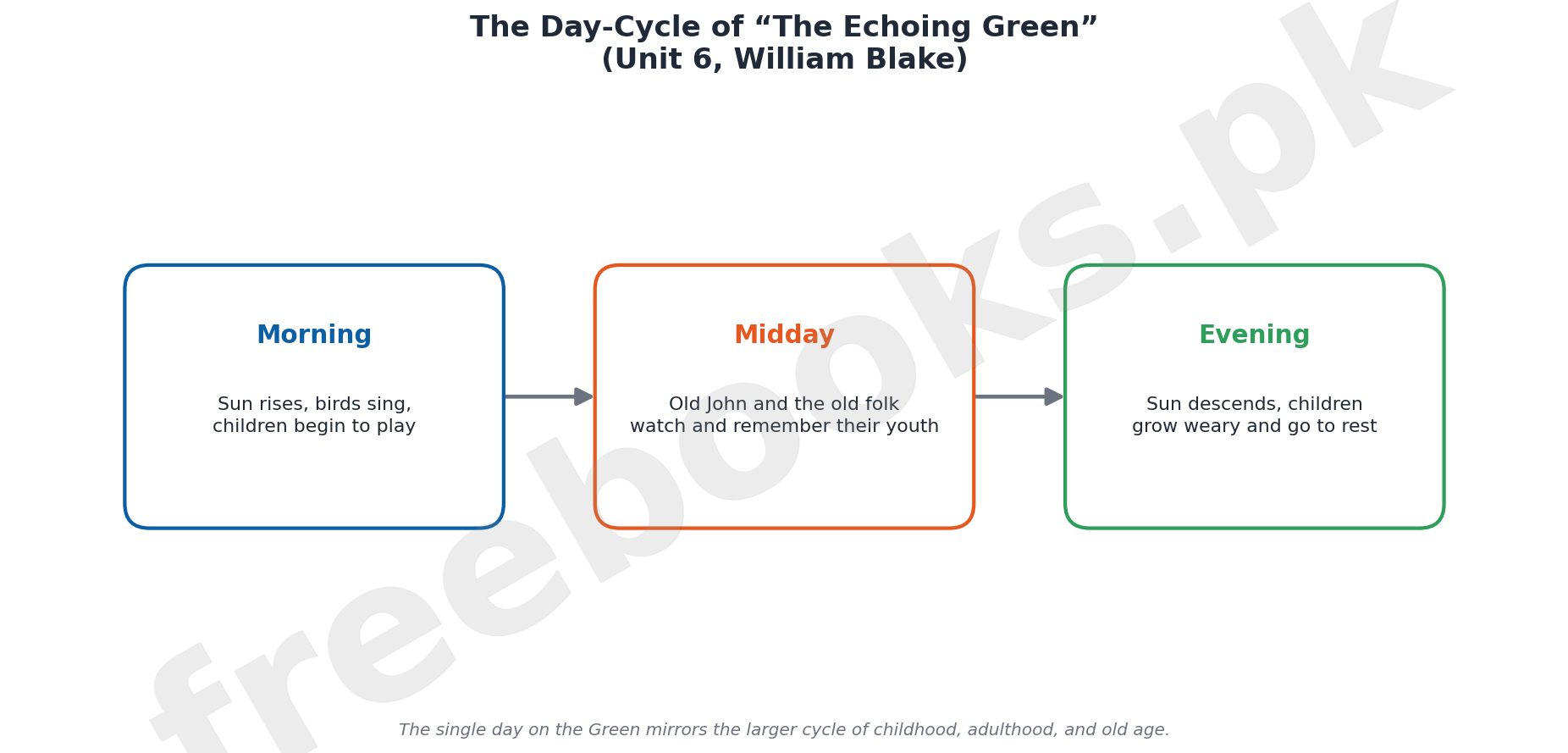
The Day-Cycle of the Poem: A sequential flow diagram of three connected boxes — Morning, Midday, and Evening — each captioned with the poem's corresponding stanza content, showing how the single-day cycle on the Echoing Green mirrors the larger cycle of childhood, adulthood, and old age.
Short Questions & Answers
What activities are taking place on the Echoing Green?
Children are playing joyful games ('sports') on the green, accompanied by ringing bells and birdsong, while the elderly watch from beneath an oak tree.
How does Blake portray the relationship between nature and human life in the poem?
Blake portrays nature and human life as harmonious and interconnected: the sun, birds, and bells celebrate the children's play, and the day's natural cycle from sunrise to sunset mirrors the human cycle from youth to old age.
What role do the 'old folk' play in the scene described?
The old folk, led by Old John, watch the children's play with joy, laughing away their cares and remembering their own youthful days on the same green, connecting the poem's generations through shared memory.
What is the significance of the shift from lively activity to quietness as the poem progresses?
The shift from lively morning play to a quiet, darkening evening mirrors the natural progression of a human life from active youth to restful old age, suggesting that this transition is peaceful and natural rather than something to fear.
How might the 'echoing' of the green symbolise memory or continuity between generations?
The 'echoing' suggests that the same joys and games are repeated across generations — the old folk's memories of their own youth on the green 'echo' in the children's play happening in front of them.
Identify an example of personification in the poem and explain its effect.
"The sun does arise, / And make happy the skies" personifies the sun and sky as capable of happiness, immediately establishing a joyful, welcoming tone for the poem's opening.
In what ways does the poem reflect the themes of innocence and the passage of time?
The children's carefree play reflects pure innocence, while the presence of Old John and the elderly, along with the day's progression from sunrise to sunset, reflects the passage of time and the cycle from youth to old age.
How might the poem be interpreted as a reflection on the cycles of life and the natural world?
By structuring the poem around a single day's natural cycle — sunrise, midday, sunset — Blake uses nature's rhythm as a metaphor for the human life cycle, suggesting that childhood, adulthood, and old age are as natural and peaceful as day turning to night.
Long Questions & Answers
Explain how William Blake uses the structure and imagery of a single day to reflect the cycle of human life in 'The Echoing Green'.
How does the poem's morning imagery represent childhood?
The first stanza's sunrise, cheerful bells, and singing birds represent the bright, joyful energy of childhood, with the children's 'sports' introduced as the natural centre of this lively morning scene.
How does the midday scene with Old John represent adulthood and memory?
The second stanza shifts to the old folk watching from beneath the oak, their laughter and memories of their own 'youth-time' representing a stage of life defined by reflection and connection to one's own past through the joy of others.
How does the evening imagery represent old age and rest?
The third stanza's setting sun and weary children returning to their mothers' laps, compared to birds settling into a nest, represent the peaceful winding-down of activity, mirroring old age as restful rather than sorrowful.
Why is this day-to-life structure an effective choice for the poem's theme?
Because a single day is something every reader has directly experienced, using its natural rhythm to represent the human life cycle makes the poem's message — that each stage of life is natural, connected, and worth celebrating — immediately relatable and emotionally accessible.
Discuss the significance of Old John and the 'old folk' in developing the poem's central idea.
What is Old John's role in the poem's scene?
Old John sits under the oak among the old folk, watching the children's play; his white hair marks him as elderly, and his laughter shows that observing the children's joy brings him relief from the cares of age.
What do the old folk's remembered words reveal about the poem's theme?
Their words, 'Such, such were the joys… in our youth-time were seen, on the Echoing Green,' directly state the poem's central idea — that the same joys experienced by the children were once experienced by the elderly themselves, linking the generations through shared, repeating experience.
How does the presence of the old folk change the meaning of the children's play?
Without the old folk, the children's play would simply be a scene of youthful joy; their presence transforms it into a demonstration of continuity, showing that childhood joy is not lost with age but lives on in memory and is renewed in each new generation.
What overall message does this generational connection communicate?
It communicates that life's joys are cyclical and shared rather than fleeting or exclusive to youth — the Echoing Green becomes a symbol of a joy that echoes across time, connecting every generation that has played, watched, and remembered there.
Multiple Choice Questions (MCQs)
Who is the poet of 'The Echoing Green'? (A) William Wordsworth (B) William Blake (C) Emily Dickinson (D) John Keats
Correct answer: (B) William Blake. 'The Echoing Green' was written by William Blake (1757-1827).
What time of day does the poem's first stanza describe? (A) Noon (B) Sunrise (C) Midnight (D) Sunset
Correct answer: (B) Sunrise. The first stanza opens with 'The sun does arise', describing sunrise.
Who is 'Old John' in the poem? (A) A young boy playing games (B) An elderly man sitting under the oak (C) The poet himself (D) A bird singing in the bush
Correct answer: (B) An elderly man sitting under the oak. Old John is described as an elderly man with white hair, sitting under the oak among the old folk.
What do the old folk say as they watch the children play? (A) "Be careful and quiet." (B) "Such, such were the joys… in our youth-time were seen." (C) "The Green is not safe today." (D) "We must go home now."
Correct answer: (B) "Such, such were the joys… in our youth-time were seen.". The old folk remember, 'Such, such were the joys… when we all girls & boys, in our youth-time were seen, on the Echoing Green.'
What happens to the children's play as the poem progresses? (A) It continues into the night (B) It ends when the sun descends and they grow weary (C) It is interrupted by rain (D) It moves indoors
Correct answer: (B) It ends when the sun descends and they grow weary. As the sun descends and the children grow weary, their sports come to a natural end and they are 'ready for rest.'
To what are the tired children compared in the final stanza? (A) Flowers closing at night (B) Birds in their nest (C) Falling leaves (D) Sleeping cats
Correct answer: (B) Birds in their nest. The children are compared to 'birds in their nest', a simile conveying warmth, safety, and natural rest.
"The sun does arise, / And make happy the skies" is an example of: (A) Simile (B) Personification (C) Alliteration (D) Metaphor
Correct answer: (B) Personification. This line personifies the sun and sky by giving them the human quality of happiness.
What does 'the Echoing Green' most likely symbolise? (A) A dangerous, forbidden place (B) A shared, timeless space where childhood joy repeats across generations (C) A place of sadness and loss (D) A location only children may visit
Correct answer: (B) A shared, timeless space where childhood joy repeats across generations. The Green symbolises a space where the same joys are experienced and remembered across generations, linking the young and the old.
Which structural pattern does the poem follow to reflect the human life cycle? (A) Night to day (B) Morning, midday, evening (C) Spring to winter (D) City to countryside
Correct answer: (B) Morning, midday, evening. The poem's three stanzas move from morning to midday to evening, mirroring the stages of childhood, adulthood, and old age.
The word 'weary' in the poem most nearly means: (A) Excited (B) Very tired (C) Frightened (D) Curious
Correct answer: (B) Very tired. 'Weary' means very tired, especially after doing something for a long time — here, after a full day of play.
Quick Revision Summary
- 'The Echoing Green' was written by William Blake (1757-1827), reflecting themes of innocence, nature, and the cycle of life.
- The poem has three stanzas of ten lines each, structured around a single day: morning, midday, and evening.
- Stanza 1 opens at sunrise, with cheerful bells and birdsong welcoming the children's play on the Green.
- Stanza 2 introduces Old John and the old folk, who watch the children and remember their own youth on the same green.
- Stanza 3 shows the sun descending and the weary children returning to their mothers, 'like birds in their nest'.
- "The sun does arise, / And make happy the skies" is a key example of personification in the poem.
- The children's tiredness is expressed through a simile comparing them to birds settling into a nest.
- The Echoing Green symbolises a shared, timeless space linking childhood joy across generations.
- The poem's central idea is the joyful, harmonious relationship between nature and human life, and the natural cycle from youth to old age.
- The 'darkening Green' at the poem's end suggests peaceful rest, not sorrow, paralleling old age as a natural, calm stage of life.
Exam Tips
- This unit belongs to PECTAA's 'poem group' (Units 3, 6, 11, 13), which under the current paper pattern carries lighter weight — 3 synonym questions and 2 MCQs are drawn from these poem units, and only 5 of 8 short questions from this group need to be attempted.
- The poem group is specifically and reliably tested with the question 'Explain the given stanza with reference to context' (5 marks) — practice writing a stanza-by-stanza explanation exactly like the one in this unit's notes, covering meaning, imagery, and how the stanza fits the poem's progression.
- Since any one of the three stanzas could be set for the 'reference to context' question, make sure you can explain all three, not just your favourite one — the stanza-wise section in these notes covers every stanza in full.
- Memorise the literary device definitions together with their exact example lines from the poem — personification ('make happy the skies'), simile ('like birds in their nest'), and symbolism (the Green itself) — as examiners often ask you to identify the device from a quoted line.
- Know the poet's background facts (William Blake, 1757-1827, English poet and painter, known for combining poetry with illustration) since short questions in the poem group often test factual recall about the poet alongside the poem's content.
- Practice paraphrasing at least one stanza in your own words, as the textbook itself sets paraphrasing as a specific writing task for this unit.