
This unit presents Robert Hayden's poem 'Those Winter Sundays', as given in the Class 11 English textbook of the PECTAA Board under the Updated National Curriculum of Pakistan 2023.
The poem is a reflective, adult look back at a father's quiet, unappreciated sacrifices on cold winter mornings, exploring how love can be expressed through difficult, silent action rather than words, and how such love is often only recognised in hindsight, with regret.
These notes summarise the poem's content, structure, and meaning strictly based on the textbook's presentation, and provide a stanza-by-stanza paraphrase and explanation (the specific skill tested in the exam question 'explain the given stanza with reference to context'), literary devices, comprehension questions, vocabulary, and exam-oriented material for this unit. As the poem remains under copyright, its text is paraphrased throughout rather than quoted in full, with only brief quoted fragments used for reference.
Learning Objectives
- Use complex questions for a range of audiences based on the poem's themes.
- Identify rhyme scheme and figurative language in the poem.
- Summarise the poem's content by paraphrasing it using correct language structure and own words.
- Consult reference materials to clarify the precise meaning of unfamiliar words.
- Demonstrate command of standard English capitalisation, punctuation, and spelling.
- Write a dialogue using appropriate vocabulary, tone, and narration conventions, inspired by the poem's family theme.
Key Concepts
About the Poet: Robert Hayden
Robert Hayden (1913-1980) was an American poet known for his reflective, emotional poetry about family, history, and African American experiences. Born in Detroit, he grew up in a foster home marked by hardship, an experience that inspired many of his poems, including 'Those Winter Sundays.'
Educated at Detroit City College and the University of Michigan, Hayden became the first African American Consultant in Poetry to the Library of Congress (equivalent to U.S. Poet Laureate). His famous works include 'Middle Passage', 'Frederick Douglass', and 'Those Winter Sundays', celebrated for their emotional depth and vivid imagery.
What the Poem Describes
The poem is spoken by an adult looking back on his childhood. It describes how, even on Sundays, his father would rise early in the freezing pre-dawn cold to light the household fires and warm the house before anyone else woke, despite hands sore and damaged from a hard week's physical labour — sacrifices that went completely unthanked at the time.
The child would eventually wake to the sound of the cold breaking as the house warmed, then rise reluctantly, not out of gratitude but out of a quiet fear of the tense, difficult atmosphere in the home. Speaking to his father with indifference as a child, the speaker did not recognise the additional small kindnesses his father performed, such as warming the house and caring for his belongings.
The poem closes with the adult speaker's regretful realisation of how little he understood, as a child, about the demanding, solitary, often unacknowledged nature of a parent's love — expressed through the poem's central closing image of love as a set of difficult, lonely duties carried out without expectation of thanks.
Central Theme: Unspoken Parental Love and Regret
The poem explores the theme of unspoken parental love, where a father's quiet, selfless sacrifices go unnoticed and unappreciated by his child. Through vivid imagery of harsh winter mornings and the father's physical labour, the poem highlights how love is often shown through actions rather than affectionate words.
It also captures the theme of regret and realisation, as the adult speaker looks back with remorse for failing to recognise his father's devotion. The tension in the household adds depth to the emotional distance between father and child, ultimately revealing that true love can be silent, enduring, and often unacknowledged.
Structure and Literary Devices
The poem is written in free verse, lacking a consistent rhyme scheme or meter, which creates a natural, conversational, and reflective style suited to the speaker's retrospective tone. It is arranged in three stanzas of uneven length (five, four, and five lines).
Key literary devices include vivid imagery describing the harsh winter cold and the father's physical hardship; symbolism, where winter represents emotional distance and fire represents the father's love and warmth; alliteration adding rhythm to key phrases; repetition of a key regretful question near the poem's end, emphasising the speaker's growing understanding; and a central metaphor comparing parental love to demanding, solitary duties. The poem's tone shifts from a neutral, descriptive opening to a reflective, regretful close, tracing the speaker's emotional realisation.
Stanza-wise Paraphrase and Explanation
This poem remains under copyright, so it is not reproduced in full here. Each stanza is explained below in original, paraphrased words, with only short quoted phrases used for reference.
Stanza 1
The poem opens by describing how, even on Sundays, the father rose early and dressed in the intensely cold, dark early morning — captured in the poem's well-known invented phrase "blueblack cold", which conveys both the colour and depth of the pre-dawn chill. Though his hands were "cracked" and sore from a week of hard physical labour, the father lit the household fires himself and worked them into a blaze to warm the house before anyone else woke. The stanza's blunt final statement, "No one ever thanked him", introduces the poem's central irony: this daily act of quiet sacrifice went completely unacknowledged by his family.
Stanza 2
The speaker recalls waking to the sound of the cold "splintering, breaking" as the house warmed, an image that gives the father's effort an almost physical, audible presence. Once the rooms were warm, the father would call for the speaker to get up, and the child would rise slowly and dress — not out of gratitude, but, as the speaker admits, out of fear of "the chronic angers of that house", a phrase suggesting a tense, emotionally difficult home atmosphere that stood between father and child.
Stanza 3
In the final stanza, the adult speaker admits to having spoken "indifferently" to his father as a child, despite the father having driven out the cold and even polished the child's shoes — small additional acts of care that went unnoticed at the time. The poem closes with its most reflective and regretful lines: the repeated question "What did I know, what did I know" underscores the speaker's belated realisation of how much he failed to understand as a child, and the poem's closing metaphor describes parental love as consisting of "austere and lonely offices" — difficult, thankless duties carried out in solitude, without expectation of recognition.
Important Definitions (Glossary)
ache
to feel a continuous pain that is not severe
austere
simple and plain; without any decoration
bank
to pile coal, etc. on a fire so that it burns slowly for a long time
blaze
to burn brightly and strongly
chronic
lasting a long time; difficult to solve
cracked
damaged with lines in its surface but not completely broken
indifferently
in a way that shows you are not interested in or do not care about somebody/something
lonely
where only a few people ever come or visit
office
here, a duty or task performed for somebody, especially one that is difficult or unpleasant
splinter
to break, or to make something break, into small, thin, sharp pieces
Poem at a Glance
| Aspect | Key Fact |
|---|---|
| Poet | Robert Hayden (1913-1980), first African American U.S. Poet Laureate. |
| Publication | Widely considered one of Hayden's most celebrated poems, drawing on his difficult childhood in foster care. |
| Form | Three stanzas of uneven length (five, four, five lines), written in free verse. |
| Central theme | Unspoken parental love expressed through quiet sacrifice, and the adult speaker's regret at failing to recognise it as a child. |
| Key symbolism | Winter/cold represents emotional distance; fire represents the father's unspoken love and warmth. |
| Key phrase (5 words) | "No one ever thanked him" — the poem's central statement of unacknowledged sacrifice. |
| Closing metaphor | Parental love described as "austere and lonely offices" — difficult, solitary, thankless duties. |
| Tone shift | Moves from a neutral, descriptive opening to a reflective, regretful close. |
Diagram
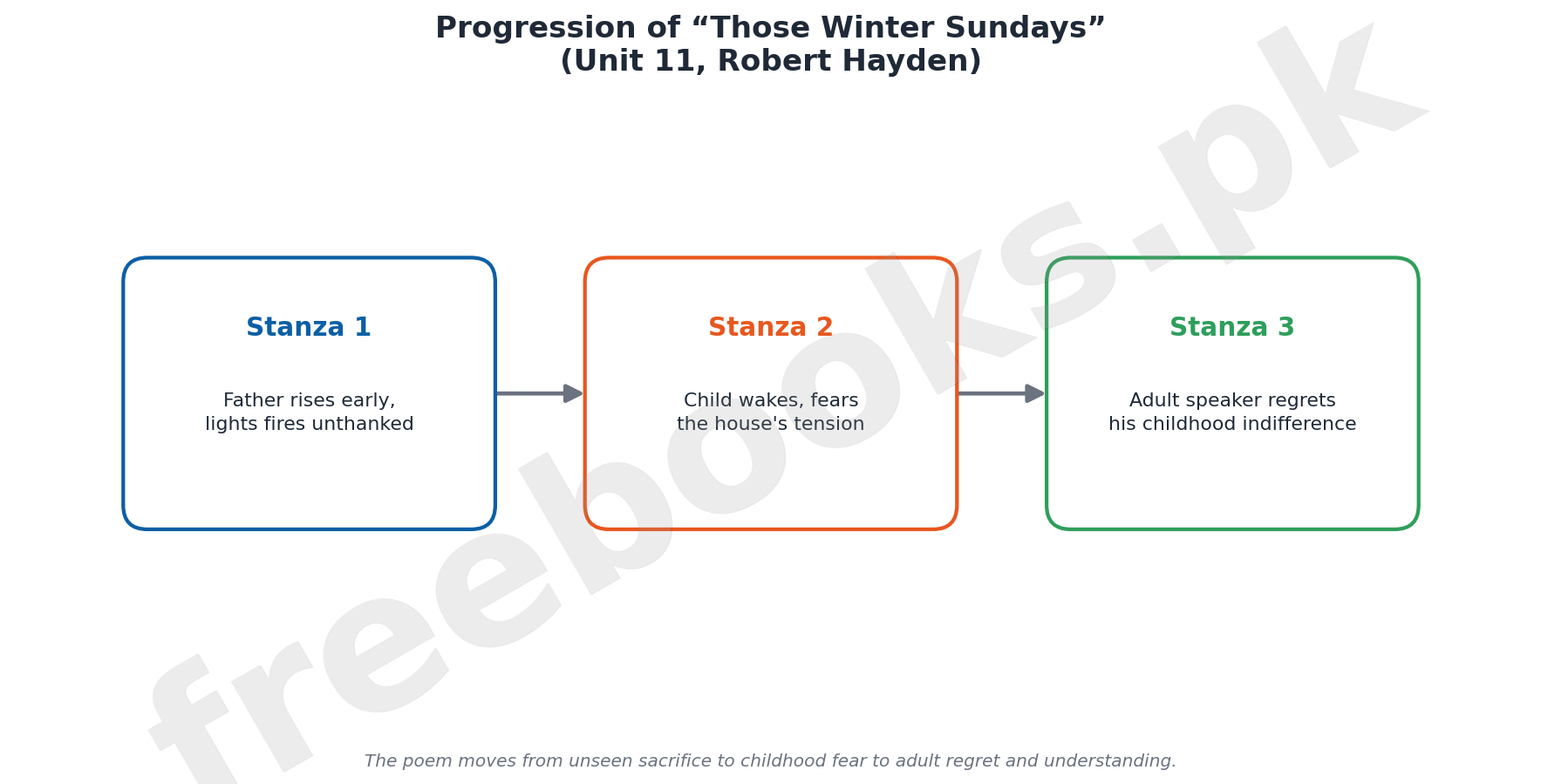
Progression of the Poem: A sequential flow diagram of three connected boxes, one per stanza, tracing the poem's movement from the father's unseen morning sacrifice, through the child's fear and indifference, to the adult speaker's final regret and realisation about the nature of parental love.
Short Questions & Answers
What is Robert Hayden's attitude towards the father's sacrifices in the poem?
Hayden treats the father's sacrifices with quiet respect and underlying sorrow, showing through the adult speaker's regretful, reflective tone that these unthanked acts deserved far more recognition than they received at the time.
How does the speaker's viewpoint change from childhood to adulthood?
As a child, the speaker responded with fear and indifference to his father's efforts, but as an adult looking back, he recognises and regrets his failure to understand the depth of his father's quiet devotion.
Why does the speaker use the phrase 'blueblack cold' to describe the winter morning?
This vivid, invented compound word conveys both the visual darkness and the intense, biting quality of the early morning cold, immediately establishing the harshness the father endured before anyone else woke.
What does the phrase 'No one ever thanked him' reveal about the father's efforts?
It reveals that the father's daily sacrifice went completely unacknowledged by his family, establishing the poem's central irony between the scale of his effort and the total absence of recognition.
What can be inferred about the father's job from the description of his hands?
The description of his hands as 'cracked' and aching from labour suggests the father worked in physically demanding, likely manual work throughout the week, leaving him in pain even before his Sunday morning duties.
What does 'the chronic angers of that house' suggest about the family's emotional environment?
It suggests a long-lasting, tense, and difficult atmosphere within the home, hinting at unspoken conflict or hardship that created emotional distance between the speaker and his father.
Why does the speaker repeat 'What did I know, what did I know' near the end of the poem?
The repetition emphasises the speaker's deep regret and dawning realisation, as an adult, of how little he understood as a child about the difficult, selfless nature of his father's love.
What does the closing image of love as 'austere and lonely offices' suggest about parental love?
It suggests that genuine parental love can take the form of difficult, solitary, and thankless duties performed without expectation of recognition, rather than being expressed through affectionate words.
Long Questions & Answers
Discuss how Robert Hayden conveys the theme of unspoken parental love across the three stanzas of the poem.
How does stanza one establish the father's unacknowledged sacrifice?
The first stanza describes the father rising early into the 'blueblack cold' with hands already 'cracked' from a week of labour, lighting the household fires alone, and closes with the blunt statement 'No one ever thanked him', establishing that his sacrifice went entirely unrecognised.
How does stanza two show the child's response to the father's efforts?
The second stanza shows the child waking to the sound of the warming house and rising slowly, but motivated by fear of 'the chronic angers of that house' rather than gratitude, revealing the emotional distance and tension present within the family.
How does stanza three convey the adult speaker's regret?
The final stanza reveals the child spoke 'indifferently' to a father who had also quietly cared for him in small ways, and the adult speaker's repeated question 'What did I know, what did I know' expresses his belated, sorrowful understanding of what he failed to appreciate.
What does the poem ultimately suggest about how love can be expressed?
The poem suggests that genuine love does not require words or visible affection — it can be expressed silently, through difficult, repeated, physical acts of care, and may only be recognised and understood long after the fact, as captured in the closing metaphor of love's 'austere and lonely offices.'
Explain the literary devices used in 'Those Winter Sundays' and discuss how they contribute to the poem's emotional impact.
How does imagery contribute to the poem's meaning?
Vivid imagery, such as the description of the intense pre-dawn cold and the father's cracked, aching hands, creates a strong sensory impression of the harsh conditions and physical toll of the father's sacrifice, making his unacknowledged effort feel immediate and real to the reader.
How does the poem use symbolism?
Winter and cold symbolise emotional distance within the family, while the fire the father lights symbolises his quiet, warming love — a contrast that runs throughout the poem and culminates in the final stanza's reflection on the nature of that love.
What effect does the poem's free verse form have on its tone?
Because the poem lacks a fixed rhyme scheme or meter, it reads in a natural, conversational, reflective voice appropriate to an adult recalling and processing a childhood memory, rather than sounding formal or artificially poetic.
How does repetition affect the poem's closing impact?
The repeated phrase 'What did I know, what did I know' slows the poem down at its most emotional point, mimicking the halting, regretful voice of someone genuinely grappling with a realisation, and reinforces the depth of the speaker's remorse.
Multiple Choice Questions (MCQs)
Who is the poet of 'Those Winter Sundays'? (A) Langston Hughes (B) William Blake (C) Robert Hayden (D) Emily Dickinson
Correct answer: (C) Robert Hayden. 'Those Winter Sundays' was written by Robert Hayden (1913-1980).
What position did Robert Hayden hold, making him a historic figure in American poetry? (A) U.S. Secretary of Education (B) First African American Consultant in Poetry to the Library of Congress (C) Poet Laureate of the United Kingdom (D) President of a major university
Correct answer: (B) First African American Consultant in Poetry to the Library of Congress. Hayden became the first African American Consultant in Poetry to the Library of Congress, equivalent to U.S. Poet Laureate.
What does the father do early in the morning, even on Sundays? (A) Reads the newspaper (B) Lights the household fires to warm the house (C) Prepares breakfast for the family (D) Goes to work at his job
Correct answer: (B) Lights the household fires to warm the house. The father rises early even on Sundays to light the fires and warm the house before the family wakes.
How are the father's hands described in the poem? (A) Soft and delicate (B) Cracked and aching from labour (C) Cold and lifeless (D) Clean and smooth
Correct answer: (B) Cracked and aching from labour. The father's hands are described as cracked and aching from a week of physical labour.
What is the effect of the statement 'No one ever thanked him'? (A) It shows the father did not deserve thanks (B) It highlights that his sacrifice went completely unacknowledged (C) It suggests the father did not want thanks (D) It shows the family was often away
Correct answer: (B) It highlights that his sacrifice went completely unacknowledged. This blunt statement highlights the central irony of the poem: the father's daily sacrifice was never acknowledged.
What does the child fear each morning, according to the poem? (A) Being late for school (B) The chronic angers of the house (C) The cold weather outside (D) Losing his father's approval
Correct answer: (B) The chronic angers of the house. The child rises out of fear of 'the chronic angers of that house', suggesting a tense home atmosphere.
How does the speaker describe his own behaviour towards his father as a child? (A) Warm and affectionate (B) Indifferent (C) Openly hostile (D) Constantly grateful
Correct answer: (B) Indifferent. The adult speaker admits to having spoken 'indifferently' to his father as a child.
What form is the poem written in? (A) A strict sonnet (B) Free verse (C) Rhyming couplets (D) A limerick
Correct answer: (B) Free verse. The poem is written in free verse, lacking a consistent rhyme scheme or meter.
What does the poem's closing metaphor compare parental love to? (A) A joyful celebration (B) Austere and lonely offices (difficult, solitary duties) (C) A simple gift (D) A public performance
Correct answer: (B) Austere and lonely offices (difficult, solitary duties). The poem closes by comparing parental love to 'austere and lonely offices' — difficult, thankless, solitary duties.
What is the central theme of 'Those Winter Sundays'? (A) The beauty of winter landscapes (B) Unspoken parental love and the speaker's later regret (C) The importance of punctuality (D) A celebration of family holidays
Correct answer: (B) Unspoken parental love and the speaker's later regret. The poem's central theme is unspoken parental love, expressed through sacrifice, and the adult speaker's regret at not recognising it sooner.
Quick Revision Summary
- 'Those Winter Sundays' was written by Robert Hayden (1913-1980), the first African American U.S. Poet Laureate.
- The poem has three stanzas of uneven length, written in free verse without a fixed rhyme scheme.
- Stanza 1 describes the father rising early into the cold to light fires, an effort that went unthanked.
- Stanza 2 shows the child rising out of fear of the household's tense atmosphere, not gratitude.
- Stanza 3 reveals the adult speaker's regret at having spoken indifferently to a father who quietly cared for him.
- Winter and cold symbolise emotional distance; fire symbolises the father's silent love and warmth.
- The poem's closing lines compare parental love to demanding, solitary, thankless duties.
- Repetition of a regretful question near the poem's end emphasises the speaker's belated understanding.
- The poem's tone shifts from neutral and descriptive to reflective and regretful.
- The central theme is that true love can be silent, enduring, and often unacknowledged until much later.
Exam Tips
- This unit belongs to PECTAA's 'poem group' (Units 3, 6, 11, 13), which under the current paper pattern carries lighter weight — 3 synonym questions and 2 MCQs are drawn from these poem units, and only 5 of 8 short questions from this group need to be attempted.
- The poem group is specifically and reliably tested with the question 'Explain the given stanza with reference to context' (5 marks) — since this poem is under copyright, practise explaining each stanza in your own words (paraphrase) rather than memorising it verbatim, focusing on meaning, imagery, and how the stanza fits the poem's progression.
- Make sure you can explain all three stanzas individually, since any one could be set for a reference-to-context question — the stanza-wise section in these notes covers every stanza in full.
- Learn the poet's background facts (Robert Hayden, first African American U.S. Poet Laureate, difficult childhood in foster care) since short questions in the poem group often test factual recall about the poet alongside the poem's content.
- Memorise the literary device definitions together with the short quoted phrases associated with them — imagery ('blueblack cold'), symbolism (winter vs fire), and the closing metaphor ('austere and lonely offices') — as examiners often ask you to identify the device from a quoted phrase.
- Practise paraphrasing the poem in your own words, since the textbook itself sets this as a specific writing task for this unit.