This unit presents Emily Dickinson's poem 'A Bird Came Down the Walk', as given in the Class 11 English textbook of the PECTAA Board under the Updated National Curriculum of Pakistan 2023.
The poem is a close, intimate observation of a bird as it eats a worm, drinks dew, lets a beetle pass, notices the speaker, cautiously accepts nothing from an offered crumb, and finally flies away with silent grace. Written in the 19th century, it presents nature with a blend of beauty and raw reality rather than the more romanticised nature poetry common among Dickinson's contemporaries.
These notes summarise the poem strictly as given in the textbook, provide the full poem text, a stanza-wise explanation (the specific skill tested in the exam question 'explain the given stanza with reference to context'), literary devices with examples from the poem, comprehension questions, vocabulary, and exam-oriented material for this unit.
Learning Objectives
- Identify the rhyme scheme and the quatrain (four-line) stanza structure used in the poem.
- Interpret figures of speech such as simile, personification, imagery, and symbolism in context and analyse their role in the poem.
- Analyse multiple interpretations of the poem's imagery, evaluating how each interpretation is supported by textual evidence.
- Cite strong and thorough textual evidence to support analysis of what the poem states explicitly, as well as inferences drawn from it.
- Identify and correctly use compound prepositions and prepositional phrases in writing.
- Use summary-writing skills to write an objective summary of the poem, covering its main idea, key imagery, and emotional tone.
Key Concepts
About the Poet: Emily Dickinson
Emily Dickinson (1830-1886) was an American poet known for her unique and unconventional style. Much of her poetry explores themes of nature, life, death, and the human experience, often through a deeply introspective and reflective lens.
Like many of Dickinson's poems, 'A Bird Came Down the Walk' was not published during her lifetime. It was only after her death that her work was brought to the public, and even then it was often edited to fit more conventional poetic norms of the time. Today, Dickinson is celebrated for her original voice and her contributions to American poetry.
Background to the Poem
'A Bird Came Down the Walk' is one of Emily Dickinson's many poems that examines nature in a detailed and intimate manner. Written in the 19th century, during a time when nature was a common subject in literature, Dickinson's approach to nature is distinct in its close observation and subtle complexity.
Unlike the more romanticised views of nature held by her contemporaries, Dickinson often presents nature with a blend of beauty and raw reality, capturing both its grace and its underlying brutality — a quality clearly visible in this poem, where the bird's violent treatment of the worm sits alongside its delicate, graceful flight.
Theme: Nature's Balance
The poem contrasts the beauty and brutality of nature, showing how these elements coexist harmoniously. The bird's actions — such as eating a worm and then gracefully avoiding a beetle — highlight this delicate balance between raw survival and gentle grace within a single, ordinary moment observed on a garden walk.
Theme: Human Interaction with Nature
The poem explores the distance between humans and the natural world. The speaker observes the bird and offers it a crumb, but the bird's decision to fly away underscores nature's independence and the boundary that exists between human interaction and natural autonomy.
Theme: Freedom and Independence
The bird symbolises freedom and self-reliance. Its refusal of the crumb and its graceful flight reflect the theme of natural independence and the desire to remain untamed by human influence, even when that influence is offered gently.
Theme: Innocence and Danger
The poem subtly contrasts innocence with the potential for danger. The bird's cautious behaviour, especially in the line 'Like one in danger, Cautious,' suggests an underlying awareness of threats present even in an otherwise peaceful moment.
Poem Text
A Bird came down the Walk—
He did not know I saw—
He bit an Angleworm in halves
And ate the fellow, raw,
And then he drank a Dew
From a convenient Grass—
And then hopped sideways to the Wall
To let a Beetle pass—
He glanced with rapid eyes
That hurried all around—
They looked like frightened Beads, I thought—
He stirred his Velvet Head
Like one in danger, Cautious,
I offered him a Crumb
And he unrolled his feathers
And rowed him softer home—
Than Oars divide the Ocean,
Too silver for a seam—
Or Butterflies, off Banks of Noon
Leap, plashless as they swim.
Stanza-wise Explanation
Stanza 1
A Bird came down the Walk—
He did not know I saw—
He bit an Angleworm in halves
And ate the fellow, raw,
The poem opens with the speaker secretly watching a bird that has come down onto a garden walk, unaware it is being observed. The bird immediately bites an angleworm in half and eats it raw, a startlingly blunt and violent image with which to open the poem. This direct, unflinching visual imagery sets the poem's tone of close, honest observation, establishing from the very first stanza that Dickinson will present nature's raw reality rather than a softened, sentimental picture of it.
Stanza 2
And then he drank a Dew
From a convenient Grass—
And then hopped sideways to the Wall
To let a Beetle pass—
Immediately after the violence of the first stanza, the bird's behaviour turns gentle and considerate: it drinks a drop of dew from a nearby blade of grass and then hops aside to let a beetle pass by unharmed. This sudden shift from predator to polite neighbour captures the poem's central idea of nature's balance — the same creature capable of raw brutality is equally capable of small, almost courteous grace, showing that beauty and harshness exist side by side in the natural world.
Stanza 3
He glanced with rapid eyes
That hurried all around—
They looked like frightened Beads, I thought—
He stirred his Velvet Head
Here the speaker studies the bird's eyes and head in close detail. Its eyes dart rapidly in every direction, and the speaker compares them, through simile, to 'frightened Beads' — small, hard, glassy, and anxious. The bird then stirs its 'Velvet Head', a tactile, personifying image that lends it a soft, delicate quality. This stanza builds the poem's watchful, slightly tense mood, showing the bird's instinctive wariness even as it is described with tenderness.
Stanza 4
Like one in danger, Cautious,
I offered him a Crumb
And he unrolled his feathers
And rowed him softer home—
The speaker now enters the scene directly, offering the bird a crumb, but the bird's cautious response — behaving 'Like one in danger' — signals its instinctive distrust of the human presence. Rather than accepting the offer, it unrolls its feathers and 'rows' itself away, softer and more controlled than a startled flight. This marks the turning point of the poem, where human interaction is gently but firmly declined, foreshadowing the bird's final, independent departure.
Stanza 5
Than Oars divide the Ocean,
Too silver for a seam—
Or Butterflies, off Banks of Noon
Leap, plashless as they swim.
The final stanza extends the image of the bird's flight into an extended comparison: its wings divide the air the way oars divide the ocean, too smooth and silver to leave any seam or trace, and it moves as soundlessly as butterflies leaping, 'plashless', from sunlit banks. This closing imagery symbolises the bird's — and nature's — complete freedom, its untroubled, seamless grace forming a striking contrast to the raw, violent opening image and completing the poem's balance between beauty and brutality.
Important Definitions (Glossary)
angleworm
another term for an earthworm, commonly used in the 19th century
beads
a small piece of glass, wood, etc., with a hole through it, that can be put on a string with others of the same type and worn as jewellery, etc.
cautious
being careful about what you say or do, especially to avoid danger or mistakes; not taking any risks
convenient
useful, easy or quick to do; not causing problems
dew
the very small drops of water that form on the ground, etc. during the night
oars
a long pole with a flat part at one end that is used for rowing a boat
plashless
an old-fashioned word meaning without splashing, used to describe the silent, graceful movement of the bird in flight
seam
a line along which two edges of cloth, etc. are joined or sewn together
velvet
a type of cloth made from silk, cotton or nylon, with a thick, soft surface
Poem at a Glance
| Aspect | Key Fact |
|---|---|
| Poet | Emily Dickinson (1830-1886). |
| Form | Five quatrain stanzas (four lines each). |
| Style | Close, intimate, unsentimental observation of nature — beauty and raw reality shown side by side. |
| Central theme | Nature's balance between beauty and brutality, and the bird's freedom and independence. |
| Simile | "They looked like frightened Beads, I thought—" — comparing the bird's eyes to beads using 'like'. |
| Personification | "He stirred his Velvet Head." — giving the bird's head a soft, human-like quality. |
| Imagery | "He bit an Angleworm in halves / And ate the fellow, raw," — vivid visual imagery of nature's raw reality. |
| Symbolism | The bird's silent, graceful flight in the final stanza symbolises freedom and untamed natural independence. |
Diagram
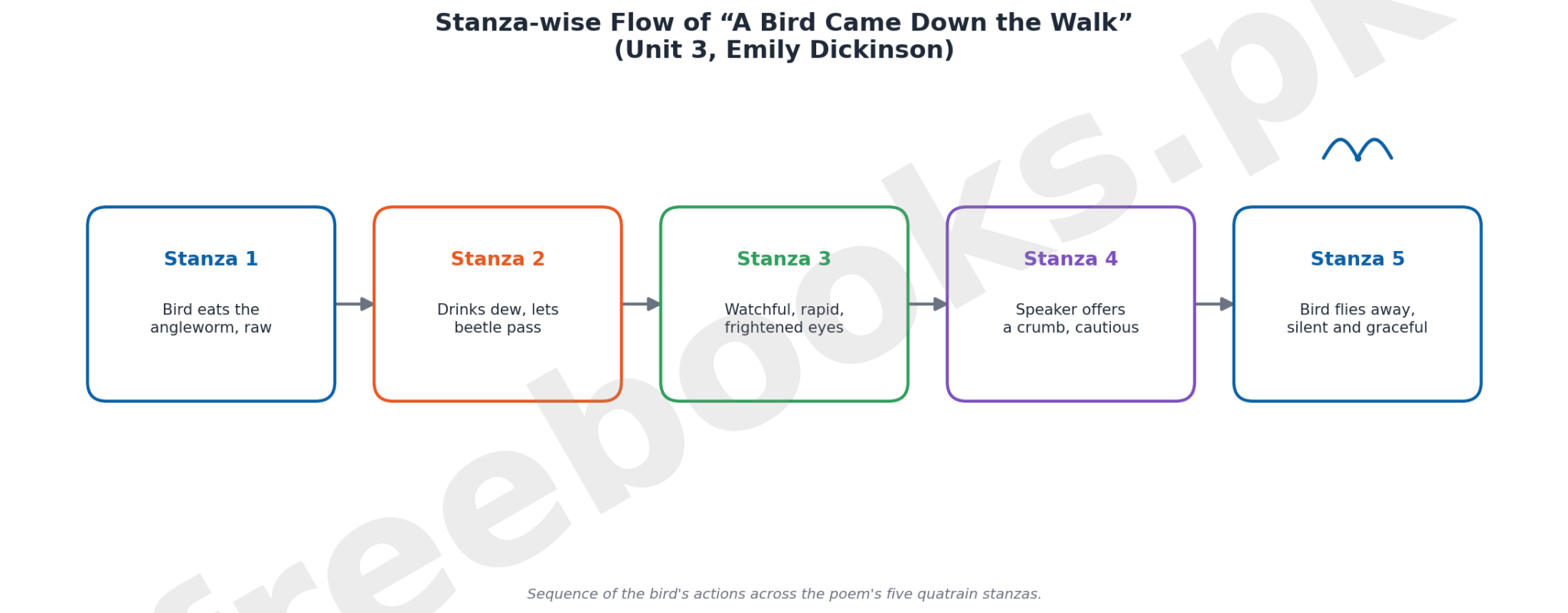
Stanza-wise Flow of the Poem: A sequential flow diagram of five connected boxes, one per stanza, captioned with the bird's action in that stanza — eating the worm, drinking dew and letting the beetle pass, watchful frightened eyes, the offered crumb, and the final graceful flight — joined by arrows showing the poem's progression, with a small abstract bird-icon accent marking the flight.
Short Questions & Answers
What is the first action the bird performs after coming down the walk?
The bird bites an angleworm in halves and eats it raw, a direct and unsentimental image of nature's brutality.
How does the bird behave towards the beetle?
The bird hops sideways to the wall to let the beetle pass, showing a small, almost courteous gesture of consideration within the natural world.
Identify the simile used to describe the bird's eyes and explain its effect.
The bird's eyes are compared to 'frightened Beads' — this simile conveys their small, glassy, rapidly-moving quality and suggests the bird's instinctive wariness.
Give an example of personification in the poem.
"He stirred his Velvet Head" personifies the bird by giving its head a soft, delicate, almost human quality through the word 'Velvet'.
How does the bird respond when the speaker offers it a crumb?
The bird behaves cautiously, 'Like one in danger', and instead of accepting the crumb, it unrolls its feathers and flies off, declining the human offer.
What does the bird's final flight symbolise?
The bird's silent, graceful flight symbolises freedom and natural independence, its untamed autonomy from human influence.
How is the bird's flight described in the final stanza?
Its flight is compared to oars dividing the ocean without a seam, and to butterflies leaping 'plashless' from sunlit banks — smooth, silent, and seamless.
What overall contrast does the poem draw about nature?
The poem contrasts nature's raw brutality, seen in the bird eating the worm, with its delicate grace, seen in its drinking of dew and its silent flight, showing that both exist together in nature.
Long Questions & Answers
Discuss the use of figurative language and imagery in 'A Bird Came Down the Walk'.
Explain the simile used in the poem with its example.
Dickinson uses a simile in the line 'They looked like frightened Beads, I thought—', comparing the bird's rapidly moving eyes to small, frightened beads using the word 'like'. This simile captures the hard, glassy, anxious quality of the bird's gaze, conveying its instinctive wariness and heightened alertness even in an apparently peaceful garden setting, and it deepens the reader's sense of the bird as a small, vulnerable, watchful creature.
Explain the personification used in the poem with its example.
In the line 'He stirred his Velvet Head', Dickinson personifies the bird by describing its head as 'Velvet', a word usually applied to soft, human-made cloth. This gives the bird a delicate, almost human tenderness, softening the reader's impression of the creature after the raw imagery of the opening stanza and reinforcing the poem's balance between nature's brutality and its beauty.
Explain the visual and tactile imagery used to describe the bird's actions.
The poem opens with vivid visual imagery in 'He bit an Angleworm in halves / And ate the fellow, raw,' which lets readers picture the bird's action clearly and conveys the unfiltered, raw aspect of nature. This is balanced by the tactile imagery of the 'Velvet Head', which appeals to the sense of touch and softens the tone, together illustrating how Dickinson blends harsh and gentle sensory detail throughout the poem.
Explain the symbolism of the bird's final flight.
The bird's graceful, untroubled flight at the end of the poem, described as dividing the air like oars divide the ocean 'too silver for a seam' and leaping 'plashless' like butterflies, symbolises freedom and the seamless, self-sufficient natural world. This flight contrasts with the human world's boundaries and limitations, reinforcing the theme that nature remains fundamentally independent of human influence, however gently that influence is offered.
Explain the theme of nature's balance between beauty and brutality in the poem, with reference to the speaker's interaction with the bird.
Discuss the bird's raw and violent action of eating the worm.
The poem opens with the bird biting an angleworm in halves and eating it 'raw' — a blunt, unsentimental image that shows nature's underlying brutality without any softening language. Dickinson does not use euphemism here; she presents the bird's predatory action directly, establishing from the outset that this poem will not romanticise nature but will show it exactly as observed, including its harsher realities.
Discuss the bird's graceful and delicate actions, such as drinking dew and stirring its head.
Immediately after the violent opening, the bird drinks a drop of dew from convenient grass, lets a beetle pass unharmed, and stirs its 'Velvet Head' — all gentle, almost courteous actions. These moments of delicacy sit directly beside the earlier brutality, and this juxtaposition is central to the poem's portrayal of nature's balance: the same small creature is capable of both raw survival instinct and quiet grace within moments of each other.
Explain the significance of the bird refusing the offered crumb.
When the speaker offers the bird a crumb, it responds cautiously, 'Like one in danger', and does not accept it — instead unrolling its feathers and flying off. This refusal is significant because it marks the boundary between the human world and the natural one; the bird does not need or trust human charity, and its cautious retreat shows that its instinct for self-preservation outweighs any comfort human interaction might offer.
What does the bird's behaviour reveal about freedom and independence as a theme?
The bird's refusal of the crumb and its subsequent graceful, silent flight reveal that it values its independence above any human offering. This reflects the broader theme of freedom and independence in the poem — the bird symbolises a natural world that remains self-reliant and untamed, choosing to fly away 'softer' and more controlled rather than accept a dependency on the speaker, reinforcing that true freedom includes the freedom to decline connection.
Multiple Choice Questions (MCQs)
What is the bird's first action when it comes down the walk? (A) It drinks from a puddle. (B) It bites an angleworm in halves. (C) It flies away. (D) It hops to a wall.
Correct answer: (B) It bites an angleworm in halves.. The poem's opening stanza states the bird 'bit an Angleworm in halves / And ate the fellow, raw,' as its first action.
How does the speaker describe the bird's eyes? (A) Bright as the sun. (B) Like sparkling jewels. (C) Like frightened Beads. (D) As calm and serene.
Correct answer: (C) Like frightened Beads.. The speaker describes the bird's eyes as looking 'like frightened Beads', a simile conveying their rapid, anxious movement.
What does the bird do after the speaker offers it a crumb? (A) Eats the crumb. (B) Flies away. (C) Sings a song. (D) Hops closer to the speaker.
Correct answer: (B) Flies away.. The bird behaves cautiously and, instead of accepting the crumb, unrolls its feathers and flies away.
The bird's flight in the final stanza is compared to: (A) Leaves falling from a tree. (B) Waves crashing on the shore. (C) Oars dividing the ocean. (D) Wind blowing through the trees.
Correct answer: (C) Oars dividing the ocean.. The final stanza compares the bird's flight to oars dividing the ocean, 'Too silver for a seam'.
How many stanzas does the poem have, and what is their structure? (A) Four stanzas of five lines each. (B) Five stanzas of four lines each (quatrains). (C) Six stanzas of three lines each. (D) Three stanzas of six lines each.
Correct answer: (B) Five stanzas of four lines each (quatrains).. The poem has five stanzas, each a quatrain comprised of four lines.
"He stirred his Velvet Head" is an example of: (A) Euphemism. (B) Oxymoron. (C) Simile. (D) Personification.
Correct answer: (D) Personification.. Describing the bird's head as 'Velvet' gives it a soft, human-like quality, which is personification.
Which line contains a simile? (A) "He bit an Angleworm in halves" (B) "And he unrolled his feathers" (C) "They looked like frightened Beads, I thought—" (D) "He stirred his Velvet Head"
Correct answer: (C) "They looked like frightened Beads, I thought—". The word 'like' signals the simile comparing the bird's eyes to frightened beads.
What does the bird's final flight symbolise in the poem? (A) Danger and threat. (B) Freedom and natural independence. (C) Sadness and loss. (D) Human dominance over nature.
Correct answer: (B) Freedom and natural independence.. The bird's graceful, silent flight symbolises freedom and its untamed independence from human influence.
In the phrase "a convenient Grass", the word 'convenient' most nearly means: (A) Expensive. (B) Useful or easy to reach, causing no problems. (C) Dangerous. (D) Colourful.
Correct answer: (B) Useful or easy to reach, causing no problems.. 'Convenient' means useful, easy, or quick to make use of, without causing problems — here, grass that is easy for the bird to drink dew from.
The word 'plashless', used to describe the bird's flight, means: (A) Loud and splashing. (B) Without splashing, silent and graceful. (C) Slow and clumsy. (D) Bright and colourful.
Correct answer: (B) Without splashing, silent and graceful.. 'Plashless' is an old-fashioned word meaning without splashing, describing the bird's silent, graceful movement.
Quick Revision Summary
- 'A Bird Came Down the Walk' is by Emily Dickinson (1830-1886), an American poet whose work was mostly published after her death.
- The poem has five quatrain stanzas (four lines each).
- The bird's first action is biting and eating an angleworm raw — a blunt image of nature's brutality.
- The bird drinks dew and hops aside to let a beetle pass, showing nature's gentler side.
- The bird's eyes are compared to 'frightened Beads' — a simile showing its wariness.
- "He stirred his Velvet Head" personifies the bird with soft, tender, human-like qualities.
- The speaker offers the bird a crumb, but it responds cautiously, 'Like one in danger'.
- The bird refuses the crumb and flies away rather than accept human interaction.
- The final stanza's imagery of oars and plashless butterflies symbolises the bird's freedom and independence.
- The poem shows nature's balance: beauty and brutality, delicacy and danger, existing side by side.
Exam Tips
- This unit belongs to PECTAA's 'poem group' (Units 3, 6, 11, 13), which under the current paper pattern carries lighter weight — 3 synonym questions and 2 MCQs are drawn from these poem units, and only 5 of 8 short questions from this group need to be attempted.
- The poem group is specifically and reliably tested with the question 'Explain the given stanza with reference to context' (5 marks) — practice writing a stanza-by-stanza explanation exactly like the one in this unit's notes, covering meaning, imagery, and how the stanza fits the poem's progression.
- Since any one of the five stanzas could be set for the 'reference to context' question, make sure you can explain all five, not just your favourite one — the stanza-wise section in these notes covers every stanza in full.
- Memorise the literary device definitions together with their exact example lines from the poem — simile ('like frightened Beads'), personification ('Velvet Head'), imagery (the angleworm lines), and symbolism (the final flight) — as examiners often ask you to identify the device from a quoted line.
- Know the poet's background facts (Emily Dickinson, 1830-1886, American, reclusive, posthumously published) since short questions in the poem group often test factual recall about the poet alongside the poem's content.
- Remember that Dickinson does not use euphemism or oxymoron in this poem — if a question asks you to find an example of either, the correct response is to note their absence, as the poem's language is direct rather than softened or contradictory.