This unit presents the essay 'The Impact of AI on Society, Human Relationships, and Ethics', as given in the Class 11 English textbook of the PECTAA Board under the Updated National Curriculum of Pakistan 2023.
The essay is an argumentative/informative piece explaining what Artificial Intelligence (AI) is, how it has transformed sectors such as healthcare, education, and finance, how it has reshaped human relationships and communication, and the ethical concerns — privacy, bias, accountability — that arise from its widespread use, before closing with principles for its responsible use.
These notes summarise the essay's content and structure strictly based on the textbook's presentation, and provide comprehension questions, vocabulary, and exam-oriented material for this unit. Note: this unit is not part of the current PECTAA examinable pairing scheme for this session, but is included here for complete coverage of the book.
Learning Objectives
- Engage in extended discussions and critiques, considering other speakers' viewpoints and presenting one's own with clarity.
- Link new facts, terms, and concepts with prior knowledge.
- Read to analyse descriptive, argumentative, and persuasive essays.
- Change tense in indirect/direct speech (present, past, perfect, future, modals, questions, orders, requests, suggestions, advice) in narrative paragraphs.
- Write multi-paragraph essays, stories, poems, or playscripts using correct writing mechanics.
Key Concepts
What is Artificial Intelligence?
Artificial Intelligence (AI) is a branch of computer science and technology that enables machines to perform tasks that typically require human intelligence, such as learning, problem-solving, decision-making, language processing, and visual recognition.
In recent decades, AI has become a central technology across sectors including healthcare, education, finance, and entertainment, transforming how people live, work, and interact with one another and with technology.
AI's Influence on Society
AI has brought remarkable improvements to society, making daily tasks faster, more accurate, and more convenient. In healthcare, AI-powered diagnostic tools such as image recognition software can identify diseases like cancer at an early stage, improving patient outcomes, while robotic surgery and outcome-prediction systems assist doctors directly.
In education, intelligent tutoring systems adapt lessons to each student's learning pace, offering personalised lessons and automated assessments. In finance, AI is used for fraud detection, customer service chatbots, and automated trading, ensuring faster and more accurate transactions. Businesses more broadly use AI to automate inventory management, transaction processing, and customer-data analysis, reducing human error and increasing efficiency.
However, this progress brings a major challenge: job displacement. As AI becomes capable of performing repetitive or even skilled tasks — such as supermarket self-checkout replacing cashiers, or chatbots replacing customer support agents, or factory robots performing assembly work — many jobs are at risk. Society must respond through re-skilling and up-skilling the workforce, and by supporting those who lose employment to automation.
AI and Human Relationships
AI has transformed how people communicate and interact. Social media platforms such as Facebook, Instagram, and TikTok use AI algorithms to personalise content, helping people connect with others who share similar interests, while virtual assistants like Siri, Google Assistant, and Alexa make everyday communication faster and more convenient.
However, this convenience carries a risk: excessive reliance on digital communication can reduce face-to-face interaction, and young people in particular may spend more time with devices than with family and friends, leading to social isolation.
AI has also enabled virtual companions and chatbots — such as Replika — that simulate human conversation and offer emotional support. Although helpful in some ways, these systems lack genuine emotion and understanding, and overreliance on them can reduce users' empathy and emotional intelligence, making some people more comfortable interacting with machines than with real people.
Ethical Considerations in AI
AI systems require large amounts of data to function, which raises serious privacy concerns — for example, facial recognition systems used in public spaces can identify individuals without their explicit consent, and their data may be stored, shared, or misused.
AI systems also learn from data, and if that data contains biases, the AI inherits them. For instance, a recruitment tool trained on historically biased hiring data may unfairly favour male candidates, and facial recognition systems may perform less accurately on certain racial groups, leading to unfair treatment in security and law enforcement.
Accountability is another major concern: when an AI system makes a harmful decision — such as an autonomous vehicle causing an accident — it can be unclear whether the manufacturer, the software developer, or the user is responsible, making justice difficult to ensure without clear guidelines. AI can also be misused to create deepfakes and other misleading content that manipulates public opinion or damages reputations, and current detection technology is not always effective at stopping this.
The Need for Responsible Use of AI
To maximise AI's benefits while minimising its risks, governments, organisations, and individuals must work together to establish ethical guidelines for its design, development, and deployment. The essay identifies four key principles: transparency (users should be able to understand how AI systems work and make decisions), fairness (systems should be trained on diverse, unbiased data), privacy protection (user data must be securely stored and processed only with consent), and accountability (clear rules should define who is responsible for an AI system's actions), alongside continuous monitoring to ensure systems keep operating ethically and efficiently.
By following these principles, the essay argues, society can harness AI's power for good while avoiding its potential harms — making a sustained commitment to ethical AI development essential as the technology continues to advance.
Important Definitions (Glossary)
assembly
the process of putting together the parts of something such as a vehicle or piece of furniture
automate
to use machines and computers instead of people to do a job or task
companionship
the pleasant feeling that you have when you have a friendly relationship with somebody and are not alone
displacement
the act of forcing somebody/something away from their home or position
excessive
greater than what seems reasonable or appropriate
interaction
the act of communicating with somebody, especially while you work, play, or spend time with them
isolation
the act of separating somebody/something; the state of being separate
reliance
the state of needing somebody/something in order to survive, be successful, etc.; the fact of being able to rely on somebody/something
transform
to change the form of something; to change in form
Essay at a Glance
| Aspect | Key Fact |
|---|---|
| Essay type | Argumentative/informative essay on the impact of Artificial Intelligence. |
| Sectors discussed | Healthcare, education, finance, and entertainment. |
| Main risk to society | Job displacement from automation (e.g. self-checkout, chatbots, factory robots). |
| Main risk to relationships | Excessive reliance on digital communication, leading to social isolation. |
| Example AI companion | Replika — an AI chatbot offering simulated emotional support. |
| Key ethical concerns | Privacy, algorithmic bias, accountability, and deepfakes/misinformation. |
| Four responsible-use principles | Transparency, Fairness, Privacy Protection, and Accountability. |
| Essay's overall stance | AI should be developed and used responsibly to maximise benefits and minimise harm. |
Diagram
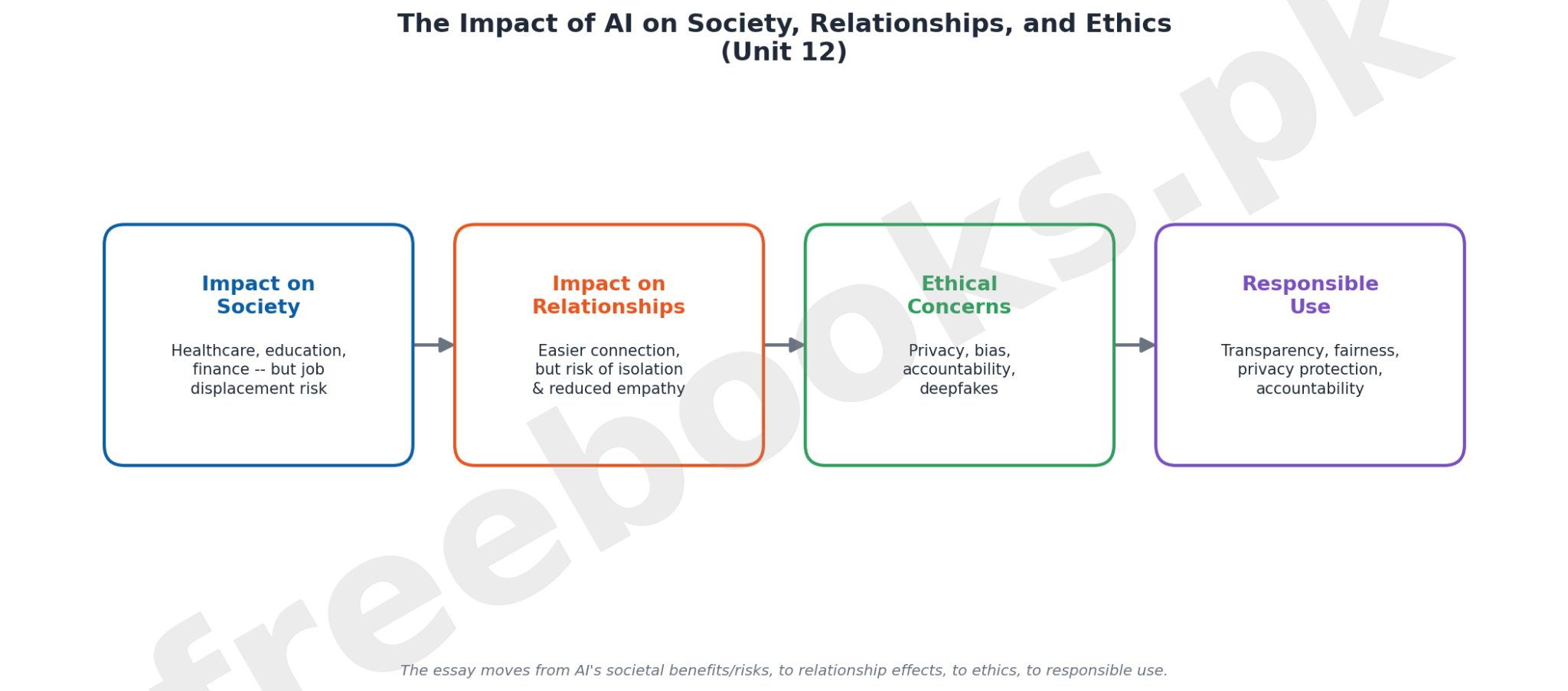
AI's Impact Across Four Areas: A sequential flow diagram tracing the essay's structure: AI's impact on society (benefits and job displacement), on human relationships (connection versus isolation), the ethical concerns it raises, and the principles needed for its responsible use.
Short Questions & Answers
What is Artificial Intelligence, according to the essay?
AI is a branch of computer science that enables machines to perform tasks typically requiring human intelligence, such as learning, problem-solving, decision-making, language processing, and visual recognition.
How does AI assist doctors, according to the essay?
AI-powered systems assist doctors in diagnosing diseases (e.g. identifying cancer early through image recognition), predicting patient outcomes, and even performing robotic surgeries.
What is one major risk AI poses to employment?
AI poses the risk of job displacement, as it becomes capable of performing repetitive or even skilled tasks — for example, self-checkout systems replacing cashiers and chatbots replacing customer support agents.
How can excessive reliance on AI communication tools affect relationships?
It can reduce face-to-face interaction and lead to social isolation, particularly among young people who may spend more time with devices than with family and friends.
Why might an AI system be biased, according to the essay?
An AI system can inherit biases present in the data used to train it — for example, a recruitment tool trained on historically biased hiring data may unfairly favour one group of candidates over another.
Why is accountability a challenge with AI systems?
When an AI system makes a harmful decision, such as an autonomous vehicle causing an accident, it can be unclear whether the manufacturer, developer, or user is responsible, making it difficult to ensure justice without clear guidelines.
What are deepfakes, and why are they a concern?
Deepfakes are AI-generated fake or misleading content, such as manipulated videos, that can distort public opinion or damage an individual's reputation; detection technology is not always effective at stopping them.
What four principles does the essay recommend for responsible AI use?
The essay recommends transparency, fairness, privacy protection, and accountability, along with continuous monitoring of AI systems.
Long Questions & Answers
Discuss the impact of AI on society and human relationships as presented in the essay.
What benefits does AI bring to society?
AI improves healthcare through early disease diagnosis and robotic surgery, personalises education through adaptive tutoring systems, and increases business efficiency through automation of inventory, transactions, and data analysis.
What is the main societal risk of AI, according to the essay?
The main risk is job displacement, as AI increasingly performs tasks once done by humans, such as cashier work, customer support, and factory assembly, requiring workers to re-skill for a technology-driven future.
How does AI affect human communication and connection?
AI-powered tools like social media algorithms and virtual assistants make communication faster and help people connect with shared interests, but excessive reliance on them can reduce face-to-face interaction and lead to social isolation.
What risk do AI companions like Replika pose to emotional wellbeing?
Because such systems lack genuine emotion and understanding, overreliance on them for social interaction can reduce users' empathy and emotional intelligence, making some people more comfortable with machines than with real people.
Explain the ethical concerns raised by AI and the principles needed for its responsible use.
What privacy concerns does AI raise?
AI systems, such as facial recognition used in public spaces, require large amounts of personal data and can identify individuals without explicit consent, raising concerns about how that data is stored, shared, or potentially misused.
How can AI systems become biased?
AI systems learn from the data they are trained on, so if that data reflects existing biases — such as gender bias in past hiring records — the AI can inherit and replicate those biases in its decisions.
Why is accountability difficult to establish for AI-related harm?
Because multiple parties — manufacturers, developers, and users — may all play a role in an AI system's actions, it can be unclear who is responsible when something goes wrong, such as an autonomous vehicle accident.
What principles does the essay propose for responsible AI use?
The essay proposes transparency (understandable decision-making), fairness (unbiased training data), privacy protection (secure, consent-based data use), and accountability (clear responsibility rules), supported by continuous monitoring.
Multiple Choice Questions (MCQs)
What is Artificial Intelligence, according to the essay? (A) A type of computer hardware (B) A branch of technology enabling machines to perform tasks requiring human intelligence (C) A social media platform (D) A type of robot used only in factories
Correct answer: (B) A branch of technology enabling machines to perform tasks requiring human intelligence. AI is defined as a branch of technology/computer science that enables machines to perform tasks typically requiring human intelligence.
Which sector does the essay NOT mention as being transformed by AI? (A) Healthcare (B) Education (C) Finance (D) Agriculture
Correct answer: (D) Agriculture. The essay discusses healthcare, education, finance, and entertainment — agriculture is not mentioned.
What is one of the main concerns associated with the widespread use of AI? (A) Improved job security (B) Job displacement (C) Reduced healthcare costs (D) Increased human connection
Correct answer: (B) Job displacement. The essay identifies job displacement as one of the most pressing concerns of widespread AI use.
What example does the essay give of an AI-powered virtual companion? (A) Siri (B) Alexa (C) Replika (D) Google Assistant
Correct answer: (C) Replika. Replika is given as an example of an AI-powered chatbot designed to provide emotional support and companionship.
What can cause an AI system to become biased? (A) Using too much computing power (B) Training on data that reflects existing biases (C) Having too many users (D) Being too transparent
Correct answer: (B) Training on data that reflects existing biases. AI systems can inherit biases present in the data used to train them, such as historical gender bias in hiring records.
What ethical issue does facial recognition technology raise, according to the essay? (A) Increased efficiency only (B) Privacy concerns (C) Lower costs (D) Faster internet speeds
Correct answer: (B) Privacy concerns. Facial recognition raises privacy concerns, as individuals may be monitored and their data stored or shared without consent.
According to the essay, who might be held responsible when an autonomous vehicle causes an accident? (A) Only the vehicle owner (B) The manufacturer, developer, or user — responsibility is unclear (C) No one, since AI cannot be at fault (D) Only the government
Correct answer: (B) The manufacturer, developer, or user — responsibility is unclear. The essay notes that without clear guidelines, it can be difficult to determine whether the manufacturer, developer, or user is responsible.
What are deepfakes used for, according to the essay? (A) Improving healthcare diagnostics (B) Creating fake or misleading content that can manipulate opinion (C) Automating financial trading (D) Personalising education
Correct answer: (B) Creating fake or misleading content that can manipulate opinion. Deepfakes are AI-generated fake or misleading content that can manipulate public opinion or damage reputations.
Which of the following is NOT one of the essay's four principles for responsible AI use? (A) Transparency (B) Fairness (C) Profitability (D) Accountability
Correct answer: (C) Profitability. The essay's four principles are transparency, fairness, privacy protection, and accountability — profitability is not one of them.
What does the essay suggest society should do in response to AI-driven job displacement? (A) Ban all AI technology (B) Focus on re-skilling and up-skilling the workforce (C) Ignore the issue (D) Reduce access to education
Correct answer: (B) Focus on re-skilling and up-skilling the workforce. The essay suggests that governments and educational institutions must focus on re-skilling and up-skilling the workforce.
Quick Revision Summary
- AI is a branch of technology that enables machines to perform tasks typically requiring human intelligence.
- AI benefits healthcare (diagnosis, robotic surgery), education (personalised learning), and finance (fraud detection, automated trading).
- A major societal risk of AI is job displacement, as automation replaces repetitive or skilled human tasks.
- Society must respond to job displacement through re-skilling and up-skilling the workforce.
- AI-powered communication tools help people connect but risk reducing face-to-face interaction and causing social isolation.
- AI companions like Replika simulate conversation but lack genuine emotion, risking reduced empathy in overreliant users.
- Key ethical concerns include privacy (e.g. facial recognition), bias in training data, and accountability for AI decisions.
- AI can be misused to create deepfakes that spread misinformation or damage reputations.
- The essay proposes four principles for responsible AI use: transparency, fairness, privacy protection, and accountability.
- Continuous monitoring of AI systems is needed to ensure they keep operating ethically and efficiently.
Exam Tips
- This unit ('The Impact of AI on Society, Human Relationships, and Ethics') is not part of the current PECTAA examinable pairing scheme for this session, but is included here for complete book coverage.
- Even though not currently examinable, the essay's structure (society -> relationships -> ethics -> responsible use) is a useful model for how argumentative/informative essays are typically organised in this course.
- Focus revision time on units confirmed in the current year's pairing scheme; treat this unit as supplementary reading if time allows.
- If this unit becomes examinable in a future year, the four responsible-use principles (transparency, fairness, privacy protection, accountability) are the most quotable, specific facts to memorise.
- Practise the indirect-to-direct speech conversion rules taught alongside this unit, as grammar rules are tested independently of which reading units are examinable.
- Understand the difference between AI's societal benefits and its societal risks, since this contrast is the essay's central organising idea.