This unit presents excerpts from the speech delivered by Quaid-e-Azam Muhammad Ali Jinnah at the Dhaka University Convocation on 24 March 1948, as given in the Class 11 English textbook of the PECTAA Board under the Updated National Curriculum of Pakistan 2023.
Addressing the graduating students not as Head of State but as a friend, Quaid-e-Azam Muhammad Ali Jinnah reflects on the birth of a sovereign, independent Pakistan, the responsibilities that come with freedom, the hardships the new state overcame, and the paths of opportunity open to educated youth beyond Government service.
These notes summarise the passage strictly as given in the textbook, preserving the respectful references used for Quaid-e-Azam Muhammad Ali Jinnah, and provide comprehension questions, vocabulary, and exam-oriented material for this unit.
Learning Objectives
- Speak confidently and fluently on the ideas of freedom, responsibility, and national duty raised in the address, using them in discussion, debate, and role-play.
- Read and use inference and deduction to recognise the implicit meaning of the speaker's words, using contextual cues and prior knowledge of Pakistan's early history.
- Evaluate two or more central ideas of the text — such as youth's responsibility and economic self-reliance — and analyse how they interact and build on one another.
- Identify and correctly use patterns of word changes that indicate different meanings or parts of speech, such as construct, constructive, and construction.
- Use all types of tenses correctly in speech and writing, drawing on examples adapted from the speech.
- Write arguments to support claims in an analysis of the text, using valid reasoning and relevant evidence from Quaid-e-Azam's address.
Key Concepts
A Personal Address, Not a Formal Lecture
Quaid-e-Azam Muhammad Ali Jinnah opens by explaining that, given the many demands on his time, he could not prepare a formal, academic Convocation Address covering the great subjects with which a university deals, such as arts, history, philosophy, science, and law. He had, however, promised the Vice-Chancellor a few words to the students, and he keeps that promise.
He makes clear that he speaks not as Head of the State but as a friend who has always held the students in affection. He thanks the Vice-Chancellor for his kind words and states that whatever he has been able to do, he has done merely as a duty incumbent upon him to serve his people honestly and selflessly. This informal, personal framing sets the tone for the rest of the address.
Freedom and Responsibility in a Sovereign State
Congratulating the graduating students on their diplomas and degrees, Quaid-e-Azam Muhammad Ali Jinnah reminds them that, unlike their predecessors, they leave university to enter life under a sovereign, independent State of their own. He explains that the shackles of slavery have been broken, and that the State and Government are now their own — of the people and responsible to the people.
He immediately qualifies this freedom: 'freedom does not mean license.' Students cannot behave as they please without regard for others or the State. A great responsibility now rests on the youth, and it is more necessary than ever to work as a united and disciplined nation. What is now required is a constructive spirit, not the militant spirit of the independence struggle — and he stresses that it is far more difficult to construct a Government than to fight or go to jail for freedom.
The Hardships Pakistan Overcame
Quaid-e-Azam Muhammad Ali Jinnah describes the dangers and difficulties faced by the new State soon after its birth. Enemies who had failed to prevent Pakistan's creation turned to weakening it instead. Hardly had the State come into being when the Punjab and Delhi holocaust struck — thousands of men, women, and children were mercilessly butchered, and millions were uprooted from their homes, with over fifty lakh refugees arriving in the Punjab within weeks.
The care and rehabilitation of these refugees presented problems that might have destroyed a well-established State, yet Pakistan not only survived this upheaval but emerged stronger, more chastened, and better equipped. Further difficulties followed — India withholding Pakistan's cash balances and its share of military equipment, and later an almost complete economic blockade of the province. Quaid-e-Azam notes that right-thinking people in India would deplore these happenings, but stresses that Pakistanis must take note of these events and maintain continued vigilance.
A Warning Against Exploitation and Disunity
Quaid-e-Azam Muhammad Ali Jinnah urges students to devote themselves solely to their studies, in fairness to themselves, to their parents, and to the State — this, he says, is the only way to equip themselves for the battle of life ahead and to become a source of strength and pride to their State.
He then lists points about which the youth should be vigilant: beware of the fifth columnists among them; guard against and weed out selfish people who wish only to exploit them for their own gain; and learn to judge who are truly honest and unselfish servants of the State, serving the people with heart and soul.
Breaking Free of the Colonial 'Clerk Mentality'
Quaid-e-Azam Muhammad Ali Jinnah criticises the old system of education and government, which — as the Vice-Chancellor had also stated — was designed mainly to produce well-trained, well-equipped clerks for the Civil Service, staffed originally by the British. This system created a mentality in which the average graduate's only ambition was to secure a Government job, considering that the height of achievement.
He points out the poor result of this mentality: an M.A. graduate could earn less than a taxi driver, and many so-called Government servants lived more miserably than menial servants employed by well-to-do people. He urges the students to break free of this rut and mentality, now that Pakistan is free.
New Avenues: Commerce, Industry, and Technical Education
Quaid-e-Azam Muhammad Ali Jinnah explains that Government cannot absorb thousands of graduates, and that most students competing for Government service will only become demoralised; those left out, growing disgruntled, become easy targets for exploitation by self-interested people. He therefore urges students to divert their ambitions to other channels — there is no shame in manual work and labour, and immense scope exists in technical education, banking, commerce, trade, and law, as new industries, banks, insurance companies, and commercial firms open up.
He gives the example of a young man who left Government service to join a banking corporation four years earlier on two hundred rupees a month, and who, having studied banking, was by then a Manager drawing fifteen hundred rupees a month. Quaid-e-Azam presents this as proof of the opportunities available in commerce and industry, urging students to think in these terms for their own benefit and that of the State.
Important Definitions (Glossary)
affection
the feeling of liking or loving somebody/something very much and caring about them
avenue
a choice or way of making progress towards something
blockade
the action of surrounding or closing a place, especially a port, in order to stop people or goods from coming in or out
chancellor
the official head of a university
deplore
to criticize something, especially publicly, because you think it is very bad
disgruntled
annoyed or disappointed because something has happened to upset you
exploit
to treat somebody unfairly by making them work and not giving them much in return
holocaust
a situation in which many things are destroyed and many people killed, especially because of a war or a fire
incumbent
a person who has an official position
selflessly
in a way that shows that you are thinking more about the needs, happiness, etc. of other people than about your own
vigilance
great care that is taken to notice any signs of danger or trouble
Key Facts
| Aspect | Key Fact |
|---|---|
| Speaker | Quaid-e-Azam Muhammad Ali Jinnah. |
| Occasion | Dhaka University Convocation Address. |
| Date | 24 March 1948. |
| Central theme | Nation-building through responsible citizenship and purposeful education. |
| Freedom vs license | Freedom does not mean license; a great responsibility rests on the youth. |
| Early hardships | Punjab and Delhi holocaust, over 50 lakh refugees, withheld assets, economic blockade. |
| The 'clerk mentality' problem | Old colonial system pushed graduates only towards Government service, even though an M.A. could earn less than a taxi driver. |
| Suggested alternative fields | Manual work, technical education, banking, commerce, trade, law, and new industries. |
Diagram
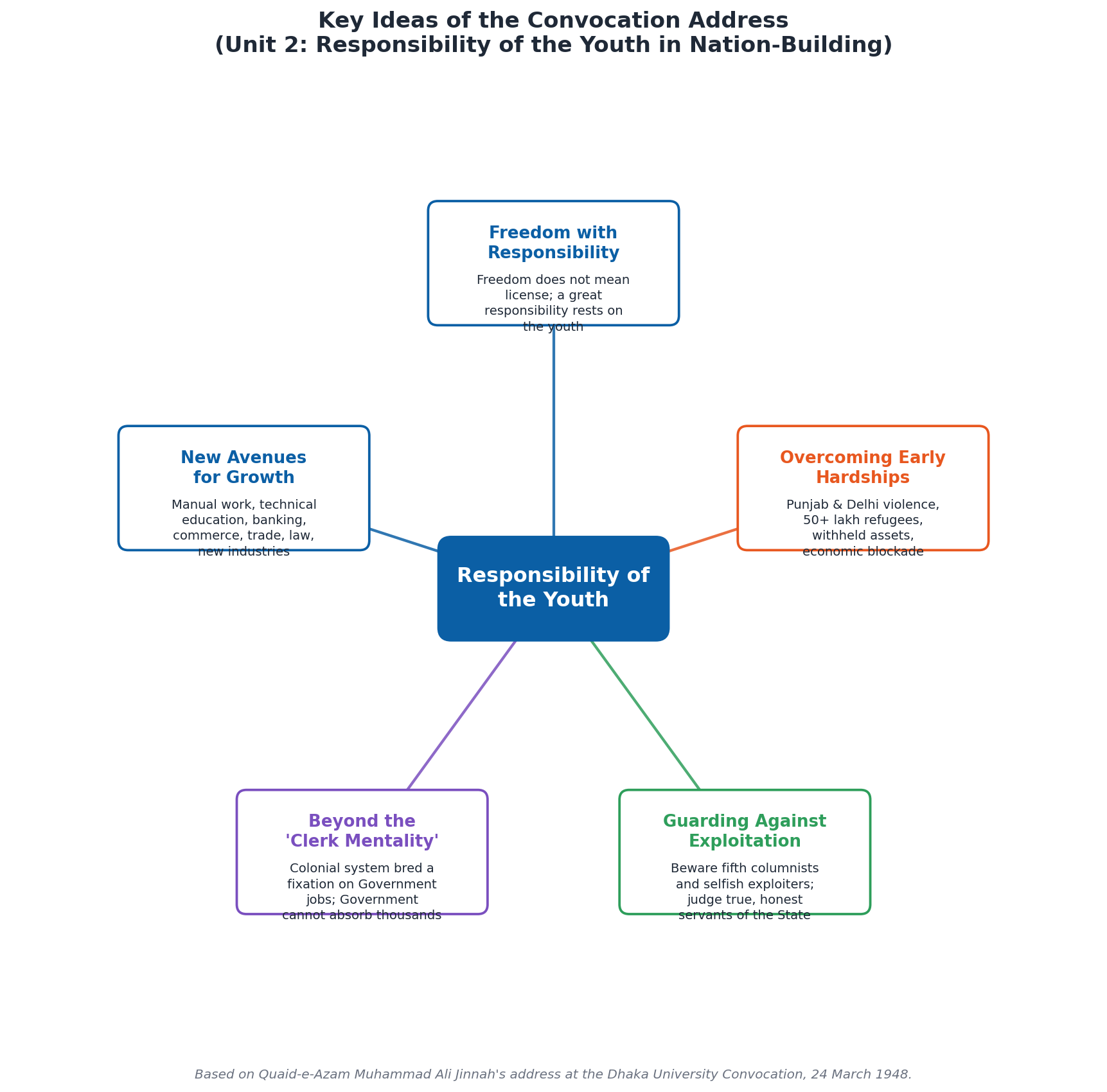
Key Ideas of the Convocation Address: A branching mind-map diagram with a central node, 'Responsibility of the Youth', connected to five sub-theme boxes drawn from the passage: Freedom with Responsibility, Overcoming Early Hardships, Guarding Against Exploitation, Beyond the 'Clerk Mentality', and New Avenues for Growth, shown as labelled text boxes joined by connecting lines (no illustrated figures).
Short Questions & Answers
According to Quaid-e-Azam, why does he say he is not speaking as Head of the State?
He explains that he is addressing the students as a friend who has always held them in affection, rather than in an official capacity, so as to speak to them personally on this occasion.
What does Quaid-e-Azam mean by 'our State is our own State… responsible to the people'?
He means that, unlike under colonial rule, Pakistan's Government now belongs to its own people, works for their good, and is accountable to them rather than to a foreign power.
Why does Quaid-e-Azam say 'freedom does not mean license'?
He means that independence does not give people the right to behave however they please, ignoring the interests of others or the State; a great responsibility now rests on the youth to act with discipline.
What hardships does Quaid-e-Azam describe in the early days of Pakistan?
He describes the Punjab and Delhi holocaust in which thousands were killed and millions uprooted, the arrival of over fifty lakh refugees in the Punjab, India withholding Pakistan's cash balances and military equipment share, and an economic blockade of the province.
Whom does Quaid-e-Azam warn the students to beware of?
He warns them to beware of fifth columnists among them, to guard against selfish people who wish to exploit them, and to learn to judge who are truly honest and unselfish servants of the State.
What does Quaid-e-Azam criticise about the old system of education and government?
He criticises it for creating a mentality in which the only ambition of graduates was to secure Government service, a mindset built to produce well-trained clerks rather than independent, capable citizens.
Why does Quaid-e-Azam say Government service is not a viable path for most graduates?
He explains that Government cannot absorb thousands of graduates, so most who compete for such jobs become demoralised, and those left out grow disgruntled and vulnerable to exploitation.
What example does Quaid-e-Azam give to illustrate the opportunities in commerce and industry?
He gives the example of a young man who left Government service for a banking corporation on two hundred rupees a month and rose, in four years, to become a Manager earning fifteen hundred rupees a month.
Long Questions & Answers
Discuss how Quaid-e-Azam describes the responsibilities that come with freedom in his address to the youth.
What does Quaid-e-Azam mean when he says 'freedom does not mean license'?
Quaid-e-Azam explains that gaining independence does not mean students can behave just as they please, irrespective of the interests of other people or the State. Instead, a great responsibility now rests on the youth, and it is more necessary than ever to work as a united and disciplined nation. He contrasts this constructive spirit with the militant spirit needed during the independence struggle, noting it is far more difficult to construct a Government than to fight for freedom.
What hardships does Quaid-e-Azam say Pakistan overcame after independence?
He describes how, hardly had the new State come into being, the Punjab and Delhi holocaust struck, with thousands of men, women, and children mercilessly butchered and millions uprooted from their homes. Over fifty lakh refugees arrived in the Punjab within weeks, presenting problems that might have destroyed a well-established State. Yet Pakistan survived this upheaval and emerged stronger, more chastened, and better equipped than before.
What warning does Quaid-e-Azam give about fifth columnists and exploiters?
Quaid-e-Azam tells the students to be vigilant and beware of the fifth columnists among them, and to guard against and weed out selfish people who wish only to exploit them for their own gain. He urges them to learn to judge who are truly honest and unselfish servants of the State, serving the people with heart and soul, so that they are not misled by those with self-interested motives.
Why does Quaid-e-Azam say a constructive spirit is harder than a militant one?
He explains that it is easier to go to jail or fight for freedom than to run a Government, because building and governing a new State requires sustained discipline, unity, and hard work rather than a single burst of struggle. This constructive spirit, he stresses, is now what is required of the whole nation, more than ever before, as Pakistan works to establish itself as a sovereign, self-sufficient State.
Explain Quaid-e-Azam's criticism of the colonial 'clerk mentality' and his vision for the youth's future.
What did the old education and Government system encourage, according to Quaid-e-Azam?
Quaid-e-Azam explains that the old system of education and Government, as the Vice-Chancellor had also noted, was really designed to produce well-trained, well-equipped clerks, since the Civil Service was originally staffed by the British. This created a mentality in which an average graduate's only ambition after passing a B.A. or M.A. was to look for a Government job, considering that the peak of achievement, regardless of how poorly such positions were actually paid or regarded.
Why does Quaid-e-Azam say Government 'cannot absorb thousands'?
He points out plainly that Government cannot absorb thousands of graduates seeking service — it is impossible. Most students competing for the limited Government positions available will only become demoralised, and Government can take only a certain number of them. Those who cannot settle into Government service, being disgruntled, are then vulnerable to being exploited by persons with their own self-interested motives.
What alternative fields does Quaid-e-Azam recommend to the youth?
He tells students there is no shame in manual work and labour, and stresses the immense scope for technical education, since technically qualified people are badly needed. He also encourages them to study banking, commerce, trade, and law, noting that new industries, banks, insurance companies, and commercial firms were opening and would continue to grow, offering more happiness, prosperity, and opportunities to rise than a life spent in Government clerkship.
What example does Quaid-e-Azam give of a young banker, and why does he mention it?
Quaid-e-Azam mentions a young man who had been in Government service but left it four years earlier to join a banking corporation on two hundred rupees a month, having studied the subject of banking. By the time of the speech, that young man was a Manager in the firm, drawing fifteen hundred rupees a month. Quaid-e-Azam offers this as concrete proof of the opportunities available outside Government service, urging students to think seriously in these terms.
Multiple Choice Questions (MCQs)
In what capacity does Quaid-e-Azam say he is addressing the students? (A) As Head of the State (B) As a friend (C) As a former student (D) As a University official
Correct answer: (B) As a friend. He explicitly states he is not speaking as Head of the State but as a friend who has always held the students in affection.
Where and on what date was this Convocation Address delivered? (A) Lahore University, 14 August 1947 (B) Dhaka University, 24 March 1948 (C) Karachi University, 11 September 1948 (D) Peshawar University, 23 March 1949
Correct answer: (B) Dhaka University, 24 March 1948. The address was delivered at the Dhaka University Convocation on 24 March 1948.
What does Quaid-e-Azam mean by saying 'freedom does not mean license'? (A) Freedom requires official permits (B) Freedom does not allow people to act without regard for others or the State (C) Freedom means unlimited personal power (D) Freedom applies only to certain citizens
Correct answer: (B) Freedom does not allow people to act without regard for others or the State. He clarifies that independence does not permit people to behave as they please, ignoring the interests of others or the State; a great responsibility rests on the youth.
Which event does Quaid-e-Azam describe as striking Pakistan soon after its birth? (A) The Bengal famine (B) The Punjab and Delhi holocaust (C) The Kashmir conflict (D) A drought in Sindh
Correct answer: (B) The Punjab and Delhi holocaust. He describes how, soon after the new State's formation, the Punjab and Delhi holocaust occurred, with mass killings and millions uprooted.
Approximately how many refugees does Quaid-e-Azam say arrived in the Punjab within weeks? (A) Fifty lakh (B) Five lakh (C) Fifteen lakh (D) One crore
Correct answer: (A) Fifty lakh. The passage states that over fifty lakh refugees arrived in the Punjab within a matter of weeks.
What does Quaid-e-Azam say about India's actions towards the new State of Pakistan? (A) India fully supported Pakistan financially (B) India withheld cash balances, military equipment share, and imposed an economic blockade (C) India offered Pakistan additional territory (D) India provided free technical training
Correct answer: (B) India withheld cash balances, military equipment share, and imposed an economic blockade. He describes India withholding Pakistan's cash balances and share of military equipment, followed by an economic blockade of the province.
What mentality does Quaid-e-Azam criticise as a result of the old colonial system? (A) A focus on agriculture (B) The pursuit of Government service as the only ambition (C) An interest in foreign travel (D) A preference for military careers
Correct answer: (B) The pursuit of Government service as the only ambition. He criticises the old system for producing well-trained clerks and instilling a mentality where graduates sought only Government jobs.
According to Quaid-e-Azam, why can most graduates not rely on Government service? (A) Government service pays extremely well (B) Government cannot absorb thousands of graduates (C) Government service is only for foreigners (D) There are no Government jobs at all
Correct answer: (B) Government cannot absorb thousands of graduates. He states plainly that Government cannot absorb thousands of graduates, so most who compete for such jobs will only be demoralised.
What alternative fields does Quaid-e-Azam recommend to the youth? (A) Only politics and journalism (B) Manual work, technical education, banking, commerce, trade, and law (C) Only agriculture (D) Only the armed forces
Correct answer: (B) Manual work, technical education, banking, commerce, trade, and law. He recommends manual work, technical education, banking, commerce, trade, law, and new industries, banks, and insurance firms as open avenues.
Enemies of Pakistan, thwarted in their desire to prevent its establishment, turned their attention to weakening it through renewed hardship. In this context, 'thwarted' most nearly means: (A) encouraged (B) prevented or blocked from succeeding (C) financially rewarded (D) openly celebrated
Correct answer: (B) prevented or blocked from succeeding. Thwarted means prevented from succeeding in an aim, matching how Pakistan's enemies were unable to stop its establishment.
Quick Revision Summary
- Quaid-e-Azam Muhammad Ali Jinnah delivered this address at the Dhaka University Convocation on 24 March 1948.
- He speaks not as Head of the State but as a friend who holds the students in affection.
- He reminds students that Pakistan is now a sovereign, independent State, responsible to its own people.
- 'Freedom does not mean license' — a great responsibility rests on the youth to be disciplined and constructive.
- A constructive spirit is harder to sustain than the militant spirit of the independence struggle.
- Pakistan overcame the Punjab and Delhi holocaust, over fifty lakh refugees, withheld assets, and an economic blockade.
- Students are urged to devote themselves to their studies in fairness to themselves, their parents, and the State.
- Quaid-e-Azam warns against fifth columnists and selfish exploiters, urging youth to judge true, honest servants of the State.
- He criticises the colonial 'clerk mentality' that pushed graduates solely towards Government service.
- He urges students towards manual work, technical education, banking, commerce, trade, and law, citing a young banker's rise from Rs. 200 to Rs. 1500 a month in four years.
Exam Tips
- This unit belongs to PECTAA's 'prose group' (Units 1, 2, 5, 8, 10), which under the current paper pattern carries heavier weight — 5 of the paper's synonym questions and 3 of its MCQs are drawn from these prose units, so revise the 11 glossary words in this unit carefully.
- Since only 7 of the 10 short questions asked from the prose group need to be attempted, practice answering all 8 short questions in this unit so you have a comfortable choice on exam day.
- This unit's passage may also be set for the punctuation exercise, so practice punctuating an unpunctuated extract drawn from this unit as part of your preparation.
- The textbook itself includes an official Urdu-translation exercise on a passage from this unit — practice translating it, and also outline a short essay in case the alternate essay-writing option is chosen instead.
- Learn the glossary words with their exact textbook meanings, since examiners often test vocabulary directly through synonym-in-context questions like the ones in this unit's MCQs.
- Maintain a formal, respectful tone and stick strictly to facts from the text when answering questions about Quaid-e-Azam's address; avoid inserting personal opinions or unsupported details.