
This unit presents 'The End of the Beginning', a one-act farcical comedy by the Irish playwright Sean O'Casey (1880-1964), as given in the Class 11 English textbook of the PECTAA Board under the Updated National Curriculum of Pakistan 2023.
Set in a rural Irish cottage in the early 20th century, the play uses exaggerated comic situations to explore gender roles and the value of domestic work, following an overconfident husband who insists housework is easy — until he is left to prove it.
These notes summarise the play's characters, setting, plot, and theme strictly based on the textbook's presentation, and provide comprehension questions, vocabulary, and exam-oriented material for this unit. As the play remains under copyright, its dialogue is not reproduced at length; the summary below is written in original words.
Learning Objectives
- Establish characters, roles, and apply dramatic techniques such as plot development and closure, with confidence, in a two- to three-act play.
- Choose words and phrases for effect.
- Read, view, and analyse grade-appropriate and high-interest drama (play scripts) from print and non-print sources.
- Verify the preliminary meaning of a word or phrase by checking inferred meaning in context or in a dictionary.
- Apply editing and proofreading skills to a wide range of texts and contexts.
Key Concepts
About the Playwright: Sean O'Casey
Sean O'Casey (1880-1964) was an Irish dramatist known for his powerful plays depicting Irish life, often blending humour with social commentary. 'The End of the Beginning' is a one-act farce that humorously questions assumptions about gender roles and domestic competence.
Characters and Setting
The play has three characters: Darry Berrill, a middle-aged, overconfident farmer who underestimates the challenges of household chores; Lizzie Berrill, Darry's practical and competent wife, who efficiently manages both domestic and farm duties; and Barry Derrill, Darry's well-meaning but inept and near-sighted friend, whose involvement only deepens the household chaos.
The action takes place in a single evening in a big, comfortably furnished kitchen of a simple, modest rural Irish cottage, in the early 20th century — a setting that keeps the farce contained to one chaotic space as the evening's disasters unfold.
Plot Summary
The play opens with Darry complaining about his workload and dismissing Lizzie's housework as easy, boasting that he could finish it all with time to spare. Provoked, Lizzie challenges him to prove it: she will go and mow the meadow herself while Darry stays behind and manages the house for the evening. Darry accepts the challenge with bravado, and Lizzie leaves, warning him half-seriously that she hopes to find the house still standing when she returns.
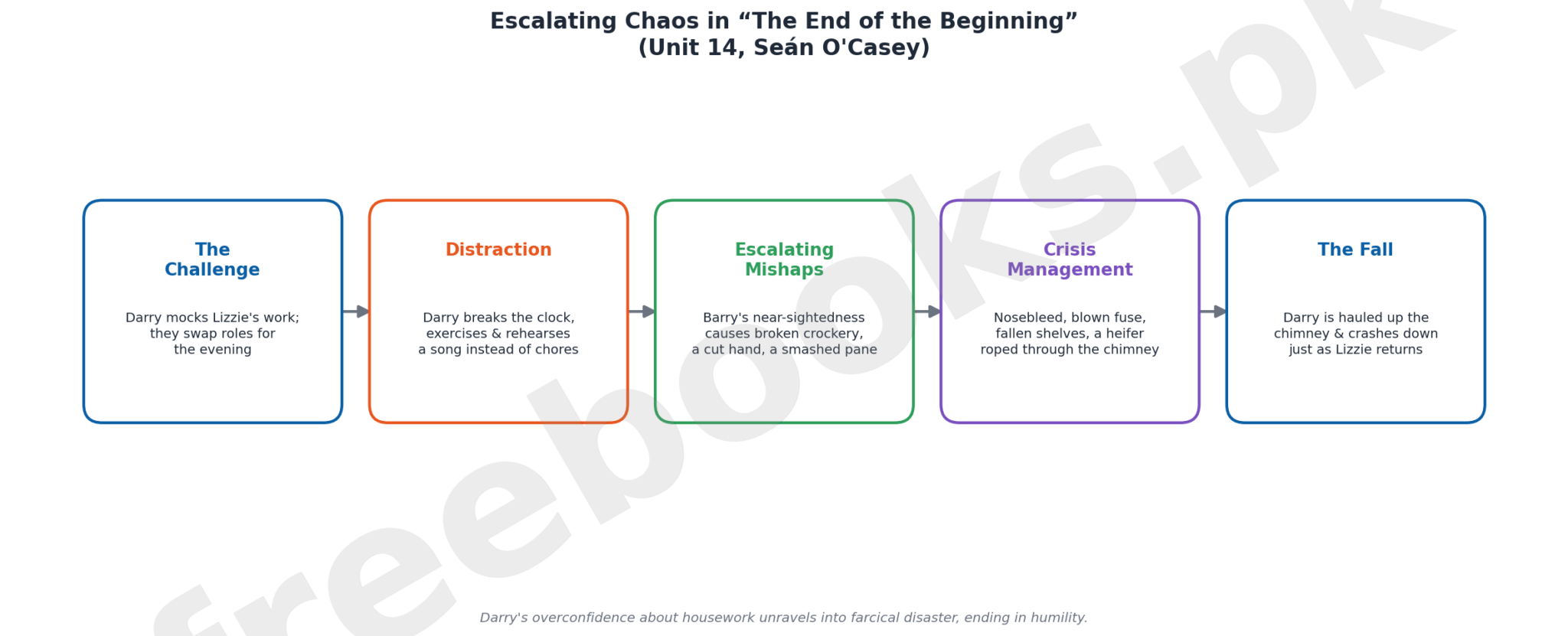
Left alone, Darry immediately gets distracted: he accidentally breaks the mechanism of a stopped clock while trying to wind it, then discovers a gramophone record of physical exercises and spends time performing calisthenics on the floor instead of starting his chores. His friend Barry Derrill arrives, mandolin in hand, to rehearse a song for an upcoming concert, and Darry persuades him to join the exercises first — leading to a long comic sequence of the two men struggling to keep time with the gramophone's instructions, followed by a mismatched rehearsal of their concert song and dance steps.
Only when the distant Town Hall clock strikes and Darry hears Lizzie's mowing machine does he realise how much time has been wasted, and he rushes to begin the housework in earnest, blaming Barry for the delay. What follows is an escalating chain of farcical mishaps: the near-sighted Barry breaks crockery and cuts his fingers while helping wash dishes, smashes a windowpane with a broom handle while sweeping, and Darry injures his own nose running into a low doorway while feeding the animals.
The chaos intensifies further as the pair try to rig a rope from a heifer grazing on a bank outside, run it down the chimney, and tie it to a chair so they can monitor the animal's movements from inside — all while also dealing with a failed light bulb, a blown fuse, and Barry falling from a shelf while fetching an oil lamp from a dark shed, breaking his spectacles in the process.
In the play's climactic farcical moment, as Darry manages a leaking oil drum and the rope-tied chair suddenly lurches (signalling the heifer has wandered), Darry ties the rope around himself for a firmer grip — only to be hauled up the chimney just as Lizzie, returning from the meadow, unties the rope from the heifer outside without realising Darry is on the other end. Darry comes crashing back down the chimney in a shower of soot at the exact moment Lizzie walks back in, and the play ends on this reversal, with Darry indignantly blaming her for not warning him.
Theme
The play primarily explores gender roles and stereotypes, using farce to challenge traditional assumptions about domestic work. Darry's overconfidence — his belief that housework is simple and that he could manage it better than his wife — quickly collapses into chaos when he is actually left to do it, exposing his ignorance and lack of experience.
Through this comic disaster, the play affirms the real value and skill involved in domestic work and traces Darry's journey from arrogance to humility. O'Casey's farcical technique — exaggerated situations and escalating clumsy mistakes — delivers this message in an entertaining way, ultimately suggesting that competence comes from experience and effort, not gender.
Important Definitions (Glossary)
agony
extreme physical or mental pain
aimlessly
in a way that shows no direction or plan
anxiously
in a worried or nervous way
brood
to think a lot about something that makes you annoyed, anxious, or upset
callisthenics
physical exercises intended to develop a strong and attractive body
clasp
to hold something tightly in your hand
crockery
plates, cups, dishes, etc.
debris
pieces of wood, metal, building materials, etc. left after something has been destroyed
dejectedly
in an unhappy and disappointed way
emphatically
in a very clear way that involves speaking with force
expedite
to make a process happen more quickly
gingerly
in a careful way, because you are afraid of being hurt, of making a noise, etc.
goading
to keep annoying somebody/something until they react
limber
flexible; able to bend or move easily
magnanimous
kind, generous, and forgiving, especially towards an enemy or competitor
modest
not very large, expensive, important, etc.
reluctantly
hesitating before doing something because you do not want to do it or are not sure it is right
sighing
taking and letting out a long, deep, audible breath to show disappointment, sadness, or tiredness
slumber
sleep; a time when somebody is sleeping
Play at a Glance
| Aspect | Key Fact |
|---|---|
| Playwright | Sean O'Casey (1880-1964), Irish dramatist. |
| Genre | One-act farcical comedy. |
| Setting | A rural Irish cottage kitchen, early 20th century, one evening. |
| Main characters | Darry Berrill, Lizzie Berrill, and Barry Derrill. |
| Central conflict | Darry claims housework is easy; Lizzie challenges him to do it himself. |
| Literary technique | Farce — exaggerated situations and escalating comic mishaps. |
| Central theme | Gender roles and stereotypes in domestic work; overconfidence turning to humility. |
| Closing irony | Darry, hauled up the chimney by the heifer's rope, falls back down just as Lizzie returns. |
Diagram
Escalating Chaos in the Play: A sequential flow diagram tracing the play's five-stage comic escalation: the initial challenge, Darry's early distractions, mounting mishaps caused by Barry's near-sightedness, a crisis-management sequence of disasters, and Darry's final fall down the chimney as Lizzie returns.
Short Questions & Answers
What challenge does Lizzie set for Darry at the start of the play?
Lizzie challenges Darry to manage the housework himself for the evening while she goes to mow the meadow, since he had been dismissing her domestic work as easy.
How does Darry get distracted after Lizzie leaves?
Instead of starting the housework, Darry accidentally breaks the mechanism of a stopped clock, then spends time performing exercises to a gramophone record and rehearsing a concert song with his friend Barry.
What role does Barry Derrill's near-sightedness play in the plot?
Barry's poor eyesight causes several of the play's comic mishaps, including breaking crockery, cutting his fingers, and smashing a windowpane with a broom handle while trying to help Darry.
Why do Darry and Barry rig a rope through the chimney?
They tie a rope from the grazing heifer outside, down the chimney, and to a chair inside so they can monitor from the kitchen whether the heifer wanders too close to the edge of the bank.
How does the play end?
As the heifer's rope suddenly moves, Darry ties it around himself for a firmer grip and is hauled up the chimney; when Lizzie returns and unties the rope outside without knowing he is attached, Darry falls back down the chimney just as she walks in.
What is the central theme of the play?
The play explores gender roles and stereotypes around domestic work, using farce to show that competence comes from experience and effort, not gender, as Darry's overconfidence collapses into humbling chaos.
How does the play use farce to deliver its message?
Through exaggerated, escalating comic mishaps — broken crockery, a nosebleed, a blown fuse, a chimney fall — the play makes a serious point about gender and competence in an entertaining, memorable way.
What is ironic about the play's final moment?
It is ironic that Darry, who confidently mocked Lizzie's work as simple, ends the play literally falling down the chimney in a shower of soot at the exact moment she returns, having accomplished none of the housework properly.
Long Questions & Answers
Discuss how Sean O'Casey uses farce to explore the theme of gender roles in 'The End of the Beginning'.
How does the play's opening establish Darry's overconfidence?
The play opens with Darry dismissing Lizzie's housework as simple and boasting he could do it easily, prompting Lizzie to challenge him to prove it by swapping roles for the evening.
How do the early scenes show Darry avoiding real work?
Rather than beginning the housework, Darry becomes distracted by exercising to a gramophone record and rehearsing a song with Barry, foreshadowing his failure to manage his time and responsibilities.
How does the escalating chaos reveal Darry's incompetence?
As the evening progresses, a chain of mishaps — broken crockery, an injured nose, a blown fuse, a chimney rope disaster — shows that Darry, for all his confidence, lacks the practical skill and patience that housework actually requires.
What does the play's ending suggest about gender and competence?
By ending with Darry literally crashing down the chimney in humiliation just as Lizzie returns, the play affirms that domestic competence comes from experience and effort rather than gender, undercutting Darry's earlier boasts.
Explain the role of the two supporting devices — farce and irony — in shaping the play's comic and thematic effect.
What is farce, and how is it used in the play?
Farce relies on exaggerated situations and physical comedy; in this play, it appears through escalating mishaps like broken crockery, a nosebleed, and a chimney fall, all triggered by Darry's and Barry's incompetence.
How does Barry's near-sightedness contribute to the farcical tone?
Barry's poor eyesight repeatedly causes him to damage things he cannot see clearly, adding a layer of physical comedy that escalates the household's chaos beyond Darry's own mistakes.
Where is irony most evident in the play?
Irony is most evident in the ending, where Darry — who confidently mocked Lizzie's competence — ends up literally falling down the chimney in soot-covered defeat at the very moment she returns.
How do farce and irony work together to deliver the play's message?
The farcical mishaps build up comic tension, while the ironic ending delivers the play's underlying point with maximum impact, using humour to make a serious statement about gender and competence memorable and effective.
Multiple Choice Questions (MCQs)
Who wrote 'The End of the Beginning'? (A) Robert Hayden (B) Sean O'Casey (C) Allama Muhammad Iqbal (D) Langston Hughes
Correct answer: (B) Sean O'Casey. 'The End of the Beginning' is a one-act farce written by the Irish dramatist Sean O'Casey (1880-1964).
What genre does the play belong to? (A) Tragedy (B) One-act farcical comedy (C) Epic poem (D) Historical drama
Correct answer: (B) One-act farcical comedy. The play is a one-act farcical comedy.
What challenge does Lizzie set for Darry? (A) To cook a large meal (B) To manage the housework while she mows the meadow (C) To repair the roof (D) To travel to town
Correct answer: (B) To manage the housework while she mows the meadow. Lizzie challenges Darry to manage the housework for the evening while she goes to mow the meadow.
What does Darry accidentally break early in the play, while alone? (A) A window (B) The mechanism of a stopped clock (C) A mandolin (D) The gramophone
Correct answer: (B) The mechanism of a stopped clock. Darry accidentally breaks the mechanism of a stopped clock while trying to wind it.
What activity distracts Darry and Barry instead of housework? (A) Fishing (B) Exercising to a gramophone record and rehearsing a song (C) Cooking a feast (D) Painting the cottage
Correct answer: (B) Exercising to a gramophone record and rehearsing a song. Darry and Barry are distracted by performing calisthenics to a gramophone record and rehearsing a concert song.
What physical trait of Barry Derrill causes several comic accidents? (A) His height (B) His near-sightedness (C) His strength (D) His deafness
Correct answer: (B) His near-sightedness. Barry's near-sightedness causes him to break crockery, cut his fingers, and smash a windowpane.
Why do Darry and Barry rig a rope through the chimney? (A) To dry laundry (B) To monitor the grazing heifer from inside the house (C) To ring a bell (D) To hang decorations
Correct answer: (B) To monitor the grazing heifer from inside the house. They tie a rope from the heifer to a chair inside, running it down the chimney, to monitor if the heifer wanders too far.
How does the play end? (A) Lizzie praises Darry's work (B) Darry falls down the chimney just as Lizzie returns (C) Barry finishes all the housework alone (D) The house catches fire
Correct answer: (B) Darry falls down the chimney just as Lizzie returns. The play ends with Darry falling down the chimney in a shower of soot just as Lizzie returns.
What is the central theme of the play? (A) The importance of farming (B) Gender roles and stereotypes around domestic work (C) The history of Ireland (D) The value of music
Correct answer: (B) Gender roles and stereotypes around domestic work. The play's central theme is gender roles and stereotypes, using farce to show that competence comes from experience, not gender.
What literary technique does the play primarily rely on for comic effect? (A) Tragic irony (B) Farce (C) Allegory (D) Soliloquy
Correct answer: (B) Farce. The play relies on farce — exaggerated situations and escalating comic mishaps — for its comic effect.
Quick Revision Summary
- 'The End of the Beginning' is a one-act farcical comedy by Sean O'Casey (1880-1964).
- The three characters are Darry Berrill (overconfident husband), Lizzie Berrill (practical wife), and Barry Derrill (well-meaning, near-sighted friend).
- The play is set in a rural Irish cottage kitchen, early 20th century, over one evening.
- Darry dismisses housework as easy, prompting Lizzie to challenge him to do it while she mows the meadow.
- Darry gets distracted by exercising and rehearsing a song instead of starting the housework.
- A chain of farcical mishaps follows: broken crockery, a cut hand, a smashed window, a nosebleed, a blown fuse.
- Darry and Barry rig a rope from a grazing heifer, down the chimney, to a chair, to monitor the animal.
- The play ends with Darry hauled up the chimney and then falling back down just as Lizzie returns.
- Central theme: gender roles and stereotypes in domestic work; competence comes from experience, not gender.
- The play uses farce — exaggerated, escalating comic mishaps — to deliver this theme in an entertaining way.
Exam Tips
- This unit is the book's drama unit and is treated separately from the prose and poem groups in the current PECTAA paper pattern — confirm the exact weightage for this unit with your teacher or latest past papers.
- Focus on being able to summarise the plot in sequence (challenge -> distraction -> escalating mishaps -> the chimney fall) since drama questions often test overall plot and character understanding.
- Know the three characters' personalities well — Darry (overconfident but incompetent), Lizzie (practical and sharp), Barry (well-meaning but accident-prone) — as character-based questions are common for drama units.
- Be ready to explain the play's central theme (gender roles and domestic competence) and how farce is used to deliver it, since this is the question type most likely to be set for this unit.
- Since the unit's writing-skills section focuses on dialogue writing, practise writing short, realistic dialogue exchanges between the three characters in the play's farcical, humorous tone.
- Review the sentence-types grammar content (declarative, interrogative, imperative, exclamatory) taught alongside this unit, as grammar is tested independently of the reading content.