This unit presents 'Ruba'iyat' (quatrains) by Allama Muhammad Iqbal (1877-1938), as given in the Class 11 English textbook of the PECTAA Board under the Updated National Curriculum of Pakistan 2023.
The poem consists of three quatrains (twelve lines in total) in which Iqbal reflects on the nature of true faith, contrasts the spiritual vitality of Islamic civilisation with what he saw as the spiritual emptiness of modern Europe, and laments the decline of passionate devotion among Muslims of his own time.
These notes summarise the poem's content, structure, and meaning strictly based on the textbook's presentation, and provide a stanza-by-stanza paraphrase and explanation (the specific skill tested in the exam question 'explain the given stanza with reference to context'), literary devices, comprehension questions, vocabulary, and exam-oriented material for this unit. As this translation's copyright status could not be confirmed, its text is paraphrased throughout rather than quoted in full, with only brief quoted fragments used for reference.
Learning Objectives
- Respond to texts through arguments and discussions.
- Identify rhyme schemes and figurative language in poems.
- Change tense in indirect/direct speech (present, past and perfect tenses, future, modals, time and questions, orders, requests, suggestions and advice) in narrative paragraphs.
- Write a descriptive composition (physical description and characteristics/traits of a person, object, or place, moving from general to specific) using correct punctuation and spelling, through brainstorming, mind mapping, and drafting.
Key Concepts
About the Poet: Allama Muhammad Iqbal
Allama Muhammad Iqbal (1877-1938) is regarded as the visionary philosopher-poet of Pakistan, known for his revolutionary intellectual legacy expressed through Persian and Urdu works. Central to his philosophy was the concept of Khudi (selfhood) — a call for Muslims to awaken from colonial subjugation and materialist decline by rediscovering their Islamic identity.
Iqbal offered sharp critiques of Western civilisation, which he viewed as spiritually hollow despite its material progress, contrasting it with what he saw as Islam's transcendent unity. For Iqbal, true faith was neither passive nor merely ritualistic, but a dynamic, passionate force capable of transforming both individuals and societies. His poetry thus serves both as a mirror exposing Muslim decline and as a roadmap for revival through self-realisation and spiritual vigour.
Background and Context of the Poem
Iqbal's Ruba'iyat (quatrains) reflect his deep concern about the spiritual and moral decline of Muslims during the early 20th century. Written originally in Persian and Urdu, these verses critique both Western materialism and the weakening faith of Muslim societies of his time.
The poem draws on Islamic history — particularly the example of Hazrat Ibrahim's (AS) unshakable faith — to contrast true devotion with what Iqbal saw as the hollow pursuits of modernity. He also highlights the cultural and spiritual disconnect he perceived between Islam and Europe, mourning the loss of passionate devotion among Muslims of his era.
What the Poem Conveys
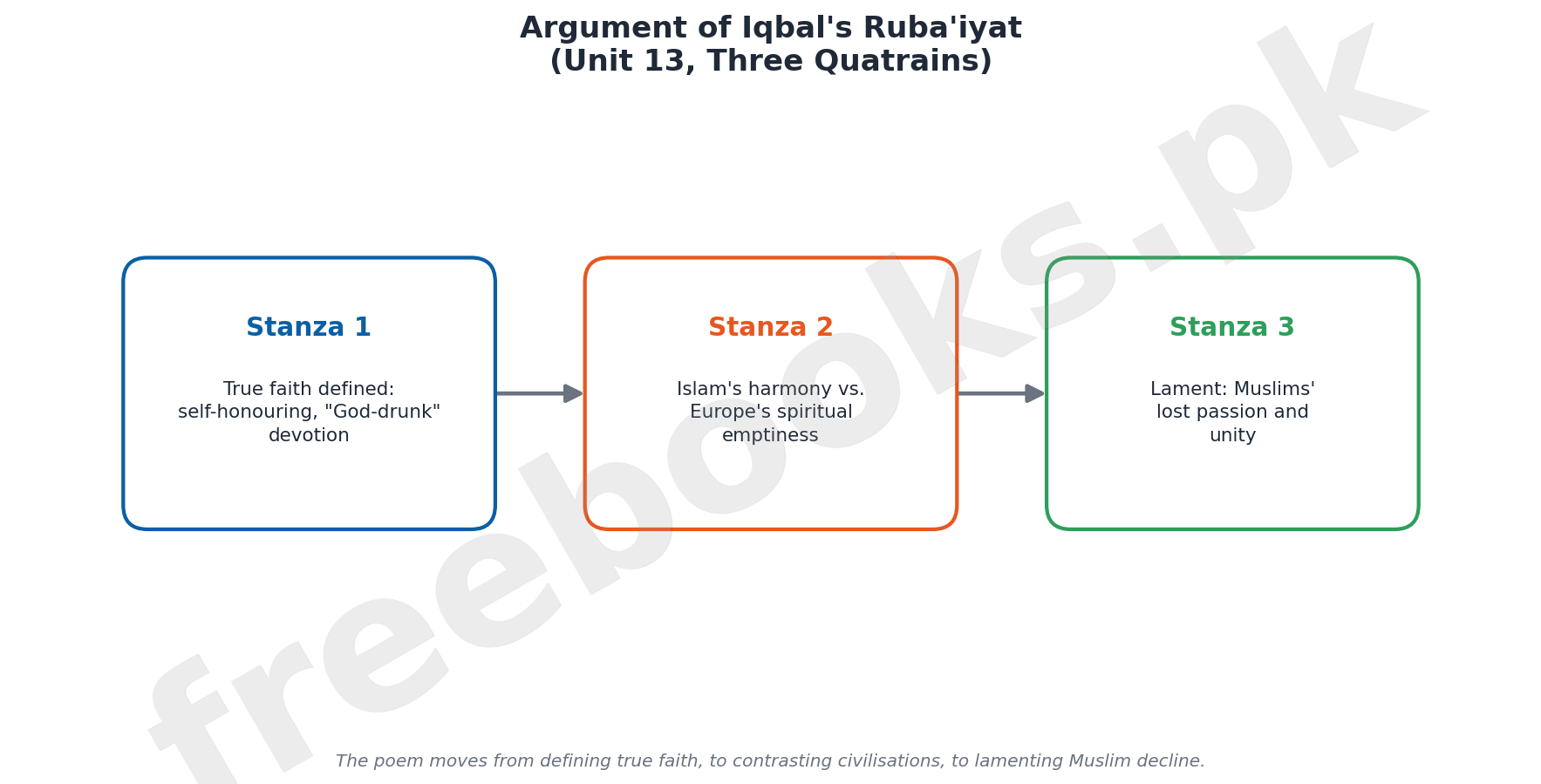
The poem opens by defining true faith through the example of Hazrat Ibrahim's (AS) trial by fire: faith, for Iqbal, is a matter of dignity and complete devotion to Allah, and to live without it is a condition he considers worse than slavery.
It then turns to a civilisational contrast, presenting Islam's spiritual vitality as the source of the Muslim nation's harmony, set against a Europe that Iqbal describes as spiritually empty despite its material achievements, refusing any submission to divine guidance.
The poem closes on a note of lament, mourning that the passionate devotion that once defined Muslim faith has faded, leaving weakened resolve, broken unity, and prayers performed without genuine feeling.
Central Themes
Nature of true faith: the poem presents faith as an active, all-consuming devotion to Allah, exemplified by Hazrat Ibrahim's (AS) willingness to face the fire, and argues that a life without such faith is worse than slavery.
Clash of civilisations: the poem contrasts Islamic civilisation's spiritual harmony, drawn from divine inspiration, with a European civilisation that Iqbal portrays as materially advanced yet spiritually hollow and disconnected.
Lament for Muslim decline: the poem mourns the loss of passionate religious devotion among Muslims, portraying their spiritual condition as reduced to superficial, unfeeling ritual.
Structure and Poetic Devices
The poem follows the classical ruba'i (quatrain) form — a Persian poetic structure of three stanzas, each with four lines, totalling twelve lines — using a modified AABA rhyme scheme typical of ruba'iyat.
Key literary devices include metaphor and symbolism (faith compared to Hazrat Ibrahim's trial by fire; a physiological image for Muslims' weakened spiritual vitality); paradox and oxymoron (faith described through a term pairing intoxication with divine devotion, and religious fervour reframed as a form of sacred passion); juxtaposition and contrast (Europe's spiritual emptiness set against Islam's harmony, and the warmth of sincere worship set against cold, hollow ritual); personification and apostrophe (the reader addressed directly, and the pull of the modern age personified as a seductive force); and sensory/thermal imagery (touch used to convey superficiality, and fire versus cold used to map spiritual states).
The poem also draws on Islamic allusion and intertextuality, grounding itself in the Qur'anic account of Hazrat Ibrahim's (AS) sacrifice, and using Makkah as a symbol of submission to Allah, in contrast to Europe's refusal to submit.
Stanza-wise Paraphrase and Explanation
This translation’s copyright status could not be confirmed, so it is not reproduced in full here. Each stanza is explained below in original, paraphrased words, with only short quoted phrases used for reference.
Stanza 1
The first quatrain opens with Iqbal's central definition of true faith: he compares it to the trial Hazrat Ibrahim (AS) faced when cast into the fire, presenting faith as a matter of dignity and total, wholehearted devotion to Allah — a state the poet describes using the striking term "God-drunk", pairing the language of intoxication with sacred devotion. Addressing the reader directly, the poet warns those charmed by the fashions of the modern age that a life lived without faith is a condition "worse than slavery".
Stanza 2
The second quatrain shifts to a civilisational contrast. Iqbal presents Islam's spiritual vitality — its "fire" — as the source of harmony and unity for the Muslim nation, blending even with the music of distant lands. Against this, he sets Europe, whose soul he calls "empty of concord": for all its material progress, its civilisation, in his view, "to no Makkah bends", refusing any submission to divine guidance.
Stanza 3
The final quatrain turns to lament the spiritual condition of Muslims themselves in Iqbal's own time. He mourns that "Love's madness" — the passionate, all-consuming devotion that once defined true faith — has departed, leaving weakened resolve as "the blood runs thin", broken ranks, troubled hearts, and prayers grown cold, so that religious feeling survives "no feeling deeper than the skin".
Important Definitions (Glossary)
bends
submits or bows (here, Europe's civilisation refuses to submit to any spiritual authority)
captivate
to charm or dominate someone's attention
concord
harmony or agreement; unity of hearts and purpose
God-drunk
intoxicated with divine love; completely absorbed in devotion to Allah
madness
intense passion or zeal (in this context, religious fervour)
perplexed
confused or deeply troubled
ranks
ordered lines or unity (metaphor for Muslim solidarity)
Ruba'iyat
a poetic form consisting of quatrains (four-line stanzas), originating from Persian literature
self-honouring
maintaining one's dignity and self-respect through noble principles
stake
a post for execution; refers to the fire prepared for Hazrat Ibrahim (AS)
Poem at a Glance
| Aspect | Key Fact |
|---|---|
| Poet | Allama Muhammad Iqbal (1877-1938), philosopher-poet of Pakistan. |
| Form | Classical ruba'i (quatrain) form — three stanzas of four lines each, twelve lines total. |
| Rhyme scheme | A modified AABA rhyme scheme, typical of ruba'iyat. |
| Central concept | Khudi (selfhood) — Iqbal's philosophy of awakening Muslim identity and spiritual vigour. |
| Key allusion | Hazrat Ibrahim's (AS) trial by fire (Qur'an 37:97-113), symbolising unwavering faith. |
| Key symbol | Makkah — symbolises submission to Allah, contrasted with Europe's refusal to "bend". |
| Central contrast | Islamic civilisation's spiritual harmony vs. Europe's material progress and spiritual emptiness. |
| Poem's lament | The loss of "Love's madness" (passionate devotion) among Muslims of Iqbal's era. |
Diagram
Argument of the Poem: A sequential flow diagram of three connected boxes, one per stanza, tracing the poem's movement from Iqbal's definition of true faith, through his contrast between Islamic and European civilisation, to his closing lament for Muslims' lost spiritual passion.
Short Questions & Answers
What does Iqbal mean by describing faith as being 'God-drunk'?
He means a state of faith so complete and passionate that it resembles intoxication — total, wholehearted absorption in devotion to Allah, beyond mere ritual observance.
Why does the poet claim that having no faith is worse than slavery?
For Iqbal, faith gives a person dignity, purpose, and spiritual freedom; without it, a person is bound by material and worldly forces alone, which he considers a deeper form of bondage than physical slavery.
How does Iqbal contrast 'music of strange lands' with 'Islam's fire'?
He suggests that Islam's spiritual vitality ('fire') is strong enough to blend with and give meaning even to the music of distant, unfamiliar lands, positioning Islamic faith as a unifying spiritual force.
What phrases show Iqbal's view of European civilisation as spiritually empty?
Phrases such as 'empty of concord' and 'to no Makkah bends' show his view that Europe, despite material progress, lacks spiritual harmony and refuses to submit to divine guidance.
How does the poet portray the spiritual condition of contemporary Muslims?
He portrays it as weakened and superficial — passionate devotion has faded, unity is broken, hearts are troubled, prayers are offered without real feeling, and faith survives 'no feeling deeper than the skin'.
Identify one metaphor used to describe Muslim spiritual decline.
The image of 'the blood runs thin' is a physiological metaphor representing the weakening of Muslims' spiritual vitality and passionate devotion.
How does the concept of 'Love's madness' relate to Iqbal's idea of Khudi?
'Love's madness' represents the passionate, self-affirming devotion that Iqbal saw as central to Khudi (selfhood) — true faith as an active, transformative force rather than passive ritual; its loss signals a loss of true selfhood.
What does the reference to Hazrat Ibrahim (AS) 'at the stake' represent in the poem?
It represents unwavering faith and willingness to endure trial and hardship for the sake of devotion to Allah, setting the standard against which the poem measures true faith.
Long Questions & Answers
Discuss how Iqbal develops his argument about faith and civilisation across the three quatrains of the poem.
How does the first quatrain define true faith?
The first quatrain defines true faith through the example of Hazrat Ibrahim (AS) at the fire, presenting faith as dignified, total devotion to Allah — a 'God-drunk' state — and warns that a life without such faith is 'worse than slavery.'
How does the second quatrain contrast civilisations?
The second quatrain contrasts Islam's spiritual vitality, which gives the Muslim nation harmony, with Europe's soul, which the poet calls 'empty of concord' and unwilling to submit to divine guidance, despite its material progress.
How does the third quatrain lament Muslim decline?
The third quatrain mourns the departure of 'Love's madness' among Muslims, describing weakened resolve, broken unity, troubled hearts, and prayers performed without genuine feeling.
What overall message does the poem build towards?
The poem builds towards a call for spiritual revival — by defining true faith, exposing civilisational spiritual imbalance, and lamenting present decline, Iqbal urges Muslims to reclaim the passionate devotion and Khudi (selfhood) they have lost.
Explain the literary devices used in Iqbal's Ruba'iyat and how they contribute to its meaning.
How does metaphor contribute to the poem's meaning?
Metaphors such as comparing faith to Hazrat Ibrahim's (AS) trial by fire, and describing weakened faith as 'blood runs thin', give abstract spiritual ideas a vivid, physical form that makes the poem's arguments memorable and emotionally resonant.
What effect does the paradox 'God-drunk' create?
By pairing intoxication (typically viewed negatively) with divine devotion (positive), the phrase captures the totality and intensity of true faith, suggesting a complete absorption that goes beyond ordinary religious observance.
How does juxtaposition strengthen the poem's civilisational contrast?
By placing Europe's 'empty concord' directly against Islam's harmony, and 'prayers cold' against the warmth of sincere worship, the poem sharpens its critique through direct, memorable contrasts rather than lengthy explanation.
What role does Islamic allusion play in the poem?
References to Hazrat Ibrahim's (AS) sacrifice and to Makkah ground the poem's arguments in Islamic tradition and scripture, lending the poet's critique of both Europe and contemporary Muslims a foundation of shared religious history and symbolism.
Multiple Choice Questions (MCQs)
Who is the poet of the Ruba'iyat presented in this unit? (A) Robert Hayden (B) Allama Muhammad Iqbal (C) William Blake (D) Langston Hughes
Correct answer: (B) Allama Muhammad Iqbal. This unit's Ruba'iyat (quatrains) was written by Allama Muhammad Iqbal (1877-1938).
What central philosophical concept is associated with Iqbal's work? (A) Democracy (B) Khudi (selfhood) (C) Colonialism (D) Materialism
Correct answer: (B) Khudi (selfhood). Khudi (selfhood) is central to Iqbal's philosophy — a call for Muslims to rediscover their Islamic identity and spiritual vigour.
What poetic form does the poem follow? (A) Sonnet (B) Free verse (C) Ruba'i (quatrain) form — three four-line stanzas (D) Limerick
Correct answer: (C) Ruba'i (quatrain) form — three four-line stanzas. The poem follows the classical ruba'i (quatrain) form: three stanzas, each with four lines, twelve lines total.
What rhyme scheme is typical of ruba'iyat, as used in this poem? (A) ABAB (B) A modified AABA scheme (C) Free verse with no rhyme (D) Couplets (AABB)
Correct answer: (B) A modified AABA scheme. The poem uses a modified AABA rhyme scheme, typical of ruba'iyat.
Whose trial by fire does the poet use to define true faith? (A) Hazrat Ibrahim (AS) (B) Hazrat Musa (AS) (C) Hazrat Isa (AS) (D) Hazrat Nuh (AS)
Correct answer: (A) Hazrat Ibrahim (AS). The poet compares faith to Hazrat Ibrahim's (AS) willingness to endure the fire for Allah.
What does the phrase 'God-drunk' suggest about faith? (A) Literal drunkenness (B) Total, passionate absorption in devotion to Allah (C) Criticism of religious practice (D) A medical condition
Correct answer: (B) Total, passionate absorption in devotion to Allah. 'God-drunk' is a paradox suggesting complete, passionate absorption in divine devotion.
What does the poet suggest about Europe's civilisation? (A) It fully submits to divine guidance (B) It is spiritually empty despite material progress (C) It has no material achievements (D) It shares Islam's spiritual harmony
Correct answer: (B) It is spiritually empty despite material progress. The poet describes Europe's soul as 'empty of concord', spiritually hollow despite material progress.
What does 'the blood runs thin' metaphorically represent? (A) Physical illness (B) Loss of spiritual vitality and passionate devotion (C) Old age (D) Poverty
Correct answer: (B) Loss of spiritual vitality and passionate devotion. This physiological metaphor represents the weakening of Muslims' spiritual vitality and passionate devotion.
What does the phrase 'no feeling deeper than the skin' suggest? (A) Deep, sincere devotion (B) Superficial, unfeeling religious practice (C) Physical strength (D) Emotional intelligence
Correct answer: (B) Superficial, unfeeling religious practice. This phrase suggests that religious practice has become superficial, lacking genuine inner feeling.
What is the overall central theme of the poem? (A) The beauty of nature (B) True faith, civilisational contrast, and the lament for Muslim spiritual decline (C) The history of Europe (D) A celebration of modern technology
Correct answer: (B) True faith, civilisational contrast, and the lament for Muslim spiritual decline. The poem's central themes are the nature of true faith, the contrast between Islamic and European civilisation, and lament for Muslims' spiritual decline.
Quick Revision Summary
- The poem 'Ruba'iyat' was written by Allama Muhammad Iqbal (1877-1938), Pakistan's philosopher-poet.
- It follows the classical ruba'i form: three quatrains (four-line stanzas), twelve lines total, with a modified AABA rhyme scheme.
- Stanza 1 defines true faith through Hazrat Ibrahim's (AS) trial by fire and the term 'God-drunk'.
- Stanza 1 also states that a life without faith is 'worse than slavery'.
- Stanza 2 contrasts Islam's spiritual harmony with Europe's 'empty of concord' civilisation, which 'to no Makkah bends'.
- Stanza 3 laments the departure of 'Love's madness' and the weakening of Muslim spiritual passion ('blood runs thin').
- Central concept: Khudi (selfhood) — Iqbal's call for Muslims to rediscover Islamic identity and spiritual vigour.
- Key literary devices: metaphor, paradox/oxymoron ('God-drunk', 'Love's madness'), juxtaposition, personification, and Islamic allusion.
- The poem draws on the Qur'anic account of Hazrat Ibrahim's (AS) sacrifice (37:97-113) and uses Makkah as a symbol of submission.
- Overall theme: true faith is active devotion, and Iqbal contrasts this with both European spiritual emptiness and Muslim decline.
Exam Tips
- This unit belongs to PECTAA's 'poem group' (Units 3, 6, 11, 13), which under the current paper pattern carries lighter weight — 3 synonym questions and 2 MCQs are drawn from these poem units, and only 5 of 8 short questions from this group need to be attempted.
- The poem group is specifically and reliably tested with the question 'Explain the given stanza with reference to context' (5 marks) — practise explaining each stanza in your own words (paraphrase), focusing on meaning, imagery, and how the stanza fits the poem's overall argument.
- Make sure you can explain all three stanzas individually, since any one could be set for a reference-to-context question — the stanza-wise section in these notes covers every stanza in full.
- Learn the poet's background facts (Allama Muhammad Iqbal, philosopher-poet of Pakistan, the concept of Khudi) since short questions in the poem group often test factual recall about the poet alongside the poem's content.
- Memorise the literary device definitions together with the short quoted phrases associated with them — paradox ('God-drunk'), metaphor ('blood runs thin'), and juxtaposition (Europe's 'empty concord' vs. Islam's harmony) — as examiners often ask you to identify the device from a quoted phrase.
- Be ready to explain the poem's central contrast (Islamic civilisation vs. European civilisation) and its closing lament (Muslim spiritual decline), as these are the two ideas most likely to appear in short-answer and long-answer questions.