This unit presents George Meredith's short story 'The Punishment of Shahpesh, the Persian, on Khipil, the Builder', as given in the Class 11 English textbook of the PECTAA Board under the Updated National Curriculum of Pakistan 2023.
Set in a Persian court in the tradition of Middle Eastern moral storytelling, the story follows Khipil, a builder who spends four years failing to complete King Shahpesh's palace while entertaining the workers with stories and eloquent talk. Shahpesh punishes Khipil's idle talk through a series of ironic 'honours' — each disguised as a reward but really a humiliation matched to his negligence.
These notes summarise the story strictly as given in the textbook and provide comprehension questions, vocabulary, and exam-oriented material for this unit.
Learning Objectives
- Evaluate how the setting of the unfinished palace shapes the characters and plot of the story.
- Evaluate the stages of plot development in a fictional text: exposition, setting, climax, character development, and resolution.
- Examine how a complex character like Khipil, with conflicting motivations, develops over the course of the text and advances its theme.
- Read and analyse a narrative from a non-print or classical storytelling tradition, identifying its moral and satirical elements.
- Construct sentences using appropriate sentence patterns and structures for narrative writing.
- Write narratives that develop real or imagined events using effective techniques, well-chosen details, and well-structured event sequences.
Key Concepts
About the Author and the Short Story Form
George Meredith (1828-1909) was an English novelist and poet known for his witty, insightful, and often ironic style, whose works frequently explore human nature, morality, and social norms through vivid characters and dramatic situations.
Short stories became a popular literary form in the nineteenth century, as rising literacy and flourishing periodicals made them an accessible medium for exploring human nature and moral dilemmas. 'The Punishment of Shahpesh' draws on the tradition of moral storytelling common in Middle Eastern literature, such as the Arabian Nights, while reflecting nineteenth-century interest in complex human behaviour and moral consequences.
Exposition: Khipil's Idle Talk and the Unfinished Palace
The story opens with King Shahpesh commanding the building of a palace, with Khipil as his builder. The work lingers from the first year of Shahpesh's reign to the fourth. When the King visits the site, he finds Khipil seated among idle masons and stonecutters, entertaining them with anecdotes, recitations, and poetic instances rather than overseeing construction — establishing from the outset that Khipil values eloquent talk over productive action.
Shahpesh's Ironic Praise
When Shahpesh asks to see the palace, Khipil answers with elaborate, flattering language describing the site's supposed excellence, without acknowledging that the palace itself remains unfinished. Shahpesh responds with a pointed metaphor about a farm servant who, having failed to sow in season, boasts of his soil's richness at harvest by displaying its abundant weeds — a direct, ironic comment on Khipil's own boastful talk masking his neglected work.
As Shahpesh tours the unfinished saloons, imperfect courts, and roofless rooms, he praises Khipil's craft and diligence with exaggerated, sarcastic admiration, 'feigning not to behold his negligence' — establishing the story's central technique of mock-honour used to expose and later punish Khipil.
The Bath of Surprise and the Chair of Mockery
Shahpesh orders Khipil to walk ahead across a marble terrace with a wide, unfinished gap in it. Despite Khipil's protests that the gap is incomplete, Shahpesh insists all parts of the palace are equally perfect and, with guards' arrows pointed at him, forces Khipil forward — causing him to fall into deep water below. Shahpesh then ironically praises this 'apt contrivance for a bath' as a fitting daily reward for Khipil's excessive talking.
Next, Shahpesh 'honours' Khipil by inviting him to sit in the throne's marble chair — which, like the rest of the palace, does not yet exist. Fearing the King, Khipil mimes sitting in the non-existent chair, and Shahpesh then orders him to remain in that strained, sitting posture until noon, surrounded by twenty-five archers, or be shot with twenty-five arrows if he moves. The crowd's laughter at Khipil's absurd, cramped position emphasises his public humiliation.
The Desert Garden and the Nettle Nosegay
Shahpesh next leads Khipil to the palace gardens, which — like the rest of the palace — are neglected: full of weeds and nettles, with dry fountains and no trees. Continuing his irony, Shahpesh praises the 'coolness' of the nonexistent fountains and asks Khipil to pick flowers and describe their perfume. Khipil is forced to pluck nettles, which burn and redden his nose as he pretends to admire their fragrance before the King.
Shahpesh then orders Khipil to present this nettle 'nosegay' to his mistress in his name, and later reveals that Khipil may seek relief for his burning nose by asking his neighbours to 'chafe' it — but they misunderstand and chafe him elsewhere, adding further humiliation and physical discomfort to his punishment.
Further Punishments: The Drought and the Pomegranate Tree
Shahpesh's persecution of Khipil continues under the guise of honour: for three days and three nights, Khipil is denied water and made to endure the drought of a dry fountain as a supposed privilege. For seven days and seven nights, he is forced to stand with his arms stretched out like the branches of a tree, holding a pomegranate in each hand, presented to the court as a 'wondrous pomegranate shoot' Khipil himself supposedly planted.
Through these escalating, ironic punishments — each dressed as a reward — Shahpesh publicly demonstrates that Khipil's idle talk and negligence will be answered in kind, teaching a lesson that discourages others in the kingdom from imitating Khipil's behaviour.
Theme and Moral: The Palace of the Wagging Tongue
The story is a timeless satire on the foolishness of valuing words over deeds, warning that speech without responsibility or results can lead to disgrace. Khipil uses eloquence and flattery to hide his negligence and laziness, but Shahpesh's irony and mock-honour expose the danger of mistaking talk for action.
The story closes by noting that anyone punished in this manner is said to be sent 'to the Palace of the Wagging Tongue' — a phrase that has since become proverbial for the humiliation that follows empty, self-important talk unmatched by real accomplishment.
Important Definitions (Glossary)
anecdote
a short, interesting or funny story about a real person or event
contrived
planned in advance and not natural; arranged in a way that is not natural or realistic
dominateth
an old or poetic form of 'dominates', meaning to have control, influence, or power over something or someone
gabble
to talk quickly so that people cannot hear you clearly or understand you
hath
an old-fashioned form of 'has'
intersperse
to put something in, among, or between other things
loquacious
talking a lot
mason
a person who builds using stone, or works with stone
nosegay
a small bunch of flowers
obelisk
a tall, pointed stone column with four sides, put up in memory of a person or an event
posture
the position in which you hold your body when standing or sitting
transfix
to make somebody unable to move because they are afraid, surprised, etc.
Key Facts
| Aspect | Key Fact |
|---|---|
| Author | George Meredith (1828-1909), English novelist and poet. |
| Genre | Nineteenth-century short story / satirical moral tale in the Middle Eastern storytelling tradition. |
| Central theme | A satire on valuing words over deeds; idle talk without responsibility leads to disgrace. |
| Main characters | Shahpesh (the Persian King) and Khipil (his negligent, loquacious builder). |
| Time taken to build the palace | Four years, and still unfinished by the time of the story's events. |
| Shahpesh's method | Ironic, mock-honour — punishing Khipil while pretending to reward and praise him. |
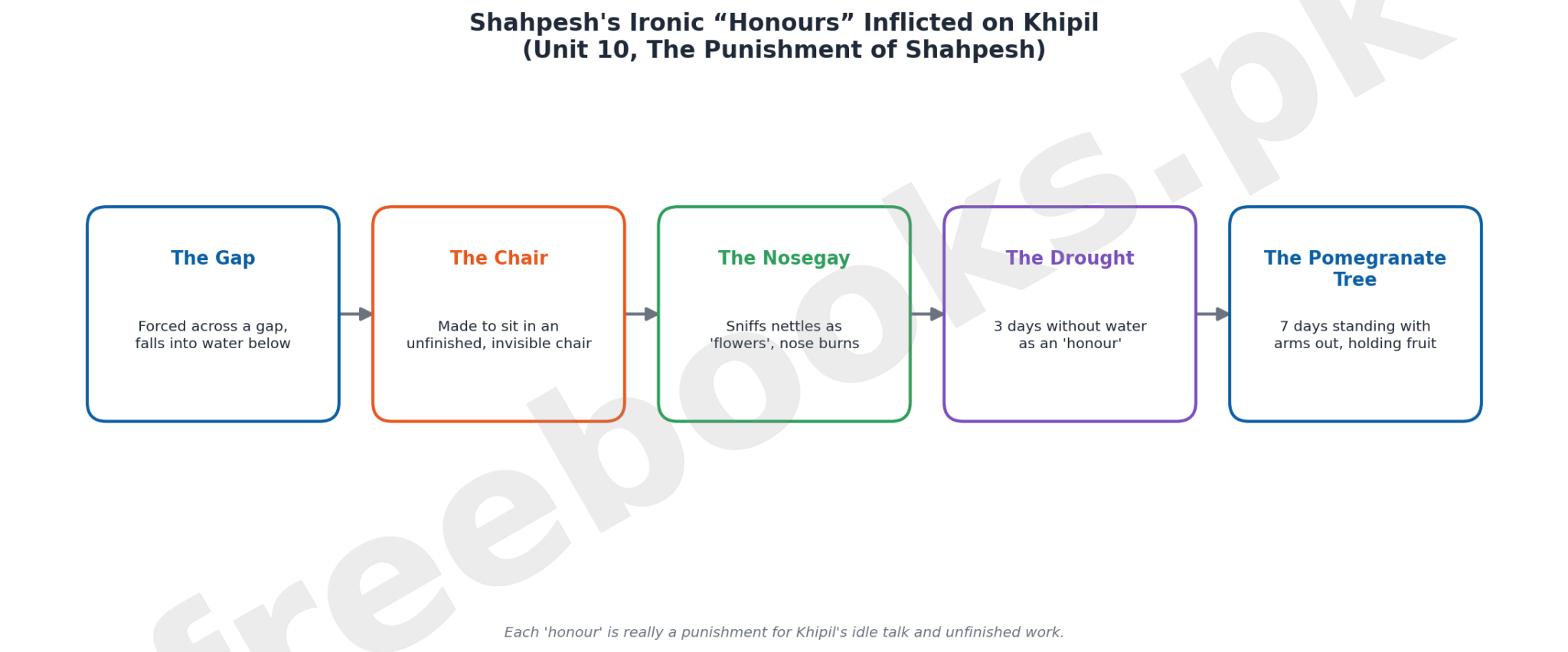
| Sequence of punishments | The gap/bath of surprise, the invisible chair, the nettle nosegay, three days without water, and seven days as a 'pomegranate tree'. |
| Proverbial phrase | "The Palace of the Wagging Tongue" — used to describe anyone punished for empty, boastful talk. |
Diagram
Shahpesh's Ironic 'Honours' Inflicted on Khipil: A sequential flow diagram of five connected boxes tracing Khipil's escalating punishments across the story — the gap/bath of surprise, the invisible chair, the nettle nosegay, three days without water, and seven days standing as a 'pomegranate tree' — each disguised by Shahpesh as an honour or reward.
Short Questions & Answers
What is the central message conveyed through the fate of Khipil?
The story teaches that valuing eloquent talk over real, responsible action leads to disgrace and humiliation, as shown through Shahpesh's series of ironic punishments disguised as honours for Khipil's negligence.
How does Shahpesh use sarcasm and irony in his treatment of Khipil?
Shahpesh consistently praises Khipil's unfinished, neglected work as if it were excellent, and frames each humiliating punishment as a reward or honour, exposing Khipil's failures through pointed irony rather than direct anger.
What metaphor does Shahpesh use about a farm servant, and what does it reveal?
Shahpesh compares Khipil to a farm servant who failed to sow seed in season but boasted of his soil's richness at harvest by pointing to its weeds, revealing his view that Khipil's boastful talk is masking neglected, unproductive work.
Why does Khipil hesitate to step into the gap on the terrace?
Khipil hesitates because the gap is wide, filled with deep water below, and he cannot swim — his hesitation reveals both his physical fear and his awareness, however belated, that the palace truly is incomplete.
What is the significance of Khipil being made to sit in the 'invisible' chair?
It exposes Khipil's habit of pretending completed work exists when it does not, forcing him to physically enact his own dishonesty by miming a sitting posture in a chair that was never built.
Why does Shahpesh send Khipil to present nettles to his mistress?
This is a further ironic punishment: by disguising nettles as a fragrant gift, Shahpesh humiliates Khipil both physically (his burning nose) and socially (his mistress's anger at the gift).
What do the punishments of the drought and the 'pomegranate tree' represent?
They represent the culmination of Shahpesh's escalating, ironic justice — physical suffering (thirst) and public ridicule (being displayed as a supposed 'wondrous' plant) matched precisely to Khipil's idle boastfulness.
What does the phrase 'Palace of the Wagging Tongue' mean by the end of the story?
It becomes a proverbial phrase describing anyone who is punished, like Khipil, for prioritising empty, boastful talk over real, responsible achievement.
Long Questions & Answers
Discuss how George Meredith uses irony to punish Khipil throughout the story, with reference to specific incidents.
How does Shahpesh's irony begin with the farm servant metaphor?
Shahpesh compares Khipil to a farm servant who boasts of his soil's richness through its weeds rather than its crop, subtly signalling from early in the story that he sees through Khipil's talk and recognises the palace's true, neglected state.
How is irony used in the incident of the gap and the 'bath of surprise'?
Shahpesh insists the unfinished, dangerous gap in the terrace is 'perfect' and forces Khipil across it, causing him to fall into water; he then ironically praises this accident as a delightful 'bath' invented for Khipil's benefit, turning a punishment into a mock reward.
How does the invisible chair episode use irony to punish Khipil?
By 'honouring' Khipil with permission to sit in a chair that does not exist, Shahpesh forces him to physically perform the same kind of pretence Khipil has used verbally throughout the story, then extends the humiliation by making him hold the pose for hours under threat of arrows.
What does this pattern of ironic punishment reveal about Shahpesh as a ruler?
It reveals a ruler who is shrewd, controlled, and precise in his justice — rather than punishing Khipil through open anger or violence, Shahpesh matches each punishment cleverly to Khipil's specific failing, making the lesson memorable and instructive to the wider court.
Explain the theme of 'valuing words over deeds' in the story, and discuss how Khipil's character embodies this flaw.
How does Khipil demonstrate a preference for talk over action from the story's opening?
From the first scene, Khipil is shown entertaining idle workers with anecdotes and poetic recitations rather than supervising the palace's construction, establishing his character as someone who substitutes eloquence for genuine productivity.
How does Khipil's language throughout the story reinforce this flaw?
Khipil consistently responds to Shahpesh with elaborate, flattering, and evasive language, describing the unfinished palace in glowing terms and avoiding direct acknowledgement of his failures, showing that his skill lies entirely in speech rather than construction.
How does the story's resolution punish this specific flaw?
Each of Shahpesh's punishments directly targets Khipil's reliance on words — forcing him to physically enact false claims (the chair), suffer for his exaggerated praise (the nettle 'flowers'), and be publicly displayed as a mock symbol of his own boastfulness (the pomegranate tree).
What broader lesson does the story's conclusion draw from Khipil's fate?
The story concludes that after Khipil's punishment, few in Shahpesh's kingdom sought to imitate his idle, talkative behaviour, establishing the tale's satirical moral: that real achievement, not eloquent talk, is what deserves honour and reward.
Multiple Choice Questions (MCQs)
Who is the author of 'The Punishment of Shahpesh, the Persian, on Khipil, the Builder'? (A) Nickie McWhirter (B) George Meredith (C) Langston Hughes (D) William Blake
Correct answer: (B) George Meredith. The story was written by George Meredith (1828-1909), an English novelist and poet.
How long had Khipil been building the palace by the time of the story's events? (A) One year (B) Two years (C) Four years (D) Ten years
Correct answer: (C) Four years. The work lingered from the first year of Shahpesh's reign to the fourth, meaning Khipil had spent four years without completing it.
What was Khipil doing when Shahpesh first arrived to inspect the palace? (A) Overseeing the masons carefully (B) Reciting anecdotes and poetry to idle workers (C) Repairing a collapsed wall (D) Meeting with foreign sultans
Correct answer: (B) Reciting anecdotes and poetry to idle workers. Khipil was found reciting anecdotes, recitations, and poetic instances to the idle masons and workers rather than supervising construction.
What metaphor does Shahpesh use to comment on Khipil's boastfulness? (A) A shepherd and his flock (B) A farm servant who failed to sow but boasted of his soil at harvest (C) A bird building a nest (D) A river changing course
Correct answer: (B) A farm servant who failed to sow but boasted of his soil at harvest. Shahpesh compares Khipil to a farm servant who neglected to sow in season but boasted of his soil's richness using its weeds as proof.
What happens to Khipil at the gap in the terrace? (A) He successfully leaps across it (B) He refuses to move and is imprisoned (C) He is forced across it and falls into water below (D) He builds a bridge over it
Correct answer: (C) He is forced across it and falls into water below. Despite his fear, Khipil is forced forward at arrow-point and falls into the deep water beneath the gap.
Why is Khipil made to sit in the 'chair' in the hall of state? (A) The chair was newly built for him (B) The chair does not actually exist, and Khipil must pretend to sit in it (C) It was a genuine honour with no irony intended (D) He requested to sit there himself
Correct answer: (B) The chair does not actually exist, and Khipil must pretend to sit in it. Like the rest of the palace, the chair has not been built, forcing Khipil to mime sitting in a nonexistent chair as part of Shahpesh's ironic punishment.
What are the 'flowers' Khipil is forced to pick and admire in the garden? (A) Roses (B) Nettles (C) Tulips (D) Jasmine
Correct answer: (B) Nettles. The neglected garden contains only weeds and nettles, which Khipil is forced to pluck and pretend to admire as fragrant flowers.
How many days and nights is Khipil made to go without water? (A) One day and night (B) Three days and nights (C) Five days and nights (D) Ten days and nights
Correct answer: (B) Three days and nights. Khipil is made to go three days and three nights without water, presented ironically as an honour by Shahpesh.
What is Khipil made to do for seven days and seven nights? (A) Stand with arms outstretched, holding a pomegranate in each hand (B) Guard the palace gates (C) Write poetry for the King (D) Sleep in the unfinished chair
Correct answer: (A) Stand with arms outstretched, holding a pomegranate in each hand. For seven days and nights, Khipil is forced to stand with stretched arms, holding a pomegranate in each hand, mimicking a tree.
What does the story's central theme criticise? (A) The dangers of foreign travel (B) Valuing words and talk over real deeds and responsibility (C) The unfairness of monarchy (D) The difficulty of palace construction
Correct answer: (B) Valuing words and talk over real deeds and responsibility. The story is a satire criticising the tendency to value eloquent talk over genuine action and responsibility.
Quick Revision Summary
- 'The Punishment of Shahpesh, the Persian, on Khipil, the Builder' is a short story by George Meredith (1828-1909).
- Khipil, the King's builder, spends four years failing to complete Shahpesh's palace, entertaining workers with talk instead.
- Shahpesh compares Khipil to a farm servant who boasted of his soil's richness through its weeds rather than its crop.
- Shahpesh forces Khipil across an unfinished gap, causing him to fall into water — ironically praised as a 'bath.'
- Khipil is made to sit in a chair that does not exist, under threat of arrows if he moves, while the court laughs.
- In the neglected garden, Khipil is forced to pluck and admire nettles as if they were fragrant flowers.
- Khipil goes three days without water and stands seven days with arms outstretched holding pomegranates, as further ironic 'honours.'
- Each punishment matches and exposes Khipil's specific failing: pretence, boastfulness, and empty talk.
- The story's theme is a satire on valuing words over deeds, warning that empty talk leads to disgrace.
- The tale ends with the proverbial phrase 'the Palace of the Wagging Tongue' for anyone punished this way.
Exam Tips
- Unit 10 belongs to PECTAA's 'prose group' (Units 1, 2, 5, 8, 10), which under the current paper pattern carries heavier weight — 5 of the paper's synonym questions and 3 of its MCQs are drawn from these prose units, so revise the 12 glossary words in this unit carefully.
- Since only 7 of the 10 short questions asked from the prose group need to be attempted, practice answering all 8 short questions in this unit so you have a comfortable choice on exam day.
- Memorise the sequence of Khipil's punishments in order (gap/bath, chair, nettle nosegay, drought, pomegranate tree) — examiners often ask you to narrate or identify events from this narrative in sequence.
- Be ready to explain how each punishment ironically matches Khipil's specific failing, since this cause-and-effect, irony-based reasoning is central to the story's exam-style comprehension questions.
- This unit's passage may also be set for the punctuation exercise or Urdu-translation/essay-writing option, so practice both as part of your preparation for this and the other prose units.
- When answering long questions, structure your answer around the story's plot stages (exposition, rising action through the punishments, resolution, theme) exactly as the story unfolds, rather than jumping between events out of order.