Space and the environment are closely connected: satellites orbiting Earth collect environmental data that helps scientists understand and protect our planet, while the study of space also reveals the origin and evolution of the universe. This chapter covers the nature of the Sun and its nuclear fusion, how planetary data (orbital distance, orbital period, density, surface temperature, gravitational field strength) is compared across planets, and how convection drives the formation of cyclones.
It also explains global warming and geothermal activity, how rising temperatures intensify extreme weather events (hurricanes, heat waves, flooding, wildfires, droughts, winter storms), and closes with radiation exposure, background radiation, and its four main natural and human-made sources: radon gas, rocks and buildings, food and drink, and cosmic rays.
Learning Objectives
- Explain the nature of the Sun as a medium-sized star composed mostly of hydrogen and helium, radiating energy across the infrared, visible, and ultraviolet spectrum
- Interpret and compare planetary data: orbital distance, orbital period, density, surface temperature, and gravitational field strength
- Use ideas of convection to explain how cyclones are formed, including the role of the Coriolis effect
- Explain how global warming contributes to extreme weather events: hurricanes, heat waves, flooding, wildfires, droughts, and winter storms
- Explain what is meant by background radiation
- State the sources that contribute significantly to background radiation: radon gas, rocks and buildings, food and drink, and cosmic rays
Key Concepts
21.1 The Sun
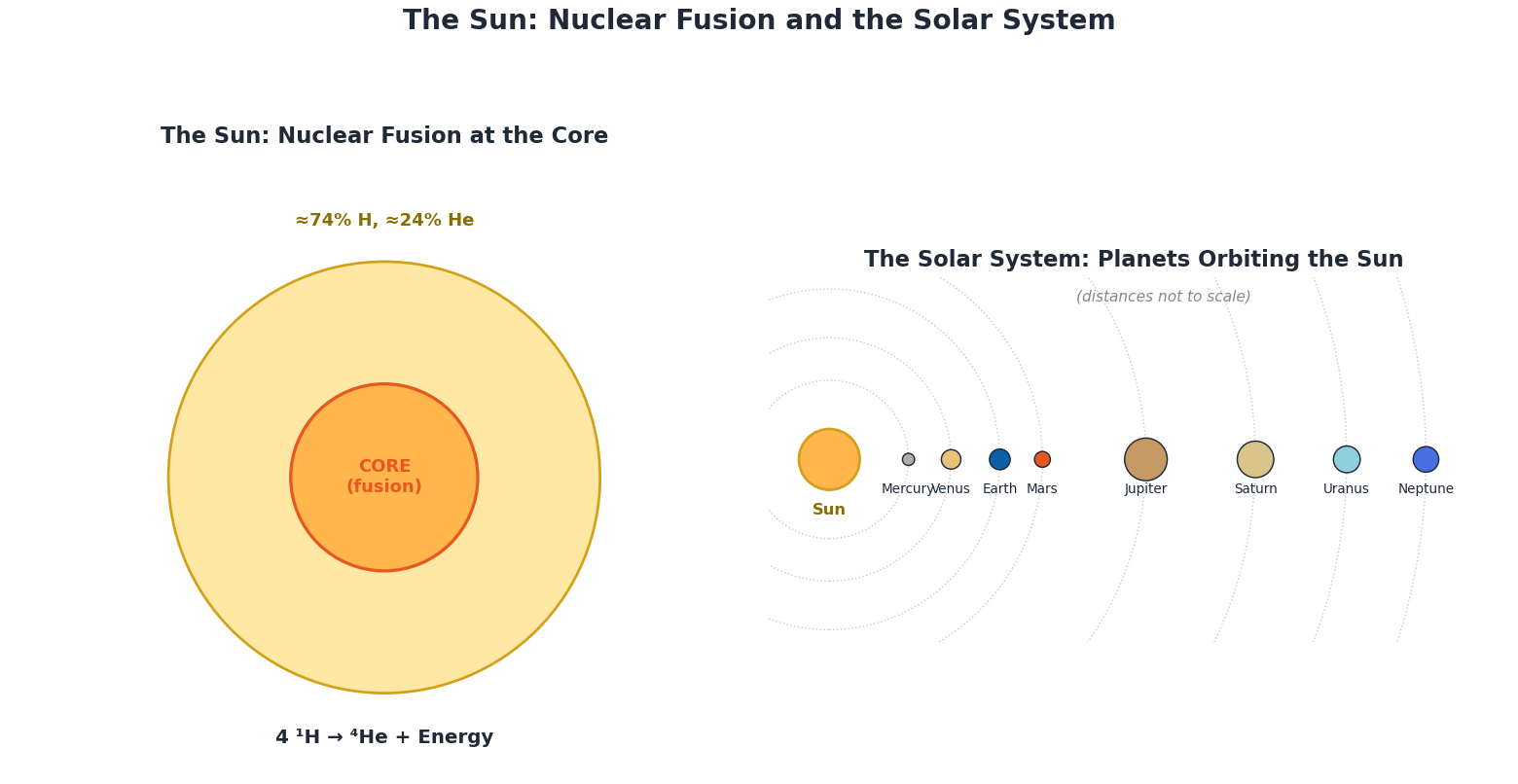
The Sun is the greatest source of light, heat, and other electromagnetic waves for our solar system, and its gravitational pull keeps the planets, including Earth, in orbit around it. The Sun is composed of about 74% hydrogen and 24% helium, along with trace amounts of other elements. At the Sun's core, nuclear fusion occurs continuously, fusing hydrogen atoms together to form helium; this process releases a tremendous amount of energy, raising the core temperature to millions of degrees Celsius and producing the light and heat that reaches Earth.
The energy released from the Sun travels through space as various types of radiation, including infrared, visible sunlight, and ultraviolet radiation, all of which significantly affect life on Earth by shaping weather patterns, driving climate, and supporting ecosystems. Unlike a fire, the Sun does not burn through combustion; it releases energy through nuclear fusion, converting a small amount of mass into an enormous amount of energy at its core.
21.2 Planetary Data
Comparing planets requires examining several key factors. Orbital distance is a planet's distance from the Sun — planets closer to the Sun have smaller orbital distances and receive more solar energy, while those farther away have larger orbital distances and receive less. Orbital period is the time a planet takes to complete one orbit around the Sun; planets closer to the Sun have shorter orbital periods (Mercury takes just 88 days, Earth takes 365.25 days, while Neptune takes 165 Earth years).
Density reflects a planet's composition: rocky planets like Earth and Mars have higher densities due to their solid, metallic cores, while gas giants like Jupiter and Saturn have lower densities since they are composed mostly of hydrogen and helium. Surface temperature depends on distance from the Sun, atmospheric composition, and greenhouse effects — Venus has an extremely high surface temperature due to its thick, heat-trapping atmosphere, while Mars is much colder due to its thin atmosphere and greater distance from the Sun. Gravitational field strength at a planet's surface depends on its mass and is nearly uniform across the surface, decreasing with distance from the planet; smaller planets (like Mars) have weaker surface gravity, while larger planets (like Jupiter) have stronger surface gravity.
21.3 Formation of Cyclones
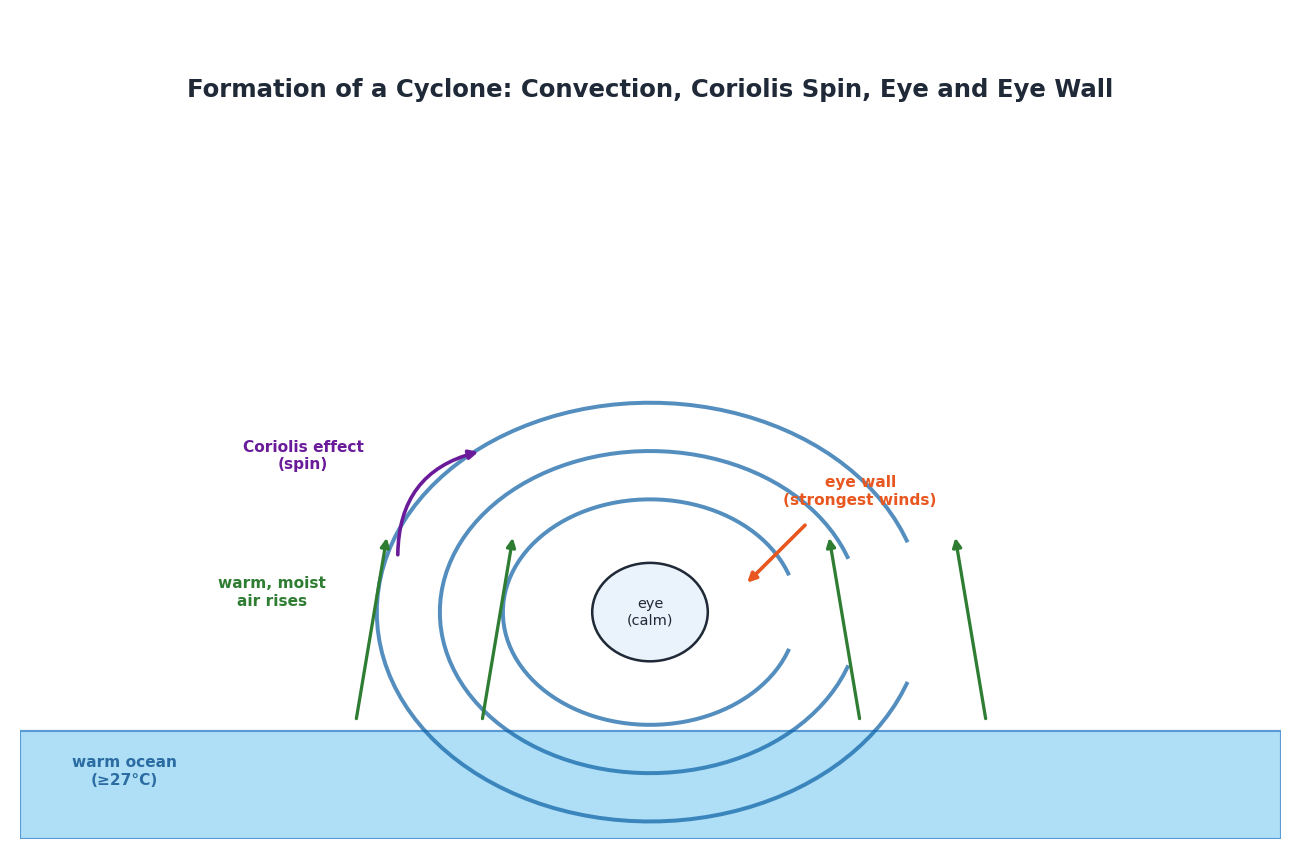
Cyclones are heavy storms with fast, spinning winds that form around a low air pressure area, driven by the process of convection: warm air, being lighter, rises, while heavier cool air moves down to replace it, and this rising motion creates the spinning effect that strengthens as more air rushes in. Cyclone formation begins over warm ocean waters (sea surface temperature around 27°C / 300 K or higher): the air above the warm water heats up, becomes less dense, and rises rapidly, creating a low-pressure area at the surface.
As this warm air rises into lower-pressure regions, it expands and cools, and its moisture condenses into clouds, releasing heat into the surrounding air — this extra heat makes the air rise even faster, forming more clouds and releasing more heat in a self-reinforcing cycle that strengthens and grows the cyclone. As warm air continues rising, it leaves a near-vacuum near the surface, pulling in more warm, moist air from surrounding areas; because the Earth is rotating, this inflowing air is deflected by the Coriolis effect, causing it to spin around the low-pressure centre rather than moving in a straight line — anticlockwise in the Northern Hemisphere, clockwise in the Southern Hemisphere. As the storm develops, a calm 'eye' forms at its centre where air moves downward, surrounded by the dangerous 'eye wall' with extremely strong winds and heavy rain. Cyclones weaken when they move over land or colder water, since they lose access to the warm, moist air that fuels their rising and spinning motion.
21.4 Global Warming and Geothermal Activity
Global warming is a long-term increase in Earth's average surface temperature, caused by burning fossil fuels, releasing gases like methane, carbon dioxide, and nitrous oxide, cutting down forests, and certain industrial and farming practices. These gases trap heat from the Sun in the atmosphere, raising global temperatures and significantly impacting weather patterns, sea levels, and ecosystems.
Similarly, geothermal activity — the Earth's own internal heat — causes volcanic eruptions, geysers, hot springs, and the movement of tectonic plates; geothermal energy is considered a renewable resource because it remains sustainable as long as the Earth's internal heat stays active (partly sustained by radioactive decay deep within the Earth, even after 4.5 billion years).
21.5 Effects of Global Warming on Extreme Weather
Rising temperatures intensify several types of extreme weather. Hurricanes become stronger and more destructive as warmer ocean waters provide more energy, increasing wind speeds and rainfall, while melting ice and expanding seawater raise sea levels, worsening storm surges and coastal flooding. Heat waves occur as greenhouse gases trap heat in the atmosphere, producing extended periods of extreme heat, worsened in cities where buildings and roads absorb and retain heat (the urban heat island effect).
Flooding increases because a warmer atmosphere holds more moisture, producing heavier rainfall, while rising sea levels from melting glaciers and ice sheets worsen coastal flooding. Wildfires become more common and severe due to high temperatures, prolonged dryness, and earlier snowmelt extending the fire season. Droughts intensify as higher temperatures increase evaporation from land, drying soil and reducing water availability, while changing rainfall patterns extend dry periods. Winter storms can also become more extreme, since warmer air holds more moisture, producing heavier snowfall and ice storms when temperatures are still cold enough for snow.
21.6 Radiation Exposure and Background Radiation
Radiation exposure occurs when someone comes into contact with radiation — a form of energy from natural sources (the Sun, the ground) or human-made sources (X-ray machines, nuclear power plants). Small amounts of radiation are generally safe, but excessive exposure can damage cells, which is why safety measures like protective wear and limited exposure time are used when working with radiation.
Background radiation is the constant, low-level ionizing radiation always present in the environment, from both natural and human-made sources — including cosmic rays from space, radioactive materials in the Earth's crust (like uranium and radon), and small amounts of radiation in food and our own bodies. Human activities such as medical procedures (X-rays, CT scans), nuclear power plants, and past nuclear testing also contribute. Background radiation is usually harmless at normal levels but is an ever-present feature of our environment.
21.7 Sources of Background Radiation
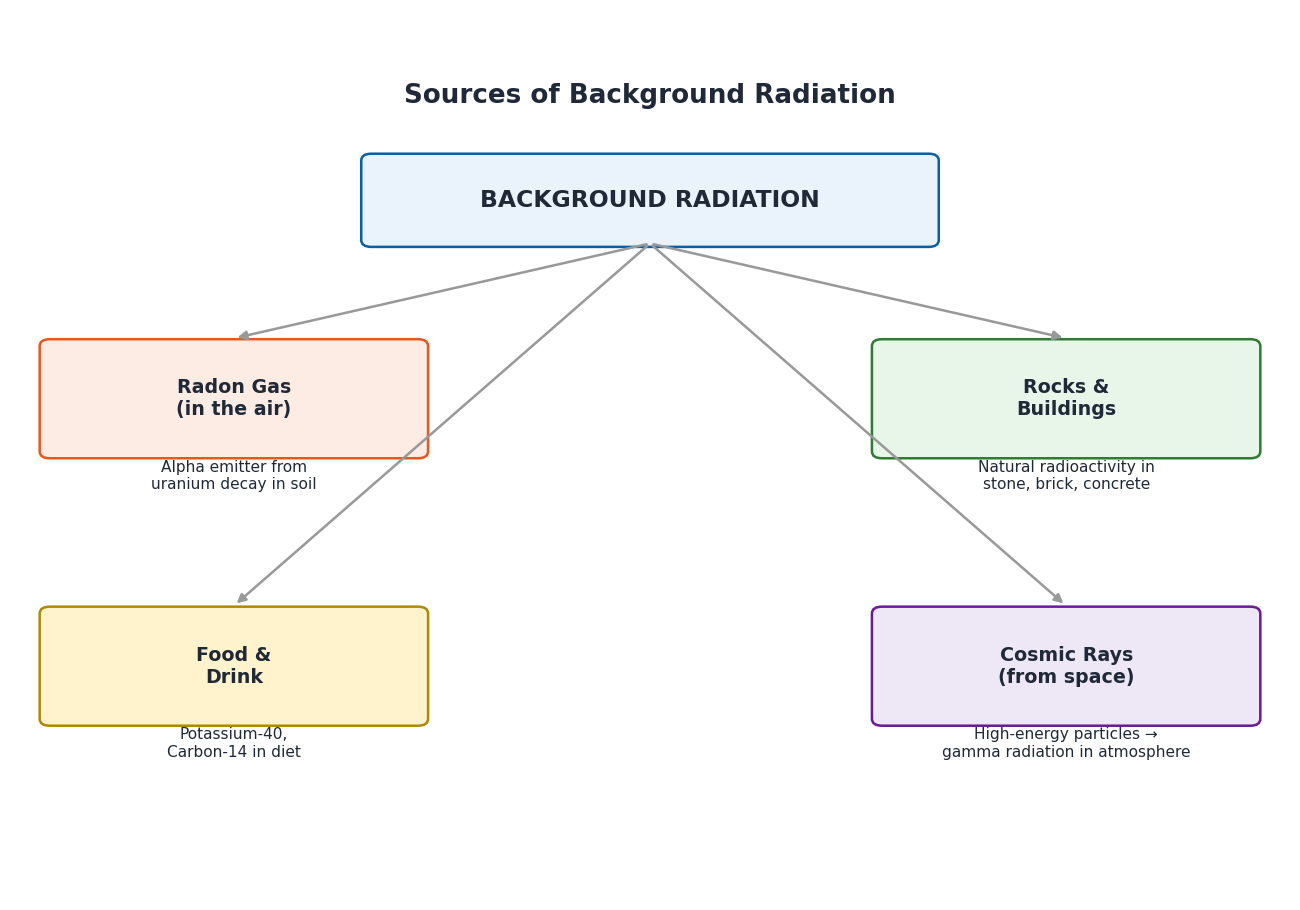
Radon gas (in the air) is an alpha emitter, tasteless, colourless, and odourless; it forms naturally from the decay of uranium in rocks and soil and can seep into buildings (especially basements), posing a health risk if inhaled in large quantities, though it is not generally a concern unless levels are significantly elevated. Rocks and buildings contain natural radioactivity from building materials such as decorative stones and bricks, and heavy radioactive elements like uranium and thorium occur naturally in rocks in the ground; uranium's decay chain produces radon gas.
Food and drink contain small amounts of naturally occurring radioactive isotopes, such as potassium-40 and carbon-14, absorbed by plants and animals and entering the human body through consumption — this contribution is generally small but consistent. Cosmic rays from space, emitted in enormous numbers by the Sun and other stars, enter Earth's atmosphere at high speed; when they collide with air molecules, they produce gamma radiation, some of which reaches the ground as part of natural background radiation.
21.8 Effects and Safety of Radiation Exposure
High exposure to radiation over a short time can cause radiation sickness, with symptoms including nausea, vomiting, fatigue, and organ damage; long-term exposure to lower levels increases cancer risk, particularly in organs like the lungs, thyroid, and bones, and can damage DNA, leading to genetic mutations that may affect future generations. Radioactive materials can also contaminate air, water, soil, and food, spreading radiation through the environment; inhaling radioactive dust or drinking contaminated water can cause internal exposure, where radioactive particles remain inside the body and continue emitting radiation.
Accidents such as leaks, spills, or explosions can occur if radioactive materials are not stored or handled safely, and nuclear power plant accidents or improper waste management can lead to large-scale disasters affecting communities and ecosystems. Safety measures — including protective wear, shielding, limited exposure time, and careful handling and storage procedures — are essential to minimize the risks of working with or being exposed to radioactive materials.
Important Definitions
What is the Sun composed of, and how does it generate energy?
The Sun is composed of about 74% hydrogen and 24% helium; it generates energy through nuclear fusion at its core, where hydrogen atoms fuse to form helium, releasing enormous amounts of energy.
Define orbital period.
The time a planet takes to complete one full orbit around the Sun; planets closer to the Sun have shorter orbital periods (e.g., Mercury: 88 days) than planets farther away (e.g., Neptune: 165 Earth years).
What is a cyclone?
A heavy storm with fast, spinning winds forming around a low air pressure area, driven by convection — the rising of warm, moist air over warm ocean waters.
What is the Coriolis effect?
The deflection of moving air (or other moving objects) caused by the Earth's rotation, which makes air spin around a low-pressure centre — anticlockwise in the Northern Hemisphere and clockwise in the Southern Hemisphere.
Define global warming.
A long-term increase in the Earth's average surface temperature, caused mainly by the burning of fossil fuels and release of greenhouse gases (carbon dioxide, methane, nitrous oxide), which trap heat in the atmosphere.
What is geothermal energy?
Energy derived from the Earth's internal heat, which drives volcanic eruptions, geysers, and hot springs; it is considered a renewable energy source as long as the Earth's internal heat remains active.
Define background radiation.
The constant, low-level ionizing radiation always present in the environment, from natural sources (cosmic rays, radioactive rocks, radon) and human-made sources (medical procedures, nuclear power, past nuclear testing).
What is radon gas?
A tasteless, colourless, odourless alpha-emitting radioactive gas produced by the natural decay of uranium in rocks and soil, which can accumulate in buildings and pose a health risk if inhaled in large quantities.
Key Formulas
| Topic | Formula |
|---|---|
| Sun's composition | ≈74% hydrogen, ≈24% helium (+ trace elements) |
| Solar nuclear fusion reaction | 4 ¹₁H → ⁴₂He + Energy (≈25.7 MeV) |
| Orbital period trend | Closer to Sun = shorter period (Mercury: 88 days; Earth: 365.25 days; Neptune: 165 years) |
| Cyclone formation threshold | Sea surface temperature ≥ ≈27 °C (≈300 K) |
| Coriolis effect direction | Northern Hemisphere: anticlockwise spin; Southern Hemisphere: clockwise spin |
| Major greenhouse gases | Carbon dioxide (CO₂), methane (CH₄), nitrous oxide (N₂O) |
| Radon gas origin | Produced by radioactive decay of uranium in rocks/soil; radon itself is an alpha emitter |
| Cosmic ray interaction | High-energy cosmic rays + atmospheric molecules → gamma radiation (background radiation) |
Diagrams
The Sun: Nuclear Fusion and the Solar System: The Sun's core where hydrogen fuses into helium, alongside a simplified diagram of the solar system showing planets at increasing orbital distances from the Sun
Formation of a Cyclone: A cross-section of a cyclone showing warm, moist air rising over warm ocean water, the Coriolis effect creating the spin, and the calm eye surrounded by the dangerous eye wall
Sources of Background Radiation: The four main sources of background radiation: radon gas in the air, radioactivity in rocks and buildings, naturally radioactive isotopes in food and drink, and cosmic rays from space
Short Questions & Answers
What are the two main elements that make up the Sun?
The Sun is composed mainly of hydrogen (about 74%) and helium (about 24%), with trace amounts of other elements.
What factors are used to compare planets in terms of their characteristics?
Planets are compared using orbital distance, orbital period, density, surface temperature, and gravitational field strength at their surface.
Explain how global warming increases the intensity of hurricanes.
Global warming raises ocean temperatures, and warmer ocean water provides more energy to fuel hurricanes, resulting in higher wind speeds, heavier rainfall, and greater overall storm intensity and damage.
What is background radiation, and what are its natural sources?
Background radiation is the constant, low-level ionizing radiation present in the environment; its natural sources include cosmic rays from space, radioactive materials in rocks and soil (like uranium and radon), and naturally occurring radioactive isotopes in food and drink.
Name three safety measures used to handle radioactive materials safely.
Using protective wear/shielding, limiting exposure time and distance from the radiation source, and properly storing and disposing of radioactive materials to prevent leaks or contamination.
Why do cyclones weaken when they move over land?
Cyclones rely on warm, moist air from the ocean surface as their energy source; over land or colder water, this supply of warm, moist air is cut off, so the air stops rising and spinning as strongly, and the storm gradually loses strength.
How does the Coriolis Effect influence the movement of cyclones?
The Coriolis effect, caused by the Earth's rotation, deflects air flowing into a cyclone's low-pressure centre, making it spin rather than move in a straight line — anticlockwise in the Northern Hemisphere and clockwise in the Southern Hemisphere.
What is the primary cause of rising sea levels due to global warming?
Rising sea levels are primarily caused by melting glaciers and ice sheets, along with the thermal expansion of seawater as ocean temperatures increase.
Long Questions & Answers
Describe the process of nuclear fusion in the Sun and explain how it generates the energy that reaches Earth.
The Sun, located at the centre of our solar system, is composed of roughly 74% hydrogen and 24% helium, along with trace amounts of other elements, and its gravitational pull is what holds all the planets, including Earth, in their orbits. Despite its fiery, burning appearance, the Sun does not produce energy through ordinary combustion in the way a fire burning wood or coal does; instead, it generates its tremendous energy output through a process called nuclear fusion, occurring continuously deep within its core. At the Sun's core, the immense gravitational pressure and extreme temperatures (reaching millions of degrees Celsius) force hydrogen nuclei to overcome their mutual electrostatic repulsion and fuse together, ultimately combining to form helium nuclei; because the resulting helium nucleus has very slightly less mass than the total mass of the hydrogen nuclei that fused to form it, this small missing mass — the mass defect — is converted directly into an enormous quantity of energy according to Einstein's equation E = mc². This continuous fusion process at the Sun's core releases energy on a truly massive scale, and this energy gradually makes its way outward from the core, through the Sun's outer layers, and is eventually radiated outward into space in the form of electromagnetic radiation spanning several regions of the spectrum, including infrared radiation, visible light, and ultraviolet radiation. A portion of this radiated energy travels the roughly 150 million kilometres across space to reach the Earth, where it warms the planet's surface, drives weather patterns and climate, and provides the light and warmth necessary to sustain nearly all forms of life and ecosystems found on Earth; without this continuous, reliable output of energy from solar nuclear fusion, Earth's climate, weather, and capacity to support life as we know it would not be possible.
Explain the process by which convection leads to the formation and strengthening of a cyclone, including the role of the Coriolis effect.
Cyclones are powerful storm systems characterized by fast, spinning winds circulating around a central area of low atmospheric pressure, and their formation and growth are driven fundamentally by the physical process of convection combined with the Earth's rotation. The process typically begins over warm tropical ocean waters, where the sea surface temperature is sufficiently high (generally around 27°C or 300 K or greater) to significantly heat the layer of air directly above the ocean surface; as this air absorbs heat from the warm water below, it becomes less dense than the surrounding cooler air and, following the basic principle of convection, begins to rise rapidly upward, leaving behind an area of reduced atmospheric pressure at the surface. As this warm, moist air continues rising into the cooler upper atmosphere, it expands and cools, causing the water vapour it carries to condense into visible clouds; this condensation process itself releases additional latent heat energy into the surrounding air, which further warms that air and causes it to rise even more rapidly than before, in turn drawing up still more moisture-laden air from below — this creates a self-reinforcing feedback cycle in which rising air, cloud formation, and heat release continuously strengthen one another, causing the developing storm system to grow progressively larger and more powerful for as long as it remains over sufficiently warm ocean water. As increasing quantities of warm air rise away from the ocean surface near the storm's centre, this steady upward removal of air creates an intensifying region of low pressure at the surface, similar to a partial vacuum, which in turn draws in additional warm, moist air from the surrounding ocean areas to replace the air that has risen; however, because the Earth itself is continuously rotating on its axis, this inflowing surface air does not simply travel in a straight line directly toward the low-pressure centre, but is instead deflected sideways by the Coriolis effect — an apparent force arising from the Earth's rotation — causing the inflowing air to be curved into a spiralling, rotational pattern around the central low-pressure area rather than flowing straight inward; specifically, in the Northern Hemisphere this deflection causes the air to spiral inward in an anticlockwise direction, while in the Southern Hemisphere the opposite deflection causes clockwise rotation. As this spiralling inflow of warm, moist air continues to intensify, drawing ever more energy from the warm ocean surface below, the storm organizes into a full cyclonic system, typically developing a distinctive calm, clear central 'eye' (where air is actually descending rather than rising), surrounded immediately by the extremely violent 'eye wall' region, where the most intense spiralling winds and heaviest rainfall of the entire storm system are concentrated; the cyclone will then continue to grow and intensify for as long as it remains positioned over sufficiently warm ocean waters to continuously supply the warm, moist air that fuels its convective engine, but will begin to rapidly weaken and eventually dissipate once it moves over land or significantly cooler ocean waters, since this cuts off its essential supply of warm, moist fuel air.
Explain how global warming contributes to more intense and destructive hurricanes, heat waves, and flooding, using specific physical mechanisms for each.
Global warming — the long-term rise in the Earth's average surface temperature driven mainly by the accumulation of greenhouse gases such as carbon dioxide, methane, and nitrous oxide in the atmosphere — intensifies several distinct types of extreme weather through specific, identifiable physical mechanisms rather than through some vague, generalized 'more heat' effect. In the case of hurricanes, the key mechanism is the warming of ocean surface waters: since hurricanes and cyclones draw their energy directly from the heat contained in warm ocean water (through the evaporation and subsequent condensation of that warm, moist air, as described by the convective process underlying cyclone formation), any increase in ocean surface temperatures directly increases the total amount of thermal energy available to fuel a developing storm, allowing hurricanes to intensify more rapidly, sustain higher wind speeds, and produce heavier rainfall than they would over cooler waters; in addition, the same warming that raises ocean temperatures also causes polar ice and glaciers to melt and ocean water to thermally expand, both of which raise sea levels, meaning any given hurricane's storm surge now pushes ashore over an already elevated sea level, worsening coastal flooding and damage even for storms of otherwise similar intensity. In the case of heat waves, the underlying mechanism is the atmosphere's increased capacity to trap and retain heat: as concentrations of greenhouse gases increase, more of the outgoing infrared heat radiation that would otherwise escape back into space is instead absorbed and re-emitted within the atmosphere, causing periods of naturally elevated temperature (which have always occurred to some degree) to become both more frequent and considerably more extreme and prolonged than they would be under a stable, unwarmed climate; this effect is further intensified within cities specifically, where extensive coverage by heat-absorbing surfaces such as asphalt roads and concrete or dark-roofed buildings causes urban areas to absorb and retain significantly more heat during the day and release it more slowly at night than surrounding rural or vegetated areas experience — a phenomenon known as the urban heat island effect — making city-dwellers particularly vulnerable to the worst effects of heat waves. In the case of flooding, the relevant mechanism is a fundamental physical property of the atmosphere itself: warmer air is capable of holding significantly more water vapour than cooler air, meaning that as global average temperatures rise, the atmosphere as a whole becomes capable of accumulating and subsequently releasing considerably larger quantities of moisture during individual rainfall or storm events, directly producing heavier, more intense rainfall and a correspondingly greater risk of both inland river flooding and urban flash flooding; simultaneously, since (as previously discussed for hurricanes) melting glaciers and ice sheets combined with thermal expansion are steadily raising global sea levels, coastal regions face a compounding, second and entirely separate flooding risk from encroaching seawater and storm surges, entirely independent of local rainfall amounts, meaning that coastal communities in particular now face an elevated flood risk from two simultaneously worsening causes rather than just one.
Explain what background radiation is, and describe the four main sources that contribute to it.
Background radiation refers to the constant, low-level ionizing radiation that is always present throughout our everyday environment, arising continuously from a combination of both entirely natural sources and additional human-made (anthropogenic) sources; unlike a sudden, deliberate exposure to radiation (such as from a medical X-ray), background radiation is an ever-present, ambient feature of the world we live in, and at its normal typical levels, it is generally considered harmless to human health, even though we are all continuously exposed to it throughout our entire lives. Four sources make particularly significant contributions to overall background radiation levels. The first major source is radon gas, a naturally occurring radioactive gas that is entirely tasteless, colourless, and odourless, making it completely undetectable by human senses; radon is produced as a natural decay product of uranium, which occurs naturally in small quantities within rocks and soil essentially everywhere on Earth, and because radon is a gas, it can seep upward out of the ground and into the air, where it can also accumulate to relatively higher concentrations inside enclosed spaces such as basements and poorly ventilated buildings; radon is specifically an alpha-particle emitter, and while alpha particles cannot penetrate even a sheet of paper from outside the body, inhaling radon gas directly into the lungs in significant quantities allows the alpha radiation it subsequently emits to directly and repeatedly irradiate sensitive lung tissue from within, making high radon concentrations a recognized health hazard. The second major source is radioactivity naturally present within rocks and building materials: many common rocks, stones, and the bricks, concrete, and other materials manufactured from them naturally contain small but measurable quantities of long-lived radioactive elements such as uranium and thorium, which have been present within the Earth's crust since the planet's formation; because many building materials are ultimately derived from quarried rock and mineral sources, buildings themselves — particularly those constructed extensively from stone, brick, or concrete — can therefore contribute a small, ongoing radiation dose to the people living or working within them, in addition to naturally contributing to the decay chain that produces radon gas. The third major source is food and drink: many common foods and drinking water sources naturally contain small, trace quantities of certain radioactive isotopes that occur naturally within the environment, most notably potassium-40 (a naturally radioactive form of the otherwise stable, essential nutrient potassium) and carbon-14 (a naturally radioactive form of ordinary carbon); because these particular isotopes are chemically identical in behaviour to their far more abundant stable counterparts, they are readily absorbed by growing plants directly from soil, water, and air, and subsequently pass up through the food chain into the tissues of animals (and ultimately humans) that consume those plants or other animals, meaning that essentially every living organism, including every human being, contains and continuously ingests small quantities of naturally radioactive material as an unavoidable, everyday part of eating and drinking; although the resulting radiation dose from this source is generally quite small on an individual basis, it remains a small but genuinely consistent, ever-present contributor to total background radiation exposure. The fourth and final major source is cosmic radiation arriving from outer space: the Sun and other distant stars throughout the universe continuously emit enormous numbers of extremely high-energy particles (predominantly protons) in all directions, and a portion of this constant stream of cosmic radiation travels across space and enters the Earth's upper atmosphere at extremely high speed; upon colliding with the nitrogen, oxygen, and other molecules that make up our atmosphere, these high-energy cosmic particles trigger complex particle-physics interactions that ultimately produce, among other things, gamma radiation, some of which subsequently reaches all the way down to ground level, contributing yet another small but continuous and unavoidable component to the overall background radiation experienced by every person and organism living on the Earth's surface.
Multiple Choice Questions (MCQs)
What process generates energy in the Sun? (A) Nuclear fission (B) Nuclear fusion (C) Radioactive decay (D) Chemical reactions
Correct answer: (B) Nuclear fusion. The Sun generates energy through nuclear fusion, in which hydrogen nuclei fuse together at its core to form helium, releasing enormous amounts of energy.
The factor which primarily determines a planet's surface temperature is: (A) its density (B) its orbital distance from the Sun (C) its gravitational field strength (D) the number of moons it has
Correct answer: (B) its orbital distance from the Sun. A planet's surface temperature is primarily determined by its orbital distance from the Sun, along with its atmospheric composition and greenhouse effects.
What is the primary reason cyclones form over warm ocean waters? (A) The presence of strong winds (B) The high atmospheric pressure (C) The rising of warm, moist air creating low pressure (D) The gravitational pull of the moon
Correct answer: (C) The rising of warm, moist air creating low pressure. Warm ocean water heats the air above it, causing warm, moist air to rise rapidly and create a region of low pressure — the driving force behind cyclone formation.
Which of the following gases contributes the most to global warming? (A) Oxygen (B) Carbon dioxide (C) Nitrogen (D) Argon
Correct answer: (B) Carbon dioxide. Carbon dioxide (CO₂), along with methane and nitrous oxide, is one of the primary greenhouse gases contributing to global warming by trapping heat in the atmosphere.
How does the Coriolis effect influence cyclones? (A) It causes cyclones to spin in opposite directions in different hemispheres (B) It strengthens cyclones over land (C) It prevents warm air from rising (D) It stops the formation of low-pressure areas
Correct answer: (A) It causes cyclones to spin in opposite directions in different hemispheres. The Coriolis effect, caused by the Earth's rotation, makes cyclones spin anticlockwise in the Northern Hemisphere and clockwise in the Southern Hemisphere.
A major cause of rising sea levels is: (A) increased volcanic activity (B) the Earth moving closer to the Sun (C) melting glaciers and ice sheets (D) decreased solar radiation
Correct answer: (C) melting glaciers and ice sheets. Melting glaciers and ice sheets, combined with the thermal expansion of warming seawater, are the major causes of rising sea levels due to global warming.
A significant source of background radiation is: (A) oxygen in the air (B) cosmic rays from space (C) sound waves in the atmosphere (D) light from the Sun
Correct answer: (B) cosmic rays from space. Cosmic rays from space are one of the main natural sources of background radiation, along with radon gas, rocks/buildings, and food/drink.
Radon gas, a source of background radiation, is primarily: (A) a beta emitter (B) an alpha emitter (C) a gamma emitter (D) not radioactive at all
Correct answer: (B) an alpha emitter. Radon gas is an alpha emitter, produced naturally from the decay of uranium in rocks and soil.
Which planet has a very high surface temperature mainly due to its thick, heat-trapping atmosphere? (A) Mars (B) Mercury (C) Venus (D) Neptune
Correct answer: (C) Venus. Venus has an extremely high surface temperature due to its thick, heat-trapping (greenhouse) atmosphere, despite not being the closest planet to the Sun.
Geothermal energy is considered a renewable resource because: (A) it comes only from nuclear reactors (B) it is sustainable as long as Earth's internal heat remains active (C) it is produced by burning fossil fuels (D) it depends entirely on solar radiation
Correct answer: (B) it is sustainable as long as Earth's internal heat remains active. Geothermal energy, derived from the Earth's internal heat, is considered renewable because it remains available as long as the Earth's internal heat stays active.
Quick Revision Summary
- Sun: ≈74% hydrogen, ≈24% helium; energy from nuclear fusion (H→He) at core, not combustion
- Planetary comparison factors: orbital distance, orbital period, density, surface temperature, gravitational field strength
- Cyclones: convection (warm air rises over warm ocean ≥27°C) → low pressure → Coriolis spin (N: anticlockwise, S: clockwise) → eye + eye wall; weaken over land/cold water
- Global warming: greenhouse gases (CO₂, methane, N₂O) trap heat; geothermal activity = Earth's internal heat (volcanoes, geysers, tectonic plates)
- Global warming intensifies: hurricanes (warmer oceans = more fuel), heat waves (trapped heat + urban heat island), flooding (more moisture + rising seas), wildfires (heat + dryness), droughts (more evaporation), winter storms (more moisture = heavier snow)
- Background radiation: constant low-level ionizing radiation, natural + human-made sources, usually harmless at normal levels
- 4 sources of background radiation: (1) radon gas — alpha emitter from uranium decay; (2) rocks/buildings — natural radioactivity in stone/brick; (3) food/drink — potassium-40, carbon-14; (4) cosmic rays — produce gamma radiation in atmosphere
- Radiation effects: high short-term dose → radiation sickness; long-term low dose → cancer risk, DNA mutations
- Radiation safety: protective wear, shielding, limited exposure time/distance, proper storage/disposal
Exam Tips
- Remember the Sun's energy source is FUSION (hydrogen → helium), never confuse this with fission (splitting heavy nuclei), which is used in nuclear power plants on Earth
- For planetary data questions, always specify WHICH factor you're discussing (orbital distance vs. orbital period vs. density vs. temperature) — they are frequently confused
- For cyclone formation, describe the full chain: warm ocean → rising air → low pressure → Coriolis-driven spin → eye/eye wall — partial answers lose marks
- Remember Coriolis direction: Northern Hemisphere = anticlockwise, Southern Hemisphere = clockwise — a commonly tested detail
- For global warming's effects on extreme weather, link the SPECIFIC mechanism to each event (e.g., hurricanes ← warmer oceans; heat waves ← trapped heat + urban surfaces; flooding ← more atmospheric moisture)
- Memorize all four background radiation sources by category: radon (alpha, from uranium decay), rocks/buildings (natural radioactivity), food/drink (K-40, C-14), cosmic rays (produce gamma rays in atmosphere)