Electrostatics is the branch of physics that studies charges at rest and the electric fields they create. From a plastic comb attracting paper after being rubbed through hair to the shock felt after sliding across a car seat, electrostatic effects are part of everyday experience. This chapter covers electric charge and its properties, electrostatic induction and earthing, real-world applications like photocopiers and electrostatic precipitators, Coulomb's law, and electric fields and their patterns.
The chapter also explains the difference between electrical conductors and insulators using a simple free-electron model, and closes with electrical breakdown — the physics behind lightning, corona discharge, Lichtenberg figures, and how lightning rods protect buildings and people.
Learning Objectives
- State that there are positive and negative charges, measured in coulombs, and that unlike charges attract while like charges repel
- Describe experiments showing electrostatic charging by friction, and explain that this involves transfer of electrons only
- Explain how a conductor can be charged by electrostatic induction and then earthed
- Suggest how charging and discharging is applied in devices such as photocopiers and electrostatic precipitators
- Describe an electric field as a region where a charge experiences a force, and state the direction convention using a positive test charge
- Discuss and illustrate electric field patterns around a point charge, a charged conducting sphere, and between charged parallel plates
- State examples of electrical conductors and insulators, and describe an experiment to distinguish between them
- Use a simple electron model to explain the difference between conductors and insulators
- Explain how a lightning rod protects structures, and explain electrical breakdown
- State that corona discharge and Lichtenberg figures are visible examples of electrical breakdown
Key Concepts
15.1 Electric Charge and Its Properties
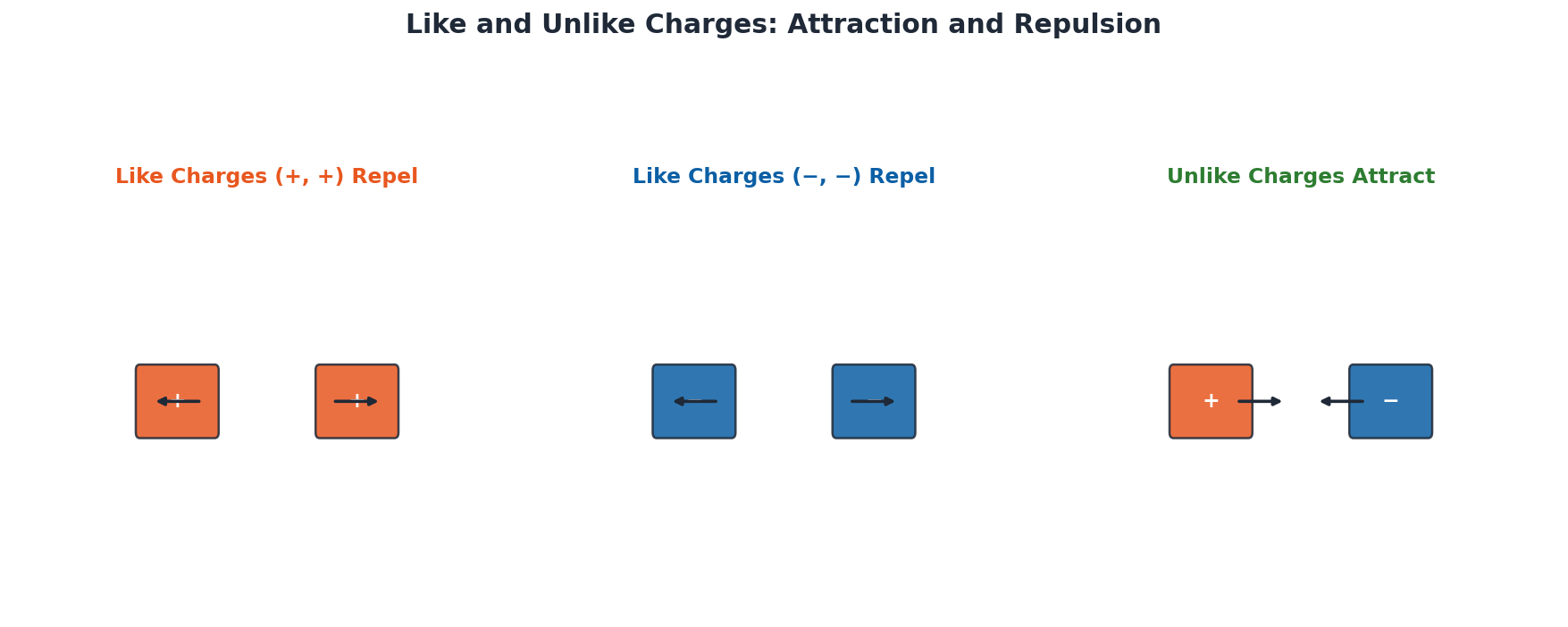
A plastic comb rubbed through dry hair, or an amber rod rubbed with silk, attracts small pieces of paper; a shock felt after sliding across a car seat or walking on synthetic carpet has the same cause — electrostatic force resulting from electric charge, an intrinsic property of matter (like mass) measured in coulombs (C). There are two types of charge, positive and negative: two glass rods rubbed with silk both become positively charged and repel each other; two plastic rods rubbed with wool both become negatively charged and repel each other; but a positively charged glass rod and a negatively charged plastic rod attract each other — demonstrating that like charges repel and unlike charges attract.
Atoms consist of positively charged protons in the nucleus and negatively charged electrons orbiting around it; since all matter is made of atoms, every material is ultimately positively charged, negatively charged, or neutral, depending on its balance of protons and electrons. Charging by friction (rubbing two materials together) involves only the transfer of electrons — never protons, which are locked inside the nucleus — from one material to the other, leaving one object with excess electrons (negative) and the other with a deficit (positive). Charge can also transfer by direct contact or by induction, and the total charge in an isolated system always remains constant.
15.2 Electrostatic Induction, Earthing, and the Electroscope
When a charged plastic rod is brought near a neutral, suspended metal rod, the two are drawn together — not because the metal rod is charged, but because the nearby charge causes a redistribution of positive and negative charge within the neutral conductor while its total charge remains zero; this is electrostatic induction. If two touching metal spheres are placed on insulated stands and a positively charged rod is brought near one sphere, negative charge is pulled toward the rod and positive charge is pushed to the far sphere; separating the spheres while the rod is still present leaves them with equal and opposite charges — this is charging by induction, achieved entirely without direct contact between the rod and the spheres.
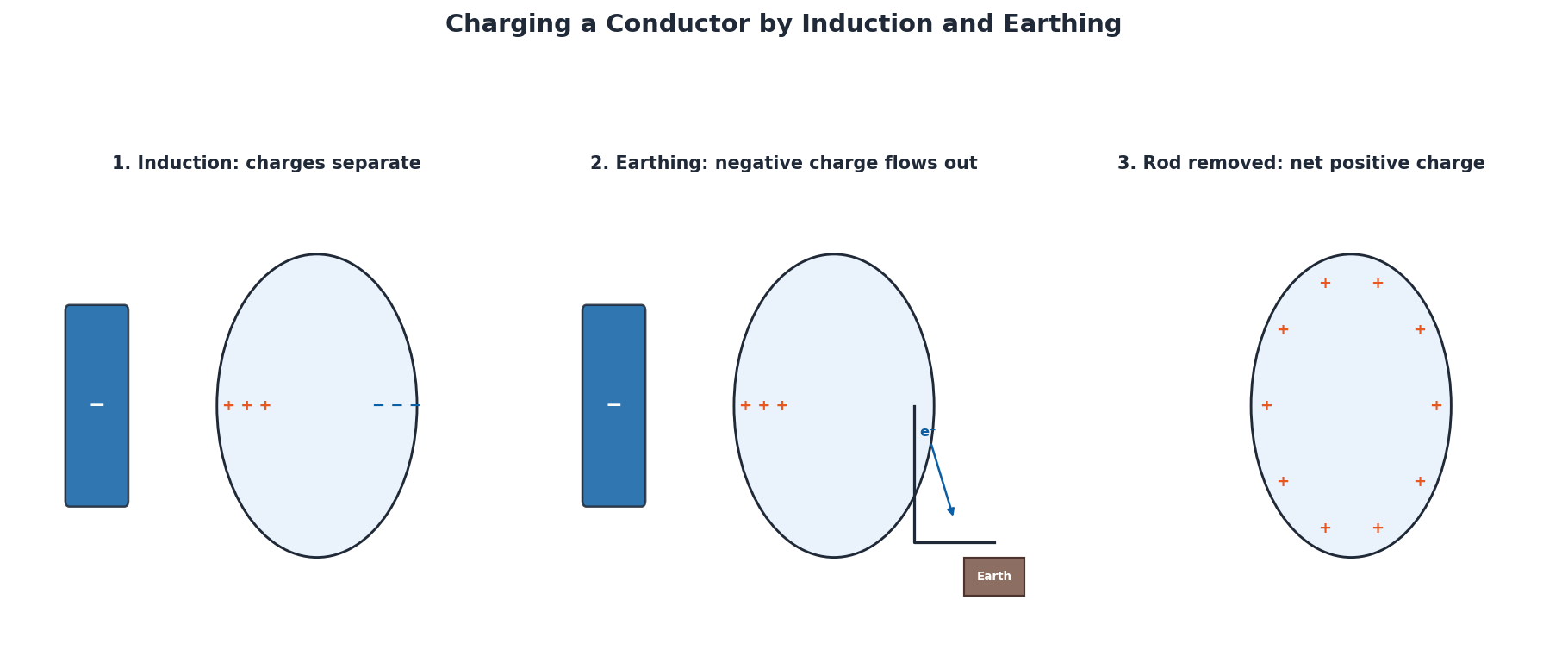
Earthing connects a conductor to the Earth via a wire, allowing unwanted charge to flow away: when a negatively charged rod is held near a neutral metal sphere, electrons are repelled to the far side; connecting that far side to Earth lets these excess electrons flow into the ground, and removing the earth connection (while the rod is still present) traps a net positive charge on the sphere, even though the rod never touched it. The gold leaf electroscope is a sensitive device for detecting charge: it has a metal disk and rod connected to two thin gold leaves; bringing a charged object near the disk (without touching) causes induced charge to spread down to the leaves, which then repel each other and diverge — the amount of divergence indicates how much charge is present, and if leaves collapse when a charged object touches the disk, the tested material is a conductor.
15.3 Applications of Electrostatics: Photocopier and Electrostatic Precipitator
A photocopier works by xerography ('dry writing'): its central rotating drum, made of aluminium (a conductor) coated with selenium (a photoconductor — behaves as an insulator in the dark, but conducts when lit), is first given a uniform positive charge. As the document's image is projected onto the drum, bright (light) areas cause selenium there to conduct, letting electrons neutralize the positive charge in those spots, while dark areas retain their charge — creating an invisible electrostatic image. Negatively charged toner powder then sticks only to the still-positively-charged (dark/image) areas, is transferred onto paper using a slightly positive roller, and finally fused permanently into the paper using heated rollers.
An electrostatic precipitator (ESP) removes particulate pollution from industrial exhaust gases using corona discharge — a high-voltage effect that ionizes air near a thin wire, producing free electrons that attach to gas molecules to form negative ions. These ions charge the particulate matter passing through the gas stream negatively; the charged particles are then attracted to and collected on positively charged plates, which are periodically cleaned, with the collected material falling into a hopper for disposal — making ESPs an essential technology for reducing industrial air pollution.
15.4 Coulomb's Law
Charges exert an attractive or repulsive force on each other called the electrostatic force. In 1785, Charles Coulomb experimentally determined that the magnitude of the electrostatic force between two point charges is directly proportional to the product of the charges and inversely proportional to the square of the distance between them: F ∝ q₁q₂ and F ∝ 1/r², combining to give F = kq₁q₂/r², where k is a proportionality constant depending on the medium — in vacuum or air, k ≈ 9 × 10⁹ N m² C⁻². Coulomb's law applies specifically to point charges, whose physical size is negligible compared to the separation distance.
If the two charges have opposite signs, the force is attractive; if they have the same sign (both positive or both negative), the force is repulsive — in both cases, the magnitude of the force follows the same formula, only the direction changes. Coulomb's law resembles Newton's law of gravitation in its inverse-square form, but differs in that gravitational force is always attractive and matters most for large masses over large distances, while electric force can be either attractive or repulsive and matters most for small charges over small distances.
15.5 Electric Field and Electric Field Intensity
An electric field is the region around a charge where it exerts a force on other charges — theoretically extending to infinity, though the force weakens with distance following an inverse-square relationship, E = kq/r². Bringing a small positive test charge q₀ into the field of a source charge Q lets us measure the field: the electrostatic force per unit positive test charge is called electric field intensity, E = F/q₀, measured in newtons per coulomb (N C⁻¹). Electric field intensity is a vector quantity, with direction defined as the direction of force on a positive test charge at that point.
Electric field lines are imaginary lines representing the electric field's direction and strength: they point from positive charges toward negative charges, never cross each other, and trace the path a small positive test charge would follow. Worked Example: for a point charge q = 10 μC in air at a distance of 0.5 m, E = kq/r² = (9.0×10⁹ × 10×10⁻⁶)/(0.5)² = 3.6×10⁵ N C⁻¹.
15.6 Electric Field Patterns
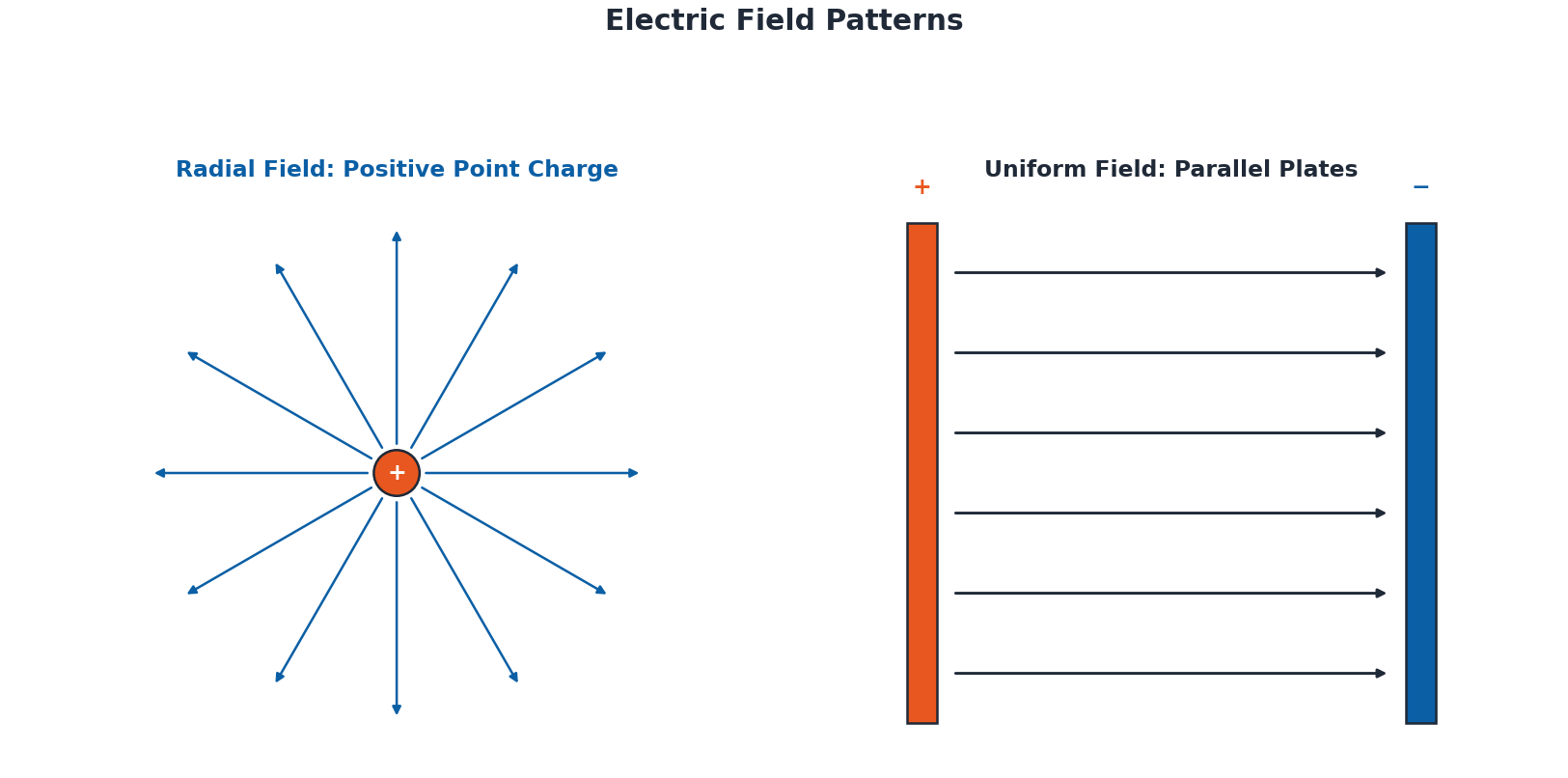
Around an isolated point charge, the electric field is radial: field lines point outward in all directions for a positive charge (showing a positive test charge would be repelled) and inward for a negative charge (showing attraction). A charged conducting sphere distributes charge evenly over its surface, producing an outside field identical in pattern to a point charge (radial, outward for positive charge, inward for negative), while the field inside the sphere is exactly zero, because surface charges rearrange to cancel any interior field — this is also why people inside metal cars or airplanes are protected during lightning strikes.
Between two large, oppositely charged parallel conducting plates placed close together, a uniform electric field forms: field lines run straight from the positive plate to the negative plate, parallel and evenly spaced, meaning the field has the same magnitude and direction everywhere between the plates (ignoring edge effects) — this configuration is the basis of capacitors, widely used in electronic circuits.
15.7 Conductors, Insulators, and the Free Electron Model
Electrical conductors are materials that allow charge to flow freely because they contain loosely bound electrons that move easily under an applied voltage, producing electric current — examples include metals like copper, aluminium, and silver, as well as graphite and electrolytes. Electrical insulators resist or prevent the flow of charge because their electrons are tightly bound to their atoms and cannot move freely — examples include rubber, plastic, glass, wood, and ceramics, which are used to block electricity flow and provide safety.
This behaviour is explained by the free electron model: in conductors, the outermost electrons are loosely bound and act like a mobile 'sea' of charge that flows readily when voltage is applied; in insulators, electrons remain fixed to their atoms even under an applied voltage, so no current flows. A simple experiment — placing different materials into a gap in a battery-and-bulb circuit — reveals this directly: the bulb lights up for conductors (like a metal key) and stays off for insulators (like a plastic spoon or wooden stick).
15.8 Electrical Breakdown, Corona Discharge, and Lightning Conductors
Static electricity (accumulation of charge) results when electrons transfer between objects, causing an imbalance of positive and negative charge; in daily life this causes minor shocks or clothes clinging together, while in industry it can damage electronics, ignite flammable substances, or disrupt manufacturing — mitigated through grounding, anti-static measures, and humidity control. Electrical breakdown occurs when a sufficiently strong electric field passes through a gas (or insulating material), ionizing its atoms and creating free electrons and ions that suddenly and dramatically increase conductivity, often producing a spark or arc — this is the basic mechanism behind lightning.
Corona discharge is a visible, less intense form of electrical breakdown that occurs near sharp points or edges of high-voltage conductors, where the electric field is strongest, ionizing nearby air and producing a faint glow — often seen near high-voltage power lines. Lichtenberg figures are branching, tree-like patterns that form on insulating materials (like wood or acrylic) when a high-voltage discharge passes through them, leaving a visible trace of the breakdown path; both phenomena are visible evidence of electrical breakdown. Lightning conductors (lightning rods) protect tall structures by providing a low-resistance path that safely channels a lightning strike's massive current into the ground, preventing fires, structural damage, and harm to occupants — lightning itself forms when charge separation within storm clouds (from friction between water droplets or ice particles) builds an intense electric field that eventually overcomes the air's resistance, triggering a rapid, brilliant discharge between cloud and ground.
Important Definitions
What is electric charge?
An intrinsic property of matter, measured in coulombs (C), that causes objects to attract or repel one another; charge can be positive or negative.
What is electrostatic induction?
The redistribution of positive and negative charge within a neutral conductor caused by a nearby charged object, without any direct contact or transfer of charge.
What is earthing?
The process of connecting a conductor to the Earth via a wire, allowing unwanted (induced) charge to flow away and neutralize.
State Coulomb's law.
The electrostatic force between two point charges is directly proportional to the product of the charges and inversely proportional to the square of the distance between them: F = kq₁q₂/r².
What is an electric field?
The region around a charge where it exerts a force on other charges, with strength decreasing with distance following an inverse-square relationship.
Define electric field intensity.
The electrostatic force per unit positive test charge at a point in an electric field: E = F/q₀, measured in newtons per coulomb (N C⁻¹).
What is electrical breakdown?
The sudden ionization of a gas (or insulating material) caused by a sufficiently strong electric field, producing free electrons and ions and a dramatic increase in conductivity.
What is corona discharge?
A visible, localized form of electrical breakdown that occurs near sharp points or edges of high-voltage conductors, producing a faint glow as nearby air ionizes.
Key Formulas
| Topic | Formula |
|---|---|
| Coulomb's law | F = k q₁q₂ / r² |
| Coulomb's constant (air/vacuum) | k ≈ 9 × 10⁹ N m² C⁻² |
| Electric field due to a point charge | E = k q / r² |
| Electric field intensity (general) | E = F / q₀ |
| SI unit of charge | coulomb (C) |
| SI unit of electric field | newton per coulomb (N C⁻¹) |
| Worked example (field) | q = 10 μC, r = 0.5 m → E = 3.6 × 10⁵ N C⁻¹ |
| Force sign convention | opposite charges → attraction; like charges → repulsion |
Diagrams
Like and Unlike Charges: Attraction and Repulsion: Two positively charged rods repelling, two negatively charged rods repelling, and a positive rod attracting a negative rod
Electric Field Patterns: Radial field lines around isolated positive and negative point charges, and a uniform field between two oppositely charged parallel plates
Charging a Conductor by Induction and Earthing: A charged rod inducing charge separation in a neutral sphere, earthing removing like charge, then the rod being removed to leave a net opposite charge
Short Questions & Answers
State Coulomb's law of electrostatics and write its mathematical form.
The electrostatic force between two point charges is directly proportional to the product of the charges and inversely proportional to the square of the distance between them: F = kq₁q₂/r², where k ≈ 9×10⁹ N m² C⁻² in air/vacuum.
What is an electric field?
The region around a charge where it exerts a force on other charges; its strength decreases with distance from the charge following an inverse-square relationship.
Give two examples each of electrical conductors and electrical insulators.
Conductors: copper, aluminium (also silver, graphite). Insulators: rubber, plastic (also glass, wood, ceramics).
List some applications of electrostatics in daily life.
Photocopiers (xerography), electrostatic precipitators (removing industrial pollutants), lightning conductors, and gold leaf electroscopes for detecting charge.
What happens when like charges and unlike charges are brought close to each other?
Like charges (both positive or both negative) repel each other; unlike charges (one positive, one negative) attract each other.
What is meant by electrical breakdown, and when does it occur?
Electrical breakdown is the sudden ionization of a gas or insulating material caused by a strong electric field, dramatically increasing its conductivity; it occurs when the field strength exceeds the material's resistance to ionization, as in lightning or corona discharge.
What are the dangers of static electricity?
Static charge buildup can cause minor shocks, make clothes cling together, damage sensitive electronic components, ignite flammable substances, and disrupt manufacturing processes in industrial settings.
What is electrostatic induction?
The redistribution of positive and negative charge within a neutral conductor when a charged object is brought near it, without any direct contact — the conductor's total charge remains zero unless it is subsequently earthed.
Long Questions & Answers
Discuss the working of a gold leaf electroscope, and explain how it can be used to detect the presence and nature of charge on a body.
A gold leaf electroscope consists of a metal (brass) disk connected via a rod to two thin gold leaves suspended inside a protective jar, with the rod held in place by an insulating material so charge can move freely between the disk and leaves but not escape to the surrounding case. To test whether an object is charged, it is brought close to the disk without touching it. If the object is neutral, no charge redistribution occurs and the leaves remain hanging together, showing no deflection. If the object carries a charge (positive or negative), electrostatic induction redistributes charge within the electroscope: for example, a negatively charged object repels electrons down through the rod to the leaves, leaving the disk positively charged and the leaves negatively charged. Since both leaves now carry the same type of charge, they repel each other and diverge — and the degree of divergence indicates roughly how much charge is present on the nearby object, with a larger charge producing a wider spread. The electroscope can also distinguish conductors from insulators: after charging the leaves (by direct contact) so they are diverged, touching the disk with a test material and observing whether the leaves collapse reveals whether charge could flow through that material to escape — collapse indicates a conductor, while no change indicates an insulator.
Explain Coulomb's law and discuss the factors that affect the electrostatic force between two charged particles.
Coulomb's law, formulated by Charles Coulomb in 1785, states that the magnitude of the electrostatic force between two point charges is directly proportional to the product of the magnitudes of the two charges and inversely proportional to the square of the distance separating them, expressed as F = kq₁q₂/r², where k is a proportionality constant (approximately 9×10⁹ N m² C⁻² in air or vacuum) that depends on the medium between the charges. Two factors therefore directly determine the strength of the force: the magnitude of each charge, and the distance between them. Increasing either charge's magnitude increases the force proportionally, since force is directly proportional to the product q₁q₂ — doubling either charge doubles the force. Distance has a much stronger, inverse-square effect: doubling the separation between the charges reduces the force to one-quarter of its original value, while halving the distance quadruples the force, since force is inversely proportional to r². The sign of the charges determines the direction, not the magnitude, of the force: opposite charges (one positive, one negative) always attract, while like charges (both positive or both negative) always repel, with the force strength in both cases governed by the same formula. Coulomb's law strictly applies to point charges, whose physical dimensions are negligible compared to the distance between them; for larger charged bodies, more complex calculations accounting for charge distribution are generally required.
Explain the concept of electric field intensity, and describe how the electric field can be represented using field lines for a point charge and for a parallel plate arrangement.
Electric field intensity describes the strength and direction of the electric field at a given point in space, defined as the electrostatic force experienced per unit positive test charge placed at that point: E = F/q₀, measured in newtons per coulomb (N C⁻¹). It is a vector quantity, meaning it has both magnitude and direction — the direction of the electric field at any point is defined as the direction of the force that would act on a small positive test charge placed there. For a point charge, the field intensity can also be calculated directly as E = kq/r², showing that field strength decreases with the square of the distance from the source charge. Electric field lines provide a visual way to represent these fields: they are imaginary lines drawn so that their direction at any point matches the field's direction there, they always point from positive charges toward negative charges, they never cross one another, and their spacing indicates field strength (closer lines mean a stronger field). Around an isolated point charge, field lines radiate outward in all directions for a positive charge (indicating repulsion of a positive test charge) or point inward for a negative charge (indicating attraction); the field pattern is therefore radial and symmetric in all directions, weakening with distance according to the inverse-square law. Between two large, oppositely charged parallel conducting plates, however, the field lines run straight from the positive plate to the negative plate, remaining parallel to each other and evenly spaced throughout the region between the plates (away from the plate edges) — this produces a uniform electric field, meaning the field has exactly the same magnitude and direction at every point in that central region, a configuration widely used in capacitors.
Explain how and why electrical conductors and insulators behave differently in terms of charge transfer and electron movement, and describe some real-life electrostatic hazards along with ways to minimize them.
The difference between conductors and insulators is best explained using the free electron model of atomic structure. In conductors, such as metals like copper and aluminium, the outermost electrons of each atom are only loosely bound to their nucleus and are free to move throughout the material's structure, forming what is often described as a 'sea' of mobile charge; when a voltage is applied, or when charge is brought nearby, these free electrons can flow or redistribute readily, allowing conductors to carry electric current and to be charged (or discharged) quickly through contact or induction. In insulators, such as rubber, plastic, and glass, electrons are tightly bound to their individual atoms and essentially cannot move through the material; even when a voltage is applied or a charge is brought close, these bound electrons remain fixed in place, meaning insulators cannot conduct current and any charge placed on them tends to stay localized rather than spreading or flowing away. This fundamental difference in electron mobility has significant practical implications, including real-world electrostatic hazards. In industrial settings, friction between materials (such as powders moving through machinery, or fabric rubbing against equipment) can build up substantial static charge on insulating surfaces; if this accumulated charge eventually discharges as a spark in an environment containing flammable dust or vapours, it can trigger dangerous dust explosions or fires. Similarly, everyday static shocks from synthetic clothing occur when charge builds up through friction between fabric fibres and is then suddenly discharged upon contact with a conductor, such as a metal doorknob. These hazards can be minimized through several practical measures: proper grounding (earthing) of equipment and structures provides a safe path for accumulated charge to dissipate harmlessly into the ground rather than building up to dangerous levels; anti-static materials, sprays, or wrist straps are used in electronics manufacturing and handling to prevent damaging static discharges near sensitive components; and controlling humidity levels helps as well, since moisture in the air allows charge to dissipate more easily than in very dry conditions, which tend to promote greater static buildup.
Multiple Choice Questions (MCQs)
Electrical breakdown is: (A) the process of ionizing a gas due to a strong electric field (B) the process of neutralizing a charged object (C) the process of charging an insulator (D) the process of discharging a conductor
Correct answer: (A) the process of ionizing a gas due to a strong electric field. Electrical breakdown occurs when a strong electric field ionizes the atoms of a gas or insulating material, dramatically increasing its conductivity.
Which of the following is a visible example of electrical breakdown? (A) Corona discharge (B) Electric current (C) Magnetic field (D) Electric potential
Correct answer: (A) Corona discharge. Corona discharge is a visible glow produced when a strong electric field ionizes air near a high-voltage conductor, a direct example of electrical breakdown.
What happens when two unlike charges are brought close to each other? (A) They attract (B) They repel (C) They neutralize each other (D) Nothing happens
Correct answer: (A) They attract. Unlike charges (one positive, one negative) always attract each other according to Coulomb's law.
According to Coulomb's law, what happens to the attraction between two oppositely charged objects as their separation increases? (A) Decreases (B) Increases (C) Remains unchanged (D) Cannot be determined
Correct answer: (A) Decreases. Since force is inversely proportional to the square of distance (F ∝ 1/r²), increasing separation decreases the force.
The device which works on the principle of electrostatics is: (A) electric bell (B) photocopier (C) electric heater (D) transformer
Correct answer: (B) photocopier. A photocopier uses electrostatic charging and discharging (xerography) to form and transfer images using charged toner.
Charging an object by friction involves the transfer of: (A) protons (B) neutrons (C) electrons (D) the whole atom
Correct answer: (C) electrons. Friction charging only transfers electrons between materials; protons remain fixed within the nucleus and are never transferred.
The SI unit of electric charge is the: (A) newton (B) volt (C) coulomb (D) ampere
Correct answer: (C) coulomb. Electric charge is measured in coulombs (C).
Inside a uniformly charged conducting sphere, the electric field is: (A) maximum at the centre (B) zero (C) equal to the field outside (D) infinite
Correct answer: (B) zero. Charges on a conducting sphere rearrange on the surface such that the electric field inside the sphere is exactly zero.
If the leaves of a charged gold leaf electroscope collapse when a test object touches its disk, the object is a: (A) conductor (B) insulator (C) magnet (D) semiconductor
Correct answer: (A) conductor. Collapse indicates that charge flowed away through the test object, meaning it is a conductor.
In Coulomb's law, the constant k in air or vacuum has an approximate value of: (A) 9 × 10⁻⁹ N m² C⁻² (B) 9 × 10⁹ N m² C⁻² (C) 3 × 10⁸ N m² C⁻² (D) 6 × 10⁻¹⁹ N m² C⁻²
Correct answer: (B) 9 × 10⁹ N m² C⁻². In air or vacuum, Coulomb's constant k ≈ 9 × 10⁹ N m² C⁻².
Quick Revision Summary
- Charge: positive/negative, measured in coulombs; like charges repel, unlike charges attract; friction transfers only electrons
- Electrostatic induction: charge redistributes in a neutral conductor near a charged object, without contact; total charge stays zero unless earthed
- Earthing removes like charge to Earth, leaving a net opposite charge on the conductor once the rod is removed
- Photocopier: selenium-coated drum + charge + light exposure + toner + heat fusing; ESP: corona discharge charges particles, collected on charged plates
- Coulomb's law: F = kq₁q₂/r², k ≈ 9×10⁹ N m² C⁻² in air; force ∝ product of charges, ∝ 1/r²
- Electric field: E = F/q₀ = kq/r² (point charge); field lines: positive→negative, never cross, show force direction on positive test charge
- Field patterns: radial around point charge/sphere (zero inside sphere); uniform and parallel between charged plates
- Conductors (free electrons, e.g. metals) vs insulators (bound electrons, e.g. rubber, plastic) — explained by free electron model
- Electrical breakdown: strong field ionizes gas/insulator → corona discharge, Lichtenberg figures, lightning; lightning rods safely ground the discharge
Exam Tips
- Always specify BOTH the magnitude and the nature (attraction/repulsion) of a Coulomb's law force answer, not just the number
- Remember friction charging transfers electrons only — never say 'protons move' in an exam answer
- For induction problems, track charge movement step by step: induce → earth → remove earth → remove rod, in that exact order
- Field inside a charged conducting sphere = 0; field between parallel plates = uniform — these are commonly tested facts
- Distinguish 'electric field intensity' (E = F/q₀, a field property) from 'electrostatic force' (F = kq₁q₂/r², a force between two specific charges)
- Corona discharge and Lichtenberg figures are both effects of electrical breakdown — but corona discharge is a glow in air/gas, Lichtenberg figures are patterns burned into solids