
Sound is produced by vibrating objects — from vocal cords and guitar strings to tuning forks — and travels through air, water, or solids as a longitudinal wave of compressions and rarefactions. This chapter explores how sound is produced and propagated, why it needs a medium and cannot travel through vacuum, the characteristics that let us distinguish one sound from another (loudness, pitch, and quality), and how sound reflects (echo), refracts, and diffracts.
The chapter also covers the audible frequency range of the human ear (20 Hz to 20,000 Hz) and the fascinating worlds beyond it — infrasound, used by elephants and whales for long-distance communication and by scientists to detect earthquakes, and ultrasound, used in medical imaging and SONAR for underwater exploration — before closing with how acoustic design keeps buildings comfortable to listen and speak in.
Learning Objectives
- Describe the production of sound and the longitudinal nature of sound waves
- State the approximate range of frequencies audible to humans as 20 Hz to 20,000 Hz
- Justify why sound waves cannot travel in a vacuum, including demonstrating experiments
- Describe how changes in amplitude and frequency affect the loudness and pitch of sound
- Describe how different sound sources produce sound waves of different quality, referencing oscilloscope traces
- Describe an echo as the reflection of sound waves and justify experiments demonstrating it
- Illustrate a method for determining the speed of sound in air using distance and time measurements
- State that the speed of sound in air is approximately 330-350 m/s, and describe how it varies across solids, liquids, and gases
- Define ultrasound (above 20 kHz) and infrasound (below 20 Hz), and analyze their real-world uses
- Analyze the effects of noise pollution and justify the importance of acoustic protection in building design
Key Concepts
13.1 Production and Propagation of Sound
Sound is produced by vibrating objects: when an object vibrates, it makes the surrounding air vibrate too, and these air vibrations travel outward and eventually reach our ears, causing the eardrum to vibrate and creating the sensation of sound. In a guitar, sound comes from vibrating strings; in the human voice, from vibrating vocal cords; a tuning fork struck with a rubber hammer vibrates audibly, and touching its prong to a hanging table-tennis ball or dipping it in water visibly demonstrates these vibrations.
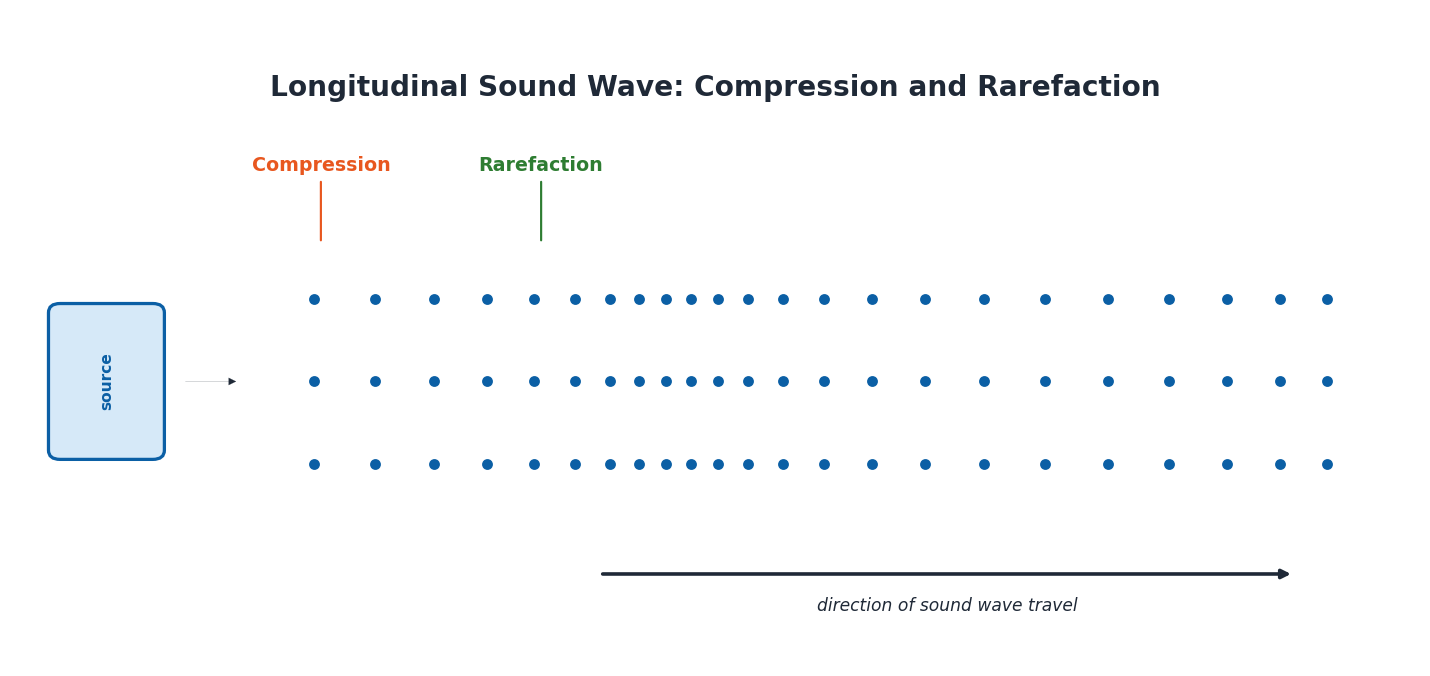
Sound needs a medium — air, water, or a solid — to travel, because it propagates as alternating compressions (regions of high pressure, where particles are pushed together) and rarefactions (regions of low pressure, where particles spread apart). This is a longitudinal wave: air particles vibrate back and forth in the same direction as the wave's energy transfer, rather than perpendicular to it. A classic bell-jar experiment demonstrates this medium requirement: as air is pumped out of a jar containing a ringing electric bell, the sound grows weaker and eventually inaudible, even though the bell keeps ringing — proving that sound cannot travel through a vacuum.
13.2 Speed of Sound
The speed of sound depends strongly on the medium: sound travels roughly 5 times faster in liquids and about 15 times faster in solids than in gases, because particles are packed more tightly and can transmit vibrations more efficiently in denser, more rigid materials. In air, temperature and humidity also affect speed — at room temperature (21°C) sound travels at about 343 m/s, and speed increases with higher temperature and humidity. Approximate values include air at 0°C (330 m/s), air at 25°C (346 m/s), distilled water (1498 m/s), and steel (5960 m/s) — clearly showing gases < liquids < solids.
Like all waves, sound obeys the wave equation v = fλ, where v is speed (m/s), f is frequency (Hz), and λ is wavelength (m). Worked Example: for a sound wave of speed 340 m/s and wavelength 2.0 m, frequency f = v/λ = 340/2.0 = 170 Hz. This equation is central to nearly every quantitative sound problem, whether finding frequency, wavelength, or speed.
13.3 Characteristics of Sound: Loudness, Pitch, and Quality
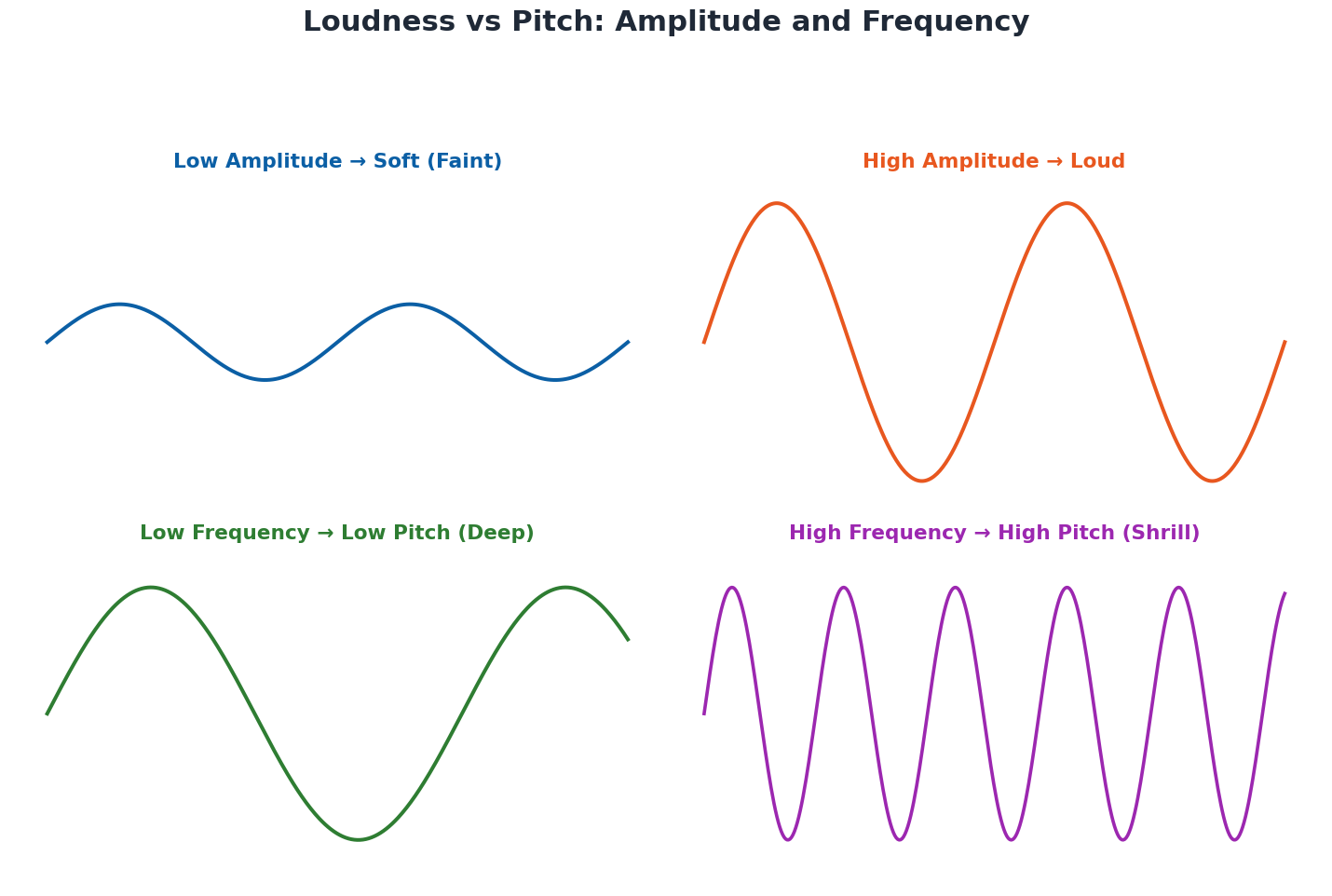
Loudness lets us distinguish loud sounds from faint ones, and depends on several factors: greater amplitude of the vibrating source produces louder sound (plucking a guitar string harder, or striking a drum harder); a larger vibrating area produces louder sound (a big drum, or a tuning fork placed on a resonating bench, is louder than a small one or one held in air); and loudness decreases as distance from the source increases, since amplitude diminishes with distance. Loudness as perceived depends partly on the listener's hearing, while intensity is the equivalent physical, measurable quantity independent of the listener.
Pitch lets us distinguish a shrill (high) sound from a deep/grave (low) one, and is directly related to frequency: higher frequency gives higher pitch, lower frequency gives lower pitch — this is why women's and children's voices (higher frequency) sound higher-pitched than men's voices (lower frequency). Quality (or timbre) lets us distinguish two sounds that share the same loudness and pitch but come from different sources, because each source produces its own distinctive waveform shape — a violin, trumpet, flute, and oboe each show a different, characteristic trace on an oscilloscope even when playing the same note at the same volume.
13.4 Musical Sounds, Noise, and Noise Pollution
Sounds with controlled, regular pitch and quality — like those from a guitar, violin, recorder, or drum — are called musical sounds and are generally pleasant to hear. Sounds from irregular, sudden vibrations — such as traffic, slamming doors, or machinery — are classified as noise, an unpleasant and potentially harmful form of pollution affecting both humans and animals.
Excessive noise from industrial machinery, vehicle horns, alarms, and construction can cause stress, poor concentration, hearing loss, sleep disturbance, aggression, and hypertension. The recommended safe noise level is 85-90 dB for a maximum eight-hour workday. Noise pollution can be reduced by using quieter, eco-friendly machinery, installing sound barriers, wearing hearing protection devices, and planting trees, which together help create a healthier acoustic environment.
13.5 Reflection of Sound (Echo)
When sound waves hit a surface and bounce back into the same medium, the effect is called an echo (or reflection of sound) — this is why clapping or shouting near a tall building or mountain produces a repeated sound after a brief delay. The human brain retains sound for about 0.1 seconds, so a distinct echo requires the reflected sound to arrive at least 0.1 seconds after the original; given sound's speed of about 340 m/s in air, this means the total distance travelled (there and back) must be at least 34 m, so the reflecting surface must be at least 17 m away.
The speed of sound can be measured experimentally using the echo method: standing a known distance from a flat wall, clapping rhythmically, and timing several claps against their returning echoes lets us calculate speed from distance and time using S = vt. Worked Example: if a flash of lightning is seen 2 seconds before thunder is heard, and the speed of sound is 332 m/s, the distance to the cloud is S = vt = 332 × 2 = 664 m.
13.6 Refraction and Diffraction of Sound
Refraction of sound occurs when sound waves change direction due to a change in the medium's properties (such as density or temperature), since the speed of sound differs between media; for example, sound travels faster in water than in air, causing it to bend when passing between the two, which is part of why a submerged swimmer hears underwater sounds clearly while someone above the surface may not. On a cool morning, sound refracts through layers of air at different temperatures and can bend back toward the ground, which is why distant train horns or bird calls often sound clearer at dawn.
Diffraction of sound occurs when sound waves bend around obstacles or spread out after passing through narrow openings, allowing sound to be heard even when its source is not directly visible — this is why we can hear someone speaking from behind a wall or around a corner, and why sound travelling through an open doorway spreads to fill an entire room.
13.7 Audible Frequency, Infrasound, and Ultrasound
The human ear can detect sound within the audible frequency range of about 20 Hz to 20,000 Hz (20 kHz); sounds below 20 Hz or above 20,000 Hz are inaudible to humans, and hearing ability for high frequencies declines with age. Infrasound refers to waves below 20 Hz, which humans cannot hear but may feel as vibrations; it is produced by natural events (earthquakes, volcanic eruptions), industrial processes, and human activities, and travels very long distances — elephants and whales use infrasound for long-range communication, sensing it partly through their feet and trunks, while scientists use infrasound sensors to detect earthquakes and monitor volcanoes as an early-warning system.
Ultrasound (or ultrasonics) refers to sound with frequency above 20,000 Hz, also inaudible to humans. In medicine, ultrasonic waves reflect differently from different body tissues, and these reflections are converted into images in a process called ultrasonography, widely used for monitoring pregnancies (prenatal scanning), and imaging organs such as the heart, liver, kidneys, and thyroid — entirely non-invasively. Ultrasound is also used in industry to detect cracks in turbines, ship engines, and airplane parts, and to destroy bacteria in liquids using high-intensity waves.
13.8 SONAR and Acoustic Protection of Buildings
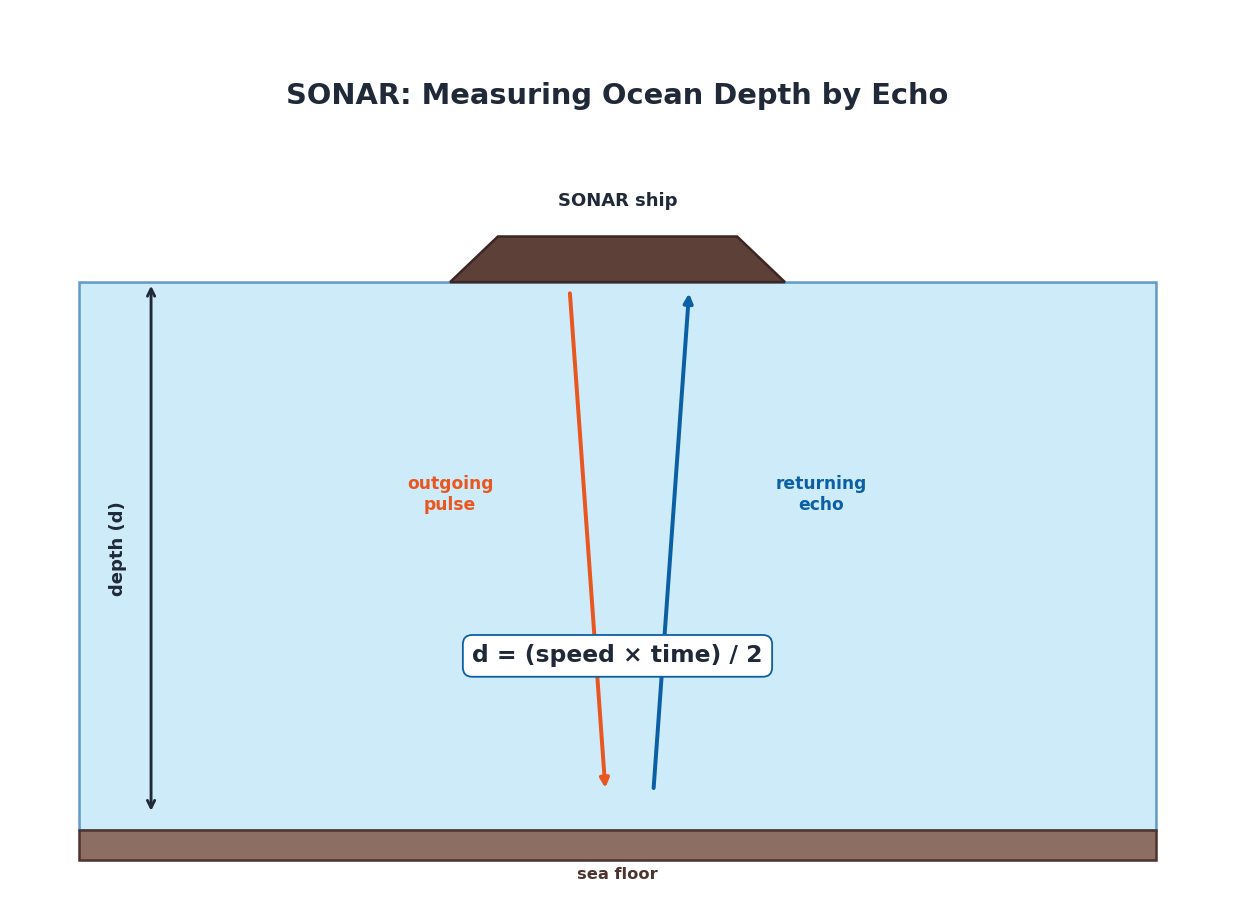
SONAR (Sound Navigation and Ranging) uses ultrasonic waves to measure ocean depth and locate underwater objects: a pulse is sent into the water, and the time taken for its echo to return is used to calculate distance using Distance = (speed of sound in water × time) / 2 — the result is divided by two because the pulse travels to the object and back. Worked Example: if a sonar pulse returns after 3.2 s and the speed of sound in water is 1600 m/s, the total distance travelled is 1600 × 3.2 = 5120 m, so the depth to the seafloor is 5120/2 = 2560 m.
Acoustic protection in buildings uses soft, porous materials such as carpets and curtains to absorb sound and reduce unwanted echo, while hard, smooth surfaces reflect more sound; too much absorption, however, can weaken audibility, so auditoriums, lecture halls, and theatres require a careful balance between reflection and absorption to avoid excessive reverberation (multiple overlapping reflections that distort sound) while still ensuring clarity. Reflective surfaces placed behind a stage, along with curved ceilings and soundboards, help direct and evenly distribute sound so that even listeners in the back row can hear clearly.
Important Definitions
What is sound?
A longitudinal mechanical wave produced by vibrating objects, travelling through a medium (solid, liquid, or gas) as alternating compressions and rarefactions.
What is an echo?
The repeated sound heard when sound waves reflect off a surface and return to the listener, requiring the reflecting surface to be far enough away (at least 17 m in air) for the echo to be distinct.
Define loudness.
The property of sound that allows us to differentiate between loud and faint sounds; it depends on amplitude, the vibrating area, and distance from the source.
Define pitch.
The characteristic of sound that lets us distinguish a shrill (high) sound from a deep (low) one; pitch is directly related to frequency.
What is the quality (timbre) of sound?
The characteristic that lets us distinguish two sounds of the same loudness and pitch, arising from the distinctive waveform shape each sound source produces.
Define infrasound.
Sound waves with frequency below 20 Hz, inaudible to humans but usable by animals like elephants and whales, and by scientists to detect earthquakes and volcanic activity.
Define ultrasound.
Sound waves with frequency above 20,000 Hz (20 kHz), inaudible to humans, used in medical imaging, industrial crack detection, and SONAR.
What is reverberation?
The persistence of sound in a space due to multiple overlapping reflections, which can distort clarity if not balanced with sound absorption in building acoustic design.
Key Formulas
| Topic | Formula |
|---|---|
| Wave equation for sound | v = f × λ |
| Speed of sound in air (room temperature) | v ≈ 343 m s⁻¹ at 21°C (approx. 330-350 m s⁻¹) |
| Relative speed of sound | solids > liquids (~5×) > gases (~15× slower than solids) |
| Distance from time delay (echo/thunder) | S = v × t |
| Minimum distance for a distinct echo | ≥ 17 m (reflecting surface), since brain retains sound ~0.1 s |
| SONAR distance/depth | Distance = (Speed of sound in water × Time) / 2 |
| Audible frequency range (humans) | 20 Hz to 20,000 Hz (20 kHz) |
| Ultrasound / Infrasound thresholds | Ultrasound > 20 kHz; Infrasound < 20 Hz |
Diagrams
Longitudinal Sound Wave: Compression and Rarefaction: A vibrating tuning fork or speaker producing alternating regions of compression (particles close together) and rarefaction (particles spread apart) travelling through air
Loudness vs Pitch: Amplitude and Frequency: Waveform comparisons showing how greater amplitude produces louder sound, and higher frequency produces higher pitch, using paired low/high traces
SONAR: Measuring Ocean Depth by Echo: A ship sending an ultrasonic pulse to the seafloor and receiving its echo, with the round-trip time and speed of sound used to calculate depth
Short Questions & Answers
How does the medium affect the speed of sound?
Sound travels fastest in solids, slower in liquids, and slowest in gases, because particles are packed more tightly and transmit vibrations more efficiently in denser, more rigid media; in air, speed also increases with higher temperature and humidity.
Do sound waves show reflection?
Yes — when sound waves strike a surface, they bounce back into the same medium, a phenomenon known as reflection of sound or echo.
What factors influence the loudness of sound?
The amplitude of the vibrating source, the area of the vibrating surface, and the distance between the source and the listener.
Why do we hear an echo when we clap near a building?
The sound waves from the clap reflect off the building's surface and return to our ears after a short delay; since the brain retains sound for about 0.1 seconds, a distinct echo is heard if the building is at least 17 metres away.
What is ultrasound, and how is it used in medicine?
Ultrasound is sound with frequency above 20,000 Hz, inaudible to humans; in medicine, ultrasonic waves reflect differently from body tissues, and these reflections are converted into images (ultrasonography) used to monitor pregnancies and examine organs like the heart, liver, and kidneys.
What is the difference between loudness and pitch?
Loudness depends on amplitude and lets us tell loud sounds from faint ones, while pitch depends on frequency and lets us tell shrill (high) sounds from deep (low) ones — they describe different, independent properties of a sound.
Why can't sound travel through a vacuum?
Sound is a mechanical wave that needs a medium with particles to vibrate and pass energy along; in a vacuum there are no particles, so sound cannot propagate, as demonstrated by the bell-jar experiment.
What is the safe noise level recommended for an eight-hour workday?
85-90 decibels (dB) is the recommended maximum safe noise level for an eight-hour workday, beyond which hearing damage and other health effects become more likely.
Long Questions & Answers
Explain how sound is produced and propagated, and describe how the bell-jar experiment proves that sound needs a medium.
Sound is produced whenever an object vibrates — a guitar string, vocal cords, or a struck tuning fork — and these vibrations push and pull the surrounding air, creating alternating regions of compression (where air particles are pushed close together, raising pressure) and rarefaction (where particles spread apart, lowering pressure). This repeating pattern of compressions and rarefactions travels outward as a longitudinal wave, meaning the air particles vibrate back and forth in the same direction that the sound's energy is travelling, rather than side to side. When these compressions and rarefactions reach a listener's ear, they cause the eardrum to vibrate, which the brain interprets as sound. Because sound relies entirely on the vibration of particles in a medium, it cannot travel through empty space. This is elegantly demonstrated by the bell-jar experiment: an electric bell is suspended inside a sealed glass jar sitting on a vacuum pump, and when the bell is switched on, its ringing is clearly audible. As a vacuum pump gradually removes the air from the jar, the sound grows steadily weaker and eventually becomes inaudible, even though the bell can be seen still vibrating and ringing inside — proving that with no air particles left to vibrate and carry the sound waves, no sound can reach the listener. When air is let back into the jar, the sound returns, confirming that a material medium is essential for sound propagation.
Describe the difference between loudness, pitch, and quality of sound, and explain how each is determined.
Loudness, pitch, and quality are three distinct characteristics that together let us fully describe and distinguish sounds. Loudness allows us to tell a loud sound from a faint one, and depends on the amplitude of the vibrating source (a harder pluck or strike produces greater amplitude and a louder sound), the surface area of the vibrating object (a larger vibrating surface, like a big drum or a tuning fork resting on a bench, produces a louder sound than a small one), and the listener's distance from the source (loudness decreases as distance increases, since the wave's amplitude spreads out and diminishes). Pitch allows us to tell a shrill, high sound from a deep, low one, and is directly determined by frequency: higher-frequency vibrations produce higher-pitched sound, which is why women's and children's voices (generally higher frequency) sound higher-pitched than men's voices (generally lower frequency). Quality, or timbre, allows us to distinguish between two sounds that share exactly the same loudness and pitch but come from different sources — for example, a violin and a flute playing the identical musical note at the same volume still sound distinctly different, because each instrument produces its own unique, characteristic waveform shape, visible as different traces on an oscilloscope, arising from the instrument's particular construction and how it vibrates.
Explain how an echo occurs, and describe how it can be used to measure the speed of sound.
An echo occurs when sound waves travel outward from a source, strike a hard, distant surface (such as a wall, building, or mountainside), and reflect back into the same medium, eventually reaching the listener's ear as a repeated sound after the original. Because the human brain retains a sound impression for about 0.1 seconds, a distinct, separately-heard echo requires the reflected sound to arrive at least 0.1 seconds after the direct sound; since sound travels at roughly 340 m/s in air, this means the total round-trip distance must be at least 34 metres, so the reflecting surface itself must be positioned at least 17 metres from the source and listener — closer surfaces produce reflections too rapid to be perceived as separate from the original sound. This principle can be used experimentally to measure the speed of sound: standing a precisely known distance from a flat wall capable of producing a clear echo, a person claps rhythmically while timing a fixed number of claps against their returning echoes using a stopwatch; knowing the total distance the sound travelled (there and back) and the total time taken allows the speed of sound to be calculated directly using the relationship S = vt, rearranged to find v = S/t.
Discuss what infrasound and ultrasound are, and describe their major real-world applications.
Infrasound and ultrasound are both sound frequencies that lie outside the human audible range of roughly 20 Hz to 20,000 Hz, yet each has important natural and technological uses. Infrasound consists of waves below 20 Hz — too low-pitched for humans to hear, though sometimes felt as vibration. It occurs naturally from earthquakes and volcanic eruptions, and is used deliberately by animals such as elephants and whales for long-distance communication, since elephants can sense these deep rumbles through their feet and trunks as well as their ears, and blue whales' infrasonic calls can travel across entire ocean basins. Because infrasound travels extremely long distances with little loss of energy, scientists also use infrasound sensors to detect earthquakes before strong shaking begins, monitor volcanic eruptions, and even track nuclear explosions, functioning as valuable early-warning systems. Ultrasound, by contrast, consists of waves above 20,000 Hz — also inaudible to humans, but with entirely different practical uses. In medicine, ultrasonic waves reflect differently off different body tissues, and capturing these reflected waves allows doctors to build real-time images of internal organs (ultrasonography) — used extensively and safely for monitoring pregnancies and examining organs like the heart, liver, kidneys, and thyroid, all without any invasive surgery. In underwater exploration, SONAR systems send ultrasonic pulses into water and time how long the echo takes to return, using the known speed of sound in water to calculate ocean depth or the distance to submerged objects via Distance = (speed × time)/2. Industrially, ultrasound is also used to detect hidden cracks in machine parts like turbine blades and aircraft components, and to destroy bacteria in liquids using high-intensity ultrasonic waves.
Multiple Choice Questions (MCQs)
What is required for the production of sound? (A) A vacuum (B) Vibrations of a medium (C) Only air (D) Light waves
Correct answer: (B) Vibrations of a medium. Sound is produced by the vibration of an object, which sets the surrounding medium's particles vibrating too.
An echo is produced due to: (A) refraction of sound waves (B) reflection of sound waves (C) diffraction of sound waves (D) absorption of sound waves
Correct answer: (B) reflection of sound waves. An echo is the reflection of sound waves off a surface, returning to the listener after a delay.
An example of a longitudinal wave is: (A) light wave (B) water wave (C) sound wave (D) radiowave
Correct answer: (C) sound wave. Sound is a longitudinal wave, with particles vibrating parallel to the direction of energy transfer, unlike light, water, and radio waves, which are transverse.
In which medium does sound travel the fastest? (A) Gases (B) Liquids (C) Solids (D) Vacuum
Correct answer: (C) Solids. Sound travels fastest through solids, due to their tightly packed, rigid particle structure; it cannot travel through vacuum at all.
What is the approximate speed of sound in air? (A) 150 m/s (B) 330-350 m/s (C) 500 m/s (D) 1,000 m/s
Correct answer: (B) 330-350 m/s. The speed of sound in air at normal room conditions is approximately 330-350 m/s.
Why is acoustic protection important in building design? (A) To increase noise pollution (B) To reduce echo and improve sound quality (C) To amplify sound (D) To increase the speed of sound
Correct answer: (B) To reduce echo and improve sound quality. Acoustic protection balances sound absorption and reflection to reduce unwanted echo and reverberation, improving clarity.
For a normal person, the audible frequency range for sound waves lies between: (A) 10 Hz and 10 kHz (B) 20 Hz and 20 kHz (C) 25 Hz and 25 kHz (D) 30 Hz and 30 kHz
Correct answer: (B) 20 Hz and 20 kHz. The typical human audible frequency range is 20 Hz to 20,000 Hz (20 kHz).
A sound wave has a wavelength of 0.5 m and travels at 340 m/s in air. Its frequency is: (A) 17 Hz (B) 170 Hz (C) 680 Hz (D) 1700 Hz
Correct answer: (C) 680 Hz. f = v/λ = 340/0.5 = 680 Hz.
Sound waves below 20 Hz, used by elephants for communication, are called: (A) Ultrasound (B) Infrasound (C) Radiowaves (D) White noise
Correct answer: (B) Infrasound. Infrasound refers to frequencies below 20 Hz, used by elephants and whales for long-distance communication.
In a SONAR system, the measured distance is divided by 2 because: (A) the ultrasound loses half its energy (B) the pulse travels to the object and back, covering the distance twice (C) water absorbs half of the signal (D) sound travels twice as fast underwater
Correct answer: (B) the pulse travels to the object and back, covering the distance twice. The recorded time covers the round trip (to the object and back), so dividing the total distance travelled by 2 gives the one-way distance/depth.
Quick Revision Summary
- Sound: longitudinal mechanical wave, needs a medium (solid/liquid/gas), cannot travel in vacuum (bell-jar experiment)
- Speed of sound: solids > liquids (~5×) > gases (~15× slower than solids); ~343 m/s in air at 21°C
- Wave equation applies to sound too: v = f × λ
- Loudness ∝ amplitude, vibrating area, and inversely with distance; Pitch ∝ frequency; Quality = unique waveform shape (timbre)
- Echo: reflecting surface must be ≥17 m away (brain retains sound ~0.1 s); distance = v × t
- Refraction: sound bends with medium/temperature change; Diffraction: sound bends around obstacles/through openings
- Audible range: 20 Hz–20 kHz; Infrasound <20 Hz (elephants, earthquakes); Ultrasound >20 kHz (medical imaging, SONAR)
- SONAR: Distance = (speed × time)/2; Acoustic design balances absorption (soft materials) and reflection to control reverberation
Exam Tips
- Always double-check whether a SONAR/echo problem wants total distance (v×t) or depth/one-way distance (v×t/2) — this is the most common error
- Memorise the audible range 20 Hz–20 kHz precisely, and know infrasound is below it, ultrasound above it
- Loudness = amplitude; Pitch = frequency — never mix these two up in exam answers
- For echo minimum-distance questions, remember the 0.1 s brain retention time and the resulting ~17 m minimum surface distance
- State clearly that sound speed ranking is solids > liquids > gases, and be ready to explain why (particle spacing/rigidity)
- For numericals, write out the wave equation v = fλ and rearrange algebraically before substituting numbers, to avoid careless errors