Waves are all around us, from small ripples on a quiet lake to the loud sound of thunder in the sky. A wave transfers energy from one place to another without transferring matter — this single idea explains phenomena as different as sound, light, ocean swells, and earthquakes. This chapter explores the nature of waves, their main types (mechanical and electromagnetic, transverse and longitudinal), key wave parameters (wavelength, frequency, period, amplitude, speed), the wave equation v = fλ, and how waves behave through reflection, refraction, and diffraction.
The chapter closes with seismic waves and the powerful, sometimes devastating, tsunami waves generated by underwater earthquakes — connecting classroom wave theory to real natural disasters and the importance of early-warning science.
Learning Objectives
- Prove that waves transfer energy without transferring matter
- Describe wave motion as illustrated by vibrations in ropes and springs and by water wave experiments
- State the two types of waves: transverse and longitudinal
- Describe the features of a wave: wave front, wavelength, frequency, time period, crest, trough, compression, rarefaction, amplitude, and wave speed
- Define frequency, wavelength, and amplitude, and apply the wave equation v = fλ
- Illustrate that in a transverse wave, vibration is at right angles to the direction of energy transfer, with examples
- Illustrate that in a longitudinal wave, vibration is parallel to the direction of energy transfer, with examples
- Describe how waves undergo reflection, refraction, and diffraction, using the ripple tank
- Describe how wavelength and slit size affect diffraction
- Analyze how tsunamis form and grow in frequency and amplitude as they reach shallow water
Key Concepts
12.1 Waves and the Nature of Waves
As waves travel through a medium, they cause the particles within it to vibrate, and these vibrations allow energy to be transferred from one particle to the next — but the particles themselves do not travel along with the wave; they simply oscillate around their original positions. When a twig is dropped into still water, ripples spread outward carrying energy, yet the water and the twig remain mostly in place. Waves transfer energy from one place to another without transferring matter.
The same principle appears in sound: when a guitar string is plucked, it vibrates and creates sound waves that travel through the air, but the air particles do not move all the way to our ears — they simply vibrate in place, passing the energy forward. A ripple tank (a shallow tray of water with a motor-driven vibrating bar) is a common classroom setup for generating and studying these wave patterns directly.
12.2 Types of Waves: Mechanical and Electromagnetic
There are two main types of waves. Mechanical waves require a material medium — such as air, water, or a solid — to travel, since they rely on the vibration of medium particles to pass energy along; they cannot travel through a vacuum. Examples include sound waves, water waves, vibrations on a rope or spring, and seismic waves from earthquakes.
Electromagnetic waves, in contrast, do not need a material medium and can travel through empty space (vacuum) — this is how sunlight reaches Earth across space. Examples include radio waves, microwaves, infrared rays, visible light, ultraviolet rays, X-rays, and gamma rays; despite differing in wavelength and frequency, all travel at the same speed in vacuum, approximately 3 × 10⁸ m/s, the speed of light. The full range of these waves is called the electromagnetic spectrum.
12.3 Transverse and Longitudinal Waves
Mechanical waves are further divided by how particles vibrate relative to the wave's direction of travel. In transverse waves, particles vibrate at right angles (perpendicular) to the direction of wave travel; holding one end of a rope and moving it up and down produces a transverse wave, with crests (highest points) and troughs (lowest points). Water waves and electromagnetic radiation (light, radio waves, X-rays) are also transverse, with fields or particles oscillating perpendicular to the direction of energy propagation.
In longitudinal waves, particles vibrate parallel to the direction of wave travel, creating regions of compression (particles close together) and rarefaction (particles spread apart). Sound waves are the most familiar example: when a hand clap produces a sound, nearby air molecules are first pushed together into a compression, then spread apart into a rarefaction, and this pattern travels outward as sound without the air itself moving permanently from source to listener.
12.4 Key Wave Terms and Parameters
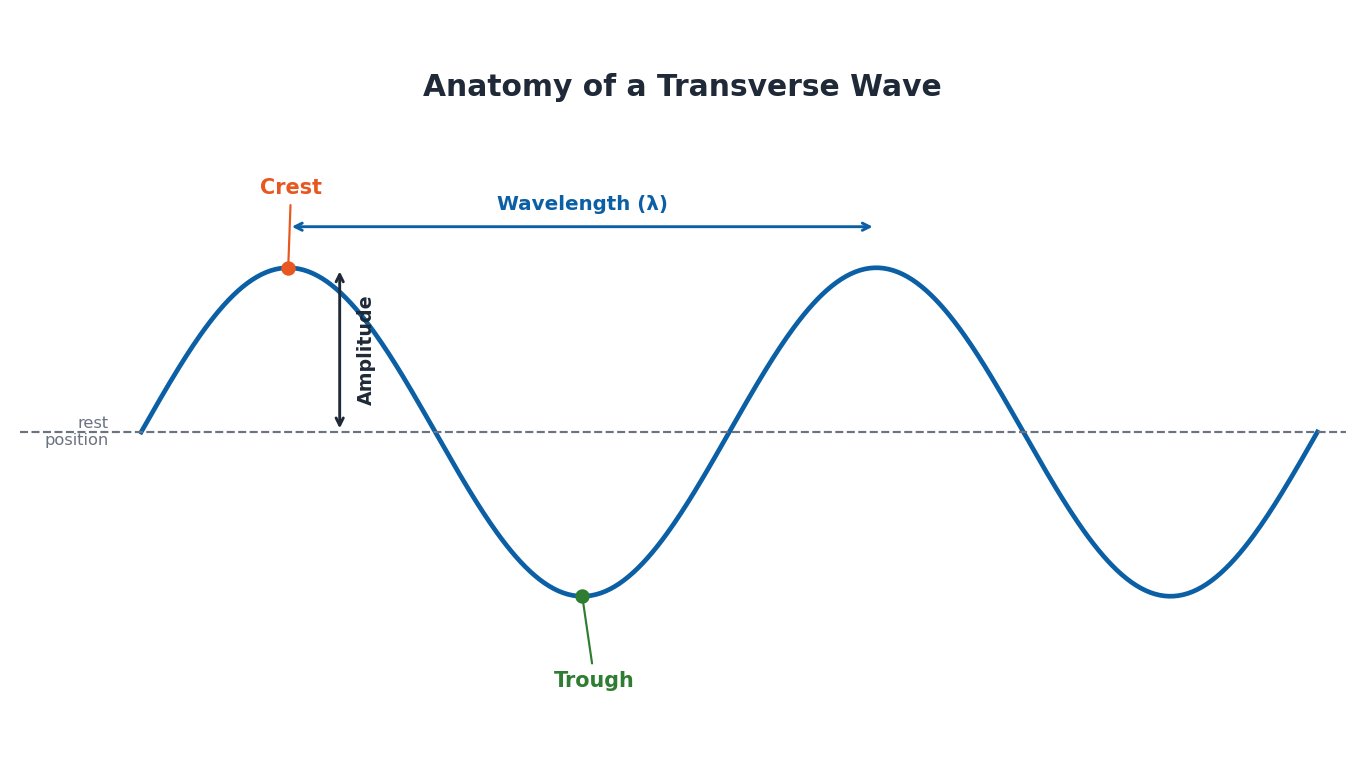
Several terms describe a wave's shape and behaviour. The crest is the highest point of a transverse wave (above the mean/rest position), and the trough is its lowest point (below the mean position). In a longitudinal wave, a compression is a region where particles are close together (high pressure), and a rarefaction is a region where particles are spread apart (low pressure). Amplitude is the maximum displacement of a point on the wave from its rest position, and it indicates the energy carried by the wave — larger amplitude means more energy.
Wavelength (λ) is the distance between two corresponding points on adjacent waves (crest to crest, or compression to compression), measured in metres. Frequency (f) is the number of complete wave cycles passing a fixed point in one second, measured in hertz (Hz), where 1 Hz = 1 wave per second. Wave period (T) is the time taken for one complete wave to pass a fixed point, measured in seconds, and is the inverse of frequency: T = 1/f. A wave front is an imaginary surface joining all points vibrating with the same phase, representing the leading edge of the wave as it travels.
12.5 The Wave Equation (v = fλ)
Wave speed is the rate at which a wave propagates through a medium. Since speed = distance / time, and for a wave the distance travelled in one period is one wavelength (λ) while the time taken is one period (T), wave speed v = λ/T. Since 1/T = f (frequency), this simplifies to the wave equation: v = f × λ, where v is wave speed (m/s), f is frequency (Hz), and λ is wavelength (m). This equation is used to calculate wave speed whenever frequency and wavelength are known, or to find one quantity given the other two.
Worked Example: A wave takes 5 seconds to complete 10 cycles, and its wavelength is 1.2 m. Frequency f = number of cycles / time = 10 / 5 = 2 Hz. Using v = f × λ: v = 2 × 1.2 = 2.4 m/s. This two-step approach — first find frequency from cycles and time, then apply v = fλ — is the standard method for wave speed problems.
12.6 Reflection and Refraction of Waves
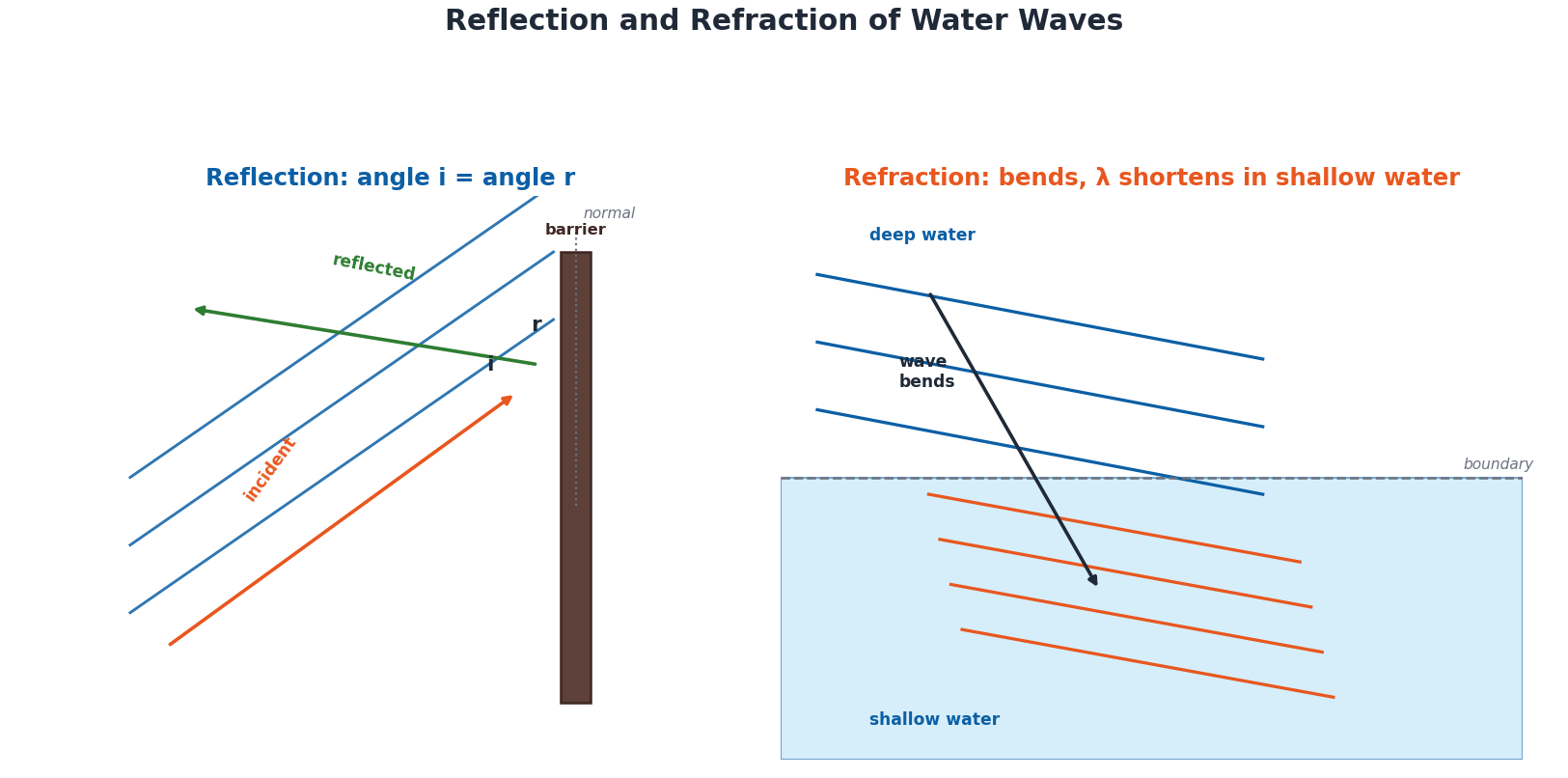
Reflection occurs when waves strike a surface and bounce back into the same medium; this can be observed in a ripple tank when straight water waves strike a barrier and reflect off it. The angle of incidence (angle at which waves approach the barrier) always equals the angle of reflection (angle at which they bounce back) — this is the law of reflection. Reflection is common to all wave types, including water waves, sound waves (echoes), and light waves (mirrors).
Refraction occurs when waves pass from one medium into another and change direction due to a change in speed. In a ripple tank, water waves slow down and bend as they cross from deep water into a shallower region, because waves travel faster in deeper water and slower in shallow water; the wavelength becomes shorter in the shallow region, while the frequency stays the same throughout. This change in speed and wavelength at an angle is what causes the wave to bend, or refract.
12.7 Diffraction of Waves
Diffraction is the bending and spreading of waves as they pass through a narrow slit or move around an obstacle. When the slit is much wider than the wavelength, waves pass through mostly straight, with only slight bending at the edges. When the slit size is close to the wavelength, waves spread out more and appear almost circular beyond the slit. When the slit is smaller than the wavelength, waves show maximum diffraction, forming strong circular patterns — so diffraction increases as slit size approaches or falls below the wavelength.
A familiar example is hearing someone speak from behind a wall: sound waves have relatively long wavelengths, so they diffract strongly around corners and obstacles, letting the sound reach us even without a direct line of sight.
12.8 Seismic Waves and Tsunamis
Seismic waves travel through the Earth and are typically produced by earthquakes, volcanic eruptions, or explosions; seismometers detect them, helping scientists study the Earth's interior. Primary waves (P-waves) are the fastest seismic waves and the first detected during an earthquake; they can travel through solids, liquids, and gases, moving by compressing and expanding material in the same direction as wave travel — a longitudinal motion much like a pushed-and-pulled slinky.
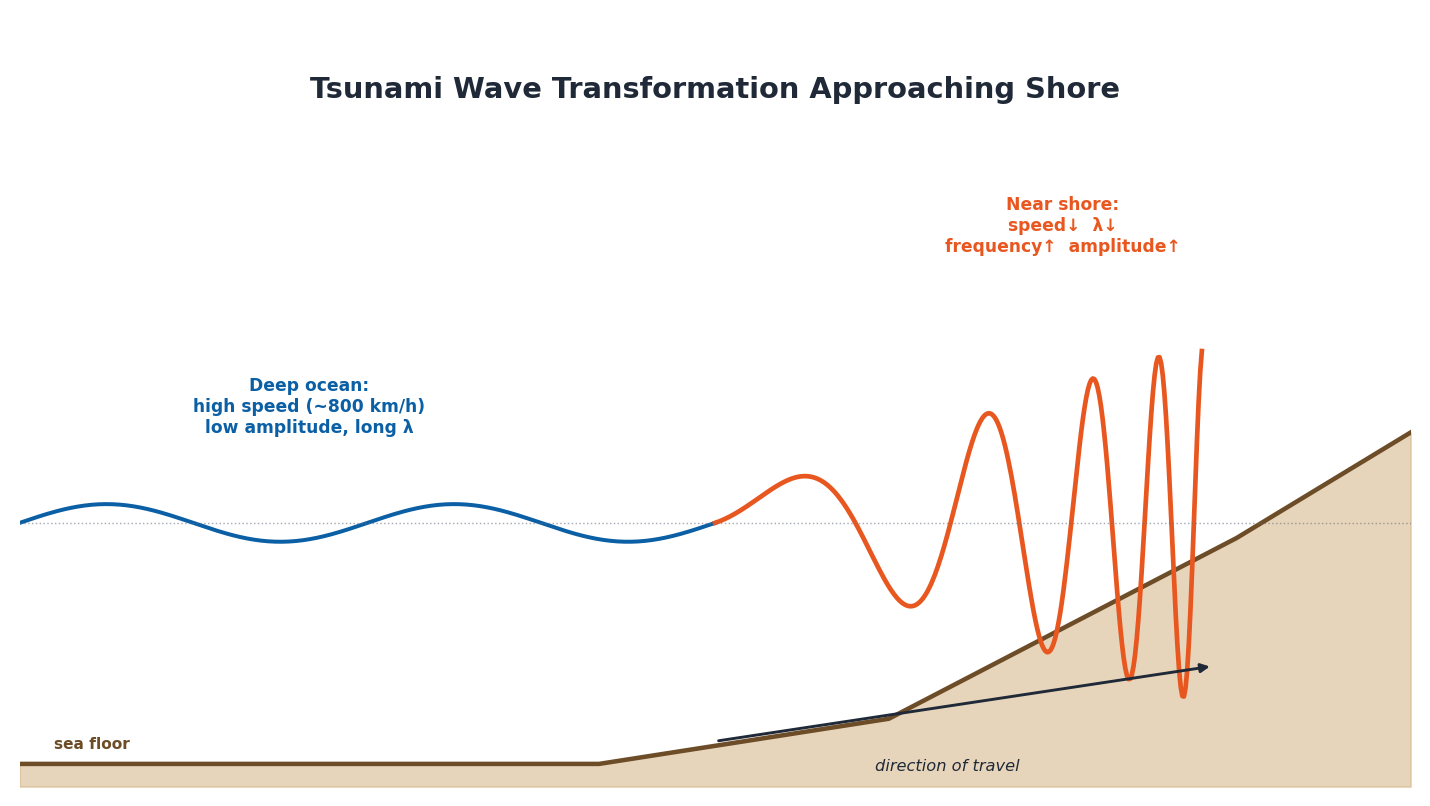
Tsunamis are extremely large, powerful ocean waves triggered by sudden undersea disturbances such as earthquakes, volcanic eruptions, or landslides that abruptly shift the ocean floor and push a huge volume of water upward. In deep ocean water, tsunami waves travel very fast (up to about 800 km/h) but are often just a few centimetres high and go unnoticed. As they approach shallow coastal water, their behaviour transforms dramatically: wave speed decreases as the wave touches the ocean floor, wavelength shortens, frequency increases (more waves arrive per unit time), and amplitude increases sharply as energy compresses into a smaller space — producing towering waves that can exceed 30 metres, causing severe flooding and destruction. The 2004 Indian Ocean tsunami, triggered by a massive undersea earthquake near Sumatra, struck Indonesia, Sri Lanka, India, and Thailand with waves over 15 metres high in places, causing the loss of more than 230,000 lives.
Important Definitions
What is a wave?
A disturbance that transfers energy from one place to another without transferring matter, as the medium's particles vibrate about fixed positions.
Define amplitude.
The maximum displacement of a point on a wave from its undisturbed (rest) position; it indicates the energy carried by the wave.
Define wavelength (λ).
The distance between two corresponding points on adjacent waves, such as crest to crest or compression to compression; SI unit is the metre (m).
Define frequency (f).
The number of complete wave cycles that pass a fixed point in one second; measured in hertz (Hz), where 1 Hz = 1 wave per second.
Define wave period (T).
The time required for one complete wave to pass a fixed point, measured in seconds; T = 1/f.
What is a wave front?
An imaginary surface on which all points share the same phase of vibration, representing the leading edge of an advancing wave.
What is diffraction?
The bending and spreading of waves as they pass through a narrow slit or move around an obstacle.
What is refraction (of waves)?
The change in a wave's direction that occurs when it passes from one medium into another at an angle, caused by a change in speed and wavelength.
Key Formulas
| Topic | Formula |
|---|---|
| Wave equation | v = f × λ |
| Wave speed from distance/time | v = λ / T |
| Frequency from period | f = 1 / T |
| Period from frequency | T = 1 / f |
| Speed of light (EM waves in vacuum) | c ≈ 3 × 10⁸ m s⁻¹ |
| Law of reflection | Angle of incidence = Angle of reflection |
| Frequency from cycles and time | f = number of cycles / time taken |
| Worked example | 10 cycles in 5 s, λ = 1.2 m → f = 2 Hz, v = f×λ = 2.4 m s⁻¹ |
Diagrams
Anatomy of a Transverse Wave: A labelled transverse wave showing crest, trough, wavelength (λ), and amplitude relative to the rest position
Reflection and Refraction of Water Waves: Ripple-tank style diagrams showing straight water waves reflecting off a barrier (equal angles) and refracting (bending, shortening wavelength) as they enter shallow water
Tsunami Wave Transformation Approaching Shore: A tsunami wave in deep ocean (low amplitude, long wavelength, high speed) transforming as it nears the shallow coast (higher amplitude, shorter wavelength, lower speed)
Short Questions & Answers
What do waves transfer from one place to another?
Waves transfer energy from one place to another without transferring matter; the medium's particles vibrate about fixed positions but do not travel with the wave.
Name any two examples of mechanical waves.
Sound waves and water waves (other acceptable examples include vibrations on a rope or spring, and seismic waves).
Which type of wave can travel through vacuum?
Electromagnetic waves, since they do not require a material medium; examples include light, radio waves, and X-rays.
What is the difference between transverse and longitudinal waves?
In transverse waves, particles vibrate at right angles to the direction of wave travel (e.g., water waves, light); in longitudinal waves, particles vibrate parallel to the direction of wave travel, creating compressions and rarefactions (e.g., sound waves).
What is meant by wavelength?
The distance between two corresponding points on adjacent waves, such as from one crest to the next crest, measured in metres.
Write the definition of frequency.
The number of complete wave cycles that pass a fixed point in one second, measured in hertz (Hz).
What causes a tsunami in the ocean?
A sudden disturbance under the sea — such as an underwater earthquake, volcanic eruption, or landslide — that abruptly shifts the ocean floor and pushes a huge volume of water upward, generating powerful waves.
What happens to a wave's speed and wavelength during refraction, and what stays the same?
Both speed and wavelength change as the wave enters a new medium (e.g., water waves slow down and shorten in shallower water), but the wave's frequency remains unchanged throughout.
Long Questions & Answers
Explain how waves transfer energy without transferring matter, using examples from daily life.
As a wave travels through a medium, it causes the particles of that medium to vibrate about their fixed rest positions, and each particle passes energy to its neighbour through this vibration — but no particle actually travels along with the wave itself. When a twig is dropped into still water, ripples spread outward across the surface carrying energy away from the point of impact, yet the water molecules themselves (and the twig) remain roughly in place, simply moving up and down as the ripple passes. Similarly, when a guitar string is plucked, it vibrates and sets up sound waves in the air; the air molecules near the ear vibrate back and forth to pass the energy along, but they do not travel all the way from the guitar to the ear. A stretched spring pushed and released shows the same principle for longitudinal waves — compressions and rarefactions travel along the spring's length, transmitting energy, while the spring's coils themselves only oscillate around their original positions rather than moving forward with the disturbance.
Describe the difference between mechanical and electromagnetic waves, with suitable examples.
Mechanical waves require a material medium — solid, liquid, or gas — to travel, because they rely on the vibration of the medium's own particles to carry energy from place to place; they cannot pass through a vacuum. Examples include sound waves (which need air, water, or a solid to travel through), water waves (which need water), vibrations on a rope or spring, and seismic waves generated by earthquakes (which travel through the rock and other layers of the Earth). Electromagnetic waves, by contrast, consist of oscillating electric and magnetic fields and do not need any material medium at all — they can travel through the vacuum of space, which is how sunlight and other radiation from the Sun reach the Earth. Examples include radio waves, microwaves, infrared rays, visible light, ultraviolet rays, X-rays, and gamma rays; although these differ enormously in wavelength and frequency, they all travel at the same speed in vacuum, approximately 3 × 10⁸ m/s (the speed of light), and together make up the electromagnetic spectrum.
Explain transverse and longitudinal waves, describing the motion of particles in each and giving examples.
In a transverse wave, the particles of the medium vibrate at right angles (perpendicular) to the direction in which the wave itself travels. This can be demonstrated by moving one end of a rope up and down: the wave moves horizontally along the rope, but each segment of rope moves only vertically, creating alternating high points (crests) and low points (troughs). Water waves are a good example, since water molecules move mostly up and down as a wave passes across the surface rather than travelling forward with it; electromagnetic waves are also transverse, since their electric and magnetic fields oscillate perpendicular to the direction the wave carries energy. In a longitudinal wave, particles instead vibrate parallel to the direction of wave travel, moving back and forth along the same line the energy is flowing. This creates alternating regions of compression, where particles bunch close together, and rarefaction, where particles spread further apart. Sound waves are the clearest example: when a source like a clap or a speaker vibrates, it pushes nearby air molecules together into a compression, which is immediately followed by a rarefaction as those molecules spread out again, and this repeating pattern of compressions and rarefactions travels outward through the air as sound, without the air itself moving permanently from source to listener.
Discuss the properties of waves — reflection, refraction, and diffraction — supporting your answer with examples.
Reflection occurs when a wave strikes a surface and bounces back into the same medium it came from, obeying the law of reflection: the angle of incidence always equals the angle of reflection. This can be seen with water waves reflecting off a barrier in a ripple tank, with echoes of sound waves bouncing off a distant wall, and with light waves reflecting off a mirror. Refraction occurs when a wave passes from one medium into another and changes direction because its speed changes; in a ripple tank, water waves slow down and bend as they move from deep into shallow water, and their wavelength shortens accordingly, while their frequency stays constant throughout the process — the same principle explains why light bends when passing from air into glass or water. Diffraction is the bending and spreading of waves as they pass through a narrow opening or move around an obstacle; the amount of diffraction depends on how the size of the gap compares to the wavelength — a slit much wider than the wavelength causes only slight edge-bending, while a slit close to or smaller than the wavelength causes strong spreading into circular wave patterns. This is why we can still hear someone talking from behind a wall: sound waves have relatively long wavelengths and diffract strongly around obstacles and corners, allowing sound energy to reach us even without a direct line of sight, whereas light — with its much shorter wavelength — diffracts far less noticeably around everyday-sized objects.
Multiple Choice Questions (MCQs)
The direction of vibration in a longitudinal wave is: (A) at right angles to the wave direction (B) in circular motion (C) opposite to the wave direction (D) in the same direction as the wave travels
Correct answer: (D) in the same direction as the wave travels. In longitudinal waves, particles vibrate parallel to (in the same line as) the direction of wave travel, creating compressions and rarefactions.
Which part of a transverse wave is the lowest point? (A) Crest (B) Compression (C) Rarefaction (D) Trough
Correct answer: (D) Trough. The trough is the lowest point of a transverse wave, below the mean/rest position.
Which of the following wave types requires a medium to travel? (A) X-rays (B) Light waves (C) Radiowaves (D) Sound waves
Correct answer: (D) Sound waves. Sound waves are mechanical waves and need a material medium (like air, water, or a solid) to travel; the other options are electromagnetic waves that can travel through vacuum.
The property of a wave which indicates how much energy it carries is: (A) crest (B) amplitude (C) wavelength (D) speed
Correct answer: (B) amplitude. Amplitude — the maximum displacement from the rest position — indicates the energy carried by a wave; larger amplitude means more energy.
A wave front is: (A) the distance between two crests (B) a region of high pressure in a wave (C) a line joining points that vibrate in phase (D) the outer edge of a wave medium
Correct answer: (C) a line joining points that vibrate in phase. A wave front is an imaginary surface (or line, in 2D) joining all points that vibrate with the same phase, representing the leading edge of the wave.
The wave phenomenon which occurs when waves change direction due to a change in speed is: (A) diffraction (B) reflection (C) absorption (D) refraction
Correct answer: (D) refraction. Refraction happens when a wave changes speed (and therefore direction) while passing from one medium into another.
What happens to wave speed and wavelength when a tsunami approaches shallow water? (A) Speed increases, wavelength increases (B) Speed decreases, wavelength shortens (C) Speed remains the same, wavelength shortens (D) Speed increases, wavelength stays constant
Correct answer: (B) Speed decreases, wavelength shortens. As a tsunami nears shallow water, it slows down (speed decreases) and its wavelength shortens, while its amplitude and frequency increase.
Which wave behaviour explains how sound is heard around a corner? (A) Reflection (B) Refraction (C) Interference (D) Diffraction
Correct answer: (D) Diffraction. Diffraction is the bending/spreading of waves around obstacles or through openings, which allows sound to reach listeners without a direct line of sight.
A wave completes 10 cycles in 5 seconds. Its frequency is: (A) 0.5 Hz (B) 2 Hz (C) 5 Hz (D) 10 Hz
Correct answer: (B) 2 Hz. Frequency = number of cycles / time = 10 / 5 = 2 Hz.
If a wave has a frequency of 50 Hz, its time period is: (A) 0.5 s (B) 0.2 s (C) 0.02 s (D) 2 s
Correct answer: (C) 0.02 s. T = 1/f = 1/50 = 0.02 s.
Quick Revision Summary
- Waves transfer energy without transferring matter — particles vibrate about fixed positions
- Mechanical waves need a medium (sound, water waves); electromagnetic waves need no medium (light, radio, X-rays) and travel at c ≈ 3×10⁸ m/s in vacuum
- Transverse waves: vibration ⊥ wave direction (water, light) — crest/trough; Longitudinal waves: vibration ∥ wave direction (sound) — compression/rarefaction
- Key terms: amplitude (energy), wavelength λ (m), frequency f (Hz), period T = 1/f (s), wave front (line of equal phase)
- Wave equation: v = f × λ — the single most important formula in this chapter
- Reflection: angle of incidence = angle of reflection, same medium. Refraction: speed & wavelength change, frequency stays constant, wave bends
- Diffraction increases as slit size approaches or falls below the wavelength; long-wavelength sound diffracts more than short-wavelength light
- Tsunamis: fast (~800 km/h) and low in deep ocean; near shore, speed↓, wavelength↓, frequency↑, amplitude↑ sharply — can exceed 30 m in height
Exam Tips
- Memorise v = fλ and be ready to rearrange it for f or λ given the other two quantities
- Always state units: v in m/s, f in Hz, λ in m, T in s — mixing units is a common source of lost marks
- In refraction problems, remember frequency never changes — only speed and wavelength change between media
- For diffraction questions, connect wavelength-vs-slit-size reasoning directly to the amount of spreading observed
- For tsunami questions, list all four changes together: speed↓, wavelength↓, frequency↑, amplitude↑ — examiners often want all four
- Distinguish clearly between mechanical waves (need medium) and electromagnetic waves (no medium needed) with at least one example of each