Electromagnetism is the branch of physics that deals with the interaction between electric and magnetic fields. It explains how a moving electric charge — an electric current — creates a magnetic field, and conversely, how a magnetic field can exert a force on a current-carrying conductor. This chapter covers the magnetic field patterns produced by straight wires and solenoids, the right-hand grip rule, and the forces between parallel current-carrying conductors.
It goes on to explain the force on a current-carrying conductor in a magnetic field (F = BIL sinθ) and Fleming's left-hand rule, the turning effect (torque) on a current-carrying coil and how this principle powers the electric motor with its split-ring commutator, the magnetic-effect applications in relays and loudspeakers, and finally the origin of the Earth's own magnetic field.
Learning Objectives
- Describe the pattern and direction of the magnetic field due to current in a straight wire and in a solenoid, using the right-hand grip rule
- State the effect on the magnetic field of changing the magnitude and direction of the current
- Describe how the magnetic effect of a current is used in relays and loudspeakers
- Describe an experiment showing that a force acts on a current-carrying conductor in a magnetic field, including reversing the current and the field
- State and use the relative directions of force, magnetic field, and current (Fleming's left-hand rule), and calculate force using F = BIL sinθ
- Describe the magnetic field patterns between parallel current-carrying conductors and relate these to the forces on the conductors
- State that a current-carrying coil in a magnetic field experiences a turning effect, and identify the factors that increase it
- Describe the operation of an electric motor, including the action of a split-ring commutator and carbon brushes
- Describe and explain the action of relays in switching circuits
- State the theorized origin of the Earth's magnetic field in the rotation of its molten iron core
Key Concepts
17.1 Magnetic Field Due to Current in a Straight Wire
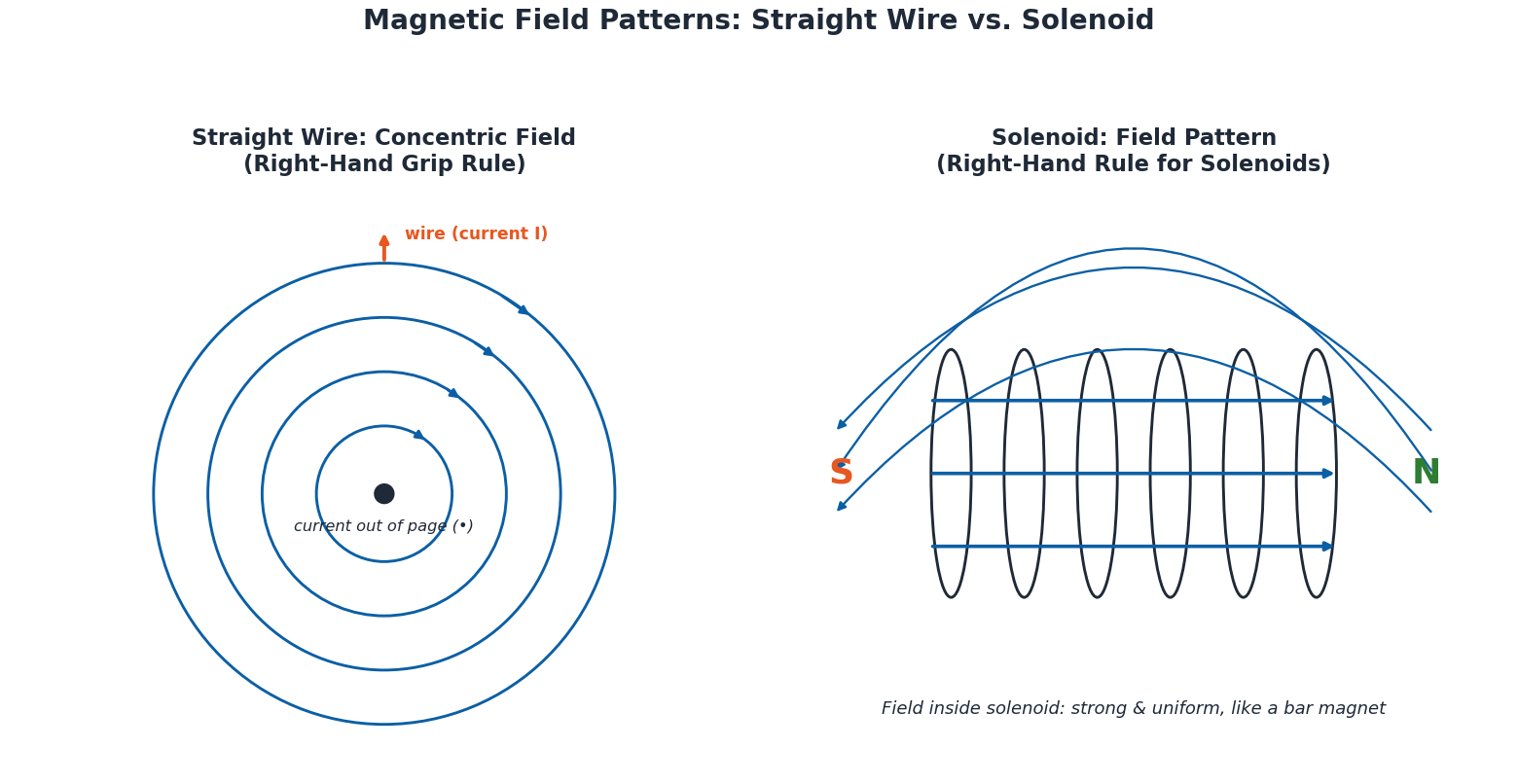
Hans Christian Oersted discovered that a steady electric current flowing through a conductor generates a magnetic field B around it. This can be demonstrated by passing a current-carrying wire through a vertical cardboard sheet sprinkled with iron filings or surrounded by small compasses: the filings/compass needles arrange themselves in concentric circles around the wire, aligning tangentially to the circular magnetic field lines. If the current direction is reversed, the compass needles and iron filings reverse their alignment too, showing that the magnetic field's direction depends on the direction of current flow.
The direction of this magnetic field is found using the right-hand grip rule: if the wire is held in the right hand with the thumb pointing in the direction of the current, the curled fingers point in the direction of the magnetic field. In the dot-and-cross convention used in diagrams, a dot (•) represents current flowing out of the page, and a cross (×) represents current flowing into the page. The magnetic field is strongest close to the wire and weakens with increasing distance from it — this is essential in electrical engineering, especially in circuits carrying alternating current.
17.2 Magnetic Field Due to Current in a Solenoid
A solenoid is a coil of wire wound in the shape of a cylinder; when current flows through it, the combined magnetic effect of every loop adds together to produce a strong, uniform magnetic field similar to that of a bar magnet, with a distinct north pole and south pole. Because a solenoid behaves as a temporary magnet powered by electricity, it is called an electromagnet, and it can attract or repel a permanent bar magnet just as a real magnet would.
The direction of a solenoid's magnetic field is found using the right-hand rule for solenoids: if the solenoid is gripped with the right hand so that the curled fingers point in the direction of the conventional current flowing through the coils, the extended thumb points towards the solenoid's north pole. Because their magnetic strength can be switched on/off and adjusted simply by controlling the current, electromagnets are widely used in motors, relays, and magnetic locks.
17.3 Properties of Magnetic Field Lines and Forces Between Parallel Conductors
Like electric field lines, magnetic field lines are an imaginary but useful way to visualize a magnetic field, and they obey several key properties: they always emerge from the north pole and terminate at the south pole; they always form closed loops (continuing inside the magnet from south back to north); at any point, the tangent to a field line gives the field's direction; magnetic field lines never cross one another; and where the lines are closer together the field is stronger, while where they are more spread apart the field is weaker.
When two parallel wires carry current in the same direction, the magnetic fields they generate interact so that the field between the wires is weakened while the field outside is strengthened, causing the two wires to attract each other. When the currents in the two wires flow in opposite directions, their magnetic fields between the wires reinforce each other, pushing the wires apart, so the wires repel each other. This attraction/repulsion behaviour between current-carrying conductors is the basic principle underlying electromagnetic devices such as electric motors and electromagnets.
17.4 Force on a Current-Carrying Conductor in a Magnetic Field
Since an electric current generates its own magnetic field, and a magnetic field exerts a force on a magnet, it follows that a current-carrying conductor placed inside an external magnetic field will also experience a force. When a wire carrying current is placed between the poles of a permanent magnet, the wire's own magnetic field interacts with the magnet's field, and the wire is pushed sideways — Michael Faraday found that this force always acts at right angles to both the magnetic field direction and the current direction.
The magnitude of this force increases with a larger current (I), a stronger magnetic field (B), and a greater length (L) of wire inside the field, and is calculated as F = BIL sinθ, where θ is the angle between the current and the field; the force is maximum (F = BIL) when the wire is perpendicular to the field, and zero when the wire runs parallel to the field. The direction of the force is found using Fleming's left-hand rule: holding the thumb, forefinger, and middle finger of the left hand mutually at right angles, with the forefinger showing the magnetic field direction and the middle finger showing the current direction, the thumb then points in the direction of the force. The SI unit of magnetic field (flux density) is the tesla (T): a field of 1 T causes a force of 1 N on a 1 m length of wire carrying a current of 1 A placed perpendicular to the field, i.e. 1 T = 1 N A⁻¹ m⁻¹.
17.5 Turning Effect on a Current-Carrying Coil
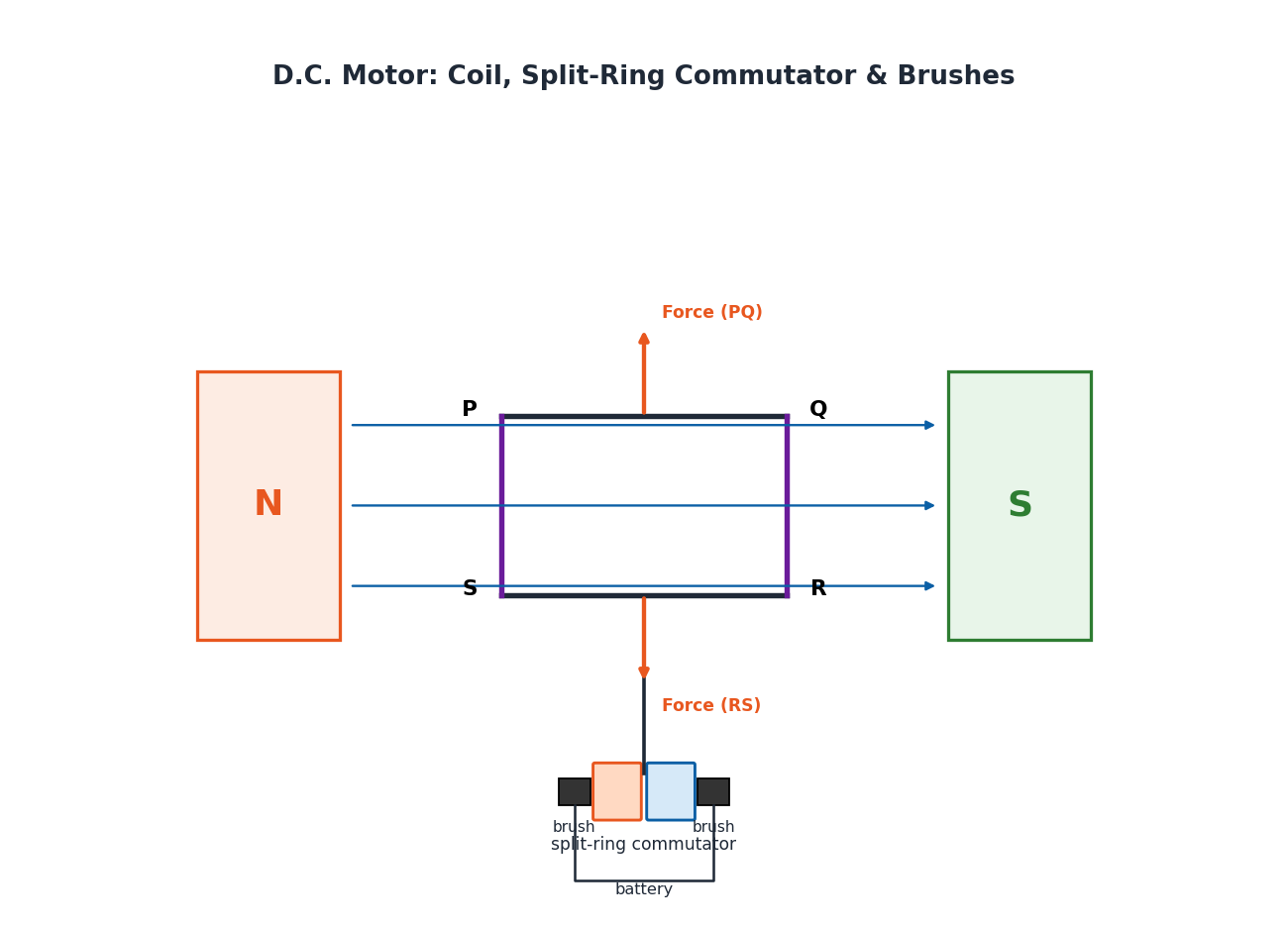
Consider a rectangular coil PQRS carrying current, placed perpendicular to a magnetic field between the poles of a permanent magnet. Applying Fleming's left-hand rule to the two sides PQ and RS shows that, because current flows in opposite directions along these two sides, the forces on them are equal in magnitude but opposite in direction — the force on PQ acts outward while the force on RS acts inward. These two equal-and-opposite forces form a couple, and a couple produces a rotational effect (torque), which causes the coil to begin rotating. This turning effect of a current-carrying coil in a magnetic field is the fundamental working principle of the electric motor.
The strength of this turning effect can be increased in three ways: increasing the number of turns in the coil (more loops mean a stronger overall turning effect); increasing the current flowing through the coil (more current creates a stronger torque); and increasing the strength of the magnetic field (a stronger magnet produces greater torque). These three factors are exactly what engineers adjust to make electric motors more powerful and efficient.
17.6 Electric Motor
An electric motor is a device that converts electrical energy into mechanical energy. There are two broad types: alternating current (AC) motors and direct current (DC) motors. A DC motor works through the interaction between a current-carrying coil (called the armature) and a surrounding magnetic field: when the coil is placed in the field, it experiences a couple of forces that cause it to rotate.
However, without additional help, the coil would stop rotating after turning through 90°, because at that point the forces on its sides (PQ and RS) push it into a position perpendicular to the field, where the net turning force becomes zero. To keep the coil rotating continuously, the direction of the current through it must be reversed exactly as the coil reaches this vertical position — this is achieved by a split-ring commutator, a metal ring split into two halves, each connected to one end of the coil, together with carbon brushes that maintain sliding electrical contact with the commutator as it rotates. As the coil turns and reaches the vertical position, each half of the commutator switches which brush it touches, reversing the current direction in the coil and, with it, the direction of the forces — allowing the coil to keep rotating continuously in the same direction. The speed of the motor can be controlled by adjusting the current flowing through it.
17.7 Relay
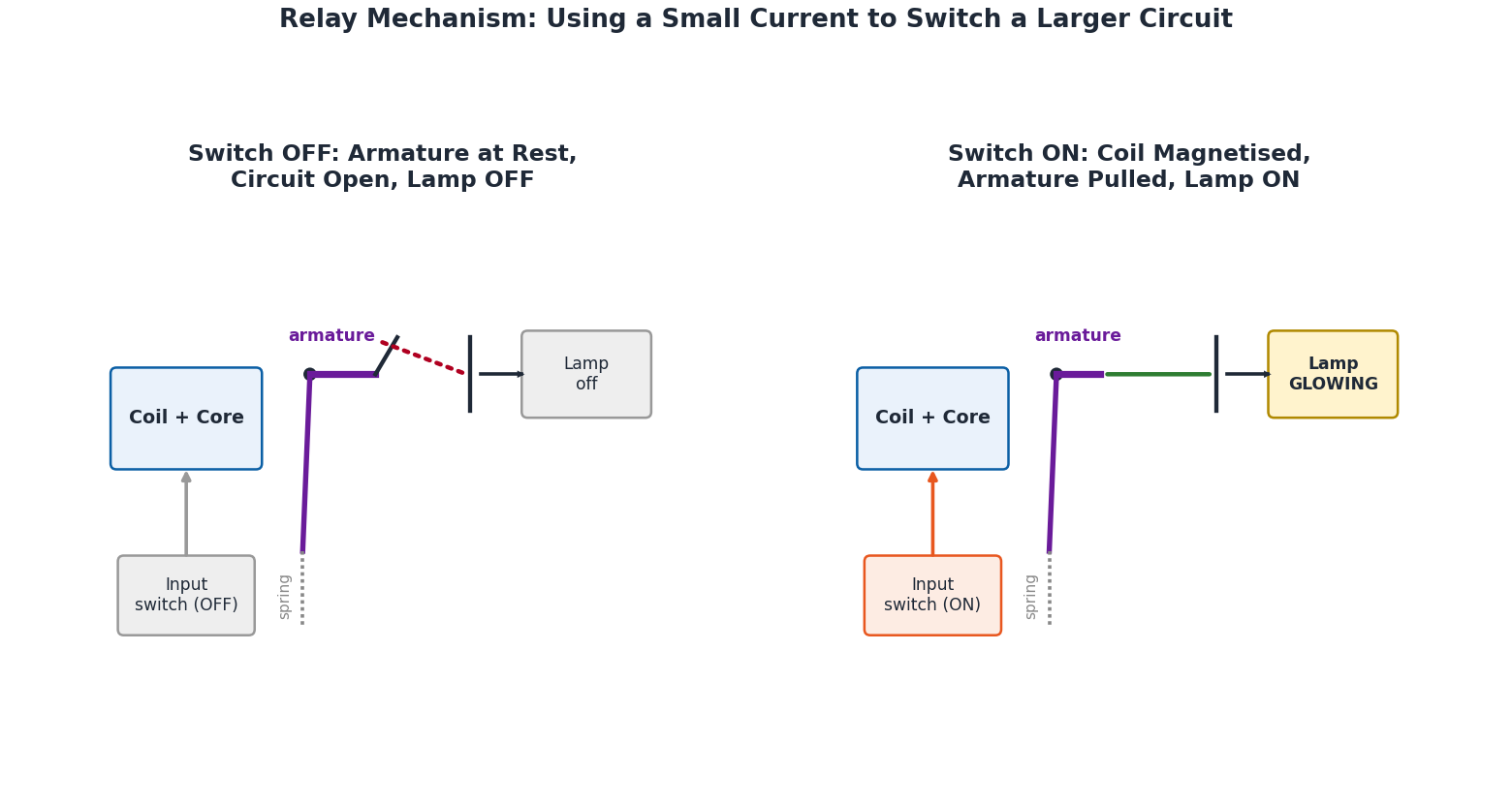
A relay is an electrical device that uses the magnetic effect of a current to control a separate circuit, acting as a bridge that lets a small input current switch a much larger output current on or off. A mechanical relay has four key parts: (a) a coil wound around a magnetic core, which produces a magnetic field whenever current flows through it; (b) an armature, a small movable piece that is pulled towards the core when the coil becomes magnetised; (c) a return spring, which pulls the armature back to its original position once the current stops, resetting the relay; and (d) a moving contact attached to the armature, which opens or closes the output circuit as the armature moves.
When the input switch is OFF, no current flows through the coil, the armature stays in its normal position, and the output circuit (e.g. a lamp) remains open, so the lamp does not glow. When the input switch is turned ON, current flows through the coil, magnetising it; the magnetised core pulls the armature towards itself, closing the output circuit's moving contact, so the lamp glows. Relays are widely used to open door locks and to start motors in cars and heavy machinery using only a small control current.
17.8 Loudspeaker
A loudspeaker also relies on the magnetic effect of current, converting an electrical audio signal into sound. It consists of a coil attached to a flexible diaphragm, positioned inside the field of a permanent magnet. When an alternating current (the audio signal) flows through the coil, it generates a varying magnetic field that interacts with the permanent magnet's field, producing a force on the coil that makes it move back and forth rapidly.
This back-and-forth motion of the coil vibrates the attached diaphragm, which pushes and pulls the surrounding air to produce sound waves that correspond to the original electrical signal — louder and higher- or lower-pitched sounds correspond to larger or more rapid variations in the current. Loudspeakers are essential components of audio systems, public address systems, and televisions.
17.9 Earth's Magnetic Field
The Earth's magnetic field acts like an invisible protective shield surrounding the planet and stretching far into space, resembling the field of a giant bar magnet with a north and south pole. Unlike an ordinary magnet, however, the Earth's field constantly shifts over time and can even reverse (flip) over long geological timescales. This field is essential to life because it deflects dangerous solar wind particles and cosmic radiation away from the Earth's surface, and it also enables navigation, helping both humans and migratory animals such as birds and sea turtles sense direction.
Scientists believe the Earth's magnetic field is generated by the dynamo effect within its molten iron core. The core consists of a solid inner core and a liquid outer core made of molten iron and nickel; as the Earth spins, heat escaping from the solid inner core causes the liquid outer core to churn and flow, and this movement of electrically charged, conducting liquid metal generates electric currents. These currents in turn produce magnetic fields that combine and reinforce each other due to the Earth's rotation, sustaining the overall magnetic field through a continuous process called magnetohydrodynamics — this process powers the magnetosphere, the protective magnetic barrier that shields the Earth from harmful solar wind and space radiation.
Important Definitions
Define magnetic field.
The region around a magnet or a current-carrying conductor within which a magnetic force can be detected, represented visually using magnetic field lines.
What is an electromagnet?
A temporary magnet formed when current flows through a solenoid (a coil of wire), producing a magnetic field similar to a bar magnet's, which can be switched on/off and controlled by adjusting the current.
State the right-hand grip rule.
If a current-carrying wire is held in the right hand with the thumb pointing in the direction of current flow, the curled fingers point in the direction of the surrounding magnetic field.
Define the tesla (T), the SI unit of magnetic field.
The magnetic field strength that causes a force of 1 N on a 1 m length of wire carrying a current of 1 A placed perpendicular to the field: 1 T = 1 N A⁻¹ m⁻¹.
State Fleming's left-hand rule.
With the thumb, forefinger, and middle finger of the left hand held mutually at right angles: the forefinger shows the field direction, the middle finger shows the current direction, and the thumb then shows the direction of the force on the conductor.
What is a couple, and what effect does it produce on a current-carrying coil?
A pair of equal and opposite forces acting on opposite sides of a coil in a magnetic field; this couple produces a turning effect (torque) that makes the coil rotate — the working principle of an electric motor.
Define a relay.
An electrical device that uses the magnetic effect of a current in a coil to open or close a separate (often higher-power) circuit, acting as a bridge between a small input current and a larger output current.
What is the dynamo effect?
The process by which the motion of electrically conducting liquid metal in the Earth's outer core generates electric currents, which in turn produce and sustain the Earth's magnetic field.
Key Formulas
| Topic | Formula |
|---|---|
| Force on a current-carrying conductor | F = BIL sinθ |
| Force when wire is perpendicular to field (θ = 90°) | F = BIL |
| Definition of the tesla | 1 T = 1 N A⁻¹ m⁻¹ |
| Right-hand grip rule (straight wire) | Thumb = current direction; curled fingers = magnetic field direction |
| Right-hand rule for a solenoid | Curled fingers = current direction; thumb = north pole direction |
| Fleming's left-hand rule | Forefinger = field (F); middle finger = current (I); thumb = force/thrust (T) |
| Turning effect (torque) on a coil | Torque increases with: number of turns (N) ↑, current (I) ↑, magnetic field strength (B) ↑ |
| Parallel conductors | Same-direction currents → attraction; opposite-direction currents → repulsion |
Diagrams
Magnetic Field of a Straight Wire and a Solenoid: Concentric magnetic field lines around a straight current-carrying wire (right-hand grip rule) alongside the field pattern of a current-carrying solenoid resembling a bar magnet
D.C. Motor with Split-Ring Commutator: A rectangular coil PQRS in a magnetic field, showing the forces from Fleming's left-hand rule and the split-ring commutator with carbon brushes that reverse current every half turn
Relay Mechanism: The main parts of a mechanical relay — coil, core, armature, return spring, and moving contact — shown in the switch-OFF and switch-ON states
Short Questions & Answers
What is the direction of the magnetic field around a straight current-carrying wire?
It forms concentric circles around the wire; its direction is found using the right-hand grip rule — thumb points along the current, curled fingers show the field direction.
What happens to the magnetic field if the current in a wire is increased?
The magnetic field becomes stronger; the field's strength is directly related to the magnitude of the current flowing through the wire.
How can you identify the north and south poles of an unmarked electromagnet (solenoid)?
Using the right-hand rule for a solenoid: grip the coil so curled fingers follow the direction of conventional current; the extended thumb points to the north pole.
State Fleming's left-hand rule and explain what it is used for.
Holding the thumb, forefinger, and middle finger of the left hand mutually at right angles, with forefinger = field and middle finger = current, the thumb shows the direction of the force (thrust) on a current-carrying conductor in a magnetic field.
What role does the commutator play in a D.C. motor?
The split-ring commutator reverses the direction of current in the coil every half rotation, exactly when the coil is vertical, so that the turning force continues to act in the same rotational direction and the coil keeps spinning continuously.
What is the theorized source of the Earth's magnetic field?
It is believed to be generated by the dynamo effect: the movement of electrically conducting molten iron and nickel in the Earth's liquid outer core, driven by heat from the solid inner core as the Earth rotates.
How do the forces between two parallel current-carrying wires depend on the current directions?
If the currents flow in the same direction, the wires attract each other; if the currents flow in opposite directions, the wires repel each other.
List three ways to increase the turning effect on a current-carrying coil in a magnetic field.
Increase the number of turns in the coil; increase the current flowing through the coil; increase the strength of the magnetic field.
Long Questions & Answers
Explain, with reference to an experiment, how the magnetic field produced by a current-carrying straight wire can be demonstrated, and describe how its direction is determined.
A steady electric current flowing through a conductor generates a magnetic field around it, as first discovered by Hans Christian Oersted. This can be demonstrated experimentally by passing a straight current-carrying wire vertically through a horizontal cardboard sheet, either sprinkled with iron filings or surrounded by several small plotting compasses placed at different points around the wire. When current flows through the wire, the iron filings arrange themselves into a clear pattern of concentric circles centred on the wire, and the compass needles align themselves tangentially to these circles, pointing in the direction of the magnetic field at each point. If the direction of the current is reversed (for example, by switching the battery terminals), the pattern of iron filings and the direction the compass needles point both reverse as well, directly demonstrating that the magnetic field's direction depends on the direction of current flow, and confirming that a magnetic field only exists around the wire while current is actually flowing through it. The direction of this magnetic field at any point is determined using the right-hand grip rule: if the current-carrying wire is grasped in the right hand with the thumb extended in the direction of the conventional current, the fingers naturally curl around the wire in the same sense as the magnetic field lines, giving a quick and reliable way to predict the field direction anywhere around a straight current-carrying conductor. In circuit diagrams, this three-dimensional field is often represented using the dot-and-cross convention, where a dot represents current (or field) emerging out of the page towards the viewer, and a cross represents current (or field) going into the page away from the viewer.
Describe, with the aid of Fleming's left-hand rule, how the force on a current-carrying conductor in a magnetic field arises, and state the factors affecting its magnitude.
A current-carrying conductor generates its own magnetic field around itself. When such a conductor is placed within an external magnetic field, such as that between the poles of a permanent magnet, the conductor's own field interacts with the external field: on one side of the wire the two fields add together (becoming stronger), while on the other side they oppose each other (becoming weaker); this asymmetry results in a net sideways force pushing the wire from the region of the stronger combined field toward the region of the weaker combined field. Michael Faraday established that this force always acts at right angles to both the direction of the current and the direction of the magnetic field. The magnitude of the force is given by F = BIL sinθ, where B is the magnetic flux density (in tesla), I is the current (in amperes), L is the length of the conductor within the field (in metres), and θ is the angle between the current direction and the field direction; the force is therefore directly proportional to each of the current, the field strength, and the length of wire within the field, and is greatest (F = BIL) when the conductor lies perpendicular to the field, falling to zero when the conductor lies parallel to the field. The direction of the force is found using Fleming's left-hand rule: with the thumb, forefinger, and middle finger of the left hand held mutually perpendicular to one another, the forefinger is pointed along the direction of the magnetic field and the middle finger along the direction of the current, and the thumb then automatically points in the direction of the resulting force (or thrust) on the conductor — reversing either the current or the field direction reverses the direction of the force, as can be verified experimentally.
Explain the working principle of a simple D.C. motor, describing in detail the role of the split-ring commutator and carbon brushes, and how continuous rotation is achieved.
A D.C. motor converts electrical energy into mechanical energy by exploiting the turning effect produced when a current-carrying coil (the armature) is placed inside a magnetic field. Considering a rectangular coil PQRS positioned perpendicular to a magnetic field: when current flows through the coil, Fleming's left-hand rule shows that the two sides PQ and RS, which carry current in opposite directions relative to each other, experience forces that are equal in magnitude but opposite in direction — one side is pushed outward while the other is pushed inward. These two opposing forces form a couple, producing a torque that begins to rotate the coil around its axis. However, if nothing else were done, this rotation would only continue for a quarter turn (90°): once the coil reaches the position where it lies perpendicular to the magnetic field (parallel to the pole faces), the forces on PQ and RS act directly along the plane of rotation rather than turning it further, so the net torque momentarily drops to zero and the coil would simply stop or oscillate back and forth rather than spinning continuously. To solve this problem, a split-ring commutator is used: this is a metal ring, split into two separate half-rings, with each half permanently connected to one end of the coil. Stationary carbon brushes press against the outside of the rotating commutator, maintaining continuous electrical contact between the external circuit and the spinning coil. As the coil rotates and approaches the critical vertical position where the torque would otherwise vanish, the gap between the two half-rings of the commutator passes underneath the brushes, and each brush then makes contact with the opposite half-ring to the one it was touching before — this instantly reverses the direction of current flow through the coil. Because the current direction reverses at exactly this moment, the direction of the forces on sides PQ and RS also reverses, so that the torque continues to act in the same rotational sense as before, driving the coil past the vertical position and allowing it to keep rotating continuously in one direction rather than stalling or reversing. The speed of rotation of the motor can be increased or decreased simply by increasing or decreasing the current supplied to the coil.
Discuss the theory behind the origin of the Earth's magnetic field and explain why this field is important for life on Earth.
The Earth behaves as if it contains a giant bar magnet at its centre, producing a magnetic field with a north and south pole that extends far out into space, forming a protective region called the magnetosphere. Unlike a permanent bar magnet, however, scientists do not believe the Earth's magnetism comes from a literal magnetized solid core; instead, the leading scientific theory attributes it to the dynamo effect occurring deep within the planet's interior. The Earth's core is divided into two regions: a solid inner core, under immense pressure, and a surrounding liquid outer core composed mainly of molten iron and nickel. As the Earth rotates, intense heat escaping from the solid inner core causes the electrically conducting liquid metal of the outer core to churn, convect, and flow in complex patterns. Because this flowing liquid metal contains freely moving charged particles, its motion constitutes electric currents circulating deep within the Earth; and, just as any electric current generates a magnetic field, these circulating currents produce magnetic fields of their own. As the Earth continues to rotate, these individual magnetic field contributions combine, reinforce one another, and organize into the large-scale, roughly bar-magnet-shaped field observed at the surface — a continuously self-sustaining process known as magnetohydrodynamics, since it involves the interplay of magnetic fields (magneto-) with the motion of an electrically conducting fluid (-hydrodynamics). This magnetic field is of vital importance to life on Earth for two main reasons: first, it acts as a protective shield, deflecting away much of the harmful solar wind (streams of charged particles emitted by the Sun) and dangerous cosmic radiation that would otherwise strip away the atmosphere and bombard the surface with damaging radiation; second, it provides a natural compass that many organisms, including migratory birds and sea turtles, as well as human navigational instruments, can sense and use to determine direction over long distances.
Multiple Choice Questions (MCQs)
A steady electric current in a conductor generates around it: (A) An electric field only (B) A magnetic field (C) A gravitational field (D) No field at all
Correct answer: (B) A magnetic field. Hans Christian Oersted discovered that a steady current generates a magnetic field around the conductor carrying it.
The direction of the magnetic field around a straight current-carrying wire is found using: (A) Fleming's left-hand rule (B) Fleming's right-hand rule (C) The right-hand grip rule (D) Lenz's law
Correct answer: (C) The right-hand grip rule. The right-hand grip rule: thumb points along the current, curled fingers show the direction of the magnetic field.
A solenoid carrying current behaves magnetically like: (A) An electric field only (B) A bar magnet (C) A capacitor (D) An insulator
Correct answer: (B) A bar magnet. The combined magnetic effect of all the loops of a current-carrying solenoid produces a field like that of a bar magnet, with a north and south pole.
If the currents in two parallel wires flow in the same direction, the wires will: (A) Repel each other (B) Attract each other (C) Have no force between them (D) Rotate around each other
Correct answer: (B) Attract each other. Same-direction currents in parallel wires create magnetic fields that attract the wires toward each other.
The force on a current-carrying conductor in a magnetic field is given by: (A) F = BIL sinθ (B) F = BI/L (C) F = B/IL (D) F = BILcosθ
Correct answer: (A) F = BIL sinθ. The force on a current-carrying conductor in a magnetic field is F = BIL sinθ, where θ is the angle between the current and the field.
The direction of the force on a current-carrying conductor in a magnetic field is found using: (A) The right-hand grip rule (B) Fleming's left-hand rule (C) The right-hand rule for solenoids (D) Ohm's law
Correct answer: (B) Fleming's left-hand rule. Fleming's left-hand rule gives the direction of force: forefinger = field, middle finger = current, thumb = force.
The SI unit of magnetic field (flux density) is the: (A) Ampere (B) Volt (C) Tesla (D) Ohm
Correct answer: (C) Tesla. The tesla (T) is the SI unit of magnetic flux density; 1 T = 1 N A⁻¹ m⁻¹.
In a D.C. motor, the part that reverses the direction of current in the coil every half turn is the: (A) armature (B) split-ring commutator (C) permanent magnet (D) return spring
Correct answer: (B) split-ring commutator. The split-ring commutator reverses the current direction in the coil each half rotation, keeping the torque acting in the same rotational sense.
A relay uses the magnetic effect of current to: (A) increase voltage in a circuit (B) control another (often larger) circuit using a small current (C) store electrical charge (D) convert AC to DC
Correct answer: (B) control another (often larger) circuit using a small current. A relay acts as a bridge, using a small input current's magnetic effect to switch a separate, often higher-power, output circuit on or off.
According to the dynamo theory, the Earth's magnetic field is generated by: (A) a giant magnetized rock at the core (B) the motion of molten iron and nickel in the liquid outer core (C) solar radiation striking the atmosphere (D) the rotation of the Moon
Correct answer: (B) the motion of molten iron and nickel in the liquid outer core. The dynamo effect: convecting, electrically conducting molten iron and nickel in the Earth's liquid outer core generates the electric currents that produce the Earth's magnetic field.
Quick Revision Summary
- Straight wire: field forms concentric circles; direction from right-hand grip rule (thumb = current, fingers curl = field)
- Solenoid: field like a bar magnet; direction from right-hand rule for solenoids (curled fingers = current, thumb = north pole)
- Field lines: north→south outside magnet, closed loops, never cross, denser lines = stronger field
- Parallel wires: same-direction currents attract; opposite-direction currents repel
- Force on conductor: F = BIL sinθ (max = BIL when perpendicular, zero when parallel to field)
- Fleming's left-hand rule: forefinger = Field, middle finger = Current, thumb = force/Thrust
- Tesla (T): 1 T = 1 N A⁻¹ m⁻¹ — the SI unit of magnetic flux density
- Turning effect on coil ↑ with: more turns, more current, stronger field — basis of the electric motor
- D.C. motor: split-ring commutator + carbon brushes reverse current every half-turn for continuous rotation
- Relay = small current controls large circuit (coil, core, armature, spring, moving contact); loudspeaker: varying current + permanent magnet → vibrating diaphragm → sound
- Earth's magnetic field: dynamo effect from convecting molten iron/nickel in liquid outer core; shields Earth from solar wind and cosmic radiation
Exam Tips
- Never confuse the right-hand grip rule (for finding field direction around a wire/solenoid) with Fleming's left-hand rule (for finding force direction on a current in a field) — grip rule uses the RIGHT hand, force rule uses the LEFT hand
- For F = BIL sinθ problems, always check the angle θ between the current and the field — many marks are lost by assuming θ = 90° when it is not stated
- Remember: same-direction parallel currents attract; opposite-direction parallel currents repel — the reverse of what students often assume
- In D.C. motor questions, always explain WHY the coil would stop at 90° before describing how the commutator solves it — examiners want the reasoning, not just the fact
- For relay questions, describe the full OFF→ON sequence (no current→armature at rest→circuit open) and (current flows→coil magnetised→armature pulled→circuit closed)
- For Earth's magnetic field questions, use the correct terms: dynamo effect, liquid outer core, molten iron/nickel, magnetohydrodynamics, magnetosphere