Atomic and nuclear physics explore the smallest building blocks of matter — the atom and its nucleus. This chapter covers Rutherford's alpha-particle scattering experiment and what it revealed about atomic structure, charge number and mass number, isotopes, and the discovery and properties of radioactivity, including alpha, beta, and gamma radiation and their relative ionizing and penetrating powers.
It also explains radioactive decay equations, nuclear fission and fusion reactions, the interconversion of matter and energy via Einstein's E = mc², half-life and radioactive decay curves, carbon dating, and the effects and practical uses of nuclear radiation in medicine, industry, and safety devices.
Learning Objectives
- Describe the structure of the atom as a positively charged nucleus surrounded by electrons behaving as quantum particles
- Justify the findings of Rutherford's alpha-particle scattering experiment regarding the nucleus
- Define proton number (Z) and nucleon number (A), and calculate the number of neutrons in a nucleus using N = A – Z
- Use nuclide notation and explain what is meant by an isotope
- Describe alpha-particles, beta-particles, and gamma-radiation, and compare their ionizing and penetrating powers
- Describe the deflection of alpha-particles, beta-particles, and gamma-radiation in electric and magnetic fields
- Use decay equations in nuclide notation to show emission of alpha-particles, beta-particles, and gamma-radiation
- Describe nuclear fission and fusion reactions with examples, and recognize fusion as the energy source for stars
- Apply E = mc² to calculate the energy released in nuclear reactions
- Define half-life, apply N = (1/2)ⁿN₀, and explain carbon dating and the uses/effects of nuclear radiation
Key Concepts
20.1 Atomic Structure and Rutherford's Experiment
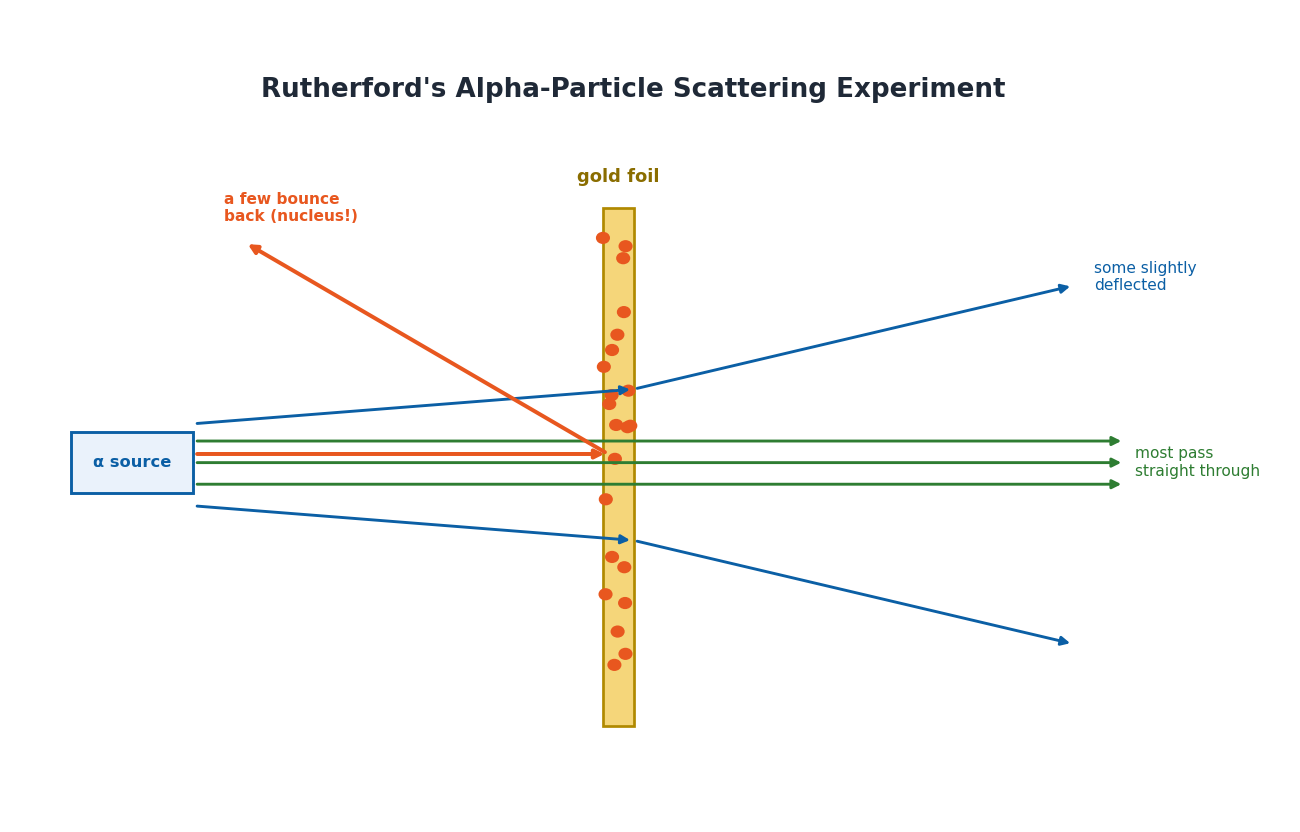
All matter is made of tiny particles called atoms (first suggested by Dalton); in 1897, J. J. Thomson proposed that atoms contain positively charged matter and negatively charged electrons. In 1911, Ernest Rutherford, with Hans Geiger and Ernest Marsden, directed a beam of alpha particles at a thin gold foil: most particles passed straight through undeflected, some were slightly deflected, and a very few bounced back at large angles.
From these results, Rutherford concluded: (1) atoms have a small, dense, positively charged core called the nucleus; (2) the nucleus contains most of the mass of the atom; (3) electrons orbit the nucleus at large distances, and the atom is mostly empty space; (4) the nucleus is extremely small, about 10,000 times smaller than the entire atom. Later studies showed electrons do not follow fixed orbits like planets; instead they exist in electron clouds — regions where their exact position cannot be known, but where the cloud is denser where the electron is more likely to be found, reflecting their quantum nature as both particles and waves.
20.2 Atomic Nucleus: Charge Number and Mass Number
The atomic nucleus is the small, dense central part of an atom that holds most of its mass; it is made of protons and neutrons (together called nucleons), held together by the strong nuclear force. The charge number Z (also called atomic number) is the number of protons in an atom, unique for each element and determining its position in the periodic table and its chemical properties. The mass number A is the total number of protons and neutrons in the nucleus (electrons are not included, since their mass is negligible).
A nuclide is represented as ᴬZX, where X is the chemical symbol, A is the mass number (superscript), and Z is the charge number (subscript). The number of neutrons N in a nucleus is found using N = A – Z. Worked Example: for the nuclide ¹⁵₇X, Z = 7 (protons), A = 15, so N = 15 – 7 = 8 neutrons — this is an isotope of nitrogen, written as ¹⁵₇N.
20.3 Isotopes
Isotopes are atoms of the same element that have the same number of protons but different numbers of neutrons. Atoms are electrically neutral (equal numbers of protons and electrons); if an atom gains or loses electrons, it becomes an ion. The number of protons and electrons determines an atom's chemical properties, while the number of neutrons affects its nuclear properties, such as stability and radioactivity.
Hydrogen has three isotopes: ¹₁H (1 proton, 0 neutrons), ²₁H (1 proton, 1 neutron), and ³₁H (1 proton, 2 neutrons) — though they have different masses, all three behave chemically the same way. Similarly, carbon has three isotopes: ¹²₆C, ¹³₆C, and ¹⁴₆C, containing 6, 7, and 8 neutrons respectively.
20.4 Radioactivity: Alpha, Beta, and Gamma Radiation
Radioactivity is the process by which unstable atoms release energy (as radiation) to become stable, discovered by Henri Becquerel in 1896 and studied further by Marie Curie and Ernest Rutherford. Some nuclei become unstable due to an imbalance of protons and neutrons or excess internal energy; to become stable, the nucleus breaks down and emits radiation — a process called radioactive decay, which is spontaneous and random for any single atom, though a large group of atoms follows a predictable decay pattern.
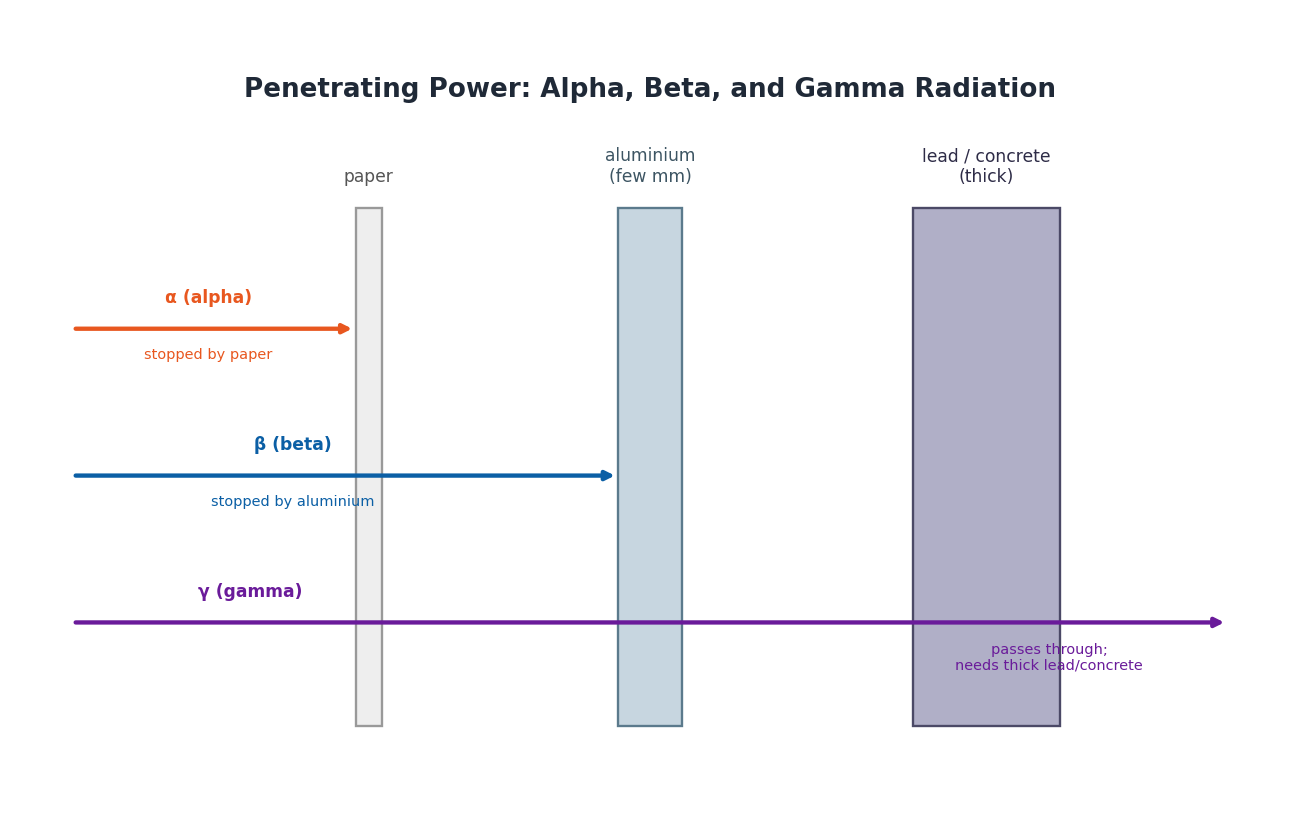
Alpha particles (α) are helium nuclei (2 protons + 2 neutrons), carrying a +2e charge and a mass of about 4 atomic mass units; they have low penetration power (stopped by paper or a few cm of air) but high ionizing power. Beta particles (β) are high-energy electrons (⁰₋₁e) or positrons (⁰₊₁e) with very small mass and -1e or +1e charge; they have moderate penetration power (stopped by a few mm of aluminium) and moderate ionizing power. Gamma radiation (γ) consists of high-energy electromagnetic waves (photons), massless and neutral, emitted from nuclear de-excitation; gamma rays have very high penetration power (requiring thick lead or concrete to stop) but low ionizing power. In electric and magnetic fields, alpha and beta particles are deflected (beta more strongly, due to lower mass), while gamma rays, having no charge, are not deflected at all.
20.5 Radioactive Decay Equations
Radioactive decay transforms a parent isotope into a daughter isotope through the emission of radiation. In alpha decay, an unstable nucleus emits an alpha particle (⁴₂He), reducing its atomic number by 2 and mass number by 4: ᴬZX → ᴬ⁻⁴Z₋₂Y + ⁴₂He. Example: ²³⁸₉₂U → ²³⁴₉₀Th + ⁴₂He + Energy (decay of Uranium-238).
In beta decay, a neutron converts into a proton and emits a beta particle (electron), increasing the atomic number by 1 while the mass number stays the same: ᴬZX → ᴬZ₊₁Y + ⁰₋₁β + Energy. Example: ¹⁴₆C → ¹⁴₇N + ⁰₋₁β + Energy (decay of Carbon-14). In gamma decay, an excited nucleus releases excess energy as a gamma ray without changing the number of protons or neutrons: ᴬZX* → ᴬZX + γ. Example: ⁶⁰₂₇Co* → ⁶⁰₂₇Co + γ (decay of Cobalt-60).
20.6 Nuclear Reactions: Fission and Fusion
Nuclear reactions involve changes in the atomic nucleus (unlike chemical reactions, which involve only electrons). In fission, first discovered in 1939 by Otto Hahn and Fritz Strassmann, a heavy nucleus (like Uranium-235) absorbs a slow-moving neutron and splits into two smaller nuclei, releasing extra neutrons (typically 2–3, averaging 2.5) and a large amount of energy: ¹₀n + ²³⁵₉₂U → ²³⁶₉₂U* → ¹⁴¹₅₆Ba + ⁹²₃₆Kr + 3¹₀n + Energy. The released neutrons can trigger further fissions, creating a chain reaction — uncontrolled, this causes an explosive release of energy (atomic weapons); controlled (by absorbing excess neutrons), it safely generates power in nuclear reactors. Each fission event releases about 200 MeV — far more than any chemical reaction (fission of 1 kg of U-235 produces about 6.7×10¹³ J, versus 3.6×10⁹ J from burning 1 ton of coal).
In fusion, two or more light nuclei (such as hydrogen isotopes) combine at extremely high temperatures to form a heavier nucleus, releasing a huge amount of energy as some mass converts to energy. Example: deuterium and tritium fuse to form helium and release a neutron: ²₁H + ³₁H → ⁴₂He + ¹₀n + Energy. The Sun and stars shine because of fusion: four hydrogen nuclei fuse into one helium nucleus, releasing about 25.7 MeV of energy, at the Sun's core temperature of nearly 20 million kelvin.
20.7 Interconversion of Matter and Energy
Matter and energy can convert into each other, as described by Einstein's equation E = mc², where E is energy, m is mass, and c is the speed of light (3×10⁸ m s⁻¹); a small amount of mass converts into an enormous amount of energy, as seen in fission and fusion. Energy can also convert into matter under extreme conditions, such as in particle accelerators, where high-energy photons create particle-antiparticle pairs (pair production) — the total energy, including mass-energy, remains constant, consistent with the law of conservation of energy.
In nuclear reactions, the total mass of the products is slightly less than the mass of the reactants; this missing mass is the mass defect (Δm), and the energy released is found using E = Δm × c², or in nuclear-scale units, E = Δm × 931.5 MeV/u, where 1 u (unified/uniform atomic mass unit) ≈ 1.66605×10⁻²⁷ kg (defined as 1/12 the mass of a carbon-12 atom). Worked Example (fission of U-235): mass defect Δm = 236.0526 – 235.8667 = 0.1859 u, so E = 0.1859 × 931.5 = 173.2 MeV.
20.8 Half-Life and Carbon Dating
The activity of a radioactive material is the rate at which its atoms decay, measured in becquerels (Bq, where 1 Bq = 1 disintegration per second) or curies (Ci, where 1 Ci = 3.7×10¹⁰ dps). The half-life of a radioactive isotope is the time taken for half of the radioactive atoms in a sample to decay into a more stable form; each isotope has a fixed, unique half-life regardless of sample size or conditions (e.g., carbon-14: 5,730 years; uranium-238: 4.5 billion years). After each half-life, the remaining quantity halves: N = (1/2)ⁿN₀, where n = Δt/T½ is the number of half-lives elapsed. Worked Example: a 50 mg sample of lead-212 (half-life 10.6 h) after 53 h has undergone n = 53/10.6 = 5 half-lives, leaving N = (1/2)⁵ × 50 = 1.56 mg.
Carbon dating determines the age of ancient organic materials (up to ~50,000 years old) using the radioactive decay of carbon-14. Living organisms constantly absorb carbon-14, maintaining a steady ratio with carbon-12; once an organism dies, it stops absorbing carbon, and its carbon-14 decays at a fixed rate (half-life ≈ 5,730 years). By measuring the remaining carbon-14 in a sample and comparing it to the original amount, scientists estimate how long ago the organism died — an essential tool in archaeology, geology, and anthropology.
20.9 Effects and Uses of Nuclear Radiation
Ionizing radiation (alpha, beta, gamma) can damage living cells by altering DNA and other molecules; effects depend on dose, exposure time, and radiation type. High doses can kill cells (useful in radiotherapy to destroy cancer cells); radiation can cause DNA mutations leading to genetic disorders if reproductive cells are affected; long-term low-dose exposure increases cancer risk (e.g., excessive UV exposure causing skin cancer); and severe short-term exposure can cause radiation sickness (nausea, vomiting, organ failure, potentially death).
The choice of radioactive isotope for a given use depends on its radiation type and half-life: short-lived isotopes (e.g., Iodine-131, 8 days) are used in medical imaging and treatment to minimize long-term exposure; long-lived isotopes are used where long-term stability matters, such as Americium-241 (432-year half-life) in smoke detectors, where alpha particles ionize air to create a current that smoke disrupts, triggering the alarm. Cobalt-60 and Caesium-137 gamma rays kill bacteria in food (extending shelf life) and sterilize medical equipment; gamma rays from Cobalt-60 are also used in cancer radiotherapy, and thickness gauges use appropriate radiation types to measure and control material thickness during manufacturing.
Important Definitions
Define the atomic nucleus.
The small, dense, positively charged core of an atom, made of protons and neutrons (nucleons), held together by the strong nuclear force, and containing nearly all of the atom's mass.
What is an isotope?
An atom of an element having the same number of protons (same Z) but a different number of neutrons compared to other atoms of that element, giving it a different mass number A.
Define radioactivity.
The spontaneous and random process by which unstable atomic nuclei release energy in the form of radiation (alpha, beta, or gamma) in order to become more stable.
What is an alpha particle?
A helium nucleus (2 protons + 2 neutrons), carrying a +2e charge, with high ionizing power and low penetrating power (stopped by paper or a few cm of air).
What is a beta particle?
A high-energy electron or positron emitted from a nucleus during beta decay, with moderate ionizing power and moderate penetrating power (stopped by a few mm of aluminium).
Define gamma radiation.
High-energy, massless, uncharged electromagnetic radiation (photons) emitted from a nucleus during de-excitation, with low ionizing power but very high penetrating power (requiring thick lead or concrete to stop).
Define the half-life of a radioactive isotope.
The time taken for half of the radioactive atoms in a sample to decay into a more stable form; it is fixed and unique for each isotope, unaffected by sample size or external conditions.
What is nuclear fusion?
A nuclear reaction in which two or more light nuclei combine at extremely high temperatures to form a heavier nucleus, releasing a large amount of energy as some mass converts to energy (the energy source of stars).
Key Formulas
| Topic | Formula |
|---|---|
| Number of neutrons in a nucleus | N = A − Z |
| Alpha decay | ᴬZX → ᴬ⁻⁴Z₋₂Y + ⁴₂He + Energy |
| Beta decay | ᴬZX → ᴬZ₊₁Y + ⁰₋₁β + Energy |
| Gamma decay | ᴬZX* → ᴬZX + γ |
| Mass-energy equivalence (Einstein's equation) | E = mc² (c = 3 × 10⁸ m s⁻¹) |
| Energy from mass defect (nuclear units) | E = Δm × 931.5 MeV/u |
| Number of half-lives elapsed | n = Δt / T½ |
| Remaining quantity after n half-lives | N = (1/2)ⁿ × N₀ |
Diagrams
Rutherford's Alpha-Particle Scattering Experiment: A beam of alpha particles striking a thin gold foil: most pass straight through, some are slightly deflected, and a few bounce back at large angles from the small, dense, positively charged nucleus
Penetrating Power of Alpha, Beta, and Gamma Radiation: Comparison of how far alpha particles, beta particles, and gamma rays penetrate through paper, aluminium, and thick lead/concrete
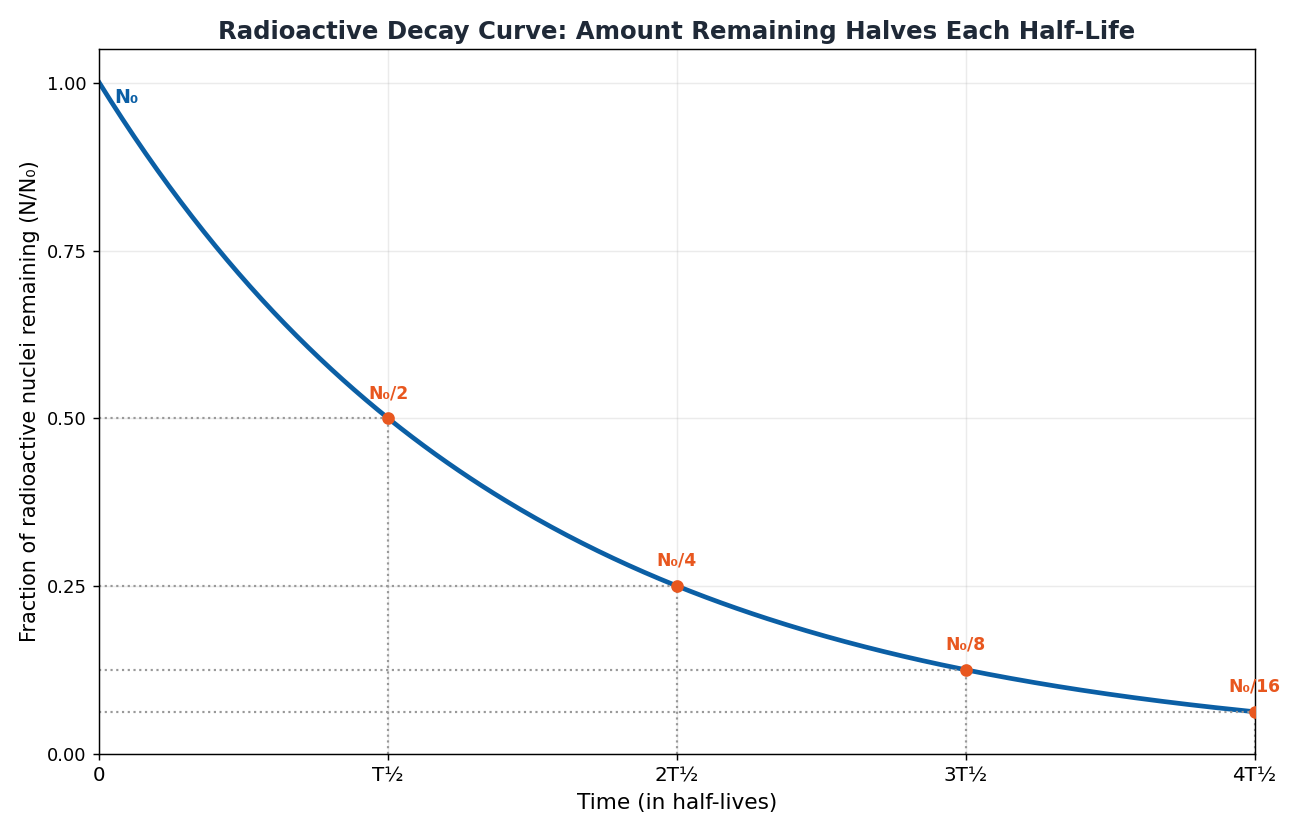
Radioactive Decay Curve and Half-Life: An exponential decay curve showing the remaining quantity N of a radioactive isotope falling by half after each successive half-life (T½, 2T½, 3T½, …)
Short Questions & Answers
Define the atomic nucleus. What are its two main characteristics?
The atomic nucleus is the small, dense, positively charged core of an atom, made of protons and neutrons. Its two main characteristics are: it contains almost all of the atom's mass, and it is extremely small compared to the size of the whole atom.
What is the structure of an atom according to Rutherford's model?
According to Rutherford's model, an atom has a tiny, dense, positively charged nucleus at its centre, containing most of the atom's mass, surrounded by electrons orbiting at relatively large distances, with the atom being mostly empty space.
How does alpha radiation differ from beta radiation?
Alpha particles are heavy helium nuclei (+2e charge) with high ionizing power but low penetrating power (stopped by paper); beta particles are much lighter electrons/positrons (-1e/+1e charge) with moderate ionizing power and moderate penetrating power (stopped by a few mm of aluminium).
What is the primary energy source of the Sun and other stars?
Nuclear fusion — specifically, the fusion of four hydrogen nuclei into one helium nucleus at extremely high core temperatures, releasing about 25.7 MeV of energy per reaction.
Name the equation proposed by Einstein that relates energy and mass.
E = mc², where E is energy, m is mass, and c is the speed of light (3×10⁸ m/s) — it shows that mass and energy are interconvertible.
What is the principle behind carbon dating and its applications?
Carbon dating relies on the fixed, known half-life of carbon-14 (5,730 years); by measuring the remaining carbon-14 in a once-living sample and comparing it to the original ratio, scientists estimate how long ago the organism died, used in archaeology, geology, and anthropology.
Define nuclear fusion with an example.
Nuclear fusion is the combining of two or more light nuclei at extremely high temperatures to form a heavier nucleus, releasing energy; for example, deuterium and tritium fuse to form helium and a neutron: ²₁H + ³₁H → ⁴₂He + ¹₀n + Energy.
Americium-241 undergoes alpha decay. Write the equation and name the nucleus formed.
²⁴¹₉₅Am → ²³⁷₉₃Np + ⁴₂He + Energy — the nucleus formed is Neptunium-237 (Np).
Long Questions & Answers
Describe Rutherford's alpha-particle scattering experiment and explain how its results provided evidence for the structure of the atom.
In the early 20th century, Ernest Rutherford, working with Hans Geiger and Ernest Marsden, conducted a landmark experiment in 1911 to investigate the internal structure of the atom, using the recently discovered alpha particles — positively charged particles similar in mass to a helium atom, emitted at high velocity by radioactive substances. The experimental setup directed a focused beam of these alpha particles at an extremely thin sheet of gold foil, with a fluorescent screen surrounding the foil to detect and record the angle at which each alpha particle was scattered after passing through or near the atoms of gold. Based on the then-prevailing 'plum pudding' model of the atom, in which positive charge was thought to be spread out relatively uniformly throughout the atom's volume (with electrons embedded within it like plums in a pudding), scientists expected the alpha particles to pass through the thin foil with only minor, gradual deflections, since no concentrated region of charge should exist to produce strong scattering. The actual experimental results, however, were strikingly different from this prediction: the overwhelming majority of alpha particles passed straight through the gold foil with little or no deflection at all, exactly as would be expected if atoms consist mostly of empty space; a smaller number of particles were deflected through moderate angles, suggesting they had passed relatively close to a concentrated region of positive charge; and, most strikingly, a very small number of particles — roughly 1 in 8000 — were deflected through very large angles, with some even bouncing almost straight back toward the source, a result Rutherford famously described as being as surprising as firing a shell at a piece of tissue paper and having it bounce back. From these combined observations, Rutherford correctly reasoned that the vast majority of an atom's volume must indeed be empty space (explaining why most particles passed straight through undeflected), but that all of the atom's positive charge, along with almost all of its mass, must be concentrated into an extremely small, dense central region — which he named the nucleus — since only a concentrated point charge of sufficient magnitude could exert a strong enough electrostatic repulsive force to deflect a small number of positively charged alpha particles through such large angles or send them back the way they came. Based on the tiny fraction of particles undergoing large-angle scattering, Rutherford was further able to estimate that this nucleus must be roughly 10,000 times smaller in diameter than the atom as a whole, establishing the now-familiar picture of the atom as a mostly empty structure with a tiny, dense, positively charged nucleus at its centre, surrounded by orbiting electrons occupying a comparatively vast surrounding volume.
Compare alpha particles, beta particles, and gamma radiation in terms of their composition, charge, mass, ionizing power, penetrating power, and deflection in electric and magnetic fields.
Alpha particles, beta particles, and gamma radiation are the three principal forms of radiation emitted during radioactive decay, and while they all originate from unstable nuclei seeking greater stability, they differ dramatically in their physical nature and behaviour. Alpha particles consist of two protons and two neutrons bound together — effectively identical to the nucleus of a helium atom — giving them a relatively large mass of about 4 atomic mass units and a substantial positive charge of +2e; because of this large mass and charge, alpha particles interact very strongly with the electrons of atoms they pass close to, making them the strongest ionizers of the three radiation types (capable of stripping electrons from many atoms along a very short path), but this same strong interaction also means they rapidly lose their kinetic energy and come to rest after traveling only a very short distance, giving them the lowest penetrating power of the three — a single sheet of paper, or a few centimetres of air, is generally sufficient to stop them entirely; being charged and relatively massive, alpha particles are deflected by both electric and magnetic fields, though only slightly, owing to their comparatively large mass and momentum, which makes them harder to deflect than the far lighter beta particles. Beta particles, by contrast, are high-energy electrons (or, less commonly, positrons) ejected directly from the nucleus during beta decay, carrying a much smaller mass (roughly 1/7000th that of an alpha particle) and a single unit of charge (-1e for electrons, +1e for positrons); their smaller size and charge give them a moderate ionizing power — noticeably weaker than alpha particles, since they interact less strongly and less frequently with surrounding atoms along their path, but still capable of causing meaningful ionization — while their smaller mass also allows them to travel considerably further before losing all their energy, giving beta particles moderate penetrating power: they easily pass through paper but are generally stopped by a few millimetres of aluminium; being charged, beta particles are also deflected by electric and magnetic fields, and quite significantly so, since their small mass makes them much easier to divert from a straight path than the far heavier alpha particles. Gamma radiation is fundamentally different in nature from the other two: rather than being a stream of material particles, it consists of high-energy electromagnetic waves (equivalently, packets of energy called photons), which are entirely massless and carry no electric charge whatsoever, being emitted when an excited nucleus releases surplus internal energy without changing its proton or neutron count; having no charge, gamma radiation experiences no ionizing power comparable to alpha or beta radiation, interacting only weakly and occasionally with the atoms it passes, making it the weakest ionizer of the three — but this same lack of charge and near-total lack of interaction with matter is precisely what gives gamma radiation its extremely high penetrating power, since with essentially nothing to strongly absorb or deflect it, gamma radiation can pass readily through paper, human tissue, aluminium, and even several centimetres of dense lead or thick concrete before being significantly attenuated; and, having no electric charge at all, gamma radiation experiences no force in either an electric field or a magnetic field, and therefore travels through both completely undeflected, unlike its charged alpha and beta counterparts.
Describe the process of nuclear fission and nuclear fusion, giving one example equation of each, and explain how Einstein's equation E = mc² relates to the energy released in these reactions.
Nuclear fission and nuclear fusion are the two fundamental types of nuclear reactions capable of releasing enormous quantities of energy from the atomic nucleus, though they achieve this release through essentially opposite processes. Nuclear fission, first observed experimentally in 1939 by Otto Hahn and Fritz Strassmann, involves a heavy, unstable nucleus — most commonly Uranium-235 — capturing a slow-moving (thermal) neutron, which causes the resulting compound nucleus to become highly unstable and split apart into two smaller, roughly comparable daughter nuclei, releasing additional free neutrons (typically two or three, averaging about 2.5 per fission event) along with a very large amount of energy in the process; a representative fission equation is ¹₀n + ²³⁵₉₂U → ²³⁶₉₂U* → ¹⁴¹₅₆Ba + ⁹²₃₆Kr + 3¹₀n + Energy, in which barium and krypton nuclei, along with three additional neutrons, are produced from the fission of uranium-235. A particularly important feature of fission is that the neutrons released by one fission event can go on to strike and split further uranium nuclei, creating a self-sustaining chain reaction — if this chain reaction proceeds uncontrolled, the very rapid release of energy from repeated fission events produces an explosive release of energy, as in an atomic weapon; but if the chain reaction is instead carefully controlled and moderated (as by inserting control rods that absorb excess neutrons in a nuclear reactor), the energy release can instead be regulated and harnessed steadily over time to generate electrical power. Nuclear fusion operates via the essentially opposite process: rather than a single heavy nucleus splitting apart, two (or more) very light nuclei — typically isotopes of hydrogen — are forced together at extraordinarily high temperatures and pressures (such as those found deep within the core of a star) to overcome their mutual electrostatic repulsion and combine into a single, somewhat heavier nucleus, again releasing a very large amount of energy in the process; a representative fusion equation is ²₁H + ³₁H → ⁴₂He + ¹₀n + Energy, in which deuterium and tritium (two heavier isotopes of hydrogen) combine to form a helium nucleus and a free neutron. Fusion reactions of this general type, on a much larger and more sustained scale, are what power the Sun and all other stars: within the Sun's core, at temperatures of nearly 20 million kelvin, four hydrogen nuclei ultimately fuse together (through a multi-step process) into a single helium nucleus, releasing approximately 25.7 MeV of energy for each such fusion sequence, and it is this continuous release of fusion energy, radiating outward, that makes stars shine. In both fission and fusion, the fundamental source of the released energy is explained by Einstein's mass-energy equivalence relation, E = mc², which states that mass and energy are, in a deep physical sense, interchangeable forms of the same underlying quantity, with any given quantity of mass m corresponding to an equivalent amount of energy E, related by the (very large) square of the speed of light, c². In both fission and fusion reactions, careful measurement reveals that the total mass of the products formed is always very slightly less than the total mass of the original reactant particles that combined or split to form them; this small 'missing' quantity of mass is known as the mass defect (Δm), and rather than truly disappearing, it has been directly converted into an equivalent amount of energy according to E = mc² (or, in the convenient units commonly used at the nuclear scale, E = Δm × 931.5 MeV per atomic mass unit of mass defect) — this converted energy is precisely the large amount of energy released as heat, radiation, and the kinetic energy of the reaction's products, in both the fission of heavy nuclei and the fusion of light ones.
Explain what is meant by the half-life of a radioactive isotope, and describe how carbon dating uses this concept to estimate the age of ancient organic materials.
The half-life of a radioactive isotope is defined as the time required for exactly half of the radioactive atoms present in any given sample of that isotope to undergo radioactive decay and transform into a more stable form; critically, this half-life value is a fixed, characteristic property of each specific isotope, remaining completely constant regardless of how much of the substance is present, what physical or chemical form it is in, or what external environmental conditions (such as temperature or pressure) it is subjected to — a sample of carbon-14, for instance, always has a half-life of approximately 5,730 years, whether the sample is large or small, hot or cold, or chemically combined with other elements. Because radioactive decay is a random process at the level of any individual atom (it is impossible to predict exactly when any single specific atom will decay), but follows highly predictable statistical patterns when applied to the very large numbers of atoms present in any macroscopic sample, the quantity of a radioactive substance remaining decreases in a very regular, predictable mathematical pattern over time, known as exponential decay: starting from an initial quantity N₀ present at time t = 0, after one half-life has elapsed, exactly half of the original quantity remains (N₁ = N₀/2); after a second half-life, half of that remaining amount again decays, leaving only one quarter of the original quantity (N₂ = N₀/4); and this halving process continues indefinitely with each successive half-life, following the general formula N = (1/2)ⁿN₀, where n represents the total number of half-lives that have elapsed, calculated as n = Δt/T½ (total elapsed time divided by the isotope's half-life). Carbon dating is a widely used scientific technique that exploits this predictable half-life behaviour, applied specifically to the radioactive isotope carbon-14, to estimate the age of ancient organic materials such as wood, bone, shell, and other remains of once-living organisms, typically up to around 50,000 years old. The technique relies on the fact that carbon-14 is continuously produced in the upper atmosphere (through the interaction of cosmic rays with nitrogen atoms) and is then absorbed by all living organisms throughout their lives — through photosynthesis in plants, and through the food chain in animals — such that, while an organism is alive, the ratio of radioactive carbon-14 to stable carbon-12 within its body remains essentially constant, continuously replenished to match the steady-state ratio found in the atmosphere. However, the moment an organism dies, it permanently stops absorbing any new carbon from its environment, and from that precise moment onward, the carbon-14 already present within its remains begins to steadily decay away at its fixed, known half-life rate of approximately 5,730 years, with no new carbon-14 being added to replace what is lost, causing the ratio of carbon-14 to carbon-12 within the remains to steadily and predictably decrease over time following the standard exponential decay formula. By carefully measuring the current amount of carbon-14 remaining within an ancient sample (typically using sensitive radiation-counting equipment) and comparing this to the known, standard carbon-14-to-carbon-12 ratio found in living organisms today, scientists can work backward through the exponential decay equation to calculate precisely how many half-lives — and therefore how many years — must have elapsed since the organism in question died, providing an accurate and scientifically well-established method for determining the age of archaeological, geological, and anthropological samples, and thereby providing crucial insights into human history, past environmental conditions, and the timeline of the ancient world.
Multiple Choice Questions (MCQs)
What did Rutherford's alpha particle scattering experiment reveal about the structure of the atom? (A) Electrons are distributed evenly throughout the atom (B) Protons and electrons are located in the nucleus (C) Atoms are indivisible and indestructible (D) The nucleus is small, dense, and positively charged
Correct answer: (D) The nucleus is small, dense, and positively charged. Rutherford's experiment showed that atoms have a small, dense, positively charged nucleus, with the rest of the atom being mostly empty space.
The atomic number of an element represents: (A) number of neutrons in the nucleus (B) number of protons in the nucleus (C) total number of protons and neutrons (D) number of electrons and neutrons
Correct answer: (B) number of protons in the nucleus. The atomic number (charge number Z) represents the number of protons in an atom's nucleus, unique to each element.
Which type of radiation is positively charged and consists of two protons and two neutrons? (A) Alpha (α) (B) Beta (β) (C) Gamma (γ) (D) Neutron emission
Correct answer: (A) Alpha (α). An alpha particle is a helium nucleus, consisting of 2 protons and 2 neutrons, carrying a +2e charge.
The process by which an unstable nucleus emits radiation and transforms into a more stable nucleus is called: (A) nuclear fusion (B) nuclear fission (C) radioactive decay (D) isotopic exchange
Correct answer: (C) radioactive decay. Radioactive decay is the spontaneous process where an unstable nucleus emits radiation to become a more stable nucleus.
Nuclear fission involves: (A) combining light nuclei to form heavier ones (B) splitting heavy atomic nuclei into smaller ones (C) absorbing gamma radiation to increase stability (D) none of the above
Correct answer: (B) splitting heavy atomic nuclei into smaller ones. Nuclear fission is the splitting of a heavy nucleus (like Uranium-235) into two smaller nuclei, releasing energy and extra neutrons.
What does Einstein's equation E = mc² explain? (A) The energy released in chemical reactions (B) The equivalence of mass and energy (C) The rate of radioactive decay (D) The conversion of mass into momentum
Correct answer: (B) The equivalence of mass and energy. E = mc² expresses the equivalence of mass and energy, showing that mass can be converted into energy and vice versa.
Which of the following is a practical application of nuclear radiation? (A) Cooking food in microwave ovens (B) Medical imaging and cancer treatments (C) Solar energy generation (D) Airplane navigation systems
Correct answer: (B) Medical imaging and cancer treatments. Nuclear radiation (such as gamma rays from Cobalt-60 or Iodine-131) is widely used in medical imaging and cancer radiotherapy.
What are the potential effects of ionizing nuclear radiation on biological tissues? (A) Increased cellular regeneration (B) DNA damage and cancer (C) Enhanced immune system response (D) Improved metabolic activity
Correct answer: (B) DNA damage and cancer. Ionizing radiation can damage DNA, potentially causing mutations, cancer, and other harmful biological effects.
The half-life of a radioactive isotope is defined as: (A) the total time for all atoms in a sample to decay (B) the time for half the radioactive atoms in a sample to decay (C) the time for a sample to double in mass (D) the time for radiation to stop completely
Correct answer: (B) the time for half the radioactive atoms in a sample to decay. Half-life is the time taken for exactly half of the radioactive atoms in a sample to decay into a more stable form.
Carbon dating is used to estimate the age of materials up to approximately: (A) 500 years (B) 5,000 years (C) 50,000 years (D) 5 million years
Correct answer: (C) 50,000 years. Carbon dating, based on carbon-14's 5,730-year half-life, is effective for dating organic materials up to about 50,000 years old.
Quick Revision Summary
- Rutherford's experiment: most alpha particles pass through (empty space), few deflect/bounce back (small, dense, positive nucleus)
- N = A − Z (neutrons = mass number − atomic number); nuclide notation ᴬZX
- Isotopes: same Z (protons), different N (neutrons) and A; same chemical properties, different physical/nuclear properties
- Alpha (α): +2e, heavy, high ionizing, LOW penetration (paper); Beta (β): ±1e, light, moderate ionizing/penetration (aluminium); Gamma (γ): 0 charge, massless, low ionizing, HIGH penetration (lead/concrete)
- Alpha decay: A↓4, Z↓2; Beta decay: A same, Z↑1; Gamma decay: A, Z unchanged (energy only)
- Fission: heavy nucleus + neutron → 2 smaller nuclei + neutrons + energy (chain reaction, ~200 MeV/event)
- Fusion: light nuclei → heavier nucleus + energy (powers stars; needs extreme temperature, e.g. Sun's core ~20 million K)
- E = mc² (mass-energy equivalence); E = Δm × 931.5 MeV/u (nuclear-scale energy from mass defect)
- Half-life: n = Δt/T½; N = (1/2)ⁿN₀ — fixed for each isotope regardless of amount or conditions
- Carbon dating: C-14 half-life ≈ 5,730 years; compares remaining C-14 to living-organism ratio to estimate age
- Uses: short half-life isotopes → medical (minimize exposure); long half-life isotopes → industrial/power (long-term stability)
Exam Tips
- Memorize the ionizing/penetrating trend: alpha = high ionizing/low penetration; gamma = low ionizing/high penetration — beta is always the 'moderate' middle case
- For decay equations, always check that both mass number (top) and charge number (bottom) balance on both sides of the equation
- For half-life numericals, always find n = Δt/T½ FIRST, then substitute into N = (1/2)ⁿN₀ — do not skip straight to the answer
- Remember alpha decay reduces A by 4 and Z by 2; beta decay keeps A the same but increases Z by 1; gamma decay changes neither A nor Z
- For E=mc² and mass-defect problems, always find Δm = (mass of reactants) − (mass of products) BEFORE calculating energy
- For carbon dating problems, recognize that the fraction remaining (25%, 12.5%, etc.) directly tells you the number of half-lives elapsed (25% = 2 half-lives, 12.5% = 3 half-lives, etc.)