Heat is an essential form of energy that plays a role in cooking, maintaining body temperature, and driving countless industrial processes. Whenever two objects at different temperatures come into contact, thermal energy flows from the hotter object to the cooler one until thermal equilibrium is reached. This chapter explores the three fundamental methods by which this thermal energy travels: conduction, convection, and radiation.
Understanding these three heat transfer mechanisms explains everyday phenomena such as why metal spoons heat up faster than wooden ones, why sea breezes blow during the day, how a thermos flask keeps drinks warm, and how the greenhouse effect regulates Earth's temperature and connects to global warming.
Learning Objectives
- Explain thermal conduction in solids in terms of lattice vibrations and the movement of free electrons in metals
- Analyze everyday applications of conduction, convection, and radiation
- Explain convection in liquids and gases in terms of density changes, and describe experiments illustrating convection
- Explain the role of convection in seawater in supporting marine life
- Describe how land and sea breezes maintain moderate coastal climates
- Explain how birds and gliders stay aloft for hours using thermal currents
- Describe radiation as heat transfer via electromagnetic waves that does not require a medium
- Describe the effect of surface colour and texture on emission, absorption, and reflection of infrared radiation
- Explain qualitatively how the rate of radiation emission depends on surface temperature and surface area
- Analyze the consequences of heat radiation in the greenhouse effect and its link to global warming
Key Concepts
11.1 Conduction
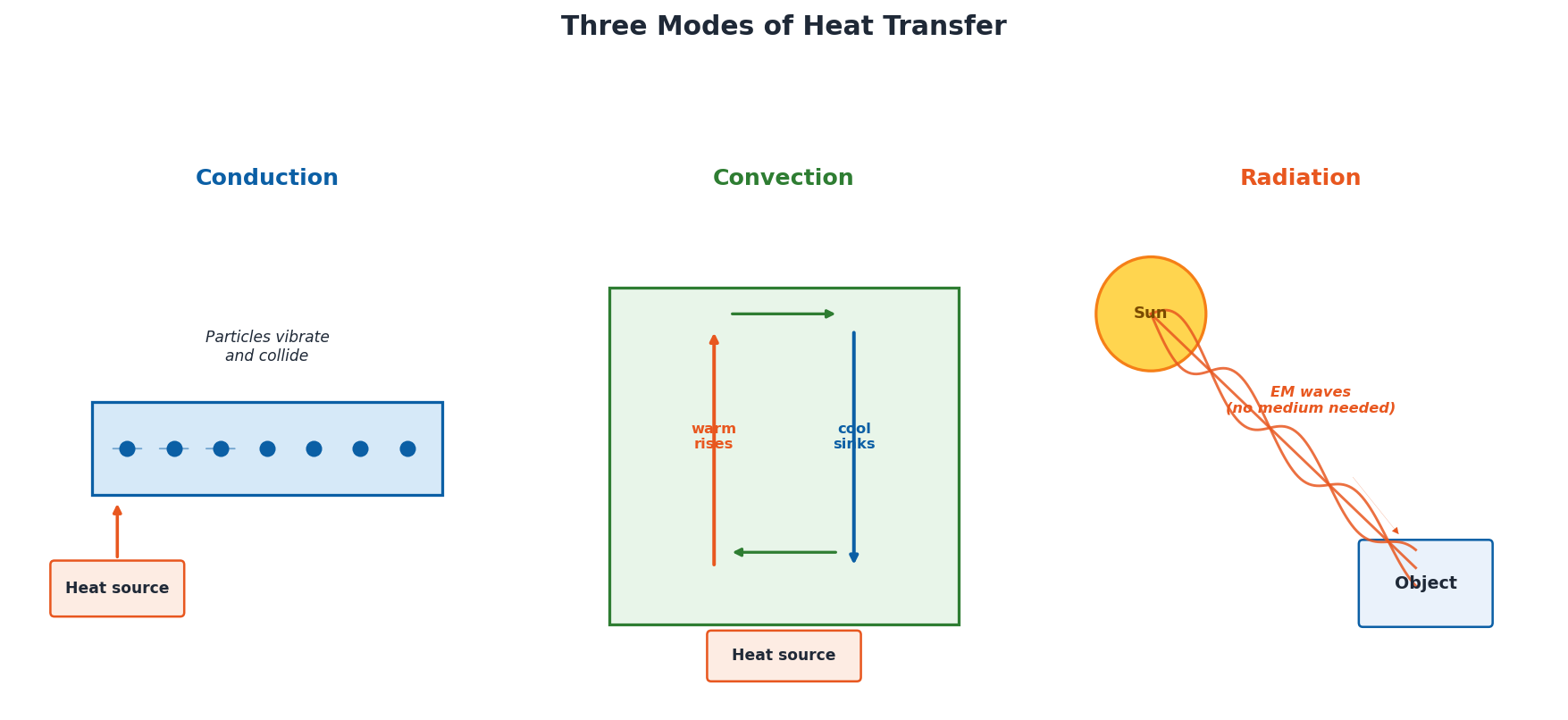
Conduction is the process by which heat is transferred through direct contact between particles in a material, without any actual movement of the material itself. It happens when fast-moving (hotter) particles collide with slow-moving (cooler) particles, transferring their kinetic energy. Conduction is most efficient in solids, especially metals, because their particles are densely packed and freely moving electrons help transfer energy quickly.
In solids, atoms and molecules are tightly packed and constantly vibrate about their mean positions. When one end of a solid is heated, particles there vibrate more vigorously, colliding with and transferring energy to neighbouring particles, which in turn pass energy further along — heat gradually spreads through the solid, though this transfer is generally slow. Metals conduct heat far better than non-metals because they contain free (delocalized) electrons that move quickly through the material, carrying energy from hot regions to cooler regions much faster than lattice vibrations alone could.
11.2 Convection in Liquids and Gases
Liquids and gases are poor conductors of heat, but heat can still travel through them by convection — the transfer of heat through the actual movement of molecules from a hot area to a cold area. When a liquid or gas is heated, it becomes less dense and expands, so the heated fluid rises above the heat source while cooler, denser fluid moves in to take its place; this cooler fluid is then heated in turn, setting up a continuous convection current.
This can be demonstrated by heating water in a beaker and dropping in potassium permanganate crystals: coloured streaks rise above the flame and flow back down along the sides, tracing the convection current, and these currents stop once the burner is removed since there is no more heating to sustain the density difference. In gases, the Sun heats the Earth's surface, warming the air close to the ground; this warm air becomes lighter and rises, cools and becomes denser as it rises, then sinks back down — this repeating cycle creates the convection currents responsible for winds, sea breezes, and broader weather patterns.
11.3 Convection in Nature: Land and Sea Breezes, and Gliding
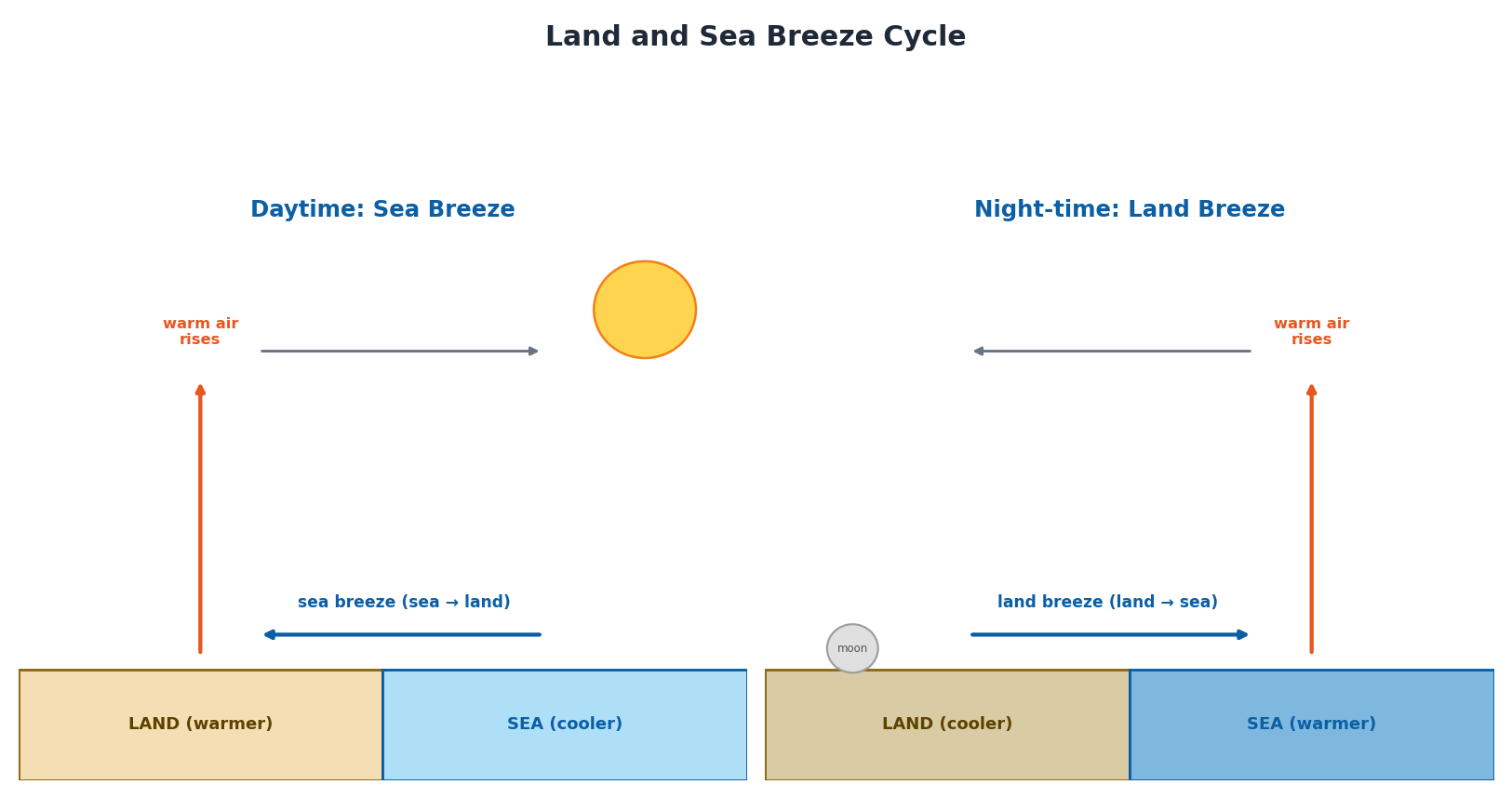
Land and sea breezes are caused by convection resulting from the different specific heat capacities of land and water. During the day, land heats up faster than the sea (since land has a lower specific heat capacity); the warm air above the land rises, and cooler air from the sea moves in to replace it, creating a sea breeze. At night, the land cools down faster than the sea; the air above the now-relatively-warmer sea rises, and cooler air from the land moves out to sea, creating a land breeze.
Gliders — engineless small aircraft — and soaring birds such as eagles, hawks, and vultures make use of thermals, which are rising currents of warm air created by convection. By circling within these rising air currents, gliders and birds can gain altitude and stay aloft for extended periods with little or no need to flap wings or use an engine.
11.4 Convection Applications: Marine Life, Rooms, and Hot-Water Systems
Convection plays a vital role in seawater and supports marine life: sunlight heats the ocean surface, and this warmer, lighter water stays near the top while cooler, denser water sinks, setting up convection currents that continuously mix oxygen from the surface into deeper layers and carry nutrients from the ocean floor upward — without this mixing, deep water would lack oxygen and surface water would lack nutrients, harming marine ecosystems.
Indoors, gas heaters warm the air near them; this warm, less dense air rises toward the ceiling while cooler, denser air sinks to take its place, gradually warming the whole room through a convection current — the same principle, in reverse, applies to air conditioning in summer. In a household hot-water storage system, cold water enters the tank and is heated by an electric element or gas burner; as it heats, it becomes less dense and rises to the top of the tank, while cooler, denser water remains at the bottom, so hot water is always drawn from the top of the tank while a thermostat controls the heating element to maintain a set temperature.
11.5 Heat Transfer through Radiation
The Sun is the main source of heat for Earth, yet this heat does not reach us via conduction or convection, since there is no medium (matter) between the Sun and Earth's atmosphere for particles to collide through. Instead, heat travels as radiation — energy transferred across space in the form of electromagnetic waves, which requires no medium at all. This same principle explains why a fireplace can warm a person across a room even though the air in between is a poor conductor of heat.
All objects in a room continuously radiate heat while also absorbing heat radiated by their surroundings. If an object's temperature is higher than its surroundings, it radiates more heat than it absorbs and so cools down over time; if its temperature is lower than its surroundings, it absorbs more heat than it radiates and so warms up — in both cases, the object's temperature moves toward equilibrium with its surroundings.
11.6 Surface Properties and Radiation
Leslie's cube is a metal box with faces made of different materials — a shiny silver surface, a dull black surface, a white surface, and a coloured surface — used to compare how different surfaces emit and absorb radiation. When the cube is filled with hot water, the dull black surface is found to be the most effective emitter of heat radiation; the dull black surface is also the fastest absorber of heat, while a polished silver surface absorbs (and emits) heat much more slowly.
The colour and texture of a surface strongly affect how it interacts with infrared radiation: dull, dark-coloured, and rough surfaces are excellent absorbers and emitters of infrared radiation, while shiny, light-coloured, and smooth surfaces are poor absorbers and emitters, instead reflecting most radiation away — this is why polished metals stay cooler in sunlight than dark surfaces, and why solar panels are made black to maximize absorption.
11.7 Factors Affecting Radiation, and Applications of Heat Transfer
The rate at which an object emits radiation depends on two key factors: surface temperature and surface area. A hotter object radiates more energy than a cooler one at the same surface area, and an object with a larger surface area can emit or absorb heat faster than one with a smaller area at the same temperature — this is why heating radiators are built with many thin fins, maximizing surface area within a compact space to transfer heat more efficiently.
Heat transfer principles have many everyday applications. An infrared thermometer measures an object's temperature without contact by detecting the infrared radiation it emits, useful for checking body temperature, ovens, machinery, or hazardous materials. Cooking with kitchen pans relies on conduction, as the metal pan quickly absorbs and spreads heat from the stove. Thermal insulation, such as in a thermos flask, uses a vacuum between double walls to block conduction and convection, a silvered inner coating to reflect radiation back inward, and insulating outer casing — keeping liquids hot or cold for hours. Similarly, buildings use thick curtains, wall insulation, double-glazed windows, and false ceilings to reduce unwanted heat transfer by all three methods, lowering heating and cooling costs.
11.8 The Greenhouse Effect
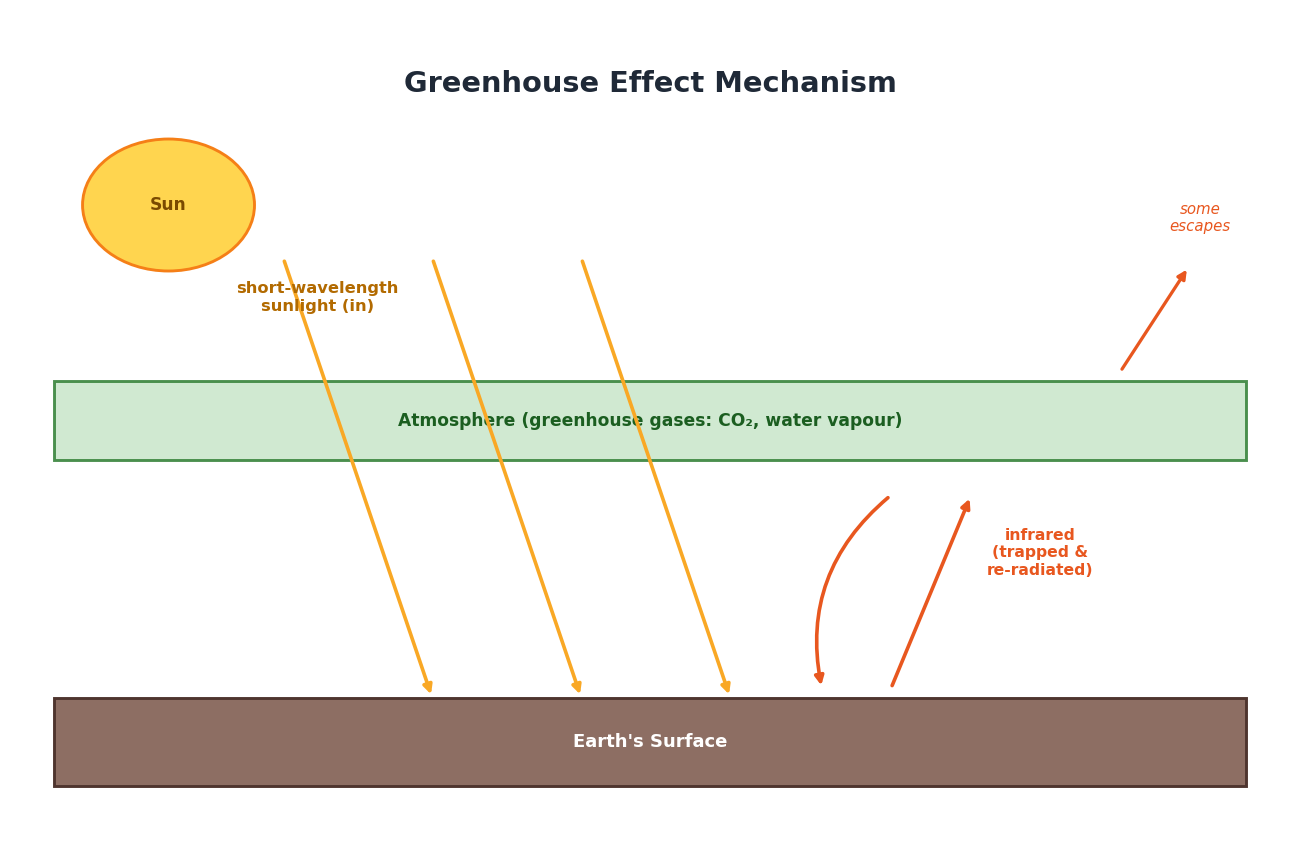
The greenhouse effect is the process by which Earth's atmosphere traps some of the Sun's heat, maintaining a temperature suitable for life; without it, the planet would be far too cold to support life as we know it. Inside a physical greenhouse, transparent glass or plastic lets in short-wavelength sunlight, which warms objects inside; these objects then re-emit the absorbed energy as longer-wavelength infrared radiation, which the glass or plastic blocks from escaping, trapping heat inside and keeping the greenhouse warm.
Earth's atmosphere works similarly, with gases such as carbon dioxide and water vapour trapping heat much like a greenhouse's glass, keeping the planet warm enough to sustain life. In recent decades, rising atmospheric carbon dioxide from human activities has strengthened this natural greenhouse effect, trapping additional heat and raising Earth's average temperature — a phenomenon known as global warming, which carries significant consequences for global climate patterns.
Important Definitions
What is conduction?
The transfer of heat through direct contact between particles in a material, via particle collisions and (in metals) free electron movement, without any overall movement of the material.
What is convection?
The transfer of heat through the actual movement of molecules from a hot area to a cold area, occurring in liquids and gases as heated fluid rises and cooler fluid sinks to replace it.
What is radiation (heat transfer)?
The transfer of heat energy across space in the form of electromagnetic waves, without requiring any medium.
What is thermal equilibrium?
The state reached when two objects (or an object and its surroundings) reach the same temperature, so that net heat transfer between them stops.
What is Leslie's cube?
A metal cube with faces of different surface materials (shiny, dull black, white, coloured), used to compare the emission and absorption of heat radiation by different surfaces.
What is thermal insulation?
Material or design (such as a vacuum, reflective coating, or insulating casing) used to reduce the transfer of heat by conduction, convection, and/or radiation.
What is the greenhouse effect?
The process by which a planet's atmosphere (or a greenhouse's glass/plastic) traps outgoing long-wavelength infrared radiation, warming the space or planet below.
What is an infrared thermometer used for?
A device that measures an object's temperature without contact by detecting the infrared radiation it emits.
Key Formulas
| Topic | Formula |
|---|---|
| Conduction | Heat transfer via particle collisions and free-electron movement; needs a medium and direct contact |
| Convection | Heat transfer via bulk movement of heated fluid (liquid/gas); needs a fluid medium, no direct contact required |
| Radiation | Heat transfer via electromagnetic waves; needs no medium, works through a vacuum |
| Best conductors | Metals (free electrons); diamond is an exceptional non-metal conductor, 4-5× better than copper |
| Best emitters/absorbers of radiation | Dull, black, rough surfaces |
| Poor emitters/absorbers of radiation | Shiny, light-coloured, smooth surfaces (good reflectors) |
| Rate of radiation emission | Increases with higher surface temperature and larger surface area |
| Greenhouse effect | Short-wavelength sunlight passes in; long-wavelength infrared is trapped, warming the surface below |
Diagrams
Three Modes of Heat Transfer: Side-by-side comparison of conduction (particle collisions in a solid), convection (rising warm fluid and sinking cool fluid), and radiation (electromagnetic waves travelling through empty space)
Land and Sea Breeze Cycle: Daytime sea breeze (warm air rises over land, cool sea air moves in) compared with night-time land breeze (warm air rises over sea, cool land air moves out)
Greenhouse Effect Mechanism: Short-wavelength sunlight passing through the atmosphere, warming Earth's surface, and long-wavelength infrared radiation being trapped by greenhouse gases
Short Questions & Answers
What are the three primary types of heat transfer?
Conduction, convection, and radiation.
Why does heat travel faster in metals compared to non-metals?
Metals contain free (delocalized) electrons that move quickly through the material, carrying energy rapidly from hot to cool regions, in addition to particle-collision conduction.
How does convection transfer heat in liquids and gases?
Heated fluid becomes less dense and rises, while cooler, denser fluid sinks to take its place; this cooler fluid is then heated in turn, setting up a continuous convection current that carries heat through the fluid.
What natural phenomenon causes land and sea breezes?
Convection currents caused by the different specific heat capacities of land and sea, which heat and cool at different rates during the day-night cycle.
How do birds and gliders take advantage of convection currents?
They ride rising columns of warm air called thermals, circling within them to gain altitude and stay aloft for long periods with little or no wing-flapping or engine use.
What is radiation, and how does it transfer heat?
Radiation is the transfer of heat energy through electromagnetic waves; unlike conduction and convection, it requires no medium and can travel through empty space, as it does from the Sun to the Earth.
Why does a dull black surface emit and absorb more radiation than a shiny silver surface?
Dull, dark, rough surfaces are much more effective at both emitting and absorbing infrared radiation than shiny, light-coloured, smooth surfaces, which instead reflect most radiation away.
How does the greenhouse effect help regulate Earth's temperature?
Greenhouse gases in the atmosphere (like carbon dioxide and water vapour) allow short-wavelength sunlight to pass through but trap outgoing long-wavelength infrared radiation, keeping the planet warm enough to support life.
Long Questions & Answers
Explain thermal conduction in solids, and describe why metals conduct heat better than non-metals.
Conduction is the transfer of heat through direct contact between particles, without any overall movement of the material itself. In a solid, atoms and molecules are tightly packed and constantly vibrate around fixed mean positions; when one end of the solid is heated, particles there vibrate more vigorously and collide with neighbouring particles, transferring kinetic energy to them. These neighbouring particles then vibrate more and pass energy to particles further along, so heat gradually spreads through the solid via this chain of collisions — though in most materials this process is relatively slow. Metals conduct heat far more effectively than non-metals because, in addition to this lattice-vibration mechanism, metals contain free (delocalized) electrons that can move freely through the material; these fast-moving electrons carry thermal energy quickly from hot regions to cooler regions, which is why a metal spoon handle in hot water heats up quickly while a wooden spoon handle does not — wood lacks these free electrons and relies only on the much slower particle-vibration mechanism.
Describe how convection occurs in fluids, and explain how it produces land and sea breezes.
Convection is the transfer of heat through the actual bulk movement of molecules within a fluid (liquid or gas), from a hot area to a cold area. When part of a fluid is heated, its molecules move faster and spread further apart, making that region of fluid less dense; this less dense, heated fluid rises, while cooler, denser fluid from the surroundings sinks or flows in to take its place. The newly arrived cooler fluid is then heated in turn, setting up a continuous circulating convection current that keeps transferring heat as long as a temperature difference is maintained. This exact mechanism produces land and sea breezes: during the day, land heats up faster than the sea because land has a much lower specific heat capacity; the warm air above the land becomes less dense and rises, and cooler air from over the sea flows in to replace it, creating a sea breeze blowing from sea to land. At night, the pattern reverses — land loses its heat faster than the sea, so the relatively warmer air above the sea now rises, and cooler air from the land flows out toward the sea, creating a land breeze.
Explain heat transfer by radiation, and describe how surface colour and texture affect the absorption and emission of radiation.
Radiation is the transfer of heat energy through electromagnetic waves, and unlike conduction and convection, it requires no medium at all — it can travel through the vacuum of space, which is how the Sun's heat reaches the Earth. All objects continuously emit and absorb radiation; an object's temperature changes over time depending on the balance between the radiation it emits and the radiation it absorbs from its surroundings, moving toward thermal equilibrium. The colour and texture of a surface strongly influences how effectively it interacts with infrared radiation. Dull, dark-coloured, and rough surfaces are excellent absorbers and emitters of infrared radiation — Leslie's cube experiments confirm that a dull black surface heats up fastest when absorbing radiation and cools down fastest when emitting it. In contrast, shiny, light-coloured, and smooth surfaces are poor absorbers and emitters, instead reflecting most incoming radiation away; this is why polished metal surfaces and light-coloured clothing stay cooler in sunlight than dark, dull-textured ones, and why solar panels are deliberately made black to maximize the radiation they absorb.
Describe the greenhouse effect and explain its connection to global warming.
The greenhouse effect is the natural process by which a planet's atmosphere traps some of the heat radiated by the Sun, keeping the surface warm enough to support life. The Sun emits short-wavelength radiation, including visible light and ultraviolet rays, which passes relatively easily through the atmosphere (or through the glass/plastic of a physical greenhouse) and is absorbed by the surface below. This absorbed energy is then re-emitted by the surface as longer-wavelength infrared radiation; however, greenhouse gases in the atmosphere — such as carbon dioxide and water vapour (or the glass/plastic sheets of a greenhouse) — do not allow this longer-wavelength radiation to escape as easily, so much of it is trapped and re-radiated back toward the surface, creating a net warming effect. This natural greenhouse effect is essential for life, since without it Earth's average temperature would be far too cold. However, human activities over the past century have significantly increased the concentration of carbon dioxide and other greenhouse gases in the atmosphere, strengthening this heat-trapping effect beyond its natural level; the result is that more heat is retained than before, causing Earth's average temperature to rise steadily — a phenomenon known as global warming, which has serious and far-reaching consequences for global climate patterns, sea levels, and ecosystems.
Multiple Choice Questions (MCQs)
Which method of heat transfer requires direct contact between particles? (A) Convection (B) Radiation (C) Conduction (D) Evaporation
Correct answer: (C) Conduction. Conduction transfers heat through direct particle-to-particle contact and collisions within a material.
What causes convection currents in liquids and gases? (A) The continuous movement of particles in all directions (B) The rising of warm regions and sinking of cooler regions (C) The conduction of heat through the medium (D) The reflection of heat waves
Correct answer: (B) The rising of warm regions and sinking of cooler regions. Convection currents arise because heated fluid becomes less dense and rises, while cooler, denser fluid sinks to replace it.
The natural phenomenon caused by convection currents in the atmosphere is: (A) earthquakes (B) land and sea breezes (C) magnetic fields (D) solar eclipses
Correct answer: (B) land and sea breezes. Land and sea breezes result directly from convection currents driven by the different heating/cooling rates of land and sea.
How does heat transfer occur through radiation? (A) Through direct contact between objects (B) Through the movement of heated fluid (C) Through electromagnetic waves without needing a medium (D) Through the absorption of water molecules
Correct answer: (C) Through electromagnetic waves without needing a medium. Radiation transfers heat as electromagnetic waves and, unlike conduction or convection, needs no medium.
The surface which absorbs and emits the most radiation is: (A) smooth and shiny surfaces (B) dark and rough surfaces (C) transparent and thin surfaces (D) polished and white surfaces
Correct answer: (B) dark and rough surfaces. Dull, dark, rough surfaces are the most effective absorbers and emitters of infrared radiation, as shown by Leslie's cube.
What is the role of the greenhouse effect in Earth's temperature regulation? (A) It allows all heat to escape into space (B) It blocks heat from entering the atmosphere (C) It traps heat to maintain a stable temperature (D) It causes immediate cooling of Earth's surface
Correct answer: (C) It traps heat to maintain a stable temperature. The greenhouse effect traps outgoing infrared radiation, keeping Earth's surface at a temperature suitable for life.
The Sun's heat reaches the Earth: (A) through conduction between air particles (B) through convection in space (C) through radiation via electromagnetic waves (D) through reflection by the moon
Correct answer: (C) through radiation via electromagnetic waves. Since there is no medium between the Sun and Earth's atmosphere, heat can only travel by radiation.
A thermos flask reduces heat loss mainly by: (A) increasing conduction (B) using a vacuum to block conduction/convection and a silvered coating to reflect radiation (C) painting the outside black (D) removing the lid
Correct answer: (B) using a vacuum to block conduction/convection and a silvered coating to reflect radiation. The vacuum between the flask's walls blocks conduction and convection, while the silvered inner coating reflects radiation back in.
Diamonds are notable among heat conductors because they: (A) conduct heat poorly, like wood (B) conduct heat better than most metals, including copper (C) only conduct heat when cooled (D) conduct heat only by radiation
Correct answer: (B) conduct heat better than most metals, including copper. A high-quality diamond can conduct heat 4-5 times better than copper, making it an exceptional conductor despite being a non-metal.
Radiators used to heat rooms are often built with many thin fins mainly to: (A) reduce their weight (B) increase surface area and so emit heat faster (C) make them look decorative (D) reduce their surface temperature
Correct answer: (B) increase surface area and so emit heat faster. A larger surface area allows an object to emit (or absorb) radiant heat more quickly at a given temperature.
Quick Revision Summary
- Conduction: heat transfer via particle collisions and (in metals) free-electron movement; needs direct contact and a medium
- Convection: heat transfer via bulk movement of heated fluid; heated fluid rises (less dense), cooler fluid sinks to replace it
- Land breeze (night, air rises over sea) vs sea breeze (day, air rises over land) — caused by land's lower specific heat capacity
- Gliders and birds use rising thermals (convection currents) to stay aloft without flapping/engine power
- Radiation: heat transfer via EM waves, needs no medium — the only way the Sun's heat reaches Earth
- Leslie's cube: dull black surfaces are the best emitters/absorbers; shiny surfaces are the poorest (best reflectors)
- Rate of radiation emission increases with higher surface temperature and larger surface area
- Greenhouse effect: short-wavelength sunlight passes in, long-wavelength IR is trapped by greenhouse gases — essential for life, but excess CO₂ causes global warming
Exam Tips
- Always name all three heat transfer methods together first (conduction, convection, radiation), then specify which applies to the scenario in the question
- Radiation is the only method of heat transfer that works through a vacuum/empty space — a frequently tested distinguishing fact
- Link dull/black/rough surfaces to 'good absorber AND good emitter' — both properties go together, not just one
- For land/sea breeze questions, always explain via specific heat capacity (land heats/cools faster than water) as the root cause
- Remember thermos flasks combine all three defences: vacuum (blocks conduction & convection) + silvered coating (reflects radiation)
- For greenhouse effect answers, be precise: short-wavelength radiation enters, long-wavelength (infrared) radiation is what gets trapped