This unit presents Langston Hughes's poem 'Freedom', as given in the Class 11 English textbook of the PECTAA Board under the Updated National Curriculum of Pakistan 2023.
The poem is an urgent, direct demand for immediate freedom, rejecting compromise, fear, and the passive idea of waiting for 'tomorrow's bread.' The speaker asserts an equal right to freedom, compares freedom to a strong seed planted in great need, and closes by insisting that freedom is wanted 'just as' anyone else wants it — a universal, personal claim.
These notes summarise the poem strictly as given in the textbook, provide the full poem text, a stanza-wise explanation (the specific skill tested in the exam question 'explain the given stanza with reference to context'), literary devices with examples from the poem, comprehension questions, vocabulary, and exam-oriented material for this unit.
Learning Objectives
- Ask and answer questions for a range of communicative purposes based on the poem.
- Comment on implied meaning, including the writer's viewpoint and the poem's central argument.
- Identify rhyme scheme and figurative language in the poem.
- Evaluate the poem's point of view, examining how the poet distinguishes his position from that of others.
- Demonstrate command of standard English capitalisation, punctuation, and spelling.
- Develop précis and summary-writing skills using the poem as source material.
Key Concepts
About the Poet: Langston Hughes
James Mercer Langston Hughes (1901-1967) was an influential American poet, social activist, novelist, playwright, and columnist, and a leading figure of the Harlem Renaissance, a 1920s cultural movement celebrating African American culture.
Hughes often wrote about the struggles, desires, and aspirations of Black Americans, emphasising themes such as racial identity, injustice, and the quest for freedom, expressing a powerful sense of dignity, pride, and hope in the face of adversity — qualities clearly present in 'Freedom.'
Central Theme: An Urgent, Unwavering Demand
The central theme of 'Freedom' is the urgent, unwavering demand for immediate freedom and equality. Hughes emphasises that freedom cannot be achieved through passivity, compromise, or deferred promises, reflecting the frustration of those denied their rights and highlighting the need for active resistance against injustice.
The poem also explores universal equality, asserting that freedom is a fundamental right for all, not something to be postponed or earned over time — a claim made explicit in the poem's closing lines, 'I live here, too. / I want my freedom / just as you.'
Structure of the Poem
'Freedom' is a five-stanza poem in free verse, separated into uneven sets of lines: the first and fourth stanzas are quatrains (four lines), the second and third are quintains (five lines), and the final stanza is a tercet (three lines). Despite being free verse, the poem contains occasional rhyme, such as 'fear' and 'year' in stanza one and 'stand' and 'land' in stanza two, used to emphasise key lines.
The poem's irregular line alignment — lines staggered or indented in places — visually reflects its theme of struggle, representing the irregular, uneven path towards achieving freedom, and creating a sense of disruption or tension that echoes the difficult, disjointed process of gaining social, political, and personal liberty.
Literary Devices
Metaphor: Hughes compares freedom to 'a strong seed', symbolising growth, and contrasts it with 'tomorrow's bread', highlighting that freedom cannot be delayed.
Enjambment: continuous lines running on without pause create a sense of urgency, pushing the reader forward. Repetition: the frequent use of the word 'freedom' emphasises its importance and the speaker's strong desire for it. Imagery: vivid images make freedom tangible, helping readers visualise the need for autonomy. Contrast: the speaker's active pursuit of freedom is set directly against the passive attitude of others ('let things take their course'), stressing urgency.
Poem Text
Freedom will not come
today, this year
nor ever
through compromise and fear.
I have as much right
as the other fellow has
to stand
on my two feet
and own the land.
I tire so of hearing people say,
let things take their course.
Tomorrow is another day.
I do not need my freedom when I'm dead.
I cannot live on tomorrow's bread.
Freedom
Is a strong seed
planted
in a great need.
I live here, too.
I want my freedom
just as you.
Stanza-wise Explanation
Stanza 1
Freedom will not come
today, this year
nor ever
through compromise and fear.
The poem opens with a flat, unqualified rejection: freedom will never arrive through compromise or fear, no matter how much time passes — 'today, this year / nor ever.' This immediately establishes the poem's urgent, uncompromising tone, rejecting gradual or negotiated approaches to justice from the very first stanza. The rhyme of 'fear' and 'year' gives the stanza a firm, closed sound that reinforces its finality.
Stanza 2
I have as much right
as the other fellow has
to stand
on my two feet
and own the land.
The speaker asserts personal and collective equality directly: he has 'as much right as the other fellow' to stand independently and own land. This stanza shifts from stating what freedom is not (stanza 1) to asserting a positive, concrete claim — the right to basic dignity and ownership, phrased in simple, physical terms ('stand on my two feet') that make the abstract idea of 'rights' immediate and tangible. The rhyme of 'stand' and 'land' underlines this claim to physical, rooted equality.
Stanza 3
I tire so of hearing people say,
let things take their course.
Tomorrow is another day.
I do not need my freedom when I'm dead.
I cannot live on tomorrow's bread.
Here the speaker directly criticises those who counsel patience — 'let things take their course,' 'tomorrow is another day' — exposing his exhaustion with such passive attitudes. The powerful line 'I do not need my freedom when I'm dead' makes clear that a delayed freedom is no freedom at all, and the closing metaphor, 'I cannot live on tomorrow's bread,' argues that promises of future justice cannot sustain someone suffering injustice now, just as a person cannot physically survive on food that does not yet exist.
Stanza 4
Freedom
Is a strong seed
planted
in a great need.
This short stanza offers the poem's central metaphor: freedom as 'a strong seed planted in a great need.' A seed suggests both vitality and the necessity of growth — freedom is not simply given but takes root and grows from real, pressing necessity. The stanza's brevity and simple, staggered lines mirror the poem's broader visual pattern of irregular structure representing struggle, while the seed image balances the urgency of earlier stanzas with a note of natural, inevitable growth.
Stanza 5
I live here, too.
I want my freedom
just as you.
The poem closes with its shortest stanza (a tercet), delivering its final, most personal and universal claim: 'I live here, too' asserts belonging and equal stake in the land and society, while 'I want my freedom / just as you' insists that the speaker's desire for freedom is identical to, not lesser than, anyone else's. This ending completes the poem's argument — moving from rejecting compromise, through claiming rights and criticising patience, to a final direct, universal statement of shared human desire for freedom.
Important Definitions (Glossary)
bread
a type of food made from flour, water, and usually yeast, mixed together and baked; also old-fashioned slang for money
compromise
an agreement made between two people or groups in which each side gives up some of what they want so that both sides are satisfied
course
to move or flow quickly (as used in 'let things take their course', meaning to let events develop naturally without interference)
fear
the bad feeling you have when you are in danger or when something frightens you
fellow
used to describe somebody who is the same as you in some way, or in the same situation
tire
to become tired and feel as if you want to sleep or rest; to make somebody feel this way
Poem at a Glance
| Aspect | Key Fact |
|---|---|
| Poet | Langston Hughes (1901-1967), a leading figure of the Harlem Renaissance. |
| Form | Five stanzas of uneven length: quatrain, quintain, quintain, quatrain, tercet — free verse with occasional rhyme. |
| Central theme | An urgent, unwavering demand for immediate freedom and equality, rejecting compromise and delay. |
| Metaphor | "Freedom / Is a strong seed / planted / in a great need." — freedom compared to a growing seed. |
| Key contrast image | "I cannot live on tomorrow's bread." — freedom promised for the future cannot sustain someone suffering now. |
| Rhyme examples | 'fear'/'year' (stanza 1), 'stand'/'land' (stanza 2), used to emphasise key lines within the free-verse structure. |
| Closing claim | "I live here, too. / I want my freedom / just as you." — a universal, personal demand for equal freedom. |
| Structural symbolism | The poem's irregular, staggered line alignment visually represents the uneven, difficult path towards freedom. |
Diagram
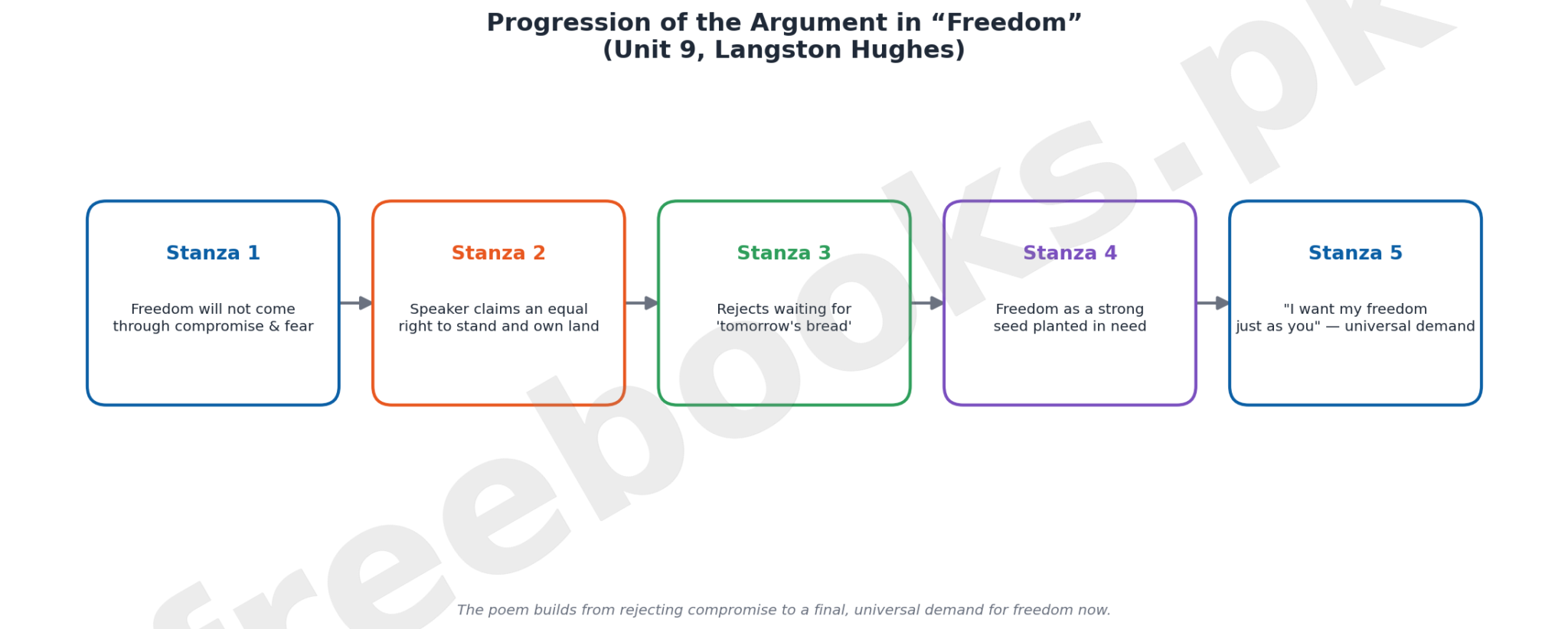
Progression of the Argument in the Poem: A sequential flow diagram of five connected boxes, one per stanza, tracing the poem's argument from rejecting compromise and fear, through claiming equal rights and rejecting the promise of 'tomorrow's bread', to the central seed metaphor and the closing universal demand for freedom.
Short Questions & Answers
Whose perspective is the poem written from, and how does this influence its message?
The poem is written from a first-person perspective, which allows the poet to speak personally while also representing the shared experience of all those denied freedom, making the demand for freedom feel both intimate and universal.
How does Hughes criticise those who believe in gradual change for freedom?
Hughes directly criticises them in stanza three, saying he 'tires so of hearing people say, let things take their course' and 'tomorrow is another day,' rejecting the idea that freedom can be safely postponed to an unspecified future.
Why does the poet reject the idea of 'tomorrow's bread'?
He rejects it because a delayed freedom is not real freedom — just as a person cannot physically survive on bread that does not yet exist, he cannot live meaningfully while waiting for a promised future justice that may never fully arrive.
What does the metaphor 'Freedom is a strong seed planted in a great need' suggest?
It suggests that freedom grows naturally and powerfully out of genuine necessity, much like a seed grows into a plant — freedom is not simply handed down but takes root and develops from real, urgent human need.
Why does the poet use the words 'compromise and fear' specifically in the first stanza?
These words suggest that those in power maintain injustice through negotiated half-measures ('compromise') and by intimidating the oppressed into silence ('fear'), and Hughes rejects both as false paths to genuine freedom.
How does the poem's contrast between the speaker and 'others' add to its power?
By setting the speaker's active, urgent demand for freedom against the passive attitude of those who say 'let things take their course,' the poem sharpens its argument, showing the speaker's position as morally and emotionally more justified than passive acceptance.
Identify one example of repetition in the poem and explain its effect.
The word 'freedom' is repeated throughout the poem, reinforcing its central importance and the speaker's persistent, unwavering desire for it, ensuring the reader cannot lose sight of the poem's central demand.
What is the effect of the poem's final stanza, 'I live here, too. I want my freedom just as you'?
This short, direct closing stanza universalises the speaker's demand, asserting equal belonging and an equal claim to freedom, making the poem's final statement personal, simple, and impossible to dismiss.
Long Questions & Answers
Discuss how Langston Hughes builds his argument for immediate freedom across the five stanzas of the poem.
How does the poem's argument begin in stanza one?
The poem opens by flatly rejecting the idea that freedom will ever come through 'compromise and fear', establishing from the outset that the speaker demands freedom now, not through negotiated, gradual change.
How does the speaker build his claim to freedom in stanza two?
The speaker asserts he has 'as much right as the other fellow' to stand independently and own land, turning the abstract demand of stanza one into a concrete, personal claim to equality and dignity.
How does stanza three intensify the poem's urgency?
The speaker openly criticises passive attitudes ('let things take their course', 'tomorrow is another day') and declares he 'cannot live on tomorrow's bread', making clear that any delay in achieving freedom is unacceptable and unsustainable.
How do the final two stanzas conclude the poem's argument?
Stanza four's metaphor of freedom as 'a strong seed planted in a great need' frames freedom as a natural, necessary growth, while the final stanza's declaration 'I want my freedom just as you' completes the argument with a direct, universal, and undeniable personal claim.
Explain the structure and literary devices Hughes uses in 'Freedom', and discuss how they reinforce the poem's theme.
How does the poem's uneven stanza structure reflect its theme?
The poem's five stanzas vary irregularly in length — quatrain, quintain, quintain, quatrain, tercet — and its staggered line alignment visually represents the uneven, difficult path towards achieving freedom, echoing the disjointed nature of the real struggle for liberty.
How does Hughes use metaphor to convey his message?
Hughes compares freedom to 'a strong seed planted in a great need', suggesting natural, necessary growth, and contrasts this with 'tomorrow's bread', a metaphor showing that a delayed freedom cannot sustain someone suffering injustice in the present.
What role does contrast play in the poem?
Contrast is central to the poem's power: the speaker's active, urgent pursuit of freedom is set directly against the passive stance of others who say 'let things take their course', sharpening the poem's argument for immediate action.
How do repetition and enjambment contribute to the poem's tone?
The repetition of 'freedom' throughout the poem reinforces its central importance, while enjambment — lines running on without pause — creates a sense of urgency and momentum, pushing the reader forward much as the speaker pushes for immediate change.
Multiple Choice Questions (MCQs)
Who is the poet of 'Freedom'? (A) Emily Dickinson (B) William Blake (C) Langston Hughes (D) Catherine Thimmesh
Correct answer: (C) Langston Hughes. 'Freedom' was written by Langston Hughes (1901-1967), a leading figure of the Harlem Renaissance.
According to the poem, freedom will not come through: (A) Patience and perseverance (B) Compromise and fear (C) Courage and unity (D) Knowledge and education
Correct answer: (B) Compromise and fear. The poem's opening stanza states that freedom will not come 'through compromise and fear.'
Why does the speaker compare freedom to a seed? (A) It is difficult to find (B) It can be easily destroyed (C) It must be planted and grown (D) It is available to everyone
Correct answer: (C) It must be planted and grown. The metaphor 'Freedom is a strong seed planted in a great need' suggests freedom must be planted and grown from real necessity.
Why does the poet mention 'tomorrow's bread'? (A) To emphasise that freedom can be postponed (B) To show that food is more important than freedom (C) To illustrate that freedom must be experienced now, not in the future (D) To highlight the importance of patience
Correct answer: (C) To illustrate that freedom must be experienced now, not in the future. The line 'I cannot live on tomorrow's bread' argues that freedom must come now, since a promised future freedom cannot sustain someone in the present.
What is the effect of the first-person perspective in the poem? (A) It creates a sense of distance (B) It makes the poem impersonal (C) It allows the poet to speak for a group while expressing personal feelings (D) It focuses only on the lives of others
Correct answer: (C) It allows the poet to speak for a group while expressing personal feelings. The first-person perspective allows Hughes to speak personally while representing the shared experience of all those denied freedom.
Which best describes the tone of the poem? (A) Humorous and light (B) Calm and accepting (C) Urgent and demanding (D) Mysterious and suspenseful
Correct answer: (C) Urgent and demanding. The poem's tone is urgent and demanding, rejecting compromise, fear, and passive waiting.
How many stanzas does the poem have, and what is notable about their structure? (A) Four stanzas, all quatrains (B) Five stanzas of uneven length (C) Three stanzas, all tercets (D) Six stanzas of equal length
Correct answer: (B) Five stanzas of uneven length. The poem has five stanzas of uneven length: two quatrains, two quintains, and one tercet.
Which pair of words rhyme in the poem's second stanza? (A) fear / year (B) stand / land (C) seed / need (D) here / freedom
Correct answer: (B) stand / land. In stanza two, 'stand' and 'land' rhyme, emphasising the speaker's claim to physical, rooted equality.
What does the poem's irregular line alignment represent? (A) A printing error (B) The uneven, difficult path towards achieving freedom (C) The poet's indecision (D) A traditional sonnet structure
Correct answer: (B) The uneven, difficult path towards achieving freedom. The staggered, irregular line alignment visually reflects the poem's theme of struggle and the uneven path to freedom.
How does the final stanza conclude the poem's argument? (A) By apologising for the speaker's demands (B) By asserting a universal, personal claim to freedom equal to anyone else's (C) By suggesting freedom is no longer needed (D) By returning to the idea of compromise
Correct answer: (B) By asserting a universal, personal claim to freedom equal to anyone else's. The final stanza, 'I live here, too. I want my freedom just as you,' asserts a universal, personal, and equal claim to freedom.
Quick Revision Summary
- 'Freedom' was written by Langston Hughes (1901-1967), a leading figure of the Harlem Renaissance.
- The poem has five stanzas of uneven length (quatrain, quintain, quintain, quatrain, tercet), written in free verse with occasional rhyme.
- Stanza 1 rejects the idea that freedom will ever come through 'compromise and fear.'
- Stanza 2 asserts the speaker's equal right to 'stand on my two feet and own the land.'
- Stanza 3 criticises passive waiting ('let things take their course') and rejects 'tomorrow's bread.'
- Stanza 4 compares freedom to 'a strong seed planted in a great need.'
- Stanza 5 closes with the universal demand, 'I want my freedom just as you.'
- Key literary devices include metaphor, enjambment, repetition, imagery, and contrast.
- The poem's irregular line alignment visually represents the uneven path towards freedom.
- The central theme is an urgent, unwavering demand for immediate freedom and equality, rejecting delay and compromise.
Exam Tips
- Unit 9 does not currently appear in this year's PECTAA paper pattern (the pattern draws from Units 1, 2, 5, 8, 10 as the prose group and Units 3, 6, 11, 13 as the poem group), so treat this unit as extra reading and comprehension practice rather than a primary exam-focus unit.
- Even though it may not be directly examined this year, practising the 'explain the given stanza with reference to context' skill on this poem is useful preparation, since that exact question type is reliably tested on the examinable poem units.
- If your teacher does include this unit for internal assessment, make sure you can explain all five stanzas individually, since any one could be set for a reference-to-context question — the stanza-wise section in these notes covers every stanza in full.
- Learn the poet's background facts (Langston Hughes, Harlem Renaissance, themes of racial identity and justice) since short questions on poem units often test factual recall about the poet alongside the poem's content.
- Memorise the literary device definitions together with their exact example lines from the poem — metaphor ('a strong seed'), contrast ('let things take their course' vs the speaker's urgency), and repetition (of 'freedom') — as examiners often ask you to identify the device from a quoted line.
- Practise summary and précis writing using this poem, since the textbook explicitly sets both tasks for this unit, and précis-writing skills are assessed more broadly across the paper.