This unit presents an informational text on 'Clean Water', as given in the Class 11 English textbook of the PECTAA Board under the Updated National Curriculum of Pakistan 2023, examining why clean water is essential for human health, the environment, and the economy.
The text explains the scale of the global water crisis using specific data — including WHO mortality figures and global access statistics — and covers the causes of water scarcity and contamination, their effects on health, agriculture, and ecosystems, and the collaborative solutions needed to address them.
These notes summarise the passage strictly as given in the textbook and provide comprehension questions, vocabulary, and exam-oriented material for this unit.
Learning Objectives
- Engage effectively in collaborative discussions on grade-level topics, texts, and issues.
- Analyse organisational patterns in an informational text, including cause-effect and problem-solution structures.
- Distinguish cause from effect, and fact from opinion, with specific reference to informational texts.
- Acquire and independently gather vocabulary important for comprehension and expression.
- Write formal letters to people in extended academic and professional environments for various purposes.
Key Concepts
Why Clean Water Matters
The passage opens by establishing water's fundamental role in life: it constitutes about 60% of the human body and covers roughly 70% of the planet, yet only 3% of the earth's water is fresh water, and only one third of that fraction is readily available for use — this small share supports all life on land.
The passage warns that human activity and climate patterns are depleting and mistreating this limited resource, using water faster than it precipitates to the ground, putting both humans and entire ecosystems at risk. Clean water is described as vital for drinking, cooking, sanitation, and hygiene, and as a cornerstone of public health, environmental sustainability, and economic development.
Impact on Human Health
Contaminated water can harbour harmful bacteria, viruses, parasites, and chemicals that cause waterborne diseases such as cholera, typhoid, dysentery, and hepatitis, with severe consequences for vulnerable populations such as children, pregnant women, and the elderly. According to the World Health Organization (WHO), around 829,000 people die each year from diarrhoea caused by contaminated drinking water, sanitation, and poor hand hygiene.
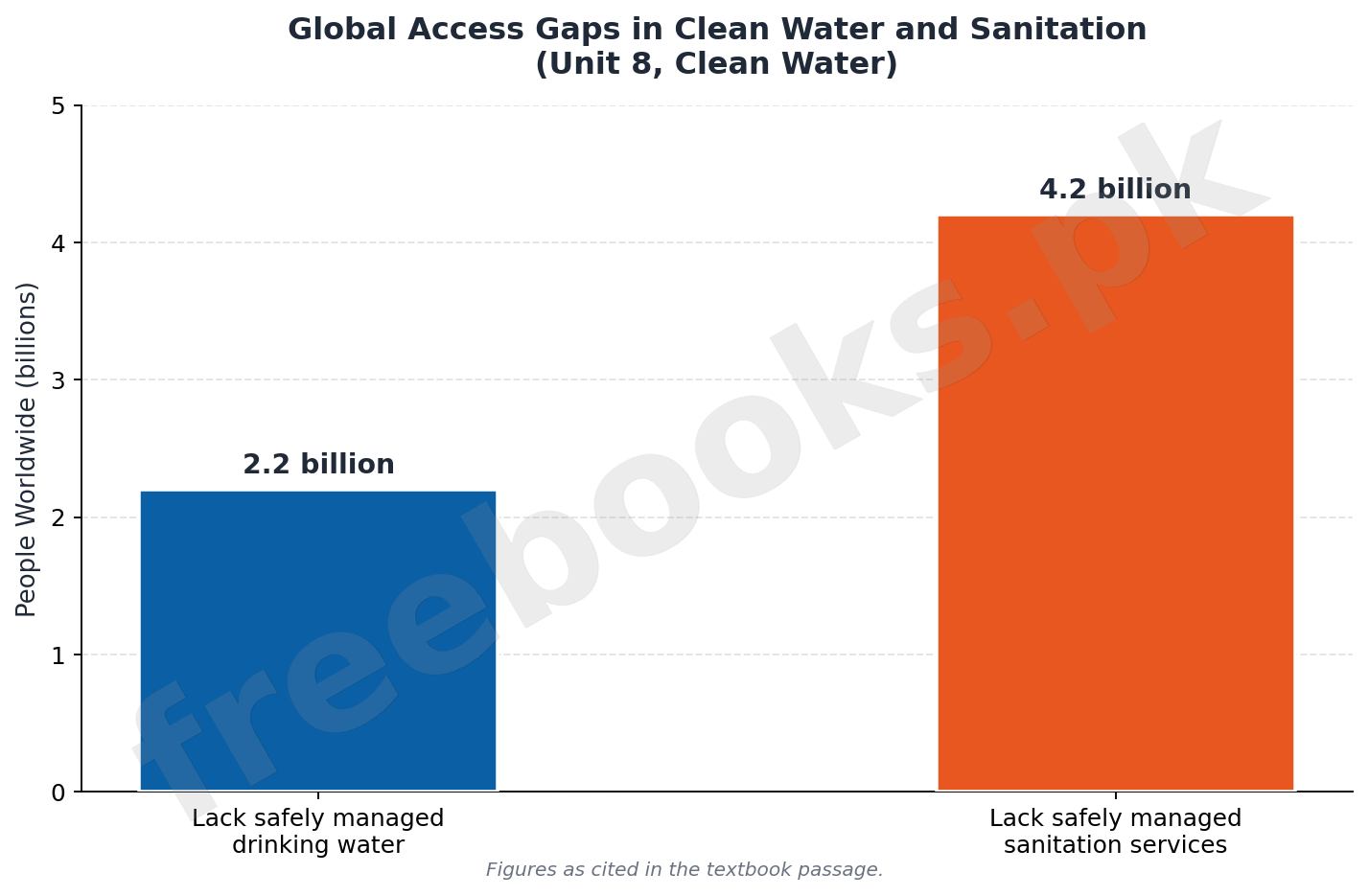
Globally, around 2.2 billion people lack access to safely managed drinking water services, and 4.2 billion lack access to safely managed sanitation services. In areas where water is scarce or contaminated, people are less likely to practise good hygiene, leading to higher rates of illness — with children especially vulnerable, many dying before their fifth birthday due to lack of clean water and sanitation.
Environmental and Economic Implications
Clean water is crucial for maintaining ecosystems: rivers, lakes, and wetlands depend on it to support diverse wildlife and plant species. Pollution from industrial activities, agricultural runoff, and improper waste disposal can degrade aquatic life and disrupt delicate ecosystems, leading to declines in fish populations and habitat loss.
Pollutants such as heavy metals, chemicals, and pesticides can accumulate in water bodies, posing risks to both human health and the environment, compounding the challenges of water scarcity and contamination described elsewhere in the passage.
Impact on Agriculture and Food Security
Clean water is vital for agricultural and food production: farmers rely on it for irrigation, livestock watering, and crop production. Without access to clean water, farmers may struggle to grow crops and raise livestock, leading to food shortages, economic hardship, and increased prices affecting both local and global markets.
The economic burden of treating waterborne diseases and managing water pollution can be substantial for governments and communities, meaning that investing in clean water infrastructure improves public health while also fostering economic stability and growth.
Barriers to Universal Access
Despite its importance, access to clean water is not universal — many regions, particularly in developing countries, face challenges related to water scarcity and contamination, worsened by population growth, climate change, and pollution. In arid and semi-arid regions, water sources are often limited, making it difficult to meet the needs of growing populations, while climate change alters precipitation patterns, leading to droughts and reduced freshwater availability.
Solutions: Infrastructure, Community Initiatives, and Technology
Addressing these challenges requires a multifaceted approach combining sustainable solutions and community engagement. Governments, policymakers, international organisations, and local communities must work together to improve water infrastructure, implement effective waste management, and promote sustainable water use.
Community-based initiatives such as rainwater harvesting, water conservation, and watershed management can improve access to clean drinking water, while investments in water purification technologies and research can help develop innovative solutions for water treatment and management.
Education, Awareness, and Conclusion
Education and awareness are described as key components of improving water access and quality: teaching communities about the importance of clean water, proper sanitation, and pollution prevention empowers individuals to protect their water sources. Supporting initiatives that provide clean water to underserved areas, such as building wells and water treatment facilities, can have a profound impact on public health and quality of life.
The passage concludes that clean water is a fundamental resource supporting human health, environmental sustainability, and economic development, and that ensuring clean water for all through collaborative effort is not only a matter of public health but a critical step towards global prosperity and well-being.
Important Definitions (Glossary)
accumulate
to gradually get more and more of something over a period of time
arid
having little or no rain; very dry
collaborative
involving, or done by, several people or groups of people working together
constitute
to be considered to be, or to form, something
contamination
the process of making something dirty or poisonous
disrupt
to make it difficult for something to continue in the normal way
drastically
in an extreme way that has a sudden, serious, or violent effect on something
drought
a long period of time when there is little or no rain
hygiene
the practice of keeping yourself and your living and working areas clean
inadequate
not enough; not good enough
incidence
the extent to which something happens or has an effect
innovative
introducing or using new ideas, ways of doing something, etc.
multifaceted
having many different aspects to be considered
profound
very great
scarcity
a shortage or lack of something
substantial
large in amount, value, or importance
vulnerable
weak and easily hurt physically or emotionally
Key Facts
| Aspect | Key Fact |
|---|---|
| Water on Earth | Covers ~70% of the planet, but only 3% is fresh water, and only one-third of that is readily available for use. |
| Water in the human body | Constitutes about 60% of the human body. |
| WHO mortality figure | Around 829,000 people die each year from diarrhoea caused by contaminated water, sanitation, and hygiene. |
| Lack safe drinking water | Around 2.2 billion people worldwide lack access to safely managed drinking water services. |
| Lack safe sanitation | Around 4.2 billion people worldwide lack access to safely managed sanitation services. |
| Waterborne diseases named | Cholera, typhoid, dysentery, and hepatitis. |
| Most vulnerable groups | Children, pregnant women, and the elderly. |
| Suggested solutions | Improved infrastructure, rainwater harvesting, water conservation, watershed management, purification technology, and education/awareness. |
Diagram
Global Access Gaps in Clean Water and Sanitation: A bar chart plotting the passage's own statistics: 2.2 billion people worldwide lack access to safely managed drinking water services, and 4.2 billion lack access to safely managed sanitation services.
Short Questions & Answers
Why is water described as fundamental to all forms of life?
Water constitutes about 60% of the human body and is essential for nearly every daily activity, yet only 3% of the earth's water is fresh, and only one third of that is readily available, making it a scarce and vital resource for all life on land.
How does contaminated water affect human health?
Contaminated water can harbour harmful bacteria, viruses, parasites, and chemicals that cause waterborne diseases such as cholera, typhoid, dysentery, and hepatitis, with the WHO reporting around 829,000 deaths each year from diarrhoea linked to contaminated water, sanitation, and hygiene.
What environmental effects does water pollution cause, according to the passage?
Pollution from industrial activities, agricultural runoff, and improper waste disposal can degrade and harm aquatic life, disrupt delicate ecosystems, and cause declines in fish populations and habitat loss, with pollutants like heavy metals and pesticides accumulating in water bodies.
How does inadequate access to clean water affect agricultural productivity?
Farmers rely on clean water for irrigation, livestock watering, and crop production; without it, they may struggle to grow crops and raise livestock, leading to food shortages, higher prices, and economic hardship affecting local and global markets.
What factors worsen water scarcity in developing regions, according to the passage?
Population growth, climate change, and pollution worsen water scarcity, with arid and semi-arid regions having especially limited water sources, and climate change altering precipitation patterns to cause droughts and reduce freshwater availability.
What community-based initiatives are mentioned for improving access to clean drinking water?
The passage mentions rainwater harvesting, water conservation, and watershed management as community-based initiatives that can improve access to clean drinking water alongside investments in purification technology.
Why is education and awareness important for improving water access and quality?
Teaching communities about the importance of clean water, proper sanitation, and pollution prevention empowers individuals to take action and protect their water sources, supporting broader efforts to improve water access and quality.
How can investing in clean water infrastructure contribute to global prosperity and well-being?
Investing in clean water infrastructure improves public health by reducing waterborne disease, while also fostering economic stability and growth, since it reduces the substantial economic burden of treating disease and managing pollution.
Long Questions & Answers
Discuss the effects of inadequate access to clean water on human health, the environment, and the economy, as described in the passage.
What effects does contaminated water have on human health?
Contaminated water spreads diseases such as cholera, typhoid, dysentery, and hepatitis, causing around 829,000 deaths annually from diarrhoea according to the WHO, with children, pregnant women, and the elderly especially vulnerable to these severe health consequences.
What environmental damage results from water pollution?
Pollution from industrial activities, agricultural runoff, and improper waste disposal degrades aquatic ecosystems, harming fish populations and other wildlife, while pollutants such as heavy metals and pesticides accumulate in water bodies and pose ongoing risks to both humans and the environment.
How does water scarcity affect agriculture and the economy?
Without adequate clean water for irrigation, livestock watering, and crop production, farmers face reduced productivity, leading to food shortages and higher prices; additionally, governments and communities bear a substantial economic burden treating waterborne disease and managing pollution.
How are these three impact areas connected in the passage's argument?
The passage presents health, environmental, and economic impacts as interconnected consequences of the same underlying problem — inadequate access to clean water — showing that solving water scarcity and contamination would simultaneously improve public health, protect ecosystems, and strengthen economies.
Explain the solutions the passage proposes for addressing global water scarcity and contamination.
What role do governments and international organisations play in the proposed solutions?
The passage states that governments, policymakers, international organisations, and local communities must work together to improve water infrastructure, implement effective waste management practices, and promote sustainable water use, framing the solution as fundamentally collaborative.
What community-based initiatives does the passage recommend?
It recommends rainwater harvesting, water conservation, and watershed management as community-based initiatives that can play a crucial role in improving access to clean drinking water at the local level.
What role does technology play in the passage's proposed solutions?
The passage highlights investments in water purification technologies and research as important for developing innovative solutions for water treatment and management, addressing contamination at its source.
Why does the passage emphasise education and awareness as a solution?
Because teaching communities about the importance of clean water, proper sanitation, and pollution prevention empowers individuals to take direct action to protect their own water sources, making education a foundational, enabling solution alongside infrastructure and technology investments.
Multiple Choice Questions (MCQs)
What percentage of the human body does water constitute, according to the passage? (A) 40% (B) 50% (C) 60% (D) 70%
Correct answer: (C) 60%. The passage states that water constitutes about 60% of the human body.
What percentage of the earth's water is fresh water? (A) 1% (B) 3% (C) 10% (D) 25%
Correct answer: (B) 3%. The passage states that only 3% of the earth's water is fresh water, and only one third of that is readily available for use.
According to the WHO, approximately how many people die each year from diarrhoea caused by contaminated water? (A) 82,900 (B) 829,000 (C) 8.29 million (D) 82.9 million
Correct answer: (B) 829,000. The passage cites the WHO figure of around 829,000 deaths each year from diarrhoea caused by contaminated water, sanitation, and hygiene.
How many people worldwide lack access to safely managed drinking water services, according to the passage? (A) 0.22 billion (B) 1.2 billion (C) 2.2 billion (D) 4.2 billion
Correct answer: (C) 2.2 billion. The passage states that around 2.2 billion people worldwide lack access to safely managed drinking water services.
How many people worldwide lack access to safely managed sanitation services? (A) 1.2 billion (B) 2.2 billion (C) 3.2 billion (D) 4.2 billion
Correct answer: (D) 4.2 billion. The passage states that 4.2 billion people worldwide lack access to safely managed sanitation services.
Which of the following is NOT named as a waterborne disease in the passage? (A) Cholera (B) Typhoid (C) Malaria (D) Dysentery
Correct answer: (C) Malaria. The passage names cholera, typhoid, dysentery, and hepatitis as waterborne diseases; malaria is not mentioned.
What does the passage identify as a major cause of ecosystem disruption in water bodies? (A) Overfishing (B) Pollution from industrial activities, agricultural runoff, and improper waste disposal (C) Excessive rainfall (D) Coral bleaching
Correct answer: (B) Pollution from industrial activities, agricultural runoff, and improper waste disposal. The passage identifies pollution from industrial activities, agricultural runoff, and improper waste disposal as key causes of ecosystem disruption.
What community-based initiative is mentioned for improving water access? (A) Deep-sea mining (B) Rainwater harvesting (C) Coal power expansion (D) Urban high-rise construction
Correct answer: (B) Rainwater harvesting. The passage mentions rainwater harvesting, along with water conservation and watershed management, as community-based initiatives.
What factors does the passage say worsen water scarcity in developing regions? (A) Only pollution (B) Population growth, climate change, and pollution (C) Only population growth (D) Only climate change
Correct answer: (B) Population growth, climate change, and pollution. The passage identifies population growth, climate change, and pollution together as factors that exacerbate water scarcity.
What does the passage identify as key components of improving water access and quality? (A) Military intervention (B) Education and awareness (C) Reducing agricultural production (D) Banning industrial activity entirely
Correct answer: (B) Education and awareness. The passage states that education and awareness are key components of improving water access and quality.
Quick Revision Summary
- Water constitutes about 60% of the human body; only 3% of the earth's water is fresh water, and only a third of that is readily usable.
- The WHO reports around 829,000 deaths each year from diarrhoea caused by contaminated water, sanitation, and hygiene.
- Globally, 2.2 billion people lack safely managed drinking water, and 4.2 billion lack safely managed sanitation services.
- Waterborne diseases named in the passage include cholera, typhoid, dysentery, and hepatitis.
- Pollution from industry, agriculture, and waste disposal disrupts ecosystems and harms aquatic life.
- Clean water is essential for agriculture; its scarcity leads to food shortages and economic hardship.
- Population growth, climate change, and pollution worsen water scarcity, especially in arid and semi-arid regions.
- Proposed solutions include improved infrastructure, rainwater harvesting, water conservation, and purification technology.
- Education and awareness are described as key to empowering communities to protect their water sources.
- The passage concludes that ensuring clean water for all is essential to public health and global prosperity.
Exam Tips
- This unit belongs to PECTAA's 'prose group' (Units 1, 2, 5, 8, 10), which under the current paper pattern carries heavier weight — 5 of the paper's synonym questions and 3 of its MCQs are drawn from these prose units, so revise the 17 glossary words in this unit carefully.
- Since only 7 of the 10 short questions asked from the prose group need to be attempted, practice answering all 8 short questions in this unit so you have a comfortable choice on exam day.
- Memorise the key statistics (60% of body, 3% fresh water, 829,000 deaths, 2.2 billion/4.2 billion access gaps) exactly as given in the textbook — examiners often test recall of specific numbers from informational texts like this one.
- This unit's passage is explicitly used for organisational-pattern questions (cause-effect, problem-solution) in the textbook exercises, so practice identifying these patterns as they may be tested directly.
- This unit's passage may also be set for the punctuation exercise or Urdu-translation/essay-writing option, so practice both as part of your preparation for this and the other prose units.
- When answering long questions, structure your answer by impact area (health, environment, agriculture/economy, solutions) exactly as the passage does, rather than mixing the points together.