
This unit presents the essay 'What You Do Is What You Are' by Nickie McWhirter, as given in the Class 11 English textbook of the PECTAA Board under the Updated National Curriculum of Pakistan 2023.
The essay argues that society unfairly judges and values people based on their jobs and job titles rather than who they are as individuals, examining how the unemployed, retired, and low-prestige workers are dismissed as being merely 'just' something, while certain professions are automatically granted greater respect regardless of their actual social value.
These notes summarise the passage strictly as given in the textbook and provide comprehension questions, vocabulary, and exam-oriented material for this unit.
Learning Objectives
- Choose words and phrases for effect, recognising the persuasive and ironic tone of the essay.
- Apply skimming and scanning strategies to identify the writer's purpose, intended audience, and main theme.
- Give an informed personal and analytical response to the text with supporting textual references.
- Practise précis writing skills by summarising the essay's main argument in 80-100 words.
- Use context clues to determine the meaning of unfamiliar words and phrases such as 'validate' and 'cast in bronze'.
- Identify and correctly use gerunds, infinitives, and participles in reading and writing tasks.
Key Concepts
Defining People by Their Jobs
McWhirter opens by observing that, unlike people in most other parts of the world, society in this context tends to define and judge everyone by the work they do, especially paid work. She gives examples such as 'Charlie is a doctor; Sam is a carpenter; Mary Ellen is a copywriter,' arguing that a person's job title is treated as if it validates or rejects their very existence.
For those without current paid work, she notes, society instead defines them by their past job history — 'Larry is a laid-off auto worker; Tony is a retired teacher' — assigning such non-employed persons to a kind of limbo, valued only for what they once did rather than who they are now.
The Limits of Past Identity
McWhirter finds this peculiar: people are not 'cast in bronze' because of the jobs they hold or once held, yet society treats job titles as permanent markers of identity. She illustrates this with Tony, a retired teacher who may spend significant volunteer time helping handicapped children — work that 'doesn't count' in the public eye, since he remains simply 'a retired teacher.'
Similarly, Larry, a laid-off auto worker, may pump gas or sell encyclopaedias on weekends, yet until he returns to steady work, he remains defined as 'laid-off auto worker' — as if, McWhirter writes ironically, 'he is nothing now, but he used to be something.'
The 'Just' Category
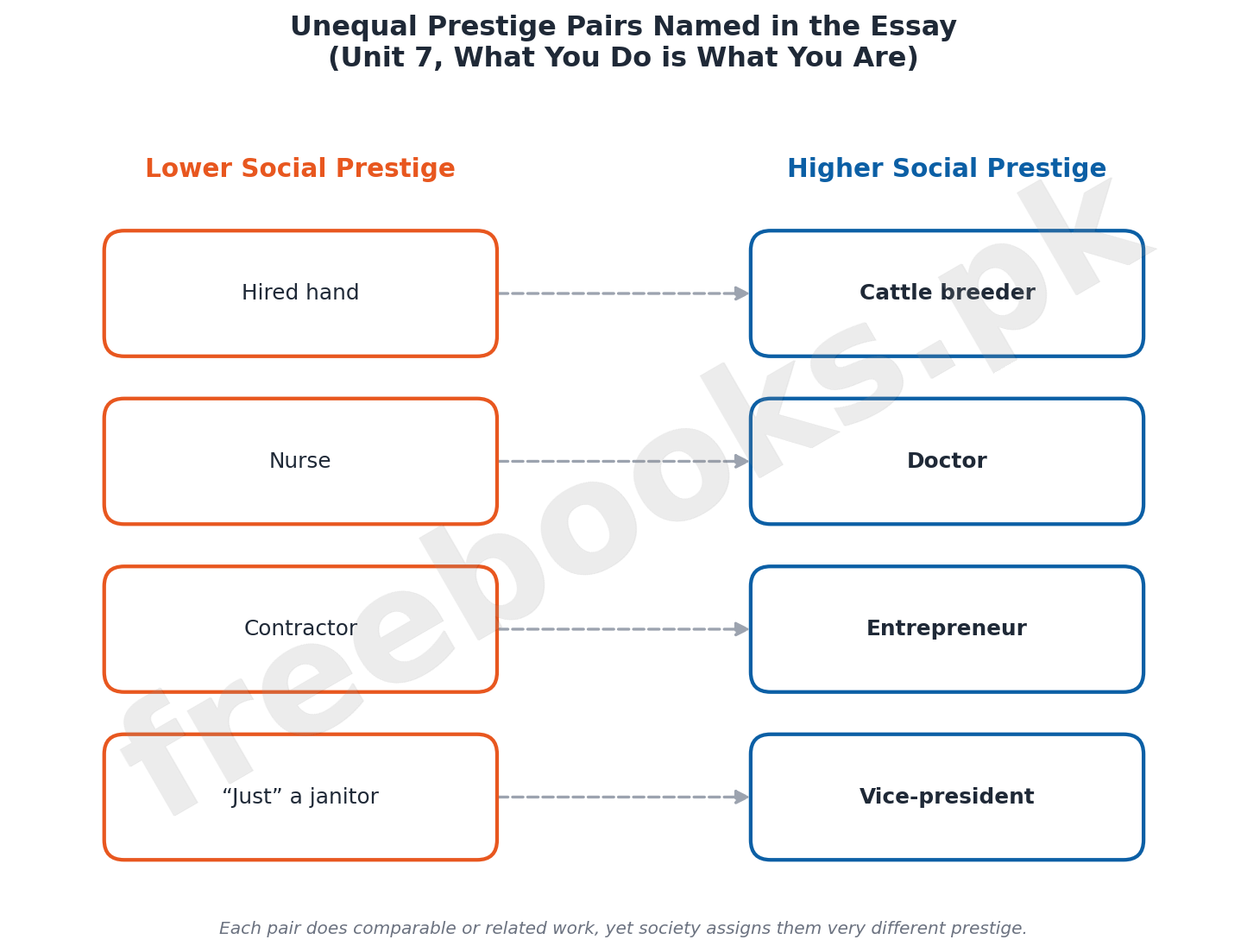
McWhirter identifies a whole category of people dismissed as being 'just' something — 'just' a housewife, 'just' a bum, 'just' a kid, 'just' a drunk, 'just' a cab driver, 'just' a janitor — a label she argues totally discounts a person's value, present and past. She notes pointedly that 'no one is ever just a vice-president,' showing that the 'just' label is reserved for low-pay, low-prestige, or non-earning roles.
This category includes present non-earners, people without a highly valued past job history, and people whose current jobs sit at the low end of pay and prestige scales — revealing, in McWhirter's view, how selectively and unfairly society applies this dismissive label.
A 'Classless' Society That Isn't
McWhirter points out the contradiction in a society that claims to be classless — refusing to recognise titled nobility or dynastic privilege — while still clearly separating the 'valued' from the 'valueless' based largely on jobs and the prestige attached to them. This section makes explicit the essay's central irony: formal equality exists alongside deep, informal inequality of respect.
Teaching Children How the System Works
McWhirter argues it is 'no use arguing whether any of this is correct or proper' — rationally, she admits, the system is silly, but since it is how society actually operates, children should be taught how it works. She uses the examples of wanting to grow up to be a cowboy or a nurse: children should understand that, apart from earning potential, a cattle breeder is far more respected than a hired hand, and a doctor receives far more respect and privilege than a nurse.
An Uncatalogued System of Respect
McWhirter suggests that an anthropologist ought to study this unwritten, uncatalogued system by which respect and deference are awarded based on jobs. She raises pointed, half-humorous questions — comparing a 'vice-president, product planning' to a 'vice-president, sales,' and observing that writers earn very little money ('diddly') yet may be held in higher esteem than wealthy rock musicians, at least among older generations.
Unequal Labels, Unequal Value, and the Essay's Theme
McWhirter closes by questioning why someone who builds shopping centres is called an 'entrepreneur' while someone who builds freeways is called a 'contractor' — two similar roles given very differently prestigious labels. She offers no final answers, but urges readers to notice this phenomenon the next time they are tempted to fawn over a stranger for holding a prestigious job, or to discount the worth of a garbage collector.
The essay's theme is a critique of how society judges individuals by their occupation or employment status rather than their actual character or contribution — exposing the irrationality of a supposedly 'classless' society that nonetheless ranks people sharply according to their work.
Important Definitions (Glossary)
anthropologist
a person who studies the human race, especially its origins, development, customs, and beliefs
bum
a person who has no home or job and who asks other people for money or food
cast in bronze
to be permanently celebrated, honoured, or remembered for something, especially for a particular role, achievement, or status
classless
not clearly belonging to a particular social class
deference
behaviour that shows that you respect somebody or something
diddly
not anything; nothing
dynastic
connected with a series of leaders of a country who all belong to the same family
entrepreneur
a person who makes money by starting or running businesses, especially when this involves taking financial risks
fawn
to try to please somebody by praising them or paying them too much attention
limbo
a situation in which you are not certain what to do next and cannot take action, especially because you are waiting for somebody else to decide
non-earners
people who do not currently earn money through a job or paid employment
peculiar
strange or unusual, especially in a way that is unpleasant or makes you worried
prestige
the respect and value that somebody or something has because of their social position, or what they have done
privilege
a special right or advantage that a particular person or group of people has
uncatalogued
not formally recorded or arranged in any recognised order or system
Key Facts
| Aspect | Key Fact |
|---|---|
| Author | Nickie McWhirter. |
| Text type | Reflective, persuasive essay with an ironic tone. |
| Central theme | Society unfairly judges and values people based on their job or employment status rather than who they are. |
| Key phrase | "Cast in bronze" — no one should be permanently defined by a job they hold or once held. |
| The 'just' label | Applied to low-pay, low-prestige, or non-earning roles (e.g. 'just' a housewife, 'just' a janitor); never applied to high-prestige roles like vice-president. |
| Central irony | Society claims to be 'classless' yet clearly separates the valued from the valueless based on jobs. |
| Cowboy/nurse example | Children should be taught that a cattle breeder is more respected than a hired hand, and a doctor more than a nurse, regardless of earnings. |
| Entrepreneur vs contractor | Someone who builds shopping centres is called an entrepreneur; someone who builds freeways is called a contractor — unequal labels for comparable work. |
Diagram
Unequal Prestige Pairs Named in the Essay: A two-column comparison diagram pairing the lower-prestige and higher-prestige job labels named in the passage — hired hand/cattle breeder, nurse/doctor, contractor/entrepreneur, and 'just' a janitor/vice-president — connected by dashed lines, illustrating the essay's central point about unequal social respect for comparable or related work.
Short Questions & Answers
Why does the author describe the way society defines people by their jobs as 'peculiar'?
She finds it peculiar because people are not permanently 'cast in bronze' by the jobs they hold or once held, yet society treats job titles as if they define a person's entire worth and identity, ignoring everything else about them.
Provide two examples the author uses to show how individuals are judged based on their employment status.
She gives Tony, a retired teacher whose volunteer work with handicapped children 'doesn't count' in the public eye, and Larry, a laid-off auto worker who remains defined by that past job even while doing other work on the side.
What does the phrase 'cast in bronze' symbolise in the context of the text?
It symbolises being permanently honoured or fixed in a particular identity or status; McWhirter argues people are not permanently defined this way by their jobs, even though society often treats job titles as if they were.
What is the critique behind labels like 'just a housewife' or 'just a janitor'?
McWhirter critiques these labels for totally discounting a person's value and contribution, showing that society reserves the dismissive word 'just' for low-pay, low-prestige, or non-earning roles, while never applying it to high-prestige jobs like vice-president.
In what way does the author suggest that children should be taught to understand respect and job roles in society?
She suggests children should be taught how the system actually works — for example, that a cattle breeder is more respected than a hired hand, and a doctor more than a nurse — even though she admits the system itself is 'rationally… silly.'
Why does the author state that no one is ever described as 'just' a vice-president?
This reveals that society reserves dismissive labels for low-status jobs while automatically granting respect and immunity from such labels to high-status positions, regardless of actual merit or contribution.
What contrast does the author draw between an entrepreneur and a contractor?
She contrasts someone who builds shopping centres, called an entrepreneur, with someone who builds freeways, called a contractor — two comparable roles given very differently prestigious labels, illustrating the arbitrary nature of social value judgments.
What is McWhirter's overall purpose in writing this essay?
Her purpose is to expose and critique the irrational, inconsistent way society assigns respect and value to people based on their jobs, and to encourage readers to notice and question this pattern in their own attitudes.
Long Questions & Answers
Discuss how the author critiques society's tendency to define people by their jobs, with reference to specific examples from the text.
How does the author introduce the idea that society defines people by their work?
McWhirter opens by noting that people are commonly identified by their job titles — 'Charlie is a doctor; Sam is a carpenter' — arguing that this practice treats a person's job as if it validates or rejects their very existence, rather than seeing the person as more than their occupation.
How are non-employed people treated differently, according to the essay?
Non-employed people are defined by their past job history instead, such as 'Larry is a laid-off auto worker' or 'Tony is a retired teacher,' with McWhirter noting that other meaningful activities these people do now — such as volunteering or part-time work — simply 'don't count' in how society labels them.
What is the significance of the 'just' category in the essay?
The 'just' category (e.g. 'just' a housewife, 'just' a janitor) represents the most extreme form of this judgment, totally discounting a person's value; McWhirter points out that this label is never applied to high-prestige roles like vice-president, revealing the selective unfairness of the practice.
What does the essay ultimately suggest about a 'classless' society?
McWhirter argues that although society claims to be classless — rejecting titled nobility and dynastic privilege — it nonetheless sharply separates the valued from the valueless based on jobs, showing that class-like distinctions persist informally through the prestige attached to different kinds of work.
Explain the examples of unequal prestige that McWhirter uses to support her argument, and discuss what she suggests should be done about this.
What example does the author give involving cowboys and cattle breeders?
She notes that while it is 'perfectly swell' for a child to want to grow up to be a cowboy, children should understand that, apart from earnings potential, a cattle breeder is far more respected in society than a hired hand doing similar physical work.
How does the doctor/nurse comparison support her argument?
She points out that a doctor receives far more respect and privilege than a nurse, even though both work in healthcare, illustrating how professional hierarchies grant unequal prestige to related roles based on factors beyond the actual value of the work performed.
What does the entrepreneur/contractor example add to her argument?
By noting that someone who builds shopping centres is called an 'entrepreneur' while someone who builds freeways is called a 'contractor,' she shows that even similar kinds of work can receive very different social labels and levels of admiration, purely based on the vocabulary society chooses to use.
What does McWhirter suggest readers should do in response to these patterns?
She does not offer a solution but urges readers to notice the phenomenon — to be conscious the next time they are tempted to fawn over someone because of a prestigious job title, or to discount the personal worth of someone like a garbage collector, encouraging greater self-awareness about these unconscious judgments.
Multiple Choice Questions (MCQs)
Who is the author of 'What You Do Is What You Are'? (A) Emily Dickinson (B) Nickie McWhirter (C) William Blake (D) Catherine Thimmesh
Correct answer: (B) Nickie McWhirter. The essay 'What You Do Is What You Are' was written by Nickie McWhirter.
According to the essay, how does society typically define non-employed people? (A) By their hobbies (B) By their past job history (C) By their family background (D) By their education level
Correct answer: (B) By their past job history. Society defines non-employed people by their past job history, such as calling someone a 'laid-off auto worker' or 'retired teacher.'
What does the phrase 'cast in bronze' mean in the context of the essay? (A) Turned into statues to be honoured forever (B) Paid for their work (C) Made into machines (D) Made unemployed
Correct answer: (A) Turned into statues to be honoured forever. 'Cast in bronze' means to be permanently celebrated or fixed in a particular identity or status.
Which of the following is NOT given as an example of the 'just' category in the text? (A) 'Just' a housewife (B) 'Just' a janitor (C) 'Just' a vice-president (D) 'Just' a bum
Correct answer: (C) 'Just' a vice-president. The text explicitly states that 'no one is ever just a vice-president,' showing the label is reserved for low-prestige roles.
What contradiction does the author highlight about society being 'classless'? (A) Society has no jobs at all (B) Society refuses titled nobility yet still separates the valued from the valueless based on jobs (C) Society values all jobs equally (D) Society only values unpaid work
Correct answer: (B) Society refuses titled nobility yet still separates the valued from the valueless based on jobs. McWhirter points out that despite claiming to be classless, society still sharply separates people by the prestige attached to their jobs.
In the essay, who is said to be more respected: a cattle breeder or a hired hand? (A) The hired hand (B) The cattle breeder (C) Both are equally respected (D) Neither is respected
Correct answer: (B) The cattle breeder. McWhirter states that, apart from earning potential, the cattle breeder is much more respected than the hired hand.
What does the author suggest about writers compared to wealthy rock musicians? (A) Writers earn more money (B) Writers may be held in higher esteem despite earning very little (C) Writers are never respected (D) Rock musicians are always more respected
Correct answer: (B) Writers may be held in higher esteem despite earning very little. McWhirter suggests writers earn very little ('diddly') but may be held in higher esteem than wealthy rock musicians, especially among older generations.
What contrast does the author draw between an entrepreneur and a contractor? (A) They earn the same amount (B) Someone who builds shopping centres is called an entrepreneur, someone who builds freeways is called a contractor (C) Both terms mean exactly the same thing (D) Contractors are always more respected than entrepreneurs
Correct answer: (B) Someone who builds shopping centres is called an entrepreneur, someone who builds freeways is called a contractor. She contrasts these two similar roles as an example of unequal prestige attached through differing job labels.
What is the overall theme of 'What You Do Is What You Are'? (A) The importance of higher education (B) Society's unfair judgment of people based on their jobs or employment status (C) The history of the American workforce (D) The benefits of retirement
Correct answer: (B) Society's unfair judgment of people based on their jobs or employment status. The essay's central theme is a critique of how society unfairly judges and values people based on their occupation or employment status.
What tone does McWhirter primarily use in the essay? (A) Purely factual and detached (B) Reflective and mildly ironic (C) Angry and aggressive (D) Formal and legalistic
Correct answer: (B) Reflective and mildly ironic. McWhirter uses a reflective, sometimes ironic tone to expose the flaws in society's job-based value system.
Quick Revision Summary
- 'What You Do Is What You Are' is an essay by Nickie McWhirter critiquing how society judges people by their jobs.
- People are often defined by current job titles ('Charlie is a doctor') or, if unemployed, by past job history ('Larry is a laid-off auto worker').
- McWhirter argues people are not 'cast in bronze' by their jobs, yet society treats job titles as permanent identity markers.
- The 'just' category (e.g. 'just' a housewife, 'just' a janitor) totally discounts a person's value; no one is ever 'just' a vice-president.
- Society claims to be classless but still separates the valued from the valueless based on job prestige.
- McWhirter argues children should be taught how this system works, even though she admits it is 'rationally… silly.'
- Examples of unequal prestige include cattle breeder vs hired hand, doctor vs nurse, and entrepreneur vs contractor.
- Writers may be held in higher esteem than wealthy rock musicians despite earning far less money.
- The essay's theme is a critique of judging people's worth by their occupation rather than their character or contribution.
- McWhirter ends by urging readers to notice this pattern rather than offering a direct solution.
Exam Tips
- Unit 7 does not currently appear in this year's PECTAA paper pattern (the pattern draws from Units 1, 2, 5, 8, 10 as the prose group and Units 3, 6, 11, 13 as the poem group), so treat this unit as extra reading and comprehension practice rather than a primary exam-focus unit.
- Even though it may not be directly examined this year, the vocabulary here (entrepreneur, prestige, deference, and others) is useful general-purpose academic vocabulary worth learning for the synonym questions drawn from other units.
- Practise identifying the author's ironic tone and persuasive word choices in this essay — this skill transfers directly to the examinable prose units, which are also tested on tone and word-choice questions.
- If your teacher does include this unit for internal assessment, the essay's key examples (Tony, Larry, the 'just' category, and the entrepreneur/contractor contrast) are its most detailed, exam-worthy material — be ready to explain each with its significance.
- Use this unit's précis-writing exercise (80-100 words) as practice for précis skills that may be assessed elsewhere, since précis writing is a specific skill named in this unit's learning outcomes.
- Keep your understanding of gerunds, infinitives, and participles from this unit's grammar section sharp, as these grammar points may reappear in the grammar section of the paper regardless of which reading units are examined.