This unit presents an informational text on the 'Impact of Global Warming on Pakistan', as given in the Class 11 English textbook of the PECTAA Board under the Updated National Curriculum of Pakistan 2023, examining the country's vulnerability to climate change under the lens of SDG 13: Climate Action.
The text explains why Pakistan is especially susceptible to global warming and details its effects across six major areas: rising temperatures and heatwaves, melting glaciers and water scarcity, extreme weather events, agriculture and food security, coastal erosion and sea-level rise, and threats to biodiversity — supported throughout by data tables and named Government initiatives launched under SDG 13.
These notes summarise the passage strictly as given in the textbook and provide comprehension questions, vocabulary, and exam-oriented material for this unit.
Learning Objectives
- Provide an objective summary of an informational, non-fiction text, capturing its main ideas and key data points.
- Use summary skills to extract salient points and develop a mind map summarising the text's structure and content.
- Interpret and integrate information from a variety of sources, including tables and charts, for comprehension.
- Consult reference materials to clarify the precise meaning, part of speech, or etymology of unfamiliar words.
- Comprehend and correctly use contemporary idioms and proverbs in speech and writing.
- Recognise and use subordinating and correlative conjunctions to connect clauses effectively.
- Produce clear, coherent, informative writing appropriate to the task, purpose, and audience.
Key Concepts
Why Pakistan Is Vulnerable to Global Warming
The passage opens by situating Pakistan's vulnerability within the United Nations' Sustainable Development Goals (SDGs), established in 2015, with SDG 13: Climate Action being particularly relevant. Pakistan's vulnerability stems from its diverse geography — high mountain ranges, vast plains, and an extensive coastline — which exposes it to a wide range of climate-related risks including glacial melt, extreme heat, and sea-level rise.
This vulnerability is compounded by heavy dependence on agriculture (a sector highly sensitive to temperature and precipitation changes), rapid urbanisation of cities like Karachi and Lahore combined with inadequate infrastructure, limited financial and technical resources for mitigation and adaptation, and immense pressure on resources from a population exceeding 220 million.
Rising Temperatures and Heatwaves
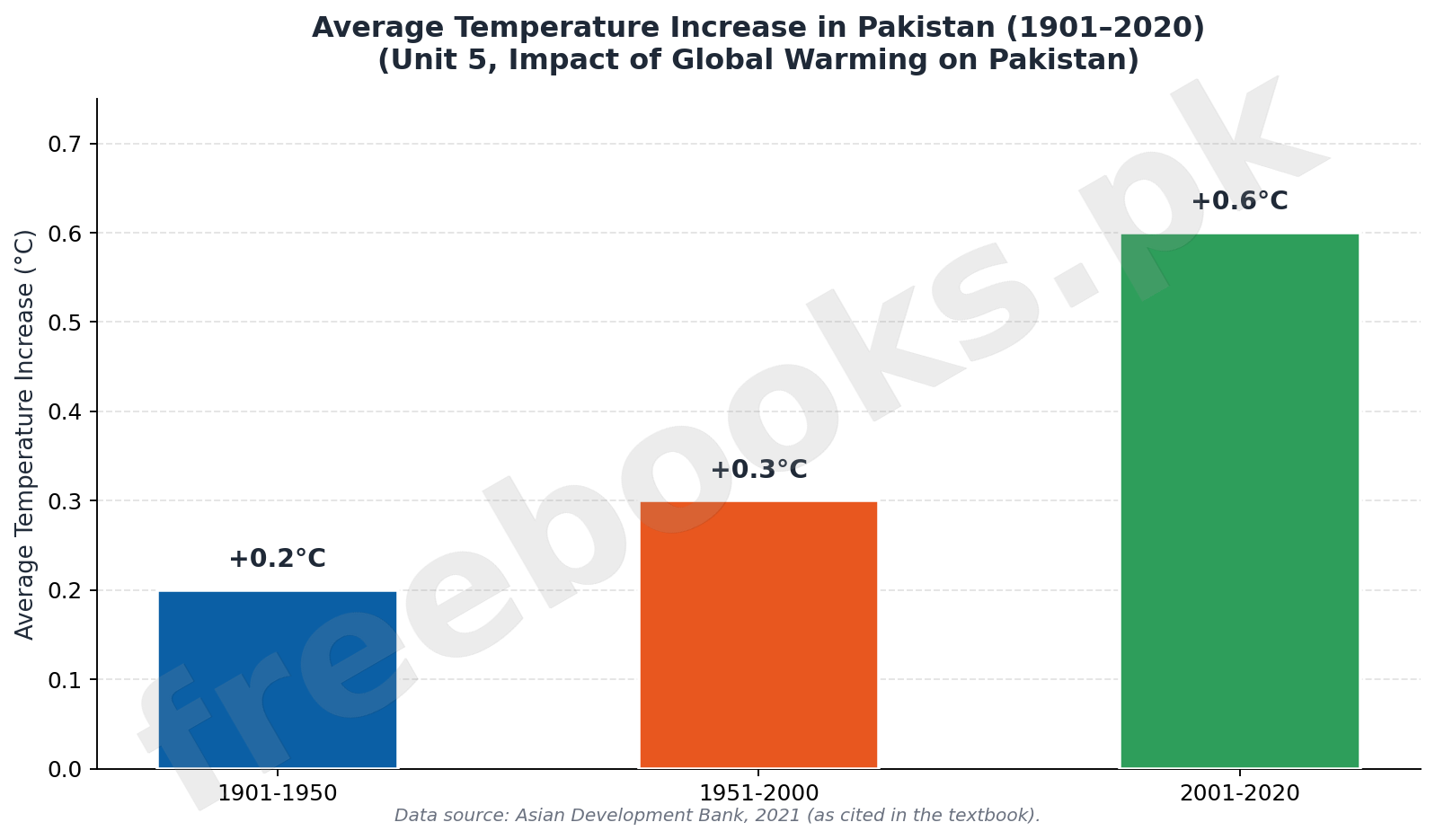
Pakistan has seen a significant rise in average temperatures over recent decades, driven by increased global greenhouse gas emissions and worsened locally by urban heat islands in densely built-up areas like Karachi. The textbook's own data (Table 1) shows the temperature increase accelerating from +0.2°C (1901-1950) to +0.3°C (1951-2000) to +0.6°C (2001-2020).
In 2022, Jacobabad recorded 51°C (124°F), among the highest temperatures in the world, and the 2015 Karachi heatwave resulted in over 1,200 deaths. In response, Pakistan introduced the Heatwave Management Plan, including early warning systems and public awareness campaigns, under SDG 13.
Melting Glaciers and Water Scarcity
Glaciers in the Himalayas and Karakoram ranges, crucial for feeding the Indus River, are melting at an accelerated rate due to rising temperatures. This initially increases water flow and flood risk, but over time reduces water availability, threatening agriculture and drinking water — a problem acute for Pakistan given its heavy reliance on the Indus River.
The textbook's data (Table 2) shows glacier melt rising from 10% (1980s, slight impact) to 20% (2000s, noticeable reduction) to 30% (2020s, significant reduction), with over 30% of Pakistan's glacial ice already melted. Pakistan has implemented the Glacial Lake Outburst Flood (GLOF) project under SDG 13, building early warning systems and protective infrastructure.
Increased Frequency of Extreme Weather Events
Pakistan is witnessing more frequent and severe floods, droughts, and cyclones, driven by disrupted global weather patterns causing more intense rainfall and prolonged dry periods. The 2010 floods affected over 20 million people and caused an estimated $10 billion in economic losses, while regions like Tharparkar face more frequent droughts, worsening water shortages and food insecurity.
In response, Pakistan developed the National Disaster Risk Management Framework under SDG 13, aiming to enhance disaster preparedness, response mechanisms, and resilience in vulnerable communities.
Impact on Agriculture and Food Security
Because Pakistan relies heavily on agriculture for food security and employment, unpredictable temperature and precipitation changes are making the sector less productive. The textbook's data (Table 3) projects wheat yields declining from 0% (2020) to 3% (2030) to 6-8% (2050) due to changing climate conditions.
The 2020 locust attack, driven by unusual weather patterns, caused crop losses worth $2.2 billion, underlining the sector's vulnerability. Pakistan is promoting Climate-Smart Agriculture under SDG 13, including drought-resistant crops, optimised water use, and improved soil management.
Coastal Erosion and Sea-Level Rise
Rising sea levels and coastal erosion, driven by global temperature increases, threaten the coastline of Sindh and Balochistan, risking displacement of coastal communities, damage to infrastructure, and inundation of agricultural lands. The textbook's data (Table 4) projects sea levels rising from 0.1m (2020, 0.2 million displaced) to 0.3m (2050, 2.0 million displaced) to 0.6m (2100, 5.0 million displaced).
The primary causes are thermal expansion of seawater and melting polar ice caps. Pakistan has launched the Mangrove Rehabilitation Project under SDG 13, restoring mangrove forests that act as natural barriers against coastal erosion and sea-level rise.
Threats to Biodiversity and Ecosystems
Changing temperature and precipitation patterns are disrupting natural habitats, causing species decline and ecosystem degradation — a serious concern given Pakistan's reliance on natural resources for livelihood. The textbook's data (Table 5) shows forest cover loss rising from 20,000 hectares (2000) to 30,000 (2010) to 43,000 hectares annually (2020).
Species such as the snow leopard and the Indus River dolphin are losing habitat due to changing climate conditions, driven by habitat destruction, deforestation, and unsustainable land use. Pakistan has initiated the Protected Areas Initiative under SDG 13 to conserve critical habitats and endangered species.
Theme: Climate Change and a Vulnerable Nation
The unit's theme is climate change and its multifaceted effects on a vulnerable nation. It explores how global warming, driven by human activities, impacts Pakistan's environment, economy, and society, emphasising the urgent need for climate action as outlined in SDG 13, and highlighting the complex, interconnected nature of rising temperatures, glacier melting, extreme weather, agricultural decline, coastal erosion, and biodiversity loss.
Important Definitions (Glossary)
biodiversity
the existence of a large number of different kinds of animals and plants which make a balanced environment
diversity
a range of many people or things that are very different from each other
glacial
caused or made by a slow-moving mass or river of ice, formed from snow on mountains or near the North Pole or South Pole
habitat
the place where a particular type of animal or plant is normally found
infrastructure
the basic systems and services necessary for a country or an organisation to run smoothly, for example buildings, transport, and water and power supplies
mitigate
to make something less harmful, serious, etc.
precipitation
rain, snow, etc. that falls, or the amount of this that falls
projections
an estimate or statement of what figures, amounts, or events will be in the future, based on what is happening now
scarcity
a situation in which there is not enough of something and it is difficult to obtain
susceptible
very likely to be influenced, harmed, or affected by something
sustainable
involving the use of natural products and energy in a way that does not harm the environment
urbanization
the process in which towns, streets, factories, etc. are built where there was once countryside
vulnerability
the fact of being weak and easily hurt physically or emotionally
Key Facts
| Aspect | Key Fact |
|---|---|
| Relevant SDG | SDG 13: Climate Action, part of the UN's 17 Sustainable Development Goals (established 2015). |
| Six impact areas covered | Rising temperatures/heatwaves, glacier melting/water scarcity, extreme weather events, agriculture/food security, coastal erosion/sea-level rise, biodiversity threats. |
| Temperature rise (2001-2020) | +0.6°C, up from +0.2°C in 1901-1950 (Table 1, Asian Development Bank, 2021). |
| Jacobabad 2022 record | 51°C (124°F), among the highest temperatures recorded in the world. |
| 2015 Karachi heatwave | Over 1,200 deaths (BBC News, 2015). |
| Glacier melt | Over 30% of Pakistan's glacial ice already melted by the 2020s (Table 2). |
| 2010 floods | Affected over 20 million people; economic losses of $10 billion (World Bank, 2010). |
| Projected wheat yield decline | 6-8% by 2050 due to climate change (IFPRI, 2021). |
| Sea-level rise by 2100 | 0.6 metres, potentially displacing up to 5 million people (IUCN, 2022). |
| Forest cover loss (2020) | Approximately 43,000 hectares annually (Global Forest Watch, 2022). |
Diagram
Average Temperature Increase in Pakistan (1901-2020): A bar chart plotting the textbook's Table 1 data, showing the average temperature increase across three periods: +0.2°C (1901-1950), +0.3°C (1951-2000), and +0.6°C (2001-2020), illustrating the accelerating pace of warming described in the passage.
Short Questions & Answers
What makes Pakistan particularly vulnerable to the impacts of global warming?
Pakistan's vulnerability stems from its diverse geography (mountains, plains, coastline), heavy dependence on agriculture, rapid urbanisation with inadequate infrastructure, limited financial and technical resources, and immense pressure on resources from a population exceeding 220 million.
How does rising temperature affect urban areas like Karachi?
Rising temperatures cause more frequent and intense heatwaves in Karachi, worsened by urban heat islands where densely built-up areas retain more heat; the 2015 Karachi heatwave alone resulted in over 1,200 deaths.
What is the connection between glacial melting and water scarcity in Pakistan?
Melting glaciers initially increase water flow and flood risk, but over time reduce water availability, threatening agriculture and drinking water supplies, since Pakistan's agriculture depends heavily on the Indus River fed by these glaciers.
Why are extreme weather events becoming more frequent in Pakistan?
Global warming has disrupted global weather patterns, leading to more intense rainfall and prolonged dry periods; combined with Pakistan's geographical diversity, rapid urbanisation, and population growth, this makes the country especially susceptible to floods, droughts, and cyclones.
How does global warming impact Pakistan's agriculture sector?
Changes in temperature, precipitation, and increased extreme weather events make agriculture more unpredictable and less productive, with wheat yields projected to decline 6-8% by 2050 and events like the 2020 locust attack causing $2.2 billion in crop losses.
Why is it important for Pakistan to implement the Heatwave Management Plan under SDG 13?
The plan, including early warning systems and public awareness campaigns, helps reduce the severe health risks posed by extreme heat, as seen in the 2015 Karachi heatwave, which caused over 1,200 deaths.
What role does Pakistan's reliance on agriculture play in its vulnerability to climate change?
Since agriculture is highly sensitive to temperature and precipitation changes and remains a major source of food security and employment, Pakistan's heavy dependence on it exacerbates the country's overall vulnerability to climate change.
Can limited financial and technical resources hinder Pakistan's ability to adapt to climate change?
Yes — the passage states that Pakistan's limited financial and technical resources hinder its ability to effectively mitigate and adapt to climate change, compounding the other geographic and economic vulnerabilities it faces.
Long Questions & Answers
Discuss the major impacts of global warming on Pakistan as described in the passage, with reference to specific data.
How has global warming affected temperatures and heatwaves in Pakistan?
The passage shows temperatures rising from +0.2°C (1901-1950) to +0.6°C (2001-2020), with Jacobabad recording 51°C in 2022 and the 2015 Karachi heatwave causing over 1,200 deaths — effects worsened locally by urban heat islands in cities like Karachi.
What impact has glacier melting had on Pakistan's water resources?
Over 30% of Pakistan's glacial ice has already melted, initially increasing water flow and flood risk but ultimately reducing water availability for agriculture and drinking water, since the Indus River — Pakistan's main water source — depends on these glaciers.
How have extreme weather events and agriculture been affected?
Extreme weather events have intensified, exemplified by the 2010 floods that affected over 20 million people and caused $10 billion in losses; agriculture has suffered too, with wheat yields projected to decline 6-8% by 2050 and the 2020 locust attack causing $2.2 billion in crop losses.
What threats do coastal areas and biodiversity face?
Sea levels are projected to rise 0.6 metres by 2100, potentially displacing up to 5 million people along Sindh and Balochistan's coastline, while Pakistan loses approximately 43,000 hectares of forest annually, threatening species like the snow leopard and Indus River dolphin.
Explain the steps Pakistan has taken under SDG 13 to address the effects of global warming described in the passage.
What has Pakistan done to manage heatwaves and glacial risks?
Pakistan introduced the Heatwave Management Plan, featuring early warning systems and public awareness campaigns, and the Glacial Lake Outburst Flood (GLOF) project, which builds early warning systems and protective infrastructure against glacial melt risks.
What measures address extreme weather events and agricultural vulnerability?
Pakistan developed the National Disaster Risk Management Framework to enhance disaster preparedness and community resilience, and is promoting Climate-Smart Agriculture, including drought-resistant crops, optimised water use, and improved soil management.
How is Pakistan responding to coastal and biodiversity threats?
Pakistan launched the Mangrove Rehabilitation Project to restore mangrove forests as natural barriers against coastal erosion and sea-level rise, and initiated the Protected Areas Initiative to conserve critical habitats and expand protection for endangered species.
Why does the passage present these initiatives as part of a single, connected response?
Because all these initiatives fall under SDG 13: Climate Action, the passage frames them as parts of a coordinated national strategy — showing that Pakistan is not just documenting the effects of climate change but actively working, sector by sector, to mitigate and adapt to them.
Multiple Choice Questions (MCQs)
Which of the following is a primary reason for Pakistan's vulnerability to climate change? (A) Lack of technology (B) Geographic diversity (C) High literacy rate (D) Industrial growth
Correct answer: (B) Geographic diversity. The passage identifies Pakistan's diverse geography — mountains, plains, and coastline — as a primary reason for its vulnerability to climate-related risks.
What is the major effect of glacier melting in Pakistan as mentioned in the text? (A) Increased agricultural productivity (B) Decreased sea levels (C) Reduced water availability (D) More frequent earthquakes
Correct answer: (C) Reduced water availability. Over time, glacier melting reduces water availability, threatening agriculture and drinking water supplies dependent on the Indus River.
Which city in Pakistan is particularly affected by rising temperatures and heatwaves, according to the text? (A) Islamabad (B) Karachi (C) Lahore (D) Peshawar
Correct answer: (B) Karachi. The passage highlights Karachi as particularly affected, citing the 2015 heatwave that caused over 1,200 deaths.
Which step has Pakistan taken to address the risks of glacial melting? (A) Renewable Energy Development Program (B) Urban Heat Island Reduction Plan (C) Glacial Lake Outburst Flood (GLOF) Project (D) Coastal Erosion Prevention Program
Correct answer: (C) Glacial Lake Outburst Flood (GLOF) Project. Pakistan implemented the Glacial Lake Outburst Flood (GLOF) project under SDG 13 to address glacial melt risks.
Which areas are being threatened by rising sea levels in Pakistan? (A) Desert regions (B) Mountainous regions (C) Coastal regions (D) Urban centers
Correct answer: (C) Coastal regions. The coastline of Sindh and Balochistan is threatened by rising sea levels and coastal erosion.
What temperature did Jacobabad record in 2022, as cited in the passage? (A) 44°C (B) 48°C (C) 51°C (D) 55°C
Correct answer: (C) 51°C. Jacobabad recorded 51°C (124°F) in 2022, among the highest temperatures recorded in the world.
According to Table 3, by how much are wheat yields projected to decline by 2050? (A) 0% (B) 3% (C) 6-8% (D) 15%
Correct answer: (C) 6-8%. The passage projects wheat yields to decline by 6-8% by 2050 due to changing climate conditions (IFPRI, 2021).
What initiative is Pakistan promoting to address agricultural vulnerability under SDG 13? (A) Urban Heat Island Reduction Plan (B) Climate-Smart Agriculture (C) Mangrove Rehabilitation Project (D) National Disaster Risk Management Framework
Correct answer: (B) Climate-Smart Agriculture. Pakistan is promoting Climate-Smart Agriculture, including drought-resistant crops and improved water and soil management.
Approximately how many people could be displaced by sea-level rise in Pakistan by 2100? (A) 0.2 million (B) 2 million (C) 5 million (D) 10 million
Correct answer: (C) 5 million. The passage projects up to 5 million people could be displaced by 2100 due to a 0.6-metre sea-level rise.
Which species are named in the passage as losing habitat due to climate change? (A) Tigers and elephants (B) Snow leopard and Indus River dolphin (C) Polar bears and penguins (D) Cheetahs and gazelles
Correct answer: (B) Snow leopard and Indus River dolphin. The passage names the snow leopard and the Indus River dolphin as species losing habitat due to changing climate conditions.
Quick Revision Summary
- Pakistan's vulnerability to climate change stems from its diverse geography, agricultural dependence, rapid urbanisation, limited resources, and large population.
- Average temperatures rose from +0.2°C (1901-1950) to +0.6°C (2001-2020); Jacobabad recorded 51°C in 2022.
- The 2015 Karachi heatwave caused over 1,200 deaths; Pakistan responded with the Heatwave Management Plan.
- Over 30% of Pakistan's glacial ice has melted, threatening the Indus River's water supply; the GLOF project addresses this risk.
- The 2010 floods affected over 20 million people and caused $10 billion in losses; the National Disaster Risk Management Framework was developed in response.
- Wheat yields are projected to decline 6-8% by 2050; the 2020 locust attack caused $2.2 billion in crop losses.
- Sea levels could rise 0.6 metres by 2100, displacing up to 5 million people; the Mangrove Rehabilitation Project protects the coastline.
- Pakistan loses about 43,000 hectares of forest annually, threatening species like the snow leopard and Indus River dolphin.
- All these responses fall under SDG 13: Climate Action, part of the UN's 17 Sustainable Development Goals.
- The unit's theme is climate change's multifaceted, interconnected effects on a vulnerable nation.
Exam Tips
- This unit belongs to PECTAA's 'prose group' (Units 1, 2, 5, 8, 10), which under the current paper pattern carries heavier weight — 5 of the paper's synonym questions and 3 of its MCQs are drawn from these prose units, so revise the 13 glossary words in this unit carefully.
- Since only 7 of the 10 short questions asked from the prose group need to be attempted, practice answering all 8 short questions in this unit so you have a comfortable choice on exam day.
- Memorise the key data points (temperature figures, glacier melt percentages, flood and displacement statistics) exactly as given in the textbook tables — examiners often test recall of specific numbers from informational texts like this one.
- Learn each SDG 13 initiative alongside the specific problem it addresses (Heatwave Management Plan → heatwaves, GLOF project → glacial melt, and so on) as this pairing is a common source of short-answer and MCQ questions.
- This unit's passage may also be set for the punctuation exercise or Urdu-translation/essay-writing option, so practice both as part of your preparation for this and the other prose units.
- When answering long questions, structure your answer sector by sector (temperature, glaciers, weather events, agriculture, coast, biodiversity) exactly as the passage does, rather than mixing the impacts together.