
This unit presents 'Team Moon', an adapted, reimagined account inspired by Catherine Thimmesh's book 'Team Moon: How 400,000 People Landed Apollo 11 on the Moon', as given in the Class 11 English textbook of the PECTAA Board under the Updated National Curriculum of Pakistan 2023.
The text moves beyond the three astronauts of Apollo 11 to tell the story of the 400,000 people who worked behind the scenes to make the 1969 Moon landing possible — from the seamstresses who stitched the spacesuits, to the engineers who built the Saturn V rocket, to Mission Control, to software engineer Margaret Hamilton, whose work saved the mission during the final descent.
These notes summarise the passage strictly as given in the textbook and provide comprehension questions, vocabulary, and exam-oriented material for this unit.
Learning Objectives
- Engage in extended discussions and critiques of the text, considering other speakers' viewpoints and presenting one's own with clarity.
- Analyse how the author's choices in structuring the narrative — such as where to begin the story and how to sequence different contributors' roles — contribute to its overall meaning and impact.
- Examine how the text develops and contrasts the points of view of different characters and contributors, such as the astronauts, engineers, and seamstresses.
- Read and analyse a descriptive, high-interest text drawn from a real historical event, identifying its key explanations of how something works.
- Identify and use adjectival and adverbial phrases correctly in reading and writing tasks based on the text.
- Construct complex sentences using main and subordinate clauses with appropriate transitional devices and correct punctuation.
- Write a book review that includes an introduction, discussion of key themes, evaluation, and recommendation.
Key Concepts
One Small Step, a Vast Hidden Army
The passage opens with the iconic moment of 6 July 1969 (as depicted in the story), when Neil Armstrong became the first human to step onto the Moon, speaking the words 'That's one small step for man, one giant leap for mankind.' The author immediately widens the frame: behind this monumental moment were not just the three astronauts aboard Apollo 11, but a vast, hidden army of 400,000 people, each contributing expertise, determination, and heart to the mission.
This opening move sets up the passage's central structural choice — rather than focusing solely on the astronauts, the narrative deliberately shifts attention to the unseen contributors whose combined work made the landing possible.
The Seamstresses Who Stitched for the Stars
In a quiet workshop far from the launch pads of Cape Canaveral, a team of seamstresses at Playtex were responsible for crafting the spacesuits that would protect the astronauts in the harsh environment of space. The suits had to be flexible enough for movement yet strong enough to withstand the vacuum of space — one misplaced stitch could spell disaster.
Working with meticulous care and quiet pride, these women stitched layer upon layer of specialised fabric, knowing their work was literally a matter of life and death. Each seam and stitch is described as a thread in the larger tapestry of the Apollo 11 mission — a section that highlights how skilled, careful labour far from the spotlight was just as essential as the mission's more visible engineering work.
The Engineers Who Reached for the Stars
Across the country, NASA engineers tackled problems no one had solved before, refining the Saturn V rocket — described as a towering behemoth of engineering — through countless tests, simulations, and calculations. They faced challenges that seemed insurmountable: keeping the rocket stable, navigating through space with precision, and bringing the astronauts home safely.
The engineers worked tirelessly, often late into the night, driven by the belief that they were part of something bigger than themselves — a section that emphasises collective purpose and sustained effort as the true engine behind the mission's success.
Mission Control: The Nerve Centre of Apollo 11
At NASA's Mission Control in Houston, a team of young flight controllers prepared for the mission with military precision, practising every possible scenario from equipment failures to emergency aborts. As the lunar module 'Eagle' descended towards the Moon, unexpected alarms suddenly blared.
Mission Control sprang into action: flight controllers scanned their screens, consulted their manuals, and conferred with each other, realising within seconds that the alarms were not mission-critical — the guidance computer was simply overloaded but still functioning. Their swift decision-making and calm under pressure allowed Armstrong and Aldrin to continue their descent, culminating in Armstrong's radio message: 'Houston, Tranquility Base here. The Eagle has landed.'
Margaret Hamilton and the Software That Saved the Mission
One of the passage's unsung heroes is Margaret Hamilton, a software engineer who led the team that developed the onboard flight software for the lunar module. In an era when coding was done by hand with punch cards, Hamilton and her team created software able to prioritise the most critical tasks.
This foresight proved invaluable during the lunar landing: when the computer became overloaded with unnecessary data, Hamilton's code discarded the less important tasks and focused on landing the spacecraft — an action the passage credits as playing a crucial role in the mission's success.
The Unseen Heroes and the World's Reaction
The passage describes the mission's success as 'a symphony conducted by countless hands' — from the janitors who kept the labs clean to the technicians who fuelled the rockets to the scientists who plotted the trajectories, every person had a part to play. As Armstrong and Aldrin explored the lunar surface, the world watched in awe.
For the 400,000 people who had poured their hearts into the mission, the Moon landing is presented as a triumph of human ingenuity and perseverance — the result of years of collaboration, countless late nights, moments of doubt, and relentless problem-solving.
Bringing the Heroes Home and the Passage's Theme
After spending just over 21 hours on the lunar surface, Armstrong and Aldrin rejoined Collins in the command module for the journey back to Earth, splashing down safely in the Pacific Ocean. The passage states plainly that the triumph belonged not just to NASA, but to every engineer, scientist, seamstress, and technician who had dared to dream.
The passage's theme is the power of teamwork and collaboration in achieving extraordinary goals: the success of Apollo 11 was due not just to the astronauts but to the combined efforts of 400,000 people working behind the scenes, illustrating that innovation, problem-solving, and dedication are key to overcoming challenges and that great achievements are made possible through working together.
Important Definitions (Glossary)
abort
to end or cause something to end before it has been completed, especially because it is likely to fail
behemoth
something which has the qualities of great power and might
collaboration
the act of working with another person or group of people to create or produce something
foresight
the ability to predict what is likely to happen and to use this to prepare for the future
insurmountable
(of difficulties, problems, etc.) that cannot be dealt with successfully
monumental
very important and having a great influence, especially as the result of years of work
perseverance
the quality of continuing to try to achieve a particular aim despite difficulties
precision
the quality of being exact, accurate, and careful
simulation
a situation in which a particular set of conditions is created artificially in order to study or experience something that could exist in reality
testament
a legal document stating what should happen to a person's money and property after death; in this text used more broadly to mean clear proof or evidence of something, as in 'a testament to what humanity can achieve'
trajectory
the curved path of something that has been fired, hit, or thrown into the air
Key Facts
| Aspect | Key Fact |
|---|---|
| Author / adaptation | Adapted and reimagined from 'Team Moon: How 400,000 People Landed Apollo 11 on the Moon' by Catherine Thimmesh. |
| Mission | Apollo 11, the 1969 Moon landing mission. |
| Central theme | The power of teamwork and collaboration in achieving extraordinary goals. |
| Key contributors named | Seamstresses at Playtex, NASA engineers, Mission Control flight controllers, software engineer Margaret Hamilton, astronauts Armstrong, Aldrin, and Collins. |
| Crisis moment | Unexpected alarms during the lunar descent, resolved by Mission Control and Hamilton's prioritising software. |
| Famous quotation | "That's one small step for man, one giant leap for mankind." — Neil Armstrong. |
| Time on lunar surface | Just over 21 hours before Armstrong and Aldrin rejoined Collins for the return journey. |
| Splashdown | The Pacific Ocean, marking the mission's safe and successful conclusion. |
Diagram
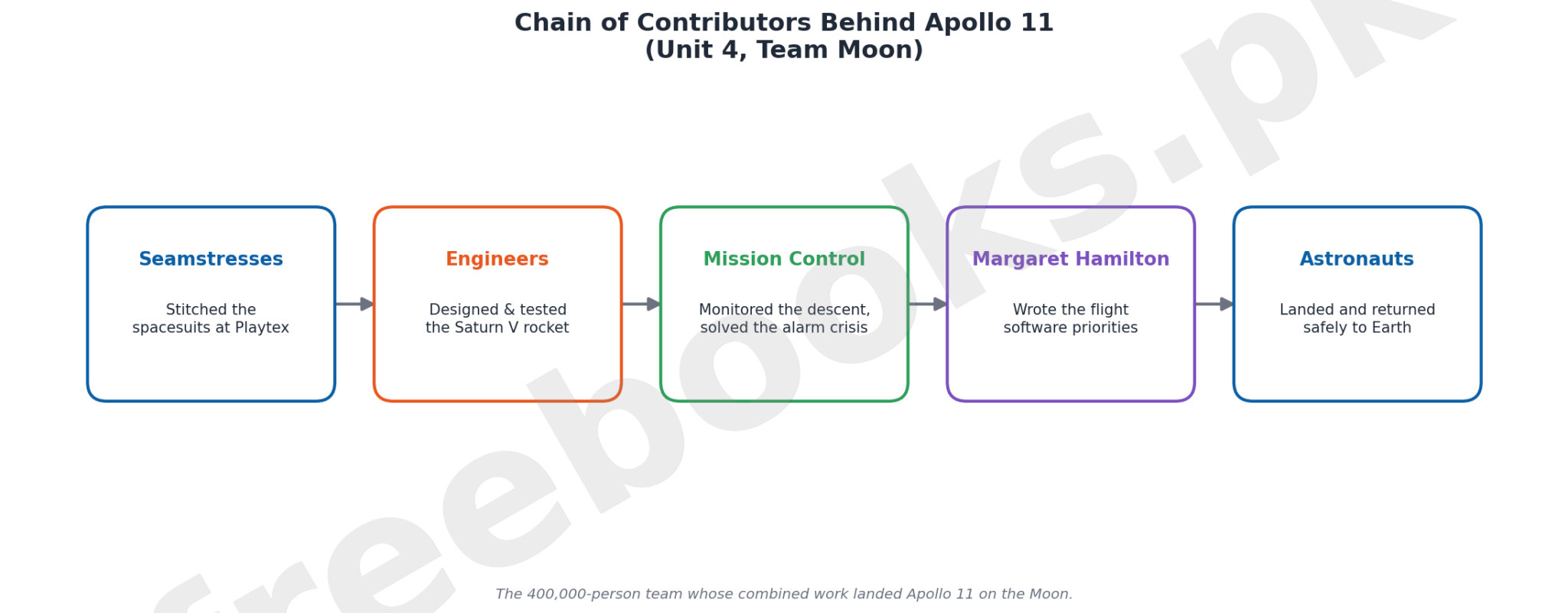
Chain of Contributors Behind Apollo 11: A sequential flow diagram of five connected boxes — Seamstresses, Engineers, Mission Control, Margaret Hamilton, and Astronauts — joined by arrows showing how each group's work fed into the mission's overall success, illustrating the passage's central idea that Apollo 11 was a team effort of 400,000 people.
Short Questions & Answers
What words did Neil Armstrong speak as he became the first human to step onto the Moon?
He said, 'That's one small step for man, one giant leap for mankind,' words that became a symbol of human achievement and were heard across televisions and radios worldwide.
Why was the work of the seamstresses at Playtex so important for the mission?
They crafted the spacesuits that protected the astronauts in the vacuum of space, and the suits had to be flexible yet strong enough that one misplaced stitch could spell disaster — making their careful, precise work a matter of life and death.
What challenges did the NASA engineers face with the Saturn V rocket?
They faced insurmountable-seeming challenges such as keeping the rocket stable, navigating through space with precision, and bringing the astronauts home safely, solving them through countless tests, simulations, and calculations.
What happened at Mission Control during the lunar module's descent?
Unexpected alarms suddenly blared as the lunar module 'Eagle' descended; flight controllers quickly determined the guidance computer was simply overloaded but still functioning, and their swift, calm decision-making allowed the descent to continue safely.
Who was Margaret Hamilton, and why was her work important?
She was the software engineer who led the team that developed the lunar module's flight software, creating code that could prioritise critical tasks — a feature that let the overloaded computer discard less important tasks and focus on landing safely.
What does the phrase 'a symphony conducted by countless hands' suggest about the mission's success?
It suggests that Apollo 11's success depended on the coordinated efforts of many different people — from janitors and technicians to scientists — each playing an essential part, much like musicians in an orchestra.
How long did Armstrong and Aldrin spend on the lunar surface, and what happened afterward?
They spent just over 21 hours on the lunar surface before rejoining Collins in the command module for the journey back to Earth, splashing down safely in the Pacific Ocean.
What is the central theme of 'Team Moon' according to the passage?
The central theme is the power of teamwork and collaboration in achieving extraordinary goals, showing that Apollo 11's success belonged to the 400,000 people who worked together, not just the three astronauts.
Long Questions & Answers
Discuss how the passage highlights the contributions of lesser-known individuals behind the Apollo 11 mission.
How does the passage describe the seamstresses' contribution?
The passage describes a team of seamstresses at Playtex who crafted the astronauts' spacesuits with meticulous care, knowing that one misplaced stitch could mean disaster. Their work, done far from the launch pads and public attention, is presented as a matter of life and death, showing that skilled manual labour was just as essential to the mission's success as the more visible engineering and piloting roles.
How does the passage present the role of the NASA engineers?
The engineers are shown tackling problems no one had solved before, refining the Saturn V rocket through countless tests, simulations, and calculations, and working tirelessly, often late into the night. The passage credits their collective effort and belief that they were part of something larger than themselves as central to overcoming the mission's technical challenges.
What role does Margaret Hamilton play in the narrative, and why is she called an 'unsung hero'?
Margaret Hamilton led the team that developed the lunar module's flight software, writing code by hand that could prioritise critical tasks during the landing. She is called an unsung hero because her foresight directly saved the mission when the computer became overloaded during descent, yet her contribution is far less publicly celebrated than the astronauts'.
Why does the author choose to widen the narrative beyond the three astronauts?
By naming and describing the seamstresses, engineers, flight controllers, and software engineers, the author shows that the Moon landing was not achieved by three individuals alone but by 400,000 people working together. This structural choice reinforces the passage's central theme of teamwork and gives credit to workers whose contributions are often overlooked in traditional retellings of the space race.
Explain the crisis during the lunar descent and how it was resolved, and discuss what this reveals about the mission's teamwork.
What happened when the lunar module 'Eagle' began its descent?
As the lunar module descended towards the Moon, unexpected alarms suddenly blared inside the spacecraft and at Mission Control — error codes that no one had expected during the final, most critical phase of the landing, creating a moment of intense tension.
How did the flight controllers at Mission Control respond to the alarms?
The flight controllers quickly sprang into action, scanning their screens, consulting their manuals, and conferring with each other. Within mere seconds, they determined that the alarms were not mission-critical — the guidance computer was simply overloaded with data but still functioning properly, allowing Armstrong and Aldrin to safely continue their descent.
How did Margaret Hamilton's software contribute to resolving the crisis?
Hamilton's team had designed the flight software with the foresight to prioritise the most critical tasks. When the computer became overloaded during the descent, this design meant it automatically discarded less important tasks and focused on the essential task of landing the spacecraft, directly enabling the mission's success at its most dangerous moment.
What does this crisis and its resolution reveal about the mission as a whole?
The crisis shows that Apollo 11's success depended on the calm, trained expertise of many people working together under pressure — flight controllers making split-second decisions and a software engineer's earlier foresight combining at the critical moment. It reinforces the passage's theme that no single person, however skilled, could have landed on the Moon alone; it required the coordinated readiness of the entire team.
Multiple Choice Questions (MCQs)
What words did Neil Armstrong speak upon stepping onto the Moon? (A) "Houston, Tranquility Base here." (B) "That's one small step for man, one giant leap for mankind." (C) "The Eagle has landed safely." (D) "We came in peace for all mankind."
Correct answer: (B) "That's one small step for man, one giant leap for mankind.". Armstrong's famous words upon becoming the first human to step onto the Moon were 'That's one small step for man, one giant leap for mankind.'
What was the seamstresses' task at Playtex? (A) Testing rocket engines (B) Crafting the astronauts' spacesuits (C) Writing the flight software (D) Monitoring Mission Control screens
Correct answer: (B) Crafting the astronauts' spacesuits. The seamstresses at Playtex were responsible for crafting the spacesuits that protected the astronauts in the harsh environment of space.
What rocket is described as a 'towering behemoth of engineering'? (A) The Eagle lunar module (B) The Saturn V rocket (C) The command module Columbia (D) The Mission Control tower
Correct answer: (B) The Saturn V rocket. The passage describes the Saturn V rocket as a towering behemoth of engineering that had to function flawlessly.
What caused the alarms during the lunar module's descent? (A) A fuel leak (B) The guidance computer being overloaded with data (C) A structural crack in the module (D) Loss of radio contact with Houston
Correct answer: (B) The guidance computer being overloaded with data. The alarms were caused by the guidance computer being overloaded with unnecessary data, though it was still functioning properly.
Who led the team that developed the lunar module's flight software? (A) Neil Armstrong (B) Buzz Aldrin (C) Margaret Hamilton (D) Michael Collins
Correct answer: (C) Margaret Hamilton. Margaret Hamilton was the software engineer who led the team that developed the onboard flight software for the lunar module.
What did Hamilton's software do when the computer became overloaded? (A) It shut down completely (B) It discarded less important tasks and focused on landing (C) It restarted the entire system (D) It transferred control to Mission Control
Correct answer: (B) It discarded less important tasks and focused on landing. Hamilton's foresight meant the software discarded less critical tasks and focused on landing the spacecraft when the computer became overloaded.
What phrase does the passage use to describe the mission's overall success? (A) "A race against time" (B) "A symphony conducted by countless hands" (C) "A leap into the unknown" (D) "A battle of wits"
Correct answer: (B) "A symphony conducted by countless hands". The passage describes the mission's success as 'a symphony conducted by countless hands', emphasising the coordinated efforts of many contributors.
Approximately how long did Armstrong and Aldrin spend on the lunar surface? (A) Just over 21 hours (B) About 3 days (C) Roughly 6 hours (D) Just over 48 hours
Correct answer: (A) Just over 21 hours. The passage states that Armstrong and Aldrin spent just over 21 hours on the lunar surface before rejoining Collins for the return journey.
Where did the Apollo 11 command module splash down after the mission? (A) The Atlantic Ocean (B) The Indian Ocean (C) The Pacific Ocean (D) The Gulf of Mexico
Correct answer: (C) The Pacific Ocean. The astronauts splashed down safely in the Pacific Ocean, marking the successful conclusion of the mission.
What is the central theme of 'Team Moon' as presented in the passage? (A) The dangers of space travel (B) The power of teamwork and collaboration in achieving extraordinary goals (C) The rivalry between NASA engineers and astronauts (D) The technical limits of 1960s computing
Correct answer: (B) The power of teamwork and collaboration in achieving extraordinary goals. The passage's central theme is the power of teamwork and collaboration, showing that Apollo 11's success depended on 400,000 people working together, not just the astronauts.
Quick Revision Summary
- 'Team Moon' is adapted from Catherine Thimmesh's book about the 400,000 people who worked together to land Apollo 11 on the Moon.
- Neil Armstrong's words, 'That's one small step for man, one giant leap for mankind,' became a symbol of human achievement.
- Seamstresses at Playtex hand-stitched the astronauts' spacesuits with meticulous care, knowing errors could be fatal.
- NASA engineers built and refined the Saturn V rocket through countless tests, simulations, and calculations.
- At Mission Control, flight controllers quickly resolved unexpected alarms during the lunar module's descent.
- Margaret Hamilton led the team that wrote the flight software, which prioritised critical tasks and saved the landing.
- The passage describes the mission's success as 'a symphony conducted by countless hands.'
- Armstrong and Aldrin spent just over 21 hours on the lunar surface before returning to the command module.
- The astronauts splashed down safely in the Pacific Ocean, completing the mission.
- The central theme is that great achievements, like the Moon landing, are made possible through teamwork and collaboration.
Exam Tips
- Unit 4 does not currently appear in this year's PECTAA paper pattern (the pattern draws from Units 1, 2, 5, 8, 10 as the prose group and Units 3, 6, 11, 13 as the poem group), so treat this unit as extra reading and comprehension practice rather than a primary exam-focus unit.
- Even though it may not be directly examined this year, the vocabulary and glossary words here (behemoth, insurmountable, perseverance, trajectory, and others) are useful general-purpose academic words worth learning for the synonym questions drawn from other units.
- Practise identifying the main idea of each of the passage's named sections (seamstresses, engineers, Mission Control, Margaret Hamilton) — this kind of section-by-section comprehension skill transfers directly to the examinable prose units.
- If your teacher does include this unit for internal assessment, the Mission Control crisis (unexpected alarms during descent) is the passage's most detailed, exam-worthy episode — be ready to narrate it in sequence.
- Use this unit's questions on structure and point of view (why the author focuses on lesser-known contributors) as practice for the kind of critical-thinking questions that may appear on other units in this book.
- Keep the distinction clear between the real historical facts of Apollo 11 and the fact that this specific text is an adapted, reimagined retelling — exam answers should stay faithful to what the passage itself states.