This unit introduces the Seerah (biography) of Rasoolullah (ﷺ), Khatam-un-Nabiyeen, as presented in the Class 11 English textbook of the PECTAA Board under the Updated National Curriculum of Pakistan 2023.
Framed as a biography/personal recount, the passage traces his early life in Makkah, his character before Prophethood, the first revelation, the migration to Madinah, and the Farewell Sermon, while also building students' skills in reading comprehension and vocabulary.
These notes summarise the passage strictly as given in the textbook, preserving the honorifics used for Rasoolullah (ﷺ) and Hazrat Khadijah (رضي الله عنها), and provide comprehension questions, vocabulary, and exam-oriented material for this unit.
Learning Objectives
- Respond to the text through arguments and class discussion about its key events and values.
- Read the passage aloud with correct pronunciation, appropriate pitch, and voice variation suitable for a biographical/non-fictional text.
- Analyse the passage as a biography/personal recount and identify its structure and purpose.
- Distinguish between the denotative (literal) and connotative (emotional/cultural) meanings of words used in the passage.
- Build subject-specific vocabulary using the glossary words introduced in this unit.
- Write informative/explanatory texts, such as short essays and biographical sketches, based on the unit's content.
Key Concepts
Early Life and Orphanhood
Rasoolullah (ﷺ) was born in 571 AD in Makkah into the noble and highly esteemed Quraish clan, at a time when Arabian society was marked by moral decay, idolatry, tribal arrogance, and widespread injustice. Known as the benefactor of humanity, he appeared while the world was silently yearning for the dawn of enlightenment and divine guidance.
His early years were shaped by profound personal loss. His father, Hazrat Abdullah, passed away before his birth, and his mother, Hazrat Amina, died when he was only six years old. Orphaned at such a tender age, he was taken in by his grandfather, Hazrat Abdul Muttalib, who cared for him until his own passing two years later, after which his paternal uncle, Hazrat Abu Talib, became his steadfast guardian throughout his youth.
Character, Trade, and Hilf al-Fudul
Despite the hardship of orphanhood, Rasoolullah (ﷺ) grew into a young man of exceptional character — known for his truthfulness, humility, generosity, and sense of justice. His honest and fair dealings in trade earned him universal respect among the people of Makkah, who bestowed on him the titles Al-Sadiq (The Truthful) and Al-Amin (The Trustworthy).
Two events from his early adulthood illustrate this noble character. He took part in Hilf al-Fudul, a pact formed by the tribes of Makkah to defend the oppressed and uphold justice — an alliance he later said he would still honour even after the advent of Islam. He also gave a wise, impartial solution during the reconstruction of the Ka'bah, when a dispute arose among the Quraish over who would place the Hajr-e-Aswad (Black Stone), preventing conflict and earning admiration from all quarters.
Marriage to Hazrat Khadijah (رضي الله عنها)
A significant chapter of his personal life began with his marriage to Hazrat Khadijah (رضي الله عنها), a woman of outstanding virtue, intellect, and business acumen who had inherited and successfully managed her father's prosperous trade. Hearing of his integrity in business, she entrusted him with a trade expedition to Syria.
Deeply impressed by his honesty, graceful conduct, and upright character, she later proposed marriage through the family of Hazrat Abu Talib, and their union was built on mutual respect and affection. Hazrat Khadijah (رضي الله عنها) stood beside Rasoolullah (ﷺ) as his first supporter, providing emotional and financial support during the most challenging early years of his mission.
The First Revelation
As Rasoolullah (ﷺ) approached the age of forty, he became deeply saddened by the moral decay and injustice prevailing in Makkan society, and would frequently retreat to the Cave of Hira seeking solitude and reflection. During one such retreat in the month of Ramadan, Hazrat Jibraeel (عليه السلام) appeared before him with the first revelation, commanding 'Read!', after which the opening verses of Surah Al-'Alaq (96:1-5) were revealed.
This moment marked the beginning of his mission as the last Rasool of Allah. The revelation of the Qur'an brought spiritual awakening and initiated a radical transformation in Arabia's socio-political and moral fabric — the call to Tauhid (the Oneness of Allah) challenged deep-rooted idolatry, class privilege, and social injustice, laying the foundation for a society based on truth, equality, accountability, and compassion.
Persecution and the Hijrah to Madinah
The same Quraish who had once admired Rasoolullah (ﷺ) now became his staunch opponents, viewing his message as a threat to their traditions and authority. The Muslims faced relentless persecution, economic boycotts, and social ostracism, yet Rasoolullah (ﷺ) remained unwavering and continued preaching Islam with patience, wisdom, and resilience.
As oppression grew unbearable, Rasoolullah (ﷺ) was divinely commanded to migrate to Madinah. This migration, the Hijrah, was a decisive turning point in Islamic history, marking the establishment of the first Islamic society.
The Charter of Madinah and Early Battles
In Madinah, the Charter of Madinah — crafted under the guidance of Rasoolullah (ﷺ) — introduced principles of governance rooted in civic equality, religious freedom, and the rule of law. It united diverse communities, guaranteeing protection for all citizens regardless of faith or ethnicity, a revolutionary model of coexistence and justice for its time.
The growing strength of the Muslim community led to military encounters with the Quraish. The first major battle, Badr, resulted in a remarkable Muslim victory and reinforced the legitimacy of Rasoolullah's (ﷺ) mission.
The Conquest of Makkah
Further victories culminated in the Conquest of Makkah in 8 AH. This event was astonishingly bloodless, marked by the exemplary mercy of Rasoolullah (ﷺ), who declared a general amnesty even for those who had persecuted him — a victory not merely of land, but of spirit, the triumph of forgiveness over vengeance.
This unmatched act of compassion transformed the hearts of the people and marked not just the political liberation of Makkah but a spiritual awakening across Arabia, reflecting the Qur'anic description of Rasoolullah (ﷺ) as sent 'as a mercy to the worlds' (Surah Al-Anbiya, 21:107).
The Farewell Sermon and Legacy
By the tenth year of Hijrah, Islam had spread across the Arabian Peninsula. That year, Rasoolullah (ﷺ) performed Hajjat-ul-Wida (the Farewell Pilgrimage), and on the plain of Arafat he delivered his final sermon — a profound address affirming universal human dignity: 'An Arab has no superiority over a non-Arab, nor does a non-Arab have superiority over an Arab… except through piety and righteous action' (Musnad Ahmad, 23489).
With this address, the divine mission of Rasoolullah (ﷺ) reached its fulfilment. He had delivered the final message of Allah, established a community of believers, and modelled a way of life balancing faith with justice, mercy, and truth — a legacy that continues to inspire and guide humanity across all barriers of time, place, and culture.
Important Definitions (Glossary)
acumen
the ability to understand and decide things quickly and well
alliance
an agreement between countries, political parties, etc. to work together in order to achieve something that they all want
benefactor
a person who offers support, help, or assistance, often in the form of financial aid, teachings, and actions, guiding and uplifting individuals, communities, or causes in need
idolatry
the practice of worshipping statues as gods
legitimacy
the quality of being based on a fair or acceptable reason
ostracism
the act of deliberately not including somebody in a group or activity; the state of not being included
persecution
the act of treating somebody in a cruel and unfair way, especially because of their race, religion or political beliefs
profound
showing great knowledge or understanding
radical
relating to the most basic and important parts of something; complete and detailed
solitude
the state of being alone, especially when you find this pleasant
vengeance
the act of punishing or harming somebody in return for what they have done to you, your family or friends
yearning
a strong and emotional desire
Key Facts: Seerah Timeline
| Date / Period | Key Event |
|---|---|
| 571 AD | Birth of Rasoolullah (ﷺ) in Makkah into the Quraish clan. |
| Age 6 | Death of his mother, Hazrat Amina; raised thereafter by his grandfather, then his uncle Hazrat Abu Talib. |
| Before Prophethood | Marriage to Hazrat Khadijah (رضي الله عنها), who became his first supporter. |
| Age 40 | First revelation in the Cave of Hira during Ramadan (Surah Al-'Alaq, 96:1-5). |
| 1 AH | Hijrah — migration to Madinah; the Charter of Madinah is established. |
| 2 AH | Battle of Badr — the first major victory, reinforcing the legitimacy of the mission. |
| 8 AH | Conquest of Makkah — largely bloodless, marked by a general amnesty. |
| 10 AH | Farewell Sermon (Hajjat-ul-Wida) delivered at Arafat. |
Diagram
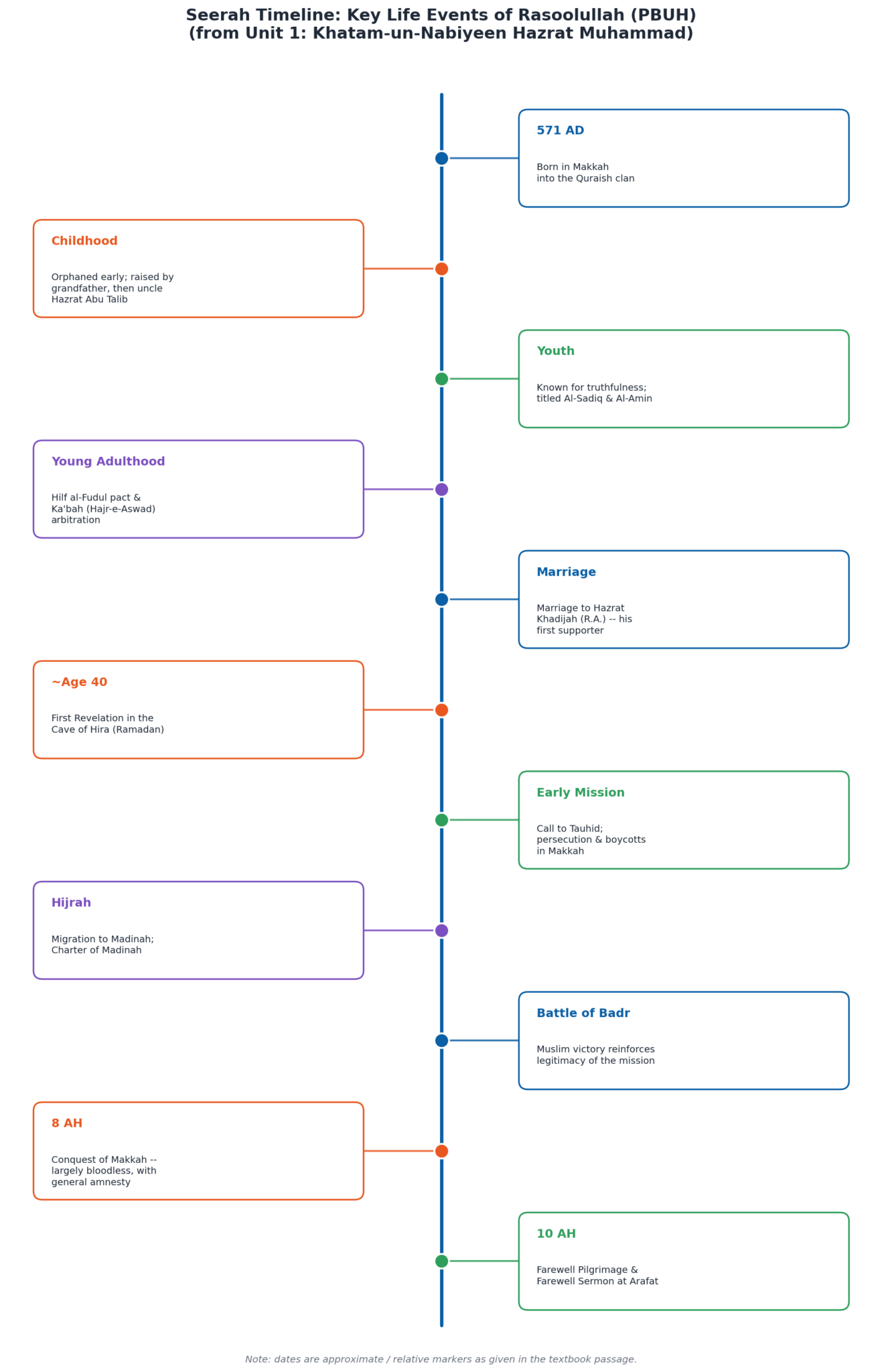
Seerah Timeline: A vertical, purely textual timeline of the key life events of Rasoolullah (ﷺ) as described in the passage, from his birth in Makkah (571 AD) through his childhood, marriage, first revelation, Hijrah, Battle of Badr, Conquest of Makkah, and the Farewell Sermon, shown as labelled boxes and dates connected by a single line (no illustrated figures).
Short Questions & Answers
Where and when was Rasoolullah (ﷺ) born, and what was the condition of Arabian society at that time?
He was born in 571 AD in Makkah into the Quraish clan. Arabian society at that time was marked by moral decay, idolatry, tribal arrogance, and widespread injustice.
Who cared for Rasoolullah (ﷺ) after his mother's death?
After his mother, Hazrat Amina, passed away when he was six, he was first raised by his grandfather, Hazrat Abdul Muttalib, and after his grandfather's death, by his paternal uncle, Hazrat Abu Talib.
What titles did Rasoolullah (ﷺ) earn in his youth, and why?
He earned the titles Al-Sadiq (The Truthful) and Al-Amin (The Trustworthy) because of his truthfulness, humility, generosity, sense of justice, and honest dealings in trade.
What was Hilf al-Fudul, and why is it significant?
Hilf al-Fudul was a pact formed by the tribes of Makkah to defend the oppressed and uphold justice. Rasoolullah (ﷺ) took part in it and later spoke fondly of honouring such a cause even after the advent of Islam, showing his lifelong commitment to justice.
How did Hazrat Khadijah (رضي الله عنها) come to marry Rasoolullah (ﷺ)?
She was impressed by his honesty, graceful conduct, and upright character after entrusting him with a trade expedition to Syria. She then proposed marriage through the family of Hazrat Abu Talib.
What happened at the Cave of Hira?
Around the age of forty, Rasoolullah (ﷺ) retreated to the Cave of Hira for solitude and reflection. During Ramadan, Hazrat Jibraeel (عليه السلام) appeared and brought the first revelation, the opening verses of Surah Al-'Alaq (96:1-5).
What was the Charter of Madinah?
The Charter of Madinah was drafted under the guidance of Rasoolullah (ﷺ) after the Hijrah. It introduced principles of civic equality, religious freedom, and the rule of law, uniting diverse communities and guaranteeing protection for all citizens regardless of faith or ethnicity.
What happened during the Conquest of Makkah, and why is it significant?
The Conquest of Makkah in 8 AH was largely bloodless. Rasoolullah (ﷺ) declared a general amnesty, forgiving even those who had persecuted him, showing that the triumph of forgiveness over vengeance was more important than mere conquest of land.
Long Questions & Answers
Discuss the early life and character of Rasoolullah (ﷺ) before Prophethood, and explain what these events reveal about his personal qualities.
What personal losses did Rasoolullah (ﷺ) experience in early life, and who raised him afterwards?
His father, Hazrat Abdullah, passed away before his birth, and his mother, Hazrat Amina, died when he was only six years old. Orphaned at a tender age, he was first raised by his grandfather, Hazrat Abdul Muttalib, and after his grandfather's death two years later, by his paternal uncle, Hazrat Abu Talib, who remained a steadfast guardian throughout his youth. These early losses reveal that, despite great personal hardship, he grew into a young man of exceptional strength and character.
How did the people of Makkah regard Rasoolullah (ﷺ) before Prophethood, and why?
He was known for his truthfulness, humility, generosity, and sense of justice, and his interactions reflected integrity and gentleness. He engaged in trade with honesty and fairness, and these qualities earned him universal respect among the people of Makkah, who bestowed on him the titles Al-Sadiq (The Truthful) and Al-Amin (The Trustworthy). This widespread respect, built entirely on his conduct rather than on wealth or status, later became one reason his early message was taken seriously by those who knew him well.
What does his role in Hilf al-Fudul and the Ka'bah dispute reveal about his character?
His participation in Hilf al-Fudul, a pact formed by the tribes of Makkah to defend the oppressed and uphold justice, shows his early and lasting commitment to fairness; he later said he would still honour such a cause even after the advent of Islam. His wise, impartial arbitration in the dispute over placing the Hajr-e-Aswad during the Ka'bah's reconstruction prevented conflict among the Quraish and earned admiration from all quarters, revealing his wisdom, fairness, and ability to unite rival parties.
How did his marriage to Hazrat Khadijah (رضي الله عنها) reflect on his early reputation?
Hazrat Khadijah (رضي الله عنها), a woman of virtue and business acumen, entrusted him with a trade expedition to Syria after hearing of his integrity. Deeply impressed by his honesty and upright conduct, she proposed marriage through the family of Hazrat Abu Talib. This shows that his reputation for honesty and trustworthiness was already widely recognised in Makkah before his Prophethood began.
Explain the mission of Rasoolullah (ﷺ) from the first revelation to the Farewell Sermon.
What happened at the Cave of Hira, and why is the first revelation significant?
Around the age of forty, Rasoolullah (ﷺ) had been retreating to the Cave of Hira for solitude and reflection, troubled by the moral decay of Makkan society. During one such retreat in Ramadan, Hazrat Jibraeel (عليه السلام) appeared with the first revelation, the opening verses of Surah Al-'Alaq (96:1-5). This moment marked the beginning of his mission as the last Rasool of Allah and initiated a radical transformation in Arabia, as the call to Tauhid challenged idolatry, class privilege, and social injustice.
Why did Rasoolullah (ﷺ) migrate to Madinah, and what was this migration called?
As Quraish opposition grew into persecution, economic boycotts, and social ostracism, and oppression became unbearable, he was divinely commanded to migrate from Makkah to Madinah. This migration is known as the Hijrah, and it marked a decisive turning point in Islamic history, ending years of hardship in Makkah and leading directly to the establishment of the first Islamic society under his leadership.
What did the Charter of Madinah establish, and what was the outcome of the Battle of Badr?
The Charter of Madinah, drafted under his guidance, introduced principles of governance rooted in civic equality, religious freedom, and the rule of law, uniting diverse communities and guaranteeing protection for all citizens regardless of faith or ethnicity. The Battle of Badr, the first major military encounter with the Quraish, resulted in a remarkable Muslim victory that reinforced the legitimacy of the mission.
What happened at the Conquest of Makkah, and what core message did the Farewell Sermon deliver?
The Conquest of Makkah in 8 AH was largely bloodless; Rasoolullah (ﷺ) declared a general amnesty even for those who had persecuted him, a triumph of forgiveness over vengeance. By 10 AH, Islam had spread across Arabia, and at the Farewell Sermon delivered at Arafat, he proclaimed the equality of all human beings regardless of race, declaring that superiority lies only 'through piety and righteous action', marking the fulfilment of his mission.
Multiple Choice Questions (MCQs)
In which year and city was Rasoolullah (ﷺ) born? (A) 571 AD, Madinah (B) 571 AD, Makkah (C) 610 AD, Makkah (D) 622 AD, Madinah
Correct answer: (B) 571 AD, Makkah. The passage states he was born in 571 AD in Makkah into the Quraish clan.
What titles were given to Rasoolullah (ﷺ) in his youth for his honesty in trade? (A) Al-Fatih and Al-Ameen (B) Al-Sadiq and Al-Amin (C) Al-Mursal and Al-Hadi (D) Al-Kareem and Al-Rasheed
Correct answer: (B) Al-Sadiq and Al-Amin. The people of Makkah gave him the titles Al-Sadiq (The Truthful) and Al-Amin (The Trustworthy).
Where did Rasoolullah (ﷺ) receive the first revelation, and who brought it? (A) Cave of Thawr, brought by Hazrat Abu Bakr (B) Cave of Hira, brought by Hazrat Jibraeel (عليه السلام) (C) Masjid al-Haram, brought by Hazrat Khadijah (D) Mount Arafat, brought by Hazrat Abu Talib
Correct answer: (B) Cave of Hira, brought by Hazrat Jibraeel (عليه السلام). The first revelation was brought by Hazrat Jibraeel (عليه السلام) to Rasoolullah (ﷺ) during a retreat at the Cave of Hira.
What did the Charter of Madinah establish? (A) Trade routes between Makkah and Syria (B) Civic equality, religious freedom, and the rule of law (C) A ban on all religious practices (D) A single-tribe government
Correct answer: (B) Civic equality, religious freedom, and the rule of law. The Charter of Madinah introduced principles of governance rooted in civic equality, religious freedom, and the rule of law for all communities.
What characterised the Conquest of Makkah in 8 AH? (A) A prolonged and bloody siege (B) A largely bloodless conquest with a general amnesty (C) The destruction of the Ka'bah (D) A treaty that excluded the Quraish
Correct answer: (B) A largely bloodless conquest with a general amnesty. The Conquest of Makkah was largely bloodless, and Rasoolullah (ﷺ) declared a general amnesty even for former persecutors.
According to the Farewell Sermon, what determines a person's superiority over another? (A) Race and tribal lineage (B) Wealth and social status (C) Piety and righteous action (D) Place of birth
Correct answer: (C) Piety and righteous action. The Farewell Sermon proclaimed that no Arab has superiority over a non-Arab, nor a white person over a black person, except through piety and righteous action.
Before Islam, many tribes in Arabia practised widespread idolatry, bowing before carved stone idols instead of worshipping one God. In this sentence, 'idolatry' means: (A) the belief in one God (B) the practice of worshipping statues as gods (C) a system of trade (D) a form of poetry
Correct answer: (B) the practice of worshipping statues as gods. Idolatry means the practice of worshipping statues as gods, as given in the unit's glossary.
The early Muslims endured harsh persecution from the Quraish, including social boycotts and open hostility, simply for their faith. Here, 'persecution' means: (A) generous support (B) cruel and unfair treatment because of one's beliefs (C) friendly negotiation (D) a formal celebration
Correct answer: (B) cruel and unfair treatment because of one's beliefs. Persecution means treating somebody in a cruel and unfair way, especially because of their beliefs, as given in the glossary.
The Farewell Sermon was a profound address that captured the ethical heart of Islam in a few sentences. In this context, 'profound' means: (A) showing great knowledge or understanding (B) short and simple (C) loud and dramatic (D) written in verse
Correct answer: (A) showing great knowledge or understanding. Profound means showing great knowledge or understanding, as given in the unit's glossary.
Facing ostracism from their own tribe, the early Muslims found themselves excluded from Makkan social and economic life. 'Ostracism' here means: (A) a warm welcome (B) deliberate exclusion from a group (C) a financial reward (D) a religious festival
Correct answer: (B) deliberate exclusion from a group. Ostracism means the act of deliberately not including somebody in a group or activity, as given in the glossary.
Quick Revision Summary
- Rasoolullah (ﷺ) was born in 571 AD in Makkah into the Quraish clan, at a time of moral decay and idolatry.
- Orphaned early, he was raised first by his grandfather Hazrat Abdul Muttalib, then by his uncle Hazrat Abu Talib.
- Known in youth for truthfulness and trustworthiness, he earned the titles Al-Sadiq and Al-Amin.
- He took part in Hilf al-Fudul and gave a wise, impartial solution to the Ka'bah's Hajr-e-Aswad dispute.
- He married Hazrat Khadijah (رضي الله عنها), who became his first supporter emotionally and financially.
- At about age 40, he received the first revelation from Hazrat Jibraeel (عليه السلام) in the Cave of Hira during Ramadan.
- The call to Tauhid led to Quraish persecution, boycotts, and social ostracism of the early Muslims.
- The divinely commanded Hijrah to Madinah led to the Charter of Madinah, establishing civic equality and rule of law.
- Victory at Badr was followed by the largely bloodless Conquest of Makkah in 8 AH, marked by general amnesty.
- The Farewell Sermon at Arafat in 10 AH proclaimed human equality through piety alone, marking the fulfilment of his mission.
Exam Tips
- This unit belongs to PECTAA's 'prose group' (Units 1, 2, 5, 8, 10), which under the current paper pattern carries heavier weight — 5 of the paper's synonym questions and 3 of its MCQs are drawn from these prose units, so revise the 12 glossary words in this unit carefully.
- Since only 7 of the 10 short questions asked from the prose group need to be attempted, practice answering all 8 short questions in this unit so you have a comfortable choice on exam day.
- This unit's passage may also be set for the punctuation exercise, so practice punctuating an unpunctuated extract drawn from this unit as part of your preparation.
- Be ready for either the Urdu-translation option or the alternate essay-writing option paired with this unit — practice translating a few passage extracts into Urdu, and also outline a short essay in case that option is chosen instead.
- Learn the glossary words with their exact textbook meanings, since examiners often test vocabulary directly through synonym-in-context questions like the ones in this unit's MCQs.
- Maintain a formal, respectful tone and stick strictly to facts from the text when answering questions about Rasoolullah (ﷺ); avoid inserting personal opinions or unsupported details.