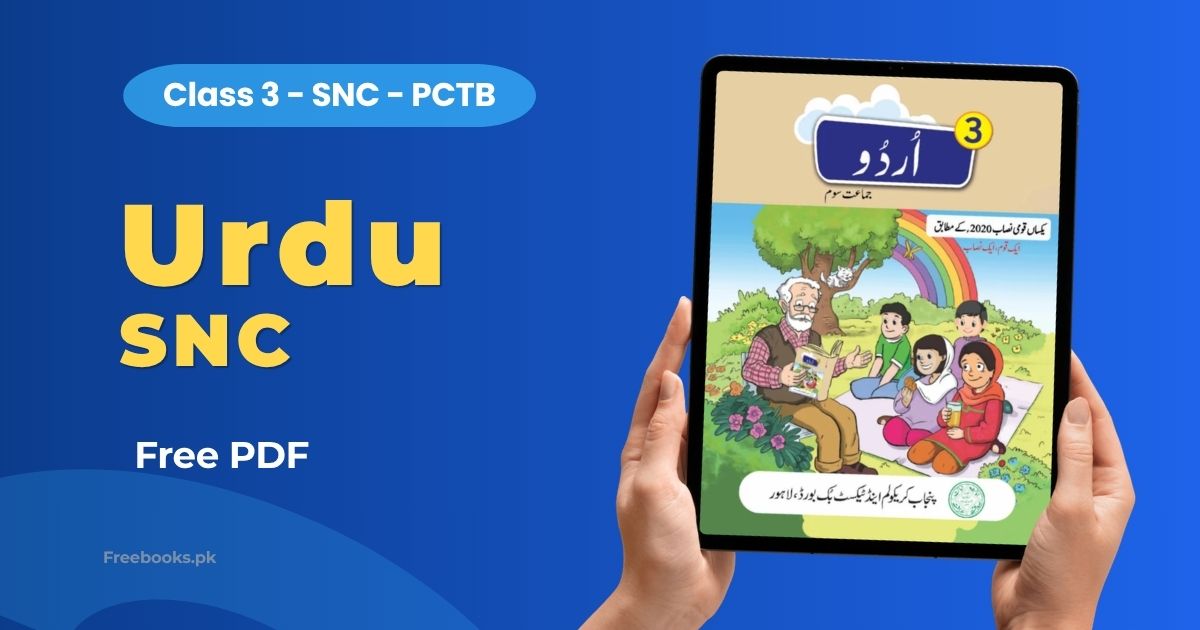
Urdu for Class 3 is part of the official Punjab Curriculum and Textbook Board (PCTB) syllabus, based on the Single National Curriculum (SNC) 2020. This page covers all 22 lessons of the book, a mix of poems, moral stories, and Seerat lessons built around themes like gratitude, kindness, honesty, and love for Pakistan.
For Class 3 students, this book builds early reading and vocabulary skills through simple stories and rhymes rather than long, difficult passages. Each lesson summary and its important questions on this page make revision quicker before class tests, so young learners can recall key points and answers without flipping back through the whole book.
Book Overview
| Class | 3 |
| Subject | Urdu |
| Board | Punjab Curriculum and Textbook Board (PCTB) |
| Curriculum | Single National Curriculum (SNC) 2020 |
| Total Lessons | 22 (plus 5 Review units) |
| Total Pages | 166 |
| Format | PDF (Free Download) |
Chapter List
Lesson 1: Hamd (حمد)
This Hamd praises Allah for creating the world’s beautiful sights, from gardens and flowers in bloom to the stars scattered across the sky. Written by Akhtar Sherani, the poem calls on children to sing of Allah’s greatness and oneness, since every flower and star reflects His glory. Students learn new vocabulary and practice identifying words from the poem.
Important Questions:
- Who created the beautiful sights of the world, according to the poem? Answer: Allah alone, who made the flowers on earth and the stars in the sky.
- Who is the poet of this Hamd? Answer: Akhtar Sherani.
- What does the poem ask children to sing about? Answer: The greatness (azmat) and oneness (wahdat) of Allah.
- What is a Hamd? Answer: A poem written in praise of Allah.
Lesson 2: Naat (نعت)
Written by Khawaja Abid Nizami, this Naat praises Prophet Muhammad (PBUH) as the light of hearts who arrived at a time when the world was overtaken by wrongdoing and darkness. The poem describes how his teachings became a source of guidance and how his coming transformed the lives of people around him. Students learn new vocabulary and discuss the poem’s central message about the Prophet’s greatness.
Important Questions:
- Who wrote this Naat? Answer: Khawaja Abid Nizami.
- What condition was the world in before the Prophet’s (PBUH) arrival, according to the poem? Answer: Wrongdoing and darkness had spread everywhere.
- What did the Prophet (PBUH) give to the world, according to the poem? Answer: The light of knowledge and guidance.
- What does the poem call the Prophet (PBUH)? Answer: The light of hearts (dilon ke ujale) and the Prophet for all people.
Lesson 3: Bemisal Hai Zaat-e-Rasool Kareem (PBUH) Ki (بے مثل ہے ذات رسول کریم کی)
This lesson tells the story of travellers who trade their camel to a stranger for dates near Madinah, only to worry afterward that they do not know him. The stranger later sends far more dates than agreed, and they discover him delivering a sermon from the mosque pulpit, revealing himself to be Prophet Muhammad (PBUH). The lesson highlights the Prophet’s honesty and trustworthiness, qualities that earned him the titles Sadiq and Ameen even before his prophethood.
Important Questions:
- What did the travellers trade for a camel near Madinah? Answer: They agreed to give dates equal to the camel’s price to a stranger.
- What worried the travellers after the stranger left with their camel? Answer: They realised they did not actually know who the man was.
- Who turned out to be the stranger who bought the camel? Answer: Prophet Muhammad (PBUH), whom they later saw delivering a sermon from the mosque pulpit.
- Why did the people of Makkah call the Prophet (PBUH) “Sadiq” and “Ameen”? Answer: Because of his honesty and trustworthiness, shown even in ordinary dealings like this one.
Lesson 4: Agar Main Na Hun To! (اگر میں نہ ہوں تو!)
Told from the point of view of a mobile phone, this lesson explains how the telephone evolved from a wired device into today’s portable mobile phone that people can carry anywhere. It describes the many uses of a mobile phone, from calling and messaging to schoolwork, booking tickets, and photography, while also warning children to use it carefully, avoid it near electrical equipment or while driving, and never share personal photos or information with strangers online.
Important Questions:
- What did earlier telephones look like, before the mobile phone was invented? Answer: They were connected by wires and could not be carried from place to place.
- Name two uses of a mobile phone mentioned in the lesson. Answer: Doing homework research on the internet and booking tickets for buses, trains, or flights.
- What safety advice does the lesson give about using the phone while driving? Answer: A mobile phone should never be used while driving, to avoid accidents.
- What does the lesson warn about sharing information online? Answer: Never share your own or your family’s photos or personal information with someone you do not know.
Lesson 5: Sab Hain Khaas (سب ہیں خاص)
This lesson introduces readers to people working in different professions in society, including a teacher, an agricultural expert, an engineer, a lawyer, a shopkeeper, and a nurse, describing what each one does to serve the community. It explains that every profession, whether teaching, farming, building, or healing, deserves equal respect because each one meets a real need in people’s daily lives.
Important Questions:
- What does an agricultural expert (zarai maahir) do, according to the lesson? Answer: Informs farmers about modern changes in farming so they can grow better crops.
- What work does a lawyer do in this lesson? Answer: Helps get punishment for wrongdoers through the courts and helps innocent people get justice.
- Why is the teaching profession described as one to be proud of? Answer: Because teaching is a prophetic profession, and the Prophet (PBUH) called himself a teacher.
- What lesson does the story teach about different professions? Answer: Every profession is respectable, and people from all professions should be looked at with respect.
Lesson 6: Chalak Lomri Aur Chhotu Murgha (چالاک لومڑی اور چھوٹو مرغا)
After days of rain, Chhotu the rooster is finally able to crow again from atop a tall tree, and his happy crowing catches the attention of a hungry fox below. The clever fox tries to trick the rooster into coming down by claiming all the animals have agreed to live peacefully together, but the wise rooster outsmarts her by pretending hunters are approaching, sending the frightened fox running away.
Important Questions:
- Why couldn’t the rooster crow for two days? Answer: Continuous rain kept him from going outside to crow properly.
- What trick did the fox use to try to get the rooster to come down? Answer: She claimed all the jungle animals had agreed to live peacefully and invited him to play.
- How did the rooster outsmart the fox? Answer: He said hunters were approaching and told her to call them over too, which made her flee in fear.
- What lesson does this story teach? Answer: Cleverness can be met with greater cleverness, and one should stay alert against those who try to deceive.
Lesson 7: Hum Kyun Bhool Jatay Hain? (ہم کیوں بھول جاتے ہیں؟)
After Hina sees a road accident between a car and a motorcycle on her way home from school, her mother explains that most accidents happen because people ignore traffic rules. The lesson introduces key road safety concepts including traffic signal colours, the zebra crossing for pedestrians, and the footpath, encouraging children to always follow these rules to avoid accidents.
Important Questions:
- What accident did Hina see on her way home from school? Answer: A collision between a car and a motorcycle, in which the motorcyclist was badly injured.
- Why do road accidents happen, according to Hina’s mother? Answer: Because people do not follow traffic rules and laws.
- What is a zebra crossing used for? Answer: It is the marked place where pedestrians should cross the road safely.
- What is a footpath? Answer: A path built alongside the road for people walking on foot.
Lesson 8: Sham (شام)
Written by Shafi-ud-Din Mir, this poem describes evening settling over the land as birds return to their nests, shops close for the day, and stars begin twinkling in the sky like jewels. The poem paints evening as a unique and beautiful creation of Allah, comparing the darkening sky and appearing stars to a peaceful close of the day.
Important Questions:
- Who wrote the poem ‘Sham’? Answer: Shafi-ud-Din Mir.
- Where do birds go as evening arrives, according to the poem? Answer: They return to their nests (aashiyanay).
- What does the poem compare the twinkling stars to? Answer: Jewels (jawahir) appearing in the sky.
- What does the poet call evening in the final lines? Answer: A strange and wonderful thing (ajab shay) that Allah has created.
Lesson 9: Allah Ta’ala Ka Inaam (اللہ تعالیں کا انعام)
On the night before Eid, Yasir and his sister Fatima excitedly search the sky for the new moon with a pair of binoculars, and the whole family celebrates once it is spotted. The story follows their Eid day, from wearing new clothes and praying Eid prayers to inviting needy neighbours for a meal and visiting an Eid fair, showing that Eid-ul-Fitr is Allah’s reward to Muslims for observing the fasts of Ramadan.
Important Questions:
- How did Yasir first spot the Eid moon? Answer: He used his binoculars (doorbeen) to search the sky and spotted it near the mosque minaret.
- What did the family do on the morning of Eid? Answer: They bathed, wore new clothes, applied perfume, and went to the Eid gah to offer Eid prayers.
- Who did Abu Jaan invite home for lunch on Eid day, and why? Answer: A few needy neighbours, so they could also be included in the joy of Eid.
- What does Eid-ul-Fitr represent, according to Abu Jaan? Answer: Allah’s reward to Muslims for keeping the fasts of the holy month of Ramadan.
Lesson 10: Jis Ka Khawab Tha Dilkash (جس کا خواب تھا دل کش)
This lesson tells the story of Allama Muhammad Iqbal, born in Sialkot in 1877, whose father Sheikh Noor Muhammad once dreamed of a dove settling in his lap, a sign later understood to mean his son would grow up to serve Islam. The lesson traces Iqbal’s education from Sialkot to Government College Lahore and his studies in Europe, describing him as the poet who first presented the idea of a separate Muslim homeland and later became known as the national poet, Musawwir-e-Pakistan, and Shair-e-Mashriq.
Important Questions:
- What did Sheikh Noor Muhammad dream about before his son was born? Answer: A white dove circling in the sky before settling into his lap, believed to be a sign the child would serve Islam.
- Where did Allama Iqbal complete his early education? Answer: In Sialkot, under teachers including Moulvi Syed Mir Hassan.
- What idea did Allama Iqbal first present for the Muslims of India? Answer: The idea of a separate homeland where Muslims could live as a free nation.
- Where is Allama Iqbal’s tomb located? Answer: Outside the main gate of the Badshahi Mosque, Lahore.
Lesson 11: Chaar Anokhay Dost (چار انوکھے دوست)
Four friends who are actually the four seasons argue over who among them is the most important, so an old shisham tree in the garden invites each one to explain their significance. Winter, summer, and spring each boast about their unique benefits, while autumn feels forgotten and sad until the wise tree points out that without autumn shedding old leaves, no season could bring fresh new ones.
Important Questions:
- Who are the four friends in this story actually representing? Answer: The four seasons: winter, summer, spring, and autumn.
- What did summer boast about to prove its importance? Answer: That it ripens crops, melts snow on mountains to fill rivers for irrigation, and provides juicy fruits and cool drinks.
- Why did autumn feel sad at first? Answer: Because the other seasons said nobody liked it, since its arrival causes leaves and flowers to wither.
- What did the shisham tree tell autumn to cheer it up? Answer: That without autumn shedding old leaves, new leaves could never grow, so it too was important.
Lesson 12: Hum Ek Hain (ہم ایک ہیں)
This lesson recalls how, after the Hijrah to Madinah, the Prophet (PBUH) paired each Muhajir (migrant) companion with an Ansari (helper) companion as brothers, and the Ansar shared their homes, land, and businesses generously with their new Muhajir brothers. It draws a parallel to the brotherhood shown among Pakistanis during the migration at the time of Partition and during the 2005 earthquake, when people across the country helped their fellow citizens in need.
Important Questions:
- What does “Hijrat-e-Madinah” refer to? Answer: The migration of the Prophet (PBUH) and his companions from Makkah to Madinah.
- What did the Ansar do for their Muhajir brothers after the Prophet (PBUH) paired them? Answer: They shared half of their homes, land, and businesses with them.
- When did Pakistanis show similar brotherhood, according to the lesson? Answer: At the time of the creation of Pakistan and during the October 2005 earthquake.
- What common bond united the Muhajireen and Ansar, despite having no prior relationship? Answer: The bond of Islam.
Lesson 13: Pak Watan Hai Pakistan (پاک وطن ہے پاکستان)
Written by Syed Zafar Zaidi, this poem praises the purity and beauty of Pakistan’s land, air, water, mountains, and plains, describing the national flag with its moon and stars as a symbol of peace and freedom. The poem calls on readers to see themselves as guardians of the homeland, proud and ready to make any sacrifice for its freedom.
Important Questions:
- Who wrote the poem ‘Pak Watan Hai Pakistan’? Answer: Syed Zafar Zaidi.
- What line is repeated throughout the poem? Answer: “Pak watan hai Pakistan” (Pakistan is a pure homeland).
- What does the poem say the national flag is a symbol of? Answer: Peace (aman) and freedom (azadi).
- How does the poem describe the people of Pakistan? Answer: As guardians (rakhwalay) of the homeland, full of honour and courage, ready to sacrifice for its freedom.
Lesson 14: Hazrat Khadija-tul-Kubra (RA) (حضرت خدیجہ الکبری۰ رضی اللہ تعالیں عنہا)
This lesson describes Hazrat Khadija (RA) as a respected and wealthy businesswoman of Makkah known for her honesty and known by the title “Tahira,” meaning the pure woman, before her marriage to the Prophet (PBUH) at the age of forty. It recounts how she supported him through the shock of the first revelation at Ghar-e-Hira and remained loyal through years of hardship, becoming the first person to accept Islam and later being honoured with the title “Umm-ul-Mo’mineen.”
Important Questions:
- What title was Hazrat Khadija (RA) known by before her marriage, and what does it mean? Answer: “Tahira,” meaning a pure and virtuous woman.
- How did Hazrat Khadija (RA) learn about the Prophet’s (PBUH) honesty before their marriage? Answer: Her servant Maisarah, who travelled with him on a trade journey to Syria, told her about his honesty and the good profit earned.
- How did Hazrat Khadija (RA) respond when the Prophet (PBUH) returned frightened after the first revelation? Answer: She comforted him, reminding him of his good character, and she later became the first person to accept Islam.
- What title is Hazrat Khadija (RA) given, meaning “mother of the believers”? Answer: Umm-ul-Mo’mineen.
Lesson 15: Woh Kaun Tha? (وہ کون تھا؟)
This lesson tells the true story of Rashid Minhas Shaheed, a young PAF cadet whose flight instructor hijacked his training aircraft mid-flight and turned it toward India. Realising the danger, Rashid Minhas fought to regain control and, when he could not overpower his instructor, deliberately crashed the plane rather than let it fall into enemy hands, earning Pakistan’s highest military award, the Nishan-e-Haider.
Important Questions:
- What was Rashid Minhas doing when his instructor seized control of the aircraft? Answer: He was taxiing the plane on the runway for his third solo flight.
- What did Rashid Minhas realise his instructor was trying to do? Answer: Hijack the aircraft and fly it toward India.
- How did Rashid Minhas prevent the aircraft from reaching enemy territory? Answer: He struggled to regain control, and when that failed, he deliberately crashed the plane into the ground.
- What award was Rashid Minhas given for his bravery? Answer: Nishan-e-Haider, Pakistan’s highest military honour.
Lesson 16: Aur Masla Hal Kiya Gaya (اور مسئلہ حل کیا گیا)
During a heavy storm, a small sparrow seeking shelter is turned away by an unfriendly tree but is welcomed by a tiny, newly-planted sapling that lets her rest beside it despite being too young to hold her weight on its branches. The grateful sparrow’s prayer for the sapling to grow strong is answered when people later fence the garden and put up a sign banning flower-picking, protecting the young plant as a reward for its kindness.
Important Questions:
- Why was the sparrow unable to shelter on the older tree? Answer: The tree refused to let her sit and shook her off, threatening to drop her.
- What worry did the young sapling share with the sparrow? Answer: That children playing football nearby kept plucking its flowers and leaves, and it feared it might not survive.
- What reward did the sapling receive for its kindness the next morning? Answer: People built a fence around the garden and put up a sign reading “picking flowers is forbidden,” protecting it.
- What lesson does this story teach? Answer: Helping someone in trouble is rewarded, since Allah loves those who show kindness.
Lesson 17: Hum Ne Dekha Aik Robot (ہم نے دیکھا ایک روبوٹ)
Written by Amjad Islam Amjad, this playful poem describes a robot wearing an overcoat, walking slowly with a distinctive “tum tum” sound, and having a nose shaped like its eyes and eyes like walnuts. The lighthearted verses describe the robot’s simple habit of always walking straight ahead and immediately turning back the moment it is called, making it a fun and rhythmic poem for young readers.
Important Questions:
- Who wrote the poem ‘Hum Ne Dekha Aik Robot’? Answer: Amjad Islam Amjad.
- What was the robot wearing, according to the poem? Answer: An overcoat.
- How does the poem describe the robot’s eyes? Answer: Like walnuts (akhrot).
- What did the robot do the moment someone called it back? Answer: It immediately turned around and walked back.
Lesson 18: Malka-e-Kohsar Ki Sair (ملکہ کوہسار کی سیر)
This lesson follows Ayesha and her family on a road trip from Lahore to Murree, describing the scenic drive past pine-covered mountains, a stop at Charra Pani for tea and pakoras, and a walk along Mall Road lined with shops selling shawls and dry fruit. The visit includes a chairlift ride over the valley, watching monkeys along the way, and shopping for gifts before the family heads home with fond memories of the “queen of the hills.”
Important Questions:
- What is Murree also known as, according to the lesson? Answer: “Malka-e-Kohsar,” meaning the queen of the hills.
- Where did the family stop for tea and snacks on the way to Murree? Answer: Charra Pani, known for its natural springs.
- What did the family do at Pindi Point? Answer: They rode a chairlift over the valley and saw monkeys along the way.
- What did Abu Jaan buy for the children and Ammi Jaan on Mall Road? Answer: A battery-operated doll for Ayesha, a remote-controlled plane for Ahmad, and a shawl for Ammi Jaan.
Lesson 19: Dil Dil Pakistan (دل دل پاکستان)
This lesson takes readers on a tour of Pakistan’s four provinces plus Azad Kashmir and Gilgit-Baltistan, describing Lahore as the heart of Pakistan and the capital of Punjab, Karachi as the country’s largest city and port in Sindh, Peshawar as the “city of flowers” in Khyber Pakhtunkhwa, and Quetta as the “city of fruits” in Balochistan. It also highlights Azad Kashmir’s valleys and Gilgit-Baltistan’s Shandur polo festival, presenting Pakistan as a beautiful land blessed with countless natural gifts.
Important Questions:
- Which city is described as the “heart of Pakistan,” and which province is it the capital of? Answer: Lahore, the capital of Punjab.
- Which province is Pakistan’s largest by population, and what is its capital? Answer: Sindh, with its capital Karachi.
- Where is the world’s highest polo ground located, and what festival is held there? Answer: Gilgit-Baltistan, where the Shandur festival is held every year.
- Where did Quaid-e-Azam spend the final days of his life? Answer: Ziarat, in Balochistan.
Lesson 20: Quaid-e-Azam Rehmatullah Alaih (قائدِ اعظم رحمتہ اللہ علیہ)
Written by Sufi Ghulam Mustafa Tabussum, this poem expresses gratitude to Quaid-e-Azam Muhammad Ali Jinnah for guiding a sleeping, wandering nation onto the right path and giving it freedom, strength, and honour. The verses describe him as the nation’s guide and protector, whose memory accompanies the people in every step of their journey as a free country.
Important Questions:
- Who wrote the poem ‘Quaid-e-Azam Rehmatullah Alaih’? Answer: Sufi Ghulam Mustafa Tabussum.
- What does the poem say the nation was doing before the Quaid guided it? Answer: It was “asleep” and “wandering without direction.”
- What qualities does the poem say the nation gained through the Quaid’s efforts? Answer: Strength, honour, and freedom.
- How does the poem describe the Quaid’s role for the nation? Answer: As its guide (rahnuma) and protector (paasban).
Lesson 21: Qudrati Aafaat (قدرتی آفات)
In this dialogue, Sarah asks her father to explain natural disasters for a speech she is preparing, and he describes events like earthquakes, floods, volcanic eruptions, and storms that occur without human involvement but cause serious loss of life and property. He explains protective measures such as building away from riverbanks and mountains prone to earthquakes, and describes how people, the government, and even foreign volunteers work together to help disaster-affected communities.
Important Questions:
- What is a natural disaster, according to Sarah’s father? Answer: A natural event with no human involvement that still causes harm to human life and property.
- Name three natural disasters mentioned in the lesson. Answer: Earthquakes, floods, and volcanic eruptions (also storms and lightning).
- What precaution does the father suggest for areas prone to floods? Answer: Planting more trees, not building homes along riverbanks, and constructing more dams.
- How can children help during a natural disaster, according to the lesson? Answer: By donating pocket money and collecting everyday household items to send to relief camps.
Lesson 22: Bachay Ki Dua (بچے کی دعا)
Written by Allama Muhammad Iqbal, this well-known prayer-poem expresses a child’s wish for a life like a burning candle that lights up the darkness of the world, and for a heart devoted to love of knowledge. The verses ask Allah for the strength to support the poor and the weak, to stay away from wrongdoing, and to always walk the righteous path.
Important Questions:
- Who wrote the poem ‘Bachay Ki Dua’? Answer: Allama Muhammad Iqbal.
- What does the child in the poem wish their life to be like? Answer: A candle (shama) whose light removes darkness from the world.
- What kind of work does the child pray to be given, according to the poem? Answer: The work of supporting the poor and showing kindness to the weak and elderly.
- What does the child ask Allah to protect them from? Answer: From wrongdoing (burai), and to guide them onto the righteous path.
Download Urdu Class 3 PDF
Click the button below to download the Urdu Class 3 PDF for free:
Who Should Read This
This book is meant for Class 3 students studying Urdu under the Punjab Curriculum and Textbook Board’s SNC syllabus. It also builds early reading, vocabulary, and comprehension skills that support stronger Urdu ability in the higher grades, including for later entry test preparation.
Applicable Boards
This book is published by the Punjab Curriculum and Textbook Board (PCTB) and is the primary Urdu textbook for Class 3 in Punjab. Since it follows the Single National Curriculum (SNC), students in other provinces and boards using the same SNC syllabus can also refer to this book for their Class 3 Urdu topics.
FAQs
Is this book for Class 3 students?
Yes, this is the official Urdu textbook for Class 3 under the Punjab Curriculum and Textbook Board’s Single National Curriculum (SNC).
Can other board students use this book?
Yes. Since this book follows the SNC syllabus used across Pakistan, students from other boards following the same curriculum can also use it for Class 3 Urdu.
Is this the latest edition?
Yes, this is the current SNC 2020 edition used in Punjab schools.
Does it include exercises and important questions?
Yes, each lesson has vocabulary, comprehension, and grammar exercises. This page also lists important questions with short answers for quick revision.
How many lessons are in this book?
The book has 22 lessons plus 5 review units, mixing poems, moral stories, and Seerat lessons with everyday themes.
Is the PDF free to download?
Yes, the PDF on this page is completely free to download.
Related Books
- Urdu Class 4 SNC PDF Download – Punjab Board (PCTB)
- Urdu Class 5 SNC PDF Download – Punjab Board (PCTB)
- English Class 4 SNC PDF Download – Punjab Board (PCTB)
- Mathematics Class 4 SNC PDF Download – Punjab Board (PCTB)
Related Books
© Copyright Policy
Freebooks.pk is an educational resource for students in Pakistan. Textbooks and other books belong to their respective boards, authors and publishers, and all rights remain with them. If you are the copyright holder of any material on this page and want it changed or removed, please contact us or file a request under our DMCA policy. We review every request and remove reported content promptly.