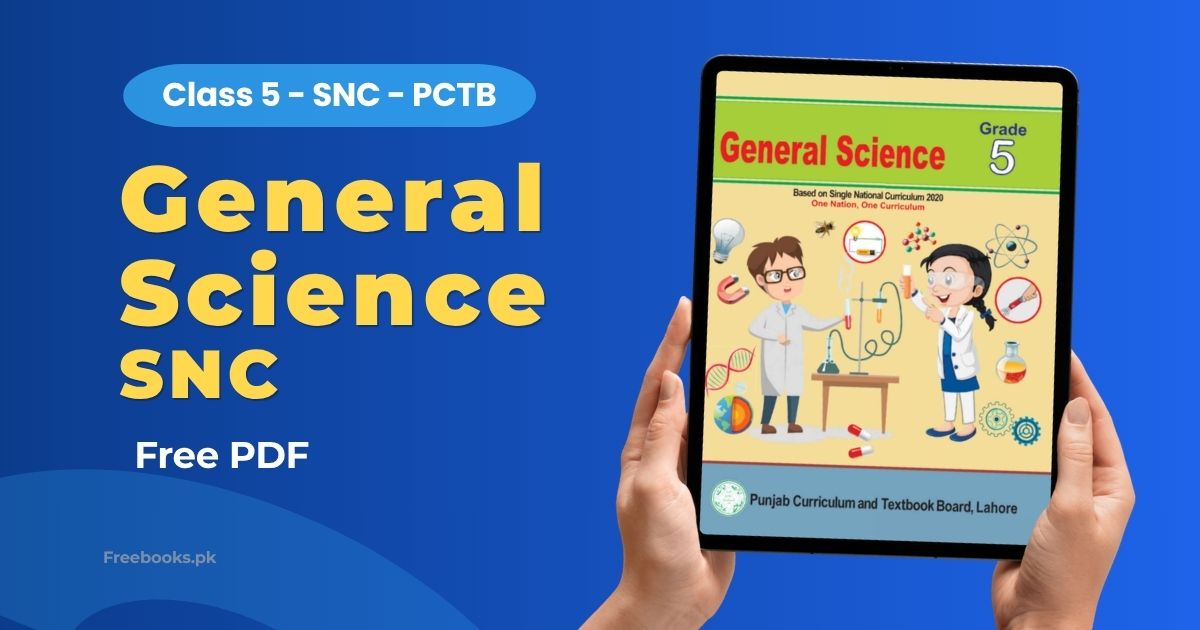
Class 5 General Science is part of the Punjab Textbook Board syllabus under the Single National Curriculum (SNC) 2020. This subject introduces young students to living organisms, matter, light, sound, electricity, magnetism, the structure of the Earth, space and everyday technology. Schools across Punjab teach this book to build a strong science foundation for Class 5 students.
Class 5 students preparing for their annual exams can use this book for quick revision and better understanding of science concepts. Each chapter is explained with simple examples, activities and diagrams that make difficult topics easy to grasp. Old PCTB editions in English and Urdu medium are also available below for students studying from earlier textbooks.
| Class | 5 |
| Subject | General Science |
| Curriculum | SNC 2020 (Single National Curriculum) |
| Board | Punjab Textbook Board (PCTB) |
| Editions Available | SNC English Medium, PCTB Old English Medium, PCTB Old Urdu Medium |
| Total Chapters | 10 |
| Total Pages | 134 |
| Format |
Chapter List
Chapter 1: Classification of Living Organisms
This chapter explains how living things are grouped based on similarities and differences. Students learn about the five kingdoms: Monera, Protista, Fungi, Plantae and Animalia. It also covers monocot and dicot plants, vertebrates and invertebrates, and the importance of biodiversity. Real examples like bacteria, mushrooms, fish, reptiles and mammals help students understand each group clearly.
Important Questions:
- What is classification? It means dividing organisms into groups based on similarities and differences.
- What are the five kingdoms of organisms? Monera, Protista, Fungi, Plantae and Animalia.
- What is the difference between monocot and dicot plants? Monocot seeds have one cotyledon, dicot seeds have two.
- What is biodiversity? The number of different kinds of living things found in a particular place.
Chapter 2: Microorganisms
This chapter introduces viruses, bacteria and fungi, the main groups of microorganisms too small to see without a microscope. It explains how microorganisms act as decomposers, how infectious diseases spread through air, water, food, animals and direct contact, and how vaccination and hygiene help prevent infections. It also covers the useful role of microorganisms in making yoghurt, bread and medicines.
Important Questions:
- What are microorganisms? Tiny organisms that can only be seen under a microscope.
- What is a pathogen? A microorganism that causes disease in its host.
- What are the five ways infectious diseases spread? Air, water, food, animals and direct contact.
- Name one useful role of microorganisms. They are used to make yoghurt, bread and antibiotic medicines.
Chapter 3: Flowers and Seeds
This chapter covers the structure of a flower, including sepals, petals, stamens and carpel, along with self and cross pollination. It explains sexual and asexual reproduction in plants, the structure of a seed, and how gram and maize seeds differ. Students also learn the conditions needed for seed germination: water, air and suitable temperature.
Important Questions:
- What are the four parts of a flower? Sepals, petals, stamens and carpel.
- What is pollination? The transfer of pollen grains from the anther to the stigma.
- What conditions are necessary for seed germination? Water, air and suitable temperature.
- How is a gram seed different from a maize seed? Gram has two cotyledons and no endosperm, while maize has one cotyledon and an endosperm.
Chapter 4: Environmental Pollution
This chapter explains air, water and land pollution along with their causes and effects on living things. It covers the greenhouse effect, global warming and their impact on climate. Students also learn the difference between biodegradable and non-biodegradable materials and how the 4R principle (refuse, reduce, reuse, recycle) helps reduce pollution.
Important Questions:
- What are the three main types of pollution? Air, water and land pollution.
- What is the greenhouse effect? Gases in the atmosphere trap heat and keep the Earth warm.
- What is the difference between biodegradable and non-biodegradable materials? Biodegradable materials break down naturally while non-biodegradable ones do not.
- What does the 4R principle mean? Refuse, reduce, reuse and recycle.
Chapter 5: Physical and Chemical Changes of Matter
This chapter explains physical changes such as melting, freezing, boiling, evaporation and condensation, along with solutions, solute and solvent. It also covers chemical changes like decaying, burning and rusting, and how physical and chemical changes differ from each other. Simple classroom activities help students see these changes in daily life.
Important Questions:
- What is a physical change? A change in appearance only, with no new substance formed.
- What is a chemical change? A change that forms a new substance with different properties.
- What is rusting? The reaction of iron with oxygen and water that forms rust.
- What is the difference between a dilute and a concentrated solution? A dilute solution has less solute while a concentrated solution has more solute.
Chapter 6: Light and Sound
This chapter explains luminous and non-luminous objects, and transparent, translucent and opaque materials. It shows how light travels in a straight line, how shadows and reflections form, and how sound is produced by vibration. Students also learn how sound travels faster through solids than air, and how noise pollution affects human health.
Important Questions:
- What is the difference between transparent and opaque objects? Transparent objects let light pass through completely, opaque objects do not let light pass at all.
- How is sound produced? By the vibration of an object.
- In which medium does sound travel fastest? In solids, such as iron.
- What is noise? Harsh and unpleasant sound that is harmful to human health.
Chapter 7: Electricity and Magnetism
This chapter covers static electricity, positive and negative charge, and how electric current flows through a circuit. It explains conductors, insulators and the use of a fuse for safety. Students also learn about magnets, magnetic and non-magnetic materials, the working of a compass, and the three types of magnets: temporary, permanent and electromagnet.
Important Questions:
- What is electric current? The flow of charge or electrons through a conductor.
- What is the difference between conductors and insulators? Conductors allow current to pass through them, insulators do not.
- What is a fuse used for? It protects a circuit by breaking when too much current flows.
- What happens when like poles of two magnets are brought close together? They repel each other.
Chapter 8: Structure of the Earth
This chapter describes the three layers of the Earth: crust, mantle and core, comparing them to the parts of an egg. It explains the sources of fresh water and the water cycle, along with the three types of soil: clay, sand and silt. Students also learn how humus makes soil fertile and supports plant growth.
Important Questions:
- What are the three layers of the Earth? Crust, mantle and core.
- What is the water cycle? The continuous movement of water through evaporation, condensation and rainfall.
- What are the three types of soil? Clay, sand and silt.
- What is humus? Decayed organic matter that makes soil fertile.
Chapter 9: Space and Satellites
This chapter introduces heavenly bodies, space exploration and the role of NASA. It explains natural and artificial satellites, including geostationary satellites, weather satellites and communication satellites. Students also learn about the Global Positioning System (GPS) and key milestones in space technology, such as the launch of Sputnik-1 and the Moon landing.
Important Questions:
- What is a satellite? An object that revolves around a larger heavenly body due to its gravity.
- What is the role of NASA? It is an American agency responsible for space exploration and aviation.
- What are geostationary satellites used for? Communication and transmitting TV signals across the world.
- What is GPS? The Global Positioning System, used to find an exact location on Earth.
Chapter 10: Technology in Everyday Life
This chapter focuses on practical skills such as making technical models like a footbridge and a bookshelf, and using tools like a spirit level and plumb line. It also covers assembling simple devices such as LED light strings, along with first aid basics, dressing a wound and safety drills for earthquakes and fires.
Important Questions:
- What is a spirit level used for? To check whether a surface is horizontal.
- What is a plumb line used for? To check whether a wall or pole is exactly vertical.
- What is first aid? Temporary care given to a person with a sudden illness or injury.
- What is the emergency helpline number mentioned in the book? 1122.
Click the buttons below to download the General Science Class 5 PDF book for the edition you need.
⬇ Download PDF (SNC English Medium) ⬇ Download PDF (PCTB Old, English Medium) ⬇ Download PDF (PCTB Old, Urdu Medium)
Who Should Read This
This book is meant for Class 5 students studying under the Punjab Textbook Board. It suits students following the SNC 2020 curriculum as well as those still using the older PCTB editions in English or Urdu medium. It is also useful for teachers and parents helping children revise science topics at home.
Applicable Boards
This book is published by the Punjab Textbook Board (PCTB) and is used in schools across Punjab. Students from other boards following the SNC 2020 curriculum for Class 5 General Science can also use this book, since the topics and syllabus are similar.
FAQs
Is this book for Class 5 General Science students?
Yes, this book is designed for Class 5 students studying General Science under the Punjab Textbook Board.
Can students from other boards use this book?
Yes, students following the SNC 2020 curriculum on other boards can also use this book since the topics are similar.
Is this the latest edition?
Yes, the SNC English Medium edition is the latest 2020 curriculum book. Older PCTB English and Urdu medium editions are also provided for reference.
Does the book include solved exercises?
The book includes exercises, activities and questions from each chapter, but solved answers are not provided in the original PDF.
How many chapters are in this book?
The book has 10 chapters covering topics from classification of living organisms to technology in everyday life.
Is the PDF free to download?
Yes, the PDF is free to download from the links provided on this page.
Related Books
- English Class 5 SNC PDF Download
- Mathematics Class 5 SNC PDF Download
- Urdu Class 5 SNC PDF Download
- Islamiat Class 5 SNC PDF Download
- Social Studies Class 5 SNC PDF Download
Related Books
© Copyright Policy
Freebooks.pk is an educational resource for students in Pakistan. Textbooks and other books belong to their respective boards, authors and publishers, and all rights remain with them. If you are the copyright holder of any material on this page and want it changed or removed, please contact us or file a request under our DMCA policy. We review every request and remove reported content promptly.