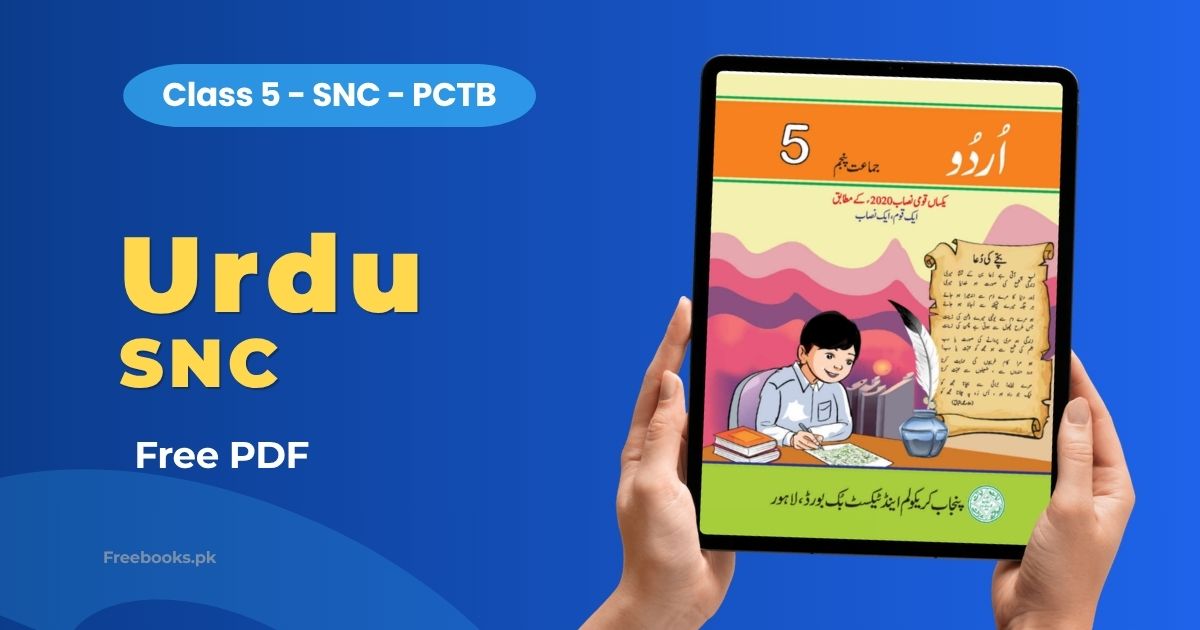
Urdu for Class 5 is part of the official Punjab Curriculum and Textbook Board (PCTB) syllabus. This page has the current Single National Curriculum (SNC) 2020 book, plus the older PCTB edition. The SNC book has 23 lessons, mixing poems, moral stories, and Seerat lessons with topics like national festivals, professions, and the environment.
For Class 5 students, this book builds vocabulary, grammar, and comprehension skills through real Urdu literature and everyday themes. Each lesson summary and its important questions on this page make revision quicker before class tests and board exams, in either the SNC or the older PCTB edition.
Book Overview
| Class | 5 |
| Subject | Urdu |
| Board | Punjab Curriculum and Textbook Board (PCTB) |
| Editions Available | SNC 2020 (current) and PCTB old edition |
| Total Lessons | 23 (plus 5 Review units) |
| Total Pages | 158 (SNC edition) |
| Format | PDF (Free Download) |
Chapter List
Lesson 1: Hamd – Praise of Allah (حمد)
This poem praises Allah as the creator of the sky, sun, moon, stars, mountains, and rivers, describing how dew freshens the flowers and greenery covers the earth. It reflects on how every corner of the world shows signs of Allah’s power and beauty. Students learn new vocabulary, answer questions about the poem’s imagery, and practice punctuation marks like the full stop and comma.
Important Questions:
- What does the poem say Allah has created? Answer: The sky, sun, moon, stars, mountains, rivers, and greenery across the world.
- What does dew do to the flowers in the poem? Answer: It freshens and brightens their faces.
- Whose command controls everything, according to the poem? Answer: Allah’s command controls everything in the universe.
- What punctuation mark shows a sentence is complete? Answer: The full stop, called khatma in Urdu.
Lesson 2: Naat – Praise of the Prophet (نعت)
This poem praises Prophet Muhammad (PBUH), comparing him to a moon whose light brightened the whole world. It describes how he brought Allah’s message of guidance, taught people to help the suffering, the disabled, and the poor, and removed evil from society. The lesson also covers new vocabulary, comprehension questions, alphabetical word ordering, and grammar on common and proper nouns.
Important Questions:
- What does the poet compare the Prophet (PBUH) to? Answer: A moon whose light brightened the whole world.
- Who did the Prophet (PBUH) tell people to help? Answer: The suffering, the disabled, the poor, and the helpless.
- What did the Prophet (PBUH) teach people about living in this world? Answer: How to live rightly and treat one another well.
- What is the difference between a common noun and a proper noun? Answer: A common noun names any general person or thing, while a proper noun names one specific person or place.
Lesson 3: Rehmat-e-Aalam Khatam-un-Nabiyeen (رحمت عالم خاتم النبیین)
This lesson describes the conquest of Makkah, when the Prophet (PBUH) forgave his former enemies, including those responsible for the death of his uncle Hazrat Hamza (RA). It also shares stories of his kindness toward a sick servant and toward animals and birds, showing his mercy toward all creation. Students practice new vocabulary, comprehension questions, and reading with correct pronunciation.
Important Questions:
- What did the Prophet (PBUH) announce when he entered Makkah? Answer: That anyone who stayed inside Abu Sufyan’s house, the Kaaba, or their own home with the door closed would be safe.
- How did the Prophet (PBUH) treat his enemies after the conquest of Makkah? Answer: He forgave them and declared them free.
- What did the Prophet (PBUH) do when he saw a sick slave grinding flour? Answer: He helped grind the flour himself and told the man to call him whenever he needed help again.
- How did the Prophet (PBUH) show kindness to animals? Answer: He told his companions to fear Allah in how they treated animals and birds, and had baby birds returned to their nest.
Lesson 4: Ae Watan! Tu Salamat Rahe (اے وطن! تو سلامت رہے)
Written as a diary entry, this lesson describes a documentary about Pakistan’s provinces, covering the culture, food, dress, and famous places of Balochistan, Sindh, Khyber Pakhtunkhwa, Punjab, Azad Kashmir, and Gilgit-Baltistan. It highlights landmarks like Quaid-e-Azam Residency Ziarat, Clifton, Qissa Khwani Bazaar, and Shandur, showing the diversity and unity of Pakistan’s people.
Important Questions:
- Which is the largest province of Pakistan by area? Answer: Balochistan.
- What is Karachi also known as? Answer: The City of Lights and Bride of the Cities (Uroos-ul-Bilad).
- What sport is famous in Gilgit-Baltistan, and where is the world’s highest ground for it? Answer: Polo, played at Shandur, the world’s highest polo ground.
- What is the capital of Azad Kashmir? Answer: Muzaffarabad.
Lesson 5: Jo Wada Karo So Poora Karo (جو وعدہ کرو سو پورا کرو)
A grandfather tells two moral stories about keeping promises. In the first, a defeated Persian governor tests the Caliph’s word before accepting Islam. In the second, Hazrat Umar (RA) frees a condemned man on his promise to return, and the man keeps his word. Both stories stress the Islamic value of honouring what you say.
Important Questions:
- Why did the caliph spare Hurmuzan’s life? Answer: Because he had promised not to kill him until he drank water, and Hurmuzan poured the water on the ground, forcing the caliph to keep his word.
- Which caliph is mentioned in the story of the young man and his promise? Answer: Hazrat Umar Farooq (RA).
- Who guaranteed the accused man would return? Answer: Hazrat Abu Zar Ghifari (RA), a senior companion.
- What lesson does the story teach? Answer: That keeping a promise is a sign of true faith and honesty.
Lesson 6: National Festivals – For Study (قومی تہوار)
A grandfather explains Pakistan’s national days to his grandchildren on Independence Day, covering Pakistan Day (23 March), Quaid-e-Azam Day, Defence Day (6 September), and Iqbal Day. He explains why Pakistan was created as an Islamic welfare state and reminds the children that keeping freedom is even harder than winning it.
Important Questions:
- What happened on 23 March 1940? Answer: The Pakistan Resolution was presented at Minto Park, Lahore.
- Whose birthday is marked as Quaid-e-Azam Day? Answer: Muhammad Ali Jinnah’s, on 25 December.
- What is celebrated on 6 September? Answer: Defence Day, marking when Pakistan’s army defeated the enemy in the 1965 war.
- What was the purpose of creating Pakistan, according to the lesson? Answer: To build an Islamic welfare state where people could live by Islamic principles.
Lesson 7: Hawa Chali – The Wind Blew (ہوا چلی)
This poem describes the cool morning wind moving through fields and gardens, waking up sleeping greenery, opening fresh buds, and letting birds fly. It reminds readers that without air, no living being could survive, and that we should be grateful to Allah for this blessing. The lesson also covers new words, prefixes and suffixes, and reading practice.
Important Questions:
- What does the wind do to the fields, according to the poem? Answer: It sways the crops and makes the ears of grain sway with it.
- Why is air important, according to the poem? Answer: Without air, no living being, human or animal, could stay alive.
- What are prefixes and suffixes? Answer: Letters or words added before (prefix) or after (suffix) a word that change its meaning.
- Whose bounty should we be thankful for, according to the lesson? Answer: Allah’s, for giving us air as a blessing.
Lesson 8: Meri Pehchaan Hai Tu – You Are My Identity (میری پہچان ہے تو)
A family discusses the national anthem after watching a 23 March ceremony on television. The father explains it was written by Hafeez Jalandhari and composed by Ahmed Ghulam Ali Chagla, first aired in 1953, and explains the meaning of each verse, praising the nation’s land, unity, and flag. Students also learn about writing formal applications.
Important Questions:
- Who wrote Pakistan’s national anthem? Answer: The poet Hafeez Jalandhari.
- How many stanzas does the national anthem have? Answer: Three stanzas, each with five lines, a form called mukhammas.
- When was the national anthem first broadcast? Answer: On 13 August 1953, on Radio Pakistan.
- What does the phrase pak sarzameen mean in the anthem? Answer: The pure land, referring to Pakistan.
Lesson 9: Our Professions (ہمارے پیشے)
Students present pictures of a school, hospital, restaurant, farm, river, and construction site, describing the professions connected to each, from teachers and doctors to farmers, boatmen, fishermen, and construction workers. The lesson stresses that no job is small or big, and everyone should choose an honest profession that serves the country.
Important Questions:
- What people work at a hospital, according to the lesson? Answer: Doctors, nurses, pharmacists, and lab staff.
- Who is called a mahigeer? Answer: A fisherman who catches fish from rivers and the sea to earn a living.
- Who draws the map for a new building? Answer: The naqsha nawees, or architect, while the contractor completes construction using workers.
- What is the main message of the lesson about professions? Answer: Every honest profession deserves respect, and people should choose one that benefits society.
Lesson 10: A Cow and a Goat (ایک گائے اور بکری)
In this poem by Allama Iqbal, a goat complains to a cow that humans treat animals unfairly, but the cow reminds her that the meadow, fresh air, and comfort they enjoy all come from humans caring for them. Hearing this, the cow feels ashamed of her earlier complaints about people. The poem teaches gratitude instead of complaining about kindness received.
Important Questions:
- Who wrote the poem ‘A Cow and a Goat’? Answer: Allama Muhammad Iqbal.
- What did the cow complain about at the start of the poem? Answer: That humans are unkind and unfair to animals.
- What did the goat remind the cow of? Answer: That the meadow, shade, and comfort they enjoy are thanks to humans looking after them.
- What lesson does the poem teach? Answer: We should always be thankful for what we are given, rather than complaining about it.
Lesson 11: Hazrat Usman Ghani (RA) (حضرت عثمان غنی رضی اللہ عنہ)
This lesson tells the story of Hazrat Usman (RA), the third Caliph, known for his generosity, including giving away a caravan of grain during a famine in Madinah and buying a well to donate for public use. It describes his achievements as Caliph, such as expanding Masjid-e-Nabawi, and explains why he is called Zun-Nurayn, having married two of the Prophet’s daughters.
Important Questions:
- What did Hazrat Usman (RA) do during the famine in Madinah? Answer: He gave away a caravan of grain, worth a great sum, free to the people.
- Why is Hazrat Usman (RA) called Zun-Nurayn? Answer: Because he married two of the Prophet’s (PBUH) daughters, one after the other.
- What well did Hazrat Usman (RA) buy for the Muslims? Answer: A well owned by a Jewish man, which he bought and donated for public use.
- How long was Hazrat Usman’s (RA) period as Caliph? Answer: About twelve years.
Lesson 12: The World in Your Hands (دنیا آپ کی مٹھی میں)
This lesson explains how the internet has changed communication, education, shopping, and daily life, letting people email photos, study from home, pay bills, and even listen to the Quran online. It also warns students about the risks of overusing the internet and never sharing personal information with strangers online.
Important Questions:
- What connected computers around the world? Answer: The internet.
- What is the modern form of a letter, according to the lesson? Answer: Email.
- What should you never do while using the internet? Answer: Never share personal information with a stranger, and tell an elder immediately if asked to.
- Name one risk of spending too much time on the internet. Answer: It can harm physical health and eyesight, and waste study time.
Lesson 13: Hum Phool Ek Chaman Ke – We Are Flowers of One Garden (ہم پھول اک چمن کے)
This patriotic poem describes the national flag as dear as life itself, comparing it to the moon and stars that light up the sky. It pledges to protect the homeland from decline, build unity through mutual love, and follow the path of discipline and trust. The lesson also introduces parentheses (qausain) in punctuation.
Important Questions:
- What is compared to the eyes’ brightness in the poem? Answer: The national flag, along with the moon and stars.
- What promise does the poem make about the homeland? Answer: To never let decline touch it, and to turn it into a paradise.
- What two paths does the poem say the nation should follow? Answer: The paths of unity and trust.
- What is jumla mo’tariza, introduced with parentheses? Answer: An explanatory phrase added inside a sentence that is not essential to its main meaning, marked with brackets.
Lesson 14: Aao Bacho! Suno Kahani – For Study (آؤ بچو! سنو کہانی)
Two friends earn their savings selling meat abroad, but a blind beggar tricks them out of their money bag, then falsely accuses them of robbery. A wise king solves the mystery by testing which of the men’s hands touched hot water and shows the fat of meat, proving the friends’ honesty and the beggar’s lie.
Important Questions:
- What profession did the two friends take up abroad? Answer: They became butchers, selling meat.
- How did the blind beggar try to trick the two friends? Answer: He asked to hold their money bag, then refused to return it and accused them of robbery.
- How did the king solve the case? Answer: He had the money washed in hot water and noticed meat fat floating on the surface, proving it belonged to the two friends.
- What happened to the beggar in the end? Answer: He was imprisoned for lying, while the two friends got their money back.
Lesson 15: Aayen! Madad Karen – Let Us Help (آئیں! مدد کریں)
After witnessing scouts give first aid to an accident victim, a boy asks his father about the Scouts and Girl Guides movements. His father explains their history, age groups, training in first aid and emergency response, and their role in helping during disasters like the 2005 earthquake, along with the story of the Edhi Foundation.
Important Questions:
- Who founded the Scout movement, and when? Answer: Robert Baden-Powell, a British army officer, in 1907.
- What are the three age groups of Scouts? Answer: Shaheen Scouts (7-11), Boy Scouts (11-17), and Rover Scouts (17-25).
- What did Scouts do during the 2005 earthquake? Answer: They pulled people from rubble, gave first aid, and provided food and medicine, especially to women and children.
- Who founded the Edhi Foundation, and when? Answer: Abdul Sattar Edhi, in 1951, in Karachi.
Lesson 16: Rakhen Mera Khayal – Take Care of Me (رکھیں میرا خیال)
Speaking as the Earth, this lesson describes how noise, litter, and pollution have damaged its beauty, then gives voice to trees, the sea, and the sky, each explaining how humans have harmed them through cutting, dumping waste, and burning fuel. It ends with practical steps students can take, like planting trees and keeping drains clear.
Important Questions:
- What day is mentioned as World Environment Day? Answer: 5 June, marked to raise awareness about keeping the environment clean.
- What types of pollution does the lesson mention? Answer: Land, water, air, and noise pollution.
- Why does standing water cause disease? Answer: Mosquitoes breed in it, spreading illnesses like dengue and malaria.
- Name two things students can do to help the environment. Answer: Plant more trees, and dispose of litter properly instead of throwing it around.
Lesson 17: Achay Bano, Neki Phailao – Be Good, Spread Kindness (اछھے بنو، نیکی پھیلاؤ)
This poem encourages students to speak the truth, help their neighbours, work hard at studies and sports, and set a good example for others through honest labour. Each stanza ends with a call to spread goodness in the nation, urging students to lead by example rather than just advising others.
Important Questions:
- What does the poem say we should do before guiding others? Answer: Walk the right path ourselves first.
- What does the poem say hardworking students teach their class? Answer: The habit of studying with interest and enthusiasm.
- What does the poem say about people who work hard for a living? Answer: They teach others the value of honest labour.
- What is the main message of the poem? Answer: To be good ourselves and spread kindness and good habits to others.
Lesson 18: An Ancient City (ایک قدیم شہر)
This lesson describes the Indus Valley Civilisation, with archaeological finds from Harappa and Moenjodaro showing seals, pottery, jewellery, and a well-planned drainage system. It explains how people there farmed, traded, worshipped idols and animals, and had a script that experts still cannot read, before the civilisation eventually declined.
Important Questions:
- Where are the remains of the Indus Valley Civilisation found in Pakistan? Answer: At Moenjodaro in Sindh and Harappa in Punjab.
- What did the Harappan drainage system show about the city? Answer: It had an advanced system for carrying away dirty water, unusual for that period.
- What work did men and women do in Harappa? Answer: Men farmed, traded, and worked in industry, while women cooked, made cloth, and looked after animals.
- Why can experts not fully understand this civilisation? Answer: Because nobody has yet been able to read the script used in their seals and writings.
Lesson 19: Husn-e-Sulook – Good Conduct (حسن سلوک)
Zafar, a well-off boy, saves his pocket money to buy a white cane for Abid, a blind boy from a poor neighbourhood. Years later, at a job interview, Zafar meets Abid again, now grown up, who explains that the cane led to a stranger helping him get an education and eventually restoring his sight through treatment. The story shows how small acts of kindness can change lives.
Important Questions:
- What gift did Zafar buy for Abid? Answer: A white cane, using money he received as a prize.
- How did Abid lose his eyesight? Answer: A serious illness at the age of two took away his vision.
- How did Abid eventually get an education? Answer: A school principal who noticed him with the cane took him in and enrolled him in a school for blind children.
- How did Abid regain his eyesight? Answer: A doctor who visited his school took him for treatment that restored his vision.
Lesson 20: Kaha Iqbal Ne (کہا اقبال رحمة اللہ علیہ نے)
This poem honours Allama Iqbal for waking up the Muslim nation through his poetry, reminding youth of their duty, guiding them toward their goal, and calling the Prophet (PBUH) the greatest guide for humanity after Allah. It also recalls his famous declaration that Muslims and Hindus were two separate nations, and his advice to build a homeland based on faith.
Important Questions:
- What did Allama Iqbal urge the nation’s children to do, according to the poem? Answer: To stay happy, read and write, serve others, and keep moving forward.
- Who does the poem call the greatest guide after Allah? Answer: The Prophet Muhammad (PBUH).
- What did Allama Iqbal declare openly in his address, as the poem recalls? Answer: That Muslims and Hindus are two separate nations.
- What advice did Allama Iqbal give about building a homeland? Answer: To build a country whose foundation is faith.
Lesson 21: Be Misal Hai Nizam-e-Qudrat Tera (بے مثل ہے نظام قدرت تیرا)
After a school library opens, students research and present facts about the solar system, explaining how the sun is the centre of the solar system, why day and night happen as the Earth spins, and how the exact distance between Earth and the sun keeps life possible. It also explains the solar year, lunar month, and why air and water are essential for life.
Important Questions:
- What is the solar system, according to the lesson? Answer: The sun along with the planets, moons, and smaller bodies that revolve around it.
- Why does day and night happen? Answer: Because the Earth rotates, and the side facing the sun has daylight while the other side has night.
- What would happen if the Earth’s distance from the sun changed? Answer: If it moved closer, everything would melt; if it moved farther, everything would freeze.
- What fraction of the Earth is covered by water? Answer: About three-quarters of the Earth is covered by water.
Lesson 22: Aqwal-e-Zareen – Golden Sayings, For Study (اقوال زریں)
This short lesson shares ten golden sayings attributed to the Prophet (PBUH), his companions, and famous scholars, on topics like kindness, patience, friendship, and hard work. Each saying is a short piece of wisdom meant to guide students toward good character and positive habits in daily life.
Important Questions:
- According to the Prophet (PBUH), who is not shown mercy? Answer: Someone who does not show mercy to others.
- What did Hazrat Umar Farooq (RA) say is the best cure for anger? Answer: Silence.
- What did Hazrat Ali (RA) say about keeping good company? Answer: That mixing with good people will make you good too.
- According to Shaikh Saadi, what makes a good friend? Answer: One who stands by you in times of trouble.
Lesson 23: Loot Parrot Ke Murghay (لوٹ پیروٹ کے مرغے)
This humorous poem tells of two roosters from Loot Parrot who go to town, get into a silly argument about who is braver, and end up fighting until a policeman punishes them both. Written by Sufi Ghulam Mustafa Tabassum, it teaches children in a light-hearted way that fighting only leads to trouble for everyone involved.
Important Questions:
- Who wrote the poem ‘Loot Parrot Ke Murghay’? Answer: Sufi Ghulam Mustafa Tabassum.
- What did the two roosters argue about? Answer: Each claimed to be braver than the other.
- What happened when the roosters started fighting? Answer: A policeman stepped in and punished them both.
- What lesson does the poem teach children? Answer: That fighting and quarrelling is a bad habit that only causes harm.
Download Urdu Class 5 PDF
Click the button below to download the Urdu Class 5 PDF for free. Both the current SNC edition and the older PCTB edition are available:
⬇ Download PDF (PCTB Old Edition)
Who Should Read This
This book is meant for Class 5 students studying Urdu under the Punjab Curriculum and Textbook Board, whether following the current SNC syllabus or the older PCTB edition. It also builds vocabulary and comprehension skills useful for entry test Urdu sections in later years.
Applicable Boards
This book is published by the Punjab Curriculum and Textbook Board (PCTB) and is the primary Urdu textbook for Class 5 in Punjab. Since the current edition follows the Single National Curriculum (SNC), students in other provinces and boards using the same SNC syllabus can also refer to this book for their Class 5 Urdu topics.
FAQs
Is this book for SNC or PCTB students?
Both editions are available on this page. Download the SNC 2020 edition if you follow the new curriculum, or the older PCTB edition if that is what your school uses.
Can other board students use this book?
Yes. Since the SNC edition is used across Pakistan, students from other boards following the Single National Curriculum can also use this book for Class 5 Urdu.
Is this the latest edition?
The SNC 2020 book is the current edition used in Punjab schools. The PCTB edition is provided as an older alternative for schools still using it.
Does this book include exercises and questions?
Yes, each lesson has vocabulary, comprehension, and grammar exercises. This page also lists important questions with short answers for quick revision.
How many lessons are in this book?
The SNC edition has 23 lessons plus 5 review units, mixing poems, moral stories, and Seerat lessons with topics like national festivals and the environment.
Is the PDF free to download?
Yes, both editions on this page are completely free to download in PDF format.
Related Books
- English Class 5 SNC PDF Download – Punjab Board (PCTB)
- Mathematics Class 5 SNC PDF Download – Punjab Board (PCTB)
- General Science Class 5 SNC PDF Download
- Islamiat Class 5 SNC PDF Download
- Social Studies Class 5 SNC PDF Download
Related Books
© Copyright Policy
Freebooks.pk is an educational resource for students in Pakistan. Textbooks and other books belong to their respective boards, authors and publishers, and all rights remain with them. If you are the copyright holder of any material on this page and want it changed or removed, please contact us or file a request under our DMCA policy. We review every request and remove reported content promptly.