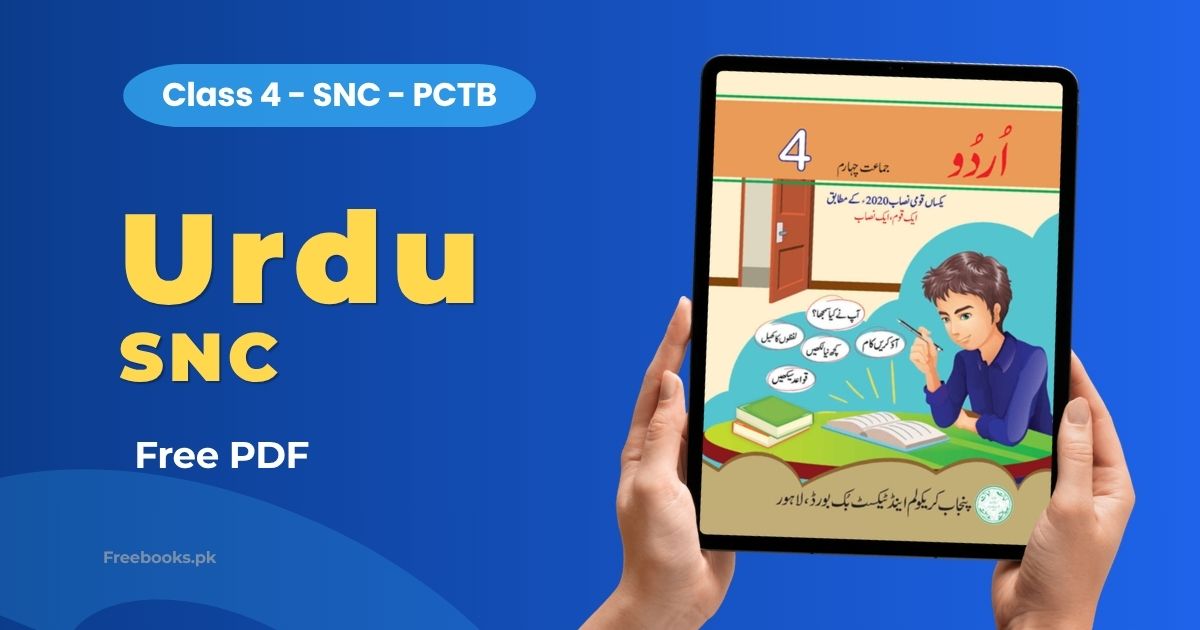
Urdu for Class 4 is part of the official Punjab Curriculum and Textbook Board (PCTB) syllabus, based on the Single National Curriculum (SNC) 2020. This page covers all 23 lessons of the book, a mix of poems, moral stories, and Seerat lessons built around everyday themes like good citizenship, hygiene, honesty, and respect for others’ opinions.
For Class 4 students, this book builds vocabulary, grammar, and reading skills through real Urdu literature and relatable stories rather than dry drills. Each lesson summary and its important questions on this page make revision quicker before class tests, so students can recall key points and answers without flipping back through the whole book.
Book Overview
| Class | 4 |
| Subject | Urdu |
| Board | Punjab Curriculum and Textbook Board (PCTB) |
| Curriculum | Single National Curriculum (SNC) 2020 |
| Total Lessons | 23 (plus 5 Review units) |
| Total Pages | 158 |
| Format | PDF (Free Download) |
Chapter List
Lesson 1: Tohfa – Gift/Hamd (تحفہ)
This Hamd, written by Ismail Merathi, praises Allah as the creator of the stars, the changing seasons, and animals like camels, cows, and horses that serve humans in daily life. It reminds children that every creation around them is a sign of Allah’s power and care. Students learn the poem’s vocabulary and answer questions about its meaning and message.
Important Questions:
- What does the poem thank Allah for? Answer: For creating the stars, seasons, and animals like camels, cows, and horses that serve mankind.
- Who is the poet of this Hamd? Answer: Ismail Merathi.
- What lesson does the poem give children? Answer: To be thankful to Allah for His countless blessings.
- What kind of poem is this lesson? Answer: A Hamd, a poem written in praise of Allah.
Lesson 2: Naat – Praise of the Prophet (نعت)
Written by Mahir-ul-Qadri, this Naat praises Prophet Muhammad’s (PBUH) humility and his kindness toward the poor and needy. It recalls his patience during the hardship he faced at Taif, showing how he bore suffering without losing his gentle character. Students learn new vocabulary from the poem and discuss its central message about the Prophet’s (PBUH) mercy.
Important Questions:
- Who wrote this Naat? Answer: Mahir-ul-Qadri.
- What quality of the Prophet (PBUH) does the poem praise? Answer: His humility and kindness toward the poor and needy.
- What hardship of the Prophet (PBUH) is mentioned in the poem? Answer: The suffering he faced during his visit to Taif.
- What does the word Naat mean? Answer: A poem written in praise of Prophet Muhammad (PBUH).
Lesson 3: Misali Muallim – The Ideal Teacher (مثالی معلم)
This lesson describes Prophet Muhammad’s (PBUH) teaching methods, from using short and clear speech to explaining ideas with hand gestures. It shares how he compared the five daily prayers to bathing five times a day in a river outside one’s door, leaving no dirt behind, to help his companions understand their importance through a question-answer style. The lesson also covers common and proper nouns and a letter-writing format.
Important Questions:
- How did the Prophet (PBUH) explain the importance of the five daily prayers? Answer: By comparing them to bathing five times a day in a river outside one’s door, leaving no dirt behind.
- What teaching method did the Prophet (PBUH) often use? Answer: Short, clear speech along with hand gestures to explain his point.
- What is the difference between a common noun and a proper noun? Answer: A common noun names any general thing, while a proper noun names one specific person or place.
- What format does the lesson teach for writing to someone? Answer: The correct format for writing a letter (khat).
Lesson 4: Hum Banain Ge – We Will Become Good Citizens (ہم بنیں گے)
In this story, Hamid Sahib’s children Ajeeb, Fauzia, and Aafiya pick flowers in a park despite clear “do not pick flowers” signs. Their father uses the moment to teach them about respecting public rules and taking care of shared spaces, explaining that good citizenship means following laws and keeping community places clean for everyone. The lesson also covers masculine and feminine nouns.
Important Questions:
- What were the children doing in the park that was wrong? Answer: Picking flowers from the park despite the “do not pick flowers” signs.
- What did Hamid Sahib teach his children about? Answer: About respecting public rules and taking care of shared places.
- Why is following rules important, according to the lesson? Answer: Because it shows good citizenship and helps keep community places clean and beautiful for everyone.
- What grammar topic does this lesson cover? Answer: Masculine and feminine nouns, both real and non-real.
Lesson 5: Chhota Hathi – The Baby Elephant, For Study (چھوٹا ہاتھی)
This story follows a young elephant who panics after noticing he has no tusks, worrying that something is wrong with him. He asks a monkey, a giraffe, and a lion for help before his mother reassures him that tusks grow naturally as an elephant gets older. The gentle story teaches children not to panic over natural changes and to trust the guidance of elders.
Important Questions:
- What worried the baby elephant in the story? Answer: He noticed he had no tusks and worried something was wrong with him.
- Who did the baby elephant ask for help? Answer: He asked a monkey, a giraffe, and a lion.
- What did the mother elephant tell him? Answer: That tusks grow naturally as an elephant gets older, and there was nothing to worry about.
- What lesson does this story teach? Answer: Not to panic over natural changes and to trust the guidance of elders.
Lesson 6: Sehat o Safai – Health and Hygiene (صحت و صفائی)
Fahad gets a stomachache after eating unhygienic dahi bhallay from a street vendor, so his uncle, who is a doctor, explains how germs enter the body through unclean food and how the skin’s pores work. The story stresses the importance of personal cleanliness and keeping the neighbourhood clean to prevent illness. The lesson also covers ordinal numbers and prefixes and suffixes.
Important Questions:
- Why did Fahad get a stomachache? Answer: Because he ate unhygienic dahi bhallay from a street vendor.
- Who explained the cause of Fahad’s illness to him? Answer: His uncle (mamu), who is a doctor.
- What did the doctor say caused the illness? Answer: Germs (jaraseem) that entered his body through unclean food.
- What grammar topics does this lesson include? Answer: Ordinal numbers and prefixes and suffixes.
Lesson 7: Hum Pakistani Bachay – We Are Pakistani Children (ہم پاکستانی بچے)
This patriotic poem by Faiz Ludhianvi describes Pakistani children as the nation’s true wealth, urging them to be brave and honest. It encourages young readers to grow up as fearless, truthful citizens who take pride in their country. The lesson also introduces the subject marker “ne” and the object marker “ko” in grammar.
Important Questions:
- Who wrote the poem ‘Hum Pakistani Bachay’? Answer: Faiz Ludhianvi.
- How does the poem describe Pakistani children? Answer: As the true wealth of the nation, brave and honest.
- What qualities does the poem encourage in children? Answer: Fearlessness and honesty.
- What grammar markers does the lesson teach? Answer: The subject marker “ne” and object marker “ko”.
Lesson 8: Gul Dast – A Bouquet of Poets, For Study (گل دست)
This lesson introduces five regional-language poets of Pakistan: Rahman Baba in Pashto, Shah Abdul Latif Bhittai in Sindhi, Baba Bulleh Shah (real name Syed Abdullah Shah) in Punjabi, Habba Khatoon, the first Kashmiri Sufi poetess who converted from Hinduism, and Baba Chilasi Dost Baigat, who wrote in five languages. Each profile highlights a shared theme of love for Allah, humanity, and brotherhood.
Important Questions:
- Which poet is associated with Pashto poetry in this lesson? Answer: Rahman Baba.
- What was Baba Bulleh Shah’s real name? Answer: Syed Abdullah Shah.
- Who is described as the first Sufi poetess of Kashmiri, born a Hindu before converting? Answer: Habba Khatoon.
- What common theme runs through the poets described in this lesson? Answer: Love for Allah, humanity, and brotherhood across languages and regions.
Lesson 9: Aatay Hain Jo Kaam – Deeds That Serve Others (آتے ہیں جو کام)
Ehsan watches his father, Siddique Sahib, donate food and money to Khidmat-e-Khalq volunteers helping needy families during the COVID-19 pandemic. Inspired by his father’s example, Ehsan learns about volunteerism and decides to donate his own pocket money to help others. The lesson also covers subject pronouns.
Important Questions:
- What did Ehsan’s father, Siddique Sahib, do during the COVID-19 pandemic? Answer: He donated food and money to Khidmat-e-Khalq volunteers helping needy families.
- What did Ehsan learn from his father’s example? Answer: The importance of volunteering and helping others in difficult times.
- What did Ehsan decide to do himself? Answer: He donated his own pocket money to help others.
- What grammar topic does this lesson cover? Answer: Subject pronouns.
Lesson 10: Ek Pahar Aur Gilehri – A Mountain and a Squirrel (ایک پہاڑ اور گلہری)
Written by Allama Iqbal in Bang-e-Dra, this poem shows an arrogant mountain mocking a small squirrel for being insignificant. The squirrel calmly replies that everything, big or small, has its own God-given purpose, teaching children to avoid pride and recognise the value in every creation. The lesson also covers question marks and quotation marks.
Important Questions:
- Who wrote the poem ‘Ek Pahar Aur Gilehri’? Answer: Allama Muhammad Iqbal, from his collection Bang-e-Dra.
- What did the mountain say to the squirrel? Answer: It mocked the squirrel for being small and insignificant.
- How did the squirrel respond? Answer: It explained that everything, big or small, has its own God-given purpose.
- What lesson does the poem teach? Answer: To avoid pride and arrogance, since everyone has their own value and place in the world.
Lesson 11: Naya Computer – The New Computer (نیا کمپیوٹر)
In this dialogue, father Inaam Sahib teaches his children Ali and Jawaria about computer parts like the monitor, CPU, keyboard, and mouse, calling the CPU the “brain” of the computer. He also shares that Charles Babbage is known as the “Father of the Computer” and explains uses like internet research, homework, and entertainment, along with internet safety rules. The lesson also includes a formal leave-application letter format.
Important Questions:
- Who is called the “Father of the Computer” in this lesson? Answer: Charles Babbage.
- What did Inaam Sahib explain is the “brain” of the computer? Answer: The CPU (Central Processing Unit).
- What uses of the computer are mentioned in the lesson? Answer: Doing internet research, completing homework, and entertainment.
- What warning does the lesson give about using the internet? Answer: To be careful and follow safety rules while using the internet.
Lesson 12: Mein Kya Banun Ga – What Will I Become (میں کیا بنوں گا)
Written by Hafeez Jallandhari, this poem expresses a child’s dream of growing up brave, wise, and successful like great figures of history such as Sikandar-e-Azam (Alexander), Arastu (Aristotle), and Rustam. The verses encourage children to aim high and imagine their own future achievements. The lesson also covers imperative verbs and prohibitive verbs.
Important Questions:
- Who wrote the poem ‘Mein Kya Banun Ga’? Answer: Hafeez Jallandhari.
- Which historical figures does the child in the poem wish to become like? Answer: Sikandar-e-Azam (Alexander), Arastu (Aristotle), and Rustam.
- What does the poem express about the child’s future? Answer: A wish to grow up brave, wise, and successful like great figures of history.
- What grammar topics does this lesson cover? Answer: Imperative verbs and prohibitive verbs.
Lesson 13: Zeba Ke Parosi – Zeba’s Neighbours (زیبا کے پڑوسی)
When a new family moves in nearby, Jamila visits Zeba’s house asking to borrow some utensils, and Zeba’s mother generously sends over breakfast as well. Zeba’s mother explains that Islam commands kindness toward neighbours, sharing a Hadith and the story of Hazrat Abdullah bin Umar (RA), who sent meat to his Jewish neighbour first, since neighbour rights apply regardless of religion.
Important Questions:
- What did Jamila ask Zeba’s mother for when she first visited? Answer: Some utensils, since their belongings had not fully arrived yet.
- What extra thing did Zeba’s mother do for the new neighbours? Answer: She prepared and sent over breakfast, including eggs, omelette, and tea.
- What did the Prophet (PBUH) say about neighbours, according to the lesson? Answer: That whoever believes in Allah and the Last Day should treat their neighbour well.
- What did Hazrat Abdullah bin Umar (RA) do when he slaughtered a goat? Answer: He told his servant to send meat first to their Jewish neighbour, since neighbour rights apply regardless of religion.
Lesson 14: Jab Har Cheez Sonay Ki Ban Gayi – When Everything Turned to Gold (جب ہر چیز سونے کی بن گئی)
A gold-loving king in Greece is granted a wish that everything he touches turns to gold, but he soon finds he cannot eat or drink, and worst of all, his own daughter turns into a lifeless golden statue when he touches her. Realising his mistake, the king begs for help, and a stranger tells him to bathe in the garden pond and sprinkle its water on everything to reverse the curse.
Important Questions:
- What wish did the king ask the stranger to grant him? Answer: That everything he touched would turn to gold.
- What problem did the king face after his wish was granted? Answer: He could not eat or drink, since his food and drink also turned to gold at his touch.
- What tragic thing happened when the king touched his daughter? Answer: She too turned into a golden, lifeless statue.
- How did the king undo the golden touch? Answer: The stranger told him to bathe in the garden pond and sprinkle its water on everything, which returned things to normal.
Lesson 15: Subah Ki Aamad – The Arrival of Morning (صبح کی آمد)
Written by Ismail Merathi, this poem personifies the morning as it announces its arrival, waking sleepy children and asking them to wash up and remember Allah. Birds fly and sing as the cool, pleasant morning air spreads across the land, painting a cheerful picture of the start of a new day.
Important Questions:
- Who wrote the poem ‘Subah Ki Aamad’? Answer: Ismail Merathi.
- What does the morning ask people to do in the poem? Answer: To wake up, wash their hands and face, and remember Allah.
- What do the birds do in the poem as morning arrives? Answer: They fly about and sing songs welcoming the morning.
- What does the poem say about the time and weather of morning? Answer: That it is a pleasant time with cool air and a delightful atmosphere.
Lesson 16: Hazrat Syeda Fatima Al-Zahra (RA) (حضرت سیدہ فاطمہ الزہرا رضی اللہ عنہا)
This lesson tells the story of Hazrat Syeda Fatima (RA), daughter of the Prophet (PBUH) and Hazrat Khadija (RA), who was raised by the Prophet (PBUH) himself after her mother’s passing. She married Hazrat Ali (RA) and became the mother of Hazrat Hasan and Hazrat Hussain (RA). The lesson shares the Prophet’s (PBUH) deep love for her, including his words that whoever pleases her pleases him.
Important Questions:
- Who were Hazrat Syeda Fatima’s (RA) parents? Answer: Prophet Muhammad (PBUH) and Hazrat Khadija (RA).
- Who did Hazrat Syeda Fatima (RA) marry? Answer: Hazrat Ali (RA), cousin of the Prophet (PBUH) and the fourth Caliph.
- What did the Prophet (PBUH) say about his love for Fatima (RA)? Answer: That whoever pleases her pleases him, and whoever hurts her hurts him.
- Where was Hazrat Syeda Fatima (RA) buried? Answer: In the Jannat-ul-Baqi cemetery.
Lesson 17: Garmi – Summer (گرمی)
Written by Inayat Ali Khan, this poem describes the summer season, advising children to drink plenty of water and avoid going out in the midday sun. It mentions seasonal fruits like mangoes and watermelons, and reminds readers that although summer heat is uncomfortable, it is also what ripens the fruits and crops people enjoy.
Important Questions:
- Who wrote the poem ‘Garmi’? Answer: Inayat Ali Khan.
- What advice does the poem give for staying safe in the summer heat? Answer: To drink plenty of water and avoid going out in the midday sun.
- What seasonal fruits does the poem mention? Answer: Mangoes and watermelons.
- What benefit of summer heat does the poem highlight? Answer: That the sun’s heat is also what ripens fruits and crops.
Lesson 18: Baatain Danai Ki – Words of Wisdom (باتیں دانائی کی)
This lesson shares four short hikayat by Sheikh Saadi, including a woodcutter who refuses Hatim Tai’s charity because he earns his own bread, and Saadi’s own story of gratitude after seeing a legless man while upset over his torn shoe. Other stories contrast a scholar and his wealthy brother, and show a wise elder telling an angry wrestler that true strength is patience, not physical power.
Important Questions:
- What did the woodcutter tell Hatim Tai when invited to his feast? Answer: That a person who earns his own bread through hard work does not need to accept anyone’s favour.
- What did Sheikh Saadi see that made him thankful despite his torn shoe? Answer: A man with no legs at all, dragging himself along the ground.
- What did the scholar brother say to his wealthy brother in Egypt? Answer: That he was grateful to have the inheritance of the prophets, which is knowledge, while his brother had only the inheritance of Qaroon, which is wealth.
- What did the wise elder say about the angry wrestler? Answer: That though he could lift heavy weights, he could not bear one unpleasant word, so he was not truly strong.
Lesson 19: Raye Ka Ehtiram – Respect for Opinion (رائے کا احترام)
Adnan tells his mother about the upcoming election for class monitor, and she explains that decisions should be made through mutual consultation, as the Prophet (PBUH) taught, and that a good candidate should be capable, honest, and sympathetic. Adnan chooses to vote for Rashid, and his mother explains the idea of a “democratic attitude,” accepting the majority’s decision even when it differs from your own.
Important Questions:
- Why was an election being held for class monitor? Answer: To let all students give their opinion in choosing a monitor, following the Prophet’s (PBUH) teaching to decide matters through mutual consultation.
- What two qualities did Adnan’s mother say a good candidate should have? Answer: Being capable of the responsibility, and being honest and sympathetic to others.
- Why did Adnan decide to vote for Rashid? Answer: Because Rashid was honest, helpful, and always made peace between fighting classmates.
- What is a “democratic attitude,” according to the lesson? Answer: Giving your own opinion, but accepting the majority decision willingly, even if it differs from your own.
Lesson 20: Diyanat Dari – Honesty (دیانت داری)
Instead of a written story, this lesson gives students a set of pictures showing a woodcutter working by a river and asks them to build their own honesty-themed story from the images. It is a creative writing exercise that lets children practice structuring a story with a clear beginning, rising action, and ending, while reflecting on the value of honesty.
Important Questions:
- What activity does this lesson ask students to complete? Answer: To write a story of their own based on a set of given pictures.
- Who is shown in the pictures at the start of the story? Answer: A woodcutter cutting wood by the side of a river.
- What value is this lesson meant to teach through the picture story? Answer: Honesty (diyanat dari), an important moral quality.
- What skill does this lesson practice? Answer: Building a story with a clear beginning, rising action, and ending, based on visual prompts.
Lesson 21: Yeh Baat Samajh Mein Aayi Nahi – I Didn’t Understand This (یہ بات سمجھ میں آئی نہیں)
Written by Ahmed Hatib Siddiqui, this humorous poem has a child asking funny, logical questions about family relationships and everyday word puzzles, like why a cat is called the tiger’s aunt or why the moon is called “chanda mama” (maternal uncle). The playful verses make children laugh while sharpening their sense of language and logic.
Important Questions:
- Who wrote the poem ‘Yeh Baat Samajh Mein Aayi Nahi’? Answer: Ahmed Hatib Siddiqui.
- What funny question does the child ask about the cat in the poem? Answer: If the cat is the tiger’s aunt, why do we keep her as a pet instead of the tiger?
- What relationship does the child question regarding the moon? Answer: Why the moon is called “chanda mama” (maternal uncle) when he is not really anyone’s brother.
- What kind of poem is this, according to the lesson? Answer: A humorous poem meant to make children laugh while playing with words and logic.
Lesson 22: Shandar Faisla – Excellent Decision, For Study (شان دار فیصلہ)
This lesson shares two stories about Hazrat Umar Farooq (RA), who is called “Farooq” for distinguishing so clearly between right and wrong. In the first, he insists on being treated exactly like the other party during a legal dispute. In the second, he orders a neighbour’s rainspout removed after it dirties his clothes, then personally restores it once he learns the Prophet (PBUH) had installed it himself.
Important Questions:
- Why is Hazrat Umar (RA) called “Farooq”? Answer: Because he distinguished so clearly between right and wrong.
- What did Hazrat Umar (RA) insist on when Hazrat Zaid bin Thabit wanted to seat him specially during the dispute hearing? Answer: That he be treated exactly the same as the other party, Hazrat Ubay bin Kaab.
- Why did Hazrat Umar (RA) order the rainspout removed from outside Hazrat Abbas’s (RA) house? Answer: Because it had dirtied his clothes with the blood of slaughtered birds.
- What did Hazrat Umar (RA) do once he learned the Prophet (PBUH) had installed the spout himself? Answer: He asked Hazrat Abbas (RA) to reinstall it while standing on his own back, out of respect for the Prophet’s work.
Lesson 23: Tareekhi Imaratain – Historical Buildings (تاریخی عمارتیں)
This lesson tours some of Pakistan’s famous historical buildings, including the Mahabat Khan Mosque in Peshawar, Kot Diji Fort in Sindh, the Quaid-e-Azam Residency in Ziarat, Lahore Fort, Baltit Fort in Hunza, and Baghsar Fort in Azad Kashmir. Each site is described with its builder, location, and historical importance, showing the rich architectural heritage found across the country.
Important Questions:
- Who built the Mahabat Khan Mosque in Peshawar? Answer: Mahabat Khan, the Mughal governor of Kabul, in the style of Lahore’s Badshahi Mosque.
- Who built Kot Diji Fort, and where is it located? Answer: Mir Sohrab Khan Talpur, in Khairpur district, Sindh.
- Which important figure spent his final days at Quaid-e-Azam Residency in Ziarat? Answer: Quaid-e-Azam Muhammad Ali Jinnah, in the last two months of his life.
- Which Mughal emperor died at Baghsar Fort in Azad Kashmir? Answer: Emperor Jahangir, while returning from a visit to Kashmir.
Download Urdu Class 4 PDF
Click the button below to download the Urdu Class 4 PDF for free:
Who Should Read This
This book is meant for Class 4 students studying Urdu under the Punjab Curriculum and Textbook Board’s SNC syllabus. It also builds vocabulary and comprehension skills that support Urdu reading ability in later years, including for entry test preparation down the line.
Applicable Boards
This book is published by the Punjab Curriculum and Textbook Board (PCTB) and is the primary Urdu textbook for Class 4 in Punjab. Since it follows the Single National Curriculum (SNC), students in other provinces and boards using the same SNC syllabus can also refer to this book for their Class 4 Urdu topics.
FAQs
Is this book for Class 4 students?
Yes, this is the official Urdu textbook for Class 4 under the Punjab Curriculum and Textbook Board’s Single National Curriculum (SNC).
Can other board students use this book?
Yes. Since this book follows the SNC syllabus used across Pakistan, students from other boards following the same curriculum can also use it for Class 4 Urdu.
Is this the latest edition?
Yes, this is the current SNC 2020 edition used in Punjab schools.
Does it include exercises and important questions?
Yes, each lesson has vocabulary, comprehension, and grammar exercises. This page also lists important questions with short answers for quick revision.
How many lessons are in this book?
The book has 23 lessons plus 5 review units, mixing poems, moral stories, and Seerat lessons with everyday themes.
Is the PDF free to download?
Yes, the PDF on this page is completely free to download.
Related Books
- English Class 4 SNC PDF Download – Punjab Board (PCTB)
- Urdu Class 5 SNC PDF Download – Punjab Board (PCTB)
- Mathematics Class 5 SNC PDF Download – Punjab Board (PCTB)
- General Science Class 5 SNC PDF Download
Related Books
© Copyright Policy
Freebooks.pk is an educational resource for students in Pakistan. Textbooks and other books belong to their respective boards, authors and publishers, and all rights remain with them. If you are the copyright holder of any material on this page and want it changed or removed, please contact us or file a request under our DMCA policy. We review every request and remove reported content promptly.
What are the main themes and values taught in the Class 4 Urdu textbook under the Punjab Curriculum and Textbook Board?