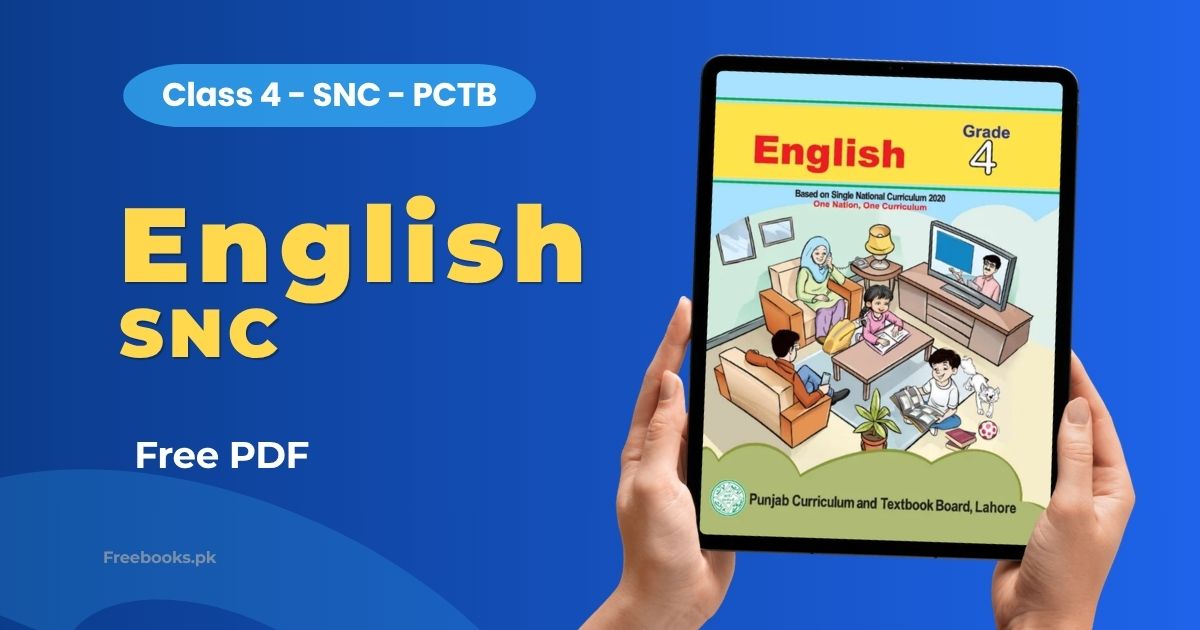
English for Class 4 is part of the official Punjab Curriculum and Textbook Board (PCTB) syllabus, following the Single National Curriculum (SNC) 2020. It is the primary English textbook for Class 4 students and has 13 units plus 4 review units, covering themes like the great Caliphs of Islam, nature, national pride, honesty, and safety, alongside oral communication, reading, grammar, and writing skills.
For Class 4 students, this book builds core English skills, reading comprehension, vocabulary, grammar, and writing, through short stories, poems, dialogues, and fables based on everyday and moral topics. The chapter summaries and important questions on this page make revision quicker and easier for young learners.
Book Overview
| Class | 4 |
| Subject | English |
| Board | Punjab Curriculum and Textbook Board (PCTB) |
| Curriculum | Single National Curriculum (SNC) 2020 |
| Total Units | 13 (plus 4 Review units) |
| Total Pages | 138 |
| Format | PDF (Free Download) |
Chapter List
Unit 1: Great Caliphs of Islam
This unit profiles the four Rashidun Caliphs of Islam, Hazrat Abu Bakr, known as Siddique and the first man to accept Islam, Hazrat Umar, given the title Farooq, Hazrat Usman, called Ghani and Zun-Noorain for his generosity and marriage to two of the Prophet’s daughters, and Hazrat Ali, the first child to accept Islam and known as Asadullah. It covers vowel sounds, digraphs, trigraphs and silent letters, countable and uncountable nouns, the articles a, an and the, and adjectives of quality, size, shape, colour, origin and quantity.
Important Questions:
- Why was Hazrat Abu Bakr given the title of Siddique? Because he always believed and supported the Holy Prophet (PBUH) without doubt, earning the name meaning the truthful one.
- Why is Hazrat Usman called Zun-Noorain? Because he was married to two of the Holy Prophet’s daughters at different times, so he became known as the holder of two lights.
- What is a digraph? A group of two letters that makes a single sound, such as ch in chick or wh in wheel.
- When do we use an instead of a? Before a noun that starts with a vowel sound, such as an apple or an umbrella.
Unit 2: Beauty of Nature
This unit opens with the poem Caterpillar, following the creature on its journey before it becomes a butterfly, and includes a story about Mahnoor making charts with her friends to protect insects, trees and the park from harm. It covers silent letters, collective nouns such as a swarm of bees and a flock of butterflies, the articles a and an with mute consonants, adjectives of origin, and how a paragraph’s topic sentence is supported by other sentences using joining words like and, but, or and because.
Important Questions:
- What does the caterpillar in the poem eventually become? A butterfly.
- Why was Mahnoor upset in the park? Because people were plucking flowers, killing insects and littering, so she made charts to raise awareness.
- What is a collective noun? A word that names a group of people or things, such as a herd of deer or a team of players.
- What is a topic sentence? The sentence that carries the main idea of a paragraph, with other sentences supporting it.
Unit 3: The Journey of Chocolate
This unit traces how chocolate is made, from cocoa pods growing on tree trunks to the beans being dried, roasted, ground into nibs, mixed with sugar and milk, and rolled into a smooth paste before hardening into chocolate. It covers diphthongs, reading pie charts and bar graphs to compare information, making anagrams, regular and irregular noun plurals, action verbs, prepositions of position such as under, over and between, and writing a simple recipe using ingredients and steps.
Important Questions:
- Where do cocoa flowers grow on the tree? On the trunk of the tree, not on its branches.
- What are nibs? The roasted, edible pieces of cocoa beans left after their shells are removed.
- What is a diphthong? A combination of two vowel sounds in a single syllable, such as in coil, pain or now.
- What is the difference between a pie chart and a bar graph? A pie chart compares parts of a whole using a circle, while a bar graph compares different groups using bars.
Unit 4: The Pride of Pakistan
This unit follows a school trip to the Pakistan Army Museum in Lahore, where the narrator and his friend Tashif learn about Nishan-e-Haider, the country’s highest military award meaning Mark of the Lion, given to eleven soldiers for extraordinary bravery. It covers diphthongs, using mind maps to summarise a text, changing words between parts of speech, synonyms and antonyms, nouns with no change in plural like sheep and deer, helping verbs, prepositions of time, and degrees of regular adjectives such as heavy, heavier and heaviest.
Important Questions:
- What does Nishan-e-Haider mean, and how many soldiers have received it? It means Mark of the Lion, and eleven soldiers from the armed forces have been awarded it.
- What was the “Rebirth of a Nation” gallery about? It showed the Quaid-e-Azam addressing the constituent assembly and told the story of Pakistan’s struggle for freedom.
- Give an example of a noun with no change in its plural form. Sheep, or deer, since the singular and plural forms are the same.
- What is the superlative form of the adjective heavy? Heaviest.
Unit 5: Thank You, Lord
This unit presents the poem Thank You, Lord, in which the poet begins each day with prayer and gratitude, trusts Allah through difficulties, and promises to help others and care for her family. It covers three-consonant clusters like str- and -mps, reading clock times such as quarter past and quarter to, homophones, the masculine, feminine and neuter genders of nouns, negative forms of be, do and have as helping verbs, and the use of apostrophes and exclamation marks.
Important Questions:
- How does the poet start her day in the poem? By taking a moment to bow and pray, giving thanks and praise.
- What time is shown by the clock reading 10:45? Quarter to eleven.
- What is a homophone? A word that sounds the same as another word but has a different meaning and spelling.
- Give an example of a neuter gender noun. Chair, or any noun naming a non-living thing.
Unit 6: Valuing Others
This unit tells the story of Sa’ad, who feels guilty for mocking his classmate Faraz for limping, and apologises after his friend Rehan encourages him to make things right. It covers the two pronunciations of the (thee and thuh), seeking permission and expressing ability or inability in conversation, inflectional endings like -s, -es, -ed and -ing, compound words such as butterfly and rainbow, common and proper nouns, and be, do and have as both main and helping verbs.
Important Questions:
- Why did Sa’ad feel guilty? Because he had been rude to his classmate Faraz for limping while walking, and Faraz left school because of it.
- How is the pronounced before a vowel sound? As thee, such as in the orange or the umbrella.
- What is a compound word? A word formed by joining two words together to create a new meaning, like butterfly or rainbow.
- Give an example of a proper noun. Lahore, or any specific name of a person, place or thing.
Unit 7: Colours of Pakistan
This unit explores the cultural diversity of Pakistan, describing the traditional dress, languages and festivals of Punjab, Sindh, Balochistan, Khyber Pakhtunkhwa, Kashmir and Gilgit-Baltistan, along with shared celebrations like Eid-ul-Fitr and Eid-ul-Azha. It covers long vowel sounds, giving directions using a map key, breaking down compound words, using pronouns correctly, the forms of be, do and have with different pronouns, and punctuation rules.
Important Questions:
- What is the traditional dress of Sindhi men? The Sindhi cap and ajrak.
- Which festival is celebrated every year in Shandur, Khyber Pakhtunkhwa? The Polo festival.
- Name one language spoken in Gilgit-Baltistan. Shina, Balti, or Burushaski.
- What does a map key or legend help us do? Locate and identify places or features on a map using symbols.
Unit 8: Good Study Habits
This unit follows a student who develops good study habits like making a timetable, taking notes and revising at weekends, then earns first position in her class and writes an invitation to celebrate with her cousin. It covers short vowel sounds, arranging words in alphabetical order by their second letter, note-taking as a study skill, subject, object and possessive pronouns, the use of can/cannot and may/may not, adverbs, and writing short informal invitations and replies.
Important Questions:
- Name two good study habits mentioned in the story. Making a timetable for studying and revising classwork at the weekend, or working on the most difficult topic first.
- How do we arrange words in alphabetical order by their second letter? By comparing the second letter when the first letters of the words are the same.
- What is the difference between can and may? Can shows ability, while may is used to ask or give permission.
- What are the main parts of a short informal invitation? The addressee’s name, the purpose, date and time, venue, and the sender’s name.
Unit 9: Manners
This unit presents the poem Whole Duty of Children by Robert Louis Stevenson, which teaches honesty and good manners at the table, alongside lessons on using a table of contents and glossary to navigate a book. It covers the three sounds of the -ed ending, similes such as as green as grass, possessive pronouns, the use of should and should not, joining words like and, or and but, and adverbs of manner such as slowly, beautifully and politely.
Important Questions:
- Who wrote the poem Whole Duty of Children? Robert Louis Stevenson.
- What does the poem say a child should always do? Always say what is true and behave mannerly at the table.
- What is a simile? A word or phrase that compares two things using like or as, such as as brave as a lion.
- Give an example of an adverb of manner. Slowly, beautifully, or politely.
Unit 10: Be Aware, Be Safe
This unit tells the story of Sara, who accepts a doll from a stranger, and her mother’s advice to never take gifts from strangers or wander off without telling a parent. It covers the weak forms of and, of, or and but, the elements of a story (character, setting, beginning, middle, conflict, ending), reading a calendar, pronoun-antecedent agreement, regular verb forms, present, past and future tenses, adverbs of time, and abbreviations with full stops.
Important Questions:
- Why should we not accept gifts from strangers? Because it might be dangerous, and a stranger’s kindness could be a trick to harm us.
- Name the six elements of a story. Character, setting, beginning, middle, conflict, and ending.
- What is pronoun-antecedent agreement? The rule that a pronoun must match its antecedent in gender and number.
- Give an example of an adverb of time. Yesterday, tomorrow, or later.
Unit 11: The Fox and The Stork
This unit tells the fable of a clever fox who tricks a stork by serving soup in a flat dish, and the stork who teaches him a lesson in return by serving a meal in a narrow-necked jar, ending with the moral that no one should be mocked for being different. It covers rising and falling intonation, the elements of a fable, subject, object and possessive pronoun cases, the simple present, continuous and past tenses, joining words, question words, and apostrophes with contractions.
Important Questions:
- What lesson does the stork teach the fox? Not to ridicule or degrade anyone, since Allah has made everyone equal.
- How did the fox serve the meal to trick the stork? In a flat plate, which the stork’s long beak could not use to eat properly.
- What is falling intonation used for? In wh-questions, commands, and at the end of statements where the voice falls on the final stressed syllable.
- Give the contraction for could not. Couldn’t.
Unit 12: Time to Think!
This unit follows Ahsan, who receives a road safety brochure from his teacher and, with his father’s help, writes a formal letter to the traffic police about a traffic jam near his school. It covers the weak forms of and, of, or and but, prepositions of position, spelling changes for regular and irregular plural nouns, pointing words like this, that, these and those, the past continuous tense, sequence connectors such as firstly and finally, and the use of hyphens in compound numbers.
Important Questions:
- Why did Ahsan write a letter to the traffic police? To report a traffic jam near his school caused by people not following traffic rules.
- What is the plural of the irregular noun goose? Geese.
- When do we use this and these instead of that and those? For people or things that are close to us, while that and those are used for things farther away.
- Give an example of a hyphen used in a compound number. Twenty-one, or any two-word number joined with a hyphen.
Unit 13: Little Things
This unit presents the poem Little Things by Julia A. Carney, which teaches that small moments, deeds and words of kindness add up to something great, much like little drops of water make an ocean. It covers stress, rhythm and intonation, non-verbal communication, reading directions on a map, spelling changes in regular verb forms, question words like when, how many and how much, the simple future tense, the difference between command, instructional and exclamatory sentences, and forming questions with do and does.
Important Questions:
- What is the main message of the poem Little Things? That small things, like little deeds of kindness and words of love, add up to something great and important.
- What is the difference between how many and how much? How many is used for countable nouns, while how much is used for uncountable nouns or quantities.
- What is an exclamatory sentence? A sentence that shows sudden feelings or emotions and ends with an exclamation mark.
- How do you form a question using does? By placing does at the start of the sentence with a singular subject, such as Does she like Italian food?
Download English Class 4 PDF
Click the button below to download the English Class 4 SNC PDF for free.
Who Should Read This
This book is meant for Class 4 students studying English under the Punjab Curriculum and Textbook Board’s Single National Curriculum. It also builds a foundation in reading, grammar, and writing that supports students as they move into higher primary classes.
Applicable Boards
This book is published by the Punjab Curriculum and Textbook Board (PCTB) and is the primary English textbook for Class 4 in Punjab. Since it follows the Single National Curriculum (SNC), students in other provinces and boards using the same SNC syllabus can also refer to this book for their Class 4 English topics.
FAQs
Is this book for SNC students?
Yes. This is the Single National Curriculum (SNC) 2020 edition of the Class 4 English textbook, published by PCTB.
Can other board students use this book?
Yes. Since this is the SNC edition used across Pakistan, students from other boards following the Single National Curriculum can also use this book for Class 4 English.
Is this the latest edition?
Yes, this is the current SNC 2020 edition used in Punjab schools.
Does this book include exercises and questions?
Yes, each unit has reading, grammar, vocabulary, and writing exercises. This page also lists important questions with short answers for quick revision.
How many units are in this book?
The book has 13 units plus 4 review units, covering stories, poems, and skill-building activities.
Is the PDF free to download?
Yes, the PDF on this page is completely free to download.
Related Books
- English Class 5 SNC PDF Download – Punjab Board (PCTB)
- Mathematics Class 5 SNC PDF Download – Punjab Board (PCTB)
- Urdu Class 5 SNC PDF Download – Punjab Board (PCTB)
- General Science Class 5 SNC PDF Download
- Islamiat Class 5 SNC PDF Download
- Social Studies Class 5 SNC PDF Download
Related Books
© Copyright Policy
Freebooks.pk is an educational resource for students in Pakistan. Textbooks and other books belong to their respective boards, authors and publishers, and all rights remain with them. If you are the copyright holder of any material on this page and want it changed or removed, please contact us or file a request under our DMCA policy. We review every request and remove reported content promptly.