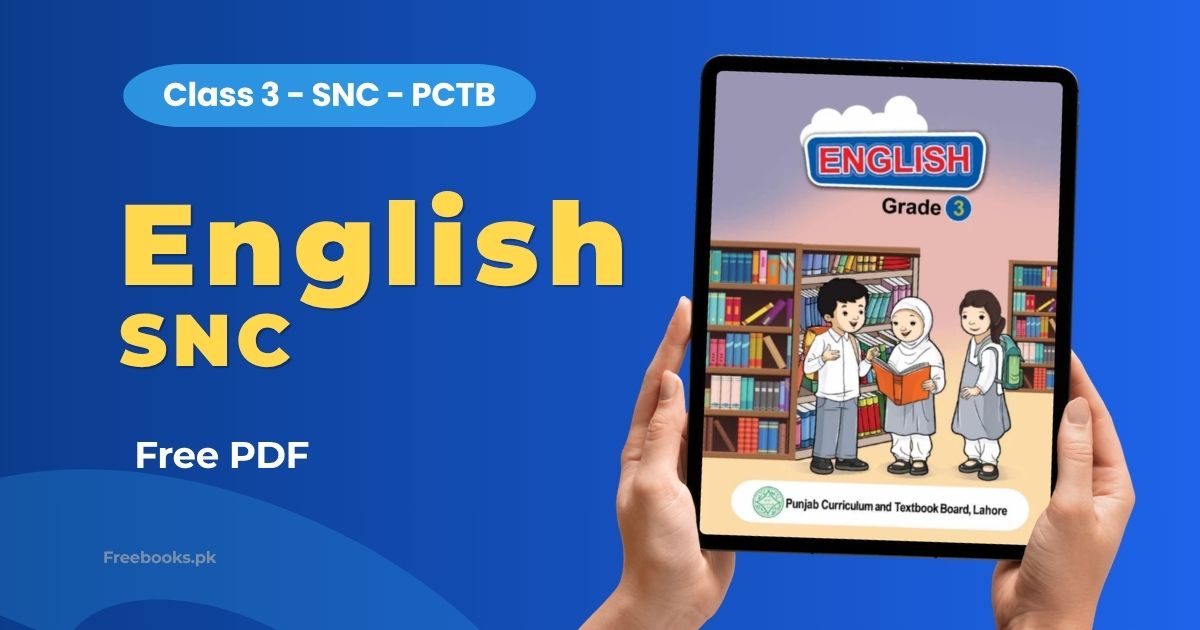
English for Class 3 is part of the official Punjab Curriculum and Textbook Board (PCTB) syllabus, based on the Single National Curriculum (SNC) 2020. This page covers all 11 units of the book, built around themes like classroom rules, family, road safety, kindness, and Pakistani culture, along with the phonics, grammar, and writing skills students need at this stage.
For Class 3 students, this book builds reading, speaking, and writing skills gradually through short stories, poems, and guided exercises rather than long, difficult texts. Each unit summary and its important questions on this page make revision quicker before class tests, so students can recall key points and answers without flipping back through the whole book.
Book Overview
| Class | 3 |
| Subject | English |
| Board | Punjab Curriculum and Textbook Board (PCTB) |
| Curriculum | Single National Curriculum (SNC) 2020 |
| Total Units | 11 (plus 3 Review units) |
| Total Pages | 126 |
| Format | PDF (Free Download) |
Chapter List
Unit 1: All Are Welcome
This unit introduces a new student’s first-day speech about settling into Class 3, covering classroom rules like listening when others talk, following directions, and keeping hands and feet to yourself. It also teaches the soft sounds of ‘c’ and ‘g’, consonant clusters ‘sh’ and ‘st’, proper and common nouns, and opposites, alongside the action poem “If You’re Happy.”
Important Questions:
- What six classroom rules does the speech mention? Answer: Listen when others are talking, follow directions, keep hands/feet to yourself, work quietly, show respect for property, and work and play safely.
- What is a consonant cluster, according to the unit? Answer: Two or three consonant letters joined to make one sound, such as ‘cl’ in class or ‘sch’ in school.
- What is the difference between a proper noun and a common noun? Answer: A proper noun names a specific person, place, or thing and starts with a capital letter; a common noun names any general person, place, or thing.
- What poem is recited with actions in this unit? Answer: “If You’re Happy” (If you’re happy and you know it, clap your hands).
Unit 2: Gifts of Nature
Centred on the poem “Golden Sun” by Lenore Hetrick, this unit explores how the sun gives life to the earth, plants, and animals, while teaching long and short vowel sounds, intonation, conjunctions, and anagrams. Students also learn to write cardinal numbers from 50 to 100 and practise writing a descriptive paragraph about their city, modelled on a sample about Neelum Valley.
Important Questions:
- Who wrote the poem ‘Golden Sun’? Answer: Lenore Hetrick.
- According to the poem, what does life on earth depend on? Answer: The sun and its magic ray.
- What is a conjunction, according to the unit? Answer: A word used to join together words, phrases, and sentences, such as ‘but’, ‘and’, ‘or’, or ‘because’.
- What is an anagram? Answer: A word or phrase made by rearranging the letters of another word or phrase, such as ‘break’ and ‘baker’.
Unit 3: The People I Love
Following Bano’s description of her “Happy Home,” this unit covers family members, always/never home rules such as never talking to strangers, and the poem “Finger Family.” It teaches the weak and strong forms of ‘has’ and ‘have’ with their contractions, exclamation marks for showing emotion, and classifying nouns into masculine, feminine, and neuter gender.
Important Questions:
- Who narrates the passage ‘My Happy Home’? Answer: Bano.
- Name two “Never” rules mentioned in the unit. Answer: Never talk to strangers, and never accept anything or gifts from them (or never go outside without permission).
- When is ‘have’ used and when is ‘has’ used, according to the unit? Answer: “Have” is used with I, we, you, they; “has” is used with he, she, it.
- What is a neuter gender noun? Answer: A noun that does not show male or female gender, such as doctor, chicken, or ship.
Unit 4: Kindness to Children
This unit describes the Prophet Muhammad’s (PBUH) kindness toward children, including how he picked up his grandsons Hazrat Hassan and Hazrat Hussain when they stumbled, and how he gave the season’s first fruit to the youngest child present. It also teaches the ‘ch’ sound, digraphs and trigraphs, adjectives and possessive adjectives, the present continuous tense, and the basic story elements of beginning, middle, and end.
Important Questions:
- What did the Prophet (PBUH) do when he saw Hazrat Hassan and Hazrat Hussain trip over their long shirts? Answer: He got up and rushed to pick them up.
- Who would the Prophet (PBUH) give the first fruit of the season to? Answer: The youngest child present.
- What is the present continuous tense used for? Answer: To describe an action that is presently going on, such as “The boy is running.”
- What are the three basic elements of a story, according to the unit? Answer: A beginning, a middle, and an end.
Unit 5: Road Safety Rules
This unit teaches the three steps for crossing a road safely (look right, look left, look right again and use the zebra crossing), along with “Always” and “Never” road safety rules and the poem “Traffic Lights.” It also covers weak-form contractions of ‘do’ and ‘does’, countable and uncountable nouns, and the modal verbs can and cannot for showing ability and inability.
Important Questions:
- What are the three steps for crossing a road safely? Answer: Look right, look left, then look right again and cross from the zebra crossing.
- Name two “Never” rules for road safety. Answer: Never rush or run on the road, and never cross at turnings or bends (or never push others while boarding a bus).
- What do the colours in the poem ‘Traffic Lights’ mean? Answer: Red means stop, yellow means get ready to start, and green means go.
- What is the difference between countable and uncountable nouns? Answer: Countable nouns can be counted, like a jug; uncountable nouns cannot, like water.
Unit 6: The Day of Silence
This story follows Rizwan, a boy who could not hear since birth, whose friend Mumtaz arranges a village-wide “Day of Silence” where everyone wears earplugs so people can understand what life is like without hearing. On that day Rizwan wins many games, helping the village see he should be treated just like any other child. The unit also teaches silent ‘b’ words, singular and plural nouns, and the articles ‘a’, ‘an’, and ‘the’.
Important Questions:
- Why couldn’t Rizwan hear? Answer: He could not hear since birth.
- Who arranged the ‘Day of Silence’ festival, and why? Answer: Rizwan’s friend Mumtaz, so that everyone could understand how different life is without being able to hear.
- What happened to Rizwan on the Day of Silence? Answer: He won many games, showing others he should be treated like any other boy.
- When do we use ‘a’ and when do we use ‘an’? Answer: ‘A’ is used before consonant sounds and ‘an’ before vowel sounds.
Unit 7: I Like to Play
This unit celebrates the value of sports and games, from outdoor games like cricket and hockey to indoor games like ludo and carom, explaining how play builds friendship, leadership, and teamwork. It teaches consonant clusters ‘sp’ and ‘cr’, giving opinions on statements, action verbs, and homophones, alongside the song “I’m Bouncing” and a Sports Day invitation card writing task.
Important Questions:
- Name two outdoor games and two indoor games mentioned in the unit. Answer: Outdoor: cricket and hockey; Indoor: ludo and carom.
- What do children learn through playing games, according to the unit? Answer: To accept victory and defeat, work in groups, and develop leadership qualities.
- What are homophones? Answer: Words with the same sound but different spellings and meanings, such as ‘knew’ and ‘new’.
- What activity does the unit ask students to prepare using the “For, Where, Date, Time, RSVP” format? Answer: A Sports Day invitation card.
Unit 8: Saving Resources
This unit explains how to conserve natural resources such as water, electricity, and paper, giving practical “Must Do” tips like turning off taps while brushing teeth and switching off unnecessary lights. It also teaches the weak forms of ‘do’ and ‘have’ in speech, possessive pronouns like mine, yours, and hers, and the correct use of the verbs do and have.
Important Questions:
- Name two ways to save water mentioned in the unit. Answer: Turn off the tap while brushing teeth, and wash cars with only one bucket of water.
- Why does the unit say we should use less paper? Answer: Because paper is made of wood, and using more paper means more trees are cut down.
- What is a possessive pronoun? Answer: A pronoun that shows who or what owns something, such as mine, yours, hers, ours, or theirs.
- What natural resources does the unit focus on conserving? Answer: Water, electricity, and paper.
Unit 9: My Culture – My Pride
This unit celebrates Pakistan’s diverse culture, hospitality, and festivals such as Eid-ul-Fitr, Eid-ul-Adha, and Jashn-e-Baharaan, describing how Pakistanis welcome guests, respect elders, and live as extended families. It also teaches the short vowel sound ‘e’, polite “magic words” like please and thank you, the present/past/future tenses, and a list of national festivals with their dates.
Important Questions:
- What are three examples of Pakistani hospitality mentioned in the unit? Answer: Cooking delicious dishes for guests, wearing colourful dresses for festivals, and taking care of the needy.
- Name two festivals or national days listed in the unit’s table. Answer: Pakistan Day (23 March) and Independence Day (14 August) (also Iqbal Day or Quaid-e-Azam Day).
- What are the three tenses covered in the unit? Answer: Present, past, and future tense.
- Give one example of a “magic word” and its function from the unit. Answer: “Please” is used for asking politely (or “Thank you” for showing gratitude).
Unit 10: Our Family Picnic
Based on a humorous poem by Kenn Nesbitt, this unit tells of a family picnic ruined by sudden rain, blowing napkins, and swarms of mosquitoes and bees, leading the family to decide they would rather go to the movies next time. It teaches consonant blends like ‘qu’ and ‘st’, apostrophes for contractions, prepositions such as into, over, and from, and the modal verbs may and can for permission and ability.
Important Questions:
- Who wrote the poem ‘Our Family Picnic’? Answer: Kenn Nesbitt.
- What went wrong during the family’s picnic? Answer: It started raining, their napkins and plates blew away, and they were bitten by mosquitoes and attacked by bees.
- What is a preposition, according to the unit? Answer: A word that shows the relationship of a noun or pronoun to another word in the sentence, such as in, over, or from.
- What is the difference between ‘may’ and ‘can’ in this unit? Answer: ‘May’ is used for permission or possibility, while ‘can’ is used to express ability.
Unit 11: Healthy Habits
In the story “Toothy Toad,” a wizard’s spell gives a toad perfect teeth, but the toad ignores warnings to brush and eat fewer sweets, and eventually loses all his teeth to decay. The unit also teaches syllables and silent letters, the three sounds of the past-tense ending ‘ed’, question words like who, what, and why, and opposites, alongside the poem “We Wash Our Hands.”
Important Questions:
- What happened to the toad in the story ‘Toothy Toad’? Answer: A wizard’s spell gave him perfect teeth, but he ignored warnings about sweets and brushing, and his teeth eventually decayed and fell out.
- What are the three ways the ‘ed’ ending is pronounced, according to the unit? Answer: As /id/ (needed), /t/ (asked), or /d/ (called).
- Name three ‘wh’ question words covered in the unit. Answer: What, when, where (also who, whom, which, whose, why, how).
- What does the poem ‘We Wash Our Hands’ teach children? Answer: To wash their hands with soap and water to keep them clean and chase away germs.
Download English Class 3 PDF
Click the button below to download the English Class 3 PDF for free:
Who Should Read This
This book is meant for Class 3 students studying English under the Punjab Curriculum and Textbook Board’s SNC syllabus. It also builds early reading, grammar, and writing skills that support stronger English ability in the higher grades, including for later entry test preparation.
Applicable Boards
This book is published by the Punjab Curriculum and Textbook Board (PCTB) and is the primary English textbook for Class 3 in Punjab. Since it follows the Single National Curriculum (SNC), students in other provinces and boards using the same SNC syllabus can also refer to this book for their Class 3 English topics.
FAQs
Is this book for Class 3 students?
Yes, this is the official English textbook for Class 3 under the Punjab Curriculum and Textbook Board’s Single National Curriculum (SNC).
Can other board students use this book?
Yes. Since this book follows the SNC syllabus used across Pakistan, students from other boards following the same curriculum can also use it for Class 3 English.
Is this the latest edition?
Yes, this is the current SNC 2020 edition used in Punjab schools.
Does it include exercises and important questions?
Yes, each unit has vocabulary, grammar, and writing exercises. This page also lists important questions with short answers for quick revision.
How many units are in this book?
The book has 11 units plus 3 review units, covering reading, grammar, phonics, and writing skills for Class 3 students.
Is the PDF free to download?
Yes, the PDF on this page is completely free to download.
Related Books
- Urdu Class 3 SNC PDF Download – Punjab Board (PCTB)
- English Class 4 SNC PDF Download – Punjab Board (PCTB)
- English Class 5 SNC PDF Download – Punjab Board (PCTB)
- Mathematics Class 4 SNC PDF Download – Punjab Board (PCTB) n
- Mathematics Class 3 SNC PDF Download – Punjab Board (PCTB) nn
- Islamiat Class 3 SNC PDF Download – Punjab Board (PCTB) nn
- General Knowledge Class 3 SNC PDF Download – Punjab Board (PCTB) nn
- Ethics (Ikhlaqiat) Class 3 PDF Download – Punjab Board (PCTB) n
Related Books
© Copyright Policy
Freebooks.pk is an educational resource for students in Pakistan. Textbooks and other books belong to their respective boards, authors and publishers, and all rights remain with them. If you are the copyright holder of any material on this page and want it changed or removed, please contact us or file a request under our DMCA policy. We review every request and remove reported content promptly.