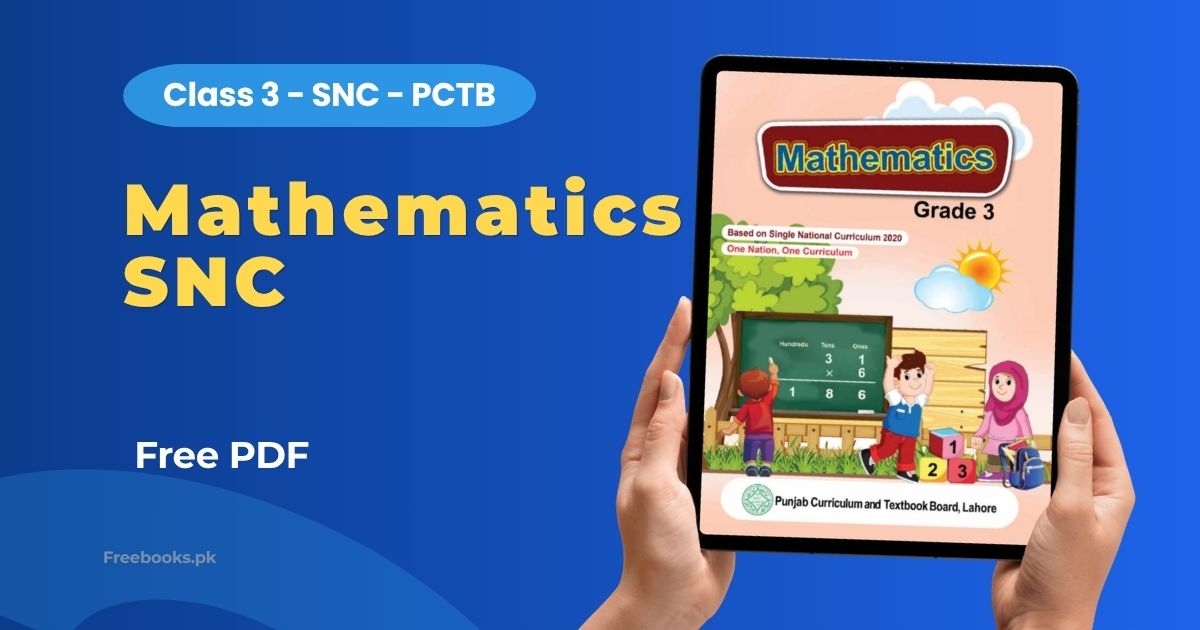
Mathematics for Class 3 is part of the official Punjab Curriculum and Textbook Board (PCTB) syllabus, based on the Single National Curriculum (SNC) 2020. This page covers all 7 units of the book, from whole numbers and basic operations to fractions, measurement, geometry, and data handling.
For Class 3 students, this book builds number sense and problem-solving skills step by step through real-life examples rather than abstract drills. Each unit summary and its important questions on this page make revision quicker before class tests, so students can recall key concepts and methods without flipping back through the whole book.
Book Overview
| Class | 3 |
| Subject | Mathematics |
| Board | Punjab Curriculum and Textbook Board (PCTB) |
| Curriculum | Single National Curriculum (SNC) 2020 |
| Total Units | 7 |
| Total Pages | 174 |
| Format | PDF (Free Download) |
Chapter List
Unit 1: Whole Numbers
This unit introduces Roman numerals up to 20, teaching students to read and write symbols like V, VII, IX, and X using examples such as clock faces. It also covers even and odd numbers up to 99, place value of digits in numbers up to 5 digits, reading and writing numbers up to 100,000 in numerals and words, representing numbers on a number line, comparing numbers using less than, greater than, and equal to, and rounding whole numbers to the nearest 10 and 100.
Important Questions:
- How is the number 9 written in Roman numerals? Answer: IX.
- What is the difference between an even number and an odd number? Answer: Even numbers can be divided into two equal groups exactly, while odd numbers cannot.
- What symbols are used to compare two numbers in this unit? Answer: “less than”, “greater than”, and “equal to” symbols.
- What does rounding a number to the nearest 10 or 100 mean? Answer: Adjusting a number to the closest multiple of 10 or 100 to make it easier to work with.
Unit 2: Number Operations
This unit teaches addition and subtraction of numbers up to 4 digits, with and without carrying or borrowing, using real-life examples like adding Eidi money or counting trees in an orchard. It also builds multiplication tables for 6, 7, 8, and 9, teaches multiplying a 2-digit number by a 1-digit number, multiplying by 0 and 1, and dividing a 2-digit number by a 1-digit number with zero remainder.
Important Questions:
- In the orchard example, how many mango and guava trees are added together, and what is the total? Answer: 3,516 mango trees and 2,322 guava trees, totalling 5,838 trees.
- What does “carrying” mean in addition? Answer: Moving a value to the next column when the sum of a column is 10 or more, such as writing 2 and carrying 1 ten when 8 ones plus 4 ones equal 12.
- Which multiplication tables does this unit focus on building? Answer: The tables for 6, 7, 8, and 9.
- What happens when you multiply any number by 0? Answer: The answer is always 0.
Unit 3: Fractions
This unit introduces common fractions using everyday examples like cutting a watermelon into pieces, teaching students to identify the numerator and denominator, and to recognise proper and improper fractions. It also covers finding equivalent fractions, comparing fractions with the same denominator using less than, greater than, and equal to, and adding and subtracting fractions with the same denominator using coloured figures.
Important Questions:
- In a common fraction like 5/8, what do the numerator and denominator represent? Answer: 5 (numerator) shows how many parts are used, and 8 (denominator) shows how many equal parts the whole is divided into.
- What is a common fraction, according to the unit? Answer: A fraction where the numerator and denominator are both integers, separated by a horizontal or slanted line, such as 6/7.
- Can fractions with the same denominator be added directly? Answer: Yes, by adding their numerators and keeping the denominator the same.
- What tool does the unit use to help students visualise fractions? Answer: Coloured figures divided into equal parts.
Unit 4: Measurement – Length, Mass and Capacity
This unit teaches the standard metric units for length (kilometre, metre, centimetre), mass (kilogram, gram), and capacity (litre, millilitre), along with their abbreviations. Using real-life examples like measuring the distance between Khalil’s office and his friend’s house, students practise adding and subtracting measurements in the same units, both with and without carrying or borrowing.
Important Questions:
- How many centimetres make one metre, according to the unit? Answer: 100 centimetres (1 m = 100 cm).
- In the Khalil example, what is the total distance from his office to his friend’s house? Answer: 9 km 600 m plus 13 km 200 m equals 22 km 800 m.
- What units are used to measure capacity in this unit? Answer: Litre (L) and millilitre (mL).
- Why is kilometre used instead of metre to measure the distance from home to school? Answer: Because it is a longer distance, and kilometres make large distances easier to express.
Unit 5: Measurement – Time
This unit teaches students to read and write time from both analog and digital clocks, and to use a.m. and p.m. correctly to describe the 12-hour clock. It also covers reading days and dates from a calendar, and adding and subtracting time measured in hours using real-life situations, such as working out arrival and departure times.
Important Questions:
- What is the difference between an analog clock and a digital clock? Answer: An analog clock has an hour hand and a minute hand, while a digital clock shows the time only in numbers.
- What do a.m. and p.m. stand for? Answer: a.m. (ante meridiem) is the time from midnight to 12 noon, and p.m. (post meridiem) is the time from 12 noon to midnight.
- How many minutes are there in one hour? Answer: 60 minutes.
- On the dial of an analog clock, what do the long hand and the short hand show? Answer: The long hand shows the minutes, and the short hand shows the hours.
Unit 6: Geometry
This unit introduces basic geometric concepts including points, lines, rays, and line segments, teaching students to draw and measure line segments to the nearest centimetre and millimetre. It covers classifying shapes as quadrilaterals or triangles based on their number of sides, calculating the perimeter of squares, rectangles, and triangles, identifying the centre, radius, and diameter of a circle, recognising lines of symmetry, and describing 3-D objects like cubes, cuboids, and pyramids by their edges and faces.
Important Questions:
- What is the difference between a line and a line segment? Answer: A line has no end points and extends in both directions, while a line segment has two fixed end points and a fixed length.
- What is a ray, according to the unit? Answer: A part of a line with one fixed starting point that extends in only one direction.
- How do you find the perimeter of a square or rectangle? Answer: By adding the lengths of all its sides.
- What three parts of a circle does this unit ask students to identify? Answer: The centre, the radius, and the diameter.
Unit 7: Data Handling
This unit teaches students to organise and interpret data using a Carroll diagram, which sorts items by two characteristics at once, such as colour and shape, or number size and divisibility. It also covers building a tally chart to record how often something occurs, such as family sizes in a society, and reading and interpreting picture graphs.
Important Questions:
- What is a Carroll diagram used for? Answer: To sort different things, numbers, or figures according to two characteristics at the same time, such as blue vs. not blue and shirts vs. caps.
- In the tally chart example, how many families had 5 members? Answer: 8 families.
- What do the marks in a tally chart represent? Answer: They are equal to the number of observations recorded in the data.
- What third way of representing data does this unit mention besides Carroll diagrams and tally charts? Answer: Picture graphs.
Download Mathematics Class 3 SNC PDF
Click the button below to download the free PDF of Mathematics Class 3 SNC for Punjab Board (PCTB).
Who Should Read This
This book is meant for Class 3 students studying under the Punjab Board (PCTB) SNC syllabus. Parents and tutors helping with homework or early exam preparation will also find the unit summaries and important questions useful for quick revision.
Applicable Boards
This book is designed for the Punjab Curriculum and Textbook Board (PCTB). Since it follows the Single National Curriculum (SNC) 2020, students from other boards that have also adopted the SNC syllabus for Class 3 Mathematics can use this book too.
FAQs
Is this Mathematics book for Class 3 students only?
Yes, this book is designed for Class 3 students under the Punjab Board SNC 2020 syllabus.
Can other students use this book?
Yes, students from other boards following the SNC syllabus for Class 3 Mathematics can also use it.
Is this the latest edition?
Yes, this is the latest SNC 2020 edition approved by the Punjab Curriculum and Textbook Board.
Does the PDF include all 7 units?
Yes, the PDF covers all 7 units of the book, from Whole Numbers to Data Handling.
Is the download free?
Yes, the PDF download is completely free.
Does this book include exercises and questions?
Yes, each unit includes exercises, and this page also lists important questions with short answers for quick revision.
Related Books
- Urdu Class 3 SNC PDF Download – Punjab Board (PCTB)
- English Class 3 SNC PDF Download – Punjab Board (PCTB)
- Mathematics Class 4 SNC PDF Download – Punjab Board (PCTB) n
- Islamiat Class 3 SNC PDF Download – Punjab Board (PCTB) nn
- General Knowledge Class 3 SNC PDF Download – Punjab Board (PCTB) nn
- Ethics (Ikhlaqiat) Class 3 PDF Download – Punjab Board (PCTB) n
Related Books
© Copyright Policy
Freebooks.pk is an educational resource for students in Pakistan. Textbooks and other books belong to their respective boards, authors and publishers, and all rights remain with them. If you are the copyright holder of any material on this page and want it changed or removed, please contact us or file a request under our DMCA policy. We review every request and remove reported content promptly.